Podcast
Associations Thrive
Hosted by Joanna Pineda · EN
This is Associations Thrive, the podcast celebrating successful associations and their leaders. Listen in as top association executives tell all, revealing the creative and innovative ways they’re increasing their bottom line, serving their members, and reimaging their organizations.
The Associations Thrive podcast is hosted by Joanna Pineda, CEO & Chief Troublemaker at Matrix Group International. Joanna’s personal mission and the mission of Matrix Group is to help associations and nonprofits increase membership, generate revenue and thrive in the digital space.
We believe that every association has a unique mission and unique story in how they’re serving their members, impacting their industry, and ultimately changing the world. Guests include top trade association, professional society, and non profit executives. We’re here to help amplify their stories so all associations can learn and thrive, together.
37episodes
Episodes
Newest firstAll episodes

189. Kelly Dooley, ED/CEO of ITEEA, on STEM Literacy, STEM Teaching Standards, and Non-Dues Revenue
2w ago00:34:36Tap to summarizeWhat does it take to prepare every student, not just future engineers, for a world shaped by technology, AI, and constant innovation? And what role should associations play in equipping educators to meet that challenge?In this episode of Associations Thrive, host Joanna Pineda interviews Kelly Dooley, Executive Director & CEO of the International Technology and Engineering Educators Association (ITEEA). Kelly discusses:Kelly's own journey from structural engineer to association CEO, and how association management became the career she never knew existed.How ITEEA has evolved from the American Industrial Arts Association into the leading professional association for technology and engineering educators, reflecting the changing nature of STEM education.Why every student, not just those pursuing STEM careers, needs technological and engineering literacy to thrive in today's world.ITEEA's Standards for Technological and Engineering Literacy (STEL) and how they define what students should know and be able to do.The association's Engineering byDesign™ curriculum, a PreK–12 STEM program that is now used by states, school districts, and individual educators across the country, and which generates significant non-dues revenue for the association.What it takes to convince an entire state to adopt an association-developed curriculum.The nationwide shortage of technology and engineering teachers, and how ITEEA is addressing recruitment, retention, mentorship, and career pathways through its new strategic plan.How AI is transforming education by helping teachers automate routine work while creating new challenges around student use, classroom policies, and AI literacy.References:ITEEA WebsiteStandards for Technological and Engineering Literacy (STEL)Engineering byDesign™
Transcribe →
188. Nir Hindie, Founder of The Artian Part Two: How Business Artistry Applies to Associations
3w ago00:37:39Tap to summarizeWhat if your conference wasn't designed around sessions, speakers, and logistics, but around how you wanted attendees to feel? How can your association bring more artistry, intention, and humanity into everything it does?In part two of this two-part special on Associations Thrive, host Joanna Pineda interviews Nir Hindi, Founder of The Artian. Nir discusses:What business artistry is, and why leaders should think of business as a platform for creative expression and human value, not simply optimization.Why association conferences should begin by asking, "What should this feel like?" rather than focusing first on speakers, logistics, or attendance goals.How associations can intentionally design conferences for the individual attendee, especially first-time attendees who arrive alone and often feel intimidated.Why post-pandemic conferences must prioritize human connection and community, since educational content is increasingly available online.How artists teach leaders to pay attention to invisible details that create meaningful experiences, even when attendees can't articulate why something feels exceptional.The Pixar meeting room story, and how changing physical environments can dramatically improve participation, collaboration, and idea generation.How storytelling should focus on members' problems, journeys, and transformations rather than organizational history, milestones, or statistics.Why associations should measure success not simply by attendance or satisfaction scores, but by whether their events genuinely transformed members' professional lives.References:TheArtian websiteNir’s Business Artistry CourseFollow Nir on LinkedInNir’s Website
Transcribe →
187. Nir Hindie, Founder of The Artian, Part One: What is Business Artistry?
Jul 200:31:14Tap to summarizeCan an association create deeper member loyalty by focusing not just on solving problems, but on creating experiences that people genuinely care about? In an era where efficiency and technology dominate, perhaps the real opportunity for associations is to bring more humanity, intention, and artistry into every member interaction.In part one of this two-part special on Associations Thrive, host Joanna Pineda interviews Nir Hindi, Founder of The Artian. Nir discusses:What business artistry is and why it differs from creativity. Creativity solves problems; artistry creates meaning and emotional connection.How some of the world's most admired leaders, including Steve Jobs, Walt Disney, and Edwin Land, approached business as a form of creative expression rather than simply optimization.Why associations should think beyond delivering value and instead design experiences that members genuinely remember and care about.How seemingly small details, from onboarding experiences to event design to member communications, can communicate care, respect, and intention.Why organizations should optimize not only for efficiency, but also for emotional resonance and human connection.The role of awe in leadership, and how inspiring visions motivate employees, members, and stakeholders to become part of something larger than themselves.How founders and executives can become better storytellers by focusing less on features and facts, and more on purpose, motivation, and impact.This conversation is Part 1 of a 2-part interview. In Part Two, Nir explores how business artistry specifically applies to associations and nonprofit organizations.References:The Artian WebsiteNir’s Business Artistry CourseFollow Nir on LinkedInNir's Website
Transcribe →
186. Phil Goldfeder, CEO of AFC, on Responsible Financial Innovation, Creating a Standards-Based Association, and Staying Warm and Fuzzy
Jun 2500:34:11Tap to summarizeHow do you help an industry innovate at breakneck speed while ensuring consumer protection, trust, and regulatory compliance? And what role should an association play in bringing competitors, regulators, and innovators together to shape the future of an emerging industry?In this episode of Associations Thrive, host Joanna Pineda interviews Phil Goldfeder, CEO of the American Fintech Council (AFC). Phil discusses:How AFC has grown from roughly 25 members to more than 175 members and partners, while maintaining a retention rate above 95%.Why AFC intentionally brings fintech companies and banks together under one roof, creating collaboration rather than competition.How AFC differentiates itself as a standards-based organization that embraces regulation, compliance, and consumer protection.Phil’s career journey from public service, including roles with Chuck Schumer, Mayor Michael Bloomberg, and the New York State Legislature, to banking and association leadership.How Hurricane Sandy exposed the need for innovation in insurance and financial services and helped shape Phil’s professional path.Why Phil believes association leadership is remarkably similar to elected office: both are fundamentally about service, engagement, and impact.How AFC creates “safe spaces” where member CEOs can openly discuss challenges, best practices, and emerging business models.AFC’s advocacy efforts to educate policymakers and regulators on fintech innovations such as Buy Now, Pay Later and Earned Wage Access programs.How AFC’s annual summit maintains an intimate, collaborative atmosphere even as attendance has grown dramatically.References:AFC Website
Transcribe →
185. Jeff Morgan, President & CEO of CMAA, on Community as the Secret Sauce, Member-Driven Growth, and Global Certification
Jun 1800:31:12Tap to summarizeHow does an association grow from 6,000 to 9,000 members without a membership sales team? What can associations learn from an organization whose members actively recruit the next generation on its behalf?In this episode of Associations Thrive, host Joanna Pineda interviews Jeff Morgan, President & CEO of the Club Management Association of America (CMAA). Jeff discusses:How CMAA represents professionals working across 3,500 member-owned clubs, including golf clubs, yacht clubs, city clubs, ski clubs, and more.How CMAA membership grew from approximately 6,000 members during COVID to 9,000 members today—with no membership sales team.Why private clubs experienced significant growth during and after COVID, including increased member demand, long waiting lists, and investments in facilities and amenities.CMAA’s highly intentional 12-month new member onboarding process, which includes welcome kits, monthly communications, quarterly Zoom sessions, and structured opportunities to build connections.The association’s long-running conference idea-sharing program, where members submit and share more than 100 best-practice posters that become a searchable knowledge resource for the profession.CMAA’s Certified Club Manager (CCM) credential, built around 12 professional competencies, continuing education, and a globally licensed certification model.How CMAA has expanded its influence internationally through partnerships, certification licensing, and conference participation from club professionals around the world.Why Jeff believes clubs are no longer simply physical facilities, but communities that remain connected through technology, virtual programming, and shared experiences.How “community” serves as the secret sauce behind both successful clubs and successful associations.References:CMAA Website
Transcribe →
184. David Walsh, ED of VSAE, on Member Recruitment, New Member Engagement, and Learning Pathways
Jun 1100:32:01Tap to summarizeWhat if your association's most effective membership recruiters aren't staff at all, but your members themselves?In an era where association professionals have countless options for education, networking, and professional development, how can associations create such a strong sense of belonging that members actively recruit, welcome, and mentor new participants?In this episode of Associations Thrive, host Joanna Pineda interviews David Walsh, Executive Director of the Virginia Society of Association Executives (VSAE). David discusses:How VSAE serves more than 450 association professionals and industry partners across Virginia, providing education, leadership development, networking, and peer exchange opportunities.How VSAE is expanding its reach throughout Virginia, including launching the Northern Virginia Association Exchange to better serve professionals in the state's largest association market.David's unique association journey, influenced by his mother’s 40-year association career and his progression through membership, marketing, advocacy, and executive leadership roles.How VSAE's annual conference attracted more than 200 registrants and over 50 first-time attendees, the strongest attendance numbers in more than a decade.How volunteer leaders personally reach out to prospective members and conference attendees, creating authentic peer-to-peer invitations rather than relying solely on marketing campaigns.How VSAE's membership committee serves as mentors and ambassadors, ensuring first-time attendees feel welcomed and connected from the moment they arrive.VSAE’s Learning Pathways that help members identify educational content aligned with their career stage, role, and professional goals.How VSAE's Northern Virginia programming combines education, peer exchange, and community-building to create meaningful opportunities for association professionals to learn from one another.References:VSAE WebsiteNorthern Virginia Association Exchange
Transcribe →
183. Emily Bardach, Executive Director of AWPA, on Advocacy, Strategic Planning, and Building Momentum
Jun 400:30:49Tap to summarizeWhen your industry is everywhere but almost invisible, how do you tell your story? And how can associations help members navigate tariffs, supply chain pressures, and changing market dynamics?In this episode of Associations Thrive, host Joanna Pineda interviews Emily Bardash, Executive Director of the American Wire Producers Association (AWPA). Emily discusses:How AWPA represents companies that manufacture wire and wire products, from bridge cables to tiny springs in Windex bottles.Why “wire is everywhere,” touching construction, infrastructure, agriculture, defense, medical devices, automotive parts, and everyday household products.How AWPA is a small but vital industry association with about 85 members, many of them family-owned businesses.Why association staff must understand each client’s unique culture, including details like whether spouses are important at events.How AWPA shifted its advocacy focus from “free and fair access to wire rod” to “building a resilient wire industry across the full supply chain.”How strategic planning helped AWPA’s board align around a new mission, vision, and playbook.How AWPA took risks with its annual conference, including booking a higher-end venue, stronger speakers, and better storytelling through photography and video.How AWPA is building momentum through advocacy, LinkedIn, facility tours with members of Congress, and more frequent Hill visits.References:AWPA Website
Transcribe →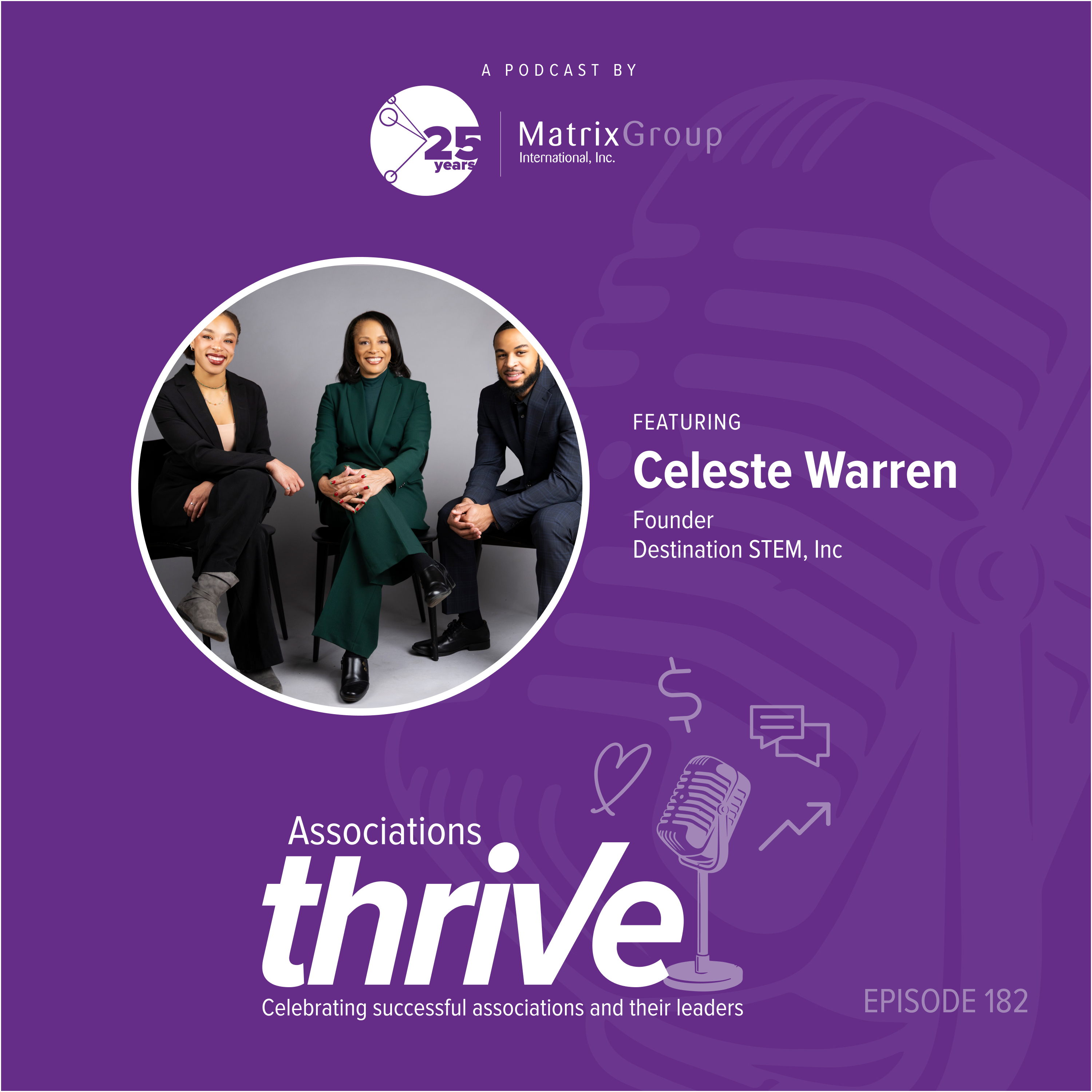
182. Celeste Warren, Founder of Destination STEM, Inc, on Representation in STEM, Virtual Access, and Building the Future Workforce
May 2800:23:20Tap to summarizeWhat happens when young people never see anyone who looks like them in the careers they dream about pursuing? And how can associations, nonprofits, and mission-driven organizations help members build stronger, earlier, and more inclusive talent pipelines in response?In this episode of Associations Thrive, host Joanna Pineda interviews Celeste Warren, Founder of Destination STEM, Inc. Celeste discusses:How Destination STEM provides resources, educational awareness events, mentoring, tutoring, and scholarships to students of color and students in need who want to pursue STEM-related degrees and careers.Why representation matters so much, especially for middle school and high school students who are just beginning to imagine what their futures could look like.How Destination STEM uses college students and young professionals as virtual mentors for younger students, creating relatable role models who feel accessible and real.Why Celeste believes STEM pipeline work must start early, long before employers begin looking for talent in the current labor market.How Destination STEM’s family founding story, with Celeste, her daughter, and her son building the organization together, has become part of its unique appeal and authenticity.How the organization is doubling its scholarships and using its annual awards and recognition banquet as both a celebration and a major fundraising vehicle.Celeste’s big vision for Destination STEM: larger-scale conferences, stronger guidance for students, and a bigger role in building the future STEM workforce.References:Destination STEM Website
Transcribe →
181. Michele Jones, EVP/CEO of NIA, on Her Long Tenure, National Standards, and Member Value in a Consolidating Industry
May 2100:27:40Tap to summarizeWhat if one of the most important contributors to energy efficiency, worker safety, and emissions reduction is also one of the most overlooked? And in an industry facing consolidation and private equity pressure, how can an association help members see the value of community, standards, and education?In this episode of Associations Thrive, host Joanna Pineda interviews Michele Jones, EVP/CEO of the National Insulation Association (NIA). Michele discusses:How NIA represents more than 250 companies across the mechanical insulation industry, including contractors, distributors, manufacturers, fabricators, and metal building laminators.What mechanical insulation is and why it matters.How industry consolidation and private equity ownership are affecting membership, dues, sponsorships, foundation giving, and conference attendance across the association.Why NIA is launching a “dog and pony show” roadshow to meet directly with member companies.How NIA just held its 70th convention, celebrated in Puerto Rico with strong attendance and recognition of past presidents.How NIA is partnering with AMPP to develop national insulation installation standards.NIA’s new Learning Management System.Why Michele believes mechanical insulation still does not get the respect it deserves, even though it lowers energy costs, reduces pollution, protects personnel, and keeps systems running properly.References:NIA Website
Transcribe →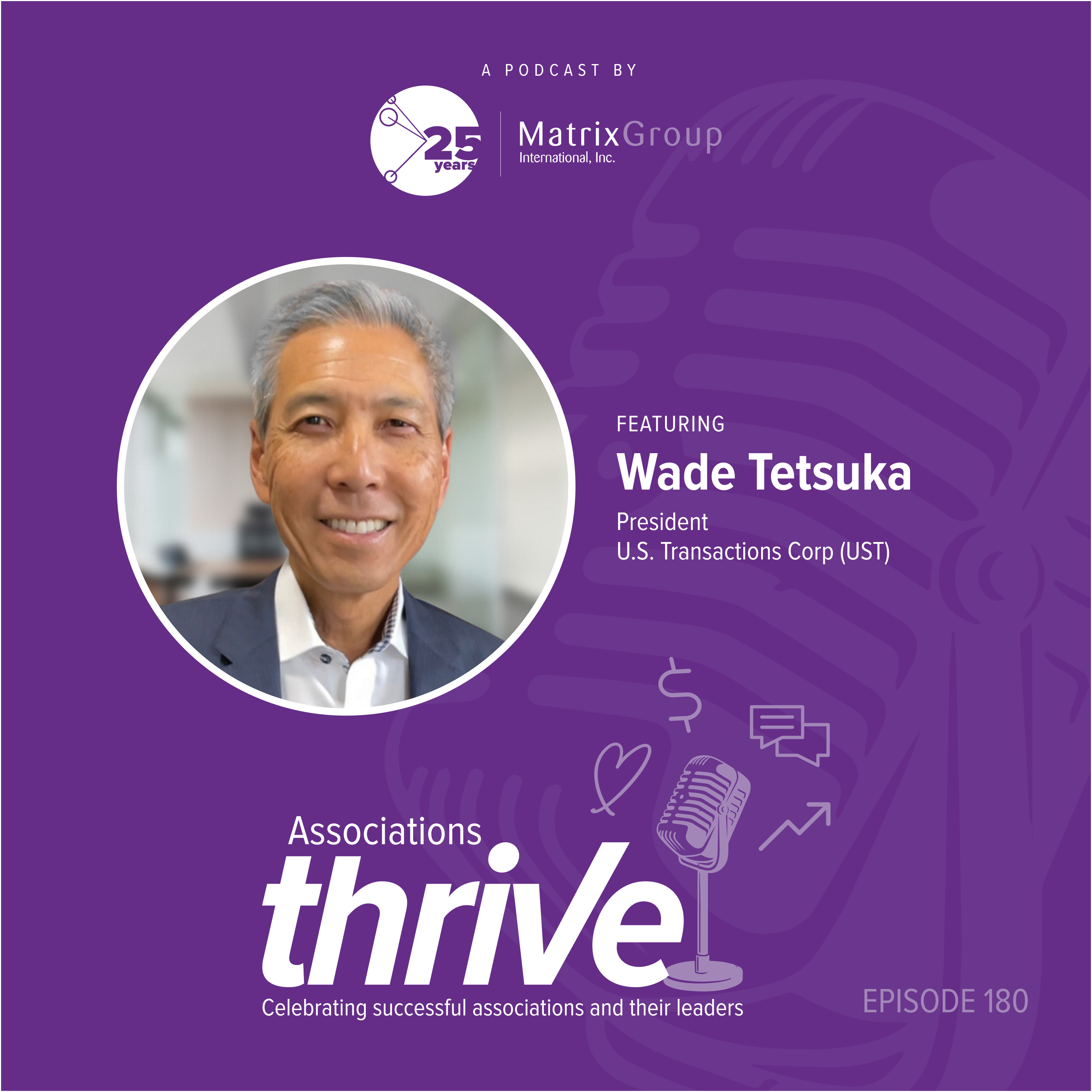
180. Wade Tetsuka, President of UST, on Payments, Peer Learning, and Education as a Bridge to Success
May 1400:25:27Tap to summarizeWhat happens when a fintech leader decides that serving the association community means doing far more than processing payments? And in an environment where associations are under pressure to deliver more value with limited resources, how can they create learning and connections that truly help members thrive?In this episode of Associations Thrive, host Joanna Pineda interviews Wade Tetsuka, President of U.S. Transactions Corporation (UST) and UST Education. Wade discusses:How UST helps associations accept credit card and ACH payments through AMS, LMS, and event platforms, while also helping reduce fees and improve service.Why payment processing becomes an especially important decision point when associations are changing AMS platforms.How UST Education began as simple peer-to-peer lunch roundtables for association IT directors and grew into a major educational platform.How the pandemic accelerated UST Education’s virtual programming and enabled it to serve association professionals across the country.Why Wade believes companies should connect with the communities they serve in a more meaningful way, and how education became that “sweet spot” for him.Why education is the common thread across Wade’s work, board service, and leadership philosophy, and why he sees it as “the great equalizer in society.”What the AANHPI association community means to Wade, and why representation and visibility matter for future Asian American leaders.References:UST Website
Transcribe →