
Podcast
Astronomy Daily: The Latest Space News
Hosted by bitesz.com · EN
Join hosts Anna and Avery for daily Space & Astronomy news, insights, and discoveries.
Give us 20 minutes and we'll give you the Universe!
For more visit, our website and sign up for the free daily newsletter and check out our continually updated newsfeed. http://astronomydaily.io.
Follow us on X (formerly Twitter), Facebook, YouTube and TikTok ...just search for AstroDailyPod. Enjoy!
Become a supporter of this podcast: https://www.spreaker.com/podcast/astronomy-daily-the-latest-space-news--5648921/support.
Give us 20 minutes and we'll give you the Universe!
For more visit, our website and sign up for the free daily newsletter and check out our continually updated newsfeed. http://astronomydaily.io.
Follow us on X (formerly Twitter), Facebook, YouTube and TikTok ...just search for AstroDailyPod. Enjoy!
Become a supporter of this podcast: https://www.spreaker.com/podcast/astronomy-daily-the-latest-space-news--5648921/support.
107episodes
Episodes
Newest firstAll episodes
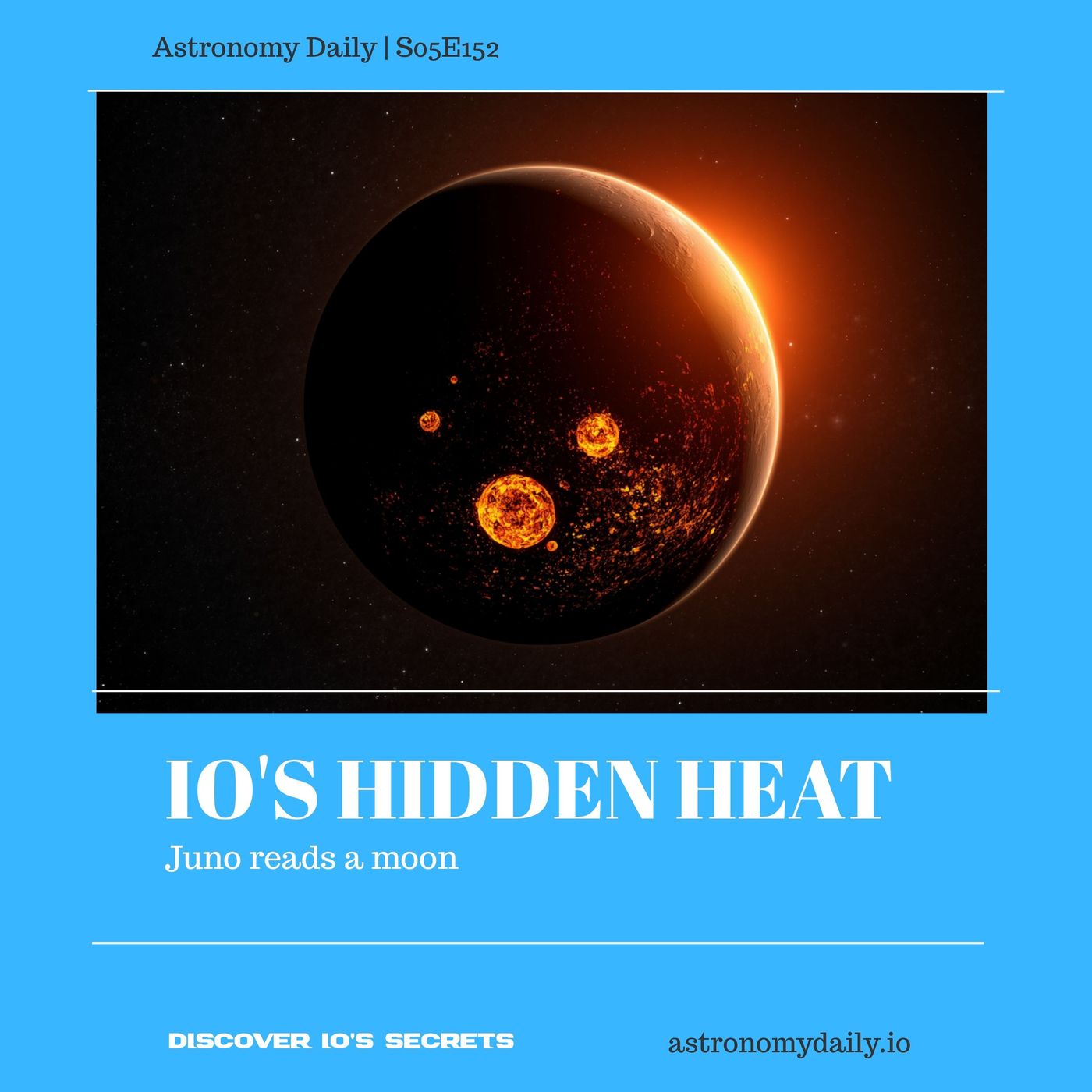
Reading Io’s Hidden Heat: Juno’s First Subsurface Reading | Today’s Space News
2d ago00:18:40Tap to summarizeAstronomy Daily S05E152 — “Reading the Heat” · Tuesday 28 July 2026. Hosts Anna & Avery. NASA’s Juno spacecraft has taken the first-ever temperature reading beneath the surface of Io, Jupiter’s volcanic moon — and the technique behind it could reshape how we study icy ocean moons and even volcanoes on Earth. We also look at why JWST’s “Little Red Dots” might be globular clusters being born, the first SETI search built from archived ALMA data (and its six-million-star surprise), and a live burst of space weather feeding into a meteor-filled — if Moon-washed — skywatch. In this episode ● Juno reads Io’s subsurface temperature for the first time — >20°C rise within a few metres, heat flow up to ~30× Earth’s average, and a remarkably smooth, low-density surface. ● Why the method matters: a multi-depth microwave thermometer that works from orbit — promising for Europa, Enceladus, and terrestrial volcanology. ● JWST’s “Little Red Dots” may be globular clusters in formation, powered by a short-lived supermassive star — linking two long-standing mysteries. ● The first SETI survey of archived ALMA data opens the millimetre band — and reveals “stellar bycatch” of 6.1 million background stars. ● Live space weather: an M3.2 flare from region AR4494 and a glancing CME, with G1–G2 storms and possible aurorae, north and south. ● Skywatch: meteor week under the full Buck Moon (29 July), the Alpha Capricornid fireball tip, evening Venus, pre-dawn Saturn/Mars/Mercury — and Jupiter vanishing behind the Sun. Sources ● NASA/JPL — “NASA’s Juno Takes Temperature of Jupiter’s Fiery Moon Io” (22 July 2026); Brown et al., J. Geophys. Res.: Planets, DOI 10.1029/2025JE009622. ● Chisholm et al., “Little Red Dots as Globular Clusters in Formation,” Astrophysical Journal Letters (press cycle 20 July 2026; UT Austin / McDonald Observatory). ● L. Mason (University of Manchester), first ALMA-archive SETI survey, RAS National Astronomy Meeting 2026. ● Space-weather status: EarthSky Sun news / NOAA SWPC (M3.2 flare AR4494, 26 July; 24 July CME; G1–G2 outlook, 27–28 July). ● Skywatch data: EarthSky, Star Walk, American Meteor Society, NASA — Southern Delta Aquariids (peak ~30 July), Alpha Capricornids (30–31 July), full Buck Moon 29 July, Jupiter solar conjunction 29 July. Become a supporter of this podcast: https://www.spreaker.com/podcast/astronomy-daily-the-latest-space-news--5648921/support.Sponsor Details:Ensure your online privacy by using NordVPN. To get our special listener deal and save a lot of money, visit www.astronomydaily.io/nordvpn. You'll be glad you did!Get the best secure and private email on the planet. Stop your Government, google and who knows who else spying on every email you write. Do what we did and use ProtonMail. They beleive in privacy and there are no ads in their business model...yet they still provide a free forever service. Check them out and get out special deal at www.astronomydaily.io/protonmailBecome a supporter of Astronomy Daily by joining our Supporters Club. Commercial free episodes daily are only a click way... Click HereThis episode includes AI-generated content.
Transcribe →
Pluto's Big Night & a Sharper Look at M87's Black Hole | Today's Space News
3d ago00:19:32Tap to summarizeAstronomy Daily · S05E151 · “The Faint Little World Has Its Day” · Monday 27 July 2026 · Hosts Anna & Avery. Pluto has its brightest night of the year — so we go deep on the world nobody can agree how to label. Then a crew comes home after 241 days, the galaxy’s most common planet turns out to maybe hide oceans of molten rock, and the first black hole ever photographed gets a sharper, two-colour read. In this episode LEAD — PLUTO AT OPPOSITION • Tonight Pluto sits opposite the Sun in Capricornus, near its closest point to Earth (~34.5 AU) and at its brightest for the year — yet still only magnitude ~15. • The full arc: Percival Lowell’s “Planet X,” Clyde Tombaugh’s 1930 discovery by blink comparator, and the name suggested by 11-year-old Venetia Burney. • The 2006 IAU reclassification to “dwarf planet” (the “clearing the neighbourhood” rule) — and the still-live debate between dynamical and geophysical definitions of a planet. • What New Horizons found in 2015: the nitrogen-ice plain of Sputnik Planitia, the famous “heart,” water-ice mountains, a hazy atmosphere, and a possible subsurface ocean. STORY 2 — HOME AFTER 241 DAYS • Soyuz MS-28 lands in Kazakhstan with NASA’s Chris Williams and cosmonauts Kud-Sverchkov and Mikaev; ~3,856 orbits, 102M+ miles; Expedition 74→75 handover to Jessica Meir. STORY 3 — SUB-NEPTUNES • New ASU modelling: deep clouds of vaporised rock and salt can act as a thermal blanket, potentially sustaining a hidden magma ocean and reshaping how we read JWST spectra. STORY 4 — M87 IN TWO COLOURS • A Shanghai Astronomical Observatory-led team builds the first spatially-resolved dual-frequency spectral map of M87* (1.3 mm + 3.5 mm, EHT + GMVA), linking the famous ring to the real physics of plasma at the event horizon. SKYWATCH — BOTH HEMISPHERES • South: Southern Delta Aquariids peaking (ZHR ~25) + Comet 10P/Tempel improving into August. North: Mu Cephei, Herschel’s Garnet Star, high in Cepheus. Both: Pluto at opposition, Saturn after midnight in Pisces. Caveat: a ~95% Moon washes out faint targets this week. Sources • NASA — “Astronaut Chris Williams, Crewmates Return from Space Station.” • ASU News / The Astrophysical Journal Letters — Mukherjee et al., clouds and the interiors of sub-Neptunes. • The Astrophysical Journal Letters — Zhao et al., “Spatially Resolved Spectral Properties of M87* on Event Horizon Scales” (DOI 10.3847/2041-8213/ae84ca). • Explore Scientific / Star Walk / astronomy.com — July 2026 observing notes (Pluto opposition, Southern Delta Aquariids, Comet 10P/Tempel, Mu Cephei).Become a supporter of this podcast: https://www.spreaker.com/podcast/astronomy-daily-the-latest-space-news--5648921/support.Sponsor Details:Ensure your online privacy by using NordVPN. To get our special listener deal and save a lot of money, visit www.astronomydaily.io/nordvpn. You'll be glad you did!Get the best secure and private email on the planet. Stop your Government, google and who knows who else spying on every email you write. Do what we did and use ProtonMail. They beleive in privacy and there are no ads in their business model...yet they still provide a free forever service. Check them out and get out special deal at www.astronomydaily.io/protonmailBecome a supporter of Astronomy Daily by joining our Supporters Club. Commercial free episodes daily are only a click way... Click HereThis episode includes AI-generated content.
Transcribe →
Lucky 13 | The Weekend Wrap
5d ago00:17:32Tap to summarizeAstronomy Daily · S05E150 · “Lucky Thirteen” · Saturday 25 July 2026. Your Weekend Wrap: Starship Flight 13 finally flies and floats, the strongest exomoon candidate yet, a robotic satellite-servicer on its way to GEO, and what the Moon’s far side reveals about Earth — plus a both-hemispheres skywatch. In this episode Chapter Segment 00:00 Cold open & headlines 01:30 LEAD: Starship Flight 13 flies — softest splashdown yet, first real Starlink V3 deploy 09:00 Exo-satellite at CD-35 2722 — strongest exomoon candidate yet (Nature) 11:45 Northrop Grumman MRV-MEP — a mechanic for the geostationary belt 14:30 Chang’e-6 — the Moon’s far side records Earth’s magnetosphere (Nature Geoscience) 17:15 Skywatch — Buck Moon, Delta Aquariids, the 12 Aug Perseids + total solar eclipse 20:45 Sign-off Sources & further reading STARSHIP FLIGHT 13 • Space.com — Starship’s “softest splashdown” yet after Flight 13 — https://www.space.com/space-exploration/launches-spacecraft/spacexs-starship-megarocket-makes-the-softest-splashdown-ever-after-launching-next-gen-starlink-satellites-in-flight-13-test-video • UPI — Starship successful flight test, splashes down in Indian Ocean — https://www.upi.com/Top_News/US/2026/07/24/Starship-has-successful-flight-test-splash-down-in-Indian-Ocean/3791784840519/ • CNN — Starship hits key milestones in “Lucky 13” test flight — https://www.cnn.com/2026/07/24/science/live-news/spacex-starship-flight-13-launch EXO-SATELLITE CD-35 2722 • ESO — New “exomoon” detection challenges cosmic labels — https://www.eso.org/public/news/eso2610/ • Nature (paper) — Planetary-mass exosatellite around a substellar companion — https://www.nature.com/ • Phys.org — Jupiter-mass “exomoon” orbiting a brown dwarf — https://phys.org/news/2026-07-jupiter-mass-exomoon-orbiting-brown.html MRV-MEP SATELLITE SERVICING • Northrop Grumman — MRV launches, ushering in a new era of in-space servicing — https://news.northropgrumman.com/launch/northrop-grummans-mission-robotic-vehicle-launches-ushering-in-a-new-era-of-in-space-servicing • Spaceflight Now — Novel geosynchronous robotic servicing satellite launch — https://spaceflightnow.com/2026/07/21/live-coverage-spacex-to-launch-novel-geosynchronous-robotic-servicing-satellite-on-decade-long-mission/ CHANG’E-6 FAR-SIDE SOLAR WIND • Nature Geoscience — Deeper solar wind penetration on the Moon’s far side — https://www.nature.com/articles/s41561-026-02042-w • EurekAlert! / CAS — Chang’e-6 samples reveal how Earth slows the solar wind — https://www.eurekalert.org/news-releases/1136535 SKYWATCH • EarthSky — Delta Aquariid meteor shower 2026 — https://earthsky.org/astronomy-essentials/everything-you-need-to-know-delta-aquarid-meteor-shower/ • EarthSky — Visible planets & night-sky guide / 12 Aug total solar eclipse — https://earthsky.org/astronomy-essentials/visible-planets-tonight-mars-jupiter-venus-saturn-mercury/ Astronomy Daily is part of the Bitesz.com Podcast Network. Follow @AstroDailyPod and find every episode at astronomydaily.io.Become a supporter of this podcast: https://www.spreaker.com/podcast/astronomy-daily-the-latest-space-news--5648921/support.Sponsor Details:Ensure your online privacy by using NordVPN. To get our special listener deal and save a lot of money, visit www.astronomydaily.io/nordvpn. You'll be glad you did!Get the best secure and private email on the planet. Stop your Government, google and who knows who else spying on every email you write. Do what we did and use ProtonMail. They beleive in privacy and there are no ads in their business model...yet they still provide a free forever service. Check them out and get out special deal at www.astronomydaily.io/protonmailBecome a supporter of Astronomy Daily by joining our Supporters Club. Commercial free episodes daily are only a click way... Click HereThis episode includes AI-generated content.
Transcribe →
The Moon That Isn't | Today's Space News
6d ago00:21:00Tap to summarizeAstronomers have confirmed the first moon-like object beyond our solar system — and immediately discovered our vocabulary cannot handle it. A Jupiter-mass world orbits a brown dwarf, which orbits a red dwarf, seventy light-years away. Is it a moon? A planet? Something we have not named yet? Also on today’s show: the Milky Way’s most powerful particle accelerator is confirmed in the direction of Altair, out-punching the Large Hadron Collider by a factor of a hundred. Chandra catches a black hole starving a galaxy it does not even live in. China flies the world’s largest solid rocket from the open ocean for the first time. Starship Flight 13 gets another window. And the Moon meets the heart of the Scorpion. Chapters Time Chapter 00:00 Cold open — what is a moon, exactly? 00:35 Welcome and headlines 01:15 The first exo-satellite — CD-35 2722 05:55 The galaxy’s most powerful particle accelerator 10:00 The Red Potato galaxy and its hostile neighbour 13:35 Gravity-1 launches from the open sea 16:55 Starship Flight 13 — when and where to watch 19:10 Skywatch — the Moon and Antares 22:30 Sign-off Story sources 1. First confirmed exo-satellite • Hoy, K., Zurlo, A., Peña R, P.A. et al. “Planetary-mass exosatellite detected around the substellar companion of a star.” Nature 655, 865–869 (2026). • European Southern Observatory release eso2610a, 23 July 2026. • Observations from ESO’s Very Large Telescope, Cerro Paranal, Chile. 2. Proton PeVatron confirmed • Mizuno, T., Sano, H., Murase, T., Oka, T., Suzuki, H., Nakahara, N. “Hadronic Scenario for Galactic PeVatron LHAASO J1912+1014u Supported by Fermi-LAT Gamma-Ray Data and FUGIN CO Data.” The Astrophysical Journal, 16 July 2026. • Hiroshima University news release; instruments: Fermi-LAT, Nobeyama 45 m / FUGIN survey, Chandra X-ray Observatory. 3. The Red Potato galaxy • NASA / Chandra X-ray Observatory news release, July 2026. Wang, W., Cantalupo, S., Travascio, A. et al., University of Milano-Bicocca. • Galaxy designation MQN01 J004131.9-493704, redshift approximately 3.25. Original JWST identification announced January 2026; the Chandra jet result is the new element. 4. Gravity-1 open-sea launch • Orienspace Gravity-1 Y4, third flight. Liftoff 0254 UTC, 22 July 2026, from a launch service ship approximately 170 km east of Shanghai. • Reporting via SpaceNews, CGTN and Space.com. Nine payloads including six Huantian constellation satellites. 5. Starship Flight 13 • SpaceX; live coverage via Spaceflight Now and Space.com. Booster 20 / Ship 40, second flight of Starship V3. • Launch window opens 24 July 2026 at 6:45 p.m. EDT (2245 UTC). Payload: 20 Starlink V3 satellites. 6. Skywatch • Astronomy.com Sky This Week; timeanddate.com Moon guide; EarthSky visible planets guide. • Moon 0.6° south of Antares, 6:00 p.m. EDT 24 July. Full Buck Moon 29 July, 14:36 UTC, in Capricornus. Astronomy Daily is part of the Bitesz.com Podcast Network. Find us at astronomydaily.io and at @AstroDailyPod.Become a supporter of this podcast: https://www.spreaker.com/podcast/astronomy-daily-the-latest-space-news--5648921/support.Sponsor Details:Ensure your online privacy by using NordVPN. To get our special listener deal and save a lot of money, visit www.astronomydaily.io/nordvpn. You'll be glad you did!Get the best secure and private email on the planet. Stop your Government, google and who knows who else spying on every email you write. Do what we did and use ProtonMail. They beleive in privacy and there are no ads in their business model...yet they still provide a free forever service. Check them out and get out special deal at www.astronomydaily.io/protonmailBecome a supporter of Astronomy Daily by joining our Supporters Club. Commercial free episodes daily are only a click way... Click HereThis episode includes AI-generated content.
Transcribe →
Far Side | Today's Space News
1w ago00:24:17Tap to summarizeAstronomy Daily S05E148 — "Far Side" Thursday 23 July 2026 Starship gets a second shot at Flight 13 — with a schedule caveat worth knowing about. The first far-side lunar samples reveal that Earth has been quietly shielding the side of the Moon that faces us. Astronomers debate whether the lunar far side should be closed to industry. The Milky Way's only helium nova finally steps out from behind twenty-five years of dust. And the case that our entire galaxy once turned over. Plus a skywatch closer with a straightforward piece of advice about the Delta Aquariids: do not wait for the peak.In this episode Starship Flight 13 ● Window opens 6:45pm EDT / 2245 GMT Thursday 23 July — 8:45am AEST and 10:45am NZST Friday 24 July. ● Schedule is not locked: Starbase road and beach closure notices point to further Pad 2 testing. ● The 16 July attempt aborted at T-0 when four of 33 Raptors missed start parameters; the limit is three. ● Two Raptors were removed and replaced before this attempt. ● First-ever Starship deployment of V3 Starlink satellites — 20 of them. ● Super Heavy splashes down in the Gulf at ~7 minutes; Ship targets the Indian Ocean off Western Australia at ~65 minutes. No catch attempts. Chang'e-6 and the solar wind ● Published in Nature Geoscience by a team at the Chinese Academy of Sciences' Institute of Geology and Geophysics. ● Based on 1,935 grams of regolith returned from the South Pole–Aitken basin on the lunar far side. ● First direct laboratory comparison of solar wind implantation between the near and far sides. ● Far-side soil records faster, deeper-penetrating particles; the neon isotope ratio sits below every near-side sample measured. ● About a quarter of the solar wind exposure at the Chang'e-5 near-side site involved wind decelerated by Earth's magnetosphere. The far-side site shows none. ● Opens the possibility of using lunar noble gases as a fossil record of Earth's magnetic field over deep time. The far side debate — NAM 2026 ● Held Tuesday 21 July at the RAS National Astronomy Meeting, University of Birmingham. Convened by Prof Martin Ward. ● For the motion: Prof Joe Silk (Johns Hopkins) and Dr Jonathan McDowell (Durham Space Research Centre). ● Against: Dr Nikita Chiu (Durham) and Dr Manuel Salvoldi (aerospace engineer and educator). ● For: the far side is the only radio-quiet site near Earth — critical for detecting the cosmic dark ages, and an exceptional platform for gravitational wave detection. ● Against: commercial investment is what makes lunar exploration sustainable, and governance can let science and industry coexist. ● Audience support for the motion rose from 68% to 76% across the debate. V445 Puppis ● Presented at NAM 2026 by John Mills, University of Warwick. ● The only confirmed helium nova in the Milky Way. Erupted in late 2000, then vanished behind its own dust for over twenty years. ● Now confirmed as a white dwarf accreting from a rare stripped helium star — only a few thousand such stars are thought to exist in the entire galaxy. ● Orbital period of 3.7 days, roughly double previous estimates. Mass transfer has resumed. ● Unexplained high-speed "bullets" of possibly oxygen-rich gas travelling up to 20 million mph (~9,000 km/s) — never seen in any other nova. ● Data from ESO's Very Large Telescope, Hubble, the Southern African Large Telescope and TESS. ● Helium novae may be one pathway to Type Ia supernovae, the standard candles used to measure cosmic expansion. The Milky Way disc flip ● Presented at NAM 2026 by Kirill Batrakov, Durham University. ● Based on 25 Milky Way-like galaxies in the Auriga simulation suite, followed across roughly 11 billion years. ● Galaxies with the most slowly rotating stellar haloes shared a major head-on merger and a disc reorientation greater than 90 degrees. ● Our stellar halo rotates at only 10–20 km/s; the disc moves at around 220 km/s. ● The Gaia-Sausage-Enceladus collision roughly 10 billion years ago is the candidate trigger. ● Batrakov describes a disc flip as likely rather than confirmed, and is looking for independent signatures. ● Separate 2026 work led by Ling Zhu, using 600,000+ giant stars from Gaia and LAMOST, found the outer dark matter halo oriented almost vertically to the stellar disc — consistent with the disc having tilted. Skywatch ● Southern Delta Aquariids are active now, running into late August, with maximum around 30 July. ● Full Moon on 29 July means peak night is close to 98% illuminated — the worst conditions of the run. ● Best window: the pre-dawn mornings from now until roughly 27 July, after moonset. ● Radiant near Skat in Aquarius. Use Fomalhaut and the Great Square of Pegasus to locate it. ● Australia and New Zealand: radiant climbs near overhead. Best from around 2am to first light. ● North America: radiant sits low in the south — fewer meteors, but a better chance of long-trailed earthgrazers. Same 2am-to-dawn window, local time. ● Sunspot region AR4493 has grown rapidly to beta-gamma-delta complexity — the highest classification — and has already fired three M-class flares in a day. Worth watching aurora alerts. Sources ● SpaceX / Space.com — Starship Flight 13 mission details and timing ● Nature Geoscience — noble gas analysis of Chang'e-6 regolith (Chinese Academy of Sciences, Institute of Geology and Geophysics) ● Royal Astronomical Society — NAM 2026 far side governance debate ● Royal Astronomical Society — NAM 2026, V445 Puppis (John Mills, University of Warwick) ● Royal Astronomical Society — NAM 2026, Milky Way disc flip (Kirill Batrakov, Durham University) ● EarthSky and the American Meteor Society — Delta Aquariid observing guidance ● NOAA Space Weather Prediction Center / EarthSky Sun News — AR4493 activityBecome a supporter of this podcast: https://www.spreaker.com/podcast/astronomy-daily-the-latest-space-news--5648921/support.Sponsor Details:Ensure your online privacy by using NordVPN. To get our special listener deal and save a lot of money, visit www.astronomydaily.io/nordvpn. You'll be glad you did!Get the best secure and private email on the planet. Stop your Government, google and who knows who else spying on every email you write. Do what we did and use ProtonMail. They beleive in privacy and there are no ads in their business model...yet they still provide a free forever service. Check them out and get out special deal at www.astronomydaily.io/protonmailBecome a supporter of Astronomy Daily by joining our Supporters Club. Commercial free episodes daily are only a click way... Click HereThis episode includes AI-generated content.
Transcribe →
Space Mechanic | Today's Space News
1w ago00:32:16Tap to summarizeAstronomy Daily — S05E147: "Space Mechanic" Wednesday 22 July 2026 A spacecraft with robotic arms is on its way to geostationary orbit to keep other satellites alive. A discarded rocket stage is two weeks out from hitting the Moon, and twenty-three astronomers have just asked the world to watch. Plus the first binary star system where both stars exploded, the first complete magnetic map of a galaxy cluster, and the asteroid breakup that may have bombarded three worlds while Earth froze. In This Episode ● The Space Mechanic Launches — Northrop Grumman's Mission Robotic Vehicle lifted off from Cape Canaveral on 21 July carrying three Mission Extension Pods. With two 3-metre robotic arms built by the US Naval Research Laboratory, it is designed to inspect, relocate, repair and refuel satellites in geostationary orbit. Each pod can give a 2,000 kg satellite up to eight more years of life. ● UPDATE — The Rocket Aimed at the Moon — A new arXiv preprint signed by 23 astronomers calls for a coordinated observing campaign when Falcon 9 upper stage 2025-010D strikes the Moon near Einstein crater on 5 August. North America has the best seat: 2:34am EDT, with the paper naming observers in the Americas as the ideal group. Refined impact time, predicted crater size, and why the ejecta plume may be visible even if the flash is not. ● Sibling Supernovae — Sixteen years of Fermi data reveal a faint supernova remnant hiding in the glare of the Jellyfish Nebula. The two may be the first known pair of remnants traced back to a single binary star system. ● Mapping a Cluster's Magnetic Field — Using the deepest radio observations ever made with LOFAR, astronomers have reconstructed the magnetic field of galaxy cluster Abell 2255 from nucleus to outer edge for the first time. ● The Eulalia Bombardment — A new Planetary Science Journal paper links the breakup of a main-belt asteroid to an impact shower that battered the Moon, Earth and Mars 800 million years ago — and may connect to a global freeze. ● Skywatch, Both Hemispheres — Why this week beats peak night for the Delta Aquariids wherever you are, how to catch them from the southern US and Mediterranean, and what's coming on 12 August: a total solar eclipse across Iceland and Spain, a North American partial, and the best Perseid peak in years on a new Moon.Sources & Further Reading ● Space.com — SpaceX launches satellite repair drone with 10-foot robotic arms to Earth orbit ● NASASpaceflight.com — Falcon 9 to launch MRV-1 robotic servicing spacecraft for Northrop Grumman ● Northrop Grumman SpaceLogistics — Mission Robotic Vehicle and Mission Extension Pod fact sheets ● Scientific American — A SpaceX rocket is about to crash into the moon; scientists will be watching ● Phys.org — When a SpaceX rocket crashes into the moon, scientists will be watching (arXiv preprint) ● Project Pluto (Bill Gray) — Upper stage impacting the moon on 2026 August 5 ● Stanford University — Researchers uncover evidence for sibling supernovas (Michailidis et al., Nature Communications) ● Reuters — Scientists spot evidence of two huge companion stars that blew up ● Space.com — Galaxy cluster's magnetic field reconstructed for 1st time with record-breaking astronomy map (Botteon et al., INAF, A&A) ● Southwest Research Institute — SwRI-led research connects asteroid collision to impact showers 800 million years ago ● The Planetary Science Journal — Bottke, Vokrouhlický, Dykhuis & Zellner, "An 800 Myr-old Impact Shower on the Terrestrial Planets from the Breakup of the Eulalia Parent Body" ● EarthSky — Delta Aquariid meteor shower: all you need to know in 2026 ● NASA Science — Total Solar Eclipse on August 12, 2026 (path, partial visibility and safety guidance) ● BBC Sky at Night Magazine — August 12, 2026 solar eclipse: USA and Canada guide Connect ● Website: astronomydaily.io ● Socials: @AstroDailyPod ● Part of the Bitesz.com Podcast NetworkBecome a supporter of this podcast: https://www.spreaker.com/podcast/astronomy-daily-the-latest-space-news--5648921/support.Sponsor Details:Ensure your online privacy by using NordVPN. To get our special listener deal and save a lot of money, visit www.astronomydaily.io/nordvpn. You'll be glad you did!Get the best secure and private email on the planet. Stop your Government, google and who knows who else spying on every email you write. Do what we did and use ProtonMail. They beleive in privacy and there are no ads in their business model...yet they still provide a free forever service. Check them out and get out special deal at www.astronomydaily.io/protonmailBecome a supporter of Astronomy Daily by joining our Supporters Club. Commercial free episodes daily are only a click way... Click HereThis episode includes AI-generated content.
Transcribe →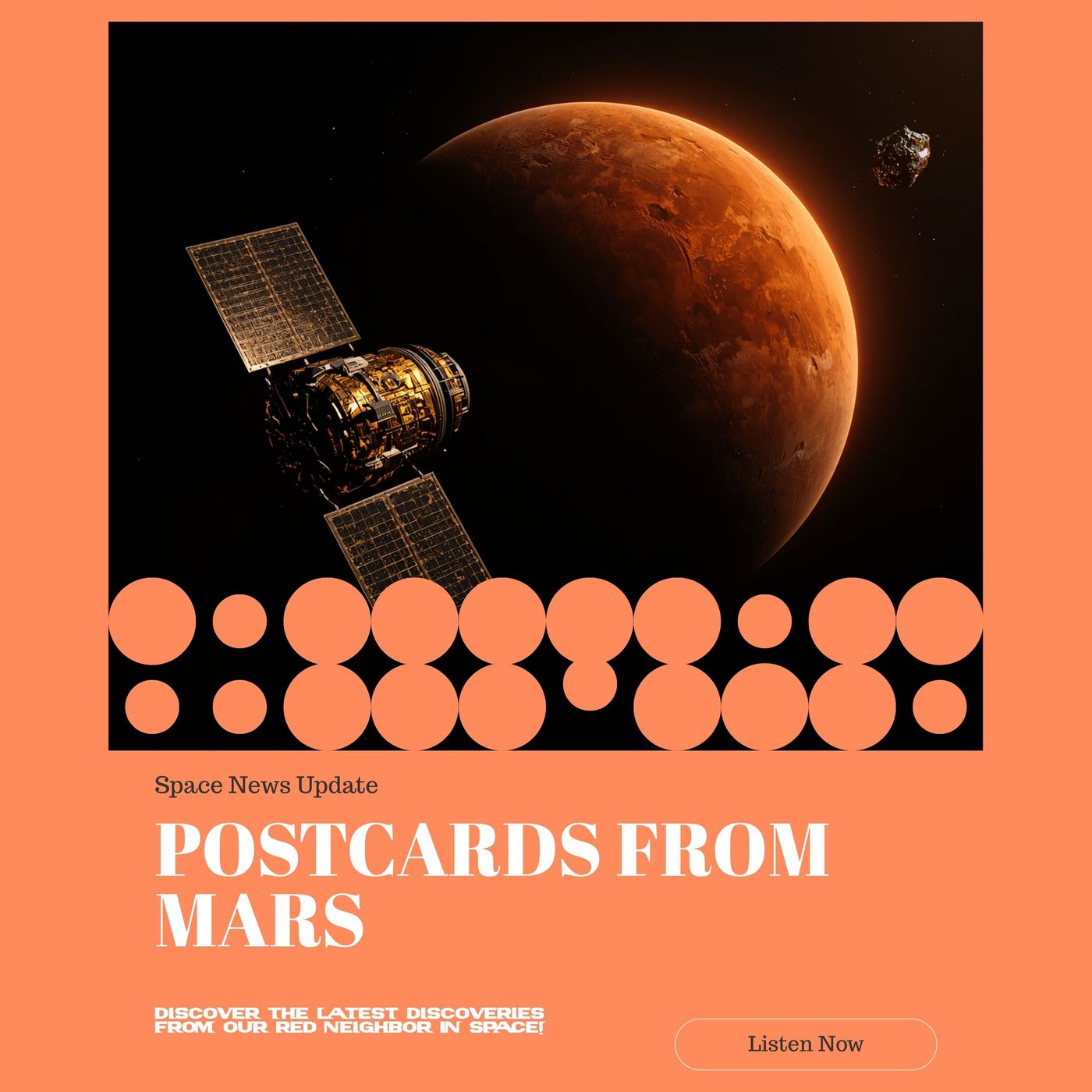
Postcards From Mars
1w ago00:16:35Tap to summarizeAstronomy Daily · S05E146 · “Postcards from Mars” · Tuesday 21 July 2026 NASA’s Psyche probe phones home from its Mars flyby — data and a spellbinding month-long time-lapse — as Europe’s Plato planet-hunter clears its final test. From the Royal Astronomical Society’s National Astronomy Meeting: a CubeSat that could give us hours of solar-storm warning, and a new way to forecast the Sun’s next active spell. Plus the first pieces of the giant ngVLA radio array, and a Southern Hemisphere meteor shower to catch this week.Story notes & sources 1 · Psyche phones home NASA’s Psyche spacecraft (launched 2023; arriving metal asteroid 16 Psyche in 2029) used a 15 May Mars gravity assist to test its instruments. The neutron spectrometer detected the anticipated count-rate enhancement near closest approach; the gamma-ray/neutron spectrometer, magnetometer and imager all performed well. Data and a month-long Mars time-lapse were released this week. ● NASA/JPL — “Psyche Mission Delivers Mars Flyby Data, Time-lapse Video” (17 Jul 2026) ● Lawrence Livermore National Laboratory — LLNL-built gamma-ray sensor’s first planetary measurements (17 Jul 2026) 2 · Plato clears its final exam ESA’s Plato — 26 cameras hunting Earth-like planets in the habitable zones of Sun-like stars — passed electromagnetic compatibility testing in the Maxwell chamber at ESTEC, its last major qualification hurdle. It’s bound for Sun-Earth L2 aboard an Ariane 6 (current target 2027). ● ESA — “Plato’s electronics ready for space” (20 Jul 2026) 3 · HENON space-weather CubeSat Presented at NAM 2026: HENON, a deep-space CubeSat that would sit ~15 million km upstream of Earth (10× farther than L1), potentially extending severe geomagnetic-storm warning from ~15 minutes to 2–3 hours. It carries the UK-built MAGIC magnetometer (Imperial College London) plus instruments from the Czech Republic and Finland, paving the way for a future European early-warning mission. ● Royal Astronomical Society / NAM 2026 — “From 15 minutes to 3 hours” (20 Jul 2026) 4 · The Sun’s “sleep” precursor Also at NAM 2026: a newly identified precursor in the solar cycle’s declining phase that could help predict the next maximum’s sunspot number. After the Sun’s active phase “switches off,” storms weaken and track a 27-day (solar-rotation) rhythm — pointing to co-rotating fast-wind streams rather than coronal mass ejections. ● Royal Astronomical Society / NAM 2026 — “How the Sun goes to ‘sleep’…” (20 Jul 2026) 5 · Building the ngVLA The US National Science Foundation, NSF NRAO and the US Naval Observatory are partnering on a pathfinder for the next-generation Very Large Array (ngVLA) — the ~266-antenna successor to the iconic VLA. The focus is very long baseline interferometry for ultra-sharp imaging and for maintaining the International Celestial Reference Frame. Construction/early operations are expected before the end of the decade. ● NSF NRAO / US Naval Observatory — ngVLA pathfinder partnership (17 Jul 2026) 6 · Skywatch: Southern Delta Aquariids Active mid-July to late August, peaking 29–30 July, with a radiant near Skat (δ Aquarii) — high overhead for Southern Hemisphere observers. ~15–20 faint, graceful meteors/hour under dark skies; suspected parent comet 96P/Machholz. A near-full Buck Moon spoils the peak, so the moon-free pre-dawn hours this week are the best window. Bright, slow Alpha Capricornid fireballs join in toward month’s end. ● Scientific American / EarthSky / American Meteor Society — Delta Aquariids 2026 Astronomy Daily is part of the Bitesz.com Podcast Network. Find every episode and the full show notes at astronomydaily.io, and follow @AstroDailyPod. Clear skies.Become a supporter of this podcast: https://www.spreaker.com/podcast/astronomy-daily-the-latest-space-news--5648921/support.Sponsor Details:Ensure your online privacy by using NordVPN. To get our special listener deal and save a lot of money, visit www.astronomydaily.io/nordvpn. You'll be glad you did!Get the best secure and private email on the planet. Stop your Government, google and who knows who else spying on every email you write. Do what we did and use ProtonMail. They beleive in privacy and there are no ads in their business model...yet they still provide a free forever service. Check them out and get out special deal at www.astronomydaily.io/protonmailBecome a supporter of Astronomy Daily by joining our Supporters Club. Commercial free episodes daily are only a click way... Click HereThis episode includes AI-generated content.
Transcribe →
India Reaches Orbit — Privately — Today's Space News
1w ago00:15:38Tap to summarizeAstronomy Daily S05E145 — “Arrival” — Monday, 20 July 2026. On the 57th anniversary of Apollo 11, we cover a first-of-its-kind launch, a Mars flyby science haul, a four-billion-year-old Martian record, a habitable-zone world with a likely atmosphere, shrimp feeding in simulated microgravity, and the new science of listening to black holes ring. In This Episode (01:30) India goes private in orbit — Skyroot Aerospace’s Vikram-1 aces its debut “Mission Aagaman,” making India the third nation with a private orbital launch capability. Plus a Starship Flight 13 update (NET 23–24 July). (05:30) Psyche’s Mars gift — NASA/JPL releases the science haul from Psyche’s 15 May Mars gravity assist, including the magnetometer’s first measurement of another body. (08:30) Mars keeps the receipts — Perseverance examines the “Broom Point member” on Jezero’s rim — some of the oldest terrain any rover has studied, recording ~4 billion years of impacts. (11:30) A world holding its breath — A Science paper detects escaping helium at LHS 1140b, pointing to a replenished, substantial atmosphere on a habitable-zone super-Earth. (A different planet from Friday’s story!) (15:00) Space shrimp — Okayama University of Science shows crustaceans can feed under simulated microgravity — a step toward closed-loop space food systems. (17:30) The bells of spacetime — A major review shows black-hole “spectroscopy” — reading ringdown gravitational waves — is becoming a real test of Einstein, ahead of the Einstein Telescope, Cosmic Explorer and LISA. (20:30) Skywatch — A coronal-hole solar wind stream brings a chance of minor aurora australis for far-southern latitudes around 21–22 July. Story Sources ● Vikram-1 / Mission Aagaman — Space.com; Skyroot Aerospace; ESA/Manorama coverage (18 July 2026). ● Psyche Mars flyby data — NASA/JPL release (17 July 2026). ● Perseverance “Broom Point member” — Journal of Geophysical Research: Planets, Imperial College London-led. ● LHS 1140b helium escape — Science, Harvard-led (16 July 2026); Magellan Clay telescope. ● Space shrimp — Microgravity Science and Technology; Okayama University of Science Space Aquaculture Project. ● Black-hole spectroscopy — Classical and Quantum Gravity review (Birmingham / Johns Hopkins / Lisbon). ● Skywatch — EarthSky Sun news; UK Met Office & Australian BOM space weather (19 July 2026). Astronomy Daily is part of the Bitesz.com Podcast Network. Web: astronomydaily.io — Social: @AstroDailyPodBecome a supporter of this podcast: https://www.spreaker.com/podcast/astronomy-daily-the-latest-space-news--5648921/support.Sponsor Details:Ensure your online privacy by using NordVPN. To get our special listener deal and save a lot of money, visit www.astronomydaily.io/nordvpn. You'll be glad you did!Get the best secure and private email on the planet. Stop your Government, google and who knows who else spying on every email you write. Do what we did and use ProtonMail. They beleive in privacy and there are no ads in their business model...yet they still provide a free forever service. Check them out and get out special deal at www.astronomydaily.io/protonmailBecome a supporter of Astronomy Daily by joining our Supporters Club. Commercial free episodes daily are only a click way... Click HereThis episode includes AI-generated content.
Transcribe →
The Sun's Hidden Power, Atmosphere on a Nearby Planet, and Starship's Five-Act Drama
2w ago00:14:19Tap to summarizeAstronomy Daily — The Weekend Space and Astronomy News Wrap | Saturday 18 July 2026 | S05E144 Anna and Avery wrap the biggest week in space news this year: brand-new research warning that extreme solar storms may hit harder than our models assume, and the delightful news that South African rooibos tea seeds are headed for the International Space Station — plus the four stories that defined the week, from the first atmosphere ever found on a rocky habitable-zone world to Starship's dramatic T-0 abort and Monday's retry. Story Sources • Solar storms underestimated — Nature (DOI: 10.1038/s41586-026-10757-4); phys.org; Space.com • Rooibos in Space — South African Rooibos Council / MaxIQ Space / SANSA announcement; phys.org; News24 • LHS 1140 b atmosphere — Science; Space.com (as covered S05E143) • Starship Flight 13 — SpaceX / Space.com launch coverage (arc across S05E139–E143; retry NET 20 July) • Omega Centauri black hole — Hubble/JWST astrometry study (as covered S05E141) • Pluto landslides & Charon tectonics — New Horizons imagery studies (as covered S05E142) Visit astronomydaily.io for our full archive. Follow @AstroDailyPod. Astronomy Daily is part of the Bitesz.com Podcast Network.Become a supporter of this podcast: https://www.spreaker.com/podcast/astronomy-daily-the-latest-space-news--5648921/support.Sponsor Details:Ensure your online privacy by using NordVPN. To get our special listener deal and save a lot of money, visit www.astronomydaily.io/nordvpn. You'll be glad you did!Get the best secure and private email on the planet. Stop your Government, google and who knows who else spying on every email you write. Do what we did and use ProtonMail. They beleive in privacy and there are no ads in their business model...yet they still provide a free forever service. Check them out and get out special deal at www.astronomydaily.io/protonmailBecome a supporter of Astronomy Daily by joining our Supporters Club. Commercial free episodes daily are only a click way... Click HereThis episode includes AI-generated content.
Transcribe →
Atmosphere Found on Rocky Exoplanet, Starship Drama Unfolds, and Meteorite Treasure Trove
2w ago00:16:29Tap to summarizeAstronomy Daily — S05E143 | Friday 17 July 2026 | "A World With Air" Anna and Avery bring you a genuine milestone: the first atmosphere ever detected on a rocky planet in the habitable zone of another star. Plus Starship's last-second launch abort, the New Jersey bedroom meteorite carrying life's ingredients, the earliest galaxy-building ever seen, metallic dunes on Mars, and a Moon–Venus meeting in tonight's sky. In this episode 01:45 — A world with air. Astronomers detect helium escaping from LHS 1140 b, a super-Earth 48 light-years away — the first confirmed atmosphere on a rocky, habitable-zone exoplanet. Published in Science. 07:00 — Starship Flight 13 aborts at T-0. Several Raptor engines failed to ignite at the moment of launch; two engines will be replaced, with a retry expected early next week. 10:15 — The Hillsborough meteorite. The rock that crashed through a New Jersey bedroom in July 2024 is a rare, ultra-pristine CM1/2 carbonaceous chondrite laced with amino acids and salts — evidence for the delivery of life's ingredients to early Earth. Published in Science Advances. 14:00 — Galaxies growing up fast. Durham University astronomers using JWST find the most distant nuclear disk ever seen — a star-forming core structure more than nine billion years back in time. Published in MNRAS. 17:00 — Metallic waves on Mars. ESA's Mars Express images the frost-tipped mega-dunes of Kaiser Crater. 19:00 — Southern skywatch. The crescent Moon meets Venus and Regulus tonight; dark-sky weekend for the Milky Way core; one month until the 12 August total solar eclipse. Sources LHS 1140 b atmosphere — Science (Cherubim et al.); coverage via Space.com, ScienceAlert, Harvard FAS. Starship Flight 13 abort — SpaceNews, Space.com, CNN live coverage. Hillsborough meteorite — Science Advances; SETI Institute release; coverage via Space.com, CNN, Popular Science, Smithsonian. Durham nuclear disk — Monthly Notices of the Royal Astronomical Society; Durham University release; Phys.org. Kaiser Crater dunes — ESA Mars Express image release, 15 July 2026. Astronomy Daily is part of the Bitesz.com Podcast Network. Visit astronomydaily.io for every episode, and find us on all platforms @AstroDailyPod.Become a supporter of this podcast: https://www.spreaker.com/podcast/astronomy-daily-the-latest-space-news--5648921/support.Sponsor Details:Ensure your online privacy by using NordVPN. To get our special listener deal and save a lot of money, visit www.astronomydaily.io/nordvpn. You'll be glad you did!Get the best secure and private email on the planet. Stop your Government, google and who knows who else spying on every email you write. Do what we did and use ProtonMail. They beleive in privacy and there are no ads in their business model...yet they still provide a free forever service. Check them out and get out special deal at www.astronomydaily.io/protonmailBecome a supporter of Astronomy Daily by joining our Supporters Club. Commercial free episodes daily are only a click way... Click HereThis episode includes AI-generated content.
Transcribe →