← Away Days Podcast: Reporting from the Underbelly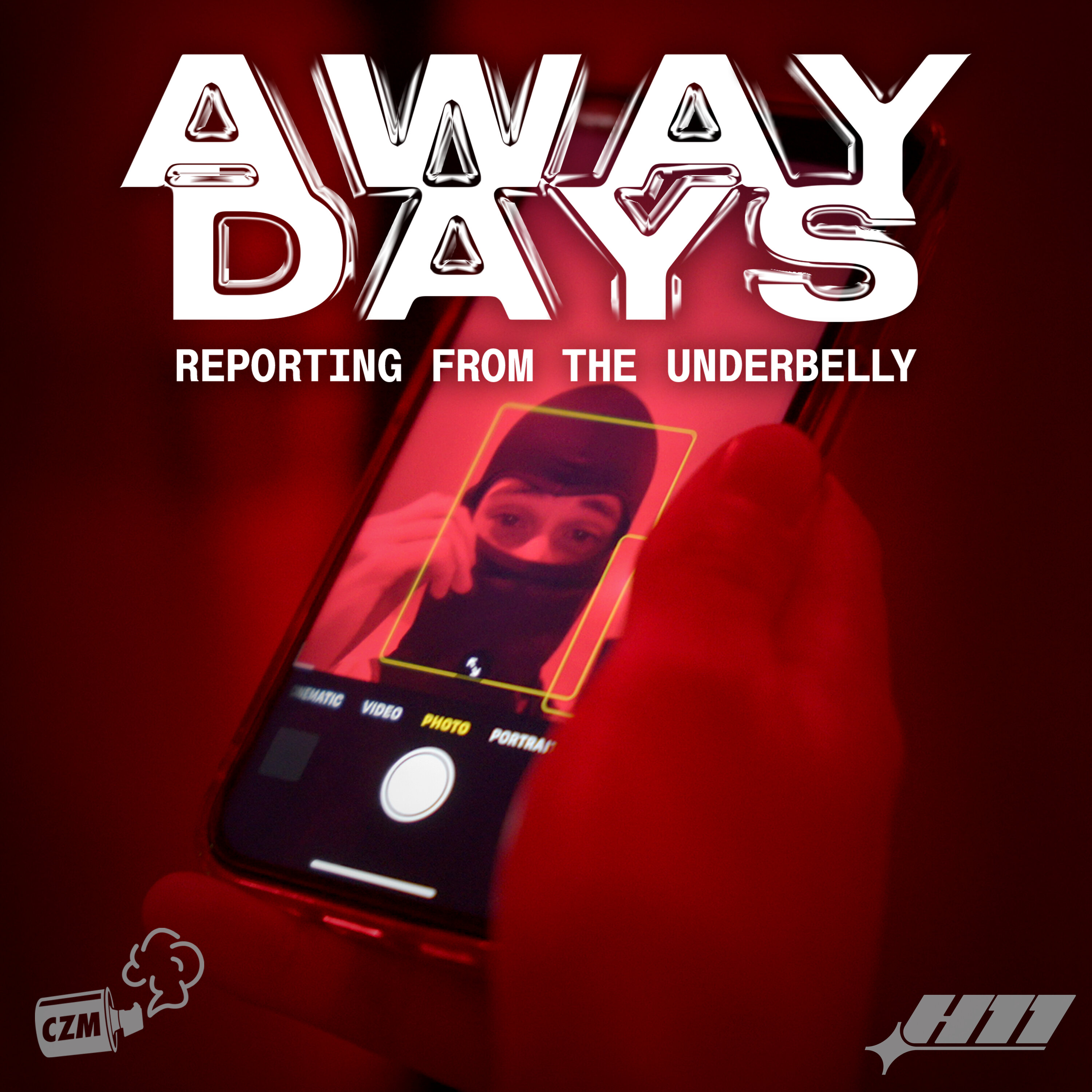
Loading summary
Transcript116 lines
- [00:00]
Bridget Todd
This is an iHeart podcast.
- [00:04]
John Lithgow
Lenovo is built for creators who don't wait for inspiration.
- [00:08]
Devin
They chase it with inventive tech, built in AI tools and seamless performance. Lenovo devices powered by Intel Core Ultra processors are designed to bring your wildest ideas to life faster. That's the power of Lenovo. With intel inside, enjoy flexible financing, rewards.
- [00:24]
Bridget Todd
On every purchase and free shipping.
- [00:25]
Devin
And students get special offers when you create an account@lenovo.com lenovo Lenovo.
- [00:35]
John Lithgow
Hello, I'm John Lithgow. We choose to go to the moon. I want to tell you about my new fiction podcast about Buzz Aldrin, one of the true pioneers of space. You're a great pilot, Buzz. That's the story you think you know. This is the story you don't. Buzz, starring me, John Lithgow, on the iHeartRadio app, Apple PO, or wherever you get your podcasts.
- [01:05]
Manny
Why are TSA rules so confusing?
- [01:08]
John Lithgow
You got a hoodie?
- [01:09]
Devin
I'll take it all.
- [01:10]
Manny
I'm Manny. I'm Noah.
- [01:12]
Devin
This is Devin.
- [01:12]
Manny
And we're best friends and journalists with a new podcast called no such Thing, where we get to the bottom of questions like that. Why are you screaming? I can't expect what to do now. If the rule was the same, go off on me. I deserve it, you know, Lock him up. Listen to no such thing on the iHeartRadio app, Apple Podcasts, or wherever you get your podcasts.
- [01:32]
Devin
No thanks.
- [01:35]
Bridget Todd
If you're looking for another heavy podcast about trauma, this ain't it. This is for the ones who had to survive and still show up as brilliant, loud, soft and whole. The Unwanted Sorority is where black women, femmes and gender expansive survivors of sexual violence rewrite the rules on healing, support and what happens after. And I'm your host and co president of this organization, Dr. Lea Tritate. Listen to the Unwanted Sorority. New episodes every Thursday on the iHeartRadio app, Apple Podcasts, or wherever you get your podcasts.
- [02:09]
Devin
Call Zone Media. You're listening to the Away Days podcast. On the ground outside, reporting from the underbelly with me, Jake Hanrahan. To watch Away Days documentaries, go to YouTube.com waydaystv this is part three, Speed Tribes 25, episode three. This podcast is a production of H11 Studio and Call Zone Media. The team of masked up youth that approach us from the garage seem a little hesitant to say hi. They're not menacing, not at all. If anything, they seem a little bit shy. They're all either late teens or mid 20s. Behind them in the garage with its now raised shutter. There's a collection of brightly coloured Civics with roof to tyre decals, painted bonnets and nets in the windows. These are to obscure the view to stop the police seeing who's driving. An older man who owns the garage approaches and explains to us that this is the base of across racing. As I look a bit closer, I notice all the Civics have the across logo emblazoned over their back windows. Across is a ragtag street racing crew that hits the Canjo loop with their distinctive cars. Many of them here have decorated their paintwork with Marlboro cigarette packet designs. Not to promote smoking, but the design on a car is just very cool. I'll be honest. One of the Civics that really stands out belongs to the only woman on the team. Her name is Menma and her Civic is bright turquoise blue with white border decals and shiny stickers making out the word across on the back. Underground street racing in Japan is a male dominated world. I go as far to say that it's 99% men that are involved. Menma is an anomaly in this scene. She's small, with huge bright eyes and dyed blond hair poking out of a balaclava. She wears high top Nike dunks in the same white and turquoise colors of her car. It is a very cool look. She's shy, but she agrees to talk a little. Usually there's not many women in the racing scene here. You one of the only ones.
- [04:52]
Bridget Todd
As I'm a woman, I need to race in a way so I don't get disrespected.
- [04:57]
Devin
What is it you like about street racing?
- [05:02]
Bridget Todd
Final street? I like this the most. You do toge or circuit? As long as I can race.
- [05:12]
Devin
Obviously this is very illegal here in Japan. What would happen if the police caught you?
- [05:18]
Bridget Todd
We run away.
- [05:20]
Devin
Does your family know you do this racing?
- [05:23]
Bridget Todd
Sometimes.
- [05:25]
Devin
Culture in Japan is quite conservative. Illegal street racing is obviously something that a lot of people here wouldn't like. What do you think the reaction would be if people knew you were doing this?
- [05:39]
Bridget Todd
I think they would think it's a nuisance but more fun which wins. So I keep racing.
- [05:45]
Devin
It makes it more fun. Okay. What do you think about the police here?
- [05:52]
Bridget Todd
I'm sure it's tough for them and they probably have a lot on, but it'd be nice if they spent their time on things other than Civics.
- [06:01]
Devin
Without revealing too much about yourself. When you're not racing, what do you do like in normal life?
- [06:08]
Bridget Todd
If I'm not racing, working, fishing and.
- [06:14]
Devin
I ride my bike, can you Tell me what it feels like when you're racing. How does it feel to you?
- [06:21]
Bridget Todd
It's scary, but the feeling of wanting to win is stronger.
- [06:29]
Devin
How did you get into racing? How did you find out about it?
- [06:34]
Bridget Todd
A childhood friend introduced me.
- [06:37]
Devin
Are you fast? You drive fast?
- [06:42]
Bridget Todd
So so.
- [06:43]
Devin
By so, so, she means. Yes, very fast. A cross is generally seen. As a Kanjo crew, these are not exactly drift cars. They go very fast down the Hanshin Expressway. So I wonder why we're here. Ready to go up a mountain far away from Osaka. Turns out the team are currently not racing the Kanjo. Right now. Their boss, the older guy who runs the garage, has decided it's a bit too hot with the law enforcement and surveillance checks. I'm guessing this has something to do with the smashed up Civic we saw on the way in. A young lad in a white balaclava who uses the name Hero explains to me that that is his car. He's just 18 and he was in a police chase recently. Now, in Japan, a police chase isn't quite what you might think. Japan active pursuit is far more restricted than in most Western countries. There's a much bigger emphasis on public safety over immediate apprehension. The National Police Agency guidelines state that officers must prioritize avoiding accidents, especially in densely populated areas. Perfect. If you're a Kanjo fugitive in hot pursuit, the getaway is strongly in your favor. Japanese police are trained to weigh the risk of a chase against the seriousness of the perceived offense. Pursuits are generally only allowed when the suspect is believed to have committed a serious crime, which dangerous driving comes under. In Japan, street racers are on their radar. The police are instructed to consider factors like traffic density, weather, road conditions and pedestrian presence before engaging in the chase. If the pursuit is likely to endanger the public, officers are required to back down. By law, speed limits still technically apply to police vehicles, but they can be exceeded if lights and sirens are used and the pursuit is officially justified, just like any other country. That said, official justification is narrowly defined and supervisors on the radio are often involved in the decision to continue or call off a chase. Legally, if a chase results in injury or death to a third party and the pursuit is deemed unnecessary or reckless, the officers and the department can face civil liability and in some cases, even criminal charges. The cautious approach stems from Japan's broader policing philosophy, crime prevention and measured response over high risk enforcement. As a result, genuine Hollywood style high speed pursuits are very rare in Japan. And when they do happen, they are usually in rural areas with lighter traffic and clearer visibility. To avoid dangerous High speed chases. Japan relies heavily on alternative methods. These include setting up roadblocks using spike strips or deploying unmarked ghost cars to shadow suspects until a safer arrest is possible. In urban areas, surveillance cameras and license plate recognition systems often allow police to track a suspect later without immediate cause confrontation. This is what happened to Hero. He was racing around the loop when police pulled in behind him. He took off. They put the foot on the gas. But ultimately, Hero's driving skills and the public traffic helped him get away. Not before the cops caught his license plate, though. For whatever reason, he didn't have the plate flipped up on its hinges and the police found out his address through registration. A few weeks later, a morning raid on Hero's house found him arrested and charged and released on bail. He laughs about it now and explains how he went back out racing anyway and totaled his car crashing into a barrier on a stiff turn. No wonder their captain doesn't want a cross on the Canjo right now.
- [11:00]
John Lithgow
Hello, I'm John Lithgow. We choose to go to the moon. I want to tell you about my new fiction podcast, that's One Small Step for Man. It's about Buzz Aldrin, one of the true pioneers of space. You're a great pilot, Buzz. As far as I'm concerned, the best I've seen. That's the story you think you know. This is the story you don't predisposition.
- [11:23]
Bridget Todd
To depression, alcohol abuse and suicide.
- [11:25]
John Lithgow
We'll see Buzz try to overcome demons.
- [11:29]
Devin
What do you say, Buzz?
- [11:30]
John Lithgow
Another beer and triumph over addiction.
- [11:32]
Devin
Who's you?
- [11:33]
Manny
Buzz Aldrin.
- [11:35]
John Lithgow
Good luck to you and become a true hero.
- [11:38]
Devin
Buzz and I will proceed into the.
- [11:39]
John Lithgow
Lunar module not because he conquers space, but because he conquers himself. Buzz, we intercepted a Soviet radio transmission starring me, John Lithgow. Can you put it through? Can you Translate on the iHeartRadio app, Apple Podcasts, or wherever you get your podcasts? Columbia adventure should never come with a pause button.
- [12:02]
Bridget Todd
Remember the MoviePass era where you could watch all the movies you wanted for just $9? It made zero sense and I could not stop thinking about it. I'm Bridget Todd, host of the tech podcast There Are no Girls on the Internet. On this new season, I'm talking to the innovators who are left out of the tech headlines, like the visionary behind MoviePass, Black founder Stacey Spikes, who was pushed out of MoviePass, the company that he founded. His story is wild and it's currently the subject of a juicy new HBO documentary. We dive into how culture connects us.
- [12:33]
John Lithgow
When you Go to France or you go to England or you go to Hong Kong. Those kids are wearing Jordans. They're wearing Kobe's shirt. They're watching Black Panther and the challenges.
- [12:47]
Bridget Todd
Of being a black Founder.
- [12:48]
John Lithgow
Close your eyes and tell me what a tech founder looks like. They're not going to describe someone who looks like me, and they're not going to describe someone who looks like you.
- [12:56]
Bridget Todd
I created There are no girls on the Internet because the future belongs to all of us. So listen to There are no girls on the Internet. On the iHeartRadio app, Apple Podcasts, or wherever you get your podcasts.
- [13:04]
Manny
Imagine that you're on an airplane and all of a sudden you hear, attention passengers.
- [13:10]
Bridget Todd
The pilot is having an emergency and we need someone, anyone, to land this plane.
- [13:16]
Manny
Think you could do it? It turns out that nearly 50% of men think that they could land the plane with the help of air traffic control. And they're saying, like, okay, pull this. Until this. Pull that, Turn this. It's just, I can do my eyes closed. I'm Manny.
- [13:31]
Devin
I'm Noah. This is Devin.
- [13:32]
Manny
And on our new show, no Such Thing, we get to the bottom of questions like these. Join us as we talk to the leading expert on overconfidence.
- [13:41]
John Lithgow
Those who lack expertise lack the expertise they need to recognize that they lack expertise.
- [13:48]
Manny
And then as we try the whole thing out for real. Wait, what? Oh, that's the Runway. I'm looking at this thing. See? Listen to no Such Thing thing on the iHeartRadio app, Apple Podcasts, or wherever you get your podcasts.
- [14:03]
John Lithgow
American history is full of wise people.
- [14:07]
Bridget Todd
Walt Whitman said something like, you know, 99.99 of war is diarrhea and 1% is glory. Those founding fathers were gossipy AF, and they love to cut each other down.
- [14:20]
John Lithgow
I'm Bob Crawford, host of American History Hotline, the show where you send us your questions about American history, and I find the answers, including the nuggets of wisdom our history has to offer.
- [14:32]
Bridget Todd
Hamilton pauses, and then he says, the.
- [14:35]
John Lithgow
Greatest man that ever lived was Julius Caesar. And Jefferson writes in his diary, this.
- [14:40]
Bridget Todd
Proves that Hamilton is for a dictator based on corruption. My favorite line was what Neil Armstrong said. It would have been harder to fake it than to do it.
- [14:51]
John Lithgow
Listen to American History Hotline on the iHeartRadio app, Apple Podcasts, or wherever you get your podcasts.
- [15:08]
Devin
Kanjo racers in Osaka are of course notorious for the defiance of the law. One of their most brazen tactics is called boxing in. When you guessed it, they box in police cars during Late night runs, when police attempt to intervene in a multi car race, the drivers sometimes coordinate to trap the patrol car between the multiple vehicles. Two or more cars will position themselves in front, beside and behind police, slowing or blocking its movement while the rest of the crew scatters. This isn't just a getaway method. It's also a deliberate act of mockery. There are several videos out there showing this tactic on the Hanshin Expressway, which with goofy music and mocking captions, it's pretty funny, honestly. Drivers will also sometimes weave aggressively in front of the patrol car, brake, check it, or rev loudly, forcing the officers into a frustrating standoff. Police are constrained by the aforementioned strict pursuit rules. They're hamstrung. They can't really respond with the same aggression without risking disciplinary action. Too bad. The Kanjo crews exploit these limits, knowing that officers are unlikely to engage in risky maneuvers in heavy traffic or at extreme speeds. Beyond the immediate tactic, this behavior feeds into the Kanjo subculture's anti authority image. It reinforces their reputation for outsmarting and goading the police on their own turf. In a society as strict and rule following as Japan, this really defines them as serious outlaws. The crew explained to us that they're going to take us for a different kind of race. One lad is very excited about this. He pops the bonnet of his car, which is painted purple and white in the Marlborough design, and points laughing at the paint on the inside. It's Japan's Imperial flag. Oh, I say. Commonly known as the Rising sun flag, it it features a red sun with 16 rays extending outwards. It's obviously different from the national flag, which is the simple red circle on a white field. The Rising sun design has ancient roots in Japanese mythology and Shinto beliefs, where the sun goddess Amit Arasu is central. The flag was officially adopted as the war flag of the Imperial Japanese army in 1870 and later used by the Imperial Navy as well. Across east and Southeast Asia, especially in Korea and China, it's viewed as a symbol of Japanese militarism and imperial aggression during World War II. Its resemblance to a military insignia tied to occupation, war crimes and colonialism makes it deeply controversial in those regions. To many Japanese people, though, the flag is just a traditional symbol of good fortune, power and national pride. It's still used today by the Japanese Maritime Self Defense Force. Even it continues to appear at sporting events, festivals, and by nationalist groups. The flag's meaning is heavily context dependent, seen by some as cultural heritage, by others as a painful reminder of wartime atrocities. For these lot racing One of them explains to me that it's just seen as a good luck charm of sorts. Nothing politically loaded about it. So with the Kanjo loop off the cards, the crew tells us that we're taking the Civics up to a mountain road to grip round corners at extreme high speed. I agreed to go with them, somewhat reluctantly, but at the same time excited to see what they do. The cars line up in convoy at the front of the garage. A row of souped up multi colored Civics, all with custom designs, lowered frames and sparkly across iconography pasted across the windows. The drivers get into their cars and they all rev in unison. I can feel the vibration of the engines roar in my chest. I hop into one of the cars. Inside, every side panel has been ripped off so you can see the full inner workings of the car. They do this for weight. The interior car handle is literally just a metal wire. The two back seats are ripped out. All that's back there is metal pipes, molded tyre trim and a DIY roll cage bolted into the exposed chassis. It's like a cockpit built by HR Giger. Even the interior roof panel is removed. We're about to zoom down the road in a metal can. With precision brake power and a custom paint job, not a single piece of this Civic has been left as is. I love it. Once everyone is in position, the order in which across the sides is the hierarchy. Today we all pull off. There's no casual drive to the mountain. These lot are racing the whole way there. It's midnight now. We fly through the streets and each Civic lights up the road as the cars weave in and out of each other. At one point, we pass a police car going the other way on the side of the road. We're traveling at least 40 miles per hour above speed limit, all in a convoy of half a dozen very distinctive cars. There is no denying that these are for street racing. My driver is wearing a ski mask and half of his window is obscured with netting. Look. He laughs in English. Japanese police. He puts his foot on the pedal and we peel off so fast I don't even know if the cops switched off on the lights and sirens. They're fast gone in the mirror. I'd be lying if I said I don't feel the same adrenaline rush as the street racers right now. It's dangerous, unfair and antisocial. But it is still true that it's exhilarating. After around an hour on the road, we end up at the bottom of a valley. It's pitch black. Not only random highway lights and the Civics expose the scene in. In front of us, I see rock faces and lush trees here and there leading up the mountain. Or at least I think it's a mountain. It looks a bit like one to me. And that's what everyone's calling it for shorthand. So we'll go with the mountain. We're all parked at a yellow gate with the engines ticking over. Right now, this mountain road is closed for the night. No one can drive through. It's restricted. Somehow, though, one of the across members manages to get the gate open. It swings out the way and we all roar up the mountain. The roads, I notice, are perfect. It strikes me that to try this back home in England would be even more deadly, seen as our roads look like they've been hit with several meteor showers. Now allow me to tell you about British roads. British roads, especially in recent years, are a disaster. Mostly to blame is of course, the government, especially local governments, who spend their budgets on just about anything else. But the tarmac potholes are absolutely everywhere. They're so common they've basically become a running joke. Repair work is slow, patchy and often poorly executed. Councils claim they lack funding, but central government investment in road maintenance has consistently lagged behind what's needed. Instead of tackling long term resurfacing, authorities often opt for cheap temporary fixes that crumble after a few months, leading to the same stretch being repaired over and over again. I've genuinely seen similarly damaged roads in the Donbas in East Ukraine. And they're at war. Britain is not. Our road network is crumbling under the strain of heavy use, bad weather and minimal upkeep. Without serious, well funded intervention, it is only going to get much worse. Japan, however, is of course the total opposite. They are exceptionally good at building roads, especially through mountainous terrain like where we're at right now. This skill has been built out of necessity, as around 70% of the country is mountainous. Engineers have had to master creating safeguards durable routes in places where the landscape is anything but forgiving. Japanese mountain pass roads like these are often feats of precision. Blending advanced civil engineering with a careful sense of safety and efficiency. You'll find winding toga routes with perfect cambers for corners, cautiously designed drainage systems that handle heavy rain, and retaining walls built to withstand both landslides and and earthquakes. Many roads use tunnels and elevated sections to reduce sharp gradients, making them easier to drive and less prone to weather closures in winter heavy regions. Road heating systems and snow shelters keep mountain passes open when they'd be impassable elsewhere. It's incredible. The asphalt quality is also usually top notch with smooth surfaces and clearly marked lanes even in remote areas. Barriers and signs are well maintained and reflective paint is common for night driving. While other countries might treat mountain roads as secondary, Japan treats them as lifelines, essential for connecting rural communities. We could do with some of that in England. The result here is some of the most reliable and well crafted mountain pass roads in the world. Balancing utility with a scenic driving pleasure. As you can imagine, this also makes them absolutely perfect for illegal nighttime toge racing.
- [25:28]
John Lithgow
Hello, I'm John Lithgow. We choose to go to the moon. I want to tell you about my new fiction podcast that's One Small Step for Man. It's about Buzz Aldrin, one of the true pioneers of space. You're a great pilot, Buzz. As far as I'm concerned, the best I've seen. That's the story you think you know. This is the story you don't predisposition.
- [25:50]
Bridget Todd
To depression, alcohol abuse and suicide.
- [25:53]
John Lithgow
We'll see Buzz try to overcome demons.
- [25:56]
Devin
What do you say, Buzz?
- [25:57]
John Lithgow
Another beer and triumph over addiction.
- [26:00]
Devin
Who's to you, Buzz Aldrin.
- [26:02]
John Lithgow
Good luck to you and become a true hero.
- [26:05]
Devin
Buzz and I will proceed into the.
- [26:07]
John Lithgow
Lunar module not because he conquers space, but because he conquers himself. Buzz, we intercepted a Soviet radio transmission starring me, John Lithgow. Can you put it through? Can you Translate on the iHeartRadio app, Apple Podcasts, or wherever you get your podcasts? Columbia Adventure should never come with a pause button.
- [26:30]
Bridget Todd
Remember the MoviePass era where you could watch all the movies you wanted for just $9? It made zero sense and I could not stop thinking about it. I'm Bridget Todd, host of the tech podcast There Are no Girls on the Internet. On this new season, I'm talking to the innovators who are left out of the tech headlines, like the visionary behind MoviePass, Black founder Stacey Spikes, who was pushed out of MoviePass, the company that he founded. His story is wild and it's currently the subject of a juicy new HBO documentary. We dive into how culture connects us.
- [27:01]
John Lithgow
When you go to France or you go to England or you go to Hong Kong, those kids are wearing Jordans, they're wearing Kobe's shirt. They're watching Black Panther and the challenges.
- [27:14]
Bridget Todd
Of being a Black Founder.
- [27:15]
John Lithgow
Close your eyes and tell me what a tech founder looks like. They're not going to describe someone who looks like me. And they're not going to describe someone who looks like you.
- [27:23]
Bridget Todd
I created There are no Girls on the Internet because the future belongs to all of us. So listen to There are no girls on the Internet. On the iHeartRadio app, Apple Podcasts or wherever you get your podcasts.
- [27:32]
Manny
Imagine that you're on an airplane and all of a sudden you hear this.
- [27:36]
Bridget Todd
Attention passengers. The pilot is having an emergency and we need someone, anyone to land this plane.
- [27:44]
Manny
Think you could do it? It turns out that nearly 50% of men think that they could land the plane with the help of air, air traffic control. And they're saying like, okay, pull this. Until this, pull that, turn this. It's just I can do my eyes closed. I'm Manny.
- [27:58]
Devin
I'm Noah. This is Devin.
- [27:59]
Manny
And on our new show, no Such Thing, we get to the bottom of questions like these. Join us as we talk to the leading expert on overconfidence.
- [28:08]
John Lithgow
Those who lack expertise lack the expertise. They need to recognize that they lack expertise.
- [28:15]
Manny
And then as we try the whole thing out for real. Wait, what? Oh, that's the Runway. I'm looking at this thing.
- [28:22]
Bridget Todd
See?
- [28:23]
Manny
Listen to no Such thing on the iHeartRadio app, Apple Podcasts, or wherever you get your podcasts.
- [28:30]
John Lithgow
American history is full of wise people.
- [28:35]
Bridget Todd
Walt Whitman said something like, you know, 99.99 of war is diarrhea and 1% is glory. Those founding fathers were gossipy AF and they love to cut each other down.
- [28:47]
John Lithgow
I'm Bob Crawford, host of American History Hotline, the show where you send us your questions about American history and I find the answers, including the nuggets of wisdom our history has to offer.
- [29:00]
Bridget Todd
Hamilton pauses and then he says, the.
- [29:02]
John Lithgow
Greatest man that ever lived was Julius Caesar. And Jefferson writes in his diary, this.
- [29:08]
Bridget Todd
Proves that Hamilton is for a dictator based on corruption. My favorite line was what Neil Armstrong said. It would have been harder to fake it than to do it.
- [29:18]
John Lithgow
Listen to American History Hotline on the iHeartRadio app, Apple Podcasts or wherever you get your podcasts.
- [29:41]
Devin
After about five minutes driving up the mountain, we pull up to a scene of bright headlights, full dark tints and incredible livery on each and every car. There's about a dozen here right now. It's a well known road for the underground racing and tonight we've got lucky. Racers from all different generations have come to put the tire to the tarmac. We get out the cars and the across team explains to the other racers what we're here for. They laugh and ask if we really plan to go down the road with them as the passenger. I nod, feeling like I don't quite know What I'm in for. Whilst my work is quite hectic and often dangerous, I am most definitely not an adrenaline junkie. I think my favorite hobby outside of the boxing gym is chilling out and doing fuck all. It is not a life goal of mine to risk death going God knows how fast down a mountain pass in a Honda Civic. But here we are. One of the across guys points out one of the older heads. He's a tall fella dressed in all black designer clothes with his hair dyed dark blonde. His car is deep navy all over with a red trim on his back window. He has the sticker of Temple Racing. He is a true OG of the underground scene here in Japan. Now Temple Racing is one of the most legendary crews in Osaka and beyond. Their roots go back to 1978 in Higashi Sumiyoshi, Osaka. Their team name came from Simon Temple, a character in the British TV series the Saint, chosen by the team's early leader. He really liked that show. Like all Kanjo crews, Temple Racing operated within a system of unwritten rules. And every team had its own turf on the Canjo Loop. And stepping onto another cruise territory without respect could cause conflict. Temple Racing was one of those crews you did not want to mess around with. Their cars were synonymous with the stripped out Honda Civic hatchbacks, the EF9s, the EG6s and the EK4s. Temple decorated their cars with racing inspired liveries. Modeled after Group A touring cars, Temple's cars were built for performance and anonymity. Gutted interiors, functional aero, mismatched wheels, rough paint jobs and distinctive camouflage patterns to make them harder to identify at speed. Drivers often wore masks or covered their faces to protect their identities. And cars would sometimes carry false number plates. Despite the police crackdown and the withering of the Kanjuro scene, clearly Temple Racing is still around to some degree. Temple Racing is more than just a name. The guys tell me that this fella here is the best downhill grip racer around. Temple embodies the scene's loyalty to one's crew, respect for the roads and a refusal to let the culture fade into history. If Kanjo Zoku is a living history of Japan's outlaw street racers, Temple Racing is one of its most important chapters. They live through the golden era and are still racing around. These guys believe still that the roads belong to the brave. And it turns out this guy will be racing alongside us. After about 30 minutes of discussion, sending off younger lookouts to check the roads and examining each other's cars, it's decided that the race is on eight cars all line up in order. The roads are far too narrow to overtake at high speed, so I'm not too sure how one wins the race. Each person I ask has a different explanation, but I think it works like this. The cars zoom down the steep mountain road in single file. High speed, controlled turning. Then when they get to the bottom where there's a wider area to maneuver, they all quickly swerve back around trying to get their car up the hill in a better position than when they came down it. I think that's how it works anyway. Honestly, the thrill of the chase is more what they're after right now, rather than a coherent race system. With street racing clamped down on so hard by the cops, they all have to just take what they can. I'm feeling nervous. If one of these drivers makes a mistake, we're looking at certain death. If the car mounts the small fence at the side of the road, it's not great either way. I hop into one of the cars of the across lads and I wait patiently as the engines rev in anticipation for the go signal. I strap myself in with The X shaped 4 point seat belt. I say a small prayer. A few minutes pass. The spotter at the front of the queue puts his hand up. It's time to go. The cars in front pull off at warp speed. My driver slams the gear stick and stamps the pedals. The Civic bursts forward and before I can even catch my breath, we're taking the first corner. Brakes are pumped, the wheels stick and we grip around the bend with total precision. To my left is a blurred, jagged rock face. To the right, a darkness below. Over the fence line. At the speed we're going, we tear right through it. In front and behind us, the headlights of the other car shake and slide as we speed down the course. Driver manhandles the steel steering wheel as if he's fighting for his life. The car jolts from side to side as we pick up speed, tear through sharp corners like nothing. My hands are so tightly gripped around my seatbelt that they hurt. The driver looks at me quick and bursts out laughing. I laugh too. This is crazy. The car is a roller coaster with tinted windows and scorched tires. The engine screams at a steady pitch, pistons working overtime as the crankshaft shaft spins fast enough to shake the stripped chassis. Heat builds up under the bonnet. Cooling fans were keeping it in check. Each gear change jolts through the transmission, sharp and carrying weight. At high speed, we finish the chosen course, then spin around and fly straight back up it. I can't even tell if we're in a better position than before, but I can see the Temple racing car spin off even faster than we are. My driver eases off the throttle for a heartbeat as we take another corner. The car slides. He stamps back on it. The rear tyres lose grip for a moment, sliding across the tarmac in a controlled sweep. The limited slip differential keeps both wheels spinning together, feeding torque evenly as the car takes the strain. The suspension dips under the sudden weight shift, then rises as the car settles into the grip. Tires hiss and squeal, faint smoke trailing out the exhaust. In front, the steering wheel moves violently in the driver's hands. The steering wheel moves violently in the driver's hands with heavy but precise adjustments that keep the nose aimed just ahead of the slide. Every system is working near its limit. Engine, gearbox, suspension, tyres. In the midst of the high speed chaos, the Civic moves in a careful balance. There's a constant connection between driver and machine. The corner unwinds, grip returns and the car straightens, the engine style still holding its own. As we pull up to the top of the hill. I tell the driver, I'm getting the out. Nice. I survived the run. He can do the rest on his own. He laughs, pats my back and then stops so I can get out. Him and the rest of the cars quickly screech off back down the track. They'll run this road a dozen times before the end of the night. There and back was enough for me. My heart's racing, ears ringing, palms sweaty. The racing lark is not for me, but I can now completely feel the appeal of it. Next week is the final part of the Away Days Podcast. You've been listening to the Away Days Podcast to watch independent Awaydays documentaries. Subscribe to our channel@YouTube.comwaydaystv the Awaydays Podcast is a production of H11 Studio for Coolzone Media. Reporting, producing, writing, editing and research by me, Jake Hanrahan co producing by Sophie Lichterman Music by Sam Black Sound mix by Splicing Block Photography by Johnny Pickup and Louis Hollis Graphic design by Laura Adamson and Casey Highfield.
- [38:46]
John Lithgow
Hello, I'm John Lithgow. We choose to go to the moon. I want to tell you about my new fiction podcast.
- [38:52]
Devin
That's one small step for man About.
- [38:55]
John Lithgow
Buzz Aldrin, one of the true pioneers of space. You're a great pilot, Buzz. That's the story you think you know. This is the story you don't. Buzz Starring me, John Lithgow on the iHeartRadio app, Apple Podcasts or wherever you get your podcasts.
- [39:16]
Manny
Why are TSA rules so confusing?
- [39:19]
John Lithgow
You got a hoodie on. Take it all.
- [39:21]
Manny
I'm Manny. I'm Noah.
- [39:22]
Devin
This is Devin.
- [39:23]
Manny
And we're best friends and journalists with a new podcast called no Such Thing, where we get to the bottom of questions like that. Why are you screaming? Well, I can't expect what to do now if the rule was the same, go off on me. I deserve it, you know?
- [39:37]
Devin
Lock him up.
- [39:37]
Manny
Listen to no Such thing on the iHeartRadio app, Apple Podcasts, or wherever you get your podcasts.
- [39:43]
Devin
No Such Thing.
- [39:47]
Bridget Todd
Every case that is a cold case that has DNA right now in a backlog will be identified in our lifetime on the new podcast America's Crime Lab. Every case has a story to tell, and the DNA holds the truth.
- [39:59]
John Lithgow
He never thought he was going to get caught. And I just looked at my computer screen, I was just like, ah, gotcha. This technology is already solving so many cases.
- [40:10]
Bridget Todd
Listen to America's Crime Lab on the iHeartRadio app, Apple Podcasts, or wherever you get your podcasts.
- [40:16]
John Lithgow
I'm Jeff Perlman.
- [40:17]
Devin
And I'm Rick Jervis.
- [40:18]
John Lithgow
We're journalists and hosts of the podcast Finding Sexy Sweat. At an internship in 1993, we roomed with Reggie Payne, aspiring reporter and rapper who went by Sexy Sweat a couple years ago. We set out to find him, but in 2020, Reggie fell into a coma after police pinned him down and he never woke up.
- [40:34]
Bridget Todd
But then I see my son's not moving.
- [40:36]
John Lithgow
So we started digging and uncovered city officials bent on protecting their own. Listen to Finding Sexy Sweat on the iHeartRadio app, Apple Podcasts, or wherever you get your podcasts.
- [40:46]
Bridget Todd
This is an iHeart podcast.