Podcast
AwesomeCast: Tech and Gadget Talk
Hosted by Sorgatron Media · EN
Everything awesome in the world of technology, social media, and entertainment! Join us as we discuss the latest gadgets, web sites, and talk with people doing awesome things in tech! www.AwesomeCast.net
22episodes
Episodes
Newest firstAll episodes
Steam Game Cartridges Are Real?! Xbox’s Disc Comeback & AI Love Island | AwesomeCast 790
1w ago00:56:16Tap to summarizeWhat happens when a PC gamer turns downloadable Steam games into physical cartridges? Sorg, Katie Dudas and Dave Podnar explore that inventive project alongside an AI-generated reality show starring romantic fruits, Xbox’s possible plan for preserving physical game collections, Fitbit’s long-awaited Apple Health support and a 9,000-pound rocket stage headed for the Moon. The crew also discusses a travel app that automatically tells stories based on your location, the staggering first imagery from the Vera C. Rubin Observatory, Kevin Mitnick’s legacy in cybersecurity and several troubling decisions from the video game industry. Stories, Gadgets and Topics Discussed Katie’s Brother P-touch label maker: Katie shows how she is using built-in symbols—including cameras, computers and warning icons—to organize and identify equipment, drives and other technology. The Vera C. Rubin Observatory reveals an enormous view of the universe: Dave follows up on the observatory’s 3.2-gigapixel LSST camera and an image containing approximately 650,000 galaxies. The hosts discuss the astonishing detail available when zooming into tiny sections of the image, the observatory’s planned decade of data collection and how AI could help scientists examine datasets too large for humans to process manually. See the Vera C. Rubin Observatory imagery Wrinkles turns city exploration into a location-aware audio tour: Katie introduces Wrinkles, a travel app that automatically shares historical facts, local stories and hidden details as users walk through supported cities. The app uses AI-generated voices, but its information is drawn from curated sources such as historians, museums and local organizations. Creators and tourism groups may also be able to build their own tours and experiences. Explore the Wrinkles travel app A PC gamer creates physical Steam cartridges: Sorg examines a DIY project that stores individual Steam games on inexpensive 128GB, 2.5-inch SSDs. A script detects the drive when it is inserted, connects the game to the owner’s Steam library and launches the title—creating something close to a modern PC game cartridge. The discussion considers storage costs, portability and whether physical presentation can make digital collections feel more permanent. See the DIY Steam cartridge project Kevin Mitnick and National Social Engineering Day: Dave looks back at famed hacker-turned-security-consultant Kevin Mitnick, whose birthday on August 6 inspired National Social Engineering Day. The hosts explain how attackers can bypass strong technology by manipulating employees, customer-service representatives and other people into revealing passwords, resetting accounts or granting access. Learn about National Social Engineering Day Read Kevin Mitnick’s congressional testimony ChachiSays Video Game Minute—“Doubling Down on Dumb Decisions”: Sony acknowledges the backlash surrounding its move away from physical PlayStation discs but plans to continue moving in that direction. Read the Sony physical-media story Electronic Arts reportedly rewarded its CEO with a major compensation increase following the success of Battlefield 6 while developers responsible for the game faced layoffs. Read about the EA compensation and layoffs August Interactive is working with NASA on Moonbase Y, a game designed to encourage children to plan, collaborate and invent solutions for a future lunar colony. Learn about Moonbase Y Xbox considers converting physical games into digital licenses: A reported Xbox disc-to-digital program could allow owners of original Xbox and Xbox 360 discs to access compatible digital copies on newer hardware or PC. The hosts discuss game preservation, license transfer, resale and whether Microsoft’s approach inspires more confidence in the long-term future of an Xbox library. Read about Xbox’s reported disc-to-digital plan Fitbit data can finally sync with Apple Health: Fitbit users can now consolidate more of their fitness information inside Apple Health. The hosts discuss the convenience of keeping activity, blood-pressure readings and medical information in one location, while noting that some measurements—including heart-rate variability—may not transfer yet. Learn how to sync Fitbit with Apple Health A SpaceX rocket stage is headed for the Moon: A roughly 9,000-pound piece of space hardware is expected to strike the lunar surface. Although the collision is accidental and likely will not be visible to the naked eye, lunar orbiters may be able to document the crater and debris, turning the impact into an unexpected scientific experiment. Read about the lunar impact Fruit Love Island and the strange appeal of AI reality television: Sorg introduces an AI-generated dating show starring anthropomorphic fruits and vegetables. The hosts examine its bizarre character designs, inconsistent AI visuals, audience voting, reality-show storytelling and surprisingly organized production workflow. They also debate whether projects like this are disposable “AI slop” or useful experiments in storyboarding, character consistency and accessible video production. Watch Hasan Minhaj react to Fruit Love Island Visit Fruit Love Island Watch the Fruit Love Island video Support AwesomeCast and receive the ad-free edition at Patreon.com/AwesomeCast. AwesomeCast is supported by Slice on Broadway, serving Pittsburgh podcasting with the perfect pepperoni pizza for more than a decade. Visit SliceOnBroadway.com. Support AwesomeCast: Tech and Gadget Talk
Transcribe →
Awesome Chat: Spotter Global
2w ago00:31:27Tap to summarizeWhat happens when drones go somewhere they’re not supposed to go? In this AwesomeChat, Sorg talks with Logan Harris, CEO of Spotter Global, about the technology being developed to detect drones, track their operators, protect critical infrastructure, and give security teams a better picture of what is happening across large areas. Spotter Global began by shrinking ground-surveillance radar technology that once required large equipment, significant power, and multiple operators into compact systems designed to provide situational awareness in the field. Today, that technology has expanded into critical infrastructure, public safety, drone detection, and some surprisingly unexpected applications. Logan demonstrates how radar, cameras, GPS tracking information, video analytics, and Remote ID can work together to help operators identify what is actually moving instead of simply generating another security-camera alert. The conversation also explores a rapidly changing drone landscape: public-event incursions, Remote ID regulations, DJI’s changes to its geofencing system, DIY aircraft, fiber-optic drones that cannot be detected or jammed through conventional radio-frequency methods, and the growing challenge of defending against inexpensive drones without using dramatically more expensive countermeasures. Learn more about Logan Harris and Spotter Global at www.spotterglobal.com. Topics, News Stories & Technology Discussed How Spotter Global started with military radar technology Logan explains how the company grew out of a need for much smaller ground-surveillance radar systems. Instead of the roughly 100-pound systems that traditionally required several operators, Spotter Global developed compact radar technology for providing situational awareness to small teams operating in remote areas. A compact radar covering a surprisingly large area Logan demonstrates a radar unit with roughly a 600-meter range that uses about eight watts of power and can monitor approximately 40 acres. Radar provides the wide-area detection layer while cameras and additional analytics help determine what the radar actually found. SnapTrack brings live targets directly onto the map Spotter Global’s SnapTrack feature combines target location information with live camera imagery. Rather than forcing an operator to monitor a wall of camera feeds, a target can appear on a map with picture-in-picture video once a camera acquires it. Radar + cameras + video AI to reduce false alarms Sorg compares the technology to conventional security cameras that send an alert without making it clear whether the movement came from a person, vehicle, animal, or even a tree branch. Spotter combines radar tracking, GPS coordinates, metadata, cameras, and video analytics to add multiple levels of verification. Critical infrastructure and the Metcalf substation attack Logan discusses how the 2013 attack on the Metcalf electrical substation in California highlighted vulnerabilities around major infrastructure. That helped drive demand for security systems capable of monitoring activity well beyond a facility’s fence line. Drones over a Fourth of July event Logan describes assisting local law enforcement around a fireworks event where four drones flew around or over a stadium containing approximately 50,000 people. Police were able to intercept two of the operators. Remote ID: a “license plate” for drones Remote ID is compared to ADS-B on traditional aircraft. Compatible drones broadcast information including an identifier and location data, allowing detection systems to track the aircraft and, in some cases, identify the location of its operator. Spotter Global’s Remote ID sensor Logan demonstrates a compact sensor capable of monitoring a large surrounding area for Remote ID broadcasts and plotting drone tracks and operator locations on a map. The 250-gram threshold and smaller drones The conversation looks at how weight affects Remote ID requirements and why some very small consumer drones operate differently from larger aircraft. DIY drones, RC aircraft, and external Remote ID beacons Sorg connects the discussion to SAE Aero Design competitions and student-built aircraft. Logan demonstrates a small Remote ID transmitter that can be attached to a DIY aircraft that needs to comply with Remote ID requirements. DJI and the change from geofencing to warnings Logan discusses DJI’s change from firmware-enforced no-fly restrictions to warnings that alert operators when they are entering certain restricted areas without necessarily preventing the aircraft from flying there. Drone activity around major sporting events The conversation touches on drone pilots entering restricted areas around stadium events despite warnings, illustrating why detection and enforcement remain necessary even when consumer drones notify pilots of restrictions. Fiber-optic “FOG” drones Logan identifies fiber-optically guided drones as an important emerging challenge. Instead of communicating with an operator using radio signals, these drones remain physically connected by an extremely thin fiber-optic cable. Why fiber-optic drones are difficult to stop Because control and video travel through fiber rather than a wireless RF link, conventional RF detection and jamming techniques may not work. That increases the importance of radar and other methods of physically detecting the aircraft. Long-range attack drones and the economics of defense Logan contrasts smaller fiber-optic drones with much larger long-range fixed-wing attack drones and discusses the challenge of using extremely expensive defensive weapons against comparatively inexpensive aircraft. Fish farms need radar too One unexpected commercial application is protecting fish farms where millions of dollars of stock could be vulnerable to theft or sabotage. Radar can alert operators to someone approaching a restricted area. Avalanches, rockfalls, and polar bears Spotter’s radar technology has moved far beyond its original security mission. Logan mentions applications involving avalanche monitoring, rockfall monitoring, and even tracking polar bears. Entrepreneurship: do it for more than money Logan says entrepreneurship involves too much work and stress for money alone to be the motivation. The Three Rs: Record, Remind, Report Logan’s productivity philosophy centers on doing small things consistently: record what needs to happen, establish reminders, and make sure progress gets reported. His lesson is that accomplishing large goals depends on consistently handling the little things. Support AwesomeCast: Tech and Gadget Talk
Transcribe →
AI Graphics Get Smarter + Xbox Classics on PC & LEGO Star Trek | AwesomeCast 789
3w ago00:54:51Tap to summarizeCan AI make you better at Photoshop instead of replacing Photoshop? Sorg, Katie Dudas, and Dave Podnar explore that question on AwesomeCast 789 as Sorg shares a workflow for turning AI-generated concepts into editable graphics while keeping control of the final design. The crew also gets into Pittsburgh technology history with plans to preserve Westinghouse’s Atom Smasher, the impressive Commercial Street Bridge replacement, and the accessibility origins of the modern audiobook. Then the geekery kicks into high gear: Xbox expands its classic-game preservation efforts to PC, Hasbro combines Transformers with Jem and the Holograms, LEGO brings Smart Play to Star Trek, Robosen releases an Optimus Prime robot designed to reopen childhood wounds, and Universal plans movies based on ten Atari properties. Plus, Chachi has gaming headlines involving Hasbro, Steam Deck and Atari, and the crew discusses the backlash surrounding a $58,000 humanoid robot proposed for use in a New York school district. It’s Pittsburgh technology, AI creativity, retro gaming, accessibility, robots and pop-culture nostalgia on AwesomeCast 789.Support AwesomeCast: Tech and Gadget Talk
Transcribe →
AwesomeCast 788: Pew Pew - Retro Gaming on Apple TV, Minimalist Flip Phones & the AI Backlash
4w ago01:06:39Tap to summarizeThis week on AwesomeCast 788, Sorg, Katie Dudas, and Dave Podnar explore the growing appeal of retro technology, screen-free devices, customizable gadgets, and digital tools that give users more control. Katie begins with Mama’s Night Off, a browser game inspired by Dungeon Crawler Carl and the Maeve Chocolate Dirty Shirley bar. Dave introduces Garmin’s new screenless fitness tracker, an alternative to smartwatches and subscription-heavy wearables. Sorg shares his experience setting up RetroArch on Apple TV, including its wide range of supported systems, open-source games, ROM management, controllers, and the tinkering required to make everything work. The conversation expands into the tension between digital convenience and physical ownership. The hosts discuss GameStop’s response to Sony’s physical-media decisions, the rapid progress of PlayStation 5 emulation, and why consumers are returning to CDs, vinyl, cassettes, retro games, and other physical formats. They also have an extended discussion about generative AI, creative production, AI-assisted image editing, automation tools, corporate responsibility, electrical-grid pressures, and the rapid construction of data centers. The hosts examine the difference between rejecting AI entirely and learning how to use it responsibly while still demanding accountability from businesses and government. Later, the show looks at NASA’s Psyche spacecraft capturing a Mars flyby, Pittsburgh movie history through the Pastfinders app, a minimalist flip phone for people who want fewer distractions, a development board that turns old Nintendo Wii Remotes into customizable controllers, and Google Photos restoring a traditional search option alongside Ask Photos. Stories and Gadgets Discussed Awesome Things of the Week Mama’s Night Off and the Maeve Chocolate Dirty Shirley Bar Katie shares a browser-based game connected to Dungeon Crawler Carl. Players fire magical projectiles at cherries to help create Mama’s Dirty Shirley. The hosts discuss the game’s intentionally retro presentation and voice work by Jeff Hays. Play the game and view the chocolate bar: https://maevechocolate.com/products/virgin-dirty-shirley/?game Garmin’s Screenless Fitness Tracker Dave introduces Garmin’s wearable fitness tracker designed without a screen. The device offers health and activity tracking without requiring users to wear a full smartwatch. The hosts discuss its approximately ten-day battery life, Garmin Connect compatibility, optional Garmin Connect+ subscription, and Garmin’s reputation for durable hardware and direct fitness feedback. Engadget: https://www.engadget.com/2219713/garmin-finally-made-a-screenless-fitness-tracker/ Garmin product information: https://www.garmin.com/en-US/p/1989182/#specs RetroArch on Apple TV Sorg explains how RetroArch can turn an Apple TV into a multi-system retro-gaming device. The software supports numerous systems, including Nintendo, Sega, arcade, PlayStation-era platforms, and older computer games. The hosts discuss Bluetooth controllers, open-source games, shareware versions of Doom and Wolfenstein, storage limitations, organizing ROM libraries, and troubleshooting incompatible files. Apple App Store: https://apps.apple.com/us/app/retroarch/id6499539433 Supported platforms: https://www.retroarch.com/?page=platforms Awesome Person of the Week Ralph Teetor and the Invention of Cruise Control Dave highlights engineer Ralph Teetor, who became blind as a child and later earned engineering degrees. Frustrated by the repeated acceleration and deceleration of drivers, Teetor developed an early version of cruise control. The hosts discuss the evolution from basic speed control to adaptive cruise control and its relationship to modern driver-assistance systems. Teetor later served as president of the Society of Automotive Engineers, and an SAE award for educators bears his name. Automotive Hall of Fame: https://automotivehalloffame.org/honoree/ralph-r-teetor/ Chachi Says Video Game Minute Playing GTA III and Vice City Inside GTA: San Andreas A PC mod allows players controlling CJ in Grand Theft Auto: San Andreas to walk up to an in-game television and launch GTA III or Vice City. The hosts compare the concept to a video-game version of Inception. https://www.tomshardware.com/video-games/pc-gaming/gta-3-and-vice-city-are-now-playable-inside-san-andreas-a-mod-lets-you-revisit-liberty-city-and-vice-city-without-leaving-san-andreas GameStop’s CEO Responds to the Decline of Physical Games GameStop CEO Ryan Cohen argues that Sony reducing physical-disc support will not significantly hurt the company because new video-game sales represent a relatively small portion of its business. The discussion includes GameStop’s continued interest in eBay and the changing economics of physical game retail. https://www.ign.com/articles/gamestop-ceo-ryan-cohen-insists-sony-killing-physical-discs-doesnt-matter-at-all-because-video-game-sales-make-up-so-little-of-his-business PlayStation 5 Emulation Progress Developers are making progress booting PlayStation 5 titles through multiple emulation projects. Two-dimensional games are advancing more quickly, while fully rendering complex three-dimensional games remains a significant challenge. The story sparks a broader conversation about game preservation, physical ownership, digital licensing, and consumer distrust. https://www.tomshardware.com/video-games/playstation/ps5-emulation-ramps-up-in-wake-of-sonys-end-to-physical-media-ps5-titles-now-booting-across-different-emulators-with-rapid-community-development-for-both-2d-and-3d-games AI, Creative Work and Data Centers The hosts discuss the growing use of AI-assisted tools in image editing, video production, business documents, email, captions, background extension, and design mockups. Sorg explains how AI can help reformat posters for different social-media dimensions without replacing the original creative work. The discussion distinguishes generative AI from other machine-learning tools, such as automated transcription, rotoscoping, search, and image organization. Dave raises concerns about social-media challenges potentially being used to gather free voice-training data. The group discusses how Google, Adobe, Canva, and other platforms increasingly build AI functions directly into existing software. The hosts argue that professionals cannot simply ignore the technology, but they should evaluate where it is appropriate and disclose its use when needed. The discussion also addresses the electrical demands of new data centers, corporate incentives, local government decisions, environmental protections, grid capacity, and the disproportionate placement of industrial infrastructure near lower-income communities. Their central argument is that rapid technological growth must be accompanied by accountability, regulation, public representation, and responsible development. NASA Psyche Mars Flyby NASA’s Psyche spacecraft used a Mars flyby as a gravitational assist while traveling deeper into the solar system. The mission captured detailed images and a time-lapse view of Mars during the maneuver. Dave highlights the value of scientific exploration driven by curiosity and the desire to understand more about the universe. https://science.nasa.gov/blogs/psyche/2026/07/17/nasas-psyche-mission-delivers-mars-flyby-data-time-lapse-video/ Pittsburgh Bridges on Film and Pastfinders Sorg highlights a collabor...
Transcribe →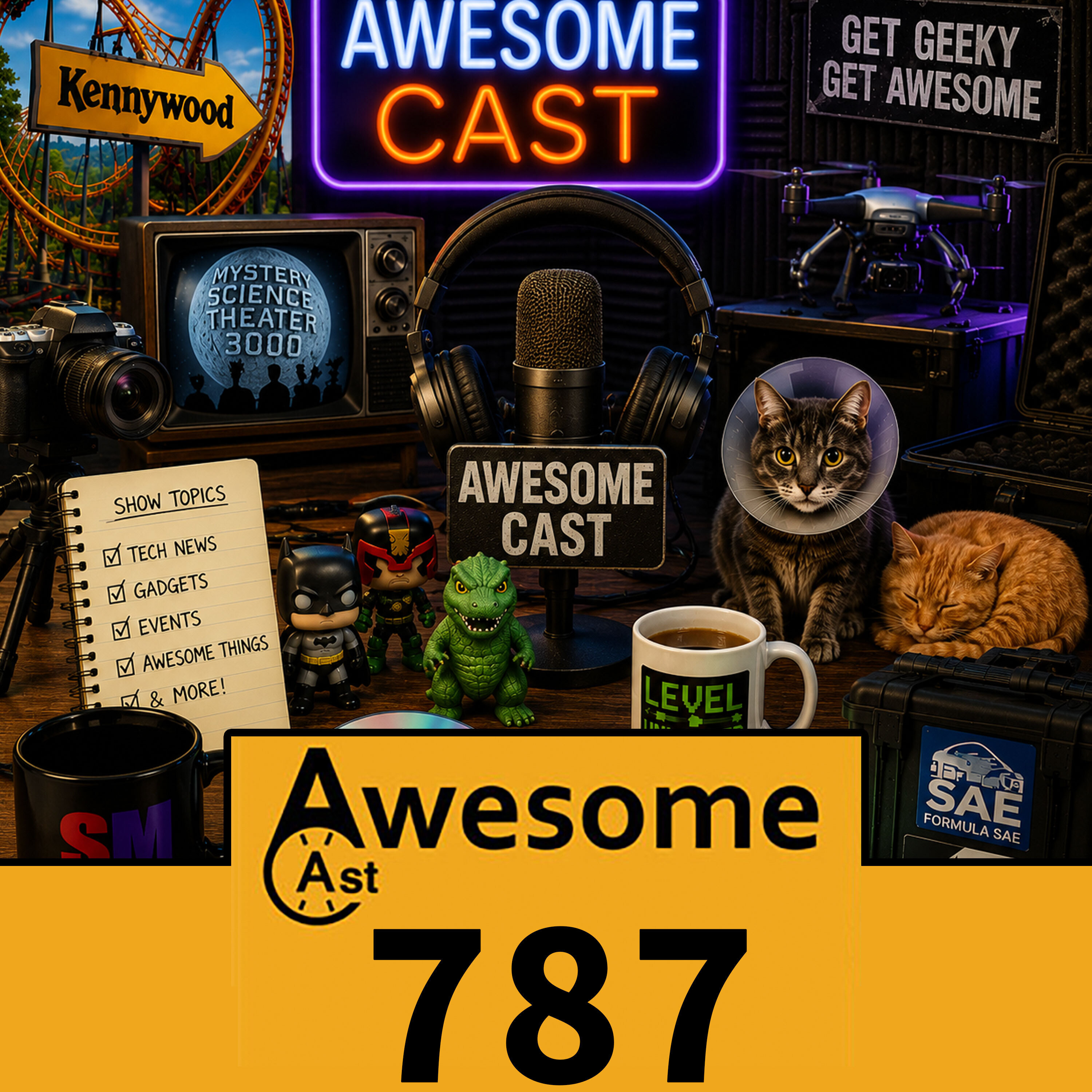
Fortnite’s Hot Bat Summer, Robot Arms & AI | AwesomeCast 787
Jul 1500:58:19Tap to summarizeAwesomeCast 787 gets practical, futuristic and increasingly strange as Sorg, Katie Dudas and Dave Podnar explore family-safe phones, connected health gadgets, USB-C mysteries, robotic limbs, Instagram’s latest AI privacy controversy and Fortnite’s revealing new take on the DC Universe. Sorg also begins downloading the iOS 27 public beta during the show, despite Katie’s warnings and a few concerns being saved for the Patreon aftertalk. Stories and Gadgets Discussed A wireless microphone saves the podcast: When Dave’s regular microphone setup breaks, he switches to a compact dual wireless microphone system that connects through USB-C. The plug-and-play backup works with phones and laptops without a complicated setup. Omron 7 Series Bluetooth blood pressure monitor: Dave reviews a new connected blood pressure monitor after getting inconsistent readings from an older device. He highlights its larger arm cuff, support for two users, storage for multiple readings, three-reading averages, Apple Health integration and the ability to export results for a doctor. https://amzn.to/4yncwxY Pinwheel phones, watches and home phones for kids: Katie introduces Pinwheel’s managed technology ecosystem for children and teenagers. Parents and caregivers can control approved contacts, monitor texts, restrict social media, set bedtime schedules, review locations and gradually unlock features as a child gets older. The company also offers a standalone smartwatch and a Wi-Fi-powered corded home phone that brings back the satisfaction of dramatically hanging up. https://www.pinwheel.com Kennywood’s reopening and the mystery bag gamble: Sorg recounts a delayed visit to Kennywood after a water-main break interrupted opening day. His $5 mystery merchandise bag produced a Kennywood gaiter, a vintage postcard and a Jack Rabbit 100th-anniversary pin. Awesome Person of the Week — Rory Cooper: For Disability Pride Month, Dave profiles inventor, engineer and Paralympic medalist Rory Cooper. After becoming paralyzed while serving in the military, Cooper designed a lighter wheelchair and built a career improving mobility technology. His Pittsburgh work includes the Human Engineering Research Laboratories, a collaboration involving the University of Pittsburgh and the Department of Veterans Affairs. https://www.invent.org/inductees/rory-cooper WhatCable diagnoses confusing USB-C connections: Sorg tests a free Mac utility that reveals what connected USB-C cables, chargers, docks and ports can actually do. The app displays negotiated speeds, charging details, supported USB standards and potential bottlenecks—useful for anyone wondering why a drive, monitor or video device is underperforming. https://www.whatcable.uk/ LEGO’s Fast & Furious Toyota Supra MK4: Katie finds a new LEGO Speed Champions version of Brian O’Conner’s Toyota Supra from The Fast and the Furious. The set includes the bright orange movie car and a Brian O’Conner minifigure in his signature T-shirt and jeans. https://www.lego.com/en-us/product/the-fast-and-the-furious-toyota-supra-mk4-77260 Speed and racing technology at the Carnegie Science Center: The hosts preview an upcoming speed-focused exhibit featuring an interactive track and specialized vehicles connected to the Petersen Automotive Museum. https://www.facebook.com/share/r/1PZqTmHP4J/?mibextid=wwXIfr Using AI to teach respectful sports camera work: The team examines guidelines designed to prevent women athletes from being sexualized through revealing angles and unnecessary slow-motion replays. Sorg discusses turning the concept into an AI-generated pro wrestling camera guide that can help videographers recognize respectful framing, understand consent and avoid exploitative shots. https://www.reddit.com/r/interestingasfuck/comments/1uwaxzx/some_of_the_new_guidelines_that_have_been/ Instagram reverses its public-profile AI remix feature: Dave explains the backlash surrounding a Meta AI feature that could use images from public Instagram profiles in AI creations without first requiring users to opt in. The hosts discuss predictable abuse, privacy risks and why technology companies need more diverse voices involved before launching features like this. Meta subsequently disabled the feature. https://www.usatoday.com/story/tech/2026/07/13/meta-disables-ai-feature-instagram-backlash/90899917007/ Jizai Arms bring Doctor Octopus technology closer to reality: A Japanese research project demonstrates wearable robotic arms that can be attached, removed and exchanged between users. The hosts debate whether the project represents meaningful cyborg research, performance art or technology created without enough consideration for how the public will interpret it. https://jizai-arms.com/ Additional commentary: https://www.instagram.com/refashionedhippie/ Fortnite launches “Hot Bat Summer”: Batman, Harley Quinn, Catwoman and Poison Ivy receive beach-ready DC skins in Fortnite. The discussion naturally turns toward the absurdity of a game where swimsuit Batman can share a battlefield with Bugs Bunny, Homer Simpson and an armed dog in a bee costume. https://www.polygon.com/fortnite-hot-bat-summer-skins-dc-batman-harley-quinn-catwoman-poison-ivy/ A shirtless protester attacks a Waymo vehicle: Video of a man climbing onto and damaging a Waymo in East Hollywood launches a wider conversation about autonomous vehicles, public surveillance, camera networks and the lack of privacy in modern public spaces. The hosts also discuss how easily hacked or deleted accounts can remove years of digital purchases. https://kotaku.com/shirtless-man-starts-butlerian-jihad-against-waymo-in-east-hollywood-2000715911 Support AwesomeCast and receive the Patreon aftertalk at: https://www.patreon.com/awesomecast AwesomeCast is part of the Sorgatron Media Podcast Network: https://www.sorgatronmedia.com Production services provided by Sidekick Media Services: https://www.sidekickmediaservices.com Supporting Pittsburgh podcasting with the perfect pepperoni pizza: https://www.sliceonbroadway.comSupport AwesomeCast: Tech and Gadget Talk
Transcribe →
Awesome Chat: iTargetGolf
Jul 900:27:16Tap to summarizeAwesomeChat welcomes Frédéric Guitton of iTargetGolf to talk about the future of interactive golf technology and how driving ranges are becoming more social, competitive, and game-like. Frédéric explains how iTargetGolf uses interactive targets, animated lights, in-bay feedback, and integrations with systems like Toptracer, TrackMan, and Inrange to make golf practice feel more like a real-life video game. We also discuss Cash Cup Golf, a new hole-in-one skills game using RFID-enabled balls and video validation to create prize-based golf challenges. This episode explores gamified sports, golf entertainment, customer engagement, worldwide virtual competitions, and the business of building technology for outdoor venues. Learn more about iTargetGolf at www.ITargetGolf.comSupport AwesomeCast: Tech and Gadget Talk
Transcribe →
GeForce Now on Apple TV, LEGO F1 Cars & Sony’s Digital Ownership Problem | AwesomeCast 786
Jul 800:59:20Tap to summarizeThis week on AwesomeCast 786, Sorg, Katie Dudas, and Dave Podnar talk practical gadgets, game streaming, refurbished tech, digital ownership, and the weird future of transportation. Katie brings a larger, easier-to-open pill organizer that solves real daily medication frustrations. Dave recommends Dell Refurbished for affordable business-class computers, and Sorg shares how Aeroplay brings NVIDIA GeForce Now streaming to Apple TV, with a few login caveats. The crew also highlights Herman Hollerith for Disability Pride Month, reacts to Sony’s reported physical disc and digital library controversies, explores functional LEGO F1 cars, checks out Pittsburgh’s upcoming Science of Speed exhibit, watches a Waymo drive through fireworks, and discovers the surprisingly adult world of Fisher-Price Little People collector sets. Get geeky. Get awesome.Support AwesomeCast: Tech and Gadget Talk
Transcribe →
F1 Drone Tech, AI Video Chaos & the World’s Largest Camera| AwesomeCast 725
Jul 100:58:41Tap to summarizeThis week on AwesomeCast 785, Sorg and Dave Podnar get geeky with the Vera C. Rubin Observatory’s massive 3,200-megapixel digital camera, Red Bull’s world’s fastest filming drone chasing a Formula 1 car, and the tech legacy of Martine Rothblatt for Pride Month. The hosts also dig into digital game ownership, GTA VI’s physical copy controversy, Nintendo-style game key cards, Sorg’s new AI video experiment “It Came From AI,” Meta and Snap’s latest smart glasses, Apple price increases tied to AI hardware demand, hand-crafted animation, Minion singing contests, and a wild pro wrestling Nintendo moment involving an NES cartridge. Links discussed in this episode: Rubin Observatory space camera: https://www.space.com/astronomy/rubin-observatory-begins-filming-the-greatest-cosmic-movie-ever-beginning-a-new-era-of-astronomy https://rubinobservatory.org/ Red Bull F1 filming drone: https://www.instagram.com/reels/DaFPQ8pOEXN/ https://www.redbull.com/us-en/worlds-fastest-filming-drone-build Martine Rothblatt: https://achievement.org/achiever/martine-rothblatt-ph-d/ Chachi Says Video Game Minute: https://www.bbc.com/news/articles/cjrg52egw1ro https://www.polygon.com/1000-dollar-game-steam-10-minutes-congratulations-on-your-purchase/ https://www.cbr.com/universal-five-nights-at-freddys-3-gary-dauberman-screenwriter/ It Came From AI: https://www.instagram.com/itcamefromai/reels/ Animation by dad for child: https://www.facebook.com/reel/3485866488230002 Meta AI glasses: https://www.meta.com/ai-glasses/meta-glasses/ Snap AR glasses: https://www.tomsguide.com/news/live/snap-specs-launch-live-latest-updates Apple price increases: https://www.cultofmac.com/news/ouch-apples-mac-and-ipad-price-hikes-brutal Minion singing contest: https://www.tiktok.com/t/ZP8G67fFM/ Nintendo wrestling moment: https://apple.news/A2iJBMG51SlKOCgHFRwk6xA Support the show at https://www.patreon.com/awesomecast and get exclusive aftertalk content for as little as $1 a month. AwesomeCast is part of the Sorgatron Media Podcast Network. Find more at https://sorgatronmedia.com/Support AwesomeCast: Tech and Gadget Talk
Transcribe →SteamOS, Shokz Headphones, Retro Phones, Sports Tech & a T-Pain Social Media Fail | AwesomeCast 784
Jun 2400:59:35Tap to summarizeThis week on AwesomeCast, Sorg is joined by Dave Podnar while Katie is on assignment. The crew digs into practical tech, gaming platforms, open-source operating systems, sports broadcast innovation, retro-inspired phones, and one very funny automated social media mistake involving DoorDash, soccer, and T-Pain. Stories and gadgets discussed: Dave’s Awesome Thing of the Week: Shokz OpenRun Pro 2 headphones Dave finally upgrades from cheap running headphones to the Shokz OpenRun Pro 2, praising the open-ear / bone-conduction-style design for running safety, comfort, sweat management, USB-C charging, and situational awareness. Link: https://www.amazon.com/dp/B0D2HKCMBP?maas=maas\_adg\_api\_582366218564361552\_static\_9\_129&ref\_=aa\_maas&tag=maas&aa\_campaignid=lv\_IGvrl5TTBxiweexlXK&aa\_adgroupid=lv\_fdLHIcjvJhpJZvQxFb&aa\_creativeid=lv\_MMLFRb8MTdZvGlnqFv&gad\_campaignid=23921418215&gbraid=0AAAABDw\_RJg26Vr6MY-sVAPsmwCxwK4mX&gclid=CjwKCAjw3ejRBhAdEiwADkqPn36qoEfzRElmQ3e9OXSxZdGKjw0DyckEdeqo82D8qqlMdTFDyLXuXhoCVn8QAvD\_BwE&th=1 Valve opens the door to SteamOS installs on AMD PCs Sorg talks about Valve allowing SteamOS installs on normal PCs with AMD GPUs, giving PC gamers a way to build their own living-room Steam Machine instead of buying Valve’s new box. The conversation also touches on Steam Deck, Linux gaming, Proton, GPU costs, tariffs, and the economics of gaming hardware. Link: https://www.pcgamer.com/hardware/steam-machines/valve-greenlights-steamos-installs-on-normal-pcs-with-amd-gpus-so-you-can-go-make-your-own-steam-machine-if-you-dont-wanna-fork-over-usd1-049/?brid=YWdncwFV2uAIYy2jMECl21FxWfGS Bazzite as an open-source SteamOS-style alternative Sorg brings up Brother Sorg’s recommendation of Bazzite, a Linux-based gaming OS with Steam gaming mode and support for launchers like Xbox Game Pass, Battle.net, EA, Epic Games Store, GOG, Rockstar, and Ubisoft Connect. Link: https://bazzite.gg/ Pride Month tech history: Jon “maddog” Hall Dave spotlights Jon “maddog” Hall, a major Linux and Unix figure, sharing stories about Hall’s long programming history, his connection to Linus Torvalds, and the importance of recognizing LGBTQ contributors in technology history. Article: https://www.lpi.org/blog/2025/09/10/a-lifetime-in-code-jon-maddog-hall-reflects-at-linuxfest-northwest/ Talk: https://www.youtube.com/watch?v=758QuvXrttM Chachi Says Video Game Minute: GTA 6, Nex Playground, and Ubisoft news Chachi covers three gaming stories: GTA 6 cover art and pre-orders, the Nex Playground motion-based console for kids, and the death of Claude Guillemot, co-founder of Ubisoft. GTA 6: https://www.ign.com/articles/gta-6-cover-artwork-revealed-pre-orders-begin-june-25 Nex Playground: https://www.bbc.com/news/articles/czx50rrz7zro Claude Guillemot: https://apnews.com/article/france-assassins-creed-ubisoft-plane-crash-2df2ea469c3fca0a45c38ae8805a6033 Baja SAE filmed on a “gas station camera” Sorg highlights a low-fi, retro-looking Baja SAE reel from Fairfield University, celebrating the charm of VHS-style and “bad camera” aesthetics in modern social media content. Link: https://www.instagram.com/reels/DZ6BjfCtzo-/ World Cup referee technology, digital twins, sensors, and 3D body scans Sorg discusses advanced soccer officiating tech, including camera sensors, player tracking, digital twins, and automated offside detection that can help reduce blown calls and give officials faster alerts. Link: https://apple.news/ABeSFqwyjRpehEy0x8Nc9nQ Ribbie turns MLB games into pixel-art broadcasts Dave shares Ribbie, a fan-built project that uses real-time Major League Baseball data to recreate live games as a retro 16-bit-style baseball broadcast. The conversation connects it to vibe coding, AI-assisted development, and new ways fans can build creative sports experiences. Link: https://techcrunch.com/2026/06/23/ribbie-turns-real-time-baseball-stats-into-arcade-like-pixel-art-broadcasts/ Commodore phone brings retro branding to a distraction-light flip phone Dave and Sorg look at the Commodore phone, a Sailfish OS-based flip phone designed as a step above a dumbphone, with calls, texting, maps, music apps, Uber/Lyft, classic Commodore games, and limited/no social media access. Link: https://order.commodore.net/callback-audio/?brid=YWdncwHwIXnsUg8Nsyh9q\_45Lj2C DoorDash accidentally tags T-Pain in soccer posts The episode wraps with a funny social media fail where DoorDash appears to tag T-Pain instead of soccer player Tim Payne during World Cup-related posts. Sorg and Dave discuss automation, agency workflows, social scheduling, and why T-Pain’s response made the whole situation better. Link: https://www.instagram.com/p/DZ56tKCnedX/?brid=YWdncwG5YHkt5InxWn1IZ1Apa3Gc&img\_index=2 Support AwesomeCast: Tech and Gadget Talk
Transcribe →
Road Trip Tech, World Cup Culture Shock, Strong Museum, and Gemini Pro | AwesomeCast 783
Jun 1701:07:38Tap to summarizeSorg and Katie are back on the road in Michigan, Dave Podnar joins from the Pod Cave, and Missy keeps the studio running from Pittsburgh for this travel-heavy episode of AwesomeCast. This week, the crew talks about Niagara Falls adventures, World Cup watch parties, international visitors discovering American mega-stores, the Strong Museum of Play, Nerdvana, Google Gemini Pro, electric vehicle camouflage, and video game news from Chachi Says. Stories and gadgets discussed: World Cup travelers discovering America Dave shares TikTok reactions from international soccer fans experiencing Walmart, Waffle House, Costco, ranch dressing, school buses, Bucky’s, and oversized American everything. Link: https://www.tiktok.com/@josievlogsthings/video/7651983684060613890?lang=en Niagara Falls World Cup watch party Sorg and Katie stumble into a World Cup viewing party at Niagara Falls with giant screens, fans, fireworks, and the falls lit up at night. The 26th-floor IHOP at Niagara Falls Katie highlights the surreal breakfast experience of eating IHOP with a panoramic view of Niagara Falls, before the space transforms into a steakhouse at night. This Week in Pride History: Sophie Wilson Dave spotlights Sophie Wilson, a computing pioneer connected to the development of ARM processor architecture, which powers phones, Macs, and many modern devices. Link: https://www.marks-clerk.com/insights/latest-insights/102k16g-celebrating-lgbt-history-month-sophie-wilson-computing-pioneer-inventor-and-advocate-for-inclusion/ Chachi Says Video Game Minute Crazy Taxi, Ocarina of Time, TMNT: The Last Ronin, and Marvel’s Wolverine game news. A sealed Super Mario Bros. copy reportedly sells for $3 million. Tupac appears in Stranger Than Heaven, a prequel to the Like a Dragon series. Links: https://www.creativebloq.com/3d/video-game-design/switch-2-zelda-ocarina-of-time-remake-is-making-some-fans-regret-what-they-wished-for https://www.inverse.com/gaming/teenage-mutant-ninja-turtles-the-last-ronin-platinum-games-ps5-xbox https://kotaku.com/copy-of-super-mario-bros-sells-for-3-million-in-auction-2000706228 https://www.cbc.ca/news/entertainment/tupac-video-game-stranger-than-heaven-9.7232112 Strong Museum of Play and Video Game Hall of Fame Sorg and Katie visit the Strong Museum in Rochester, New York, including the Video Game Hall of Fame, giant Donkey Kong, Oregon Trail, Street Fighter, Sonic, Sesame Street, Peanuts, Hello Kitty, Dungeons & Dragons, and interactive game exhibits. Nerdvana The crew talks about the restaurant across from the Strong Museum where guests can play Xbox, PlayStation, Switch, or board games while eating. Ford’s hidden QR code in EV camouflage Dave discusses Ford hiding a QR code inside the camouflage pattern on a prototype electric pickup, turning spy photos into promotion. Link: https://www.theautopian.com/the-30000-ford-ev-pickup-we-photographed-was-hiding-a-qr-code-on-its-camouflage-heres-where-it-takes-you/ Google Gemini Pro and Google One Sorg discovers Google AI Pro access connected to Google storage plans and talks through Gemini, Google Forms automation, vibe coding, AI tools, NotebookLM, Flow, and possible app development. Link: https://gemini.google/us/subscriptions/?hl=en&brid=YWdncwHVFyhYRkb6SzEgcIU3w1kG Support AwesomeCast on Patreon for exclusive aftertalk content: https://www.patreon.com/awesomecast Thanks to our supporters: Brian Crawford, Cynthia Closkey, John DeGore, and Dave Podnar.Support AwesomeCast: Tech and Gadget Talk
Transcribe →