Podcast
The AWS Developers Podcast
Hosted by Amazon Web Services · EN
Stay updated on the latest AWS news and insights for developers, wherever you are, whenever you want.
41episodes
Episodes
Newest firstAll episodes
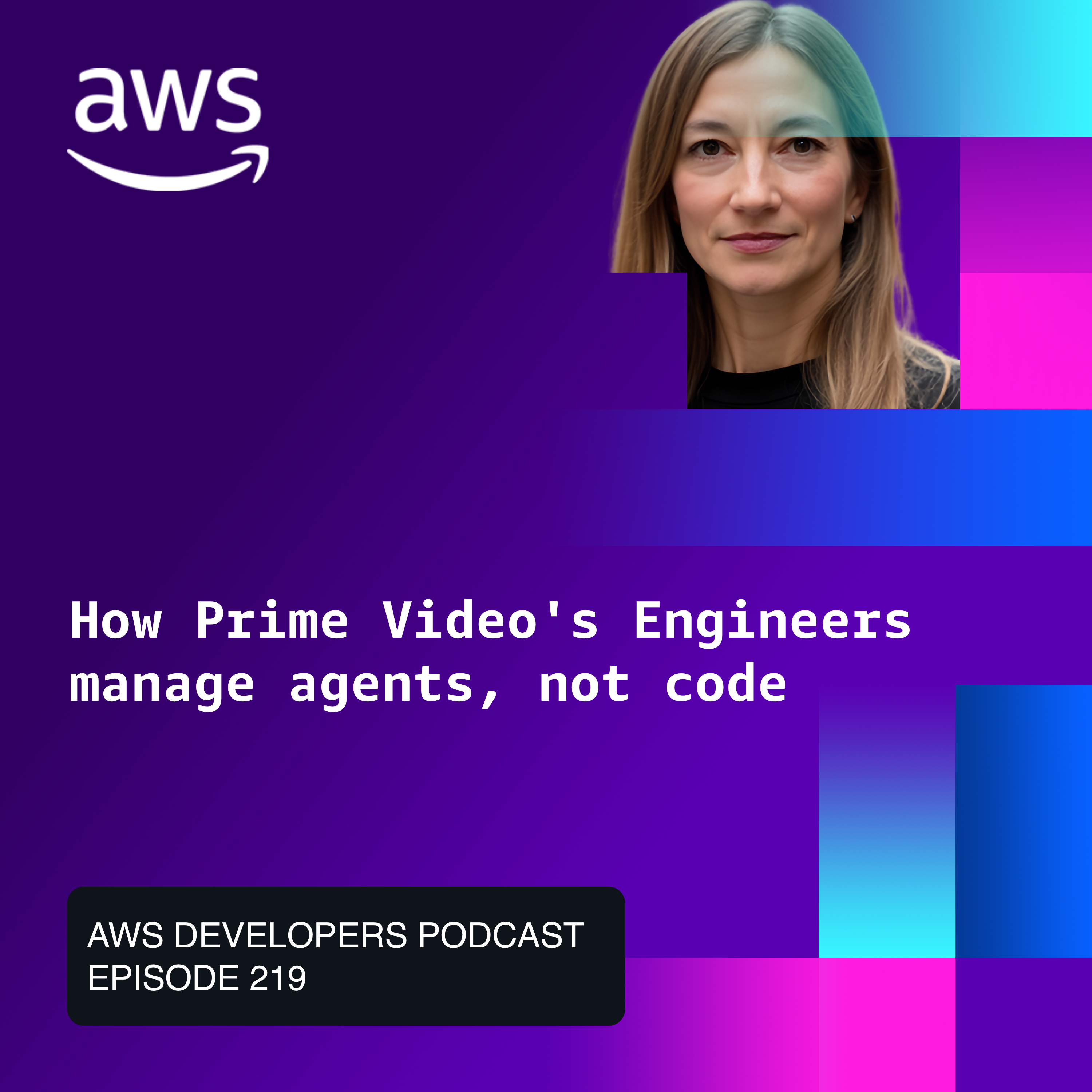
How Prime Video's engineers manage agents, not code
2w ago01:11:24Tap to summarizePrime Video serves over 300 million monthly customers across 240+ territories and 8,000+ device types. Lilia Abaibourova leads the AI-native transformation there. Prime Video started early, adopting CodeWhisperer as soon as it became available in preview, progressing through Amazon Q Developer, and now using Kiro to put agentic development in the hands of engineers, product managers, and designers. Romain sits down with Lilia to trace that journey — from CodeWhisperer preview to Amazon Q Developer and now Kiro — and explore MCP as the organizational inflection point: teams run two-person pods with full decision autonomy, while managers oversee fleets of agents instead of just headcount. Key takeaways: • Prime Video adopted AI coding tools from day one — CodeWhisperer in preview, then Amazon Q Developer, and now Kiro — building institutional muscle even when specific features were later sunset • MCP was the inflection point for organizational (not just individual) transformation — connecting disciplines end-to-end and eliminating handoff bottlenecks • Code generation is now effectively solved; the new frontier is verification, validation, and code review at scale • Team structures are being actively experimented with — from 2-person pods with full autonomy to larger teams where managers leverage agent fleets • The biggest anti-pattern: waiting on the sidelines for a standard instead of learning through experimentationWith Lilia Abaibourova, Principal Product Manager, AI-Native Transformation at Prime VideoLilia Abaibourova at AWS re:Invent 2025Prime VideoKiro — AI-Powered Development EnvironmentAmazon Bedrock AgentCoreStrands Agents SDK — Open SourceIntroducing the Model Context Protocol (Anthropic)A Return to Two-Pizza Culture — Werner VogelsI, Robot — Isaac Asimov (Lilia's Book Recommendation)Lilia Abaibourova on LinkedIn
Transcribe →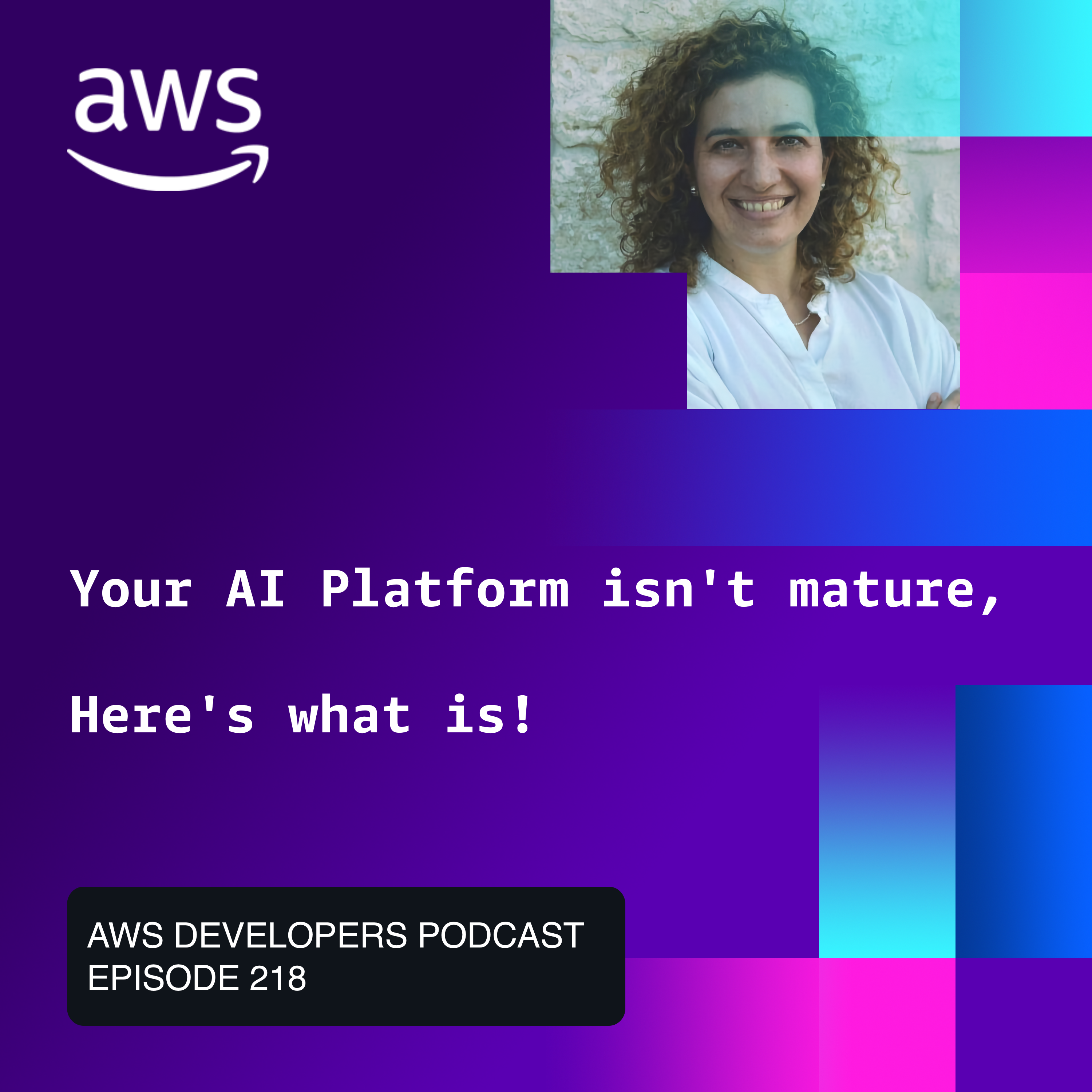
Your AI platform isn't mature — here's what is
3w ago00:53:02Tap to summarizeI keep hearing 'we're building an AI platform' from enterprises. Most are stitching together demos. Thomson Reuters has been doing AI for 30 years. I sat down with Laura Skylaki (VP AI Engineering, Thomson Reuters) at AWS Summit London — and the gap between what they're doing vs. what most companies call 'AI maturity' is striking. In this episode, Laura breaks down how Thomson Reuters built an enterprise AI platform that serves 30,000 employees across three user personas — from business users to AI creators to developers — with 16 internal services, a $200M/year AI commitment, and a healthy skepticism about when agentic is actually the right answer. Key takeaways: • Evaluation before building — 'It's increasingly harder to retrofit an evaluation framework to an agent capability you already deployed.' They build evaluation benchmarks first to force understanding of the business problem, then build the agent. LLM-as-a-judge with human-in-the-loop calibration — and the judges themselves need continuous regression checks. • Know when NOT to use agents — 'Where we can go and write deterministic code with a logical rule-based approach, I don't think it makes sense to rely on the agent.' Not everything needs to be agentic. When tools exceed a dozen or overlap semantically, specialize into multiple agents instead of overloading one. • Engineers haven't written code manually in 3-4 months — Not experimenting; their AI coding tooling is that far ahead. The shift is toward system design, architecture, and clear structuring for AI assistance. • AWS under the hood with AgentCore and Strands — The platform runs on AWS with API Gateway, Lambda, Step Functions, and Amazon Bedrock AgentCore for agent deployments (runtime, memory, MCP marketplace, code interpreter, browser tools, policy and identity governance). They use Strands Agents SDK to build agents. AgentCore removes the infrastructure burden of long-running agent sessions. • Rethink workflows, don't retrofit — Teams reimagining legacy workflows from scratch for AI rather than bolting generative AI onto systems not built for it. 'If I was building this now for the first time, how would I build it?' The companies that succeed with AI are not fitting it into existing processes — they're redesigning the process through AI.With Laura Skylaki, VP of AI Engineering at Thomson ReutersThomson Reuters — AI & TechnologyCoCounsel — AI Assistant for Legal ProfessionalsAmazon Bedrock AgentCoreStrands Agents SDKAWS Summit London 2026Automated Reasoning on AWSExtreme Ownership — Jocko Willink & Leif Babin (Laura's Book Recommendation)Laura Skylaki on LinkedIn
Transcribe →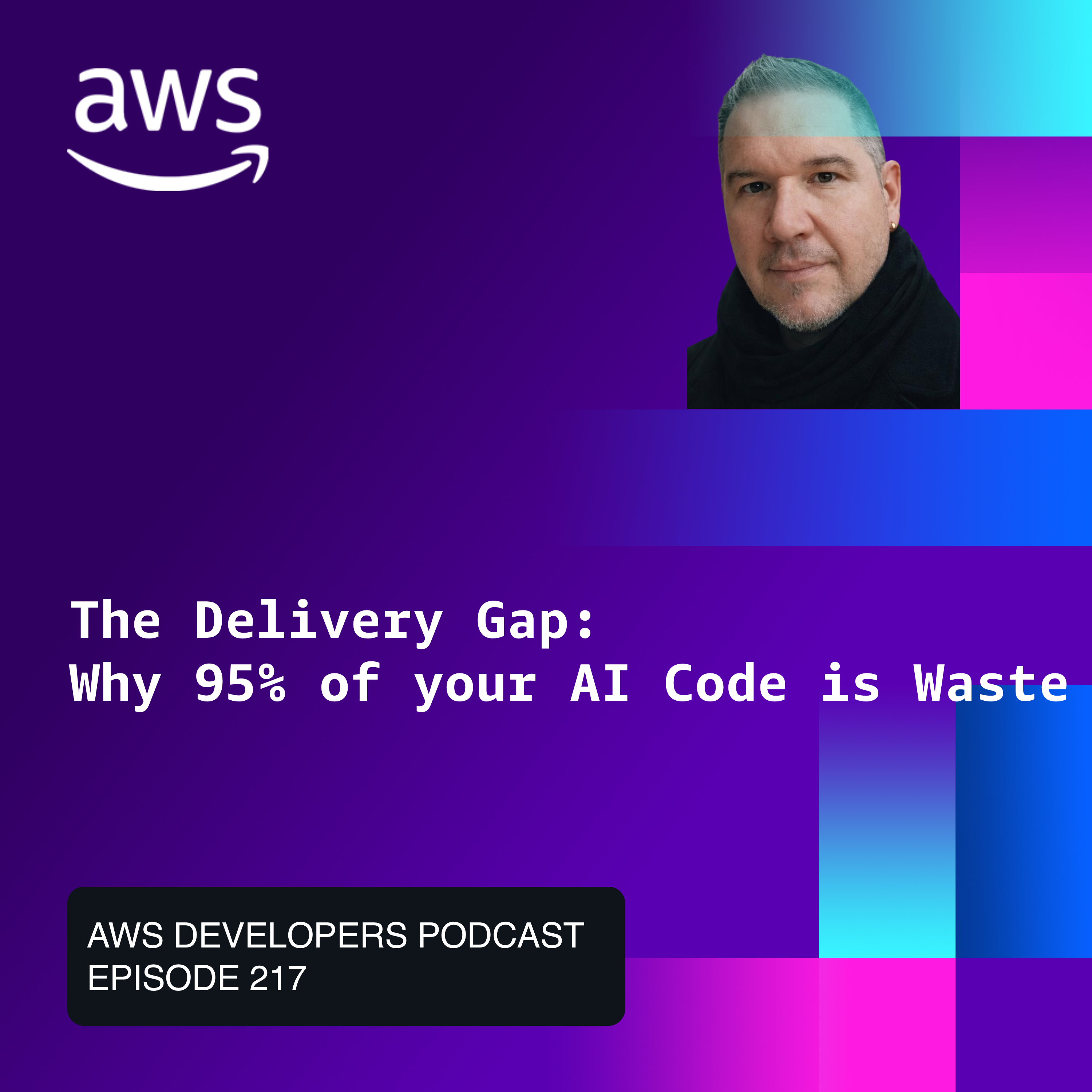
The Delivery Gap: Why 96% of Your AI Code Is Waste
4w ago01:07:45Tap to summarizeBrenn reached out via LinkedIn to share his experience with AI-driven software development and his new book, The Delivery Gap. Romain read a copy during a business trip and found it deeply aligned with how he guides customers through their AI transformation — and discovered a few new angles worth exploring, including a convergence on cost tracking that maps directly to Amazon's internal cost to serve software metric. In this episode, Brenn — Senior Manager at Delivery Hero (one of the world's largest food delivery companies, operating in 65 countries) — breaks down why most companies fail to see returns from AI coding tools despite individual developers feeling more productive. The core insight: generating code 10x faster means nothing if your verification infrastructure can't keep up. You're just driving 10x faster into a wall. Key takeaways: • The 96% waste problem — If you generate 100 PRs and only 4 make it to production and stay there, the other 96 are waste. Measuring PRs created is meaningless; measure what ships and survives. • The verification triangle — Your delivery speed is governed by verification infrastructure, not generation speed. Banks can't release faster than they can audit. Find your constraint — that's where investment should go, not more coding tools. • Cost per accepted change — Total token costs + human time for all PRs, divided by changes that reach production and stay there. This single metric reveals where waste accumulates and aligns with Amazon's cost to serve software model. • Specs as alignment documents, not source code — Specs align humans and AI on intent and why, not for deterministic code generation. The same spec produces different software each time. Focus on why; let the AI document the what. • Keep agents small and focused — Every MCP server re-injected into context is a cost multiplier per turn. The smallest, tightest, most precisely aimed agent outperforms a Swiss Army knife agent on both cost and accuracy. Apply cost per accepted action to measure agentic ROI.With Brenn, Senior Manager at Delivery Hero & Author of The Delivery GapThe Delivery Gap — Brenn's BookBusiness Value of Developer Experience Improvements: Amazon's 15.9% BreakthroughDelivery Hero — Global Food Delivery PlatformAWS DevOps AgentKiro — AI-Powered Development EnvironmentThe Phoenix Project — Gene Kim, Kevin Behr, George Spafford (Book Recommendation)The DevOps Handbook — Gene Kim, Jez Humble, Patrick Debois, John Willis (Book Recommendation)Warp — AI-Powered Terminal (Brenn's Dev Tool Pick)Brenn on LinkedInEpisode 214 — AWS DevOps Agent: Can Your Pipeline Keep Up with AI?
Transcribe →
What are MCP apps and why should you care?
Jul 800:50:36Tap to summarizeMost MCP tools today return text. But what if your agent could render a chart, a form, or a full dashboard right inside the chat? That's what MCP apps do — and they're already live on ChatGPT, Claude, and Amazon Quick. Romain sits down with Luigi Pederzani, co-founder of Manufact (the company behind mcp-use, 10K+ GitHub stars), to explore MCP apps — the first official extension of the MCP protocol that lets servers return interactive UI inside AI chat interfaces. Key takeaways: • What MCP apps are — Standard MCP returns text and actions; MCP apps let a server send back a piece of interface (a form, a chart, a dashboard) that renders right inside the chat. It became the first official extension of the protocol this year, growing out of MCP-UI. • UI drives retention — Amplitude saw 2x retention for users exposed to a chart-rendering MCP app versus text-only responses. UI lets software products stay experiences, not just systems of record. • AI apps are the new browsers — Extending Paul Graham's thesis, every software product will be rendered inside AI chats, pulling data and structure from different sources the way we switch tabs today. • Building with mcp-use — Reuse existing React components with minimal changes; the useMcp hook bridges tool arguments (filled by the agent) into component props. The server stays a normal MCP server, the client is the host, and the view runs in a sandboxed iframe. • Interactivity and safety — Iframes are battle-tested and the model-to-server communication is standardized. UI can send events back to the model, so clicking a chart element can trigger another tool call in the chat. OAuth is now standard for production MCP servers. • Tool design best practices — Don't wrap OpenAPI specs directly as MCP. APIs are granular and atomic; MCP tools should serve a task end-to-end so agents don't get confused on ordering. Limit the number of tools exposed; progressive disclosure is now handled by the major clients. • MCP as the A2A protocol — A2A never really landed, and MCP is becoming the agent-to-agent protocol, with companies embedding an agent as a single tool whose main argument is a prompt. • Getting to production — Start with a plain MCP server, then add UI. Skills are now part of the product, and Manufact focuses on agent-readiness of the SDK, testing across clients, deployment, auth, observability (OTEL), and per-tool analytics. • AWS integration — mcp-use can sit on the server side while AgentCore Gateway sits in front to handle enterprise concerns like auth policies and routing. • What's next — Exposing skills directly from MCP servers (rather than decoupled files), and the next stateless-by-default release of the protocol.With Luigi Pederzani, Co-founder of Manufactmcp-use SDK (GitHub)Manufact CloudOra.ai — Agent Readiness ScannerAmazon Bedrock AgentCore Gateway — MCP Server TargetsAgentMail — Email Infrastructure for AgentsThinking, Fast and Slow — Daniel Kahneman (Luigi's Book Pick)Luigi Pederzani on LinkedIn
Transcribe →
5 Lessons Running AI Agents in Production
Jul 100:56:01Tap to summarizeJohn Sexton and Aaron Tummon from Genesys join the show to share hard-won lessons from building and operating Cloud Copilot — an agentic AI layer serving 2 million users across 21+ AWS regions. Genesys powers customer experience for brands like Virgin Atlantic, Vodafone, and HSBC, and their copilot helps admins, supervisors, and agents work more efficiently through natural language. We cover the migration from Bedrock Inline Agents to Strands Agents, multi-agent orchestration with agents-as-tools, context management strategies, cost optimization, and the testing discipline required to keep agentic systems stable at scale. The 5 lessons: 1. Pick a framework that scales with you — Bedrock Inline Agents worked for 12–15 tools but became exponentially flakier beyond that. Strands Agents gave sensible defaults and room to grow without pinch points. 2. Separate orchestration from domain logic — Agents-as-tools creates a clean line between the orchestrator and sub-agents. You can pull functionality in and out per persona without destabilizing the system, and domain teams own their sub-agents independently. 3. Manage context aggressively — Long context windows for the orchestrator, stateless sub-agents, summarizing and sliding-window conversation managers, and strict control over what tools return. Every extra token in context degrades quality and increases cost. 4. Make prompt caching non-negotiable — System prompts, tool definitions, and conversation history rarely change between invocations. Enabling prompt caching delivered significant cost reductions with almost no effort. 5. Test relentlessly because prompt drift is invisible — One prompt change is never a breaking change; five accumulated changes are. A dedicated weekly Sentinel role investigates failures, and full test suites run on every single change.With Aaron Tummon, Software Engineer at Genesys ; With John Sexton, Engineering Manager at GenesysGenesys Cloud — Customer Experience PlatformStrands Agents SDK — Open-Source AI Agent FrameworkStrands Agents — Agent Evaluation SDKAmazon Bedrock — Prompt CachingAWS Lambda — Serverless ComputeAaron Tummon on LinkedInJohn Sexton on LinkedInThinking, Fast and Slow — Daniel Kahneman (Aaron's Book Pick)Mythos — Stephen Fry (John's Book Pick)
Transcribe →
AWS DevOps Agent: Can Your Pipeline Keep Up with AI?
Jun 2400:46:18Tap to summarizeTipu Qureshi — Senior Principal Engineer at AWS — joins the show fresh from the AWS Summit NYC 2026 announcements to break down how DevOps Agent is changing the way teams handle operations and release management. After 14 years across EC2, Elastic Load Balancing, AWS Support, and Networking, Tipu moved into the Agentic AI organization to build the DevOps Agent and contribute to Agent Core. We explore how the agent investigates incidents autonomously, integrates with your IDE through Kiro and Claude, and validates code changes in sandboxes before they hit production. Key takeaways: • Reactive and proactive — DevOps Agent triggers on alarms and ServiceNow incidents, but Custom Agents now run on schedules to detect anomalies before they become outages. • Context is king — Customers who integrate their Git repos, metrics, and logs get significantly more accurate root causes. Native GitHub/GitHub Enterprise support plus bring-your-own MCP for custom observability. • IDE integration — Kiro powers and Claude plugins give on-call engineers the full agentic loop: investigate, root-cause, fix, and validate without leaving the editor. • Release management — The new readiness review inspects pipeline stages, past deployment failures, and integration tests to catch issues before merge, while sandbox testing validates proposed fixes. • Multi-cloud support — Native Azure integration via IDC with RBAC, plus bring-your-own MCP and A2A for on-premises and other clouds. • Custom agents and skills — Bring domain-specific knowledge (SAP HANA failure modes, proprietary tooling) via skills from GitHub repos or the assets API, with MCP tools for full customization. • A2A bi-directional — DevOps Agent can be engaged by other agents and can reach out to other agents, enabling multi-agent escalation workflows. • Transparency — Every tool call, skill invocation, and reasoning step is captured in a journal visible to customers via API and the operator console. • What's next — Deeper integrations, automated mitigation actions with safety policies, time-bound rules for agent escalation, and script execution coming soon.With Tipu Qureshi, Senior Principal Engineer at AWSAWS DevOps AgentAWS DevOps Agent — Release Management (Blog)AWS Context — Context Intelligence for Data and AI Agents at ScaleAWS Summit NYC 2026 AnnouncementsTipu Qureshi on LinkedIn
Transcribe →
KiroGraph: How a Local Code Graph Saves 80% of Your AI Tokens
Jun 1701:06:42Tap to summarizeDavide de Sio built KiroGraph as a personal side project to stop his AI agent from burning through credits just searching files. It turned into a community-driven, open-source MCP server that gives Kiro (and other AI agents) a semantic map of your codebase — reducing token usage by up to 80%. We dive into the architecture, security, and modules, how everything runs 100% locally, and how the AWS Community shaped the project's roadmap. Key takeaways: • Code graphs vs. grep — Tree-sitter and AST-based graph generation give AI agents a smarter navigation model, eliminating wasteful file searches. • Architecture module — Detects patterns and prevents drift by validating your codebase against its own structural rules. • Security module — Finds exposed secrets and vulnerabilities by tracing the call graph, born from an AWS Summit Milano talk. • Watchman module — Auto-generates Kiro skills from repetitive patterns, building persistent memory for your agent. • 100% local execution — Embeddings run with Nomic and summarization with Gemma 3, no data leaves your machine. • Spec-driven development — Davide built KiroGraph with Kiro itself, using specs to drive the entire development lifecycle. • Portability — Commit the graph to Git and share it across machines and team members. • Community-driven roadmap — CI/CD integration, validation hooks, and container deployment are next.With Davide de Sio, Head of Software Engineering at ElevaKiroGraph — Open-Source Code Knowledge Graph (GitHub)Kiro IDE — AI-Powered Development EnvironmentTree-sitter — Incremental Parsing SystemNomic Embed — Local Text EmbeddingsAWS Community Builders ProgramDavide's Blog — Building KiroGraphKiroGraph-Sec — From AWS Summit Milano to a Cybersecurity Feature
Transcribe →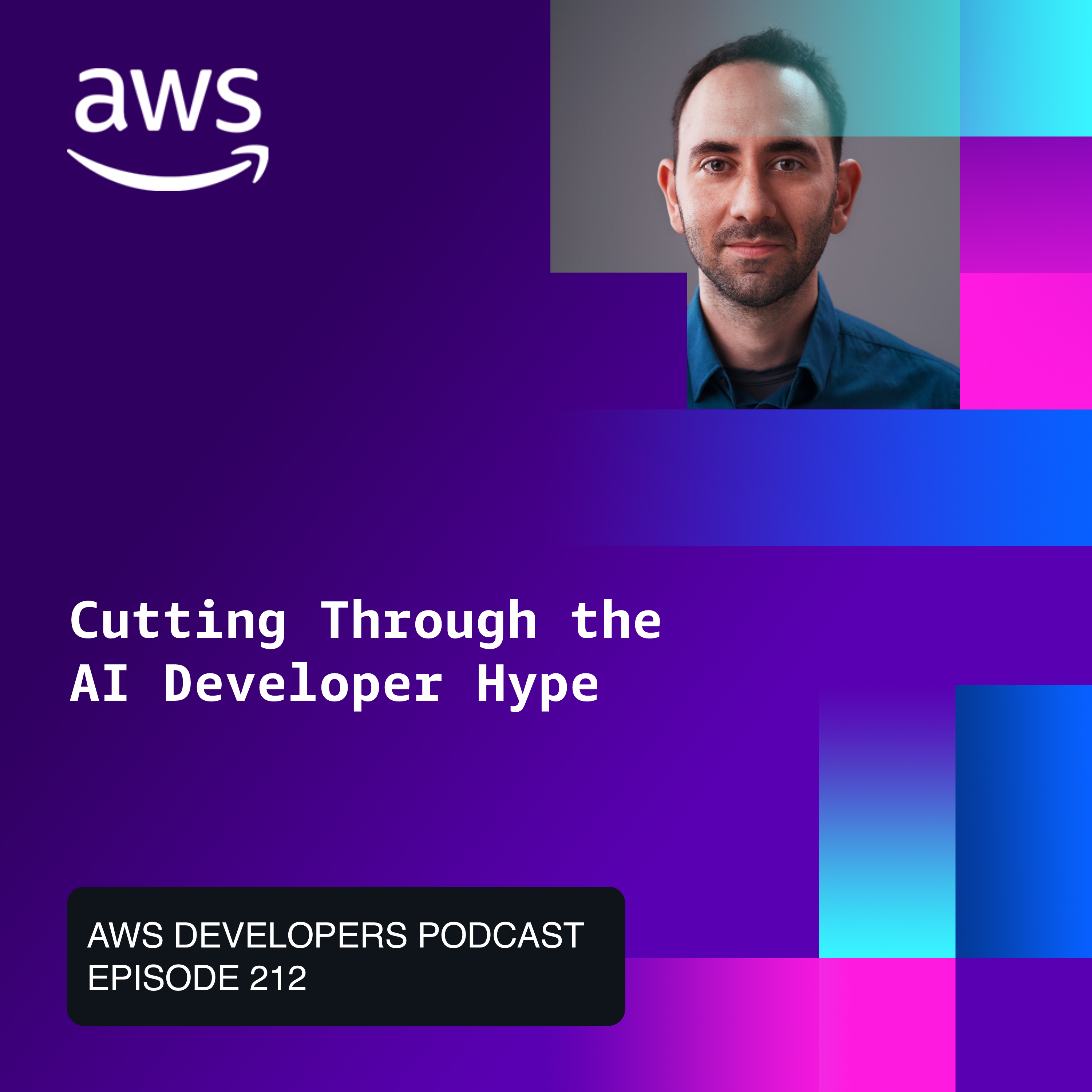
Cutting Through the AI Developer Hype
Jun 1001:20:22Tap to summarizeAn honest, no-filter conversation about where developers actually stand with AI today. Warren Parad — CTO at Authress, AWS Community Builder, and host of Adventures in DevOps — brings a contrarian 'LLM realist' perspective grounded in daily use, while Romain nuances with enterprise customer observations and the data behind the hype. Together they explore why 93% of devs feel productive but only 4% of enterprises see results — and what separates those who benefit from those who don't. Key takeaways: • AI is a multiplier, not a magic wand — The DORA 2025 report confirms AI amplifies your existing processes. If those processes are broken, AI makes them worse faster. • Spec-driven development beats instant responses — Long-form spec-based workflows let you disengage and return, avoiding the 'TikTok-ification' of software engineering where you're always context-switching. • Sub-agent opacity is a real problem — When agents delegate to sub-agents, you lose visibility into why decisions were made. Custom agents with explicit permissions and tool access help contain the blast radius. • Greenfield work is where LLMs struggle most — LLMs excel at refactoring and targeted feature changes where engineers already know the implementation. Open-ended new projects lead to scope creep and unfinished work. • Critical thinking erosion is measurable — Microsoft/Carnegie Mellon research shows knowledge workers self-report reduced cognitive effort when using AI. The long-term implications for engineering judgment are concerning. • Governance first, tools second — Enterprises that succeed with AI spend the first month on governance, AI registries, and codifying best practices before enabling tools across teams. • Software development was never the bottleneck — Unless AI solves handoffs, knowledge management, and organizational alignment, faster coding alone won't compress your roadmap.With Warren Parad, CTO at Authress & Host of Adventures in DevOpsAuthress — Login and Access Control for B2BAdventures in DevOps PodcastWarren Parad — Personal SiteDORA 2025 ReportMicrosoft/CMU — The Impact of Generative AI on Critical ThinkingForgejo — Self-Hosted Git with FederationRig — Rust AI FrameworkAWS Kiro — AI-Powered Development EnvironmentAWS Strands Agents SDKSimon Wardley — Wardley Maps & PST FrameworkThe Phoenix Project — Gene Kim, Kevin Behr, George SpaffordThe Magicians — Lev Grossman (Warren's Book Pick)
Transcribe →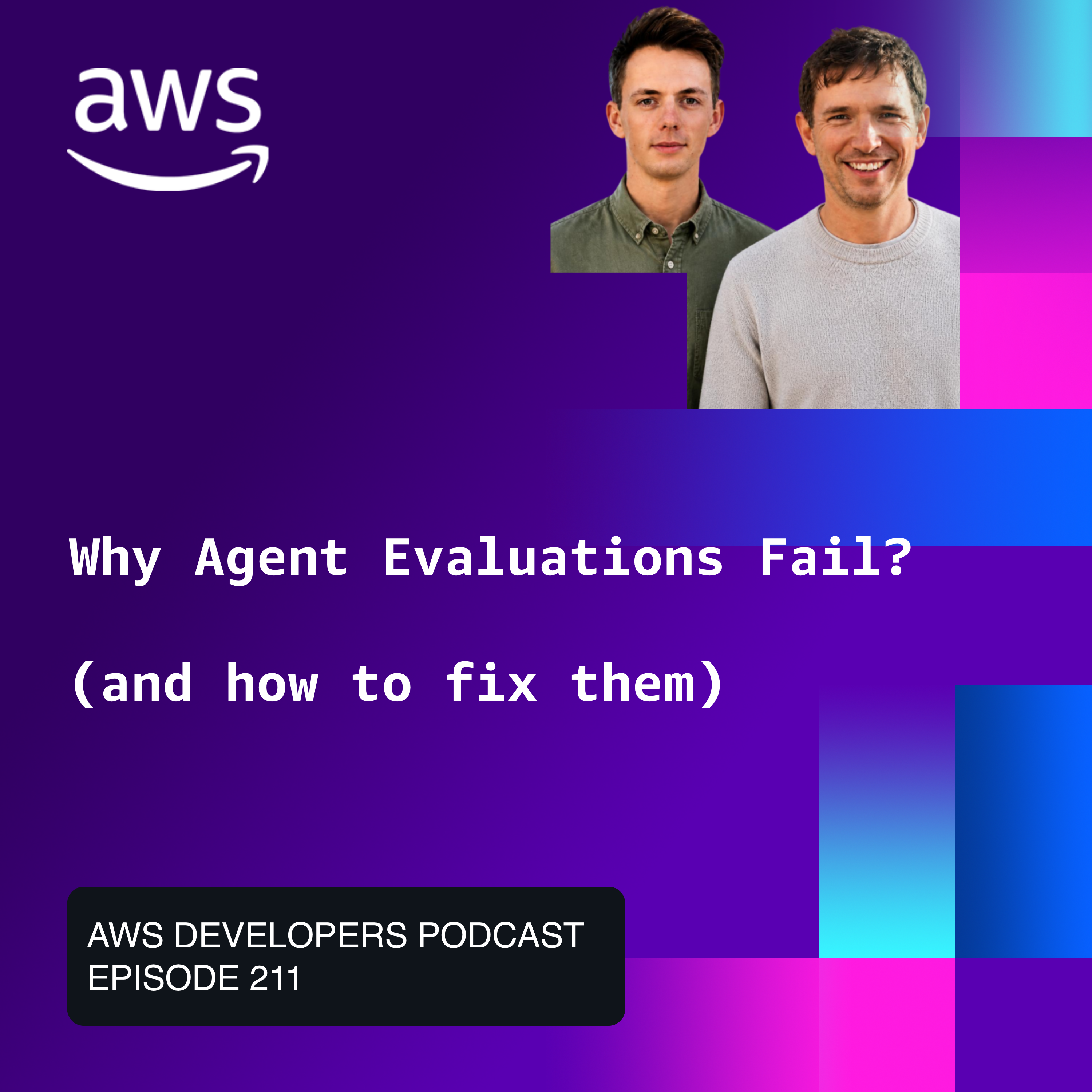
Why Your Agent Evaluations Will Fail You (and How to Fix Them Before Production)
Jun 300:44:06Tap to summarizeAnthropic deprecated Sonnet 3.5. Some of Xelix's pipelines migrated smoothly. Others broke — and customers noticed within hours. What separated the two? Evaluation. Paul Solomon and James Price Farr have spent 5+ years building AI systems that process millions of invoices for enterprise customers. In this episode, they share the evaluation-first framework that now saves them every time a model changes, an orchestration layer fails, or an agent picks the wrong tool. Key takeaways: • Evaluation-first, not evaluation-after — Retrofitting evaluation on an agent already in production is painful. Build your eval pipeline before you build the agent. • Monitor tool calls, not just outputs — If the agent isn't selecting the right tools, nothing downstream will be correct. Tool-call monitoring is your leading indicator. • 3 tiers of automation — Not everything needs an agent. Rules-based → single LLM call → agentic system. Pick the simplest tier that solves the problem. • Extended thinking tames token explosion — After migrating to newer, more verbose models, enabling extended thinking (with a budget) moved reasoning out of expensive output tokens and brought costs back under control. • Human-in-the-loop by default — Start with human review on every output, then earn trust toward touchless automation as customers gain confidence. • Pragmatism wins — Use whatever technology works best for the problem. Not every feature needs an LLM. Recorded live at AWS Summit London.With Paul Solomon, Head of AI Engineering at Xelix ; With James Price Farr, AI Engineering Team Lead at XelixXelix — AI-Powered Accounts Payable PlatformStrands Agents SDK — Open SourceAmazon Bedrock — Managed LLM InferenceAmazon Bedrock AgentCoreStrands Agents — Steering Files and Hooks for Agent Accuracy (Claire Liguori)Amazon SageMakerFast.ai — Practical Deep Learning Courses (Book Recommendation)The Fifth Risk — Michael Lewis (Book Recommendation)Neurosymbolic AI and Automated Reasoning on AWSKiro — AI-Powered Development Environment
Transcribe →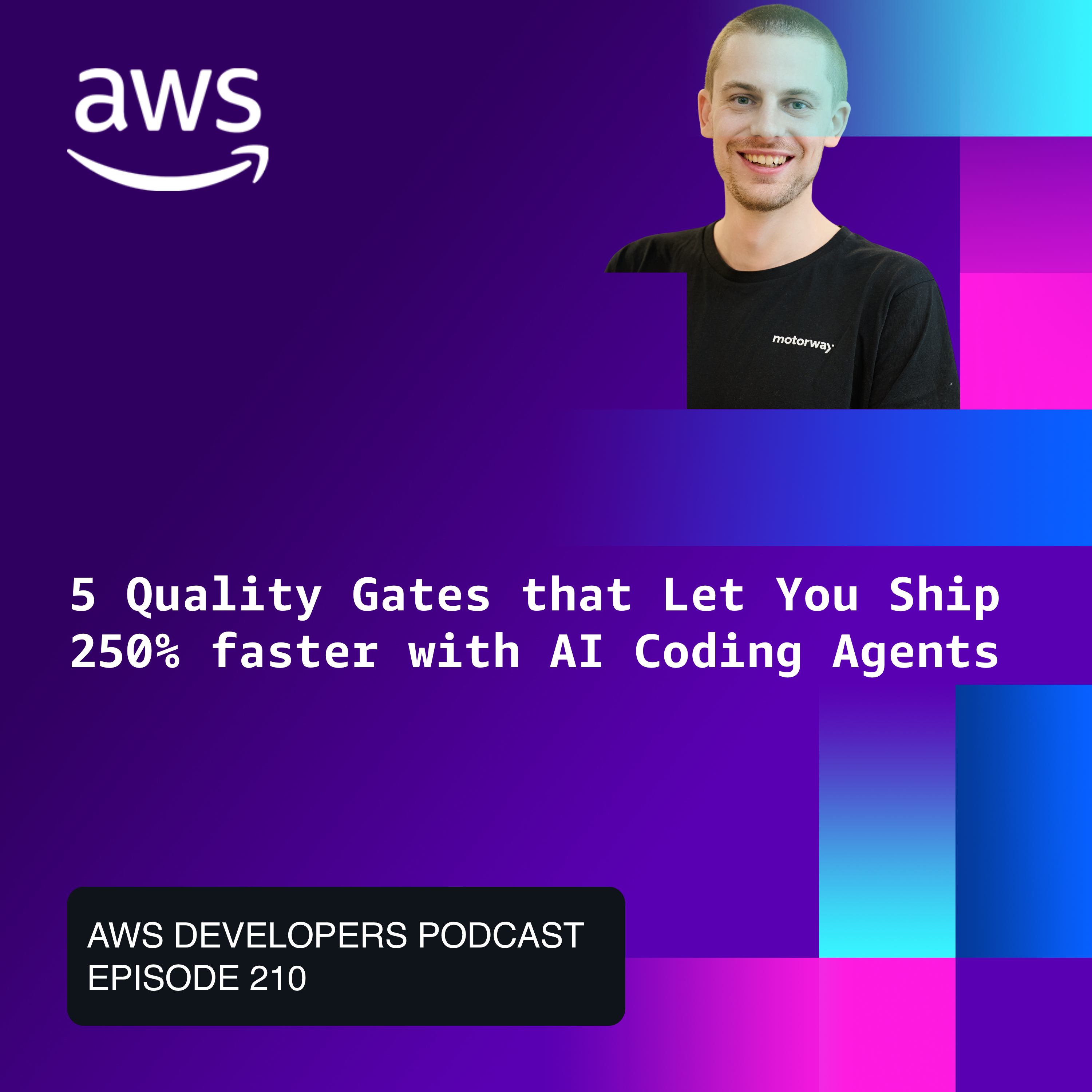
5 Quality Gates That Let You Ship 250% Faster with AI Coding Agents
May 2701:01:43Tap to summarizeHow do you give 120+ engineers AI coding agents — and NOT break production? Ryan Cormack, Principal Engineer at Motorway and AWS Community Builder (recognized as a Renaissance Developer by Werner Vogels), shares the exact system his team uses to ship 250% more deployments while keeping quality high. In this episode, we break down the 5 quality gates that let Motorway's engineering teams move faster without sacrificing reliability: spec-driven planning to catch design issues before a single line of code is written, AI-assisted code review to verify code matches the plan, deterministic tests (unit + integration) as an automated safety net at the boundary, cyclomatic complexity checks to keep code maintainable, and human review as the final gate that stays human. Ryan explains how cross-functional DevOps teams — organized like Amazon's two-pizza teams with full end-to-end ownership — enable faster AI adoption. He walks through running parallel agents to explore multiple solutions simultaneously, building custom tools on top of ACP (Agent Client Protocol), and sharing agent configurations across 120+ engineers via a Git + S3 pipeline. The conversation also covers the Renaissance Developer mindset that Werner Vogels introduced at re:Invent 2024: curiosity, ownership, systems thinking, communication, and experimentation. Ryan shares how Motorway embraces this philosophy by encouraging engineers to build their own tools, experiment with new technologies in parallel, and focus engineering time on design and planning rather than writing code. Whether you are scaling AI coding assistants across a large engineering org, building quality gates for agentic development, or rethinking how your team ceremonies and processes should evolve in the age of AI, this episode offers a practitioner's blueprint from someone delivering measurable results: 250% more deployments, 4x engineering throughput, and no uptick in production incidents.With Ryan Cormack, Principal Engineer at MotorwayRyan Cormack — Personal WebsiteRyan Cormack — MediumRyan Cormack — GitHubACP and Strands — An Open Source Match (Ryan Cormack)Motorway — UK's Fastest Growing Used Car MarketplaceWerner Vogels — The Renaissance Developer (re:Invent 2024)The Phoenix Project — Gene Kim, Kevin Behr, George SpaffordThe Unicorn Project — Gene KimThe Architect Elevator — Gregor HohpeStrands Agents SDK — Open SourceKiro — AI-Powered Development Environment
Transcribe →