← Azeem Azhar's Exponential View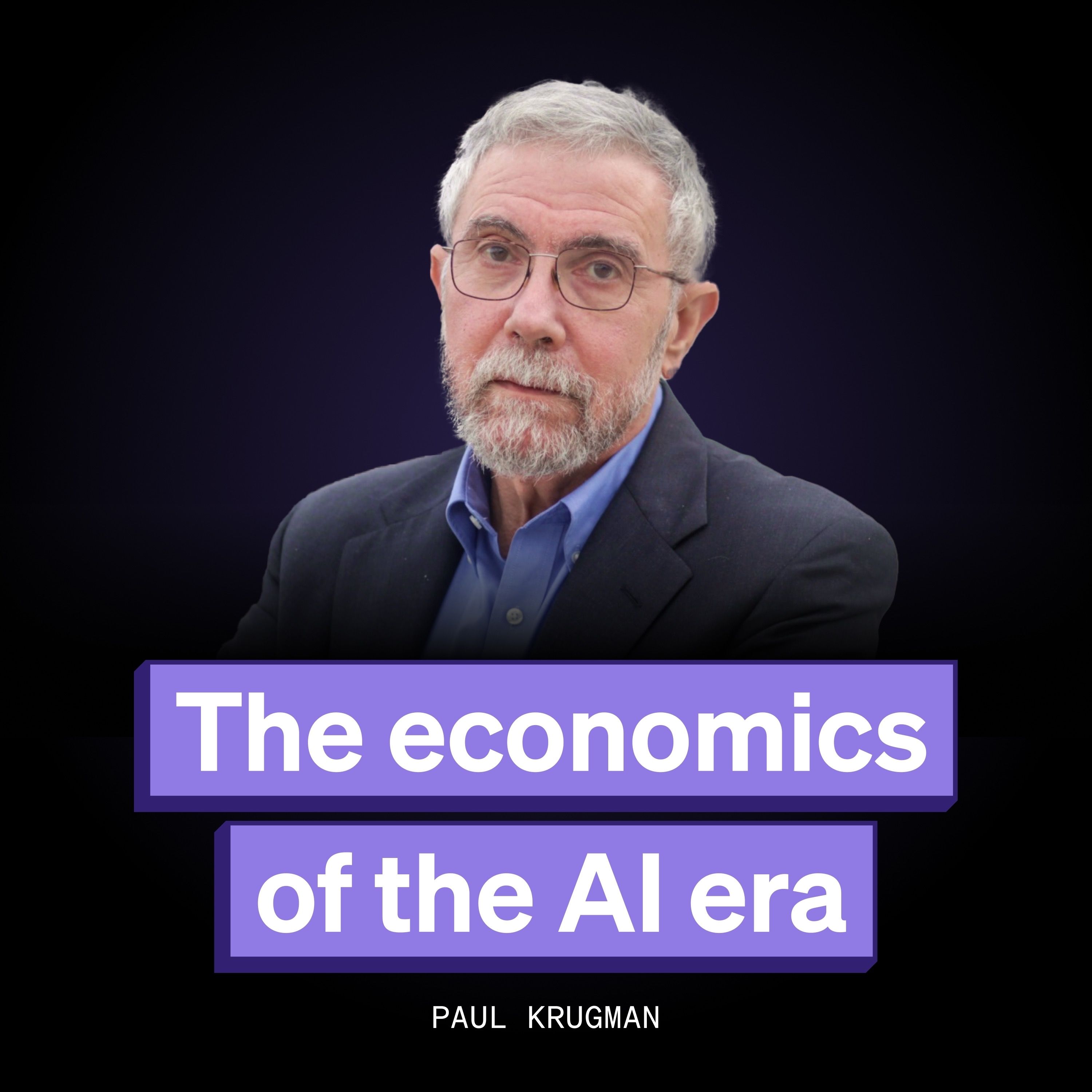
Azeem Azhar's Exponential View
AI, markets, and power: A conversation with Paul Krugman (2025 re-run)
00:47:14
In this episode, Nobel Prize-winning economist Paul Krugman and I discuss how a strong US economy, high asset valuations, and rapid AI adoption are sitting in uneasy tension. We explore what past technology cycles can teach us, why safety nets struggle to address disruption, and where genuine optimism still makes sense.
Loading summary
Transcript51 lines
- [00:00]
A
In early 2025, I hosted the legendary economist and Nobel laureate Paul Krugman on my show. We never released it in the podcast feed, but it really is too relevant to leave in the archives, so we're sharing it now. In that conversation, Paul and I covered the most critical economic questions raised by artificial intelligence. We explored whether today's tech and AI valuations look more like a genuine productivity boom or a replay of the late 1990s. We investigated why the US is pulling away from Europe, whether AI might substitute for globalization and what that might mean for emerging economies. And we asked what happens to workers and communities as this technology transition unfolds. Listening back, it's a really sharp guide to the economic backdrop for everything we now discuss on Exponential View. Enjoy. We need to talk about the economy in 2025 and what's going on. I know you've got opinions, so why don't you start with your view of where we are in 2025 as sort of short term horizon, headwinds or tailwinds, and then I'll respond to that. Okay.
- [01:10]
B
So I mean, we are very close to a Goldilocks economy in the United States. Unemployment is low historically. Inflation is low historically. It's a little bit above the, you know, we have an official target of 2% inflation. And it's. If you look at probably the better measures, it's more like 2.5. And if you think that's really important, maybe you should have a, have a drink or two and calm down. It's really, we're really, we're really in good shape. You know, it's starting point. This is about as good a moment as we've seen for a very, very long time. And there's, the question is there's always going to be something. Some stuff happens as the bumper stickers don't quite say. And there's really two kinds of stuff that can happen. One of them is politics. And, you know, I'm reading whether there's now it's possible that my president is about to impose 25% tariffs on Canada and Mexico tonight or then again, maybe not. And that's a big deal. And we have a bunch of potential political shocks to the system. I've just been doing some work and if you look at tech stock valuations, it really has that sort of end of 1999 feeling. And are we going to be facing a sort of financial bubble burst? It's, you know, and so they really calm. Good times never last. And in this case, I think it's unusual that we have at least two obvious threats to the times we're in. But it all this would take time to unwind. So the numbers will continue to look good for the next few months at least.
- [03:03]
A
Yeah, I mean it's interesting that we head into this with such a strong American economy. I'm sitting here in North London and there's a particularly depressing series of charts which show OECD growth rate. These are the club of rich countries and you have the US as part of it. And the US is just motoring away. Right. It's the biggest economy there, it's growing much faster, far faster than the uk where essentially the economy is roughly the same, has been the same size for, you know, a decade or more. And, and, and you know, Europe at some cases up until about a week ago, it almost the mood felt funereal. But I think that there has been a change in the last few days. The bit that I query, wonder about is this issue of the tech stock valuations. I mean we're definitely at a point where this magnificent seven. I love the way how the investment bank has always come up with these wonderful terms. So the MAG7 are highly concentrated. In fact, this is the highest level of stock market concentration since before the Great Depression. And of course stock analysts love to look at things like this because history rhymes in a sense. But it does feel that there is something that is different this time around. For one thing, there is revenue momentum in a lot of these companies compared to the dot com bubble where companies had valuations without revenue. The second is the world economy is much richer and much more complex than it was in 99 or in 1929. And so when I look at that, I wonder. Of course animal spirits can upset stock market valuations as they did on Monday with deep seat. And if stock market valuations drop, they can spill into the real world through wealth effects or other dynamics. But it doesn't quite feel as overinflated as 99 because we can see the revenue flow into these businesses.
- [05:09]
B
Okay, I would actually mildly disagree with you that because 1999, we think about the conspicuously silly stuff, we think about pets.com and so on, but that bubble was in large part telecoms companies rather than dot coms and, and the telecoms companies had real revenue and just not enough to justify the valuations and the technological. The technology actually did deliver, maybe not on quite the ethical scale that people had hoped for, but we really did get a decade of substantially accelerated productivity growth out of the technology. So it was real stuff. What happened was that the idea that early movers were going to be able to, as we now say, build a moat around their position that they were going to be able to earn sustained high profits turned out to be wrong. And in many ways we look similar. Now that this is, I think we're past the point of wondering whether AI is actually going to do anything useful. We still don't know how much useful it's going to do, but it's clearly something real and there's real revenues coming in. But on the other hand, are the valuations. The valuations are far, far above anything that you would normally expect from those revenues. So the valuations depend on the belief that these are going to lead to entrenched positions for the existing companies.
- [06:39]
A
Yeah, well, I think that's really true. And in fact, that is probably what we saw on Monday, right when this Chinese model, Deepseek, it wasn't released. I mean, deep seq R1 had been around for a while. They declared they were doing it weeks, if not months ago. I had written about Deep sea back in December 23rd and in December 2024 I said deep Seek is a Chinese Sputnik moment for the us. So that was before the new year because I, I thought that a lot of these stock market valuations have embedded within them the idea that the US will have sustained AI dominance. And sustained AI dominance will mean the best technology turning into the best product turning into the fastest revenue growth dragging forward with them the supply chain. So effectively the Nvidia, the demand for Nvidia chips, ultimately AMD chips and the manufacturing. And that that bet was so concentrated that of course any little wobble will have animal spirits running through that China shop. Yeah.
- [07:51]
B
And not just that the US will continue to dominate, but that the Mag 7 will continue to dominate and that there won't be some contender, US contender, European contender. You know, it's worth remembering that although European macroeconomics doesn't look too good, there's a whole lot of. It's not as if the technological sophistication is restricted to the United States. And so. And it's really hard. And some of it is, some of it is just. I mean, I suppose we need to talk about Tesla at some point and they're. That is really bizarre. I mean, their actual business doesn't seem to be doing too well. But, but people have decided that somehow or other there's magic associated maybe with the political partnership. So. But I, you know, I take the lesson of the, of the dot com telecom bubble, of the 90s to be that even a really great technology does not necessarily justify really high valuations.
- [08:51]
A
Right. Okay. Okay, I hear that. I'm going to, I'm going to stick on with this, with this point because here's where I think today is different to, to, to the dot com. And I stopped by telling you a story. So back in 90, you know, 97, 98, I was building Internet companies and one of the companies that I invested in was a Realtor online Realtor in France. Of course, online real estate is a, is a huge business now, right? You have Zillow and Redfin and a whole bunch of others. When we got into that market, not only did only 4 or 5% of French people have Internet access, they were still largely on the Minitel system. But that 5% wasn't far advanced in other parts of Western Europe. None of the realtors had PCs. When we went off or the founders went off to, to win business, they had to buy PCs for the realtors, train them on how to get onto the Internet and how to upload their images and their inventory. I mean, it was a complete nightmare. The difference today is that every company or the large proportion of companies, particularly big ones, are sitting on a digital stack which they've built over 20 years. All those billions of fees they paid to Accenture and PwC and SAP to do digital transformations means they've got a digital infrastructure. And today it takes a single decision in Microsoft headquarters to put an AI tool into every copy of Microsoft Excel because it's all run on the cloud. And that feels really different to 99. It feels like there's a whole set of hurdles that now don't exist that would allow a much more rapid deployment. And with rapid deployment should come much faster increase in revenues.
- [10:45]
B
Well, this does. Yes, it does mean much faster increase in revenues. I think it's very clear that the whole AI thing is moving much faster. I mean, we thought things were moving fast in, in the 90s, but there's much faster. The adoption rates have just been, you know, the, the S curve of adoption is just far steeper. The question is going to be revenue for whom?
- [11:11]
A
Right?
- [11:12]
B
And that's now what is true, and I think is which I'm, I think I'm learning to some extent from you right now, is that the, the fact that this stuff in some ways sits on top of existing technologies and existing networks may actually be a reason to think that the incumbents can actually continue to capture a lot of this. I mean, when we say something like Microsoft is it's all about network externalities. Everybody uses Microsoft products because everybody uses Microsoft products. And the interesting thing about AI is in a way, how undisruptive it is that it goes, you know, it can be just put on top. Actually, I spend a lot of time turning these things off because I don't want it. But Copilot is right there. And you're still, after all these years using Word and Excel, which is the network externalities and the moat. But it's not some upstart competitor bringing AI to word processing or number crunching. It's. It's quite straightforward for Microsoft to actually go right in there and do it itself. So that might be a difference. Now. It may be that we're just not thinking big enough and that there's something just radically different will break through. But it is true that right now it's looking as if this is, in terms of market share, kind of less disruptive than some past technologies.
- [12:46]
A
Yeah, I feel that that's right. Gemini from Google and Microsoft are all doing reasonable. Well, I mean, we do have the new players. But what's interesting about the configuration of the market is that each of the new players, like OpenAI and Anthropic and others, are really closely embedded with the last generation's giants. And it's not as if the Ford motor company or AT&T was closely allied so strategically with the firms that went before. So it feels that this industrial transition has different characteristics. And perhaps it is just that bits are bits and you're building on bits. And so what else can we expect at this time? I would love to talk also about something that I think is quite close to your heart that is, I think, quite difficult to navigate right now, which is what should we think about what happens to the workforce under the speed need of this kind of AI transformation? And I will start with a little sort of pitch of how I see the state of the nation, which is that companies are really, really eager to make productivity improvements. And these tools can automate large parts of roles. Right? They can automate many, many tasks. And so the natural outcome for, for workers will be either suppression of wages or it will be, you know, it'll be loss of jobs on the flip side of that, productivity gain. And that the question is not whether new jobs will get created, because historically we've always created new jobs. And, you know, we've seen work from some of your colleagues in the field of academic economics to show that, you know, most jobs in the US are in categories that didn't exist 60 or 70 years ago. But I suppose the question that I have is that I wonder about is what is the likelihood that the economy will create enough new jobs in those categories for there not to be some kind of schismatic dislocation as this technology rolls out. How have you thought about that?
- [15:02]
B
I think there's quite a lot of dislocation coming, although that's not new. I mean that's, that has been the case for. With every major change in every major technological revolution that, that a lot of jobs are destroyed and a lot of jobs are created and in the end, one way or another there, there ends up being full employment because that's more or less, you know, mass unemployment due to automation has been, you know, people have been predicting that for a very, very long time and it never happens. But the transition. A lot of people can find themselves in the wrong job in the wrong place, sometimes geographically. I mean it just, it feels to me like it was just a year or two ago that it was, you know, we were telling people learn to code. And now it turns out that coding is one of those things that AI does. Apparently I have no personal experience of, but apparently does pretty well.
- [16:01]
A
It does pretty well.
- [16:02]
B
And you know, the way I've been thinking about it. So one of the sort of put down remarks that people make about large language models and I'm not quite sure if it applies fully to everything else, but that it was just souped up autocorrect, which is, but the thing is there were, first of all, you could say that something like agricultural machinery is just souped up guy with a. Guy with a scythe cutting down, cutting down wheat, which didn't stop it from being hugely disruptive and meaning that we basically have, you know, we, we have fewer. The United States is a major agricultural exporter and we have fewer farmers than we have people playing World of Warcraft. So, so a technology can be sort of not all that magical and still have enormous impacts and destroy a lot of traditional jobs. And the, in this case, souped up autocorrect. Well, even if that's all it is, but very souped up. A lot of, a lot of people's jobs are basically souped up autocorrect. And those are in many cases jobs that we considered highly skilled. So a lot of things in middle management, a lot of, I mean, I don't know if there's a way to get this, but things that I've noticed is that translation, translation software is not perfect, but damn good. And how many people were displaced by the fact that you don't actually need somebody who, who, who, who speaks Mandarin. How many. The, yeah, the, just a lot of, a lot of the jobs that we, we, we think we like to imagine and maybe we can talk about this. We like to imagine that the very highest creativity level stuff can't be automated, although that may come, that may come as a rude shock at some point. But a lot of stuff that's just a few rungs below that can go away. I think in some ways the safest jobs are the ones that involve manual labor and dealing with the material world.
- [18:08]
A
Right. Well, it's fascinating because 15 years ago the story was AI was going to come after routine jobs in offices. And what we have seen is this souped up autocorrect. It doesn't really matter how it works in theory. If it's working in practice and doing much more than that, it will have an impact is taking enabling lawyers and software developers and creatives in all sorts of areas. And I think that that has come as quite a surprise. The Goldman Sachs did some work last year and they were showing that the sort of, the pinpoint where jobs really started to be impacted by effective LLMs was about $100,000 a year salary, which is well above the average. So we end up in this quite interesting world. And I agree with you that we may feel that there are certain jobs that are very high polluting and creative and the machines won't be able to at least support or augment them. But with every, you know, release of an AI system, those systems get better and better. And I think that that does create a real pressure and attention. I mean, later today OpenAI will release their next model which is called O3. And I think quite a lot about what policy responses to this ought to be. Given that there is so much uncertainty and given that it's really expensive to run a safety net. Right. We know that in Europe our tax levels are much higher. We have a much deeper safety net. And that to me feels like a kind of politically quite a difficult problem to close down. Right. Nobody really wants higher taxes, whether it's here or in Europe or in the US and certainly the politics in the US for the next three or four years won't support it. So that I think is going to be a really key point of tension which is what happens if we do start to see really mass job displacement.
- [20:13]
B
Well, I mean, my point of view is that since we don't know which jobs will be lost and we don't really know how to devise policies. Honestly, we can do some things here and there, but trying to. Efforts to deliberately promote the jobs of the future have gone rather spectacularly wrong in many cases. So safety nets is mostly what you have. Now I have an American perspective where our safety net is extremely threadbare compared with Europe and our taxes are quite low and we could certainly do more of that. Now what it doesn't do, even if you can have a safety net which protects people from real miserazation from the technology, you can't restore. You can't, it doesn't restore communities. You know, if, if you have a community that is based around an industry that ceases to exist because it's, it's either because of globalization, which is what mostly is the focus, but also just technology or even changes in tastes. I mean I, I like to talk about the detachable collar and cuffed industry of Troy, New York. Right. That, that just went away.
- [21:21]
A
Right.
- [21:22]
B
And when it does, you can, you can have a safety net that ensures that nobody starves or goes without healthcare. Maybe not in America you can't, but anyway, but, but you can't restore the community and you can't restore necessarily the dignity. And that's. I don't, I don't have an answer for that. I mean you do what you can, but we are going to be seeing a lot. I just want to key in on one point you said the technology.
- [21:50]
A
We.
- [21:51]
B
May not be at a point where it replaces people of exceptional creativity or whatever, but it does enhance their reach.
- [22:02]
A
Yeah, absolutely.
- [22:03]
B
And we've been seeing that for quite a while. I mean I still have some ties in academia, which is a poor model, but I think may have something to do with. I think it's also true in things like the legal profession, which is that the very top people can actually do a lot, can basically cover a lot more bases because of technology and which actually makes things more hierarchical. I mean I used to joke about a couple of fields that I follow that we were now at a stage where there were only three people in the top 10. And, and that's a, again, it's an unequalizing effect of the technology to which I have no answer.
- [22:44]
A
No, I think we're also going to see that there is in my other hat, which is to invest in startups, in particular deep technology and AI startups, there is a mood towards a belief that you could build the billion dollar single person company like the one man unicorn as they call it. And the idea is that there's a whole array of ordinary and Increasingly complex tasks that can be delegated to tens of thousands of AI agents. And you've swapped labor for capital and you're just paying a rental to a cloud service for that. And I think that is a direction of travel that we've seen. The number of people employed, even by a huge company like Facebook is far smaller than was ever employed by General Motors and so on and so forth. I know that we're going to go to questions in a few minutes. One thing I would love to, also for us to talk about is trade and tariffs. You know, we've got a man in the White House who loves tariffs and certainly loves the threat of tariffs. And we also have this geopolitical fragmentation. Now. As a technologist, what I see happening is a number of different things. We've seen from the political side, the building up of more and more walls around the Internet. So it's not just China's great firewall. It's also, you know, Russia being able to seal off its Internet. There is now this political pressure which is about around free speech in the US And a departure from European standards and of course in technologies with the export controls, most importantly in a way forcing China to start to do its own development in really hard technologies, in sort of advanced semiconductors. So I see a world where there will be increasingly a couple of lanes of technology. And that of course reduces the size of markets and adds quite a lot of friction to all of it. It feels like that's a, a general drag on growth.
- [24:51]
B
Yeah, it is a general drag on growth. Now, a little bit funny, the whole tariffs on everything push. That is, if you want to understand that. I think you need a model of the mind of Donald Trump. There really isn't very much of a constituency behind that, except that he wants it. I really see business kind of hates it, but economic nationalism, more sophisticated economic nationalism is definitely on the rise. I mean, the Biden administration was far more economically nationalist than any American administration we've seen for decades. Europe is clearly moving somewhat in that direction. And the reason is mainly, I think at some level the world is a scarier place. We now are, you know, who thought that large scale conventional warfare was going to make a comeback in the 21st century. And now it has. And now you think that, well, we need to have capabilities either domestically or in our close allies that mean that we are not, can't be shut out, that we have the ability and if possible, we're going to try and deny this stuff to people that we don't consider our friends. And that is going to fragment the world. And also, by the way, worth saying, I know we need to get questions. I'm the one who said that. One of the things that is also true is that to an important extent, technology can actually substitute for globalization. If you need customer service, instead of getting somebody in Bangalore on the line, you instead are talking to a chatbot. And that's a, that's a real change in dimensions. So we may be headed for a much more fragmented world, both because it's less necessary to have global trade and because it's. We're much more afraid, with good reason, of being too dependent upon other countries. And what I worry about is the small countries who may be left out in the cold. And so, you know, the EU is going to be fine. I think Britain will reach some kind of accommodation with the eu. If Britain will be fine, America will be fine. Bangladesh, Vietnam. Not so clear.
- [27:12]
A
Well, I love this line. Technology is a substitute for globalization. I'm going to come back to you after we finish this live on that. In my first book, I talk about the coming fragmentation that was going to be driven by changing technology. And I identified this idea, although I didn't have quite the pithy communication, that you have technology as a substitute for globalization, that there are technologies that will do the job that globalization used to do. And that would be things like, you know, 3D printing or vertical farming that allow localized production, particularly of, you know, food. But also I think critically, the change in the energy system. So you buy solar panels, once, they last for 25 years, you buy batteries, they last for much longer than we ever thought. And you don't need to be a vassal to a petro state. And that I think does create an interesting path for countries like Bangladesh or Pakistan or Vietnam, where a lot of their sense of sovereignty and ability to develop is about their access to energy. How much energy capture do they have as an economy? How many energy services can they actually use? And in the last two years in Pakistan, there's been this remarkable change driven by the falling cost of solar panels, which has meant Pakistan has become one of the largest importer of solar panels and broke the link between measured grid delivered electricity and GDP growth because businesses could not be bothered to sit behind brownouts and blackouts and went off and bought solar panels to keep their businesses running. And I think that there is this possibility where the declining cost of this technology can provide a much more affordable energy sovereignty for the long tail of the world that is not energy sovereign, especially smaller and poorer countries. And you know, the first kilowatt hour of consumption a family has in a day from zero is the one that delivers the water pump, the refrigeration, the lights, the charging of the smartphones and could make a big deal. Now of course, that is me, Paul, as an absolute relentless optimist about the human condition and where we can go. But it is sort of one bright spark that I look at.
- [29:32]
B
Oh, the whole thing, yes. Just to say that the renewable energy revolution is the most hopeful thing of today's world. And it's funny how people get all people get excited about it, which I understand, but in terms of actually really changing people's, changing the prospects for development, changing the prospects for the planet. Solar, wind, batteries are probably the most important thing and they've really had Moore's Law type productivity improvements. So it's awesome.
- [30:08]
A
A quick note, if you want to support us in bringing more of these conversations to the world, please consider subscribing to the show the 2025 Adelman Trust Barometer. So Trust Barometer, run by a big public relations firm, shows a high level of grievance worldwide, particularly against the wealthy in governments. How can markets, traditionally quite poor at addressing inequality, tackle this grievance given the potential negative consequences? Well, that's a doozy. Over to you, Paul.
- [30:37]
B
Oh, but this is not you. Markets are not going to solve this. This is, let me just say I grew up, I'm somewhat older here. I grew up in what was really a middle class society. At least it felt like a middle class society. There was poverty, there were some people, wealthy people, though not the way there are now, but it was mostly middle class. And I had assumed that that was a society that sort of evolved naturally. Actually we kind of thought that was an end state of economic development, but it turns out it wasn't. Obviously inequality soared again back to Gilded age levels. But it also turns out to be that, that society, both in the US and in the UK and Europe more generally, that didn't just happen, that was created. The US was a highly unequal society in 1938 and it was a pretty much middle class society by 1946. And, and it was all deliberate government action, strengthening of unions, new wage norms enforced during by wartime controls. So look, if inequality, and I think this is an issue, I think people are, whether or not they frame it that way, the fact that there's so much spectacular inequality and perceived and I think true unfairness out there, this is one of those things that governments need to do. Now, whether we are able to get Our act together. I think it was kind of a miracle that we dealt with those tensions so well in my grandfather's generation. But maybe we should do it again.
- [32:13]
A
Yeah, I guess the question is what is the external impetus that drives that? And I think there is a sense amongst perhaps technologists that that impetus will be, will come because technology will solve every problem. But of course, we do find ourselves with a situation where dynastic persistence of ultra high wealth in the US is pretty substantial.
- [32:41]
B
Major movements towards equality historically have always basically been associated with wars.
- [32:48]
A
Absolutely.
- [32:49]
B
Yeah. And there's the old joke, sorry, European people who work at the European Commission say that they should have a statue in front of the Berlaymont, the headquarters, a statue of Joseph Stalin, without whom none of this would have been possible.
- [33:05]
A
That's grim humor. There have been a load of questions about debt, so I think we should turn to those. I'm just trying to read my notes. Alan Greenspan used to say we don't know the level of maximum federal debt and I hope we never find out because when we do, it will be too late. And I guess this is directly to you. Which is what is the max according to Paul or what is the ideal level of debt?
- [33:28]
B
Okay. I mean there's a pretty good analytical doctrine called functional finance, which is not mmt, although there is a whole other thing, but which says that the number doesn't matter.
- [33:42]
A
Right.
- [33:42]
B
You said just think about the macroeconomics. And I don't think that's entirely true, but it's largely true as long as you're not having uncontrollable inflation. Particularly countries that issue debt in their own currency have a lot of running room and examples. I mean, I think the max debt number we've ever seen as a share of GDP would be the UK which came out of World War II with debt at 250% of GDP, so more than double the current US level. And there was no debt crisis. Now you can argue that there was a fair bit of financial repression and controls, but we haven't lost the ability to do that if necessary. But in any case, I don't think that was the issue. I think that we're. It's imprudent to just keep on running up that debt to GP ratio, but there is not a hint in anything. I can see that we're hitting any kind of limit. People who bet against JGBs against Japanese debt because of their debt levels have just lost money and lost money and lost money over the years. Advanced countries with stable governments that borrow on their own currency just have far more fiscal space than most people tend to imagine.
- [35:02]
A
Although, I mean, in the U.K. of course, we got heavily punished a couple of years ago when two prime ministers back. It's hard to keep track, really spooked our debt markets. And in a sense we've got the hangover today. And I guess the Chinese are contending with a whole slew of other debt problems themselves, which actually may advantage the US over the next few years.
- [35:28]
B
Yeah, well, although I have to say that the reason that Liz Truss lost the, the race with a head of lettuce as to who would, would survive longer there was, I think the UK economists calling it the moron premium or the, I mean it was, it wasn't simply that her plans looked fiscally irresponsible, they looked stupid. And now of course stupidity always comes along, but I, I don't think that was a fair test really of, of, of the sustainable level of debt.
- [35:59]
A
Yeah, well, fair enough. I mean, we're gonna, we're gonna figure it out. And I think the one thing I would say in the UK now is in the last week the government has, has really come out fighting, they've come out fighting for investments in infrastructure, for public private partnerships. It's a sort of, I suppose, quite a healthy neo Keynesianism in a way. Right. Let's build a lot of stuff. Let's make it, make sure it's infrastructural, make sure you can build on top of it rather than, you know, spinning up debt for consumption this year or the next. We had another question. When does it make sense for the Fed to raise interest rates? Is it possible that high interest rates might help with labor disruptions?
- [36:38]
B
I'm not quite sure I understand the center part of that. I mean, the Fed is, look, they have, as they should, a dual mandate. They're supposed to achieve full employment or sustainably full employment, and they're supposed to have low inflation and there's a target of 2%, which is rather arbitrary as one of the few things in the world that you can really blame on New Zealand, which is a whole story, but something like that. Inflation basically keep inflation low enough that people are not constantly thinking about it. The right level of inflation is low enough so that it does not become a major source of major use of cognitive energy and as full employment as you can manage. And that's where they will set, that's what will determine where they set interest rates. They will judge it wrong sometimes because they're actually the dirty little secret of all this stuff is that Jerome Powell has no, essentially no information that anybody who knows how to use, you know, it knows how to use Fred, the Federal Reserve database doesn't have. And so they'll get along. But I don't think now the labor market disruption issue, not, not really. I mean, we did have a big labor market disruption as we came out of COVID because the mix of stuff that people want to buy was very different. And we had a period when we had a really high ratio of unfilled job openings to people, people looking for jobs, which was transitional and probably, you know, and the Fed raised interest rates in part because that seemed to be kind of inflationary. But that problem has kind of solved itself for the time being. Now if AI could produce another similar disruption, although unlikely to go as quickly. But I, I don't think, you know, there's fact of the. The Fed has got one dial to turn central banks, you know, the overnight interest rate. And there's only so many problems you can solve with only one dial.
- [38:47]
A
Yeah. And I also wonder about when we think about how this intersects with the labor market, what is happening from a geographical structure perspective. You know, as we move into these advanced economies, you get this effective agglomeration. You know, people want to get to where the other strong growing companies are. And so you get these clusters building. San Francisco Bay Area being the most powerful in the world. And it strikes me as quite a challenging public policy problem to figure out how to turn a 21st century economy into one that grows across a broad geographic spread. I remember talking to somebody very senior at one of the Foundation AI Labs a couple of months ago and they said to me, you know, what we can't figure out is how this technology doesn't become a giant vacuum cleaner sucking all of the wealth to San Francisco. And this is obviously not an interest rates question, but it is a challenge, I think, about how you revitalize local economies because local economies are fundamentally where people live. It's where they have their roots.
- [40:03]
B
Well, this is right up my alley. I mean, so half the Swedish thing he was for work on exactly this kind of issue. To a first approximation, the answer is we can't do that. There have been major efforts in some places to really support lagging regions when technological changes is wanting to pull stuff into the already region rich parts. What can you do to promote development and the lagging parts? And so Italy has poured vast sums into the messengiorno, which mean that people have enough to eat, people have healthcare, but has never really Gotten business to go back there. Germany, the former East Germany, you know, Germany has pretty generous benefits and all of that. And, and nobody is suffering materially very much in former East Germany, but they also haven't, but the industry hasn't come back and it's a lot of money. And so basically you have policy failures. And even in the United States, although we don't do very much of that explicitly, although Biden tried to some, but we have, because of the way our benefits and tax system is structured, we in effect give enormous aid to lagging regions. If you look at West Virginia or Kentucky that received foreign aid, that's about 20% of their GDP through the US tax and transfer system, which means that industrial jobs, there's a lot of jobs in healthcare in West Virginia. What there aren't are coal mining jobs. What there isn't is industry and what there isn't is any of the cutting edge technology. Because why would a technology company want to be in West Virginia? And so, and no one has ever cracked that one. It's, I'm sorry, I mean, I wish that there were brilliant solutions, but the fact of the matter is that kind of, you know this, we have an economy where to the extent that, where people, people doing sophisticated stuff want to be near other people doing sophisticated stuff. And yeah, and that's been, which is a huge reversal by the way, up to about 1980, stuff was spreading out and then. But there's a real reversal since then, which is everywhere.
- [42:19]
A
When I got involved in the tech industry, you know, the ratio of San Francisco to Boston was about 2 to 1 and now it's whatever 50 to 1 or 30 to 1. I mean, it's really, it's really changed. And I agree it's a really, this agglomeration problem that you know so well, very, very hard to find great policy solutions, solutions towards. I suppose the only things that start to perhaps be a little bit rosier. I mean, I wonder the extent to which the ira, which was one of Biden's flagship policies, has been able to revitalize manufacturing in places that are not San Francisco or New York. And with that you can start to see local ecosystems and expertise in those areas and further down the track, ultimately local economies can function because there are, there are people there. But it doesn't feel like you're going to have the anchor tendency of the big 10 or 20 companies. I mean, of the big 10 companies in the U.S. i think every single one is on the West Coast.
- [43:22]
B
Yeah. And, and then if you take the, the Other great source of, of high value added per worker is greater New York, which is mostly financial industry. And now, you know, isolated places in the, in the hinterland can thrive. University towns, places that have spectacular natural beauty can. And those can become, not just, they can become places where remote work becomes possible. And you can. And so maybe like 1 in 10 small towns in the hinterland can actually thrive. And, but the trouble is it's highly selective. And so if you travel around, you will find, I found this in multiple countries, but certainly in the United States, you, you travel through central Pennsylvania, which is already far enough away that it's kind of beyond the, the metro New York orbit. And you'll see this thriving town with a lot of boutiques and coffee shops and actually a very internationalized workforce. And then 10 miles down the road is desolation. Don't have an answer for that. I mean, it's, and to just say, well, people should move. Well, people don't want that.
- [44:41]
A
They live where they live. Yeah.
- [44:45]
B
And even if they do, even if they do move, something is lost there. You have a community. Yeah, it's gone. And that's, that's again, the kinds of things that you can't, that are really, really hard to fix.
- [44:54]
A
So, you know, there are things that I can't predict. You can't predict events, I can't predict the breakout of a war, and I can't predict, you know, a crazy extreme diplomatic position that might emerge. But I think the US Is just really, really well positioned. I wrote an essay six months ago saying the US is well positioned for the 20 to lead the 21st century, subject to the politics holding together. And I do think that the degree of dynamism that exists will help it at the top line. I don't think there's much attention being paid to all of the points, attention that we discuss about inequality and access and distribution. But compared to the UK and Europe, I think it could be in for quite a healthy top line year, buoyed by a sense amongst CEOs that can just get on and do things.
- [45:49]
B
Okay, so if somebody would just make our current administration just shut up and not do very much, then I think 2025 is going to be a very good year. And that may be how it plays out. It's kind of looking like a lot of stuff is going to be blocked or backed off, but I don't know that. In fact, I might be able to give you a better answer tomorrow when we find out whether Trump actually does those tariffs on Canada and Mexico. So the big risk points. I am worried about overvaluation in tech, but the big risk points for the US Are trade wars and deportation, because deportation we haven't talked about at all. But that is something that I really worry can spin out of control and become enormously disruptive. But we start off this is amazingly good. All of us who do these macroeconomic stuff are just sort of rubbing our eyes at how good the situation looks right now.
- [46:48]
A
Right? Of course. But we can never tell. Paul, thanks so much. I really enjoyed this. I hope you did.
- [46:53]
B
I did indeed. Good to talk to you.
- [46:56]
A
Thanks for listening all the way to the end. If you want to know when the next conversation is released, just hit subscribe wherever you're listening. That's all for now, and I'll catch you next time.