← Azeem Azhar's Exponential View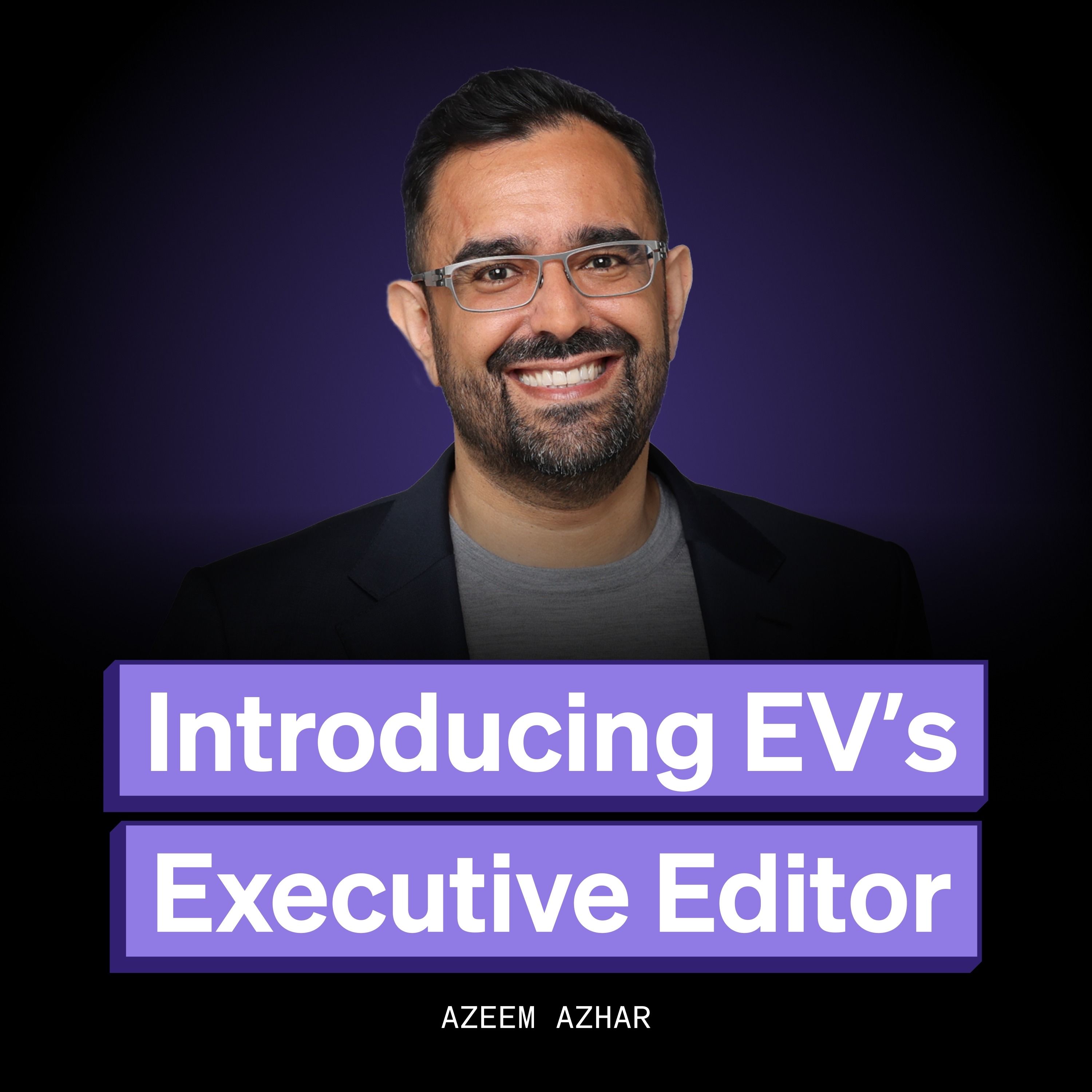
Azeem Azhar's Exponential View
AI, writing and artisanal media – inside Exponential View with Greg and Azeem
00:28:18
Greg Williams has joined EV as Executive Editor — two years in the search. He was editor-in-chief of WIRED UK, recognized as Editor of the Year (Technology) three times, and is a five-time novelist. Introducing him to our community in this week’s episode became an opportunity to redefine what EV is: why we make maps instead of stories, and where I think AI is taking institutional media.
Loading summary
Transcript29 lines
- [00:00]
A
It is a special call for us today. We have a new member of our team. Say hello. Greg Williams.
- [00:08]
B
Hi everyone. Great to be here.
- [00:10]
A
So what's it about briefly, Exponential View that made you feel it was the right next step in a world where
- [00:18]
B
a lot of news, a lot of culture, a lot of journalism, a lot of content. Forgive me for saying that word. In some ways it has come commodified and I think being able to think clearly despite all the noise, despite all the signals that we're all getting every single day is, is hugely valuable and I think EV delivers that in spades. I've been a long time reader and subscriber to EV I can't remember what year I started, but I remember very vividly kind of getting your Sunday newsletter probably around sort of like 2013, 2014, I'd imagine. And it just really striking me as that there's something very, very going on here and it delighted me and I just was seeing the world in a, in a kind of like a new way. And it was whimsical as well, which, which I really, really enjoyed. Most publications you get information from but EV is, is unique in my view because it actually changes the way how I think through ideas. You know, I love the way, the way you guys are interrogating and thinking through your own hypotheses and how you'll always act to try and at some point offer the reader a framework, a way of being able to work through something that's complex, that needs rigorous sort of thought and application. So what I very quickly realized when you and I were talking, and obviously I've seen this in the work as well, is that those frameworks, the research is underpinned by these really world class capabilities and incredible data tools that you and the team have built. And I have to say in the time that I've been working with the team, just seeing the way that you are building and the capabilities that have just come online in the past few weeks have been genuinely inspiring. I'm a little awestruck if I'm honest. Definitely not ready to build my own open claw agent just yet. But I am thinking what I'm going to name them or name it, I should say. But here's the thing I keep coming back to whenever I think about what makes CV different. And that's just, you know, it's not just the analysis is good, it's who's reading it, why are they reading it. It's because what, you know, you and the team have built is a community of decision Makers across big technology, finance, policy, academic research. And all these people have something in common, which is they're looking for insights that they can actually use, they can actually deploy in the world. So clearly, you know, at a moment when there are enormous amounts of capital being deployed in response to sort of the profound moments of change, technological change that we're all facing, that really matters. So just, you know, as we've been talking over the past few weeks, I keep just returning to one kind of key idea, which is the EV isn't just, you know, read widely, it's really read meaningfully. Right? There's purpose behind how people are interacting with ev. So that puts enormous pressure on EV to be rigorous, for us to be rigorous in our analysis, to stress test ideas, and ultimately to build these frameworks that have real utility in the world. And I think that the framework you built in the boom or bubble piece that you published a few months ago was an absolutely fantastic example of that. And I remember kind of it being published and really being by wowed by it. I know we're a research studio, but if I'm thinking about it with my kind of media hat on, I'm thinking about community as being absolutely vital to that kind of, that business model, the economics of ev. Obviously, everyone is aware that economic models around media have been challenged enormously. And I remember being in a gym in Stockholm recently. No, I wasn't. I was in Copenhagen. And I remember listening to your podcast with Nick Thompson of the Atlantic and you mentioned Four Horsemen of the Media Apocalypse, which I thought was really, really interesting. And you're absolutely right in terms of challenges to journalism. So what you identified was obviously the power is shifting away from institutional media brands and it's moving towards individual creators. So obviously EVs published on substack and we've seen many journalists, very established names, moving away from traditional outlets and you know, being able to monetize through that through their own audiences, engaging directly with their subscribers. And we're seeing a bleed away obviously from institutions to a wide variety of platforms. So obviously people are consuming through social video, TikTok reels, newsletters, LinkedIn, Telegram. If you're in India, you're probably getting your news through WhatsApp as well as
- [05:20]
A
obviously your fake news based on what I receive from my Indian relatives.
- [05:24]
B
That's true. And obviously we're seeing fragmented audience. And that's a phrase, there's a phrase that media people use a lot, which is we need to meet our audiences where they are. What that means today for a lot of media companies is just having, you know, being able to have a presence on a lot of channels at a time when resources are constrained. So you identified that, then you talked about search traffic, which is something that most media companies now are really grappling with. I remember whenever it was a couple of years ago, people were talking about Google zero, meaning, you know, when Google stops basically functioning as a search engine that would send an audience to publishers, now it's going to hold users on page as more of an answer engine because all the answers will be there in overviews. So that is having an enormous impact obviously in publishers, clearly tools like ChatGPT as well, reducing traditional search engine traffic, which has historically been a massive driver for top of the funnel, audience and discovery. And obviously what's ironic is a lot of these tools have been trained on the IP from the very publishers now that are being challenged financially because they're not finding the audiences they need. So in my view, publishers are absolutely right to defend their assets. And we're seeing obviously some significant lawsuits both in the US and elsewhere. I think the other thing you identified is really important and obviously EV has this in spades, which is trust and authority, that it's being weakened broadly through, you know, misinformation online. You know, audiences are losing trust in institutional media. They are favoring individual commentators like yourself. And there's a reason for, you know, because the high degree of expertise that you have and then finally rise of AI, which is a huge unknown for media, potential competitor. But also, you know, I think the EV view would be collaborator. We are seeing it deployed in newsrooms, things like idea generation, headline iteration, as well as synthesizing information and summarizing, you know, really complex documents, things like transcripts, which when I remember, you know, I used to have to sit down and transcribe tapes, you know, myself. And it was just the most miserable task. And some journalists are using it obviously for creation purposes. There was a story recently about a Fortune journalist who'd had, I think something like 600 bylines just over a few months.
- [07:55]
A
Is he paid by the word?
- [07:59]
B
Definitely. Not by the hour.
- [08:01]
A
Yeah.
- [08:02]
B
You know, spending time with you and the team over the last few weeks. Clearly you see AI, there's something energizing, something that's additive and I'd love to talk a little bit about that just to finish up in terms of the four horsemen. Look, I think EV is incredibly well placed subscription model with a highly desirable, highly engaged community that's embracing these incredibly fast shifts in technology. It's highly trusted by its audience. And I think that's a great platform to build on. So I would like, if you don't mind, I'm going to take a bit of a liberty. So over the past few weeks, I've spent a lot of time talking to Azeem, and I'd say that probably 90% of that Azim has been asking me questions. So I'm going to turn the table, if you don't mind, of course, ask you a few questions. Let's talk a little about your philosophy versus maybe the sort of like traditional media model. Media companies think about audiences and content. You've said to me during our conversations that Evie thinks about people with lives and models and frameworks. And I'd love for you just to talk about what that actually means in practice from your perspective.
- [09:11]
A
We don't really think in terms of stories in exponential view. We think in terms of themes, hypotheses, and most importantly, models and frameworks. That's the critical dimension. Whenever we look at things and why you see us go back and forth agonizing over 600 words we're going to send out about Mythos, which is have we really got the right framework that helps the people are going to read this, make sense of it. And that, I think, is really, really distinct because we're not really about the transmission mechanism. And I think within lots of organizations, whether it's analysts in a bank or it's great journalists, they are often going much further than just transmission. But it's not the lodestone of the business. And when it comes to who we serve, I don't want to pretend that this is a strategic decision by me, but I do think about every person individually. I mean, of course, now the audience is so big, the community is so big, we have to think about segments, but ultimately we have a responsibility. When this arrives in your inbox or you're watching it on YouTube, to give you something that you otherwise wouldn't have got every other person listening. Today, reading has got a million better things to do than whatever you and I and the team concoct. So it has to be meaningful. And that sits with me and I hope with the team really, really regularly. And so when we think about what we're going to write about, it's really what issue are we going to tackle against the frame of the things that matter. And to some extent, everybody who subscribes is helping us understand that. But to some extent, they're coming to us because they don't understand that and they trust me to do that for Them that is ultimately how we drive this. And there's maybe an ordinary English word we can use rather than model or framework, is that we make maps. That's what we're doing. We are making maps of the terrain of the near future or of the far future. And we're doing the best we can. And we're pretty good cartographers some of the time.
- [11:27]
B
Does your kind of philosophy or does your thinking change depending on the format? Because it might be a kind of a. An essay that's a personal reflection or a deep piece of analysis, or you might be, you know, publishing a data set or thinking about, I don't know, a tent pole series which really offers a deep framework. Is that the core? It's always there? Well, it's one of the writes kind of a map.
- [11:51]
A
It's one of the reasons why you're here because we, we have a number of ways in which we, we tell those stories, right? And we do think through what helps it make sense. So a few weeks ago we published the Solar Super Cycle. And if people haven't seen that, Solar ExponentialView co. And in that, what I wanted to help people understand was that we all know that solar photovoltaic has a learning rate. And that means that every time we produce more of it, it gets cheaper. But there's a second order, perhaps it's a third order effect, which is as the price comes down, more people buy it and there end up being places where it becomes economical to use solar when it wasn't before. And so you get this flywheel that as more gets sold, the price comes down. And now it's useful in X application, Y application, which in turn expands the market. And it's really similar to the flywheel we saw in the computer industry from the mid-70s. Now, in the case of that particular piece of work, we did a really, really fantastic. Or Hannah, we. Hannah did an amazing piece of work building this model that is backed up with a ton of academic research validating it that shows you how to play with those scenarios. So you could see how the solar super cycle could play out, where the pressure points are, where it might break. And I think it would be very difficult to have told that story without that model. Not least that in explaining that model and that framework, we needed that interactive model to be sure that what we were telling the people who read it that it worked. Now I hope we can do other things. Maybe we can do a video series around it. Maybe you'll come up with some other way of explaining it that takes it further to new people. But yeah, we will use increasingly those types of tools to make sense of what we're saying.
- [13:50]
B
I wanted to touch on, you know, it's very hard to have conversation with you and not talk about AI. And just, just every news organization right now is in a real state of hand wringing around artificial intelligence. How it should be used, when it should be used, how it should be controlled. Should we work with these companies or should we be, you know, taking them to court? Should we do both? In most of the cases you've got a very different perspective and they're obviously concerned that AI scraped their work and it's damaging their ip. But in our conversations, in one of our conversations, I remember over lunch you suggested that EV could create things that AI can actually use. And I'd love you just to explain your the thinking behind that because it's quite different, I think to the way that most large organizations would think about AI.
- [14:43]
A
Yeah, well, I think they've found themselves in a really difficult position. Some part of which we can be sympathetic to and other bits I think one can say your large businesses, you could all have had Exponential View subscriptions and your strategy officers could all have read what I wrote about GPT3 four years ago and you could have all phoned me and I could have had an honest conversation with what I thought was going to happen. And aren't just people like me. You could have called, you know, Ben Thompson, you could have called a whole bunch of other people to get an insight and you know, in a sense they chose not to. But of course it's the other side. Or you could be sympathetic. Is essentially this sort of legal arbitrage that has been end run by the AI companies knowing full well that the damages will be very, very small at the end of the day relative to the revenues. The difference I think is that we've got these models, these maps and these frameworks. That is the piece that makes sense. A single essay from Exponential View can be fun, can be interesting, but it doesn't make as much sense as subscribing and reading it over the longer period of time. Because you also get to see how you, me and the rest of the team are thinking and how our thinking is evolving given the privileged position we have in being able to talk to people and hear from them. So that means that if my model, our models and frameworks can get consumed by an AI, that's fine because we'll find a pricing mechanism for it. And we have, I think just in the last week We've done the internal release of the, as you know, the MCP API across one of our data sets of sort of AI data. And so we're starting to play with that internally. If that starts to make sense for us, we will allow AI systems to interact at that API level so that you can just pull in the quality of thinking or some of our reasoning tools or other things that we use internally to make these maps into your environment. And that is not going to conflict at this point with our business. I think it will. I don't want to be blase about this, right. Because it sounds like I've solved it all. And as you well know from our conversations, I have not solved it all at all. And I'm looking for help is that at some point I can imagine there being a real tension in that model, but the truth is nobody really knows. All I can say is that if you are producing written work, written material that is replicable, that doesn't have the 11 herbs and spices of Colonel Saunders special recipe, I think you're going to find it hard. And that's why the Bloombergs and the Financial Times of this world are well positioned and why they've pulled their paywalls up very, very high because they're literally getting people to go out and do the difficult work that AI can't do. But if you're in the mid medium where it's a nice to have type of essay, I think that's a difficult spot. I do think, curiously, what I would call artisanal writing. So think about Paris Review or the London Review of Books or Eon. I think these can still succeed in AI because the point of those pieces is their entirety. It is not filleting out a sports score. It is going on the journey for 35 or 40 minutes with something that's been incredibly well crafted and you just can't read a New York article by summary and get the same impact. So there are a few complicated things going on, but with our positioning, sorry, I went off track there. Ultimately the map can be used by an AI and we'll figure out how to charge for it.
- [18:37]
B
Yeah, no, I think you're absolutely right. That long form experience I think is something that isn't replicable by AI. Also, obviously AI can't do hard news journalism. It can't do scoops and break stories and cultivate sources. So I think there are lots of opportunities for media organizations to, to stand out and to do good work and to continue to sort of thrive.
- [19:02]
A
A quick note, if you want to support us in bringing more of these conversations to the world, please consider subscribing to the show.
- [19:13]
B
Now we're seeing AI beginning to reshape sort of structures and functions within organizations. And I know that you have a strong interest in organizational models, so I'd love to get your sense how you would think about structuring a large media company in the age of open claw.
- [19:34]
A
Do you know, I feel insulted with what you just said, that I've got a long standing interest in organizational models. That makes me, honestly, it makes me sound like, I mean, I don't even want to insult anyone else with a parallel. But I will take it, Greg. I will wear it. That. I've been thinking about this quite a lot because it is the question that comes up. The question two years ago is, what do we do with this thing? The question now is, how do we make it work? And I went to New York a couple of weeks ago and I did meet a number of media companies there, but I also talked to somebody in a tech company who had hundreds of people working for them and they said, listen, everybody is more productive and more effective, but as a group, we're not more productive. And you know, it's sort of what's going on there. The realization that I, that I had after that was that we start to use AI to become superheroes at a task level, at the tasks that we do individually. But most of the delay in an organization is not the task, it's the tribulation, it's the coordination, the discussion, the back and forth, the permission you need to seek. And that's where the jam happens. It's not as narrow as saying, oh, it's a bottleneck at the next part of the process. It's actually that the way in which organizations make their decisions has been designed for this sort of assumption of human speed work. And that's where a lot of it happens. And so if I go back to your direct question about, like, if you were running a media organization, what do you change? The thing that you have to change is the place where the delay happens. And it's not about necessarily eliminating delay. It might be about, I mean, you know, if you're a, if you're a monthly magazine, if you're Vogue, you're not going to go weekly because you've got AI the idea is you're going to produce a better September edition. That's what you're going to do. The question is, in that coordination layer, what are the tools that you can bring that make those decisions Much better, like creatively better, commercially better, that drive more acuity in how you present things. Because everything else for me is like table stakes. If you are getting AI to rewrite headlines and ABC test them to get the best link. If you are, you know, using them to search public disclosures like, yeah, that's fine, I expect you to do that. Just as I expect my employees to wash their hands after they use the loo.
- [22:20]
B
Yeah.
- [22:21]
A
And I think that the way in which you need to manage the harder questions is the piece that is really, really important. And I think that's where I would start with a media company which is what really moves our dial. Where are the things like how do we make our decision better so that we deliver better things rather than faster or cheaper things? And I know it's difficult because everyone's under cost pressure and as you know, we spend roughly $2,000 a month per person on AI. So that's a big burden if you're a large company with 100 employees or 1,000 employees or 10,000 employees. But I would say that you still need to recognize that you will get all this easy task stuff done very quickly. So start working on that kind of coordination layer piece and what that mean specifically. We have done some things. You've, you've observed some of them where on that particular piece of work that might be coming out In a, in two to three weeks, you know, we've, we've got a 40,000 word dossier of data and we've got so many charts and analyses that we can pull together so we can do a better job. And now we will deliver that thing in a month or so and please everyone sign up. It's going to be awesome. And it will be a package that will help people understand the world and really get to grips with it.
- [23:45]
B
Yeah. Fundamentally though, we have to run it through a human being at the end point, right?
- [23:49]
A
I mean, yeah, yeah, we still do.
- [23:51]
B
I mean, yeah. Which is really interesting, but it's at what point the human being is actually hands on and actually making the decisions and how the human being can obviously collate the information, the data beforehand in order to make the best decisions possible. So we talked a little bit about. Well, I apologize for suggesting you had a long term interest in organizational structure. You're working on the book at the moment, which I believe is printed out all over right behind me. Yeah, it'll be great. And I'm sure you're going to talk about this at length around publication, but can you just give us a quick insight into how that's changed since, you know, you wrote exponential, which was how many years ago? Five, six years?
- [24:35]
A
Five years ago?
- [24:35]
B
Yeah, five years ago. What's changed since then? How's your process different? What maybe can people who are watching this learn? How would you advise them to think about using these tools in their writing projects?
- [24:46]
A
It has changed, actually, just during the writing of this, of the book as well, because the AIs have got so much better. There's sometimes this word where people say, oh, I haven't got a single word of AI in my book. And, you know, that's the easy part, right? The easy part is just like the kind of production of the words when you're writing a book or indeed you're writing anything. The harder part is what happens when you take away all the scaffolding? What happens when you have that core thread? If you're writing fiction, do your characters have a believable interiority by Chapter 7? If you ask a reader, well, what do you think Bob will do at this stage? If you've done a good job, they'll be able to tell you because you've constructed that. And all of that is happening away from the words. And my book, that's nonfiction, there are all of those layers that you have to think about. I have to think about the pacing of the book. Think about the. The way in which we cover the ground in the vignettes and the examples that we give. I have to think about where you are as a reader emotionally at any point. These are all things that to do by hand, take a really, really long time. And you can get hints and help from. From the AI at that sort of really deep structural level. And I think that, you know, as you've seen within, you know, exponential view in the sort of last few weeks you've been with us. That's really where we use the tools, right? We use them so that you don't have to wait for an expensive, busy editor to spend two weeks to read the manuscript and say to you, hey, all your examples are from the US and this is a global book. You can get a tool to help you do that audit. I mean, it's never as extreme as that, obviously. It's much more subtle. And what I've also discovered over this period of time is that I have gone really, really deep in figuring out what my writing style is now at the words on a page level, it's simply not possible yet for the AI systems to replicate that. They can replicate it to the point at which someone who doesn't know my work might not recognize it, but someone who does, and certainly my editors, would absolutely recognize it. And the reason is that all writers, indeed all humans, are idiosyncratic characters. And we will pull out analogies. We will bring things in from personal experience that we simply, the other people don't expect. Yet it makes sense to the words and it makes sense to you. And it makes sense then. And an LLN may know all of that because it's gone off and grabbed all the words that anyone has ever written, whether we wanted to or not, but it can't pluck out that word at that time. And so the least helpful point, frankly, for the AIs is at that sort of writing pace. So I think of the team as pseudo editors. I think, I mean, the AI team, sorry, the Armini, Arnold and Rvlin and, you know, all of his buddies, as, you know, an editor, as a researcher, as, you know, somebody who's a bit more quantitative, and that's a role that they play, their text. Isn't that great? Yeah. Greg, I've just seen the time and I know that you have to go off and you've got an essay to put out. I have, yeah.
- [27:57]
B
I have indeed.
- [27:58]
A
Time to get back to work. It is time to get back to work. Thanks for listening all the way to the end. If you want to know when the next conversation is released, just hit subscribe wherever you're listening. That's all for now, and I'll catch you next time.