← Azeem Azhar's Exponential View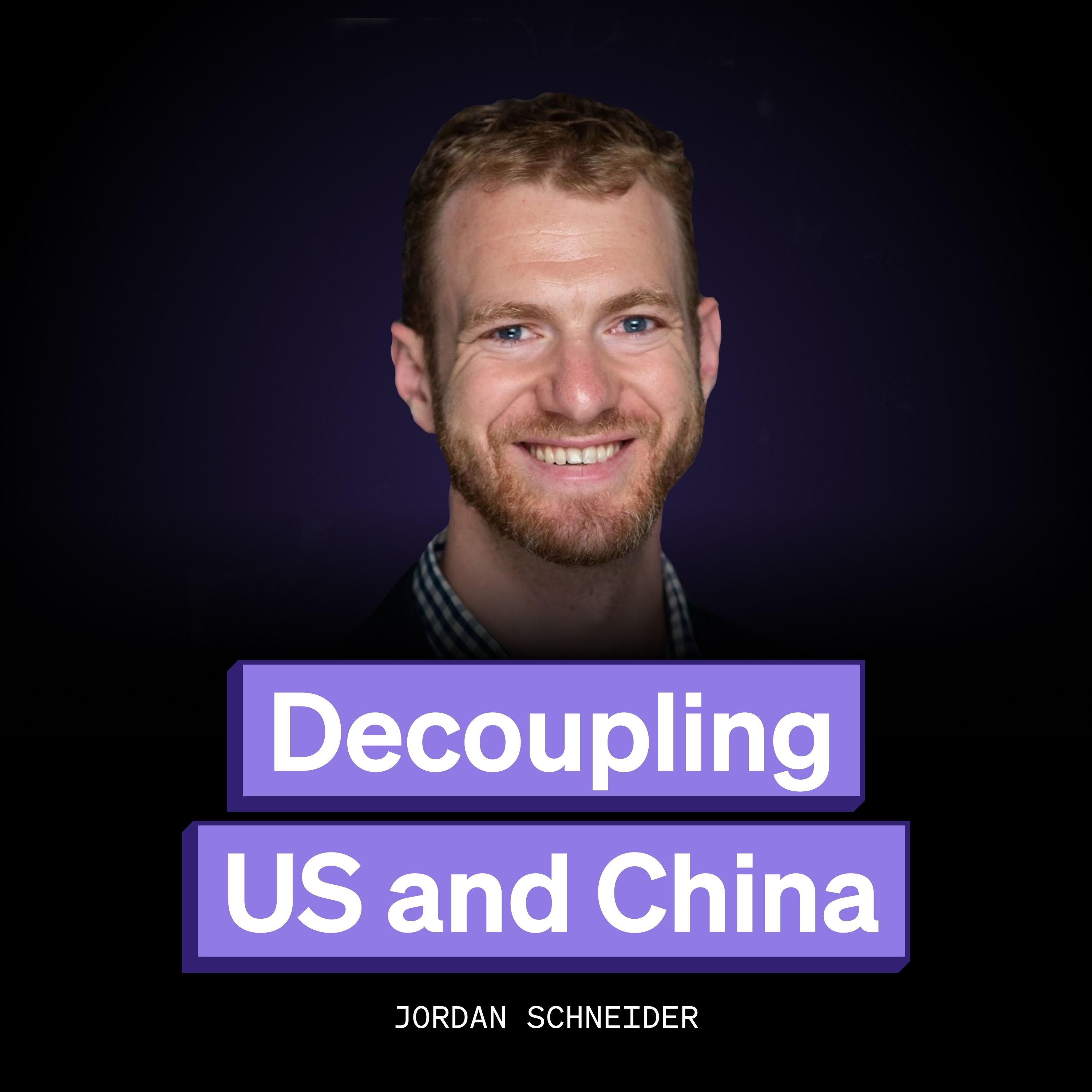
Azeem Azhar's Exponential View
Inside the US–China decoupling: What’s really at stake (AI, rare earths, Taiwan, trade)
00:45:19
In this episode, I speak with Jordan Schneider, creator of Chinatalk, to explore the new phase of US–China competition. Both countries are using trade policy, export controls and industrial strategy to shift the balance of global power. Yet, their economies remain tightly bound.
Loading summary
Transcript49 lines
- [00:00]
A
Hello, everyone, and welcome to this conversation. I'm Azeem Azhar, the founder of Exponential View. Please do introduce yourselves and tell us where you're from in the chat. I'm in London. I'm delighted to be with a legend of substack, Jordan Schneider. Jordan, where are you?
- [00:17]
B
I am in New York City, and I'm so glad to be here.
- [00:21]
A
We have just partnered up in a new publishing project as well, which I've been finding pretty exciting, right, to have all of these new, new business partners. Why don't you say something about it for a minute?
- [00:31]
B
Sure. So if you care about AI, which, if you are watching this right now, I think you make it into that set and you perhaps work at a firm or an organization that would be interested in buying the one AI Content bundle to rule them all. And you should head down to Readsale.com, which sells Group AI subscriptions for teams. We got an incredible lineup, including myself, Azeem, Nathan Lambert, Jasmine, Kevin Hsu, and I think that there's like eight in total of us. Substack doesn't let you bundle for whatever godforsaken reason. So we have taken it upon ourselves to save you the time and allow you to make yourself and your team smarter about what's coming down the pipe with artificial intelligence.
- [01:26]
A
It's a great initiative. I'm super happy it started. We will, of course, talk about AI today, but you are best known for China talk, and there is so much going on between the US And China, and I just want to make sense of it, and hopefully you'll be able to help us do that. It seemed to me that we're watching the US And China do more than traditional trade wars. And we've moved from a phase where the US Was trying to contain China, perhaps, into something more, a decoupling. And what I want to argue that that decoupling is actually more interesting and perhaps more dangerous than things we've seen in the past. It's not so much separation, but the emergence of these two parallel tech universes. But they remain deeply entangled. And the rub of all of this is that the tools we use to manage it, export controls, tariffs, sanctions, well, they're 200 years old. We're dealing with a 21st century problem, a 21st century economy, and a 21st century technology. So are those traditional containment tools helping or harm harming, or was I overstating the case in the first place?
- [02:39]
B
Oh, man. Where to even start with that? I'll do a little personal history, I guess, because I'm Introducing myself to you and the. And the audience as well. So I moved to China in 2017 and I was like, you know, played video games, like, built PCs in like middle school. But my. I was a history major. My profession wasn't in working in or understanding technology. It was a policy analyst. And the reason I reoriented my professional life around technology was because I hit the thing that you just mentioned, Azim. This idea or this reality that living in China, you live in a similar but different technological ecosystem where the apps that you interact with on your phone are just different than the ones that the rest of the world uses. And that kind of trickles down into like literal, like UI changes of how WeChat works versus how Facebook works at the time means you relate to your friends in a different way and just kind of understanding like how fundamental these products are to our lives nowadays. And it didn't sink into me until I. I lived in that separate ecosystem and everything that I kind of assumed was like baked in or took for granted actually surfaced to me as like actual product management managers or decisions that policymakers made to create a sort of like, different way of being almost in mainland China versus the rest of the world. So that's like step one, zooming way out from where did this decoupling come from and where is it going? It is really messy, man, because there are not easy takeaways and there are not clean lines that I think either country really wants to draw. So from 1949 to 1973, there was basically no technological or commercial contact between the US and China. The US didn't even recognize China or mainland China until that time. You know, for. For American diplomatic purposes, Chiang Hai Shek and the KMT in Taiwan were like the rightful owners of mainland China.
- [04:56]
A
So that's where my daughter has just flown off to this today, in fact, to a school trip to. To Taiwan for 10 days.
- [05:04]
B
Oh, amazing. I hope she has a great time. So, you know, 1973, we have the Sinusoviet split, where Mao decides that he's sick of Khrushchev's BS and sees an advantage in becoming better friends with America. And all of a sudden we have this, I would say, 50 year arc of actual pretty dramatic US and Chinese economic, technological, and even up until the 1990s, military entanglement, where America had this idea that during the Cold War that supporting Chinese development would help gain an edge over the Soviet Union. And then afterwards that morphed into, oh, this is an important emerging economy. There's a lot of economic Opportunities sort of couched in this, like, liberalization thesis that the more we engage with China, the more. The more kind of open, democratic friendly it will feel to our small l. Liberal sensibilities that may have ended up being the case had 1989 turned out differently. But that's not the world we're in. And I would put our third periodization, starting around, I don't know, 2013, 2014, where the Obama administration followed by Trump one really started to reframe China as more of an enemy, or I would say a competitor. And in that, we've had a lot of different permutations of the thing we're seeing Today, from Trump 1's trade war to Covid to Biden putting on all these export controls and banning stuff like Chinese electric vehicles, to now Trump too, where we're now like, you know, six months into a saga of we had Liberation Day and now we're escalating on this and that front. But the fact of the matter is it's a big mess because these are the two largest economies in the world and they're not separate. And there's a lot of sort of pieces of both systems that see advantages in keeping connections, right?
- [07:05]
A
And we've seen that a little bit with these new rare earth tariffs or controls, rather, that were announced a couple of weeks ago, where it's the heavy rare earths that you can find in missile control systems that have fallen under this new control, but the lighter rare earths that live in things that the Chinese export, like wind turbines, don't fall into that control. There's some pragmatism that's going on. But I guess the thing that I thought felt like it might look different is a sense that every attempt at control creates an unintended resilience, a greater capability to be independent. I think of the quote, it's a misquote of Fontaine, but it's in Kung Fu Panda and Master Oogway says to Master Shifu, one often meets one's fate on the path one takes to avoid it. And if the path you want to take is to have more control, in this case, what you may end up doing is making the other side much, much more resilient. And we've known from China's various five year plans that they wanted greater independence in semiconductors. They wanted greater independence in a range of other products. They do lean more heavily on open source for their software infrastructure than we do in the West. If there is any coherence to this big mess that you described, does it actually Just lead to a control illusion rather than a real sense of control. And I feel, I mean, one of the reasons I wanted to talk to you today was that it starts with those October 9th rare earth rules. You know, what breaks first in that environment.
- [08:50]
B
It's a fascinating question. I'm going to start with a history analogy. There was a big autarky fetishization in the late 20s and 1930s as well. And you had, um, this idea of sort of Nazi Germany and Imperial Japan that, you know, the equivalent of chips or rare earths in that age was, you know, stuff like access to oil or other, or other minerals or there are all these like, you know, ball bearings, all these like critical inputs that if you didn't have control in a literal colony of yours, you didn't have factories in your country, then you were sort of subject to the whims of another country. And if you think the world is fine and we're going to keep trading, then, like, that's great. That's like, you know, this is like Ricardian trade and like, we're all richer for it. If you come at it from a perspective that they did in the, in the 1920s and 30s with, you know, Mussolini and Stalin and Hirohito, that like, this is a vulnerability, we are bound to get screwed. So we need to act first and, you know, get what's ours because it's all gonna, you know, come to shit sooner or later. Then you end up in these very dangerous dynamics. And look, I, I don't think that we are like the, the fetishization of doing everything in a way which is entirely like on your land and controlled by you. And you know, you can feed your country with like the, the farms that are in your landmass. Like, we're not entirely there yet, but it has been fascinating that I think China was very early to this. You know, there is like a deep aspect of like PRC history where they feel like they've gotten screwed. And so even before the October, like far before the October 7th controls, like, when she comes to, like, you can find dung quote, you can find Mao quotes about this, you can find dung quotes about this. One of the first speeches she gives is all talking about sort of self reliance and not being vulnerable to having the other world, like other countries, like bullies around. Be that sort of economically, culturally, what have you.
- [11:10]
A
Let me just dig into this question, which is we have got these leaders and you know, when you talk about self reliance and you bring up these examples from the 1920s, we, we could Also think about juche, right, the North Korean theory of self reliance. But what really are the politics of the leaders? Because it does feel that China and Chinese communism looks very different today to how it looked in the era of the bicycle or just at the moment that Nixon started that rapprochement. I mean there is something changed. So what are their politics and their influences around this particular question?
- [11:47]
B
Yeah, see this is the problem with self reliance is it is expensive, it is uneconomical to do things because if it wasn't then your country would already have it. Right? So after the disaster of Mao, lots of Chinese leaders made what I think is like the correct strategic decision that yeah, we are going to need to get more dependent on exports, to get more dependent on sort of foreign technology. Because if or not like, yeah, you can be self reliant like North Korea and you can be really, really poor. That is basically the experience that you had in Mao ara China where like, yeah, they weren't importing a ton of technology because they were too worried about starving every seven years because of like you know, terrible, the sparrows and the.
- [12:33]
A
Locusts and the four plagues and these types of things.
- [12:36]
B
Exactly. What I think is kind of really interesting is over the past five years you've seen this mindset start to come home to roost in, in the west, right? Like you have EU leaders talking about strategic autonomy, you have Trump talking about re industrialization and a lot of people I think over the past few years have made the argument, oh, like America cutting off chips to China, that's only going to make them like industrialize, you know, build, build chips faster. Like well we're about to run that experiment in the opposite direction because I think the rare earth stuff has gotten a lot of people very focused and concerned in the west. And then we're going to have this very fascinating sort of like system competition where like is the fact that America still like, I guess kind of a little bit has friends around the world who are also worried about Chinese rare earth export controls. Like will that cut against the advantages that the Chinese system has of being able to keep their eye on the ball for a longer period of time and being able to sort of bust companies and countries around. Like that's a whole different ballgame.
- [13:45]
A
Well, I think, I think there's something else that has, has changed in the international environment over the last 10 or 15 years which has been the explicit weaponization of dependency. In this Ricardian trade world we always have dependencies on each other. You know, famously the Airbus Passenger jet is manufactured in 100 countries and the wings cross borders 20 times. And you do that because of the gains of trade. You do that because of the gains of specialization. But underpinning trade is that sense of dependency. And countries have generally been a little bit wary of doing that. I suspect the OPEC cartel is a good example where the dependency on oil was used as a. Manifestly, as a tool. But in the past five or six years, that weaponization has become increasingly manifest and it's becoming perhaps part of the geopolitical landscape. So I just, I'm just curious about whether you see that as a, as a phase change as well, or is it a rerun of the tape that you so eloquently described in the 20s and 30s?
- [14:52]
B
Well, rerunning the tape of the 20s and 30s, that would be a real phase change, right? I mean, I think it's, it's somewhere in between. Right. Because I agree with the thesis. So during the Cold War, you did not have these dynamics between the US and any kind of non Warsaw Pact country. Right. You know, and then we had this really nice fif, you know, 25 years from 1990 to, you know, 2013, 2014 or so, where like, as long as you weren't Iran or North Korea, you kind of got to play the same game. Everyone was kind of on the same side. And the benefits to the Ricardian version of international commerce outweighed any sort of, sort of latent concerns that weird history nerds had about the return to a world where you had great powers kind of competing much more directly than they did in the past.
- [15:43]
A
But, but do you think that what's. What we see this specifically between the US And China today has a grand plan to it, or is it a bit incoherent? I mean, I look at things like 100% tariffs, but carve outs for Nvidia's H20 chips, you know, with the Chinese response to their domestic industry saying you've got to use domestic chips, it doesn't look that look like either side is fully proactive and escalating in a consistent way. And it certainly looks from the US Side that there's a little bit of shooting from the hip.
- [16:16]
B
Look like we now have policy that's basically driven by three people and that is new.
- [16:24]
A
I'm trying to work out which three you're talking about.
- [16:27]
B
I think we got like Trump, we got Lutnick, we got besants, and then, you know, give J. Give J.D. like 25%.
- [16:35]
A
I don't know.
- [16:35]
B
Well, we'll see how many group chats he ends up being on. But like, there was a mode of policymaking that I think America really recoiled from fdr. He was president for, for three and a half terms. He basically shot from the hip. And it was what he said goes and all of his buds just like listen to what he did. And there was an understanding at the start of the Truman administration that there needed to be institutionalization, that you needed sort of more people thinking about these things, more planning. The world's a really complicated place. We got to trade off all these dynamics and interests and think about the military and the economic and the diplomatic and the social components so that you need bureaucracies to like move paper, make sure all these opinions are heard, such that when you start making these very consequential decisions, it's not just like, you know, FDR vibing it out. And we have now returned to a President vibing it out with the world immensely more complicated than it even was in 1946. Right. So, yeah, it's totally incoherent. It is not just that Trump is a very unique historical figure, which is making it incoherent. I think you could also look at the Biden administration, which much, which was a lot more process forward as having a sort of Janice faced, like confused version, you know, collab they literally call it. Like we're going to compete and collaborate. It's like talking about AI, like we got to like use the benefits and mitigate the risk. It's like, okay, well know you gotta square that circle somehow. And if you stop trade with China tomorrow, the US economy stops working. Like the, like, like GDP just goes away. Right?
- [18:13]
A
So, so maybe you don't, you don't stop trade with China, but maybe it is that any kind of systems change is necessarily messy, feels incoherent at the tactical level. Because what you need to do is generate momentum, generate force in order to, to change the system. The White House, the administration has been reasonably clear about the gestalt that they want, which is sort of make America great again, have fewer dependencies, have a greater, more transactional control over relationships with other nations rather than alliances that are writ on paper. So perhaps tactically that will always need to have that, that sense of frivolity and friction rather than, you know, people in suits walking down a, walking down a checklist. I wonder whether what's really going on here is system building, that we tend to talk about the components or the minerals, we tend to talk about the bandwidth of the memory and the chips or whether the battery can come out, or we know whether, whether a particular rare earth is allowed. But perhaps it's as much about creating these innovation and technology systems that are not dependent at a fundamental and strategic level on your great rival. Right. You can compete in other areas, but you want to be soup to nuts in that area. And if you want to have systems change, it's going to be messy, especially given that there were all these interrelationships that you're working from.
- [19:48]
B
Yeah, I mean, look, Xi has this great line, I think he said it in a 2020 speech where he is like, we want to not be dependent on other countries and we want other countries to be dependent on us. I think, you know, when you see Lutnick talking about how he wants to get China addicted to H20s, like it's the same dynamic playing out on both sides. And yeah, that is super messy. And that means that sort of there are two system which are really wrestling with each other. Like, I think that, look, I honestly don't feel like the Trump administration deserves to earn as much sort of like cognitive coherence, as you may have put it so eloquently, Azim. But there is, I think, a new instinct to the melange of, like, things you care about, of not wanting to be reliant on China because you can't trust them, because they're scary. And, oh, by the way, they can, you know, shut down Ford plants in a week if they feel like it, and.
- [20:50]
A
And vice versa. Right, sure.
- [20:52]
B
That understanding, I think, has been in this, in, in the Chinese system for much longer. And there was a understanding in the 70s, 80s, 90s, 2000s, even early 2010s that it just like we're just going to have to live with it because we're too poor to kind of break out of the interdependence. But now that China is richer and I think maybe also she is more ambitious, he is more excited to develop a higher degree of resilience as well as to weaponize the interdependence that China has vis a vis the rest of the world.
- [21:28]
A
There is this word that goes around which is sovereignty, and it's appeared in Google Trends far more in the last two years than it did in the previous 50. And of course there's a very legalistic, formal term meaning for the word sovereignty, but there's also vibe based sovereignty, which kind of means we can sort of make our own decisions. And of course, lots of countries are talking about sovereign AI and sovereign energy and sovereign this and sovereign that in truth there are only two countries in the world that have the depth and the capacity, the dynamism to achieve that vibe based sovereignty in any real way. But even they it seems are quite dependent on each other totally.
- [22:10]
B
Okay, so now, now we get to talk about chips and AI. You saw the EU this week talking about semiconductor sovereignty. Like I'm sorry, no, like this is not happening. Are you really going to try to spend like what, $50 billion, $75 billion to build a competitor to intel or TSMC or Samsung? It is an interesting fact to me that that is even a, a kind of like a worry that I think Europe, you know, maybe 10 years ago would not feel. The fact that you even have plans about that today is interesting. But like the reality is like no, you're still going to get all of your advanced chips for decades to come from Asia or from the U.S. absolutely.
- [22:50]
A
So let's talk about AI then. Because of course AI is running on the chips. Let's give the received wisdom right now. So the received wisdom is that the US leads in the frontier, that the US foundation model labs are by and large chasing after the machine God that is AGI or asi, and that the US is highly constrained by some of its physical infrastructure, so the power systems and so on. And on the other hand, China is doing really well with open source models. It has abundant power capacity and the open source models are getting better and better. But critically, the Chinese state civil enterprise fusion is all about deployment and that these are two entirely different approaches to AI. I think that's the received wisdom. Is that right? Is that wrong?
- [23:42]
B
Can I stay on the sort of like can anyone be sovereign in AI for a second before we get to the tale of the tape stuff? Because I think it's really interesting, like at what level different countries want to be sovereign? Because as you said, I like Azim, there's only two countries in the world that can go from sort of chips to cloud, to labs, to you know, to models, to like companies and have that whole AI stack be something that they can like roughly indigenize. I mean we'll, we'll round out the fact that like China still needs a lot of sort of foreign SME and the US is still buying its chips primarily from Taiwan. But like every other country in the world is going to have to make a decision or try to plead their case to China, you know, to, to Huawei or to the White House and Nvidia that like, oh please sell, like I would like to buy the chips please. And Then I'm going to have a local kind of like cloud provider and then I'm going to fund an AI lab to train a model and build companies on that. Or, you know, other companies will say, like, I just want some data centers here. If they're aws, that's fine. Or say, I don't really care. Like, just give me access to OpenAI, you know, Claude and OpenAI, and that'll be. That'll be it. Right. And coming back to my first discussion for the sort of Internet boom of the 2000s and 2010s, you basically had, you know, a little bit of this like data localization stuff, but for all intents and purposes it was American companies on American chips by American cloud providers that like run, ran the world ex China. So, you know, Google, Facebook, Uber, Amazon, whatever. It was like, it was just like.
- [25:26]
A
The U.S. but you know, what started to change, I think, was in the mid 2010s when the strategic importance and national importance of data, particularly data about citizens, started to emerge amongst policymakers. And you get to the Stage that by 2020, more than 100 countries have got their own privacy frameworks. We always think about gdpr, but you know, Kenya had one and Brazil had one. They were expressing some desire of classic Westphalian sovereignty in this new domain against the backdrop of essentially having been happy for the Americans to do the running for 30 years. Yeah.
- [26:03]
B
And also you had this time period where no one was pushing back all that much about the sort of censorship decisions of Twitter and Facebook. But like, that started to change once governments all around the world realized how important this was. And then, you know, you have the Indian government like throwing Google employees in jail until they like take links on YouTube down because they're worried about, you know, X, Y or Z thing. So, like, I think it is inevitable that countries will end up wanting to put their spin on this. But sort of what is, what is also interesting to me is like right now it's still early enough that the incumbents aren't so entrenched that you can't imagine a new cloud provider emerging or imagine a new model developer existing, or imagine a, you know, a new company that's being built on top of these models. Right. And so it seems much more fluid than like, oh, I guess we're stuck with Facebook and YouTube. We're going to have to work these American companies like now we can still maybe try to squeeze the Americans into, into building sort of higher value stuff.
- [27:14]
A
I just returned from Abu Dhabi this, this morning and of course the UAE has gone all in on AI as a technology for the nation, as a technology for its industry and economy. It's building huge data centers. But, but critically to your point about new model providers, they have released in the last two or three weeks a really performant open source reasoning model that is extremely light, measured by billions of parameters. And you know, it is interesting to see that to your point, nothing's yet locked down. There are certain things that feel rather more locked down. So Nvidia's chips and TSMC's fabrication and ASML's lasers. But above that layer, there is still quite a lot to play for and quite a lot of space then for countries to think about. What does sovereignty mean in this environment?
- [28:06]
B
We'll have to see. I don't know, it's kind of fun and also depressing if you're like work in the Abu Dhabi, like, I don't know, tech policy department or whatever. Because on the one hand, yeah, there's room to play where there really wasn't if you're talking about this from 2018. But it's also like you're competing against these companies which are valued in the trillions of dollars at this point.
- [28:30]
A
But, you know, we don't know. I mean, I think this goes back to the question I asked you about, about AI that you so neatly dodged, which is that we don't know how the industry structure will play out. We're full of surprises. The Internet provided a ton of surprises. Remember, it was always going to be about decentralization and it ended up being incredibly centralized. It was going to be about the Arab Spring and people speaking with one voice and it ended up being anything but that. So one of the things that I've got some experience and some scar tissue from is trying to understand exactly the path that a technology takes from here to there. And as I said, China seems to have a different approach to AI, which seems to focus on deployment rather than really, really breaking the frontier. I mean, is that a fair way of characterizing it?
- [29:21]
B
I'm not sure. I think it's harder to push the frontier when you don't have as many chips. So if you don't have as many chips, you'll do some other stuff. I mean, the amount of like hand wringing I've read from Chinese CEOs saying we need to do more like basic research. Like we can't just let the, let the foreigners like steal a march on us. I mean, there is angst about this fact that all of the breakthroughs seem to come out of California as opposed to, you know, Zhejiang Province. That I think the, the sort of tech leaders as well as, you know, Xi himself and, and, and the heads of sort of Chinese science bureaucracies aren't necessarily comfortable with. I mean, I think there are some unique dynamics in China in terms of like the fact that is it is a protected market, right? Like OpenAI and Anthropic. Their models like you cannot have like, well, I mean people are like fucking around and trying to get around it. But like ostensibly the Chinese government has banned them from having direct access to consumers in China. So you can't build a domestic business in China off of a cloud API, which just like this wouldn't work for Abu Dhabi, right? But like it's big enough that, that opens up the Chinese ecosystem to have another round of what you just had in the US where you went from like having Mistral or whatever be a player to like, you know, consolidate down to a few. So all that to say like when you see all these open source models coming out of China, I think that is less like design than that is like market dynamics of like look, if you have a worse model and you try to sell it and get people interested in around the world, like they're not going to pay for it, right? Because you have stuff which is cheaper and more performant coming out of the closed labs in the us so in order to gain a sort of relevance or market share, you're going to have to go in a different direction.
- [31:12]
A
Well, I mean there is that necessity because ultimately they don't have the chips. And Huawei is starting to produce chips that can be suitable for training high end LLMs, but they are way, way behind where Nvidia sits right now. But there is also this question about what actually drives the economic success of a technology like this. So I'm sure you know Jeff Ding. Well, Jeff had his book recently and he made the case that it's less about breakthrough innovation and more about broad diffusion and deployment. And one of the things that we see are state pronouncements, the State Council in China saying we want 70% deployment for everything from industrial applications to philosophy by 2027 and that to be 90% by 2030. So a focus on deployment. How do you interpret that melange of messages?
- [32:09]
B
I think Jeff's right, but it's also nice to have the thing first too. So I don't necessarily think these, these two things are mutually incompatible. And you know, when it comes to like diffusion, this stuff will diffuse if it is economical and useful, right? And I think this sort of really interesting question to me is how and at what point and to what level are different countries in the world going to try to. Going to start to put the brakes on stuff?
- [32:45]
A
That's really important because it feels to me that there are different versions of techno accelerationism. There is a techno accelerationism that comes out of Silicon Valley, which is really about building AGI, then asi, then ASI that builds itself. But there's also, you know, policy tech accelerationism. And, you know, as a slightly distant observer of China, what I see is a type of techno acceleration on the deployment side. Get it out there, get it used, an acknowledgement that there's going to be job losses and labor market ructions, but a willingness to push past that. And perhaps that type of techno accelerationism can occur in a society with the political controls that China has. And to your point, the politics, if not the permitting for power, might slow things down in. In the US or other parts of the West?
- [33:37]
B
Yeah, I mean, that question of, like, which societies will hold up better in a time of sort of rapid employment turnover is one that I find fascinating and one that I think is a very open question. Look, in the 1980s, there was a lot of growth in China. There was a lot of inflation. There was also a lot of unemployment. And that sort of, like, mix of things led to the protests in 1989. And that lesson has been internalized. And I think one of the sort of other things that happened with the COVID controls is like, there was this very ideological decision by. By. By Xi to like, lock stuff down, and this is the right policy. And at a certain point you started getting protests and people being frustrated, and there was enough of economic pain that one day he was just like, all right, fuck it, like, let's let him get Covid and we'll figure it out as we go along. So with any of these sort of big political decisions, there are competing interests, and it's not like one is going to go away just because you are sort of marginally more inclined to rely on software innovations to power productivity growth. So I'm talking less, less about the sort of energy permitting than just like, at what point is a system going to feel like change is coming too fast? And then this sort of like, anesthesiologist lobby, like, locks it off from coming into their ecosystem. The teachers say, no, we don't want AI in our schools. I mean, that. That sort of thing to me is going to be the more relevant variable of which country is going to gain the most from this and be able to diffuse the technology because if it is so economically relevant and useful, like both countries are capitalist enough, you know, there, there will be people trying to make money by bringing it into their systems or out competing other firms based on their ability to be ten times more efficient.
- [35:33]
A
I love the way you describe that as systems ability to deal with the speed of change because that of course, absolutely allows us to say there's an American system and a British one and a Chinese one. And they all face challenges when change is accelerated rapidly and that gets expressed in different ways and their control mechanisms are different. But it's still a deep, deep problem. Now, earlier today, actually, while I was prepping to talk to you, I read this great essay by Kaiser Kuo. I don't know if you've, you've seen it in the last day or two. This is relevant for, for the question of systems. So he, he's an analyst, he's a podcaster as well. In, in a summary, he says China has become a principal architect of modernity, perhaps even the principal architect of it. So, you know, Western states need to replace a denial of that with an honest assessment and learn from China's performance legitimacy. And he says that you know what's happening now, and you touched on this with the Biden administration, this notion that legitimacy came from procedure. And Kuo argues that legitimacy is actually moving from procedure to performance and that the Chinese track record of the last 30 years is really about that performance. And given what's happening with the build out of solar and high speed rail and other things, it might continue for a little bit longer.
- [36:55]
B
If we're calling China the sort of like archangel of modernity, we also have to understand that there are parts of that modernity which I hope listeners of this are very uncomfortable with, like modernity. If you are a Muslim in Xinjiang in 2018, 2019 feels pretty uncomfortable. Then yeah, if you happen to own some shares in a EV company. Right. One thing I'll say is like the trend of having, I think more deliberate state involvement in strategic industries on the one hand is like something I think is something that, you know, a lot of, a lot of Asian developing countries have done to various levels of success. Like, I don't want to give all the credit to the Chinese policymakers for manifesting this stuff. Like the fact that is, it is like a country that is large enough to have a protected market which is relevant, is a very special and unique part of China and one of the reasons why it can cultivate these industries To a, to an extent which, like Europe hasn't figured out how to do or America hasn't really figured out how to do is, is relevant. But it's very funny because I remember writing articles about golden shares in China for a, in a, in a past job, in 2011, in 2021, 2022, being like, oh, this is kind of like cute and clever. And now we have the Trump administration doing the exact same thing. Like, there clearly is something to this whole industrial policy thing. And I don't think it is a surprise that a lot of the moves that you see the current White House doing are sort of queuing off of or pattern matching headlines in the Financial Times that Scott Besant read and vaguely remembered being like, oh, China did this thing. So, like, yeah, we could do it too. It's like kind of fun to be a portfolio manager at the same time as you're, as you're a cabinet secretary.
- [38:54]
A
But there's, there is a deeper question there, which is how well can anyone ever understand it? And, you know, it's famously a difficult system to get your head around. And there's lots of misperception. I went to Tianjin and to China for the first time in many years and, you know, I came away with the same experience that I think many people do, which is, first of all, things are similar, but different. So all the apps are very different. But the second thing is a lot of things work and they work really well. I mean, I was in the most stunning electric vehicles and there were all these other automated gadgets that were running around making life quite interesting. From your perspective and what you see and you read about in the US and you talk to people, what is the thing that they most get wrong in trying to understand China? Wow.
- [39:49]
B
You know, I actually think China's a lot more legible than you may have alluded to. On the one hand, I think there are things that we can't know and that frankly, no one really knows, particularly when it comes to Chinese elite politics. There's a great quote from Hua Bang, who was a prominent politician in the 1980s. At one point he says, I was in these rooms, in these meetings, and even I didn't know, you know, who was advocating for what and why. So, like, you can be the, like the premier of China and kind of not understand the machinations. The idea that we can get a vision into it by reading Wall Street Journal articles, I think is silly. But if you're talking about something like trying to get a better handle on the question of why has The Chinese EV market succeeded for those sorts of questions. It's a pretty transparent system. And, you know, these are companies, right, that like, have to raise money and they put documents out. And, you know, I watch YouTube videos of, like, car reviews on bilibili all the time for fun. The government policies around subsidies and, you know, charging stations and whatever, all that stuff, I think is. Is very transparent. And I agree with Kaiser, from the perspective of there are really lessons that the US and other countries around the world should learn about when it comes to cultivating strategic industries and giving policy support and knowing when to pull that policy support away and let the companies sort of run on their own. So what's my one sentence conclusion for you, Azeem? Like, yeah, like, it is a very complicated, weird artifact, but it's not a fool's errand to try to learn things about it, even if you don't speak Chinese. I think there's a lot of good writing and analysis out there.
- [41:34]
A
Yeah, I was certainly not suggesting it's a fool's errand. I think it's more. One needs some humility about understanding what you're seeing. I mean, it doesn't feel like a communist country in the five or six days I was there. Right. It felt like, like, you know, a rich, capitalist Asian country with nearly as many CCTV cameras as some parts of London. I wanted just maybe to finish on. On this. I noticed you've got a poster of the Manhattan Project behind you on your wall. Tell me about that. And is there anything that we can learn from that project as we think about public policy today?
- [42:07]
B
I'm so glad you asked. No one ever asks. So, you know, I was in Los Alamos. I think this is like, deep pandemic. We did like a. We spent a few. My wife, like, driving around New Mexico and Texas and like, it's there to remind me that this stuff is really serious and this stuff matters. And as much as I try to, like, make light of these dynamics between the US and China, like, things can go incredibly poorly. I would very presumptuously say that the point of chinatalk and the work I've been doing for the past eight years is actually aimed at avoiding great power war. I don't know. That's a lot to put on a podcast and newsletter.
- [42:53]
A
I love the ambition. I love the ambition. So with my, my, my last question there for that. If in 2030 things are getting better rather than getting worse as they have been for the past couple of years, what are the one or two things that either side will have done between now and then to get us to a place that you would consider better.
- [43:13]
B
I think that America needs to make it really clear, both from a diplomatic and from a sort of military hardware perspective, that a war in Taiwan is a war that China would lose. And then this is the harder one is that in order for the two countries to like, really get to a different phase than the phrase that we've been in since 2015 of my little periodization of these are two countries that are competing, I think there needs to be a different understanding of, from Chinese leadership that they can play a role in the world which is not a sort of inherently sort of threatened and confrontational one. There is like deep psychological trauma and wounds that has led not just one generation, but multiple generations of. Of PRC leadership to that conclusion. So I don't know what it takes to get there. And, you know, you have this tension of. On the one hand, the things that I think are most important to preserving the balance of power between America and its liberal allies and China that would deter that war in Taiwan are also the things that are sort of reinforcing the view among Chinese leadership that these guys are out to get us and we need to, you know, push back every every which way but hope Spring is eternal. There have been many moments in Chinese history where the trajectory has been different than the one we've been on since, I don't know, 2010. And I'm hopeful that the dynamics will.
- [44:50]
A
Change given this complex scenario. I'm glad you're hopeful. The legend Jordan Snyder from ChinaTalk. I'm Azeem Azhar, Exponential View. Thank you everybody for listening in. Thanks for listening all the way to the end. If you want to know when the next conversation is released, just hit subscribe wherever you're listening. That's all for now, and I'll catch you next time.