
Podcast
Azeem Azhar's Exponential View
Hosted by Azeem Azhar · EN
How will the future unfold? What is the impact of AI and other exponential technologies on business & society? Join Azeem Azhar, founder of Exponential View, on his quest to demistify the era of exponential change.
40episodes
Episodes
Newest firstAll episodes

AI in 2025 – Infrastructure, investment & bottlenecks with Dylan Patel
Dec 23, 202400:51:13Summary readyDylan Patel, founder of SemiAnalysis and one of my go-to experts on semiconductors and data center infrastructure joins me to discuss AI in 2025. Several key themes emerged about where AI might be headed in 2025:1/ Big Tech’s accelerating CapEx and market adjustmentsThe hyperscalers are racing ahead in capital expenditure, with Microsoft’s annual outlay likely to surpass $80 billion (up from around $15 billion just five years ago). By mid-decade, total annual investments in AI-driven data centers could climb from around $150–200 billion today to $400–500 billion. While these expansions power more advanced models and services, such rapid spending raises questions for investors. Are shareholders ready for ongoing, multi-fold increases in data center build-outs?2/ The competitive landscape and new infrastructure playersThe expected explosion in AI workloads is drawing in a wave of new specialized GPU cloud providers—names like CoreWeave, Niveus, Crusoe—each gunning to become the next vital utility layer of AI compute. Unlike the hyperscalers, these players tap different pools of capital, including real-estate-like finance and private credit, enabling them to ramp up aggressively. This dynamic threatens the established order and could squeeze margins as competition heats up. The market is starting to understand that.3/ The semiconductor supply chain isn’t the only bottleneckWe often talk about GPU shortages, but the real sticking point is broader infrastructural complexity. Yes, Nvidia and TSMC can ramp up chip supply. But even if you have enough high-end silicon, you still need power infrastructure and grid connectivity. Building multi-gigawatt data centers in the US—each the size of a utility-scale power plant—is now firmly on the agenda. In some states, data centers already consume 30% of the grid’s electricity. By 2027, AI data centers alone could account for 10% or more of total US electricity consumption, straining America’s aging infrastructure.4/ Commoditization of models and margin pressureA year ago, advanced language models were scarce and expensive. Today, open-source variants like Llama 3.1 are driving commoditization at speed, slicing away the profit margins of plain-vanilla model-serving. If your model doesn’t outperform the best open source, you’re forced to compete on price—and that’s a race to the bottom. Currently, only a handful of players (OpenAI and Anthropic among them) enjoy meaningful margins. As models proliferate, value will increasingly flow to those offering distinctive tools, integrating closely into enterprise workflows and locking in switching costs.5/ Into 2025: exponential curves and new market normsDespite these challenges—soaring costs, stalled infrastructure build-outs, margin erosion—Dylan is confident that exponential scaling will continue. The sector’s appetite for GPUs, specialized chips and next-gen data centers appears insatiable. We could easily see record-breaking fundraising rounds north of $10 billion for private AI ventures—funded by sovereign wealth funds and other capital pools that have barely scratched the surface of their capacity to invest in AI infrastructure. There’s also a very tangible productivity angle. AI coding assistants continue to reduce the cost of software development. Some software companies could be looking at 20–30% staff reductions in these technical teams as high-level coding becomes automated. This shift, still in its early days, will have profound downstream effects on the entire software ecosystem.Find us:Exponential ViewSemiAnalysis Hosted by Simplecast, an AdsWizz company. See pcm.adswizz.com for information about our collection and use of personal data for advertising.
SummaryExponential Growth: Why AI, Solar & Batteries Will Keep Getting Cheaper | Exponential View & Cleaning Up Podcast
Nov 28, 202401:10:29Summary readyAs we race towards a future powered by AI and data centres, how will the insatiable demand for energy impact the environment? With the richest companies ploughing billions into energy generation, might there be some unexpected upsides for the climate transition? And can exponential technologies address the climate crisis on a finite planet? Cleaning Up host Michael Liebreich sits down with Azeem Azhar, founder of Exponential View, to explore the complex relationship between exponential growth, climate change, and the societal implications of transformative technologies. Michael and Azeem delve into the promises and pitfalls of a future shaped by the rapid advancements in renewable energy, battery storage, and artificial intelligence. This podcast was originally published on Cleaning Up.
SummaryThe Science of Making Truthful AI
Feb 7, 202400:43:47Summary readyArtificial Intelligence is on every business leader’s agenda. How do we make sense of the fast-moving new developments in AI over the past year? Azeem Azhar returns to bring clarity to leaders who face a complicated information landscape. This week, Azeem speaks with Richard Socher, CEO and founder of You.com, an AI chatbot search engine at the forefront of truthful and verifiable AI. They explore approaches to building AI systems that are both truthful and verifiable. The conversation sheds light on the critical breakthroughs in AI, the technical challenges of ensuring AI’s reliability, and Socher’s vision for the future of search. They also discuss: How AI’s future is tied to advancements in natural language processing. The role of scientific rigor in large language models’ current and future developments. The founding of You.com and its mission to revolutionize search. Predictions for the next big breakthroughs in AI. @azeem @RichardSocher Further resources: Why AI is humanity’s mirror — and what we can learn from it (Richard Socher, TED, 2023) The Promise of AI with Fei-Fei Li (Azeem Azhar, Exponential View, 2020) AI is the real web3 (Azeem Azhar, Exponential View, 2023)
SummaryAzeem’s 2024 Trends: AI, Energy, and Decentralization
Jan 31, 202400:20:52Summary readyAs 2024 begins, leaders are facing increasing uncertainty and a host of difficult decisions. Azeem Azhar returns to bring clarity amid a complicated information landscape, with his analysis of 12 core themes that will shape the year ahead, including AI adoption, geopolitics, decentralization, the energy transition, and more. The discussion specifically touches on: What will drive widespread corporate adoption of AI. How to think about the emergence of new business models around AI. What you need to know about the new wave of decentralization technologies. How leaders should think about an electrified world of stable and declining power prices. @azeem Further resources: The Horizon for 2024: The Biggest Questions on the Horizon (Azeem Azhar, 2024) Notes from a Ski Resort, 2024 Edition (Azeem Azhar, 2024)
Summary
Introducing Exponentially with Azeem Azhar
Sep 7, 2023Tap to summarizeNever before has it been harder for leaders to make sense of what’s going on in the world. As exponential technologies like artificial intelligence (AI) march on, the ability to make future-proof decisions is all the more important for leaders. Azeem Azhar’s new TV show and podcast, Exponentially with Azeem Azhar (created in partnership with Bloomberg Originals), goes beyond mainstream conversations about technology to explore new ways of thinking about our collective future. In eight episodes, released weekly starting September 6, Azeem speaks with OpenAI CEO Sam Altman, co-founder and CEO of Anthropic Dario Amodei, and legendary Silicon Valley investor Vinod Khosla, among others. They discuss questions such as: What does it mean to legally own your thoughts, and why may we want that to happen soon? Could AI reduce global inequality by boosting productivity in the Global South? What assumptions do we need to change about conflict to avoid a second Cold War? @azeem @exponentialview Hosted by Simplecast, an AdsWizz company. See pcm.adswizz.com for information about our collection and use of personal data for advertising.
Transcribe →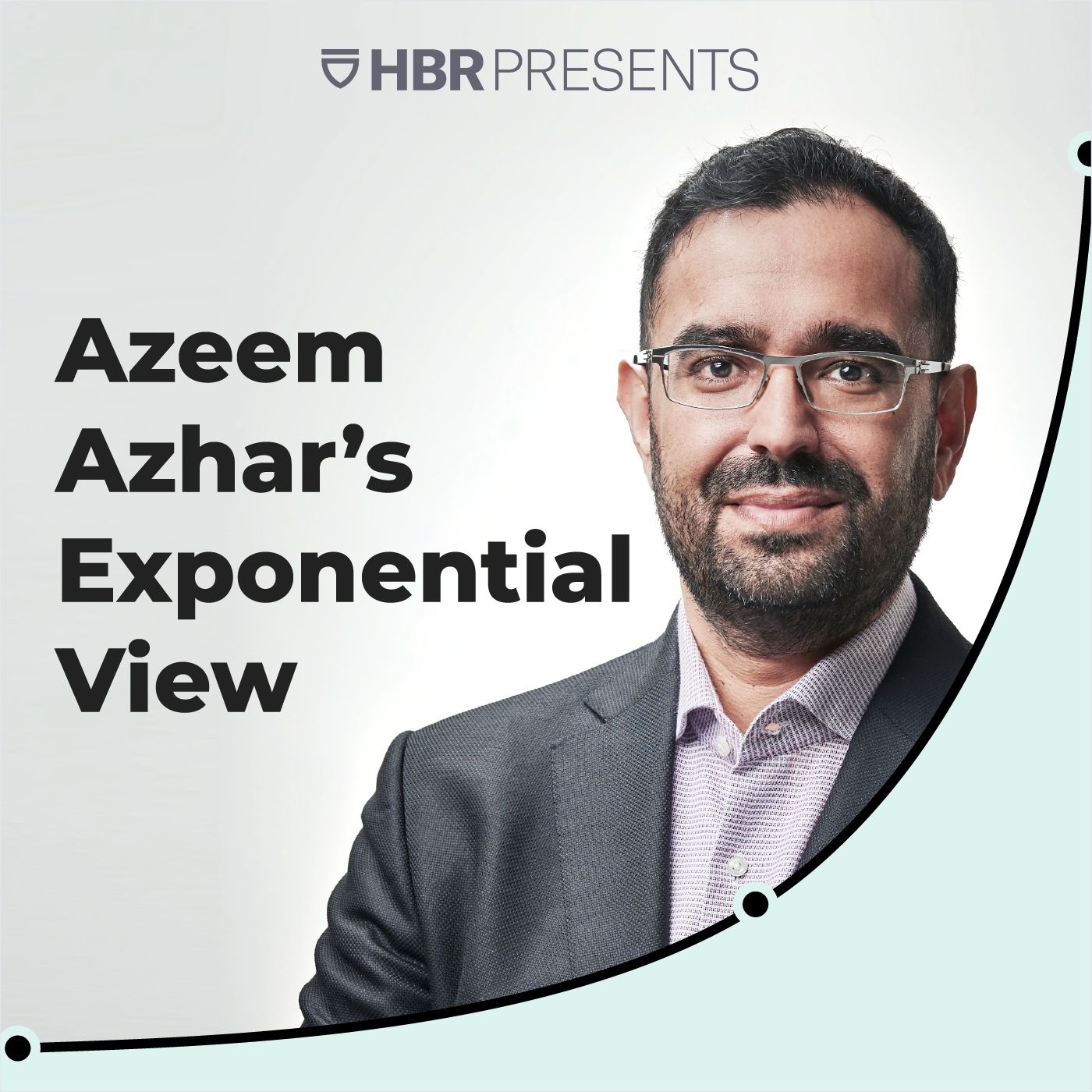
The Future of Warfare Is Here (with General Sir Richard Barrons)
Mar 16, 2022Tap to summarizeGeneral Sir Richard Barrons, the former commander of the UK’s Joint Forces Command — whose remit included military intelligence, special forces, and cyber, joins Azeem Azhar to discuss how technology is changing the definition of warfare and why our society’s resilience in the face of threats to peace must be founded on education. As war returns to Europe, General Barrons’ warning about how technology is transforming conflict is more prescient than ever. They also address: The nature of Russia’s offensive capabilities and how they have previously deployed cyber and disinformation strategies. What societal resilience is and how it can ensure democracy’s survival. What better leadership looks like in the exponential age. This episode was originally broadcast on October 23, 2019. @Azeem @exponentialview Further resources: When the Pieces Land (Exponential View 2022) How The Russia-Ukraine Conflict Will Change Cyber War (Exponential View Podcast 2022) How to Stay Informed on the Future of War (Tim Fernholz, 2019) The Future of War is Already Here (P. W. Singer, 2019)
Transcribe →
Universities and the Innovation Landscape
Mar 10, 2021Tap to summarizeWhat are universities for? Are they an elite pipeline for elite jobs, or can they meet the needs of societies transforming amid technological advances? Azeem Azhar explores the role of higher education in research, innovation, and progress with Geraint Rees, Dean of Faculty of Life Sciences at University College London and a leader of their AI strategy. They also discuss: How University College London researchers drove the design, approval, and production of a breathing aid for COVID-19 patients in just 6 weeks. Why liberal, diverse universities can survive alongside more focused, skills-based institutions. Why universities are essential to a healthy startup ecosystem. @azeem @ExponentialView @profgeraintrees Further resources: “Understanding the Enduring Consequences of Covid-19” (Exponential View podcast, 2020) “What will education look like in 20 years? Here are 4 scenarios” (World Economic Forum, 2021) Hosted by Simplecast, an AdsWizz company. See pcm.adswizz.com for information about our collection and use of personal data for advertising.
Transcribe →
IKEA: Making a $40 Billion Company Climate Positive
Dec 9, 2020Tap to summarizeIKEA generates 0.1 percent of the world’s annual greenhouse gas emissions. Can this $40 billion multinational company become climate positive by 2030? Jesper Brodin, CEO of Ingka Group, joins Azeem Azhar to discuss how to grow a business while investing in renewable energy, sourcing sustainable materials, and building a circular economy. They also discuss: How being a leader in the “green revolution” is a business opportunity. How mass production could actually expedite progress towards sustainability. Why supporting customers in their efforts to re-use and recycle is part of IKEA’s plan. Further resources: “The Drive to Decarbonize with Ramez Naam” (Exponential View podcast, 2020) “Ikea says it’s easier being green if you are private” (Financial Times, 2020) “Ikea Will Buy Back Used Furniture” (New York Times, 2020) @azeem @ExponentialView
Transcribe →
Fei-Fei Li’s Mission to Transform Healthcare AI
May 13, 2020Tap to summarizeAfter ImageNet transformed AI vision, superstar Stanford computer science professor Fei-Fei Li has turned her attention to advancing healthcare. Fei-Fei Li, co-director of Stanford’s Human-Centered AI Institute, is leading the next generation of interdisciplinary technologists. She joins Azeem Azhar to explore her journey from pioneering AI vision to her current focus on healthcare, and to discuss the need to craft AI systems that enhance human flourishing. They also discuss: How AI technologies could support the isolated and elderly during the pandemic. Why machine values must mirror human values, and how to embed that connection. What allowed Li’s — and the industry’s — early naivete to the dangers of facial recognition. Why Li’s health technologists must work with doctors and patients, not just medical data. Further reading: “Fei-Fei Li’s Quest to Make AI Better for Humanity” (Wired, 2018) “AI Pioneer Fei-Fei Li on Building Benevolent Machines” (Wall Street Journal, 2019) “AI, Accountability, and Power” (Exponential View podcast with Meredith Whitaker, 2019) @drfeifei @azeem @exponentialview Exponential View newsletter Hosted by Simplecast, an AdsWizz company. See pcm.adswizz.com for information about our collection and use of personal data for advertising.
Transcribe →Beneficial Artificial Intelligence
Jun 26, 2019Tap to summarizeIn 2015, computer scientist and AI pioneer, Stuart Russell, became the first signatory of an open letter calling on researchers to ensure “that increasingly capable AI systems are robust and beneficial.” Stuart joins Azeem Azhar to discuss the possible AI futures and how to ensure technology serves the good of humanity. Stuart and Azeem also discuss: The nature of intelligence and re-creating intelligence in machines Algorithmic fairness and regulating AI Embodied intelligence Using AI to reach the UN Sustainable Development Goals Further reading: Stuart Russell, “The Long-Term Future of AI” (Berkeley) “Moral technology” (Aeon, March 21, 2019) “Concerns of an Artificial Pioneer” (Quanta Magazine, April 21, 2015) “Research Priorities for Robust and Beneficial Artificial Intelligence” (Future of Life Institute) Stuart Russell Azeem Azhar @azeem www.exponentialview.co Hosted by Simplecast, an AdsWizz company. See pcm.adswizz.com for information about our collection and use of personal data for advertising.
Transcribe →