← B2B Breakthrough Podcast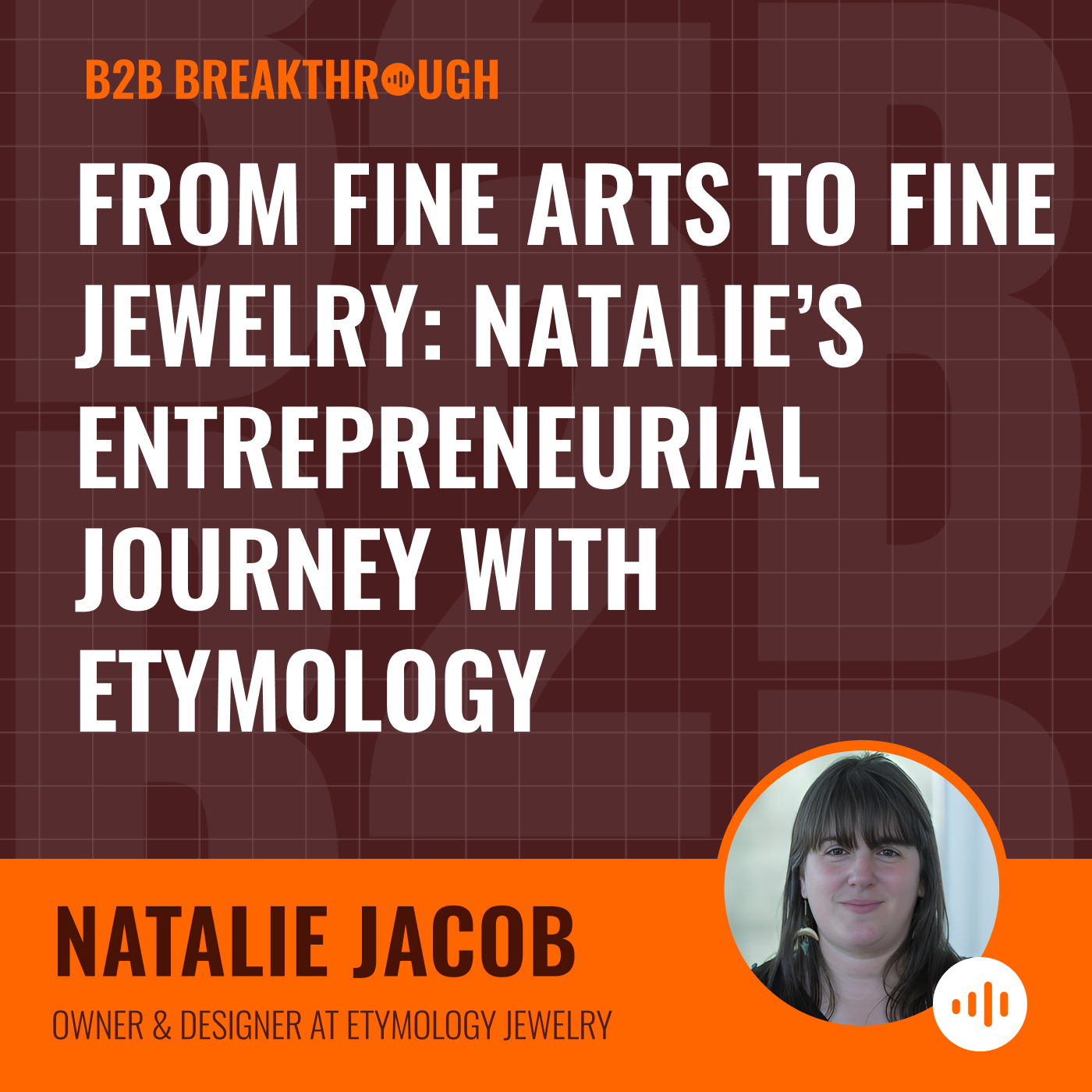
B2B Breakthrough Podcast
From Fine Arts to Fine Jewelry: Natalie’s Entrepreneurial Journey with Etymology
00:33:24
In this episode of B2B Breakthrough, our new host, Ciara Cristo, chats with Natalie Jacob, founder of Etymology Jewelry, about her creative journey and commitment to sustainability. Natalie shares how her fine arts background inspired her to build a thriving jewelry business blending vintage charm and modern style. She discusses challenges and successes in navigating the jewelry industry, from sourcing sustainable materials to connecting with customers. Packed with entrepreneurial insights, this conversation will inspire listeners to embrace their creativity and pursue their passions.
Loading summary
Transcript127 lines
- [00:02]
A
Welcome to the B2B Breakthrough Podcast. We're here to bring you all the best knowledge, insights and strategies from e commerce experts, successful business owners, and the team@alibaba.com that you'll need to grow your business and achieve your next big breakthrough. I'm your host, Sierra Christo. Today's episode marks a new chapter for the B2B Breakthrough podcast to address what you may be wondering. Where's Sharon? Don't worry, she's rocking it somewhere. Awesome. Things move fast in the sourcing world, just like your next breakthrough product, and that's what I'm here to help with. I'm Sierra, the brand lead on the marketing team@alibaba.com I'll be your guide, helping you navigate the latest sourcing trends and insider tips straight from the brand. Today we're lucky because we have an incredible guest joining us, Natalie Jacob, the founder and creative genius behind Etymology Jewelry. She's here to share her inspiring journey where she takes recycled and fair trade materials and transforms them into stunning handcrafted pieces that blend vintage charm with modern style. We'll be diving into her creative process, how she leverages the global supply chain and her approach to sustainable jewelry making. Natalie, welcome to the show.
- [01:08]
B
Oh, my gosh, I'm honored. It's a joy. Thank you so much for having me.
- [01:12]
A
So let's get into it. The first thing, I kind of want to lay a foundation for our listeners. You and I were talking the other day about how you didn't really have a traditional entry point into entrepreneurship. Can you set the stage for us? How did you get into this position and what brought you to creating Etymology?
- [01:28]
B
Well, initially when I started out, I was more of a traditional fine artist. I was in college and just experimenting, kind of trying to find my way. And I always knew I wanted to do something creative, but I didn't know exactly in what capacity that would be or necessarily what that would look like down the road. I started experimenting with jewelry making and seeing what I could do with different tools, and being in school really taught me that. And I thought, okay, well, what could this look like in the longer term? I'm not entirely sure. And, you know, things just kind of blossomed and grew with the Internet. And as time went on, my business grew as well, which was amazing.
- [02:11]
A
So I want to take a moment and take a step back to the very beginning of your journey. In my time@alibaba.com, we've talked to a lot of entrepreneurs and experts in the e commerce world, and we we chat about how to begin and find your way into entrepreneurship, and everyone says, just start, just do it, take the leap. I think it's such sage advice and it holds true in, in my experience. And I want to turn back a little bit and tell us what your first step was. What was that first move to transition, rather from fine artist to entrepreneur in the creative world?
- [02:47]
B
Yeah. You know, it's interesting that you mentioned that because I don't feel as though, you know, I think I'm still both. I don't think I've ever really left that creative realm fully. And I think entrepreneurship, it finds you, you know, you don't necessarily go seeking it. You just kind of have that impetus to begin with. And for me, I always knew that I couldn't really imagine myself in like a corporate environment. I really wanted to be my own boss, get my creative work out there, and just share that story with the world. So it was a very sort of natural transition.
- [03:22]
A
And so what was that first step, though?
- [03:25]
B
I think for me it was just seeing how people responded to my work and knowing, hey, you know, maybe this is something that I could really run with and really grow as a business down the line. Just knowing that people get so excited by what I'm creating, it was invigorating and it brought me so much joy. It still does to this day.
- [03:43]
A
So it was the reaction from your customers that really helped you build that momentum?
- [03:49]
B
Absolutely. And it was interesting because when you're an artist or a maker, even as a small business owner, when you're creating your products, it's just you and the product. You're not necessarily getting upfront feedback from anybody because it's a very kind of solitary experience. So getting that feedback and seeing those reactions is what really changed my mind and what really moved me forward.
- [04:12]
A
I realized we didn't really cover what the product is at Etymology Jewelry. So since you mentioned that, what is the product you're producing, what are some of your best sellers and the things that you're most excited about creating put into the market?
- [04:25]
B
Oh yeah. Well, Etymology Jewelry is handmade jewelry. It's sustainable for creative base. So anyone who loves bright, colorful design, things that no one else will have, jewelry that you stumble into a store and you say, wow, I've never seen that before. That's what I aim to create on.
- [04:44]
A
A day to day basis.
- [04:46]
B
And for me, I use a lot of bead, lots of crystals, and in those creations, bracelets seems to be the most popular, and rings too, but bracelets.
- [04:56]
A
So we know that you like to integrate some sustainable practices to bring, you know, the most eco friendly jewelry to the market and sustainable jewelry that you know, you know that your audience is looking for. How do you combine the vintage sourcing with new products that you source on Alibaba?
- [05:14]
B
I really love to integrate little bits of, you know, upcycling, just little flourishes of that into anything that I design. So initially, if I have an idea for a piece of jewelry, I start with the materials and then I go into actually making it and I'll, you know, I initially start with the materials that I can get, you know, over and over again more easily. So Alibaba is key for that. For me, Alibaba.com is so key. And then after that, the sustainable aspect, I think. Okay, so I have, you know, amethyst and then I have these really cool gold plated chains. Like what accent or what sort of flourish can I contribute to that, to bring it to a whole other level? And that's where the upcycling really comes into play.
- [06:03]
A
So what materials spark the most inspiration for you? What draws your eye? If you're walking into a thrift store, where are you immediately beelining?
- [06:12]
B
The jewelry case? Definitely, yeah. That's where all the goodies are.
- [06:16]
A
So you're upcycling from existing jewelry and giving it new life?
- [06:19]
B
Yes, and sometimes it's very interesting because, you know, at this point, my business, I do a lot of wholesale, so I'm doing full quarters for folks with jewelry. And, you know, I need to be able to get certain materials over and over again. But when I'm thrifting, there might not necessarily be a guarantee of that. However, the thrift stores, they are so inundated with stuff that they'll just take a giant gallon bag and put a ton of jewelry in it and, you know, sell that. But that's like a bulk of materials for me. So then I'm like, okay, I can actually use this in a greater way because I have so much. So it's helpful. It works out.
- [06:59]
A
Do you go into that with a design in mind already, or are you creating what your materials are telling you? Are you listening to the materials, letting that guide you?
- [07:08]
B
I think it's a little of column A and a little of column B where, you know, sometimes I do have a design, But I think nine times out of 10, I let the materials inspire me.
- [07:17]
A
Nice. So I want to shift to the Alibaba.com side of those sourcing practices because this is a platform where you are able to refine your Search a little bit more. And it's. It is a treasure trove, but it's less of a luck of the draw situation.
- [07:32]
B
Absolutely.
- [07:34]
A
So when you go into a sourcing practice on Alibaba.com, do you have a design in mind or do you also seek inspiration in the search?
- [07:44]
B
Oh, it's definitely both. Because when I'm searching, you know, I'll say, okay, so I really need some amethyst here, and I'll look that up. You know, amethyst is one of my favorites. I've been really loving designing with it for a fall and winter. But, you know, Alibaba offers so many different options that I can't help but be inspired by all the search results. And I'll say, oh, you know, I didn't even know this product existed. I think I need to integrate this into my line and inevitably I'll leave with more than I bargained for.
- [08:17]
A
Can you tell me about a lucky find that really inspired a piece that you're really proud of?
- [08:22]
B
I mean, you know, like I said, I've been really stuck on amethyst, and I found these really great kind of like raw amethyst slices where you could really see the layers of the stone. It was very unique and different because usually you just see it's like kind of plain purple. It's very kind of not like in its natural state. It's like they treat it a little bit. So this looked a little bit more organic, a little bit more different. I'm like, wow, okay, this is cool.
- [08:50]
A
Frankly, I'm not all that familiar with amethyst as a material. So when you are looking for something like that you mentioned some of them look more treated, some of them look more organic based on the producer. So what are some of the things that you look for as you are sourcing to make sure that it is the high quality, you know, other than first glance in a thumbnail image. What questions are you asking or what key features are you looking for in your search?
- [09:16]
B
At this point, I feel like when I look at a photo, I can pretty much tell, okay, well, this is a genuine stone. You know, it's not plastic or glass. And I've had that experience, so I'm able to kind of discern that at this juncture. But when it comes to someone new, and it's a bulk purchase, you know, a new vendor, a new supplier, I'll. I'll get a sample before I really go to town and say, get, you know, dozens and dozens of beads type of thing.
- [09:46]
A
Cool. So what does that conversation look like, how do you get into that routine and ask the right questions to get the information you're really looking for?
- [09:54]
B
Oh yeah, Well, I really love the Alibaba.com messaging system for that. I'm able to connect with vendors and suppliers just so seamlessly and in such a, like a user friendly way. And, you know, if I have any doubts about the products, I'll obviously ask questions. I'll say, you know, how many beads per order? What does the shipping time look like? Standard, things like that.
- [10:16]
A
What are some of the challenges in dealing with those conversations? Have there been any blunders or miscommunications, communicating globally that have become frustrations for you and how do you overcome them?
- [10:28]
B
Necessarily within the global communication, like, I've been relatively lucky where I really have no complaints on that realm. People are very responsive. You know, I don't have to wait too long. Once in a while, if I find a vendor who has a certain product and then maybe another vendor who has a similar product, but their order minimums are different, I'll reach out to the vendors and say, I'll ask them questions like, what's the lead time on shipping? How long should I anticipate waiting? And if one vendor kind of gets back to me, like way later than another, then it makes it a little complicated.
- [11:02]
A
Interesting. So does that deter you from working with that supplier or do you weigh them equally still?
- [11:07]
B
I think so.
- [11:09]
A
I do.
- [11:09]
B
I mean, you know, if I'm inspired or I really need a material for an order, I'm going to go with the supplier who got back to me the fastest and is the most communicative. Because as someone who is also a small business owner, I value that sort of communication with my own customers. I think that's abundantly important. My business is my priority and if I have an idea, I got to jump on it.
- [11:33]
A
Yeah, absolutely. So. So the logistics piece is, is coming into play a lot too.
- [11:38]
B
Oh, without a doubt. Yeah, absolutely, I agree.
- [11:41]
A
How do you manage that? I mean, there's so many moving pieces. How do you structure that timeline to get the right product to the right client?
- [11:49]
B
I know. So I just experienced that with a, a large client that I can't necessarily name, but I mean, there were a lot of moving parts. This was an order where they requested over 500 units of jewelry. And I really had to pace myself in terms of, okay, well this piece takes the most time to construct, so we need to order the materials for that first. And all those materials need to come at the same time in Order to create it was a charm bracelet. To create this charm bracelet and to create it in the timely manner that is needed here.
- [12:21]
A
So do you engage in different conversations when there's that kind of time crunch on the sourcing side of it?
- [12:26]
B
Oh, I would say so, yeah. I will say, you know, I need it by a certain time or, you know, can we do expedited shipping? And at most junctures, they've been completely able to do that. And that's been so welcoming, so helpful.
- [12:41]
A
Does that change based on whether you've worked with them before, or do you frequently jump supplier to supplier, have an established relationship with some, and does that change the way you talk with them?
- [12:52]
B
I guess it can be a little bit more casual when I know the supplier, but for the most part, it's pretty even keel. You know, I will get some new people in the mix once in a while. If I see something exciting, really inspiring, I'm like, okay, yeah, let's. Let's get this in the mix. Yeah, let's bring it on. But other times, if I have an established relationship and my supplier, via Alibaba.com has been, you know, wonderful, I don't want to, you know, change that. Like, it's not broken. Don't fix it.
- [13:24]
A
Absolutely. As you're processing the inventory management side of it, how do you determine how much to order? Especially when there's, you know, we talked earlier about inspiration being a part of your creation process.
- [13:38]
B
It's huge. Yeah. I mean, that's a big driver overall.
- [13:43]
A
Yeah. So does that restrict you from placing bulk orders far in advance? Are you making smaller orders to keep up with trends?
- [13:52]
B
Oh, sure. I mean, that's huge because I have made the mistake in the past of bulking up on something where neon was a big trend a couple years ago, and I got a lot of that, and I didn't even end up using all of it when the trend was done. And that kind of gave me pause, and I said, okay, well, this wasn't as intentional of a business decision as I could have made, but having the access to, you know, the ease of sourcing with Alibaba.com, i can really keep abreast on trends and just know, okay, so dainty is really popular right now. Charm. Anything with charms is huge. What can I do to create something exciting like that for my customer?
- [14:36]
A
Nice. So how are you managing the trends? How do you keep up with that?
- [14:41]
B
I think social media is very helpful just in general, seeing what is resonating with my customers. When I'm doing shows in person. Those are all big, for lack of a better term, influences, influencing influencers, et cetera.
- [14:55]
A
Cool. Yeah. That was actually one of my questions I had for you was we talk with a lot of folks who are sourcing online and selling online.
- [15:02]
B
Yeah.
- [15:03]
A
And keeping everything in the e commerce realm. And you know, that's always a part of it in the, in the upfront for business owners. But when it comes to in person sales, how does it impact your ethos? How does that impact your inspiration? Tell me a little bit about your. Your retail experience on the ground.
- [15:20]
B
Oh yeah, I mean I've had ample experience both in e commerce and selling person to person also wholesale in, you know, a market capacity where I'm meeting the clients in person also in an online e commerce way. But I think it all kind of melds and influences one another. You know, all these certain experiences with customers. And it's interesting because I know something that I like to tell people is that when it comes to either retail customers or wholesale buyers, you can't say that every single person likes blank thing. You know, like every single person will love this bracelet. It's just never going to happen. So it's interesting. Even if something is a top seller, there's always going to be someone out there that says this isn't her being. But it's nice to know that you can make things that make people smile and bring the utmost joy in the products that you're providing.
- [16:18]
A
Is the complexity of sourcing holding you back? Are you getting overwhelmed by information in an endless search? Now, sourcing for your business has never been easier. Meet Axio, the world's first AI sourcing engine that helps you source like a pro. With five key features, you'll get product inspiration that leverages real time market data from comprehensive web insights, social media trends and B2B knowledge. Generate detailed requirements to find the perfect match from AI verified products and suppliers through Axio's multimodal search. Use supercomparison to easily discover and compare millions of products from leading suppliers, focusing on the best selling and most competitive options. With Axio Page, you'll get AI generated encyclopedia pages that compile verified product information for each SKU and finally leverage Axio Agent to streamline negotiations with conversation, guidance, real time summaries and direct answers about products and suppliers without having to browse detail pages. Head over to Axio AI today. That's Accio AI to try Axio for free and start sourcing like a pro. Some of that is we were talking about it being at Artisan fairs and farmers markets and situations like that. So do you have any anecdotes from those experiences that really warmed your heart or struck a particular chord with you?
- [17:36]
B
I mean, I always get excited. Yeah, I actually do. I did a show. I try to travel to do shows once in a while. I haven't. I've. I'm kind of splitting right now. I'm doing some shows in upstate New York and New York City. I did a show in North Carolina a few years back and it was a really large show that I just kind of took a chance on. Cause I saw it on Instagram and I mean, this audience was so enthusiastic. I mean, girls would run screaming to my table and say, I've never seen anything like this. And I'm like, wow. I mean, the response blew me away. It was amazing. I mean, that's what every product based business wants is customers that are genuinely excited about what they're providing.
- [18:21]
A
That's so heartwarming.
- [18:23]
B
Thank you.
- [18:24]
A
Can you tell us a little bit about your design?
- [18:26]
B
Cuff bracelets are so popular. I like to do an individual stone or a little mix of stones and just highlight those materials in a really beautiful and special way. Again, in a way that captures people's imaginations and makes them just say, wow, I've never seen this before. Everything is handmade and designed in our studio based in New York. And it's the type of thing where anything can be, you know, even in a larger quantity. Anything can be handmade, but it just needs the proper, like, timing. So, you know, if you're going to order like a thousand of pieces of jewelry, I'll say, okay, well that might take a month, it might take some time, but it can be done.
- [19:13]
A
Wow. And so what are some of those strategies beyond, you know, giving your clients a heads up? What are those strategies that help you manage your time to give every piece the attention that I know that you want to give it?
- [19:24]
B
Oh, yeah. Well, I will say, oddly enough, it's easier to make dozens and dozens of the same design versus dozens and dozens of a different thing. Because when you're making the same thing over and over again, you kind of get into a groove, you kind of get into a rhythm, and you're really able to streamline that process just from the repetition. But with something where each individual piece is one of a kind, it's a little bit more challenging.
- [19:50]
A
And so those bulk orders, you know, when you're making hundreds of pieces that are identical or, you know, whatever that quantity is, are those more for your commission? Based clients.
- [20:00]
B
They're for my wholesale clients. So like store clients. I have, I've worked with a few museum stores, I've worked with some larger companies. That's been really exciting. The biggest company I ever worked with in a wholesale capacity was actually Macy's.
- [20:14]
A
Oh, wow.
- [20:14]
B
Yeah.
- [20:15]
A
What were you producing for Macy's?
- [20:17]
B
Well, it was, it was part of an Etsy Macy's pop up. And this was maybe six or seven years ago. They had it around holiday time. They wanted to promote, you know, New York City based artisans and designers. And they approached me and I was overjoyed.
- [20:32]
A
Really cool.
- [20:34]
B
It was very fun.
- [20:35]
A
So for a client like that, how do you decide what to make and how to source for that?
- [20:39]
B
I mean, I work directly with the client, but I keep in mind, okay, this is an item that I need to be able to order these materials consistently to maintain that sort of quality throughout every piece that I make. So they're not all going to be exactly the same. Right, because it's handmade. But they need to be sisters, not twins.
- [21:01]
A
There you go. Like our eyebrows.
- [21:03]
B
There you go. The truth. But it's also the type of thing I work with the client and say the thing I like to ask, first and foremost, what is resonating with your customer? I think that's a beautiful place to start a conversation. It's the type of thing where you can, you can gauge this is working in this store. Or maybe, you know, they don't really like rings, but they want bag charms. So that's something I've experienced recently. Like bag charms are big, but I want to make some where they're like kind of keychain, kind of for your bag. A little bit of both.
- [21:35]
A
When did bag charms come onto the scene?
- [21:38]
B
I think recently.
- [21:39]
A
And so where. What kind of audience do you find is gravitating towards those products? Do you find that your audience is, is kind of segmented based on the products that you're, you're producing?
- [21:49]
B
I would say so. So the majority, and it's nice because on a place like Instagram, I can actually break down the demographics of who my audience is and where they live, how old they are, et cetera. So I've looked there and that's really kind of given me that baseline. My audience over 60% is between the ages of 25 and I believe it was 44.
- [22:19]
A
What are they buying? What is that demographic getting from you?
- [22:22]
B
So they're definitely buying things that are on trend, but they might not necessarily want something so out there that it's not approachable. So a bag charm is a great way to go in that way for a few reasons. You don't need to be a jewelry lover to want or need one. And alternatively you can also use it as a keychain.
- [22:44]
A
We like flexibility. That's, that's helpful that the, that versatility is huge.
- [22:49]
B
Cross product pollination.
- [22:50]
A
Yeah, exactly. How do you maintain profitability throughout your process? What are some of those strategies that help you stay afloat?
- [22:59]
B
I think being very mindful of, I mean something that's huge and very impactful in the jewelry world is the metal market. Because that's kind of been really, I don't know if you keep abreast of this or keep track of it, but metal has increased so much in price just over the past year. You know, the fine market with like 14 karat and up is kind of the pinnacle. But it influences plated because when you plate something you're using a fine material to go for a less expensive material. So it does drive the cost up. And it's something I, you know, I really try to keep in the forefront of my mind, really be intentional about and say, okay, how can I maintain this profitability but also keep things in line with my clients expectations and what my clients need for a price point?
- [23:46]
A
Got it. So it's, it's tracking the trends in that market, without a doubt. And how do you in that, in that same breath, how do you maintain the quality of your materials in that pursuit of profitability of, you know, appeasing your clients as well?
- [24:01]
B
I mean that's pretty easy. And Honestly, you know, Alibaba.com helps with this too. When you buy in bulk, you're able to diminish your overall cost, but you're not necessarily sacrificing quality. And that's really major in my line, entomology, jewelry, just making sure I have that uniqueness, that quality that people expect, but still keep prices relatively approachable.
- [24:28]
A
So as you're looking forward, what are some of your next steps that you're getting excited about and where are you trying to push your brand?
- [24:35]
B
I mean the holiday season is ahead, so really focusing on that, seeing you know, what comes of the in person shows, opportunities come that way in addition to online organically and that's kind of amazing. After holiday, I think I want to try to explore getting into some more gallery type places like museum stores. Just because I've always been an artist at heart. That's something I've really valued and it's been important to me. So that's Something I'm kind of looking forward to in the future.
- [25:06]
A
That's really beautiful. So how do you find and maintain those relationships with the buyers from the museums? Is that a different process than traditional retail?
- [25:15]
B
Oh, it is. I mean, when you're approaching a wholesale buyer, it's like a whole different ball game than peer to peer. Person to person, I would say. I mean, the avenue I've had the most luck has been Instagram. I have done traditional trade shows, but they are very touch and go, and it's a very high investment to not have an absolute certainty that it's going to pay off.
- [25:38]
A
Does that change the dynamic a little bit in your sourcing?
- [25:42]
B
I would say so, because I think they're a little bit more open to experimentation, a little bit more open to, hey, you know, you're the designer, you're the boss. You know, you make what you think is going to be cool. And, you know, that's what every artist and designer wants. However, when you're working with a bigger company, it can be the type of thing where it's like a design challenge where they say, okay, we want a necklace that's a certain length and a certain colorway. Can you fulfill that? The answer's always yes.
- [26:09]
A
Okay, that's cool.
- [26:11]
B
So it's different.
- [26:12]
A
So you have more freedom.
- [26:13]
B
I think so. I think there's always freedom in the way where, you know, buyers will tell you, you know, this is what we want, and you can always make it with your vision. I never feel restricted in that way.
- [26:24]
A
That's cool. So I want to go back to the holiday planning piece. The holiday push is big for a lot of small business owners. Everyone is prepping. How far in advance do you start thinking about Christmas?
- [26:37]
B
Not far enough. I'm a little more freeform, but, you know, I kind of like to let the client guide me in that way. It's hard to predict when people go full throttle on the Christmas ordering. I think we're definitely in that mode right now, but we maybe just got there, so it's take a little more time. Some of these stores order in October for more. Like in November, when we start thinking.
- [26:59]
A
About Christmas and the holiday season on our side from the Alibaba perspective, that's when super September kicks in for us. We start thinking as soon as September hits, we are always curious, like, where are you falling in this process and how can we continue to support you?
- [27:15]
B
I think for every buyer, different. September, I think, is a great time because you will have those early birds in my book. But then you'll also have people that come through later on. More. October, November. I mean, I'm getting a lot of November right now, but yeah, it varies every year.
- [27:32]
A
That's crazy. So I want to take a look back again. If you could look back to day one, Natalie, setting up etymology, what is some encouragement or advice that you would whisper in your own ear?
- [27:44]
B
I would say, I mean, I guess it sounds cliche, but just keep going, keep doing it. Keep hitting the pavement, hustling. Just get your work out there and don't be hesitant to do that.
- [27:57]
A
Would it impact your creative freedom or is it more about the business mindset that you would encourage her?
- [28:05]
B
You know, I don't think it impacts my creative freedom because the thing that I use as my guiding light, I'm kind of like, well, I love this quote. It's tell your own story and you will be interesting. So if I'm true to myself in both my products and my business, everything else will fall into place. And I continue to let that be my North Star to this day. And that helps me a lot.
- [28:27]
A
That's a great. So tell your own story and you'll always be interesting. That's the line.
- [28:31]
B
It's from the artist Louise Bourgeois. She said it originally, but yeah, that's gorgeous. I love that quote.
- [28:39]
A
That's great. So, you know, just feeding off of that. How do you stay motivated and inspired when you're balancing beyond staying true to yourself? How do you stay motivated? Balancing art and business?
- [28:52]
B
It's hard. As a business owner, one has to wear so many different hats and fulfill so many different roles. And this is nice too. Just talking to my client, they tell me, okay, my customers are asking for this to do you have that? And the answer's always yes. And it's like, well, how can I make that? And recently it was a client who wanted bag charm because she didn't like a traditional keychain and that the keychain kind of ruins your nails. But a bag charm can be both a charm and a keychain, so why not both interesting?
- [29:21]
A
So those pushing the boundaries prompts are really keeping you inspired to stretch your creative freedom?
- [29:28]
B
Without a doubt. Yeah.
- [29:30]
A
Nice. Tell me a little bit more about how you find inspiration for new designs.
- [29:36]
B
Honestly, I'm such a high energy person that I need to be exploring. Whether just walking around New York City or visiting a new place. I think a change of scenery always helps to inspire and motivate, and I know that helps me.
- [29:52]
A
I think we've covered a lot of ground here, and I want to wrap up with a couple forward thinking questions, I want to think back to some of the advice that you received early on and what is, what is a piece that resonated with you so strongly that you feel like you got to pay it forward? What does that pay it forward? Gem?
- [30:09]
B
Well, this really dates me, but this is kind of like more of a joke and then the other one's a little more serious. But I was not on Instagram as a business starting out and that's initially how I connected with Alibaba, which was amazing. But, you know, folks said you're such a visual person. You know, I think Instagram will really open up doors and like, get your work out there. So it's kind of like, you know, getting your work out there. But they're like, yeah, you should be Instagram. Like, Instagram was brand new at the time. And I'm like, I don't even have a smartphone. I can't do that. I, I'm 35 now. I didn't get a smartphone until I was 26, 27. Wow. I know. I went a long time.
- [30:49]
A
You know what, I admire that. I think that's great.
- [30:51]
B
Thank you. I don't know, it was, it's interesting. And then I became like, took to the deep dive into Instagram. But the other thing that I would say that someone told me that has been very valuable advice is sometimes no means not right now in terms of products or your, your own small business. Because someone might be wanting to see, okay, well, how is this line going to evolve? How is this small business going to grow? I want to see just what comes in the future. Certain clients have said, you know, we love it, but maybe not this season. And I say, you know, okay, I'm going to keep your information. Let's circle back in a few months. I can't wait to show you my new products then. Always leave the door open just for opportunity because you just never know what will come about in the future.
- [31:36]
A
All right, I have one last one for you. Who and what are your biggest inspirations? Who are your biggest role models as a business owner?
- [31:44]
B
Definitely other business owners. You know, folks who are just very open with the knowledge that they've kind of garnered over the years. I actually have a mentor in the diamond district of New York and he has taught me so much about sourcing different metals, like what certain vintage eras look like. He's just given me so much knowledge and it's been, I mean, it was, it's influenced my business in terms of what I design. And what I make and what I look for.
- [32:13]
A
That's awesome. Well, this has been really cool chatting with you, Sierra.
- [32:17]
B
Thank you. Before we fully sign off, where can people find you?
- [32:21]
A
How do we stay tuned into your journey?
- [32:23]
B
Oh, wonderful. Thank you. So I'm on Instagram tymology jewelry. So etymology is the study of words. If you're not sure how to spell that, look up what is the study of words and then jewelry. You can find etymology jewelry online. I have an e commerce site. It's at emologyjewelry Shop. And I'm Also on Facebook, TikTok under the same name.
- [32:46]
A
Awesome. Well, we will stay tuned and look forward to seeing all that comes out this holiday season. And thank you for joining us.
- [32:53]
B
My pleasure. Thank you for having me.
- [32:57]
A
B2B Breakthrough is produced by Alibaba.com to find out how Alibaba.com is empowering its customers with the tools, services, and resources they need to grow their business, visit alibaba. Com and then make sure to search for B2B breakthrough on Spotify, Apple Podcasts, or wherever you find your podcasts. Make sure to follow us so you don't miss future episodes. On behalf of the team here@alibaba.com thanks for listening.