← B2B Breakthrough Podcast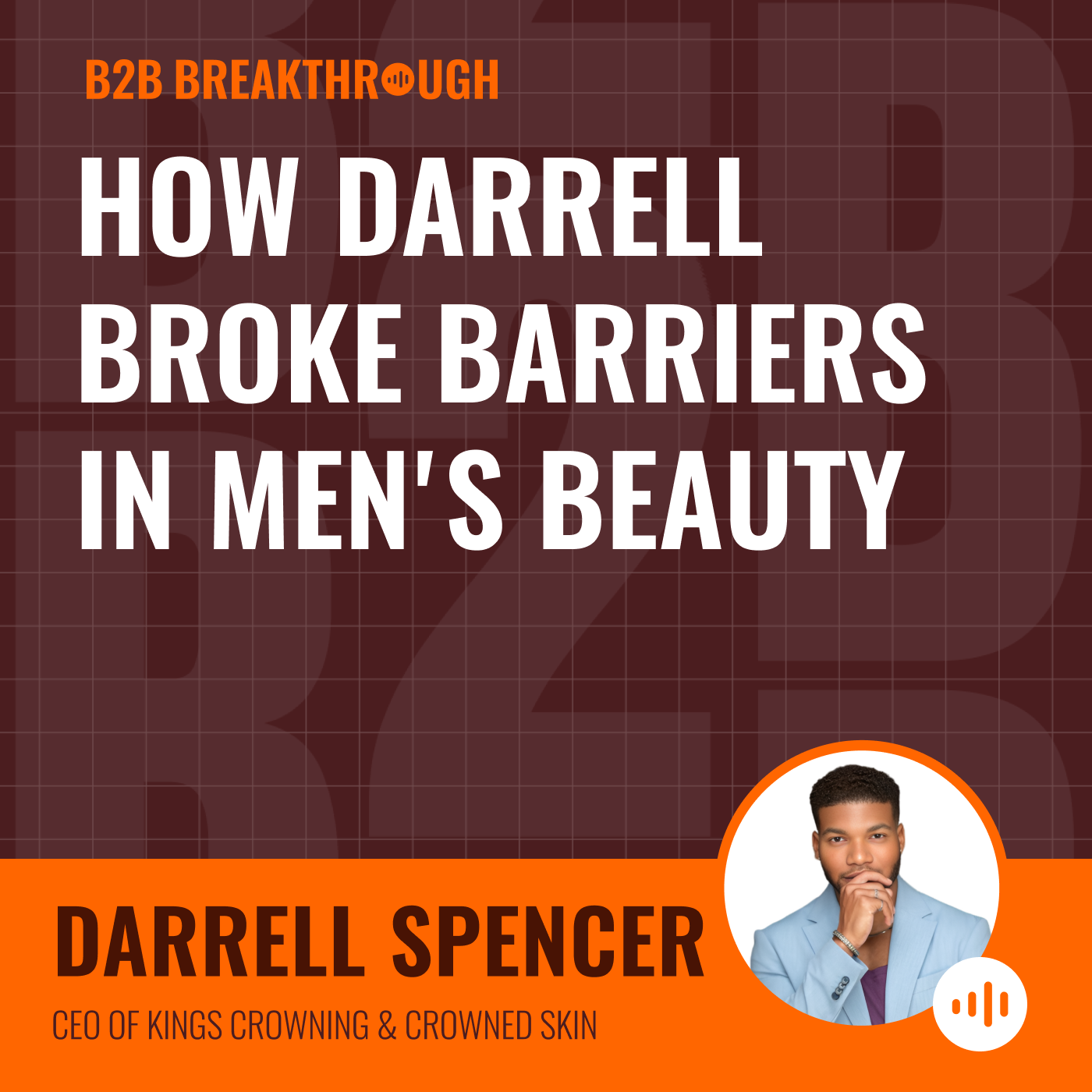
B2B Breakthrough Podcast
How Darrell Broke Barriers in Men's Beauty
00:36:17
In this episode of the B2B Breakthrough Podcast, host Sharon Gai interviews Darrell Spencer, the founder and CEO of King's Crowning and Crowned Skin. Darrell discusses his journey from a corporate career to pioneering beauty and hair care products designed for Black men. He shares insights into omnichannel marketing, product development, and the importance of customer engagement. Darrell also touches on the challenges he faced breaking into the beauty industry, how he balances rational and emotional appeal in marketing and his vision for empowering men to embrace self-care.
Loading summary
Transcript86 lines
- [00:02]
A
The other angle was desirability past a woman and she smelled you. What's her reaction? And then we realized these reactions of getting, like, women to smell you, men flock to it the most. So at that point, we kind of pivoted and said, you know, okay, we're seeing the data. We're seeing the numbers. Men are converting insanely when we hint at their emotions.
- [00:23]
B
Welcome to the B2B Breakthrough Podcast. We're here to bring you all the best knowledge, insights, and strategies from e commerce experts, successful business owners, and the team@Ellen Alibaba.com that you'll need to grow your business and achieve your next big breakthrough. I'm your host, Sharon Guy. That was Darrell Spencer, a trailblazer in the beauty and hair care industry, specifically championing the needs and narratives of black men through his innovative brand King's Crowning. He just successfully launched his skin care brand as well as the founder and CEO. Darrell has not only filled a significant void in the market, but has also crafted a movement that celebrates the rich diversity of black men's hair and beauty. Welcome, Darrel.
- [01:04]
A
Thank you. That was a. That was a very warm intro. I like that. That's a good one.
- [01:09]
B
Yeah, we're gonna write that for your LinkedIn bio.
- [01:12]
A
Look, let's do it.
- [01:14]
B
So to get us started, take us back to the day where this idea sort of sparked from your head, when you were probably, I don't know, sitting at a corporate cubicle somewhere.
- [01:25]
A
For sure. Okay. So I had an interesting corporate path, so I would say mine really wasn't as traditional. I graduated from a private college. I went to school in the east coast in Connecticut, and I was an econ major. So candidly, you know, I've always known I wanted to do something in business, so I went to liberal arts college. So my major is econ, and that was closest you think you can get to a business major at a liberal arts college. Right. So candidly, I had no idea what I wanted to do. So I found my first role coming out of college. I was working at Capitol American Funds. So I was working for an investment management firm or. Right. And I was in this rotational program where ideally, the goal would be to graduate and go into an internal wholesaler role, where basically, you're selling mutual fund products for Capital Group. I did that for about six months. Hated it. I did. I hated it. Finance just wasn't for me. It wasn't for me. The culture wasn't for me, and it wasn't dynamic enough at that time. I was actually living in Indianapolis. So home for me is in Chicago. So at that point as well, I was just homesick. I missed Chicago. I went to college in Connecticut for four years. Then I moved straight to Indiana, away from home again. I kind of took the first role that I could out of finance to get to Chicago, which brought me into like a cold calling, like nitty gritty sales role for a company in tech. So daily I was like punching in 150 calls a day, cold calling people, getting hung up on every single day. Stop calling me like I was that person, hated it. So at that point it's well, I'm like, Jesus, I need to find another gig. So at that point it transitioning into tech, but in the paid advertising space in big tech. So it happens that I had a friend who actually was working for Meta at the time. He was in account management and he worked in paid advertising. So basically his role was to work with these big companies as their consultant and then basically he would help them manage their overall Facebook ads and consult them. So naturally it happened, thank God, because I did not know how much longer I had cold calling every single day. So I made it out. So then that's when my career in big tech began and that's when I began working in digital advertising. And then that's kind of where I found my love. You know, it. It took a few different companies to jump into to actually really find what, what I was most passionate about, which was digital advertising, paid advertising, the marketing space, digital advertising, large customer sales. So at this point I'm generating tons of revenue for the largest companies in the world and large customer sales at Google, Meta. And I'm getting just so many like amazing skills and I understand how to make these ads work for you and your company. And at that point I'm like, I have this knowledge. I think it'll be useful and helpful for me to figure out a way to do it for myself. So at that point I ended up realizing like one of my pain points and a pain point that I realized most men actually had many black men with textured curly hair. I would wake up every single morning with my hair just. I had at that point I had a longer curly hair. At that time I would wake up, my hair was all over the place. And black women, they actually have these things called bonnets. Some know, some may not know. But bonnets are function to protect black women's hair, keep them in place, reduce frizz. But black men didn't have anything like that in the market. So I'm like It'll be cool if I can actually create this product because I'm, I'm sure many men right around the world would benefit from this. If it's me, if I needed this problem solving, I'm sure many other men would. So I began to tie in my background in paid advertising and marketing and mesh the world and created this business which is King's Crowning where we create functional side in line products for men. And that's kind of how it started. But it really started from my rich history, my rich background in digital advertising that, that essentially informed me on how to really set out a strong marketing framework to really set the business off.
- [05:08]
B
But those big, like those brands that you worked with at Meta and Google, were they like the Fortune 500s or were they smaller D2C brands like King's Crowning?
- [05:19]
A
So initially when I first started, I started off in our scale division where it was scaled so they were smaller. But then the goal was to overall scale them to, you know, millions.
- [05:27]
B
I'd imagine the Fortune 500s have million dollar budgets for marketing or ad spend versus the smaller guys have so much less. So is it really different or do you think helping the smaller guys scale bigger contributed more to your success at King's Crowning? Or was it seeing the how the million dollar budgets were spent fed more insights into what you're doing now?
- [05:49]
A
I would say they both helped me in many different ways. Right. I will say the biggest Fortune 500 companies, they actually helped me to dream bigger. I was seeing numbers in these accounts I've never seen before, spending these daily amounts on ads. So working with those big companies, that's spending millions on millions right daily. I was watching that and I was inspired. And then it helped me understand that this could be me at one day in time right now, mind you, working with the smaller companies, that just showed me honestly, like you can literally come from the ground up and really create a strong brand, strong culture, understand your marketing and scale it progressively. I've watched many companies in our scaled group literally go from 5,000 to 10k a day, to a hundred k a day, 500k and a million a day. But it was all through persistency, being eager to learn, eager to grow and it was very inspirational, right? So I found inspiration through working with both of these different groups. But it really inspired me watching these smaller brands really build the brand and company of their dreams, right? And we can get real, right? And they have more, a lot more passion, right? The passion just, it came out of them and it was an inspiring Multi that, you know, they had a thought, they had a dream and literally like they made it come alive and it was the most inspirational thing about it.
- [07:05]
B
Yeah. Is there a secret to scaling those smaller brands? Is it a ratio thing where you just have to invest a certain number of amount of your revenue back? How can the average small guy win in paid advertising?
- [07:21]
A
I would say it's multiple things, right? My number one that I always say is creative and digital advertising. Content is going to always be key. You can have a strong advertising strategy, but without solid creative and solid content, you're not able to market and communicate to your customers what this product is and why it's useful and why they need it. So I always say if you're able to really understand strong use cases for your products and your company and be able to illustrate that via creatives, you're already on your way. Number two, I think people focus on singular platforms, right? So they might put all their focus into just Facebook or just Google or only TikTok. Mind you, it's not a terrible strategy, but we believe in omni channel strategies, whereas we believe that all these different platforms work together. So like I can say for my business as well, we advertise across Facebook, Facebook, Google, TikTok and YouTube. Now all of these different platforms, they work for us in different ways. So I would say have an omnichannel strategy across paid media, but then also understand content and scheme, understand the use case of your products and then be able to illustrate it that way.
- [08:31]
B
What have you done on the content side?
- [08:33]
A
So early on, when I first started, I didn't have a budget, right? So I was actually the model. If you would go and scroll down. In our earlier videos with, with King's crowning, I was literally our very first model. I would throw on our side of my turb, I would show my hair, I would show what it did for my hair, I would show the satin line crown, show what it did for my hair as well. And the use cases, honestly, it spoke for itself, right? But I didn't have the budget initially then. So my main thing was what are the benefits of rocking with this satin line serpent or this product? How can I show in a quick 5, 10 second video right across TikTok or Instagram and I did it. So really understand the features of the product. And you don't need a huge budget, right, to have solid freighters. But as you scale up and you're spending more on ads, you're going to need a lot more creative. But when you're first starting out, you don't need to have a huge budget for marketing. It can literally just start with you. And that's honestly a misconception that most think is that you really need to have tons of, you know, a big budget when it comes to your overall video creative. You don't have to do that when you first start out, it can be literally just you in front of your phone, right. And just illustrate and show why others need this product and it'll hit.
- [09:37]
B
Is there like a amount to it? Some people say you gotta post four or five times a day on TikTok for it to even gel a little bit. Is there a, like a secret number for these channels that you have to always produce?
- [09:52]
A
So I will tell you, Instagram, that was once daily for me. I would post once daily on Instagram. But then now TikTok was a different beast. So with TikTok legit, like, you have to post about four to five times daily on TikTok because with TikTok, there are different people seeing your videos every single day. So it isn't like Instagram, where the algorithm shows your videos are the same same your same cult following, right. Your video's been shown to different people daily. So literally, if you post one video, right, in one hour, but then in the next hour, that video can hit and go across many different people within that same hour. So I will say TikTok for sure. I would hit it about four to five times daily. Instagram. I did initially buy women time of day.
- [10:33]
B
As a black man working in the beauty industry, do you feel like there's certain stereotypes or barriers that you've had to face and overcome?
- [10:41]
A
Yeah, for sure. Well, I mean, I would say one of the stereotypes, it was difficult breaking into this space also, but also breaking down the stigma behind, like, black men in beauty.
- [10:51]
B
There's not many of you at all.
- [10:53]
A
There's not many of us at all. And I think it's for a reason. I think that as black men, black women, I think over time we had to have this barrier and this shield around us to protect us. And sometimes there are certain conversations we just don't want to step into. We know that there's stigmas involved with certain things and we want to stay stand far away from it. Right. We already have a lot and enough things in the world that's against us. We don't need to add anything more. Right. And now tie that into being a black male entering the beauty space. It's very fickle. And there's a stigma around beauty I will say beauty for black men as well. Black men, and it's changing and I love to see the change in stride. But historically, beauty among black men was stigmatized. Black men didn't feel comfortable talking about their beauty regimen. Right. Or how do I take care of my skin, how do I take care of my hair? Black men self care, right? These things are actually a new conversation that's happening. I'm so grateful and happy to see and happy that I was able to also have my small part in it.
- [11:49]
B
There's a lot of black men founders in the fashion space. I think they've sort of carved out that industry. But men in beauty is less and far and fewer between for sure.
- [11:59]
A
It definitely is. I mean, and that's kind of the reason why also I wanted to bring enroll up crown skin.
- [12:05]
B
Is that why you wanted to go into skin? Because there's that empty space so you want to go in when like strike when the iron is hot?
- [12:12]
A
For sure. So here's the honest truth. So with King's crowning, I filled a huge gap in the market for men with hair that wanted to protect it. And we have really, you have a cult following base because I mean, there were no other products out there like it that protect men's hair. And we need products to protect your hair as well. Right. So in creating that, I got so much fulfillment and joy hearing from men saying that they're just rape over these products and how they couldn't find anything until they came across King's crowning. So thinking about that, I'm like, geez, I mean, what about skin care right now? At this point, I kind of want to begin just empowering more men and men in general just to take care of their skin. Now it's like we tackle hair now. I think we can get to skincare. Right. And I think that with skin care, I mean it comes to education. Right. So I wanted to create a skincare brand and skincare company where we create sustainable organic products that are amazing for the skin but also smell great. Right. And I think that's a way to insert. Right. I wanted to answer it as well with helping you understand the fact that you can take care of your skin. Right. While also smelling good too. Adding a caveat to it, make it easier and a bit more digestible for men to throw some body butter in the skin. Right. So in tandem with that, it smells amazing. Right. It's great for your skin, but also it's a cologne in a bottle as well.
- [13:22]
B
Can you share more about the Product development side of things in both the satin and also the body butter.
- [13:28]
A
Yeah. Okay. So the body butter is crown skin and King's Crowning is our satin line product. So with King's crowning, I kind of explained it atco create Alibaba.com so I was on stage speaking about inception, how it created it, and essentially, you know, I utilize Alibaba.com and I'm just searching, trying to figure out are there any factories that create just any kind of satin products, right. So that's not came across companies that companies manufacture actually produce seven bonnets, right? So that was the closest thing to what I was looking for. So at that point I vetted out about three to five different manufacturers, told me what I was looking for, gave them sketches, gave them drawings, right? And then I requested one sample from about three different manufacturers, compared them, compared cost, checked quality. But then also I wanted to understand what's their overall ordering capacity, right? So like how many production capacity, Right. How many can you also produce in one month? Right. So I'm already thinking about at this company takes off, can they sustain, right. Can they handle 20k in a month and send it over to me in ample amount of time. So then that was kind of how I began developing it through alibaba. Com. I sentenced to the vetted out the manufacturers across the site and figured out who had the strongest quality products, right. Who had the best turnaround times, who had great production capacity and then just kind of worked that way. And then over time we've scaled and grown and then we've also innovated and created other products. I told him my story, I told him what I wanted in my products, right? It had to be organic and I wanted to utilize body butters. That made sense, right? So I wanted to utilize organic shea butter, organic mango butter, jojoba oil. Now all these butters are amazing. They all have antioxidant properties, right? They're great for the skin, anti aging, anti inflammatories. So mind you, the skin health, we're great there. But then also I told him, you know, I wanted these to essentially be like cologne in a bottle too. So we needed to have top tier fragrances. So we worked for a few months actually going through various samples. The sampling process probably have about hundreds in my house right now. Like for all the samples we went through to figure out the best fragrance, the best body butter formulation. And eventually we did and we rolled out our very first product which was King. And King is our very first fragrance, King Body Butter. We released that in April and then I would say in May, literally, like King went viral. King took off.
- [15:47]
B
How did it catch on?
- [15:49]
A
Smart advertising. What we did was with our strategy and how we communicated these products, we kind of played with the idea of desirability, right? So men want to be desired. So you can take two approaches with the product. You can take it from an educational standpoint from like how amazing it is for your skin, or you can market it in a way where it's. It smells so good, it'll make you desired.
- [16:14]
B
It's like a balance between selling the rational side and the emotional side. But the emotional side probably works so much better.
- [16:21]
A
And the emotional side work. Right. So we emotionally sold, but in tandem with that as well. I mean, we also educated, so it was a good balance between the two. But we really did showcase, right. How amazing these were for the skin but also the emotional side of selling, where we helped them understand, you know what, these smell amazing. These smell good. And honestly will skyrocket your desirability when you wear these products. And literally, like men resonated most with that. We tested tons of creative. Right. We tested the educational side too. Why shea butter matters. Why mango butter matters. Right. Why this ready for your skin? But then we also tested to see which angle made the most sense and what a men flock to most. And the other angle was desirability past a woman and she smelled you, what's her reaction? And then we realized these reactions of getting like women to smell you and men wearing the body wears. Men flock to it the most. So at that point, we kind of pivoted and said, you know what? Okay, we're seeing the data. We're seeing the numbers. Men are converting insanely when we hint at their emotions and the desirability, right. So then we just kind of. We pivoted and worked from there and find a good balance between the two. And then ever since, they're even kept saying singing girl. I think people are saying this as well on TikTok, what's also huge, right? Because I mean, also in order to stay up to date and you know, with our creative laws, we follow TikTok heavily. I do. I mean, I scroll for leisure, but also scroll to understand what's happening and what trends can we pick up on. So one trend that I noticed was these street interviews, the street style random.
- [17:46]
B
Interviews, the what are you wearing?
- [17:48]
A
Yeah. Or, you know, if like you walk up to a stranger and then accent to smell you and get their reaction, a candid reaction. There's different things you can Play with. Right? So then we texted many different street interview styles and then the street interview styles were the actual. The ones that literally took off us as well is when I mean, I feel like those just seem most organic and I think our audience, they flock to just something that feels more organic as opposed to producing stage. So those did really well. And we actually had a video where one of our creators actually approached an older lady, she was about 70 years old, in the mall in Cleveland actually. And he walked up to her, you know, he was like, smell the body butter. What do you think? What are your reaction? This is proud skin, you know, it's shea butter mango also. It smells amazing. What do you think about it? And then she smelled it and she was like, what is this? She was like, I want to eat them all. And like that she gave the most insane reaction. And to this day, that is one of our most viral videos is because she snowed and she was like, if I had a man that walked past me something like this, I would eat him up. And literally like her reaction garnered so much engagement, right? Our shares, our comments and it was just, it was a shock value video. Right. And I think that shock value also catapulted us as well. So I mean, you gotta be able to pivot. That's what I'll say is one thing that we've mastered well is the art of the pivot. We see what's working well for us and then we pivot and we go to there. I mean, it's evolving forever, right? Eventually we might find a new trend to hop on, but I mean, that's our strategy. You've mastered the art of the pivot.
- [19:14]
B
I want to take a minute to talk about Alibaba Guaranteed. Sourcing can be long and complicated, but we're making it as easy as everyday online shopping. With Alibaba Guaranteed. A selection of stock and customizable products with on time delivery and money back for order issues. All guaranteed by Alibaba.com with Alibaba guaranteed, you can source with added confidence. You'll find products at competitive wholesale prices and you can enjoy peace of mind knowing your delivery will arrive on time by the guaranteed dates. Should any issues arise with your orders or product quality, you're covered with a comprehensive money back guarantee. Search for Alibaba Guaranteed to start sourcing more simply and achieve your next big breakthrough. Are you planning to add another, a third hero product to the whole portfolio or what's your vision with now both brands and like, how are you going to massage that?
- [20:10]
A
Yes. So Crown skin. We're actually in formulation right now. We're going to actually roll out hand.
- [20:16]
B
Soap or like body soap.
- [20:18]
A
Body soap for sure. So we really want to be the go to company for just anything men's grooming. So we want to be that staple men's grooming company. So men literally, they're all of our comments asking us, Darrell, can you roll out deodorant? And you roll out so, so we're like actually, I mean I'm listening to the market and our customers and they really, they love our products and they want to honestly just have crowds can be the one stop shop for everything grooming. That's we actually want to be. And I want to carve that land for us over time. But yes, next up would be soap, but also retail as well. That's one that we're looking forward to as well and working on now.
- [20:52]
B
How do you listen to your customers? I'm sure they come through every which way. But is there like a systematic. I mean some brands have these surveys or feedback forms, but do you do that or is it more you're absorbing from different channels?
- [21:07]
A
It's a mixture of multiple things, right. So one, we absolutely do. Surveys are very important. So we actually do post checkout surveys. So if anyone is not doing it, I think you for sure should because you can actually get a lot of knowledge and information about your company, your customers through those surveys. So for the post checkout survey we also asked them because sometimes we can't always track accurately right. With what channel that conversion came from. So in the survey all we also asked them, where did you see our ad from? Right. Facebook, Google, TikTok. It's also a great way to understand our customer journey. We asked them that. But then we also asked for feedback. Right. And then I literally read all of our surveys. I take multiple hours out of my week to read all of the surveys. That's important. But also I go through all our comments. Our comments are the place where prow and scam customers sound off about how they feel, their likes, their dislikes. Right. The suggestions, their feedback. So I listen in that regard to our comments, but also our surveys. Surveys are very important.
- [22:03]
B
How are you inserting that in? Is it a tool on Shopify?
- [22:06]
A
So I believe there is an option to do a survey in Shopify, but actually on the back end, right? So on the backend we utilize an attribution software called triple. Well, so I think most companies that are doing strong with solid numbers, they have some kind of attribution software. Triple is one of them. And then with that integration, Shopify, you can actually create and curate your own survey and ask the questions you want to ask, whatever is most meaningful to you.
- [22:30]
B
Do you do like interviews? One on one interviews with some customers.
- [22:35]
A
So we actually haven't. So we actually have done that at one point in time for Kings Crowning when we were really trying to figure out what new products to roll out, obviously my customers, we actually brought in a third party company to help us out with that. But we haven't actually did that with Crown Skin. But honestly that would be a great thing to add into Crown Skin soon. Just kind of sound off. But what I will say is what I am looking to do soon, Crown Skin is roll out a community. Right. I want to roll out a face to community where you know, our crowds and customers can come in. Right. It's a safe place for men to come in, discuss beauty, discuss skin care. Right. Come in and get education. Right. I want to hop in and do weekly live sessions. Right. But then that's when I can sign off with them, talk to them, talk live, educate, but then also hear back on the things that they want and need and would like to see in the company.
- [23:20]
B
Do you like to sort of ask me anything? Live streams where it's interactive?
- [23:24]
A
Yeah. But also I think a strategy with that can also be just, you know, giving them first time access to new drops.
- [23:30]
B
Looking at your business, what is really hard about building that business.
- [23:34]
A
What I will say is I would say the hardest thing for, for me was the fact that I didn't have a father who was an entrepreneur or an uncle who was an entrepreneur. No one in my family actually were entrepreneurs. I was the first in the space to do it. So I felt like I was very resource constrained. So I felt like the hardest part about it for me was I had to really go out and create my network and it wasn't easy. Right. I didn't have the network at all and I really had to go out, rub shoulders, stick myself out there and really find a network.
- [24:06]
B
Who did you think should have been in your network?
- [24:08]
A
LinkedIn. So one I started on LinkedIn. I just looked for any black male founders in the E Comm space. So I utilized LinkedIn in that regard. LinkedIn's heavy for me. I looked up many like different like Chicago meetups for e com founders. I joined and did those. But also YouTube was huge as well. So I mean from my own personal education, like I would just look up just various YouTube videos around like E commerce founders listening to their sessions, listening to their lives. And I really threw myself in face first, honestly, to really understand what they did. And then I would even go and find them Instagram and I would DM them. And I really just pushed myself to be uncomfortable with network because also I didn't even know how to network. I mean, I feel like there's no like real networking class teaches you how to network what it looks like. I wasn't taught that specifically.
- [24:56]
B
It wasn't part of the economics degree.
- [24:58]
A
It wasn't. It wasn't a part of my degree specifically. So I mean, I had to figure it out myself. And then, I mean, I think over time I've gotten better at it. And I think now that I have some kind of credibility with King's crowning and crown skin. I can actively reach out to others and they'll respond to me. And then, I mean, because now at this point we also don't discuss like how you can sometimes outgrow your network. And I feel like recently I entered a space where I did and now it's like now I have to look up, right? And I have to find others who's doing better than me. So I mean, I believe in like operating in your areas of genius. And I feel like one of my areas of genius is marketing. I understand full funnel marketing to the core, creative marketing. I have all of that. And I think now, you know, my goal is to begin positioning myself in a way where now I'm understanding like the full foundational basis of building these businesses now beyond just marketing. And I'm asking these like sound but informed questions now because when you're at seven figures, things look different. When you're at eight figures, things look totally different. Right. And there's different milestones and plateaus as well. But if you don't ask the right questions and get in front of those who are actually at those milestones, you can get lost and you can reach plateaus. So I mean, I've also just. I've always remained eager to learn and eager to grow. No matter where I've gone in my business is my company, you can't plateau.
- [26:15]
B
Are there certain brands that you look up to or founders that you look up to that you would like to have in your network?
- [26:22]
A
For sure. I will say one of them. So there's not many black males in the beauty industry? One. Right. So one founder who I think did an amazing. I think he actually exited actually this year. I think it was a very silent exit. Have you heard of the brand Butta by Dorian Rabb.
- [26:38]
B
Did they sell body butters?
- [26:40]
A
It's similar, right? Yeah, but no, so they actually, it's. So I think they started with facial care. Right. So it was. But I think his very first product was like a shea butter facial moisturizer. And it was. He literally started with just one singular product, which is a moisturizer for your face, but it was shea butter. And then, like, he innovated and then wrote out facial cleansers, gel creams. He created this facial care empire as a black male. I mean, he's really built a beauty conglomerate, and I think he's exited for a sizable amount of money. So I would love to understand, you know, how he's really built that success and how he made it sustainable over the past six years. Then how this six year mark, you know, what did he do?
- [27:19]
B
Yeah, I was thinking we were saying males grooming. Like, the first company that came to my mind was Perry's.
- [27:25]
A
Perry's, yeah.
- [27:26]
B
Or the Dollar Shave Club. But I guess that might be more of a more classic realm of male grooming because it's shaving. And that's like what one would normally automatically think of when it comes to male grooming versus male skin care and like cologne, which is probably a different direction.
- [27:46]
A
It's a different beast. But I mean, also who I would love to connect with is they're one of the biggest black hair care companies founded by a male, and he exited and he got bought out by P and G. Now I feel like he has a lot of insights that would have been beneficial to talk to. If I could have a seat at the table with him, I could probably grab some gems from him.
- [28:07]
B
Yeah, you also mentioned retail, because that's something that you want to get into. How do you think somebody who's done well in the D2C space, when they're ready for retail, how do they get into it?
- [28:19]
A
I would say there's many different platforms and outlets. So I think one of the more streamlined ways where you can build a foundational knowledge while also garnering a connection. When it comes down to retail strategy, manufacturing, how to get in front of certain different things, key mesh, that you should know. But I think also it's like really who you know. But one thing that I've learned as well, design, is many of these buyers go to trade shows. They really do. One of the easiest ways to get in front of buyers are at trade shows. So honest, really being present and available. But also one thing that we are utilizing and have utilized in the past was range me And Range Me is essentially a platform where all buyers go to online to source and vet out and check out different suppliers and different vendors to bring on stores. So, you know, Target goes to Ranger Me, Ulta goes to Ranger Me. So there's many different resources. One thing that we're currently working on is creating a really strong pitch deck. And then luckily we have some connections right, to those different things. And I mean, some place that we're trying to get into is Target. Target's one of them. Ulta is one of them.
- [29:22]
B
Would you ever want to raise investment funding?
- [29:24]
A
Yes, I do. I want to raise capital, but I want to raise it in a way where it's strategic, where I still ensure that I still have strong stake and ownership in the company. And I want to maintain. I want to ensure that we maintain our integrity. Products that we have ensure that it's still organic, sustainable. So for sure. But I want to do it strategically.
- [29:43]
B
Do you have a personal self care routine? You know Those Korean like 10 step routines that they always do on? I mean, that was years ago, but.
- [29:53]
A
Yes, but those are. The skin looks amazing though. I'm like, Jesus.
- [29:57]
B
Yeah, but is your routine also 10 steps or is it less?
- [30:01]
A
My routine is probably about a good five to six steps. So this came from Green Skincare. I learned about the double cleanse. Have you heard about the double cleanse?
- [30:10]
B
Yes, I'm a double cleanser myself. Yeah, I do.
- [30:14]
A
Honestly, I just learned about the double cleanse and I would never go back. So I use an oil cleanser first and then I do a facial cleanser. May not mean my skin has legitimately, it's come a long way after the double cleanse. So I double cleanse and then I apply a toner. Right now, my favorite toner is the ordinary. I use the ordinary salicylic acid.
- [30:38]
B
Oh, so you're like a chemist. I always feel like the ordinary user people, they're like chemists because you gotta know the different properties. You don't want to mix things poorly.
- [30:49]
A
You do. That's not all. It's a few more steps, Sharon. So also then after the toner, I do niacinamide, and then I use the ordinary niacinamide. And now that's like amazing for like blemishes, right? Wrinkles, uneven skin, niacinamide, then hyaluronic acid and a strong moisturizer. Then I'm done, then sunscreen, and that's it. But I test these all up. I mean, eventually I do want to roll into a skincare as well. To the face. So I mean, you got to really understand and know the skin properties in order to do it. And recently I've been really invested in my skin.
- [31:20]
B
But do you think guys will ever get to a point where they have the patience to do all of those steps? Do you think that'll ever happen? Because I think men's skin care, I mean, from the days of L'Oreal men, and I think Kiehl's trying to get into it and sort of veering into the male skincare industry and some of the other brands that's come up. There's a lot of people that's come in and then it's sort of gone out just because from a customer behavior standpoint, they just habitually, women have like, I'm here for you. But on the men's side, it's always, I either don't do it or just give me a bottle that covers it all. Do you think it'll ever come to the point where they will build that regimen?
- [32:04]
A
I do. It was a point in time where men didn't want to protect their hair. I mean, you know what I'm saying? Like, it's, it's how we position these products in the market and, and then, and how we educate and market it. If we market it in a way and show the world and show men that these products have these features, they help you and this one is why you need them. And then we build that code following. I mean, I think that we for sure can, but I think at points in time I did not think that. I did think, because honestly I wanted it for myself, but it became a mainstream product for my hair, for others, men wanting the products for their hair. But it was a point in time where men didn't really think about their hair. And I kind of educated them on why they need to think about their. So I think it gets to a point where we educate them on why they need this for their facial, like for their facial regimen. Right. So I mean, eventually you'll get wrinkles, right? Eventually you're going to go, it'll get dull.
- [32:52]
B
And I guess all of those brands just couldn't figure out that right way. They couldn't get the messaging correctly.
- [32:58]
A
You know what I will say too is I feel like when it comes down to skincare, anything in the beauty space, I think it's a. Things aren't specifically gendered towards men. I think it's automatically assumed that it's for a woman. Have you noticed that?
- [33:11]
B
Yeah.
- [33:11]
A
And it's interesting as well. Right. And it speaks to this. I don't know if you've noticed. I noticed actually recently I was in Target. I was grabbing there. I near under my neck. I don't like to shave under my neck, so I was grabbing there. And then I looked and I saw there is a near for women and a Nair for men. Strategic, but legit. The exact same product, but they've just marketed, engendered it for men, and now men are now buying there. So honestly, I think that when men feel as if there are products created for them specifically, I think that's when they probably will go to it more. It's an interesting thing because, I mean, I feel like the Nair analogy is actually.
- [33:46]
B
Yeah, no, I think there's. That is kind of a jackpot insight for brand building. Even. Like yesterday on the New York subway, I saw this athleisure brand. It's just like any other old athleisure brand, but it was geared specifically for doctors. As if you are like an MD holder, you have to have this type of athleisure. And, you know, it's the New York subway.
- [34:13]
A
So, like, is it figs?
- [34:14]
B
It's not figs. So the first brand I thought of was, oh, is this like, another thing of figs? No, it's a whole separate brand. It's a new brand. And the New York subway is one of those places where you want to see, like, what new brand is coming in or going out. You see it on those New York subway ads because they use that as, like, a testing ground to see if it's sticking. And I guess this brand just spent a couple hundred dollars as a on a panel for one of those ad spots.
- [34:44]
A
Do you want to know what I hear from a marketing angle when I learned about that fun fact? Like, literally just testing out, like, any kind of brand or product on a subway train. Literally, like, the subway is, like, where most go to find their newest singer. How can you play with that idea on the train? Right. And find, like, strategic, like creatives. Right. And visual creatives illustrate that. My mind's kind of racing. Right. And I'm like, hmm, I need to do a trip to New York now and test that out.
- [35:08]
B
Yeah, you give someone some kings and see if the women on the subway.
- [35:13]
A
Are turning around, apply the body butter, walk straight through the subway and just kind of record directs and see what they're doing.
- [35:20]
B
Exactly. Cool. It was super awesome to have you with us. I think Alibaba.com in itself is also a network, so message to not just yourself, but all of our listeners to I think this is also a great platform and community where we've gathered a lot of founders who's either starting off for the first time or build their brand to a certain degree and want to get to that next level. I think there's something there too, with that community. Thanks so much.
- [35:50]
A
Thanks.
- [35:52]
B
B2B Breakthrough is produced by Alibaba.com to find out how Alibaba.com is empowering its customers with the tools, services and resources they need to grow their businesses. Visit Alibaba.com and then make sure to search for B2B Breakthrough Podcast on Spotify, Apple Podcasts, or wherever you find your podcasts. Make sure to follow us so you don't miss future episodes. On behalf of the team here@alibaba.com thanks for listening.