← B2B Breakthrough Podcast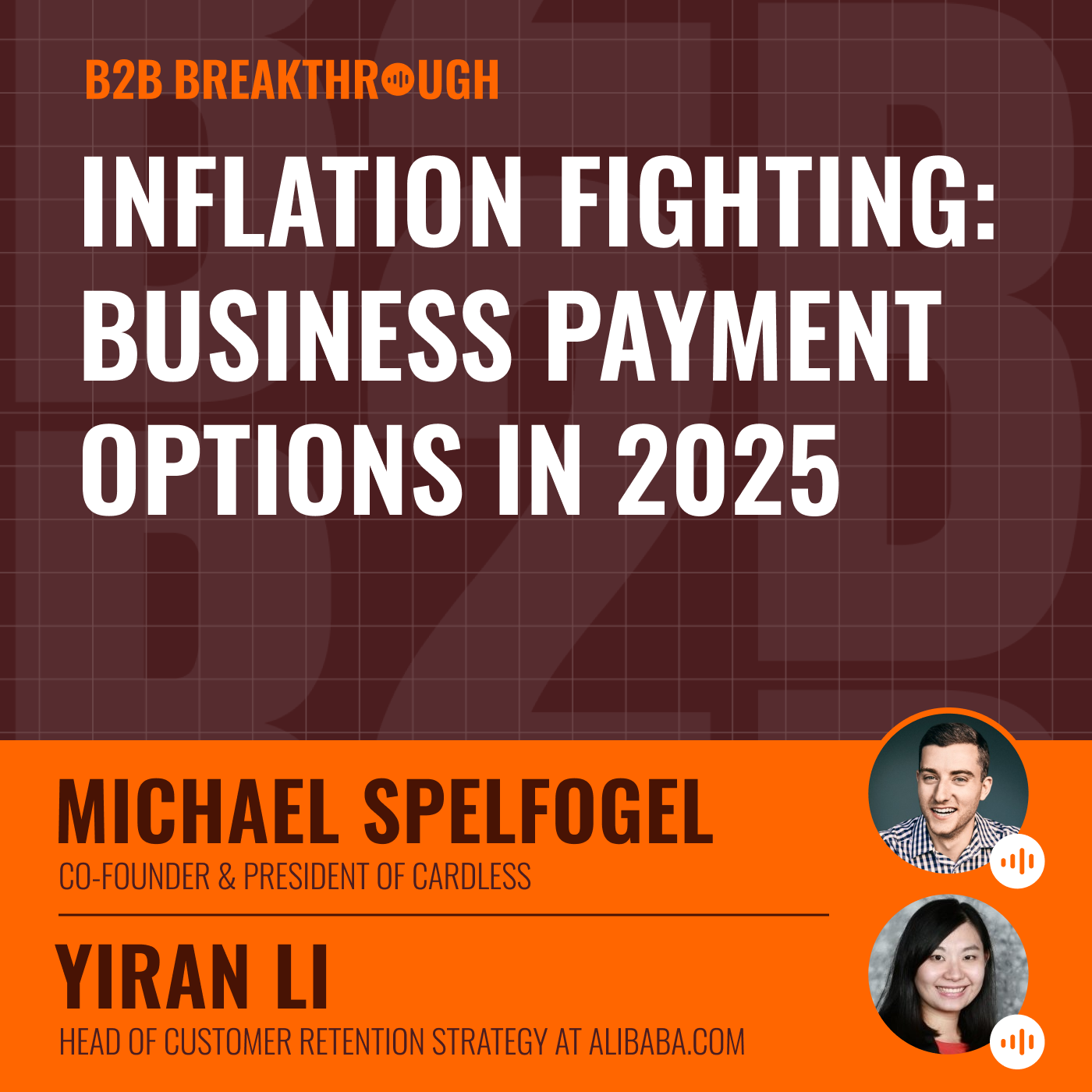
B2B Breakthrough Podcast
Inflation Fighting: Business payment options in 2025
00:33:15
In this episode of B2B Breakthrough, host Ciara Cristo sits down with Michael Spelfogel, Co-Founder and President of Cardless, and Yiran Li, Head of Customer Retention Strategy at Alibaba.com, to explore the evolving world of business financing. They discuss how small businesses can navigate inflation, leverage new credit solutions, and build strong business credit. From the Alibaba.com Business Edge credit card’s unique benefits to strategies for managing cash flow and supplier diversification, this episode offers actionable insights for business owners looking to scale. Tune in to discover how digital payments and flexible financing are shaping the future of global e-commerce.
Loading summary
Transcript56 lines
- [00:03]
Michael Spelfogel
If you're looking to expand and you need to buy more raw materials or goods to then go out and sell, if you're only relying on your sales and your cash flows, you have a negative working capital system, which is problematic, and it's really hard to grow incrementally.
- [00:20]
Sierra Christo
Welcome to the B2B Breakthrough Podcast. We're here to bring you all the best knowledge, insights and strategies from e commerce experts, successful business owners, and the team@alibaba.com that you'll need to grow your business and to achieve your next big breakthrough. I'm your host, Sierra Christo. Inflation, am I right? It's a doozy. We feel it as consumers and as business owners. More than half of businesses in the US rank inflation as their number one concern. And 61% plan to or are actively paying for their business expenses on a company card. So we're talking all things finance today with two incredible guests. Joining us from the wonderful world of finance is our partner and friend, Michael Spelfogel, CEO of Cardless Cardless powers the new Alibaba.com Business Edge credit card that could be helping you offset business expenses. He's here to shed some light on how to contend with our current economic climate and build credit for your business. And sharing her insights and solutions for small businesses is my dear colleague, Eron Lee, who leads buyer benefit strategies to ensure smooth experiences on Alibaba.comEran and Michael, welcome to the show.
- [01:24]
Eron Lee
Thank you.
- [01:24]
Michael Spelfogel
It's nice to be here.
- [01:26]
Sierra Christo
Oh, really happy to have you. We have a lot that we want to get into today, but I want to take a moment and just kind of set the stage for who our audience is, who the folks are that are using Alibaba.com and in my two years at the company, I've met some really incredible business owners, and they've all got these diverse models powering their businesses. They're solopreneurs, side hustlers, inventors, designers. They all have different talents and backgrounds, so it's kind of difficult to paint them with this homogenous brush and say, you know, business owners is one distinct group. But, you know, there are a couple things that unify everyone. It's their drive. You know, no one is complacent. I've never met a complacent business owner. And the second is this universal struggle with financing and funding and looking for the next grant or accelerator and or whatever solution is available to them. And it is an ongoing struggle for a lot of them. So, Iran, can you start us off here and Help us understand a little bit more who the core users are on Alibaba.com Absolutely, Sarah.
- [02:31]
Eron Lee
So Alibaba.com serves a diverse range of business buyers. So we can generally categorize them into three main groups. So the first is the small and medium sized business owners. So they are independent retailers, e commerce sellers and wholesalers who rely on Alibaba.com for bulk sourcing at a competitive prices. So many are entrepreneurs running their own online stores or brick and mortar shops. And second type of buyers we see on Alibaba.com are those procurement specialists and special supply chain managers. So they are from larger businesses and organizations and they often have dedicated teams responsible for sourcing inventory, raw materials or components from global suppliers. And a third group of buyers we see are manufacturers and product developers like they are inventors, designers, private label brands who use Alibaba.com to find suppliers that can help them bring their products to the market. They often customize or develop goods from scratch. So regardless of their business models, these buyers use Alibaba.com for efficient and cost effective sourcing solutions that allow them to maintain competitive in this global market.
- [03:47]
Sierra Christo
And can you talk to us a little bit about how these groups of buyers are financing their sourcing? What are those common methods they've been using to date?
- [03:57]
Eron Lee
A lot of our small businesses are still paying the suppliers directly with credit cards, bank transfers or digital payments like PayPal. So it's simple, but it can tie up a lot of cash. A second type of well method we see is from suppliers like a supplier give them a payment terms. So some suppliers, they do offer payment terms, but this usually depends on how strong the buyer's relationship is with that particular supplier. And the third type we see is business loans and credit cards. Many of our buyers, especially here in the US use business credit cards or loans to help manage cash flow. A lot of the business owners lean on company cars, not just for financing, but also for rewards and expense tracking. And lastly, we also see a lot of final pay later usage. So this is becoming a big deal in payment. Instead of paying everything upfront, businesses can split payments into instruments, making it easier to stock up the inventory without draining their cash flow. So at the end of the day, I think businesses are looking for more flexibility. They need financing options that keep operations running smoothly without putting too much strain on their cash flow.
- [05:13]
Sierra Christo
Totally. And this is a unique example for our platform in terms of the breakdown. But looking for those flexible solutions is a much broader problem. So Michael, I want to come to you and talk a little bit more broadly about the ecosystem. And can you tell us a little bit more about the financing options that are widely available for business owners across the board?
- [05:35]
Michael Spelfogel
I think it's so interesting. The vantage point Alibaba has and where the company sits. We found that the people using this credit card are largely in that first bucket. There are people that are sole proprietors, mom and pop shop, they're, you know, hustling and building a brand or running a small business. At the same time, we do see that third bucket as well. Folks that work for larger companies and are looking for distribution or building custom goods and materials. So online e commerce providers, we see people that build out custom shoe companies, apply for cards, things like that. And the common thread is people want rewards or people want cash flow benefits. And in terms of what is the most impactful for businesses today, I'd say certainly one of those things, but that cash flow piece is probably the most important. The number one sided benefit we offer on our credit cards is 68 payment terms. So you have longer time duration to pay for your, your charge on alibaba.com when you use this credit card. So we want to make this the default method of payment. And for people that fit into those buckets, they're running their own business or they're working to source materials that you know, then takes time to sell and get cash flows from. You want to be able to help them with that financing.
- [06:52]
Sierra Christo
At the same time, what is the, the biggest challenge with traditional payment methods that people have been facing prior to options like this?
- [07:01]
Michael Spelfogel
Well, what I've seen from our vantage point is a lot of small businesses are actually using personal consumer credit cards to buy things for their businesses. And that indicates to me two things. Number one, either their business is nascent, it hasn't got, you know, traditional S and P cards set up, or banking infrastructure designed for businesses. Or in, you know, more common cases, that infrastructure doesn't exist at all. So people have no other option but to use a personal card or they don't benefit from these cash flow options that larger businesses certainly do. So this card in a way is meant to level the playing field. It's meant to empower brands and small businesses of all stripes and sizes to get access to critical financial products. So it's much more beneficial to a company in that position to put a charge on an S and P card, earn rewards, or use those cash flow benefits versus, you know, an everyday credit card you use for personal expenses instead.
- [07:59]
Sierra Christo
Part of the perk, I would imagine, for a small business Owner using a personal credit card in a situation like this is building those points and just trying to benefit from that in a business context personally. And there's some overlap there, I'm sure. And building your credit. Now building your credit is something that we all understand as adults in the world, you know, using personal credit cards. But how can having those benefits really work for you and for your business? What's at stake building business credit with a card like this?
- [08:30]
Michael Spelfogel
It's such a good question, and a lot of people don't realize this, but there are consumer credit bureaus. You've probably heard of them. Experian, Equifax, TransUnion. But then there are commercial bureaus, too. SBFE is one that Carlos uses today. So the commercial bureaus do sort of the same thing that consumer bureaus do, but for small business use cases. So they look at your payment history, your, your business history, how much revenue you've generated and your cash flows and try and get a sense of your riskiness as a borrower on, on the commercial side of things. So when we underwrite customers today for Alibaba's business credit card, we're actually using both consumer credit as well as commercial credit. And for people that run businesses that are newer or that don't have business data, will actually help them build their business credit by furnishing good payment history to business bureaus, not just the consumer bureau.
- [09:23]
Sierra Christo
Interesting. That's a distinction that I don't often make as someone who doesn't own a business and can't relate. So I think it brings with itself its own set of challenges. And eran, I know you have, you're really close to the business owners on our platform and how they're managing these situations. You know, beyond separating those finances and getting your house in order, how can you mitigate these challenges for our users? Or what are some tools and features that they can leverage to feel a little bit more secure in these, in these massive purchases?
- [09:55]
Eron Lee
So, you know, Alibaba.com is all here like to provide a suite of protections and tools to really mitigate this kind of situations. Right. So we are committed to making making global trade easier and more secure for business owners. And we have several tools that, you know, I'm going to mention it one by one. So first one is a trade assurance. So this is our building protection program that safeguards waters from payments to delivery. And the second tool that we offer is a flexible payment options. So beyond traditional methods, we've introduced solutions like Buy now, pay later. So binary pay later really allows eligible businesses to defer payment while securing inventory today. So this is incredibly helpful for managing cash flow. And then the third tool that we provide is the Alibaba.com Business Edge credit card. So this new business credit card, of course, powered by Cartless, gives our business owners more purchasing power with cash back rewards and financing options that really fit their needs. So ultimately, business purchases are larger. Right. So they require more protection. We get it. And they demand more flexible financing tools that personal purchases. So our goal is really to provide these solutions to our business owners so they can focus on growth rather than financial roadblocks.
- [11:20]
Sierra Christo
I mean, growth is, is the cornerstone of all of this. It's exactly the main driving factor. Are you finding that there is any reluctance to adopting a credit card or if there's any bigger concerns around these flexible, you know, maybe unfamiliar financing options for small business owners?
- [11:40]
Eron Lee
Yeah, for sure. So, you know, there are a few big reasons that we see that some of the business owners hesitate to use financing options. First, there is just a fear of debt and the rate payment uncertainty. So especially for those newer entrepreneurs and I, they probably feel like it. Taking on debt can feel risky and they're worried about overextending themselves and losing control over their cash flow, which is completely understandable. And then there is a concern about the hidden fees or inflexible terms. So, like a business owner is really value transparency. And then traditional financing can sometimes come with a little bit complicated terms with fluctuating interest rate and surprise fees, which can make them wary of borrowing. And then finally, we know that some businesses just prefer the simplicity of paying upfront, so they like the idea of paying as they go, even if it means the missing out on growth opportunities that come with more flexible credit solutions.
- [12:42]
Michael Spelfogel
One of the reasons we started Cardless in the first place was for that very reason you called out. I think there's a lack of transparency in financial services in general. Credit cards oftentimes in the US have a negative perception or connotation, and we're bringing visibility back to that space that sometimes didn't, you know, offer that. So things that Cardless does that I think are quite unique is we're digital first, so we'll actually give people instant access to their credit card number. They can use it right away. We really dark this brand to bring that level of ownership back to financial services and empower business owners to take control of their financial livelihoods through the product and through the actual offering itself.
- [13:25]
Sierra Christo
Michael, I want to talk to you a little bit more broadly about advice that you have for a small business owner, whether they're a sole proprietor or, you know, working with a small team on how to build that creditworthiness and, and feel more confident in this decision.
- [13:41]
Michael Spelfogel
Yeah, it's, it's such an important conversation and I think it's one that people don't always have out in the open because there's definitely a stigma around credit, especially on the consumer side we have. So I think, you know, the number one word of advice I have, and this is speaking as someone who has three credit cards, which I don't always love to interrupt you, but you get good context and experience from lending businesses like banks. I think managing your credit responsibly is the most important thing. As a consumer and also as a small business owner, debt is a very powerful thing. People know how to wield it to their advantage and use it to improve their cash flows to get leverage on their businesses. But when mismanaged, it becomes incredibly problematic and it can create systems and outcomes that are bad for people and for businesses. So I think that sort of use transcends consumer versus business. Using credit responsibilities is really important, but SMBs can have a leg up. The financial products that are out there are getting much better. The Alibaba credit card's a great example of that. Giving people the flexibility to choose between cash flow or rewards. They can literally toggle it on and off in the checkout flow. And perhaps most importantly is the structural components of lending credit cards in the business side, they earn more interchange, the rewards are better. So they're really intended to support the end user and change the way that businesses interact with their financial services providers and give them those cash flow benefits. Most importantly, so you can spread out when you pay back the purchase of all the inventory and goods you're buying and then turning around and selling and.
- [15:26]
Sierra Christo
How does that benefit them in the long run? When we talk about scaling your small.
- [15:31]
Michael Spelfogel
Business, it allows you to get access to capital more quickly. And that is the lifeblood of any small business. So you know, if you're looking to expand and you need to buy more raw materials or goods to then go out and sell, if you're only relying on your sales and your cash flows, you have a negative working capital system, which is problematic and it's really hard to grow incrementally. So if you're good about your cash flows and you understand you're going to make more money over time, you can borrow against that future cash flow stream. Use your credit card.
- [16:04]
Sierra Christo
Is the complexity of sourcing holding you back Are you getting overwhelmed by information in an endless search now? Sourcing for your business has never been easier. Meet Axio, the world's first AI sourcing engine that helps you source like a pro with five key features. You'll get product inspiration that leverages real time market data from comprehensive web insights, social media trends and B2B knowledge. Generate detailed requirements to find the perfect match from AI verified products and suppliers through Axio's multimodal search. Use super comparison to easily discover and compare millions of of products from leading suppliers, focusing on the best selling and most competitive options. With Axio page, you'll get AI generated encyclopedia pages that compile verified product information for each sku. And finally leverage Axio Agent to streamline negotiations with conversation guidance, real time summaries and direct answers about products and suppliers without having to browse detail pages. Head over to Axio AI today. That's Accio to try Axio for free and start sourcing like a pro. So I just want to take a quick moment to address the elephant in the room being tariffs. So Eron, I want to talk to you a little bit about this. I know that this is a concern that's been brewing for a while now among small business owners, among consumers. And I mean, simply put, higher tariffs means that business owners need more access to that capital and more flexible solutions. So how are you finding. Small business owners are navigating this particular challenge.
- [17:37]
Eron Lee
So one big strategy that they're using is diversifying their supplier networks. So they're looking at the suppliers in different regions really just to keep the cost down, to keep it under control. So another approach that we're seeing is using financing tools to maintain purchasing power. So many of our business owners are turning to flexible credit solutions to help them buy in bulk without straining their cash flow. We're also seeing businesses placing larger orders just to secure better discounts, so when they have access to credit, they can take advantage of the bulk pricing and reduce their cost per unit. So finally many businesses are negotiating with their suppliers. So whether it's for better pricing, extended payment terms or bundled deals, so stronger supplier relationships can really go a long way in managing risk. A rising cost.
- [18:34]
Michael Spelfogel
And my perspective is to add real quick, the hardest part about the tariffs is the volatility of it. You know, there was a 25% proposal in exit or Canada that was paused at least for the time being. China at 10%, you know, 10% in the meaningful tariff. And ultimately our view is that's passed on to the end customer and that makes life harder for everyone involved. And like Yaron said, that makes the access to financial products, access to lending capital, paying in terms like 60 days and cash flow benefits for businesses even more important. So I think products like Dalibaba Credit card are going to continue to gain in prominence at times where there's uncertainty.
- [19:15]
Sierra Christo
Yeah, for sure. And you know, you mentioned cards like Alibaba's and yes, there are a lot of great business cards on the market for, you know, to find solutions like this. So. But I want to talk about the different user that, that we cater to with ours. Aaron, can you talk to me a little bit about what, what the Business Edge credit card does and why, why do we even need it to exist?
- [19:40]
Eron Lee
Yeah, that's a great question. So I think the truth is that the traditional business credit cards don't always work for Alibaba.com buyers. That's because our buyers, especially those E commerce sellers and small business owners, have some unique challenges. So for example, they deal with high upfront costs for things like samples and customization fees. And then their products sometimes have shorter life cycles so they need to move inventory fast. So while they want to buy in bulk for better pricing, they don't always have the cash on hand to do it. So that's where Alibaba.com business edge credit card comes in. So it gives them more flexibility to manage those costs without slowing down the growth and also rewards them for business purchases and provides extra protection. So all in a way that's tailored to global sourcing.
- [20:34]
Sierra Christo
Yeah, it's an incredibly niche category and it's great that there is finally.
- [20:38]
Eron Lee
That's right.
- [20:39]
Sierra Christo
Going back to some of the archetypes, some of the different kinds of business owners that use our platform. There's so much diversity in that group. But Michael, I was hoping you could talk to me a little bit about what kind of user could benefit from this the most. Could you paint a picture of the ideal cardholder for this product?
- [20:58]
Michael Spelfogel
Yeah, of course. It's something we spend a lot of time thinking through as we craft the value proposition. Who is the intended audience? Who's going to get this? Who's going to benefit from this the most? And you know, look at the benefits we're offering. So if you need or you have a problem with your item, there's you know, extended order protection on it and there's the regular day to day rewards which people come to expect not just on Alibaba, but bonus rewards in different categories related to business shipping and online ads and things, things like that. And then of course that 60 day payment term. So I think the people that benefit from this the most are small business owners that buy frequently in Alibaba. They're not doing this as a casual thing every year, every couple years, but this is the go to way that they're supplying their business and they're coming back to Alibaba.com every few months or every few weeks to buy more. So that frequency is really important. Businesses that have a need for changing how their cash flows work, this product is great for and if you combine it with the rewards and benefits the card offers, if you're a frequent Alibaba.com shopper, that's the perfect combination.
- [22:08]
Sierra Christo
Yeah. And so that, that long term payoff comes into play here as well in terms of reshaping the way that your, your cash flow works in your entire financial setup.
- [22:19]
Michael Spelfogel
I mean, if you think about the small business owners that already are using the card every day, they're using a top of wallet. They want to get more rewards, they want to be more engaged with Alibaba and for their business, the card's a game changer because it gives them the opportunity to really grow their business in a way that might not otherwise be possible.
- [22:39]
Sierra Christo
You know, we were just talking about this micro use case of a single user and how it benefits their business. Now, when we look at things from the Alibaba.com perspective, how does the use of this credit card with this audience reshape the purchasing habits and processes? What do you anticipate seeing from this user group as a whole moving forward?
- [23:01]
Eron Lee
Right, so I think we're really hoping to see this group of buyers. Whoa, first of all, like have a good habit of using credit. Right. Like we want to see them having like leaning more towards using the credit card. Well, start using more Fox Flexible financing solutions. So I think that's really what we're hoping to see for these group of buyers.
- [23:25]
Sierra Christo
Great. I want to pivot us a little bit to talk about the broader landscape again and the future of digital credit in E commerce. Michael, you've been in this industry for a while and you're, you're so connected to what's happening in this space. Can you talk to us a bit about what's next for digital lending and how AI, alternative credit scoring or blockchain play a role in this environment, in this movement?
- [23:52]
Michael Spelfogel
Yeah, it's a great question and I think the world is changing quickly and AI plays a large part in that. Things that I think are going to happen in the next five years are that consumers and small Businesses are going to default to getting their financial services not through traditional banks and brick and mortar branches, but through brands that they know, that they trust and that they interact with on a frequent basis. So I wouldn't be surprised to see more consumers gravitate towards financial products issued by brands like Alibaba. You know, Cardless helps work with Alibaba to understand a business's cash flows and financial livelihood before they ever apply for the product to see if it could be a good fit for them. And I think we'll see that trend continue with more and more brands using data they have access to to get a better understanding of a brand or an SMB or a consumer's financial livelihood and then build products that are AI enabled to make that experience better. Whether it's chatbots for customer service, whether it's better data sharing to give offers that are relevant to them in their business. But I think those changes are going to happen at a pretty record pace over the next couple of years.
- [25:03]
Sierra Christo
There's so much to learn, there's, it's almost overwhelming. Yeah, to really weigh the options of the different products on the platform, different options to proceed with with a major business purchase. And these purchases are massive. So keeping that in mind, I want to talk about moving forward and preparing for options like this. So what can Alibaba.com buyers do, those folks who may be interested in this credit card option, how can they prepare for integrating this into their day to day procurement practices?
- [25:41]
Eron Lee
Yeah, I think two things. So the first, I think our buyers should really evaluate on their current purchasing and cash flow situations and then really to understand like what are they using? Right. Like do they have a, like some cash flow constraints that what strategy are they using now, what strategy strategy can they using in the future? And two is really consider their growth goals. Right. So if they're looking to scale their business, I mean flexible financing options could help them tremendously in helping them secure inventory faster and then expand their product offerings. I think buyers should definitely like evaluate their current situation and think about long term, how they want to grow and where they want to be. Maybe in like in a year, in three years and in five years I.
- [26:33]
Sierra Christo
Want to come back to the buy now, pay later option as well. Because we've seen that as an option in the marketplace from a consumer perspective since 2005. It's been around for a minute and it's been steadily growing in the past 20 years as that has been growing. On the consumer side, have you seen B2B habits changing alongside that? That Buy Now Pay later option, has that been integrated more and more on the business owner side? And is that like a competitor to digital, to digital credit?
- [27:06]
Michael Spelfogel
Yeah, it definitely is. Ade Buyer later is just a one point, moment in time financing option. And I think the reality is that there are a lot of different ways that people and businesses can finance things. The thing that I love about credit cards and what I think makes this company great is that we're not just building this one time relationship with the customer where they say I want to finance this big purchase, pay six installments and be done with it. We're actually trying to support them and build a product that is longer lasting. And it's a credit card that works in perpetuity. So we're constantly giving them access to capital.
- [27:43]
Eron Lee
Yeah, I would say like both Buy Now Pay later and the credit cards, they serve different purposes. Right. So our buyers really evaluate and you know, use both, but maybe for different, different scenario, different situations. For Alibaba.com we definitely are seeing an uptick in terms of like the number of buyers using Buy Now Pay later options. We've seen some successes there, but also at the same time, like what Michael said, like what Buy Now Pay later cannot provide you is a long term relationship. Right. That rewards that building into the credit card. So like, you know, simply put that way, like you don't get rewards or cash back from using Buy Now Pay Later. So I think that's a unique feature that Alibaba.com business edge credit card can provide.
- [28:31]
Sierra Christo
Yeah, it's that forward thinking mentality that's really helpful in, in scaling and in preparing yourselves for a prosperous future for your, for your business for sure. Now speaking of the future, let's do some forecasting. I want to look five years down the line. Where do you feel that we will stand when it comes to payment flexibility for business owners? What does 2030 look like?
- [28:57]
Michael Spelfogel
I think it's going to look a lot like the world in China looks today. One of the reasons we called this company Cardless was because I met my co founder Scott in Beijing. We were living on Peking University's campus and in the span of a few years going back and forth, China, they went from a completely cash focused economy to one that operated exclusively on things like hourly pay, digital payments and different lending opportunities. So I think the future is Cardless, literally speaking. And it's probably sooner than you think. I think in the US we're going to move to that same model where people are no longer using cash. They're probably not Even bringing a physical credit card around, they just have their phone and there's complete financial flexibility to finance a purchase at point of sale, to put it on a credit card, add in payment terms, turn those toggles on and off and optimize for your lives in a really flexible way.
- [29:55]
Eron Lee
Yeah, I think that's really cool. Right? That kind of reminds me, I think it's two, three years ago, I visit my mom in Beijing for the first time since Pandemic. So I was shocked because I hadn't been home for, I want to say, maybe four or five years. And that was my first time going back home. And then I literally couldn't got to pay for the taxi because the taxi driver doesn't accept cash payment. So that's crazy. And then. So I would definitely agree with that. And even now, like I use Apple Pay pretty much everywhere. Right. Like on the merchants where. Except Apple pays. I pretty much just use it just like so convenient. So definitely I would say that convenience perspective will be the future and also transparency and the flexibility. Right? So like I'm sure that the buyers will have more and more flexible payment options in the future. So I'm really looking forward to it.
- [30:55]
Sierra Christo
The days of Cash is King is behind us, guys. We are, we are.
- [31:00]
Michael Spelfogel
We're fully cardless.
- [31:02]
Sierra Christo
You called it, Michael. You, you laid the foundation, predicted it. I love it. All right, awesome. Well, this has been a really helpful guide. I want to ask you both, Michael, starting with you, if there are any resources that you can recommend to folks where they can find you to continue this conversation and research.
- [31:20]
Michael Spelfogel
Yeah, you know, our website is a bunch of resources. We have a blog, we have some educational material. Taking a step back through Cardless. And as much as I love our LinkedIn and all the content we put out, there are a lot of other bloggers that put out great pieces of information too. You know, the points guy was actually the first place I ever worked. They have fantastic information, more from a consumer lens, but they cover business use cases as well. And I think that online ecosystem is really helpful in getting people set up and understanding how to build a business.
- [31:50]
Sierra Christo
Iran, do you have any, any resources or tools on the platform that you would like to recommend, folks before we wrap up here?
- [31:57]
Eron Lee
Yeah, so we have a buyer central on alibaba.com so everything that buyers needs to know, like whether it's trade assurance related or payment related, everything can be found on buyer Central. But on the same time, I know like Sierra and wonderful marketing team has put together a lot of like podcasts.
- [32:16]
Sierra Christo
And we'll link all of this in our post here on social media, so be sure to follow us on Instagram, on LinkedIn, on Facebook, all the places. And we'll, we'll keep you posted with the good stuff. Promise. All right. Well, Michael and Eran, thank you so much for chatting today. This was delightful.
- [32:31]
Eron Lee
Thank you so much, Sarah.
- [32:32]
Michael Spelfogel
Thank you so much.
- [32:35]
Sierra Christo
B2B Breakthrough is produced by Alibaba.com to find out how Alibaba.com is empowering its customers with the tools, services and resources they need to grow their business, visit Alibaba.com and then make sure to search for B2B Breakthrough on Spotify, Apple Podcasts, Podcast, or wherever you find your podcasts. The Alibaba.com Business Edge Credit card is issued by First Electronic bank, serviced by Cardless. Terms and conditions apply to all features discussed here, subject to credit approval, and applicants must have an Alibaba.com account in order to be eligible. Make sure to follow us so you don't miss future episodes. On behalf of the team here@alibaba.com, thanks for listening.