← B2B Breakthrough Podcast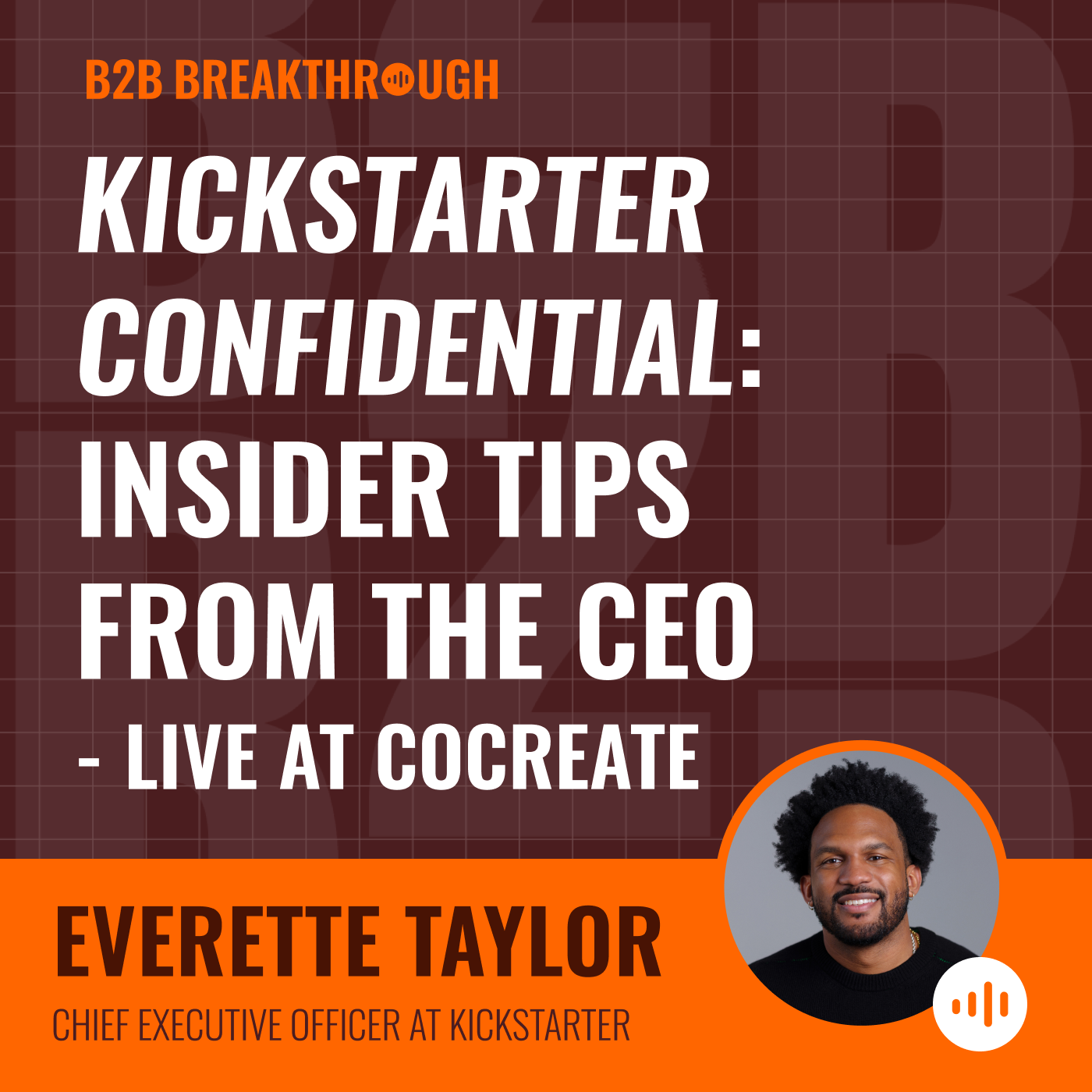
B2B Breakthrough Podcast
Kickstarter Confidential: Insider Tips from the CEO - Live at CoCreate
00:27:46
In this episode of the B2B Breakthrough podcast, Everette Taylor, CEO of Kickstarter, joins host Sharon Gai. With a diverse background from event ticketing to digital influencing, Everette’s journey is a testament to innovation and entrepreneurship. In this podcast, he shares his evolution from launching Easy Events to leading Kickstarter, and provides insights into what it means to be a modern inventor. Everette discusses the powerful role of Kickstarter in bringing creative projects to life, the misconceptions about the platform, and the strategies for setting and achieving campaign goals. Sharon Gai and Everette also dive into the latest trends in crowdfunding, the growing popularity of physical products, and offer tips on maintaining momentum and fulfilling backer expectations. You won’t want to miss this engaging and thought-provoking conversation with an extraordinary entrepreneur – so tune in now!
Loading summary
Transcript100 lines
- [00:01]
Sharon Guy
Welcome to the B2B Breakthrough Podcast. We're here to bring you all the best knowledge, insights and strategies from e commerce experts, successful business owners, and the team@alibaba.com that you'll need to grow your business and achieve your next big breakthrough. I'm your host, Sharon Guy.
- [00:17]
Everett Taylor
Welcome, Everett.
- [00:19]
What's up? We haven't even met yet.
- [00:21]
Sharon Guy
We have not met.
- [00:22]
Everett Taylor
How are you? I'm also a New Yorker, so.
- [00:24]
Yeah, I mean, I don't know. I haven't been in New York seven years yet. They say you have to be in New York seven years to claim it. Yeah, but I've been there for. And.
- [00:32]
Oh, is that the. Is that the magical number you have to hit seven?
- [00:35]
Yeah, it's bull, you know?
- [00:36]
Now if you feel like a New Yorker, you can call yourself a New Yorker. I'm a client, so. Everyone please welcome Everett Taylor.
- [00:43]
Hey, what's up, everybody?
- [00:45]
One more time to the stage. I'm going to read your very extensive bio.
- [00:50]
Oh, man, you can.
- [00:51]
You can, like, goes for pages.
- [00:53]
You can, like, shorten it. You could. You can remix it however you want to.
- [00:57]
Why don't you take us through your journey of all the places that you've been? Because prior to being CEO of Kickstarter, the CMO of Artsy, which was a online marketplace and selling fine art, but then you started your own company, and then you started a series of companies, including Pop Social, which I remember, Millicent Artx. And you are also a digital influencer, a brand ambassador for several companies. Anything you want to add to that resume?
- [01:28]
I think I'm a pretty good person too, you know, good boss.
- [01:31]
Okay, I like that. Also for the audience.
- [01:33]
Thank you for the 1. Clap in the audience.
- [01:35]
Yeah, yeah, no, go, go. Yeah, clap for that. This is also a live podcast recording, so thank you all for taking part in this live podcast recording too. I'll first start out by asking you about inventors, because we've seen a lot of different types of inventors today. What do you think it means to be an inventor in this day and age?
- [02:01]
So we have 8 billion plus people in the world, right? And we have 8 billion plus people with ideas, right? It's a lot. A lot of people with ideas. Inventors, to me, are the very, very small percentage of people out there that are willing to take that idea, believe in that idea, invest in that idea, sacrifice for that idea to make it a reality. You know, the people that are sitting in this room that are inventors, the people that are in here that are creators and entrepreneurs know that you are part of a small fraternity of people that are willing to actually go out there and make it happen and do it because everyone has ideas. But to me, inventors are the people that are brave enough and have the fortitude to actually make those ideas into reality.
- [02:48]
And you're an inventor yourself?
- [02:50]
I guess you could say that a little bit, yeah.
- [02:52]
Can you share with us what have you invented in the past and how has that shaped into your current role of being CEO of a marketplace that represents inventors?
- [03:02]
The first thing that I did, I'm a terrible developer. I went to this school called Virginia Tech. It's actually a great engineering school. But I didn't graduate. I dropped out. My first company was this company called Easy Events. And. And it started from me, just like I just liked to party at that time and point in my life. I was like 18, 19 years old. And I was trying to solve two things. Number one, when I was throwing parties, a lot of people would haggle us at the door being like, hey, I don't have cash or I don't have this or I don't have enough money. And so we created a way for the streamline that to be able to sell tickets to events digitally. This was a time when like Eventbrite wasn't a big. I didn't even know Eventbrite existed.
- [03:44]
So you were the OG Ticketmaster.
- [03:46]
I'm not going to say all that because I definitely didn't turn into a billion dollar company, but it was a great way to be able to sell tickets online. And then also we created a way for you to buy pictures from events so we would have, you know, a photographer at our events and if you wanted to buy tickets from the event, you could buy it in our online store. And so that was like the first thing that like I like created on my own. And then I founded several other companies after that for sure too.
- [04:13]
Were you always in the app space? Did you ever err on the side of physical products?
- [04:19]
Yeah, I've never invented a physical product. Like, honestly, going through and seeing all the entrepreneurs, inventors here and seeing like the physical products and like being at Kickstarter, to be honest, the people that do the best on Kickstarter, I mean we definitely have people who've created apps and films and music and all these things. But the things that like do the best on Kickstarter are actual physical products from like design and technology and hardware to books to games to anything that you can think of from like a physical product. They tend to do the best. I mean, Peloton started on Kickstarter, Oculus, which is named MetaQuest, Oura Ring, Brooklyn and Sheets, Auburn shoes, all these things. Wow. I didn't even start it on Kickstarter. Yeah.
- [05:06]
Because it's a really great platform to test out an idea.
- [05:09]
Yeah.
- [05:09]
Why do you think a lot of people actually don't launch on Kickstarter?
- [05:13]
They don't launch on Kickstarter.
- [05:15]
Yeah. Why don't they launch on some people make.
- [05:17]
Because I would say it seems obvious, right?
- [05:19]
It seems obvious that Kickstarter is already.
- [05:21]
A huge group of.
- [05:22]
How many users are there?
- [05:24]
We have over monthly over. I think we're over 30 or 40 million users monthly. Monthly active users. Yeah.
- [05:31]
So that's 30 million people waiting to see the latest and greatest product that is out there. So it kind of sounds obvious that if you're selling a physical product that you would show it to potentially 30 million customers. So why do you think the allbirds on the Peloton stay launched on there, but there's a vast majority of people that don't do that.
- [05:52]
I think there's a brand perception around Kickstarter sometimes that's wrong. Like some people think that Kickstarter is like, oh, I'm begging for money, or like looking like I need money when that's not the case. We have multi million dollar, multi billion dol companies anchor out of China, like they're launching new products all the time. Orel just launched new products. Hallmark just launched a new product. There's companies that are multinational, billion dollar companies that are launching products. There's multimillion dollar creators with millions of followers and audiences that are launching every single day. But I think there's still a perception from some people that are like, I don't want to look some type of way by launching on Kickstarter, but we're not, no offense to GoFundMe, which is an incredible platform too. But Kickstarter is not charity. Kickstarter is for creative projects and creative ideas. And people are investing in you because they want that product or they want that thing. So it's very, very different. And what I tell people is that Kickstarter 1 gives you a platform to centralize your audience, to bring your audience to one place where they can transact and support you. Number two, it's a platform where millions of people are active on the platform every day that are looking for new things in the niches that they are most interested in. Right. And so to me, it's really a no brainer if you're entrepreneurial minded and you're able to, you know, be humble enough to go out there and with your idea. But I think it's not for everybody, but we've proven that it's been a really great platform for a lot of people.
- [07:23]
Some of us also are considering raising money. So going to angel investors, how do you think that couples with launching on Kickstarter?
- [07:32]
How many of you guys have tried to go to angel investors or investors for your company by show of hands, and you guys know how hard that is by show of hands. You know, you go to an investor and they're like, oh, well, what kind of revenue have you done already? How many products have you sold already? All these things. Now it's getting so much harder to receive angel investments in venture capital investment. A lot of these investors now want to see product market fit. They want to see if you could actually sell product or get a product out to market. And so Kickstarter provides you an opportunity to prove yourself right? It gives you an opportunity to show that, hey, I've built an audience around this product. I've been able to actually build a prototype. I've been able to show that there's traction and interest before I take any dilutive capital.
- [08:17]
What's popular on Kickstarter to launch?
- [08:19]
Literally everything. I mean, I would say again, the most popular things are always going to be physical products. Like our two top categories are what we call design and technology. So that could be pretty much everything you saw today getting pitched is design and technology. These are physical products that are being brought into the market. Some of them are like very high tech things and some of them might be like a simple product or a coffee maker or whatever it is, or a 3D printer. So that's huge on our platform also. And design and technology includes fashion and jewelry and just anything you can imagine. Number two biggest is games, right? From video games to board games to card games, like, gaming is such a huge industry as a multi, multibillion dollar industry now, so that does well too. But like film and music and food and you name it, it does well on the platform. But I think those two categories take the cake for sure.
- [09:16]
And then I guess after somebody has successfully launched that campaign and raised that money, I guess first of all, let's break that down a bit. Like, if I launch something on Kickstarter, how can I ensure I reach my fundraising goal? And also, what should my fundraising goal even be?
- [09:32]
Oh, that's a great, great question. So one of the things that tell people is like setting Your goal is so important, like setting the right goal. Kickstarter is all or nothing. If you don't know what that means is that, say you. You have a goal of $100,000 and you raise $99,999.99, you will not get your money if you do not hit your goal. Now, does that ever happen? Like, if people are super close to their goal? Like, I don't see that happen. Like, people. If they're people who are super close to the goal, they just make it happen. We never have someone that's like, you know, a hundred dollars or a thousand dollars away from their goal, not hit their goal. Right? So people make it happen. But that means that, hey, if you're raising 25,000 and you raise 10,000 and you don't get to 25,000, then you're not going to get that money. And so I tell people all the time, think about the cost of your product. We have a product right now on the platform, and it's sunscreen, and it's only $10 for the sunscreen. And so that person's goal is like 4,000, but that's a lot of sunscreen at $10 a pop to get your first customers for it. Now, she set her goal for 40,000 or 50,000. Think about how many sunscreens she would have to sell or move to meet her goal. Right. And so I think Kickstarter is really about understanding the size of your organic audience. Like, how many people do you think you could actually drive to the platform? Right. Kickstarter is going to obviously add a lot of 30, 40, 50% support to it, but you got to be able to drive people to the platform as well. So realistically, what can you drive to the platform? Number two is the product that you have or the rewards that you have for your product. Does it make sense for your goal? If you're selling the $10 product and you have a $50,000 goal, can you actually sell that many products to get to that goal?
- [11:19]
So is there a formula of some sort? Like, if it's a under $20 product, then I multiply, I don't know, a potential number of traffic, and then times that by the conversion rate and then set that goal. And if it's something more expensive to use another formula or.
- [11:37]
Yeah, I mean, I think it's. The formula is really like, how many people from your. You think you can actually push to it. So if you think. Say you think you could push a hundred people. I tell people, cut that in half. Right. So like if you think you can get a hundred people from your own audience to support, cut that in half. It's not going to be what you think it is. And then factor in organically how many people you think you can get on Kickstarter and that should be your minimum viable goal is what I like to call it. Anything else above that is extra. So we have creators all the time. We had someone just have a $250,000 goal and they did $15 million, right. So we have people all the time that will have goals and then they have stretch goals after it. So oh, we hit 250,000. Our next stretch goal is half a million. Our next goal is a million, 2 million, 5 million. But they got the guaranteed money initially.
- [12:27]
So now say I've hit my goal and now I've gotten my money. Where do you advise these founders to be spending this money?
- [12:35]
It's different for every product and situation. Number one is like fulfillment. You don't want to lose the trust of your audience and your customers not being able to fulfill your product. Over 90% of Kickstarter products do fulfill, but there's less than 10% that don't, that don't actually deliver or fully deliver to their full audience. Right. And that is going to just break the trust if you're going to try to build and scale a company. So I tell people, number one is like, use that money to actually fulfill what you said that you were going to do. The next step is obviously business development, marketing, all the other things that you need for your business. But number one, you just have to make sure that you fulfill and ship the product that you said you would.
- [13:19]
Sharon Guy
I want to take a minute to talk about Alibaba Guaranteed. Sourcing can be long and complicated, but we're making it as easy as everyday online shopping. With Alibaba Guaranteed. A selection of stock and customizable products with on time delivery and money back for order issues. All guaranteed by Alibaba.com with Alibaba guaranteed, you can source with added confidence. You'll find products at competitive wholesale prices and you can enjoy peace of mind knowing your delivery will arrive on time by the guaranteed dates. Should any issues arise with your orders or product quality, you're covered with a comprehensive money back guarantee. Search for Alibaba Guaranteed to start sourcing more simply and achieve your next big breakthrough.
- [14:04]
Everett Taylor
What do you see as a very common headache that these founders have?
- [14:08]
I think something that's really, really common is like 2020, for example, like shipping rates just go crazy. So Sometimes when you're building out a product.
- [14:18]
Covid years.
- [14:19]
Yeah, the COVID years.
- [14:20]
What was Kickstarter like actually during that time?
- [14:23]
Actually, Kickstarter had, at that time, the best years. Now we're, you know, doing even better. But that had its best years because like Many E commerce, D2C brands or whatever it may be, the COVID years, people were at home and people were just buying E commerce, et cetera, et cetera. So at that point, 2020, 2021 were the best years Kickstarter ever had from a revenue standpoint. So we did really, really, really well. But also we had people that struggled sometimes to fulfill because shipping became so much more expensive, cost of goods and materials became so much more expensive. And so you can plan something out and then that could potentially become more expensive for you. And so you have to really have the foresight to make sure that you're leaving some gaps there for some expenses that you may not be expecting.
- [15:11]
Let's shift and talk a little bit about products themselves. So Kickstarter's purpose is to help inventors crowdfund to bring their products to life. And Alibaba.com serves that purpose to connect product makers to product sellers. So can you offer any advice to the audience who are full of entrepreneurs that's looking to bring a new product to market?
- [15:33]
Number one is, like, really understanding your audience and spending the time speaking to your audience. Like, what is the message that's going to really resonate with them? What is the marketing that's going to resonate with them? What's going to turn them off? Really, really understanding your core audience. I see what a problem with a lot of creators and entrepreneurs is. Like, they think something's a good idea, and so they think it'll be a great idea to their audience or how they brand things. And, like, just because you like the color magenta does not mean that your, your audience is going to like the color magenta. And so that just happens to be our competitor's color. But, you know, whatever. So making sure that you're spending the time and doing the research to really genuinely understand your audience, what they need, what they're looking for, where they actually reside. Someone could be telling you, I was talking to a creator earlier, that pitch is like, someone can be like, man, you got to get on TikTok and do TikTok ads. But, like, if your audience isn't on TikTok, you're just wasting your money. So really understanding the messaging that's going to resonate with your audience, but also where your audience lives, where do they consume content and information and news and things like that? And are you creating content and marketing in a way that's going to resonate with them?
- [16:46]
So in that campaign to help get to that goal, are people creating TikToks to drive traffic to that product page? Like, how are people usually for Kickstarter?
- [16:54]
Yeah, so people do all different types of things. People have email lists that they tap into. They do performance marketing. I launched two new business lines this year. One of them is called Kickstarter Performance. And so a la like in Etsy or other platforms, we actually are doing digital marketing and performance marketing for projects on the platform. For example, we just had this one project that broke and became the biggest games project of all time. And we were getting at 1.10x return on ad spend for that project and literally delivered millions of dollars extra to that project that they wouldn't have been able to drive themselves. And so performance marketing has been very, very powerful for people on Kickstarter, whether they use us, whether they use another agency, or whether they do it themselves. Obviously social media is huge. Social and digital communities tapping into that, all those things are pretty strong. But honestly, being able to like roll your sleeves up and enter into the communities that are going to most resonate with your product, that seems to be the most effective for sure.
- [17:59]
So speaking of games, I actually also, I had a friend recently who just launched his game. It's called Getting Laid off. Because in the tech industry there's a lot of layoffs happening. And then he was laid off. And they create a game. It's called Getting Laid Off. And games is one of those really growing categories on Kickstarter. What's another growing category people can think about?
- [18:19]
Comics and publishing is really growing fast. So any of you, all that have like a book that you want to publish, or if you're a big comic book or manga or all those things like comic books in publishing are like, I think comics might be the fastest growing category. Like the number one way that indie comic makers publish comics is through Kickstarter now. So that category has been insane for us for sure.
- [18:48]
Have you bought one recently or funded one recently?
- [18:51]
I have more comics than I ever thought I would own. I'm an avid Kickstarter backer. Like, I back hundreds of projects a year. It's like addictive to me. Like, for you all who are sitting here that don't have the Kickstarter app on your phone, Alicia, go ahead and download it right now. If you don't have it on your phone. Go and download the Kickstarter app right now. It's amazing because you're at the precipice of like, new creativity, new innovation. If you have a particular niche, whether it's music, whether it's film, whether it's new technology, you can find it on that platform. And so I love it. It's really addictive. And you're supporting fellow entrepreneurs and creators too.
- [19:29]
It's kind of also, I feel like a new way of shopping because, you know, there's like Amazon and you can browse all these products.
- [19:35]
Sure.
- [19:36]
But Kickstarter, it's a more content driven, content based form of shopping.
- [19:40]
Yeah. And you, you really get to know the creator and know their story. Like you might have this mom of four in the middle of the country that is like building AI robots in their garage. You have these really, really incredible stories. Like everyone sitting in this audience has a unique, incredible story. And Kickstarter gives you an opportunity to share that story with the world and share your passion for whatever it is that you're trying to do.
- [20:08]
What's the last thing that you backed?
- [20:10]
The last thing that I backed. Wow.
- [20:13]
What's a crazy product that you backed?
- [20:15]
I backed an album that was made completely by robot AI. Like a music album that was literally like not human made. Like it was like a robot that they programmed with AI that created music and made it into an album and I bought it.
- [20:33]
Do you have it right now?
- [20:34]
It's at home. Like, I don't, I don't have it. I don't have it here. But yeah, yeah, that's like a crazy project. I back so many like weird, wild things all the time. Like what's was so cool? Like even today, listening to all the pitches today I'm like, all these products are like things that I would see on Kickstarter. Right. And so I will just go at any given time and just back 20 projects. And the cool thing is you can back from a dollar to thousands of dollars or whatever you want to give or however you want. And so it's an easy way. But I back all different types of things. The category I probably back the most is actually film though. I really, really enjoy film.
- [21:12]
Like indie films or.
- [21:14]
Yeah, indie films, like short films, documentaries, feature length films. We've had Oscar winners, we've had people that showed us Sundance and Tribeca and Cannes. It's been really, really incredible. All the films that have come off the platform, I think we've had like over 90,000 films over the past 15 years. Launch on Kickstarter.
- [21:33]
Sometimes for early founders, it's really hard to keep up the momentum. Like, I think a lot of us are great idea creators and we have that idea, but sometimes it's hard to keep that idea going and see all the money come in. Do you have advice for people to. Throughout this process of launching to, to keep at it and just to keep going?
- [21:55]
Yeah. You know, it's so funny. I just did this conversation with Damon's partner on shark tank, Kevin O'Leary, and one of the things that he talked about. So if you guys watch Shark Tank, you probably noticed that many of the people that go on Shark Tank actually had launched a Kickstarter before going on Shark Tank. And he said that, you know, one of the things he looks out for is like, oh, this person? Yeah, you raised a million dollars on Kickstarter, but what were your sales in year two? What were your sales in year three? What type of momentum were you able to maintain after that? And that's why it's so, so important to really think about your utilization of your money and making sure that you have a customer acquisition strategy and plan in place. Like, okay, I launched this Kickstarter, I made this money, but now how do I attract my next thousand, ten thousand, fifty thousand customers? And I think so many people put so much energy into thinking for how to launch, they're not thinking long term about their strategy and how they're going to utilize the money from their Kickstarter. Like we said, to actually be able to put that into true customer acquisition and retention as well and increasing lifetime value.
- [23:04]
A lot of these campaigns that's launched out of Kickstarter, do you sort of send it to Kevin O'Leary or Damon and just kind of usher them that way? No, it's just something organic like a Kickstarter as grade one and you graduate and then grade two is the next.
- [23:20]
Thing, which is it's just been an organic process. I was talking to Kevin and we were like, we need to like put like an official partnership together because so many Kickstarter projects are on Shark Tank. But it's just been an organization organic process. Right. Like this is Kickstarter attracts people who are entrepreneurial minded that want to bring their ideas into the world. People go on Shark Tank because they want to further validate their idea and get the support to scale these ideas. And so I think Kickstarter is a great launch pad. And then, you know, a place like Shark Tank can pour the gasoline onto the fire to continue to scale that product.
- [23:54]
These Two mega brands aside, Kickstarter and Shark Tank. Because sometimes Shark Tank is very hard to get on, too, especially if you're a new product. And then Kickstarter. Kickstarter, with all of the campaigns, are there other platforms or hubs that entrepreneurs can consider going on?
- [24:11]
No, Kickstarter is the only one. Don't even think about anything else. What are you guys doing? No, I'm kidding. There's some really cool accelerators out there for entrepreneurs, but be very, very careful.
- [24:23]
For products, for physical products, for people.
- [24:25]
That are building products and things like that. But be very, very careful, because some of these accelerators, they prey on entrepreneurs and they take, I think, too much equity for the money that they're giving and the resources that they're giving. So just be very, very careful with that. But there's a lot of grants out there for entrepreneurs and things like that. And so I know so many entrepreneurs that are, like, literally living off of just grants that they're winning. I've given out grants with different organizations, but I think one of the best things you can do is finding your tribe. Like, the people that are here at Co Create, this is your tribe. Like, you are all from different places in the world, but coming together and bonding together and networking and leaning on one another and sharing information is super, super powerful. So that when you want to launch on Kickstarter, you have that support.
- [25:14]
Okay. So I'm going to put you on the spot as we close things up.
- [25:17]
Okay.
- [25:18]
If you would crowdfund any product idea, no matter how crazy or impractical it would be, what would it be and why?
- [25:26]
So there's this poet named Nikki Giovanni. I don't know if anybody's familiar with Nikki Giovanni. She taught at my alma mater. I didn't graduate Virginia Tech, but she's like, an incredible woman, and her dream was to always go to space. And she has an incredible documentary that launched at Sundance last year. I think it's like Nikki Giovanni Goes to Mars or something like that. I can't remember exactly what it's called, but I would love to do a Kickstarter to send Nikki Giovanni to space and to have the first.
- [25:55]
What would you put as your fundraising goal?
- [25:57]
Oh, it's $120 million to send someone to space.
- [26:01]
And that much still is it.
- [26:03]
Yeah, I heard it's like 120 million, but I could be wrong.
- [26:06]
I heard that at, like, Bezos with the Blue Origins thing, because he's also trying to commoditize and try to make that into, like, a luxury experience that.
- [26:15]
It could hopefully is less than 120 million. But we've never had a poet be in space and describe the experience of what it's like to be in space. And Nikki Giovanni is such an incredible poet person. And what gets me out of bed every day is the ability to help people live out their dreams. I think that's what makes Kickstarter so, so special. That's what makes Alibaba so special. It gives people a platform to live out their dreams. So if I could do anything for a Kickstarter, it would be to help someone like Nikki Giovanni live out her dream.
- [26:49]
And then after you do that, can you put me to space, too? Well, that is all we have today. Thank you so much for being with us and sharing all of this.
- [26:59]
We're New York homies now.
- [27:01]
Yes. We're going to meet up in New York before we meet up in space, hopefully. And thank you guys for being part of this episode, which is the first live taping of our podcast. And thanks so much for coming together.
- [27:15]
Thank you, everybody. Thank you so much.
- [27:20]
Sharon Guy
B2B Breakthrough is produced by Alibaba.com to find out how Alibaba.com is empowering its customers with the tools, services and resources they need to grow their businesses. Visit Alibaba.com and then make sure to search for B2B Breakthrough Podcast on Spotify, Apple Podcasts, or wherever you find your podcasts. Make sure to follow us so you don't miss future episodes. On behalf of the team here@alibaba.com, thanks for listening.