← B2B Breakthrough Podcast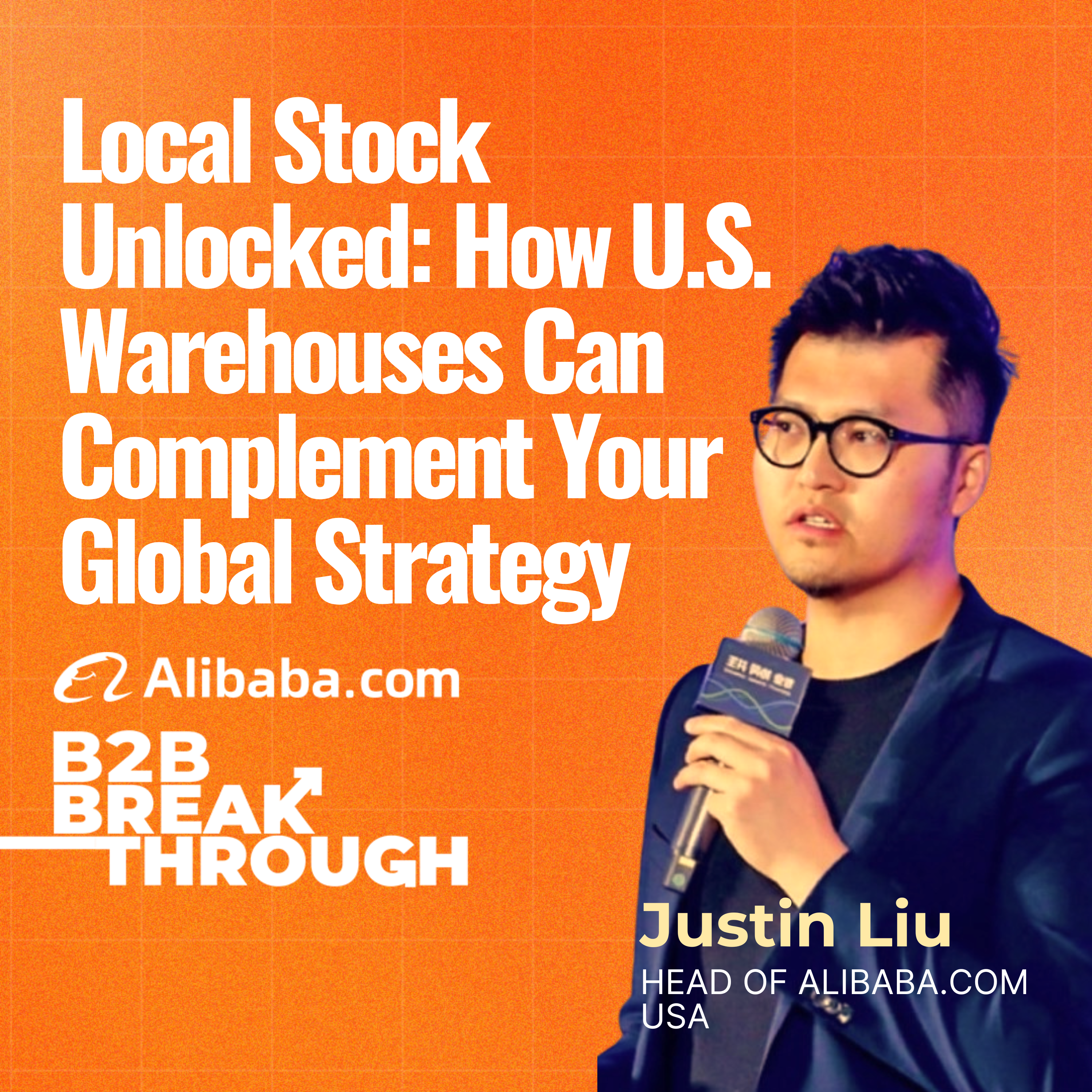
B2B Breakthrough Podcast
Local Stock Unlocked: How U.S. Warehouses Can Complement Your Global Strategy
00:35:17
Could catalog-based browsing transform how you discover new products for your business?Sourcing globally isn't just about finding the lowest prices—it's about building resilient supply chains and smart business relationships. In this episode of B2B Breakthrough, host Ciara Cristo chats with Justin Liu (https://www.linkedin.com/in/justinliu/), U.S. Country Manager for Alibaba.com, about helping U.S. businesses navigate unpredictable times through diversified sourcing strategies. Learn how today's retailers and manufacturers can leverage both international suppliers and emerging U.S. brands to build stronger distribution networks. Whether you're a small business scaling up or a retailer diversifying your inventory, Justin offers practical insights on everything from catalog-based discovery to local stock opportunities.Tune in to learn: (00:00) Platform Strategy and Buyer Experience Focus (01:22) Justin Liu's Role as U.S. Country Manager (02:50) Challenges Facing Small Business Owner...
Loading summary
Transcript40 lines
- [00:01]
Justin Liu
If I'm going To summarize what Alibaba.com has done in terms of helping buyers, it comes down to in the past couple of years, us our commitment to really sit down, understand the US Buyer's experience, what are the pain points, be it big or small, and be committed to make fixes and improvements to actually be able to provide a better experience to our buyers.
- [00:29]
Sierra Christo
Welcome to the B2B Breakthrough Podcast. We're here to bring you all the best knowledge, insights and strategies from e commerce experts, successful business owners, and the team@alibaba.com that you'll need to grow your business and achieve your next big breakthrough. I'm your host, Sierra Christo.
- [00:45]
Narrator
Before we dive in, a quick heads up.
- [00:47]
Sierra Christo
This episode was recorded before the recent.
- [00:49]
Narrator
90 day pause on tariffs was announced. While all the information we're sharing is still super relevant, we always recommend staying nimble. Things can change fast.
- [00:56]
Sierra Christo
If you've got the chance to stock.
- [00:57]
Narrator
Up during this pause, it might not.
- [00:59]
Sierra Christo
Be a bad move.
- [01:00]
Narrator
At Alibaba.com, we're here to help business owners like you master the twists and turns of global whether it's navigating tariffs, streamlining logistics, or protecting your shipments. So stick around for actionable tips from one of our own on how to make the supply chain work for your business, whether you're a buyer, seller, or just trying to stay ahead of the ever changing curve. Now, enjoy the show. All right, if there's one thing that we've learned in recent years, whether it was Covid or managing today's trade uncertainties, it's that unprecedented times are starting to feel kind of precedented. So how do American businesses adapt and find resilient ways to source and sell globally? Well, that's where today's guest shines. Justin Liu is the US country manager for Alibaba.com and has spent over a decade helping American buyers, entrepreneurs and brands unlock smarter supply chains. From small businesses scaling up to major retailers diversifying their networks. With deep expertise in both B2B and B2C, he's all about practical strategies in unpredictable times. Justin, welcome to B2B Breakthrough.
- [01:57]
Justin Liu
Thank you. Thank you, Sierra.
- [01:58]
Narrator
Justin, I want to start off here by just laying a quick foundation. Can you share with the gang here what your team and what your role is@alibaba.com and how that's helping small business owners?
- [02:09]
Justin Liu
My title sort of says a little bit about it, right? I'm the US country manager for Alibaba.com so my team covers, I would say, focus on two things okay, number one thing, no doubt US buyers or US demand is the largest buyer market on Alibaba.com so we want to make sure we're continuously improving our buyer user experience to make sure that our US buyers are happy. Right. They could always find the products they're looking for. We're providing with them, you know, the effective tools to search, to compare to send out inquiries to, you know, communicate with the suppliers and be able to source cost efficiently globally. Another thing that my team is responsible for is to help US based suppliers and manufacturers to sell their products and distribute their products on Alibaba.com as everybody knows, Alibaba.com is sort of the go to marketplace, right, the go to platform when it comes to creating your own brand or sourcing for resale purposes. So we want to open up this platform to our US based creative manufacturers and suppliers. So if you're someone who's doing manufacturing work or creating your own brand and you're looking to build your own distribution network.
- [03:23]
Narrator
We talk a lot about small business owners who are trying to create new products and source internationally. What are some of the bigger challenges that you're seeing? Small business owners or manufacturers rather, what are their challenges on reaching a retail.
- [03:38]
Justin Liu
Audience from the U.S. u.S. Is going to be have to be the most vibrant E commerce and retail business out there in the world with all the top E commerce D2C, you know, opportunities, channels out there. I think for a lot of want to be brand owners or people that are interested to create their own brand, there's a lot to juggle, there's a lot to you know, sort of handle simultaneously and looking for the right qualified supplier and manufacturer that you actually have the trust with and to continue to work with is critical to the success. So we want to help our, you know, the brand owners or people that are coming to ollieboy.com to source or find the trusted supplier. We want to make that as easy as possible for our buyers. Our marketing team host the co create every year in our in our co create last year we I actually got on stage and shared a of the cool user or buyer features and functionalities on the stage. Like our new search engine that's powered by a large language model, our new detail page that's tailor made oriented for technical kind of products, our new communication tool and stuff like that. It's not rocket science. It's never crazy complicated. The E commerce has been out there for however long that be there are very successful E commerce platforms that are helping brand owners to do D2C B2C different, you know, capture different sales, different markets, opportunities. So whatever that we're doing today, we're not doing it the first time in this world. All it takes is really just the level of commitment, the determination to invest resources and manpower to make it better and having that eye or sense of customer obsession and really sit down and talk with our users, with our buyers and understand through like their sourcing procedure or process, what are the pain points they're experiencing today. I know it sounds super easy and general, unfortunately, but if I'm going To summarize what Alibaba.com has done in terms of helping buyers, it comes down to in the past couple of years, us, our commitment to really sit down, understand the US buyer's experience, what are the pain points, be it big or small, and be committed to make fixes and improvements to actually be able to provide a better experience to our, to our buyers.
- [06:11]
Narrator
So you mentioned, you know, talking to small business owners and buyers to get a sense for what, what are some of those demands that, that they are sharing with you or unfulfilled needs that they're sharing that you are able to employ from your side on the supply end of this whole equation. So what are those challenges that they're bringing to you to, you know, ask for a fix?
- [06:31]
Justin Liu
From a buyer's demand or needs perspective, we sort of break it down into two buckets. Obviously there's a need for selection. That's the core and the essence of the competitiveness of every platform. You know, you could provide the best, best service, but if you don't have the right product at the right price point, then it doesn't mean anything in the end of the day. Another thing is more related to the user experience front we touched upon. We talked about, you know, what are the pain points, you know, Ida di Yada While at the same time the group of buyers that we're entertaining today are quite special. These buyers are not, you know, just regular B2C E commerce buyers that place an order of 30 bucks and wait to receive it three days after the order was placed. The buyers that we're working with are business owners, retailers, resellers, offline retailers, online retailers and service providers. I'll give you some examples. On the selection front, we know that Alibaba.com has originated from cross border B2B white label customization. Those are the keywords that would ring the bell when you think about Alibaba.com, but we also know a lot of the retailers are looking for branded selection for retailers, the most important thing is a margin that comes from buying low and selling high and reselling white label products is profitable. But at the same time it could end up being very challenging. Right, because the market there lacks to be a shared or commonly agreed upon price or value of some white label products. We've seen multiple cases, thousands of examples of someone buying a white label Christmas tree. And after Christmas the inventory essentially becomes a burden and there's no real or significant value that everybody agrees upon. Would you know you will be able to resell it at. However, in the branded selection scenario, it's easier for people to have a good understanding of what the MSRP of this product is. If the retailer or the reseller is able to have access to a discounted product at a pretty good deal, let's say 50% of the MSRP and then he or she will be able to resell that product. Adding throwing in 20% margin still be 30% of MSRP. Oftentimes this trading of discounted branded selection happens within a small circle and is geographical, sort of constrained, if that makes sense. Someone from Dallas probably doesn't have access to the same level of selection opportunities as someone that's based in LA or New York where more trading is happening. So we want to be able to provide this opportunity to everybody. We can connect someone from, you know, Dallas to do a business with someone, a seller from New York or la. So that's sort of what we're doing. That's from the selection perspective. Also from, let's say the service perspective. After talking with a lot of retailers, you know, a couple, couple of key takeaways. Catalog is really important business. Buyers or retailers, they tend to look at the catalog from one manufacturer, from one brand. Right. All together versus a B2C scenario product discovery procedure or journey where most product discovery is based off individual keyword searches. That's a big difference. You know, when we are forcing someone that's so used to look at a catalog to go search different keywords to identify brands or products under different categories. It's a painful experience. If you operate a gift shop, right, you want to look at a catalog from a gift assortment or product manufacturer or provider. You can see, oh, there are different water bottles on page one and different decors on page two and different carpets on page three. I'm just throwing examples out. Versus if you go to a regular online e commerce platform, you have to search water bottle, it gives you a gazillion of water bottles and that would probably suck up two hours of your Time and then you search carpet and you look at all the carpets. So it's a complet. A lot of those experiences or those habits make sense in an offline business world. People remember, don't remember the sku. People remember the brand or the supplier if it is a trusted supplier. I bought a water bottle from you next time I can easily buy something else from you if I'm happy with water bottle quality and everything. Right. But in the B2C world, it's more based on SKU, it's more based on keyword searches. So how do we replicate that experience based on catalog to our business buyers? That's just one example. We're investing in resources to make that happen. Also payment terms. Payment terms is really applicable to small to medium sized business owners. Right. And we are working with service providers to make that happen for more US based buyers to leverage more flexible and low cost payment terms that will better support their business from a running and a P and L perspective. So these are just examples from I guess a service and experience perspective, what we're doing to better serve the small to medium sized buyers or retailers in the U.S. yeah.
- [11:49]
Narrator
So it's about making the experience feel a little bit more familiar from a consumer perspective to make the interface and the whole experience a little bit more intuitive.
- [12:00]
Justin Liu
Yeah.
- [12:00]
Narrator
So you mentioned a little bit about the retailer case scenario based in Dallas versus New York versus la. I want to talk about that because it's, you know, you're talking about a very specific type of business as a retailer now we work with a lot of small business owners and resellers on Amazon folks who are creating net new products with manufacturers from around the world. So using this example of a retailer, how do the resources that your team is helping provide specifically cater to that audience? And how does that differ from the needs of someone creating a brand new product and seeking manufacturers creating something from scratch?
- [12:40]
Justin Liu
I think you, you almost answered your own question. Someone that's looking to create their own brand or their product, they have a very specific need. Right. Which is to identify the trustworthy manufacturer. That's super important. That's what the Alibaba.com as a platform has been focusing on for over two decades, which is to connect brand owners or builders with some of the best manufacturers out there, you know, that are capable of realizing their dream of building their own brand. So yes, we have a lot of suppliers, manufacturers from China, but in the past, I want to say a decade or so, we've been really doubling down on diversifying the supplier portfolio. Or pool of manufacturers that are selling on our platform to meet different needs of these brand creators or brand builders. I think it is pretty safe to say that we have a very good coverage of business development manpower based in all the regions and countries that are something we think of as a manufacturing powerhouse around the world today. China, of course, Southeast Asia, European countries, us, Latin America, just to name a few. We have people on the ground that are looking for the top manufacturers and suppliers under different verticals. That is the key to the success of the platform as well versus on the retailer. In the retailer case, right? There's less about creating your own brand customization, your own logo, your own branding, your own patent or anything like that. There's less about that, more about what product sells in the downstream B2C market or channel and what is the price point that someone else is selling it at? If I buy it, source it from seller A, do I have a margin when I resell it in my channel? It comes down to the diversity or the broad of the selection that we're able to offer as well as the price competitiveness that we're able to offer on this selection. But I don't think these are drastically different from the strategy that we're adopting on the customization or on the brand owner funnel or channel. Because essentially we believe the more suppliers, the more wholesalers that we have, the better price competitiveness we'll be able to achieve as a, as a platform as a whole. So it's a simple flywheel, right? Like we want more suppliers and the suppliers will be able to provide better experience because they're competing with each other and we want more wholesalers. You know, they're competing on the same products, so the cost will be lower and there will be more better margin for our retailers. So essentially, as a platform in the US or globally, our goal has remained very resilient and consistent, which is try to bring as many qualified suppliers, wholesalers onto the platform, be able to list their products properly with really competitive price points. That is the foundation of, I believe, a better experience for both brand builders as well as for retailers.
- [15:46]
Narrator
So part of that pursuit of bringing more suppliers onto the platform is bringing some stateside as well for retailers to have access to. Just to address the elephant in the room, the tariff conversation is fluctuating day after day and it's a little bit difficult to predict where that's headed. So what are some strategies and some opportunities that are in development within our platform to make it a little bit more accessible for retailers to get access to brand name products or imports from other countries, specifically China, that they can get access to a little bit more quickly and more affordably.
- [16:24]
Justin Liu
We have been investing in diversifying our supply pool almost like 10 years ago. The only constant is change here, right? From a US perspective, we are doubling down to work with some of the best wholesalers and manufacturers, mostly wholesalers and distributors in the US to be able to, like I was saying at the beginning, to be able to, you know, help them to distribute their product wholesale, their product better. And we're doing the same thing in other parts of the world, European countries, Southeast Asia. I just want to make it clear it is not something that just came to our mind after what happened, right with a macro or external environment. It is a holistic strategy that we have been holding onto for the past decade or so and we will continue to invest in this because this is the the bloodline or the lifeline of the success of our business to be able to help buyers from different part of the world to source easily globally. And if we don't have a diversified enough portfolio, then it is not sourcing globally. So it's very straightforward. We don't have a strong preference with whoever is selling to US buyers. But what I care the most is US buyers are able to find whatever they feel the best deal for their business on this platform. We really start from our buyers or customers perspective and that sort of dictates a lot of the decision making or direction of the business or investments as a platform. From a long term perspective, is the.
- [18:01]
Sierra Christo
Complexity of sourcing holding you back? Are you getting overwhelmed by information in an endless search now? Sourcing for your business has never been easier. Meet Axio, the world's first AI sourcing engine that helps you source like a pro. With five key features, you'll get product inspiration that leverages real time market data from comprehensive web insights, social media trends and B2B knowledge. Generate detailed requirements to find the perfect match from AI verified products and suppliers through Axio's multimodal search. Use Super Comparison to easily discover and compare millions of of products from leading suppliers focusing on the best selling and most competitive options. With Axio Page you'll get AI generated encyclopedia pages that compile verified product information for each sku. And finally leverage Axio Agent to streamline negotiations with conversation guidance, real time summaries and direct answers about products and suppliers without having to browse detail pages. Head over to Axio AI today. That's accurate. Dio AI to try Axio for free and start sourcing like A pro.
- [19:05]
Narrator
I want to talk about the local stock of products that we have to offer and how that also helps contribute to cost saving strategies for small business owners. What does that local stock look like, what does it mean and why is it helping these retailers continue to stock their businesses sustainably?
- [19:24]
Justin Liu
Local stock is kind of our baby right now. We've been thinking about, or we've been actually practicing, you know, helping US Sellers to sell for a long time. I'm not gonna lie, we've been, we've been doing that for, for a super long time. We had to make a lot of changes, a lot of adaptation to adjust to what the US Sellers are looking for. I think we are gradually, I'm confident to say I think we're gradually getting on the right track in terms of how we can provide value to our US Local sellers in the first place. Believe it or not, there are not as many manufacturers in the US as in China, but there are a lot of brands in the U.S. some of the top brands as we all know, are from us and a lot of the emerging brands are from us. I think the US Companies are really top notch when it comes to creating brands versus manufacturing a, let's say just a water bottle. So our strategy needs to change, adapt to the market. How do we help instead of US Manufacturers to export their manufacturing capacity and skills or experience the proper conversation or the value proposition should be how do we help the US Emerging brands to distribute, build their distribution channel and enter other markets around the world. That's sort of the strategy that we have been adopting recently for the US markets. That's why I'm super excited to share the US local stock selection that we have been able to curate for our US buyers. Through this selection, US Retailers online offline will be able to discover emerging brands, be it big or small, medium sized brands under different categories that are ready to ship, ready to be resold through the B2C distribution channel. From my perspective, that makes perfect sense and that really keeps me really excited about what we're doing in addition to what we have been talking about. The tariff situation does help with it, but I think the core competitiveness of US Local stock is not necessarily the fact that we have cleared a customer already. There's no tariff that you know, or the tariff has been cooked in or you know, that complexity. Business owners are ready to deal with that. Business owners are ready to do that calculation. At the end of the day, a penny is a penny, a dollar is a dollar, right? They can, they can figure that out fairly Straightforwardly, I believe in the US local stock because I believe the core competitiveness is the differentiation of these products, the branding, the thinking that goes behind this local stock or this local US Brands, I think that gives full play to the creativity of US based manufacturers or suppliers. Instead of holding them or trying to compare their cost of operation to some, you know, other factories that are based at other parts of the world, which is not a fair comparison. I don't necessarily want to put US election in a case where it's purely competing based on price and cost. The US brands that we're putting together, this US local stock that we're putting together, there are other aspects that they could shine really brightly. Of course, cost is important, channel is important, quality is important, but there's more that goes behind a resale opportunity than just a price competitive competition.
- [22:56]
Narrator
So it's simplifying the procurement process, the logistics, the mechanism. And so you mentioned one of the, you know, the core competitive advantage here is the diversified supply and making sure that it is a robust offering. As we talk to on this podcast and some video content that we create as we talk to small business owners who use our platform, we talk to a lot of folks who are creating new products and you know, working with overseas suppliers and manufacturers to make those. Now as they're trying to sell these products within the US or globally, is this a viable sales channel for them to kind of cut through the noise and make their way to other retailers just via our local stock?
- [23:38]
Justin Liu
The demand is there. We're lucky to have accumulated a really robust pool of buyers, business buyers, retailers, online retailers, offline retailers, service providers, dropshippers, just to name a few. We're lucky to have a pretty strong group of followers that are looking for resell business opportunities on the platform. So the demand is there. It all comes down to are the US based suppliers, the local stock, able to get the exposure and present their products and selection in front of the right group of buyers? And that has been very challenging in many cases to be able to sell on Alibaba.com as a seller for a US based company is not very easy or it has end up being more difficult than we want it to be. This process normally would take up roughly, I want to say three to four weeks. Don't quote me on it, but yeah, it ended up taking a lot, a lot of time. We are in the process of combining it really shrink down the list of information, pieces of information that we're asking from our sellers, incorporate new technology, facial recognition and stuff like that to be able to give our sellers immediate results in terms of whether you're approved to sell or not. So the hope is that by the end of, I want to say end of May ish, we will be able to shrink this time from three, four weeks to two to three days. And then sellers after they create a storefront, they want to list their products right. Listing products for E commerce sellers, especially cross listing products right when you're selling on Shopify, on Amazon, on Walmart.com and you want to list something also for Alibaba.com but with B2B discounts it could end up pretty complicated. Okay, previously at least that's what the sellers needs to go through. We're going to pretty much replicate the best practice within the industry, you know, the templates that people can actually understand with the easy tweaks that they can make to make it a B2B ready product. Right. With MOQs graded pricing, all those stuff that's obviously important. So you know, we'll try to really streamline that process for them and we have AI powered functionalities that will help you to do to streamline that process. Process even better. If you're a B2B wholesaler, you probably don't have the full collection of product data points right as ready as a B2C retailer or a B2C E commerce player, generally speaking because they are more used to SEO search results optimization. So they need to have just be more prepared when it comes to product related data points. So for a wholesaler you probably only have one image, product name, enterprise, that's it. Art AI tool will help basically look at the image and say okay, now I know what category it is. Now I know what are the appropriate search keywords for this item because the AI will be recognized the item and categorize it and populate, auto populate some of the key product attributes and specifications for the seller. That really helps the sellers, especially wholesalers who doesn't have a whole lot of online electronic data to be able to quickly populate their catalog or listing their products to our platform. So we identified all these key pain points and we're working with product owners in China, in Hangzhou, relentlessly to fix these issues and pain points as soon as possible. So fingers crossed, we're confident, I think we're pretty confident. Like we should be able to have a much, much better experience by the end of May and by the end of June. We're going to have even better, better experience overall speaking for our sellers. And we are determined to raise our Level of experience of the selling tools and functionalities of the platform drastically to somewhere close to the market standards in the next quarter or so. So anybody, all the sellers, brand owners, wholesalers, distributors in the US that are ready to distribute their products more widely to more buyers, retailers, by then they will have a much smooth experience to be able to grow their business faster with, with higher confidence.
- [27:58]
Narrator
That's great. And, and so that applies to both the locally stocked products and exporting from the US Is, is that correct?
- [28:05]
Justin Liu
Exactly, yes, yes.
- [28:07]
Narrator
So where do you see opportunities for U.S. manufacturers or U.S. wholesalers when it comes to exporting? Do you see any gaps in the global supply chain or, or emerging buyer markets that they can appeal to? In any of your conversations, your research, what are you seeing?
- [28:25]
Justin Liu
There are a lot of opportunities, right? Trading happens cross border between countries. You'd be surprised to see how many brands, emerging brands, how popular they are in China. That's different from our normal understanding of okay, it's always exporting from China to us but you know, vice versa. There's a very robust and booming trading happens from US to China, from US to European countries, from US to Middle East, Latin America. I mean, you know, exporting from US to China help Chinese consumers to have access to the coolest brands originally from us. Actually, you know, under the Alibaba conglomerate, right, we have TMALL Global. They have been doing that for, for quite some time, right. That serves as a channel for China based consumers to discover the latest trends, the latest cool brands and products from us and other parts of the world. That being said, I mean there is a supply, there is a demand for that. But the platform that we have been talking about, they're mostly doing B2C. It is the B2B part that requires or end up being a little bit more complicated than B2C. You know, if you're just shipping one bottle of perfume or one pair of sneaker from US to China to the consumer's hands directly, that's relative straightforward. But if you are thinking about, hey, how do I expand my distribution channel in China or in some country that I've never been to, how do I find the trustworthy local retailers and wholesalers to help me to sort of nest out my distribution network in that country, it becomes a little bit more complicated. And the complexity mostly is about the company, the business partner that you're dealing with today. In a B2C scenario, it's just one order, one pair of sneakers. That's easy. But in a B2B scenario, you're allowing Someone in that local market to have access to your products, your brand in bulk and be able to be authorized to resell and distribute your product to consumers in that local market. So you want to be able to connect with the best of the best distributors basically in that country. And we, Alibaba.com as a platform, we are lucky to have a lot of those buyers on our platform today. Like I was saying, we have buyers, we have brand owners. Yes, of course, we also have wholesalers and distributors that are looking for, you know, buying constantly and looking for business opportunities online on our platform. So this is from my perspective, one of the most valuable assets as Alibaba.com has been able to, you know, accumulate it through the past 25, 26 years, which is this serious and qualified and experienced professional business buyers that are probably closest or the quickest go to parties for a brand to enter a new marketplace. You want to have three, four big distributors that knows, understands the local distribution network that help you to put your product on different shelf spaces in different markets. We have some of the most fundamental infrastructures that makes us at a, you know, positions ourselves at a, at a better position to help rent owners to expand globally in bulk.
- [31:47]
Narrator
So as we're coming up on time here, I want to do a little forecasting. We've explored what, how people are finding solutions in this uncertain time in these unpredictable circumstances. As we look forward, you know, it is tough to make a prediction for the next couple of years, but based on the trends that we're seeing technologically, where do you see the biggest opportunities for US sellers and buyers on Alibaba.com in the next two to three years?
- [32:14]
Justin Liu
I'm not going to propose like, oh, this category. You should totally check it out. Create your own yoga mat. You can make millions of dollars from it. But I think everybody should just focus on doing what they're supposed to do as brand owners. Forget about, I don't want to say forget about the risks, but don't be distracted by the risks, the tariff or whatever that is, and be worried about, hey, is my product or is my brand going to be impacted by the tariff or not? I think as a brand owner you should focus on am I creating the right product to my consumers? Am I fixing or solving someone's pain points? And as a seller, you should focus on, hey, am I sourcing from the right place? Am I maintaining a good enough of a collection of products at competitive price points? Am I able to ship my products to my buyers on time with a competitive logistic costs I think as long as they're all focusing on what they're supposed to do, we as a platform continue to connect them efficiently. I think we'll all just be fine. The worst thing that could happen is be overly concerned or worried about something that you just don't have control over which forbids you from spending time and efforts and focused on what actually creates value to your business. Right. I think that holds true for both sellers and buyers and platforms. That is, I guess, just my take on this question.
- [33:37]
Narrator
I think it's a common theme that I've heard in a lot of conversations recently. I spoke with Carmine Danisko a few weeks ago talking about IP product protection. And at the end of the day, the underlying element here that's going to keep your business successful and safe is high quality. You know, maintain your quality, maintain your dedication to your audience, and that is going to take you far, whether it's uncertainties in the market or your own product and patent protection. This was really great. I think that there are plenty of opportunities and so many things to learn from how you can optimize from a seller perspective and new opportunities for retailers and resellers close to home as well. I think there's a lot of good takeaways for our buyers and sellers alike here.
- [34:21]
Justin Liu
I hope everybody, you know, all the audience or listeners got to understand a little bit more about what, you know, Olibo.com is doing. Local stock, the new opportunities, you know, the wholesalers, brand owners that, you know, we're eager to work with and, you know, if you have a great brand, some great selection, feel free to reach out to, to us and we're, we're here to help.
- [34:43]
Narrator
You know, as always, thank you so much, Justin. This was a great conversation.
- [34:47]
Justin Liu
Thank you, Sierra. Really, It's a pleasure.
- [34:50]
Sierra Christo
B2B Breakthrough is produced by Alibaba.com to find out how Alibaba.com is empowering its customers with the tools, services and resources they need to grow their business. Visit Alibaba.com and then make sure to search for B2B Breakthrough on Spotify, Apple Podcasts or wherever you find your podcasts.
- [35:08]
Narrator
Make sure to follow us so you.
- [35:09]
Sierra Christo
Don'T miss future episodes. On behalf of the team here@alibaba.com thanks for listening.