← B2B Breakthrough Podcast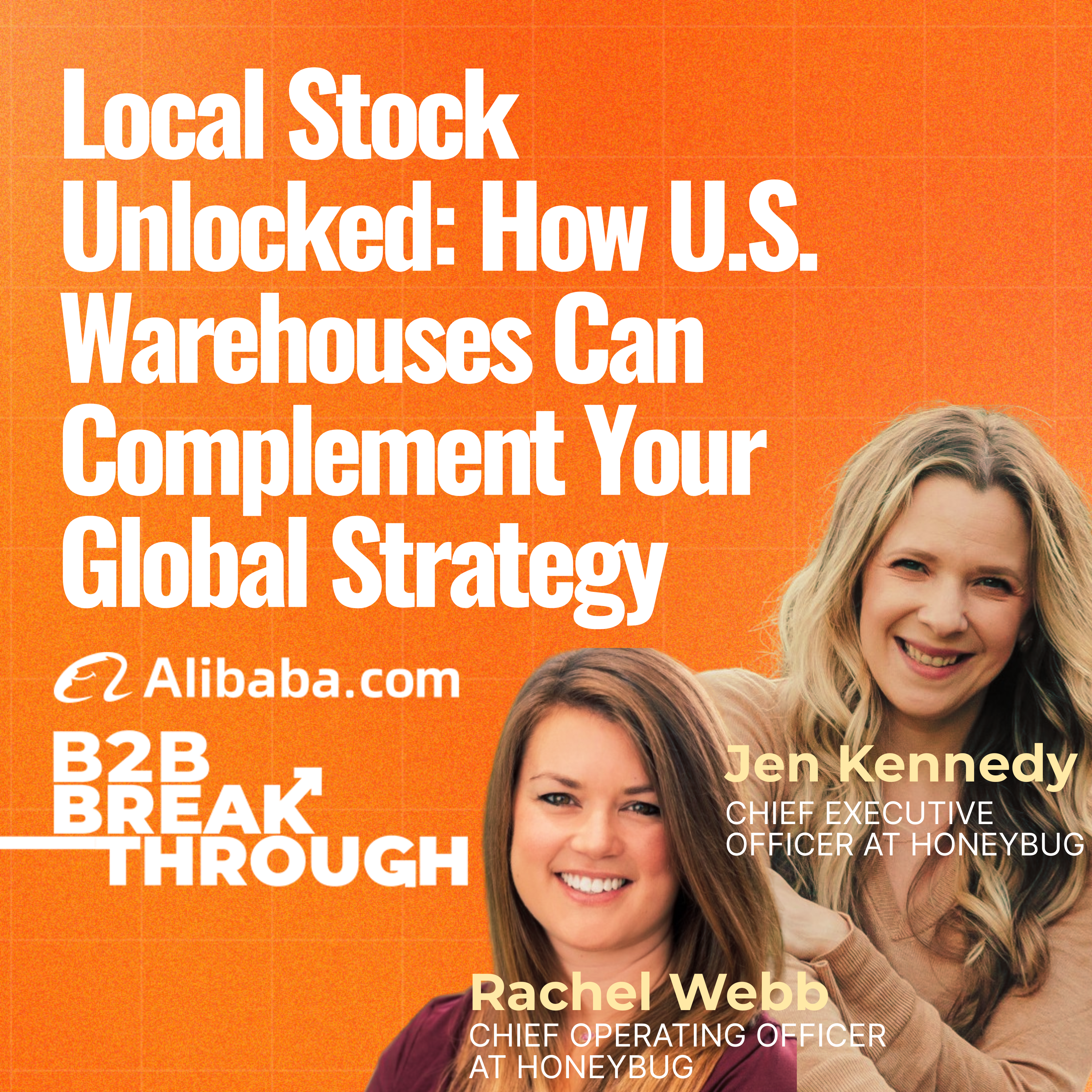
B2B Breakthrough Podcast
Scaling a Purpose-Driven Brand: Inside HoneyBug's Growth Journey
00:40:50
What if the secret to breakthrough supplier innovation isn't telling them what to make, but asking them to solve your problem instead?Building a brand that parents trust and kids love requires more than just great products—it takes thoughtful design, strategic partnerships, and an unboxing experience that creates lasting memories. In this episode of B2B Breakthrough, host Ciara Cristo chats with Jen Kennedy, founder and visionary behind HoneyBug, and Rachel Webb, the company's brilliant chief operating officer. Together, they share how they revolutionized family gifting by creating clean, effective, and thoughtfully designed products that solve real parenting pain points. Learn how they built lasting supplier relationships through Alibaba.com, developed their signature unboxing experience, and scaled from garage operations to a trusted marketplace featuring 500+ brands.Tune in to learn: (00:00) The Parking Lot Epiphany: How HoneyBug Was Born (07:01) Building a Scrappy, Authentic T...
Loading summary
Transcript73 lines
- [00:01]
Jen Kennedy
I think it's really important as you go through this process that you don't restrict yourself. And I think that's where I've seen just talking to people in the industry or peers or friends, they kind of have this idea of what they want, and then they will go out and say, can you make this? Or I think the way we approach it is this is the problem we're having. Can you solve that? And many people will come at it many different ways. And then we move into the sample phase, and that's kind of where the rubber meets the road.
- [00:25]
Sierra Christo
Welcome to the B2B Breakthrough Podcast. We're here to bring you all the best knowledge, insights, and strategies from e commerce experts, successful business owners, and the team@alibaba.com that you'll need to grow your business and achieve your next big breakthrough. I'm your host, Sierra Christo.
- [00:42]
Rachel Webb
What does it take to build a brand that parents trust and kids love? Today, we get the inside story from the dynamic duo who really cracked the code. I'm delighted to welcome Jen Kennedy, founder and visionary behind Honey Bug, the company revolutionizing family essentials and gifting with their clean, effective, and thoughtfully designed products and packaging. And joining her is Rachel Webb, Honeybug's brilliant chief operating officer and logistical force to be reckoned with. These two are masters of creating products that families actually need while building a business that lasts. From smart supplier relationships to playful packaging, they're here to share their secret sauce. Jen and Rachel, I'm so excited to have you. Welcome.
- [01:17]
Jen Kennedy
Hey, Era, thank you for having us. We're so excited.
- [01:21]
Rachel Webb
Can you help us just real quick by laying a foundation of what Honeybug is and how it came to be?
- [01:28]
Jen Kennedy
It's pretty simple in terms of the concept. It was really created as a way to make things easier for parents. I was working a corporate 9 to 5, and I just had my first baby, and I found myself running around multiple times a week putting together gifts in the parking lot of a big box retailer that we will not mention. You're just kind of like, trying to keep up. And a very interesting sort of dynamic with women in particular, but also millennials, is we are the Pinterest generation. We are the generation that kind of wants to do it all. We are the ones who want to be good at everything. And the truth is, we're not. And so I found myself constantly struggling to show that I was a thoughtful friend and a thoughtful, you know, relative, and trying to put together these gifts that showed. I actually gave it more than five minutes of consideration. And the truth is, I didn't give it more than five minutes of consideration. So there was a moment where I'm kind of sitting in the back of my car thinking, like, okay, it'd be really nice if there was a way that I could just say, hey, I have a baby shower on Saturday. And then poof, this magical, thoughtful, curated gift arrives. And that's kind of how it was born.
- [02:35]
Rachel Webb
You know, just from my own standpoint, I sent a box to my niece a few months ago and it was just everything about it was really, really so well received. And there was this amount of care that, you know, I, as someone who's not a parent, don't always know what is going to be well received by a mom of small kids and was all so intuitive to put together.
- [02:56]
Jen Kennedy
That's kind of one of the most important things that we focus on. And it's funny because when you have one year old, you know everything about a one year old, but you know nothing about a two year old. And then when you have a two year old, you know everything about the two year old, but you know nothing about a three year old. And so that exists over and over again as you go through your parenting journey. And if you have a boy, well, you know nothing about what girls want. If you have a girl, you, you know. So we wanted to make the whole process really easy and help people be able to celebrate everything that exists within this parenting journey. You know, there is, I think at one point, putting you on the spot. We ran the numbers. It was like thousands of occasions that you celebrate with a child for those 18 years that they're in your house or I know it's more now, but I think it was somewhere around a thousand moments between birthdays and, you know, little moments at school and losing your first tooth and the leprechaun coming and all those kind of things. So there's all these moments and you want to celebrate them, but there's, you know, kids don't care that you spent $1,000 and got a unicorn for a birthday party. And they don't. They just want. They remember these really little moments. On Valentine's Day, we did a makeshift escape room in our house for them to find, like a basket of candy. And they will always remember that. And so we wanted to bring that heart and emotion and sort of the joy of celebrating to the business. And I think we've only scratched the surface at this point. We're really still within the baby space, more within the toddlers moving into the toddler space. But there's thousands of more occasions that we're going to tackle in the years to come.
- [04:35]
Rachel Webb
I didn't even think about the sheer volume of events that, that you need to consider as a parent or even an aunt or someone, a child. You know, they. You become part of this broader community and it's. There's a lot to. There's a lot to plan. There's a lot of. Of wheels turning at every moment to. To make sure that those moments are special. Rachel, how. Tell me a little bit more about how you came into the Honey Bug fray. What. What brought you on board?
- [05:01]
So I came on board because of Jen. So I worked with Jen for many years prior to this, and she has always been an innovation powerhouse. She has all of these creative ideas, but she's very grounded in the facts. So she knows what a consumer is willing to pay and what they will pay for and what they won't. And I think she has taken all of those skills and applied it to this brand that she's built from scratch. And so, you know, as it was getting off the ground and she was, you know, packaging things in her garage, we're like, okay, we have to come see what this is all about, like, what's going on here. And it was very clear that there was something special there. So I came on board to help support that journey. And I will say she continues innovating to this day. You know, we don't take things at face value. She challenges the team, she challenges me, like, why do we have to solve it that way? Let's solve it this other way that helps benefit us, you know, in 20 years from now, versus just taking the easy way out. And so I think that mentality, there's a grit to that. It's very scrappy, never settling. And I think she is the embodiment of all of that and has brought that to light at Honey Bug. And I honestly wouldn't have come to this brand if she wasn't the, you know, the creator of it, because there's a lot of validity there in everything that she's doing, and I very much admire it.
- [06:21]
Jen Kennedy
Except she's not mentioning that Rachel is basically the translator. So without her, Rachel always makes me look really good because she translates. And usually it's like, you know, after the fact, kind of. The big ideas seem to always have a cool story, like, oh, that was awesome. But when it's happening, it's far more chaotic and disruptive and getting our team on board.
- [06:47]
Rachel Webb
And I mean, the coolest stuff is born of chaos, though. It's that authenticity that comes out of those really real moments of a little spark of inspiration. So that's the best. Now, you mentioned something about your team is growing. You've got a director of ops on board now. And, Rachel, you joined pretty early on, and I think we see a lot of entrepreneurs building small businesses and really sticking with a solopreneur model for a long time at the beginning of building their brand. So you brought a team on board really quickly. How were you able to do that? Really simply asking the question, how did you rally this team together and how did that benefit you in scaling?
- [07:28]
Jen Kennedy
You know, I am a big believer in sort of the. There are moments in your life where things are meant to be and things sync up, and that's sort of how the team has come together, to be honest with you. I also very much believe in outsourcing as much as possible. It was really important to us that we wanted to do it in a way that we really brought on people that were going to be with us for the long run, that this was going to be, you know, founding team, day one members that we could look back and say, hey, that person was number three. That person was number four. And so we are very selective with who comes on the journey because at this phase, the chemistry is so important, and you throw in sort of one outlier, and it's pretty amazing to see how the dynamic changes. I will also say it's really important to us to have very different viewpoints. I mean, we really do pride ourselves in having people that are very good at what they do. It's finding people that do what they need to do well and what that does for the business. And so we've been very methodical about it.
- [08:33]
Rachel Webb
I would also say when you're building something, there's really not a lot of time. You know, everyone says fail fast, but there's really not a lot of time to let those people who drain the culture or drain the productivity to keep them around for a while. So we did have to make some tough decisions. And so if you get people on board who are draining that culture or who are, you know, we thought they would be great on paper, but then when they come in, it's kind of like, wow, that just isn't a fit. Like, you learn you have to make those decisions much quicker than you typically would in an organization. And so I think we've learned that.
- [09:10]
Jen Kennedy
Along the way as well, because you can feel it. You can feel it in a small organization when you Walk in, you can feel, you know, like, oh, is there tension? Or do these two people not work well together? And then, you know, there are those people that they were just like beautiful bright spots in the journey. We have a beautiful mural on our wall that says, celebrate everything that our number two employee hand painted on the wall. We had the most incredible designer that we are still desperately trying to get back who moved on in her journey and has two incredible kids now. But there's people that really touched the company when it really needed it. And now we're at this point of like, okay, let's make sure every person that touches us moving forward really are a cultural fit that brings something that's you, because you need to have. You gotta show up every day and just believe it.
- [10:03]
Rachel Webb
Well, and you've, you've cultivated this, this culture of joy so, so effortlessly. I mean, I say effortlessly, but there's a lot of effort that goes into it as well and, you know, identifying those weak spots and making the tough call. But you know that that joyful element is such a huge through line throughout everything that I've seen from Honey Bug. And I want to talk to you a little bit about your packaging experience because that is such an experiential part of the gifting process from the recipient side and from the gifter. You mentioned this thing of wanting to put together the most thoughtful gift and having that first impression be really striking. So how was that evolution process as you brought the packaging into the. The equation?
- [10:48]
Jen Kennedy
I've always been a really big fan of packaging. I'm a big experiential person. What's very interesting, I know Rach can speak to it all the time. She, she had some fun stats you would throw out. But the product itself is the Honeybook box. We are very fortunate to be able to feature dozens of other brands, up and coming brands, massive brands, our own private label items, thanks to Alibaba, in those boxes. But the box has been the thing that has been the consistent through line with everything. Whatever goes in that box, that box will sell. And it's amazing. So we've been very fortunate that we were able to create a product that itself was the unboxing experience. So when you get a Honey Bug box, maybe it has a swaddle from this brand, maybe it has a toy from that brand, maybe it has because people are also able to create and customize their own personalized baby gifts themselves and put their own stamp on it. But the box itself has been this thing that when you see that at a baby Shower, you're able to sort of go, oh man. That means it's going to be something that's great and thoughtful and fun. And so the box really is that first line of defense, what the brand is. We also have, which it seems so small, but we have this glitter wand that was from day one, I don't even know. I wish I had a cool story about how the glitter wand, I thought it was pretty. And so the glitter wand goes right on top of the box and it's become this kind of heirloom piece that people have been keeping at baby showers and they're putting in their baby keepsakes and things like that. Is this beautiful little wand that sort of says like, the magic is about to happen in your life. And it does. But we've seen, you know, pictures. People have sent us pictures of their toddlers playing with it or pictures of them as they grow up holding this, you know, little glitter wand that came from their baby shower. But the experience of celebrating has been something that we really wanted to bring to life in the packaging.
- [12:43]
Rachel Webb
Just knowing that we're in an audio format. Can you help us paint a picture of what the box, the whole experience feels like?
- [12:50]
Jen Kennedy
Yeah. So the box itself, as we've gone through this process with Alibaba, it's become this really high quality, beautiful, soft, if I could like, for lack of a better term, a soft laminated box that's white and has this beautiful bee on the front of it. And the bee is holding this glitter wand through its wing. The glitter wand itself is just this small 2 by 2 inch gold sparkly paper wand with a wooden stick. And it is, you would think it's something that's like incredibly expensive and it's not. It's just this like, beautiful kind of key to what's every. What's going to be in the box. And the box itself is also hand wrapped with a black ribbon. And you open the box up and inside. I think the inside of the box is stunning because this is beautiful, bright yellow with our logo. But it has this awesome, beautiful packaging insert that kind of says like, enjoy. You're about to celebrate this moment. And it's, it's really fun.
- [13:51]
Rachel Webb
So, you know, it's funny. I, again, I've already mentioned I don't have kids, but, you know, as I gifted this box to my niece and my stepsister, I got this video of my niece running around with the wand. She has her cute little headband that I put in the box. But that was the video she sent me, was her daughter playing with this paper wand. And you know, to me, I was like, is this really going to pack a punch? I know, you know, I don't mean to be rude, but you know, transparently I'm like, what would that do? It made such a difference in the experience for them just opening this box. It was so sweet.
- [14:26]
Jen Kennedy
I have this like dream of this anthemic super bowl ad one day that basically shows the progression of the wand from a baby shower and that baby grows up and has her own kids and she passes the wand along like, I've got this one day, one day, one more billion dollars. I love that super bowl ad. Massive.
- [14:44]
Rachel Webb
We're going to manifest it. I'm with you. I'm on board. We're going to put it into the universe.
- [14:49]
Jen Kennedy
Let's just make it. Let's make it.
- [14:51]
Rachel Webb
Let's do it. I like it. I like it.
- [14:54]
Sierra Christo
Is the complexity of sourcing holding you back? Are you getting overwhelmed by information in an endless search? Now, sourcing for your business has never been easier. Meet Axio, the world's first AI sourcing engine that helps you source like a pro. With five key features. You'll get product inspiration that leverages real time market data from comprehensive web insights, social media trends and B2B knowledge. Generate detailed requirements to find the perfect match from AI verified products and suppliers through Axio's multimodal search. Use super comparison to easily discover and compare millions of products from leading suppliers, focusing on the best selling and most competitive options. With Axio page, you'll get AI generated encyclopedia pages that compile verified product information for each sku and finally leverage Axio agent to streamline negotiations with conversation, guidance, real time summaries and direct answers about products and suppliers without having to browse detail pages. Head over to Axio AI today, that's Accio AI to try Axio for free and start sourcing like a pro.
- [15:59]
Rachel Webb
I want to bring it back because it is such an interesting progression on how you managed actually physically wrapping the box and making it, you know, having it come to fruition because there is so much care put into it. But you have to find these efficiencies along your process to be able to scale and you know, so that you're not the one hand wrapping everything or hand cutting all of the materials to send these out, you know, at, at scale. So how has that changed since the first inception of the box to now.
- [16:29]
There'S a process to getting things to scale and we used Alibaba for all of this. So what started as sketches what started as Jen hand tying a bow, you know, using a glue gun to ensure the wand is in the exact perfect place on the way.
- [16:46]
Jen Kennedy
I still do that, but they don't, they don't like, no one likes it either.
- [16:50]
Rachel Webb
But it started out, it started as a sketch. That then became talking to suppliers through Alibaba's platform to get samples to figure out, okay, is this how we want it to fold? I've never seen a team measure things so many times in the sense of like, okay, what is the exact length of the ribbon that we need? And building it in with elastic. So all we do now is just slide the bow right on the box. There's no hand tying, but it looks hand tied. And so there are elements like that that we are able to produce through Alibaba that really brings the vision to life without having Jen sitting in the back and hot gluing everything. Every order that comes through comes through our warehouse. But it really is a pretty structured process about designing it, working with the suppliers to get samples, a variety of suppliers at that, and then seeing, okay, which quality works is the pricing. Right. How can we work this into our cost structure?
- [17:46]
Jen Kennedy
Because it's amazing, it's honestly amazing that every time stuff arrives we're like, oh my goodness, like, how? Why were we doing it the other way for so long, the ribbon in particular, that I didn't even know that that actually could exist that you could make it.
- [18:01]
Rachel Webb
But again, how can we do this a better way? There has to be a way. We found a way. And so that's all Jen's vision and just thinking outside the box to make that happen.
- [18:10]
And the communication element here is so crucial and being able to articulate that to your supplier. So how do you even find these solutions in that dialogue? Do you pose an explicit problem to them or is it more of a free flowing conversation that results in something really innovative that gets you to this point where you can streamline your process and make it all feel very cohesive.
- [18:32]
Lots of videos, lots of like, let's draw this out and take a picture. And then lots of back and forth, like, well, we have this off the shelf. And it's like, well, that's not really what we had in mind. So there's so much communication that takes place at the beginning of the process to really get to a spot where it's like, okay, that actually might be a viable option, but it's, it's pretty scrappy.
- [18:55]
Jen Kennedy
Yeah, right. I think posing the question, can you solve this? That usually has been the Most effective for us. Can you solve this problem? We have. I worked with packaging engineers in the past, and, you know, that's what they do. You know, they go in with these. These sketches and models and things like that. So it's been very impressive. And there's been things, especially our packaging supplier, like, we joke all the time that she's our employee of the month every month, because she will keep finding these kind of really unique solutions that maybe are not so unique to experts, but they're unique to us, certainly. And so when she'll bring these ideas back, we're like, oh, my gosh, that's, like, perfect. But I think it's really important as you go through this process that you don't restrict yourself. And I think that's where I've seen, just talking to people in the industry or peers or friends, they restrict themselves because they kind of have this idea of what they want, and then they will go out and say, can you make this where I think the way we approach it is, this is the problem we're having. Can you solve that? And that's. And many people will come at it many different ways. And then we move into the sample phase, and that's kind of where the rubber meets the road. And Rachel really starts the process of making sure it's actually scalable and the price is right and all that kind of stuff. But we usually bring many people in at the beginning, and we pose the same question to many people. We also find very quickly. I think you see, you really do see who fits our. Our culture and our. Our personalities and our vibe of the company. You know, you'll find these people that are like, oh, my goodness, I love this. This is great. Here's my ideas. And then you'll find other people that are just maybe are less sort of bought into the idea or the concept, and they'll certainly be there to help support you. But we've found a few really awesome suppliers that are really into it, and that has made it really fun. As we've gone through this, it seems.
- [20:46]
Rachel Webb
Like trust is such a huge element of this as well. When you're posing a problem and giving them a little bit of leash to explore and to play and to find something that's going to work. So that upfront vetting is huge. To find that good match. Have you found that, you know, beyond the packaging, as you talk about sourcing the products that are going into these boxes, do you see the same process come into play in vetting suppliers for the products?
- [21:12]
We typically go to a variety of suppliers like she mentioned, to get samples, to get the process started. But I would say we're not quite there with having consistent vendors for those because we're still in that early exploration stage. You learn very early on that over communication is key. And so what one supplier might interpret in terms of sizing or expectations around zippers or where the hang tag goes or things, little things that you might not think are super important to nail down, we found ourselves, you know, having to like reiterate, these are all the components that we need. And so we're still in the process of getting all of that. Right. But to your point, trust is very important. We've found incredible packaging suppliers over the past few years and I think we're still on that journey.
- [22:03]
Jen Kennedy
For the other elements, we carry around 500 domestic brands, domestic and a few overseas brands. And that trust has also been something that's been very important to us. It's really actually very interesting because when we started, you know, you're just happy if anybody works with you. You just want people to work with you and return your phone call. And the dynamic, I would say, was often far more one sided. As we've grown, we have been very fortunate to be able to start to kind of pick brands that sort of wanted to go on this journey with us because this is not easy. I mean, this past year has been one of the most challenging years of my entire career. So that level of trust is so, so incredibly critical because, you know, there are those partners in your life in general, be it team members and, or vendors or suppliers or brands or anything that are very draining and not that this was even what we were talking about, but my advice to anybody is you can, as a business owner and as an entrepreneur, you cannot have that in your orbit. You really have to start to streamline and keep those around you that are gonna go on the journey, whatever the journey looks like. So using that in every aspect, be it sourcing or hiring, you really have to make sure that the people around you are those that are gonna support you when things are good and bad, because both are gonna happen maybe sometimes in the same day.
- [23:34]
Rachel Webb
Yeah, I believe it. It is crucial to have pieces that feel cohesive for the honeybug offerings on the website and to have these pieces that uphold a standard of quality and a standard of, of playfulness that, that you've established with the brand. So what are some of those key features that you're looking for? You know, aside from a brand that's willing to come on this journey with you. What are, what are some of the more tactical checkboxes that you're working through to find someone that really fits the honey bug ethos to be considered for, for a custom package?
- [24:09]
Jen Kennedy
I think first and foremost it's quality and safety. Safety is something that you don't often think much about because the quality is so there with our brands that they, it's already pretty much assumed by the time we start conversations with them that they're in fact a well regarded, trusted brand and they're going to be safe for the kids that are going to be playing with the products or wearing the clothes. And it's very hard to be honest because in this sort of time it's very easy to go, oh, I can cut corners here, I can cut corners there. And we have really held ourselves accountable to not doing that. And it's not about price point. We have many incredible brands that are very, from the most reasonable price points to maybe a more premium luxury price point. And they are all exceptional quality, all of them. So making sure that the brands are in fact something that can represent us. We have an incredibly low return rate on our gifts. Incredibly low, somewhere around the like 1 to 2% mark. And that's been over the past four years. So we talk a lot about making these return proof, return proof gifting. And if somebody wants to return, I will say we've made the return process also something very easy and hassle free because there is nothing more embarrassing than the person that bought you a gift getting a notification that you're returning it. And then there's a lot, I mean, I know Rach can speak to it. There's a lot about just the responsiveness of the partners we work with because people, when they're buying a baby gift, they expect that baby gift to get out the door. And so we try to also be really helpful. And a lot of times people say, hey, I really want this one item, you know, it's sold out. Or I want this other thing, oh, we've got an option. And so we're constantly offering this really handheld VIP service. If somebody wants it, they just ask. I mean, simply just ask. Like we'll get an email from somebody saying, I just bought this, but I really want that. No problem, we'll take care of it. So there is a lot of that magic and moving things around that I know Rach is constantly working with our brands on. So having responsive brands has been really important.
- [26:17]
Rachel Webb
Jen mentioned there's a lot of ups and downs throughout this journey. So if we Know that something is trending one way or the other. I think also having partners who are willing to go on that ride with you. We haven't really talked about tariffs, but how our suppliers handle tariffs and all of those types of, you know, pressures that just come upon your brand and all the other brands you work with. It's finding partners that you can talk through those kinds of issues with and know that you're going to have a thoughtful conversation and that it's not just purely transactional. That's very important to us. And we really pride ourselves on working with and featuring the brands that. That do partner with us.
- [26:57]
Jen Kennedy
Well, great, great word. Transactional. Like, we try to avoid transactional at all costs.
- [27:02]
Rachel Webb
Yeah.
- [27:02]
Jen Kennedy
Because, you know, the industry people are constantly feeling in competition with each other, and we have tried really hard. And I wouldn't say we've nailed it yet. I think we're bringing some people along, but, you know, we've even talked about, should we just set up like a group chat with all these brands, like, let's help each other, especially during, when all the stuff has started coming up with the tariffs. So we are trying to bring people along with us in terms of finding a more collegiate experience than just sort of a transactional relationship. And some people have definitely started getting more comfortable and, you know, and then we're able to help them with things or, you know, people will be honest with us. Hey, I've got this shipment coming in. I can't. I'm going to put these products up. You can buy them, but I don't have them yet. Then it kind of, it makes it a more authentic relationship.
- [27:47]
Rachel Webb
Yeah, I mean, we talk about community a lot. You know, as. As a brand and a brand that really focuses on bringing small business owners together is something that, you know, is really important for us. So I'm curious, from your standpoint, you know, within this industry, within retail, kids and baby products, how are you fostering that kind of community? How do you begin those conversations and kind of open the door to showing, like, hey, we're an approachable, relatable brand. We're not trying to cannibalize your audience. We just want to help one another out. How. How do you start a relationship like that?
- [28:21]
Jen Kennedy
It's challenging. It really. It is challenging because I think people, our brands have been very open with us because as certainly we have our own product, but we have become a really robust marketplace for baby and children's items. So we are a retailer and a, you know, direct to consumer brand for products. So having that conversation has been very easy with our brands to some extent because we are not making directly competitive items. And I wouldn't say they are very eager to share information amongst each other. I do feel like it's a. It's a missed opportunity as we create things. We have ended up with almost every factory that has produced stuff for our brands, and it doesn't change how we operate in any way. But I understand why they don't want to share information. But if we could get to this point where everybody was pretty honest about things and maybe in a way that sort of masked some of the sensitive information, I actually think the industry as a whole would feel a lot better because I had posted something a couple weeks ago on our stories, just about the tariffs and sort of how that was impacting us and asking how other people were sort of dealing very tactical things. And I got the most replies I have ever had on one of our, our stories. But people were, yeah, I feel this way too, or I'm having this, or this is happening. I wanted to put ourselves in that position to say, hey, we're here if you want to ask any questions or how we're doing stuff or how we can kind of mediate between brands. But I don't think we're there yet. I think it would be cool to kind of create this collegiate environment, maybe like a anonymous forum or something.
- [30:03]
Rachel Webb
I like that. A little, little intrigue in there. Well, I mean, in the spirit of, of openness and starting that dialogue, what is a big challenge or learning curve that you experienced coming from completely different industry, coming from the restaurant space? What was a big learning curve that you can share with, with folks in this industry that helped you really find your momentum with Honey Bug.
- [30:28]
Jen Kennedy
I wish again, it was something that was like this incredible aha moment, but it really was cash flow. Like that was it managing cash flow. And I'm sure any entrepreneur has that exact same experience. But as a brand person, we took off very quickly. People wanted to buy the product we had. That's all I. That's what I knew. Product and marketing and brand. And so it took off. But then, you know, being able to sort of manage the growth, I think early on we grew too quickly and it starts to put a strain on cash flow and resources and things like that. And it's scary when you look back on it, that there was, I feel many times we could have stepped on catastrophic landmines and we did step on landmines, no doubt, like, like quite a few, but they weren't absolutely Catastrophic in the long run. And that's the part that I think making sure you are fixated on what the long run looks like and the cash flow in the long run. Not just sort of the top line metrics of things and not just the unit economics, like the actual cash flow of it, because that is the lifeline of the business. So just things like that, making sure that was in order really was kind of the unlock for everything. And you know, in the long run.
- [31:49]
Rachel Webb
I would say that's a big one. Like, I think whenever you're starting a business, especially if you've come from a more structured corporate environment, there are so many little things that you take for granted in the sense of process and the sense of structures, certainly cash flow. But I also think, you know, processes going into the baby and kids industry in particular, like Jen mentioned before, there are so many brands that are sort of making onesies in their basements or this is like, this is like a growing brand, but they also don't have that structure. And so you have to create that. And so working with vendors on processes, on timelines, things that when you're in a larger organization, those already exist. And you work with, we've worked with some of the largest suppliers in the world from a food perspective. And there's just sort of, you walk into an organization like that and you think, wow, this is already established. None of that exists when you're starting from scratch. So things like payroll, things like taxes, like we've had to learn so much about those processes. But at the end of the day, I think overall cash flow is the number one that you kind of take for granted, that you don't realize, you know, if it's really great this week, come Monday you might be in a completely different situation. So you have to really think through all of that on a day to day basis and manage it very closely.
- [33:14]
And Rachel, one other question that I had for you on this front is the systems in place really help facilitate a smooth flow from, you know, a corporate standpoint. And you get really comfortable with that. And part of that is having these subject matter experts at your fingertips to understand the product inside and out. And one thing that you know, as you've made the transition from restaurant world to baby and kids, how has that learning curve been for you getting accustomed to the standards that are in place and what safety means for products like these and quality metrics for an entirely different industry? Has that created a little bit of a speed bump or did it at the beginning?
- [33:53]
I actually think we were probably better suited for the safety conversations, in particular, coming from the food space. Safety is always the number one, and we've certainly seen brands go through a roller coaster from that standpoint. And so I know early on, especially talking with suppliers overseas, knowing to ask for certificates, knowing to ask for testing, all of the documentation around all of that, we already had a little bit of an idea that you needed to ask for those things just by way of coming from restaurants. But I think in terms of learning, you know, there's a different language in different industries, so learning how folks talk about their sizing or all the measure, all those types of things, I feel like it was a little bit of a learning curve. But I feel like we. We made it over that hump pretty quickly.
- [34:40]
Jen Kennedy
Yeah, we had a recall early on, and, man, I think we crushed that recall.
- [34:46]
Rachel Webb
We crushed the recall.
- [34:46]
Jen Kennedy
We crushed the recall. Yeah. I mean, I think we just. We knocked that out in, like, hours.
- [34:51]
Rachel Webb
Yeah.
- [34:52]
Jen Kennedy
But we were talking. This is where it goes back. This is where it goes back to the community. Right. Like, it would be wonderful to have this community where we would be able to go and say, all those impacted by this recall, this is what we did, and here's best practices and white papers associated with it, and you're gonna be just fine. This is what you need to do. But, you know, one day as we.
- [35:09]
Rachel Webb
Wrap up, I want to talk to you a little bit more about what's next for Honey Bug, what's next for both of you.
- [35:14]
Jen Kennedy
I really do believe we have just scratched the surface. We have finally come into our own in terms of having processes in place and a structure in place that will allow us to scale even more. And there are so many, you know, if you just look at it strictly from just occasion based, there's so many occasions that we still want to celebrate and need to celebrate. The dozens of holidays, the dozens of celebrations that happened, like a couple weeks ago, there was a Teacher Appreciation Week. And every week I'm like, oh, my. Every year I'm like, we should have easy access to teacher appreciation gifts, because I was making those in my, you know, back bedroom and gluing and assembling and all that kind of stuff. So, you know, things like that, easy ways to help people celebrate. We have some very cool technology, things that we've wanted to do over the years that have gotten a lot of interest. So we. We have started thinking about what that would look like to bring some of that stuff to life and bringing the brand to life, to be honest with you, you know, Again, like, as a brand person, there are so many things that we could be doing better to help the world celebrate and to bring some happiness to the world and celebrate literally everything. If you just think about the things that you celebrate throughout your life, those are the things that we want to bring to life. And. And so that's on the horizon. It will happen.
- [36:38]
Rachel Webb
I believe it, and I kind of working backwards a little bit. But from a more tactical standpoint, Rachel, in the imminent future, you know, the. The tariff conversation is always looming, and it's always evolving day after day. How are you looking forward and planning logistically to move Honeybug into the rest of the year and years beyond?
- [36:58]
So I think it's a very fluid conversation, but to our point, earlier communication is absolutely key. So, you know, as soon as we heard some of the headlines or the news, we reached out to our suppliers through Alibaba. We reached out to our brand partners here domestically, and we made sure that we were just having the conversation, having an open conversation. Many of our partners were very quick to make decisions in one direction, and the next week they're like, okay, maybe we can change it this way. So. So we've been trying to really get a good handle on brand by brand. We carry hundreds of brands, so trying to figure out brand by brand, how our partners are planning to work through the tariffs and how we can support them and how we can sort of carry the weight together. Because at the end of the day, we know what our customers are willing to pay, and we know that they look to us to curate the best quality products. And so we're making sure that we don't lose sight of what the customer needs from us or wants from us. Looking forward, it's all about figuring out, you know, will we have the cash to support those decisions and how do we make sure at the end of the day, we're not sacrificing the brand because of this new challenge or this new pressure. Tariffs is one example. But, you know, there's tons we deal with every week related to new challenges or, you know, getting shorted inventory or what have you.
- [38:25]
Jen Kennedy
So.
- [38:26]
Rachel Webb
So we're constantly trying to manage through that from, I would say, putting the customer first and foremost and then figuring it out on the back end, how we can make it happen.
- [38:33]
Jen Kennedy
I mean, I think she just nailed it about the customer first and foremost. And we are very comfortable with high volume, low margin, just weather the storm, just come out the other end. The only way that you will actually succeed, whatever happens, the only way we're going to win in the long term is still being around. And that's usually the number one focus. And as long as you're focusing on the customer, you're going to be fine. We're trying to find all the things out of this that we could take that will make us stronger in the long run. And, and I think we are, and we are learning some lessons through it, so.
- [39:02]
Rachel Webb
Well, you're well positioned for it with your background in restaurants anyway. You know, talk about an industry that's really dependent on resilience to make it. So that's great work. That's awesome. All right, well, you know, just keep an eye on the clock here. I just want to leave everyone with where they can find you and continue following your story. Where, where can people look you up?
- [39:22]
Jen Kennedy
Yes, please. If you ever need anything for baby toddlers and big kids, check us out at www.shophoneybug.com that shop honeybug.com and on.
- [39:35]
Rachel Webb
The socials, where can we find you?
- [39:37]
Jen Kennedy
Yes, @shop honeybug.com there's a whole story about the why the shop's there, but yes, shop.com shop honey bug for Instagram, Tick Tock, Facebook, Pinterest, wherever you find.
- [39:50]
Rachel Webb
Your social media opinion, amazing. We love consistency. We'll be sure to link it in the show notes and make sure everyone has access to you.
- [39:59]
Jen Kennedy
And if any of your listeners send us a DM on Instagram, we'll make sure we throw in a few goodies for them when they order. So just make sure you mention Sierra.
- [40:08]
Rachel Webb
There it is. Yeah, drop my little name drop and it'll get you far. That's awesome. Well, thank you guys so much. This has been such a pleasure as always, and I can't wait to see what's coming. Coming up next with Honey Bug.
- [40:21]
Awesome. Thank you.
- [40:22]
Sierra Christo
B2B Breakthrough is produced by Alibaba.com to find out how Alibaba.com is empowering its customers with the tools, services and resources they need to grow their business. Visit Alibaba.com and then make sure to search for B2B Breakthrough on Spotify, Apple Podcasts, or wherever you find your podcasts.
- [40:40]
Rachel Webb
Make sure to follow us so you.
- [40:41]
Sierra Christo
Don'T miss future episodes. On behalf of the team here@alibaba.com, thanks for listening.