← B2B Breakthrough Podcast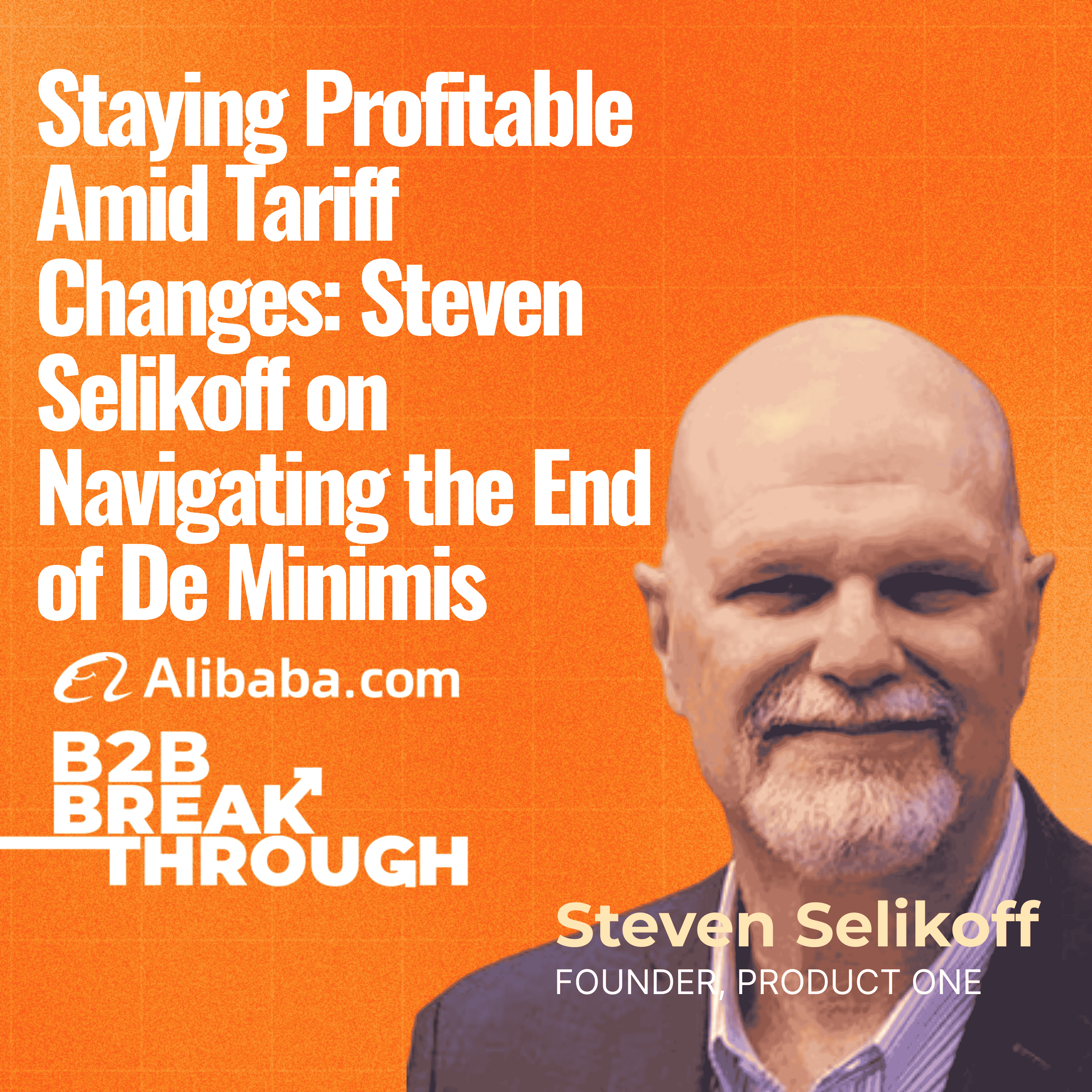
B2B Breakthrough Podcast
Staying Profitable Amid Tariff Changes: Steven Selikoff on Navigating the End of De Minimis
00:37:43
Why are smart entrepreneurs celebrating the end of de minimis while their competitors panic about margin compression?The suspension of the de minimis rule has left many e-commerce sellers scrambling to understand new costs and compliance requirements. In this episode of B2B Breakthrough, host Ciara Cristo chats with Steven Selikoff (https://www.linkedin.com/in/stevenselikoff/), founder of Product One (https://product.one/) and author of The Complete Book of Product Design, Development, Manufacturing, and Sales, about navigating the new tariff landscape with a profit-first mindset. Steven breaks down the myths surrounding de minimis changes, reveals how tariffs and duties can actually be tax-deductible, and shares his proven strategies for achieving 9-10x multipliers even in challenging trade conditions. Learn why building a "purple cow" product is your best defense against margin compression and how smart entrepreneurs can turn trade disruption into competitive advantage. Tune in t...
Loading summary
Transcript50 lines
- [00:00]
A
The only way that you add to profit of your business is by making sure that product is profitable. If you're breaking even on your profit, you could go from 100 to 100,000 units and you're still breaking even. It's mathematically impossible for that to make you money. So that's where I focus. I focus on the product.
- [00:19]
B
Welcome to the B2B Breakthrough Podcast. We're here to bring you all the best knowledge, insights and strategies from E commerce experts, successful business owners and the team@alibaba.com that you'll need to grow your business and achieve your next next big breakthrough. I'm your host, Sierra Christo. Today we're joined by Steven selakoff, founder of Product1 and an expert in global product development and trade. He's guided entrepreneurs through sourcing, compliance and strategy worldwide. With deep experience in tariffs and duties, Stephen will help us unpack the suspension of de minimis rule and what it means for pricing, logistics and customer expectations. Steven, welcome to B2B Breakthrough.
- [00:58]
A
Hello. How are you doing today, Sierra?
- [01:00]
B
I'm doing very well. It's very nice to see your face again.
- [01:03]
A
Good to see you.
- [01:05]
B
How are you doing? How have things been since Co Create?
- [01:08]
A
Things are going really well. I had an interesting experience yesterday. I came across an old talk I gave at the executive level at Microsoft about the exact same things. It hits everyone. Large enterprises, small entrepreneurs. This is a business, you want to treat it like a business. You want to make money, you got to do the right things. And Dominus now is just the latest bit of rough water that's been rocking our boats.
- [01:37]
B
Yeah, I mean, thank you for that. Tee up tariffs was a huge theme at Co Create. Everyone was talking about it and your keynote was really helpful in laying a foundation and sharing some tactics and myth busting to get people on the right track. So I want to take just a quick second with you, if you don't mind, and zoom out and lay that foundation of what de minimis was, how it's changed and why is it such a big deal in E Commerce?
- [02:05]
A
Well, Dominus, as you can tell from the name, has to do with a minimum or in this case a threshold. You could bring anything into the country as long as the total was under $800 of of goods. You've paid for your goods of under $800 total. And that's not just from China, from all sorts of of countries. And it impacted you if you came to the airport with a bunch of souvenirs or something special you bought wherever you traveled or if you're sending it in via post or courier and so on. And that's the aspect that really became troublesome because there were a lot of companies, companies in China, companies in the United States, entrepreneurs and so on, who routinely brought products in that were under that threshold. And when that occurred, that means that the tariffs and duties were not being collected. It's under 800, just let it happen type structure. It's been talked about for quite a few years and finally in the last, you know, 12 months it's been removed, put back on, you know, suspended, not suspended, suspended. Selectively. At this point, every country is facing the same issue, which is there is no more threshold. You send something into the US you're going to have to pay duties, taxes and make tariffs and make sure that you're compliant. It's interesting, a lot of people are surprised by the compliance issue, but they've made some, some major changes on that as well. Of course, when it hits your pocketbook, it gets your attention like a smack to the face. But both of those issues need to be looked at and they need to be addressed. But again, as I, this is a business that's not impossible to address. And frankly, as we talk about compliance for a moment, you absolutely do not want to start going into black hat tricks and hacks and cheats and stuff like that. Because as I said, compliance is also part of this and you will eventually be caught.
- [04:10]
B
So what does the shift really mean for online sellers and even D2C sellers in kind of a different category here in terms of the cost and timelines to really make sure that they are checking all the boxes and fitting into exactly where they need to be to be a top seller on any of these platforms.
- [04:32]
A
Well, one, to make it a little simpler, the Customs and Border Protection, they don't care whether you're D2C or whether you're on Amazon or Walmart or any other marketplace, or even if you're selling out of a pop up shop in, in a shopping mall, you're still going to have to pay duties, tariffs and be compliant. So what does the change mean to someone's business? One of the things is that you've got to pay tariffs. And the tariffs depending on the country could range from from an additional 10 to 15% to an additional 30, 40, 50%. And these are on top of your duties. It's not a replacement for your duties. You still have to pay duty under HTS codes and then the tariff is on top of that. That's one aspect which means it's costing you money. Another aspect is, is that it's collected when you come across the border. So it's impacting your cash flow because it's money you have to take out of your pocket when it comes across the border. And then third again is compliance. They're going to be doing more checks and so on. So on a real base level, it's going to impact your profitability, it's going to impact your cash flow. And, and you have to ensure that you're being compliant, which frankly, Alibaba is very good about, making sure that you are compliant. There's lots of opportunities, lots of labs and certification. You should be taking care of that anyway.
- [05:59]
B
That's very fair. So when we know that this is something that we need to be really diligent about as sellers online, what kind of steps do you take to ensure that you are, you are well educated about the compliance requirements for your category? And what should you look for on a platform like Alibaba.com to really ensure that you're heading in the right direction for, for your product, for your category and for your end consumer?
- [06:25]
A
Good question. So it's not that difficult. If you're selling on Amazon, you can put up a dummy listing and you can see all the, the certifications that are required. If you're dealing with a factory, not a trading company, the factory is very, very familiar with all of the certifications that are required. This is their bread and butter. This is how they put food on the table. Of course they know the certifications required for every country because their customers need to be supported. If you're dealing with a trading company, they could be dealing with a whole bunch of goods. I mean, they could be doing something from a speaker to Mr. Panda. And they may not know all of the certifications for your specific product. And then customs brokers, they have to know what the certifications are that are required. So those are three different channels you can go to easily and find out. I wouldn't be looking to put up posts in Facebook groups or WhatsApp or whatever, because you're going to have a lot of people with good intention, but maybe not good information. That's a risk you don't want to take. This is not rocket science. And I'll say it a hundred times and 100 times more, this is a business. Think about it as a business, because at the end of the day, you want to make money. And these are just little, you know, obstacles you have to deal with, get around and resolve.
- [07:49]
B
And so what, what is some of the, you know, the misinformation. What are some of the myths that people are seeing in circulation? I don't want to draw too much attention to them because we're trying to correct that and steer them onto the right path. But, you know, what are some of those tips and tricks that we're seeing out in circulation that people should kind of be more skeptical of in their review?
- [08:10]
A
Talk about the biggest one there. And you and I chatted about this at Co Create, and that is people think they're just stuck. They have to pay these things and that's it. So we're with not good. Losing money. No, no, no, no, no, no. Tariffs. Duties are tax deductible. You can deduct them from your taxes in the United States. Same thing with your inventory, which you should be doing. If you are not deducting the cost of your tariffs and your duties, then you're throwing money out the window. I get to say that because you have a gorgeous window behind you. You're throwing money out the window. Number one thing, number beyond everything else, tariffs and duties are tax deductible. Now, you had. In order to do that, there's a couple of rules around it. Number one, they you have you deduct them when they're sold. So you don't deduct them after you pay. You deduct when your products are sold on each individual product. And again, this goes for your inventory. So you should be deducting it. If you don't have an accountant, get an accountant. The other thing is you need to document. You need your commercial invoice. That's the invoice that your factory or reseller or whoever your supplier is gives you and says, send this amount of money to us. That's your commercial invoice. You need that. And lastly, you need form 7501. This is the form that gets issued when you actually fill it out and it gets approved. That's the form that says how much money you're paying in their duties and tariffs. So you need 7501. Form 7501. You need your commercial invoice, and your accountant will deduct it after the product is sold. It's that simple.
- [10:02]
B
There's a way to recoup that a little bit on the back end once all is said and done.
- [10:07]
A
Yeah, that to me is the biggest myth, is you're not stuck.
- [10:12]
B
We're not stuck.
- [10:12]
A
Be aware, as a business, you can deduct it. If you're shipping ddp, you can't take advantage of this, but if you ship any one of the other 10, there are 11 Incoterms. Any one of the other 10 Incoterms, you get that 7501. That's pretty standard. You don't even have to ask for it. It's given. Ask for it if you don't get it. But it is, it's very simple.
- [10:34]
B
So what is, you know, it sounds like all of these other methods have, have this really strong case for, for managing all of your imports, these other routes. What is the benefit of importing ddp, knowing that this is not a benefit that they can take advantage of.
- [10:51]
A
So the difference between DDP and all the others is DDP is training wheels. Go ahead, use DDP. When you first start off, focus on all those difficult things you need to do, whether it's Amazon or whether it's dtc. But frankly, once you get comfortable there, go back, spend a little bit time, learn about shipping. It is not difficult. When I teach people in China, when we go on our China trips, It takes about 20 minutes. They know everything they need to know about shipping. And then because my mom was a teacher, she told me kids learn more on field trips. So we take you on field trips, we go to the port. We've got some good, nice connections with the pork and Guangzhou nonchalant. And we actually take you behind the scenes and you go by the boats and everything else. But with that and 20 minutes of explaining incoterms, you know, all you need to know about shipping.
- [11:50]
B
So it's better for someone just starting out. You know, I think this is something we talk a lot about with, with small business owners on the podcast as well. When you start to expand, you're starting to hire your team, you know, hire people who are, who have different strengths than you. And some of the times you know someone who is well versed in shipping terms and operations and logistics, that's someone you want in your corner to move away from ddp. At the end of the day, I.
- [12:16]
A
Can give you a real rough comparison. When you hire someone for ddp, you say, hey, please take care of this. They take care of it. They pick it up at the, at the factory and they tell you it's been delivered at the port. If you're hiring for any of the others, you can have them pick it up at the factory, or you can have the factory drop it off at the port. Just like, you know, taking an Uber. If you're hiring an Uber to pick you up at the factory door and Take you to the airport and catch your plane. You're paying them. If the factory says, or if your buddy says, I'm going to bring you to the airport, you give them a little bit of money for the gas. Whichever way, whoever does it, that's who pays for it. After that, it's just basically the same. It goes on a boat comes across, goes through customs. They'll tell you, hey, you're at customs. This is how much you have to pay. You pay, it goes through customs. It's that simple. All those letters mean are little things like whether insurance is already included or not. But with everything you're learning for the first time, and I understand that's when you want to put the training wheels on, but then take it off once you're ready. And you could take advantage then of deducting your tariffs and your duties.
- [13:27]
B
Even just talking about this now, it feels really highly technical and, you know, just so much to sift through. So, you know, I want to take a, a quick diversion here to talk a little bit more about Product One, because it feels like you're providing all of these resources that really help small business owners feel more literate and feel more comfortable dealing with all of these terms, this Alphabet soup of acronyms to get products across the board border. So can you talk to us a little bit more about, you know, what Product One does for small business owners and entrepreneurs trying to get their business on its feet?
- [13:59]
A
Certainly. First of all, it was officially announced at Co Create, so that is our rebranding, our new name. We were a product development academy again focusing on teaching and knowledge and so on. Now we are Product One. And that's because in the midst of people selling, as you said, D2C, selling on Amazon, selling on Walmart, selling to physical stores, which is still huge in the United states, is still 84% of products are bought in physical stores. There's a lot to learn no matter what you're doing. I just focus on one swim lane. I focus on the product. Getting the best product you can make sure it's, you know, it's going to be successful to make sure that you are profitable, which is really the most important part of all of this. And then all of the minutiae and operations that go on around that. I do teach people how to sell in retail stores because that's something that's woefully, I shouldn't say the lack of information, but over the last 10 years, there's been so much information about selling on Amazon that if you want to Sell in physical stores. It's difficult to dig through that and find it. But so I teach people that as well. You want to get your product in front of the right people who are looking for the right thing, and then they see your product. The challenge there is that advertising is an expense. And the more that you do it efficiently, the more you're going to be spending less. That's the most that advertising can do to add to your profits. If you have a product that's not making money, it's never going to make money no matter how good your advertising is. In business school, there's a great story that they teach everyone in the first level, the first class business 101. They tell a story of two brothers. They decide that they want to sell watermelons. So they rent a truck, they buy a bunch of watermelons that go through the town and they sell all their watermelons. And at the end of the day they're excited because they've sold out. They count up their cash and they just break even. Or the two brothers said, oh damn, we, we sold out of all our watermelons. We didn't make enough money. Let's rent some more trucks. No, if you're selling out, not making money, then renting more trucks may help you sell out more. But you're still not going to make money if your product is not profitable. No amount of advertising is going to make it profitable. And within the e commerce community, there are a lot of fantastic people who will make your advertising more efficient. Add to the ROI of your advertising, add to the profit because you're decreasing the spend on advertising. But the only way that you add to profit of your business is by making sure that product is profitable. If you're breaking even on your profit, you could go from 100 to 100,000 units and you're still breaking even. It's mathematically impossible for that to make you money. So that's where I focus. I focus on the product. And one of the things until this year we've taught everyone is how to source at a 7x multiplier. Now we teach everyone to source at a 9x or 10x multiplier. And lots of people get more than that because I focus on the product. Yeah, other people, their specialty is Amazon. And then they'll help you and they'll say, look, we'll help you source and stuff like that. But it's not that simple. You know, you're not going to ask your, your general practitioner doctor to go in and, you know, remove your appendix. You need a surgeon and that's where I am. I'm here to to help you with all aspects of your product, which is why we're here talking about tariffs and duties.
- [17:53]
B
You're the E commerce surgeon. You're the.
- [17:55]
A
There we go.
- [17:57]
B
I like it. That's great.
- [17:59]
C
Is the complexity of sourcing holding you back? Are you getting overwhelmed by information in an endless search? Now, sourcing for your business has never been easier. Meet Axio, the world's first AI sourcing engine that helps you source like a pro with five key features. Features you'll get product inspiration that leverages real time market data from comprehensive web insights, social media trends and B2B knowledge. Generate detailed requirements to find the perfect match from AI verified products and suppliers through Axio's multimodal search. Use Super Comparison to easily discover and compare millions of products from leading suppliers, focusing on the best selling and most competitive options. With Axio Page, you'll get AI generated insights pages that compile verified product information for each sku and finally leverage Axio Agent to streamline negotiations with conversation, guidance, real time summaries and direct answers about products and suppliers without having to browse detail pages. Head over to Axio AI today. That's Accio AI to try Axio for free and start sourcing like a pro.
- [19:05]
B
You touched on a piece there on that whole profitability anecdote. So I think when we talk about margins a little bit, that's the piece that people are really concerned are going to take the biggest hit. So as we shift back into more tactical discussion, how are people recovering their cash flow and making sure that it's consistent and profitable as their margins are slowly getting more and more compressed?
- [19:32]
A
You need to be sourcing your product at a better price so that you're not dependent on hoping and figuring out ways to bypass fees. You need to be making money from the beginning and give me a moment, let me walk you through this, please do you know when you start off with a product, you want to differentiate it. Seth Godin says in a field of brown cows, a purple cow stands out. You see it, you want to be different and consumers see you as a category of one. You're on your own. People don't look at a purple cow and then go online and see a bunch of brown cows. If they're looking for a purple cow, if they saw that purple cow, they're going to buy a purple cow. If there's no other purple cows, then you're in control of your own destiny. You're in Control of your price, you have more leverage when it comes to suppliers, and so on. So don't be a brown cow. Start off by being a purple cow. So find out what people are willing to pay for a purple cow. That willingness to pay, it's an economic term. It's called wtp. You can have fun Googling it and so on, but that means you're determining up front what people think is a fair retail price. Boom. Let's say they say that your purple cow is fair price at $50. Great, okay. That becomes your North Star. You know that price. So when you're designing your product, when you're making the changes to your product, when you're meeting with a factory, and when you're negotiating for the price of your product, use in your head, don't have to share it right away. Use that WTP price as your North Star. And if you want an 8x multiplier, you divide it by 8. If you want a 7x multiplier divided by 7, and these days I tell people, go for a 10x multiplier. So that means you take your $50 retail price that customers want, you divide it by 10. Now you have a target price. And that is the number one bit of advice I could give every single Amazon seller, D2C seller, retail seller, know what your target price is. And I've been doing this for years, and I've helped hundreds and hundreds of entrepreneurs and so many of them negotiate to a price that feels good. It's like, oh, yeah, or I really want to squeeze them. You know, I think I can push harder. Before I realized that people didn't know their target price, I would say, well, as long as they're not saying it's impossible, you can, you know, negotiate more. But if you don't know where you're going, how do you know you've arrived? You could feel really good about your price and it could still be too high, but you feel great right now. You buy it, you bring it in, you go through customs and duties and tariffs, you put it up, and people are saying, well, that's too high. Guess what? You paid too much. If it doesn't meet your target price, then walk away. Find another supplier. Change your design. Now, when you negotiate, by the way, don't start at your target price. Start below and work your way up. All the tactics that you should already know about negotiating, but have that target price now because you calculated it by knowing what customers want to pay and then putting your using your multiplier to divide it out and know what your target price is now, you're going to be making profits. So starting there, before we go any further, there's. There's a great saying. I believe it's by Confucius. He who says he can and he who says he cannot are both correct. You got to believe that you can. Yeah, do it. Reason I used to teach 7x was because I teach people to sell at retailers as well. And for decades, 7x is the standard multiplier for retailers because they take half of of of the money. If you're selling something on the shelf for $50, you're selling it to the retailer for $25. 50% margin. 50, 50% margin, 100% markup. Actually a word for that in retail called keystoning. That was fantastic because Amazon was much, much less. There's a Chinese word called guanxi, which means a mutually beneficial relationship. It's a business relationship, it's networking. There's a lot of layers and nuance to it. But one of the critical parts for every entrepreneur is that it is mutually beneficial. What does that mean? When they start negotiating, that supplier wants higher and higher quantities because the higher the quantity, the more money they're making. But if you have a product that's obviously going to do well and over time is going to sell a lot of products, then they're right at the beginning they say, yeah, we can charge a little bit less for this because over the long term we're going to make money. If it's the same product as everyone else, they know it's eventually going to go into a race for the bottom. But when you're the purple cow, they say, aha, let's, we can, we can make some money if we partner on this together. And therefore your price comes down just because you're the purple cow. And you're not going to get caught into that, that, that race to the bottom competition, which by the way, is always going to be happening if you're a member supply and demand in school, if you have an increased supply gets a stagnant demand equilibrium point of the price point is always going to drop. But when you're a purple cow, you're a category of one, you're in control. So do that, you'll get a lower price, you'll be able to get your multipliers, you won't have to worry about being in this competitive war and you make money, which is what we want to do.
- [25:27]
B
It's the goal, it's where we're all headed. Yeah, I love that now. So, you know, this is. It's reminding me a little bit of a conversation we had on our. On our last episode with Sveta Kolenska, and she runs Rila Global Consulting, and they do audience research to help you identify how to find your purple cow, how to make your purple cow purple. So can you help us understand from your perspective a little bit on. There's two things here. Making sure that your cow is purple and making sure that you. You have the right target price in mind. So how are you encouraging your students and coaching your students to do this audience research to identify those two elements, that differentiator and that target cost?
- [26:11]
A
The target cost is the easier part. You literally ask your target customers, Porsche, when they brought out Love stories. So when Porsche brought out their suv, their very first suv, they put together a bunch of customers, target customers. And every design decision they made, they put in front of the customers and asked them, do you want this? Do you not want this? Would you pay for this? How much? It was an immediate success. Within 10 years, it was responsible for half the profits of the company. Wow. And it was a category leader because they asked their customers. So that's the easy part. Now, how much is it cost? I always suggest find something that you know a lot about. You know, I used to have a pug dog, and I knew that collars were not good for pugs, that harnesses were better because I owned a pug. So you find something you already know about. If you love skateboarding or rappelling or dance or pottery, work within a niche that you're already knowledgeable about. And there are wonderful tools out there that'll tell you, you know, how many people are. Are buying this product or that product or so on. A lot of people will tell you to go through the reviews and find out what are people saying they want to see better. Basically, you're looking to fix the flaws. Problem is, thousands of other people are doing the exact same thing. It's no longer something that only handful of people do. So when thousands of people are all fixing the flaws, then if you're one of the thousand, you're no different. If everybody's doing the same thing, then everything's, you know, results are the same. So what you need to do is take it the extra step. Now we come up with another story, but hopefully this will explain it well. In World War II, bombers were coming back to the air base filled with bullet holes. And the military said, let's get some reinforcements and reinforce all these places where the bullet holes are. So that more of our, our flyers can come back safely. And a, a young statistician from Columbia University said, Whoa, whoa, whoa, stop, wait. The planes that are coming back with bullet holes here in the wings and the tail and so on, they're actually coming back to base. We need to think about the planes that are not coming back to base. Where are they being shot? Obviously if the bullet holes are in the wings, that works. Let's look where the bullet holes are not. It's called survivorship bias. So when you're looking online and you're seeing all these people saying aha, we need to do this, we need to do that, they're looking at the planes that have already returned to base. You need to look at those planes that didn't. So what is it that people would want that they're not seeing? You can fix the other problems, but become that purple cow by doing something people have not seen.
- [29:11]
B
So my question is, you know, it's so achievable. All the tools are right there, the resources are right here, all of the, the classes you can take. What mistakes are sellers still making that can really help them combat these? You know, whether it's, it's dealing with compressed margins or stress over tariffs, what mistakes are they doing that they can, they can really turn around?
- [29:33]
A
Number one by far is to make sure that you're paying a price that allows you to make a profit. Doesn't matter how many you sell, what matters is your profit. So focus on your profits because being a seven or eight figure seller is fantastic if you're making a bunch of money. But if you're not putting money in the bank, then take a deep breath, look in the mirror and say what are my profits? Focus on the profits and not the sales or the revenue. And now you'll be able to make money.
- [30:08]
B
When we were talking at Co Create and when you were doing your presentation, we talk a little bit about these 10 different strategies to combat some of these stressors in small business owners lives. Can you pull a couple examples from that? What are some of these other strategies that are helpful in combating these, these external forces to, to get on the right path?
- [30:28]
A
Let's focus in because we're talking about dominionists, let's focus in on strategies that particularly help you with your tariffs.
- [30:35]
B
Cool.
- [30:36]
A
So basic information, your tariffs and your duties are determined by what you're paying for your product, multiplied by the tariff rate for the tariffs and multiplied by your HTS code for your duties. And that HTS code sometimes can be changed based on what you're selling. So for example, if you're selling a sharp steak knife, any knife, your HTS code's going to be up here. But if you bundle it with a fork and a spoon and butter knife, now it's flatware and flatware is down here. It's the same product, but if you're selling it as flatware, it's less. If you've got a product with maybe a chair with wooden legs, change the metal legs and the HTS code is going from here to here. So your duties are much less. In Amazon, a lot of people know about bundling. You take a lot of products and you put them together to think a bundle that's very, very appealing to customers. The same thing works for tariffs. Let's say that you have a fancy, super duper high tech flashlight. The tariffs are up here, or maybe a small personal generator, tariffs are up here. If you've got a portable shovel and tent pegs, the tariffs are down here. But you put them all together together and you make them a camping kit. That bundle, the tariffs are down here as a camping kit. So bundling is another way of bringing down the tariffs. 2009, the head of BO Customers Border Protection was in front of Congress and they said, hey, how can you tell us we're safe if you're not inspecting 100% of the containers that come in? And they said, we are inspecting 100% of the containers we should be inspecting. And what happens is they had started an algorithm and everybody has something called a weighted risk score. Now, your freight forwarder and your shipper, your NVOCC may not even be aware of this. So if you're a freight forwarder or an NVOCC and you're watching this video, you're probably going to run to your computers and start researching your weighted risk score every time that your container comes through and there's something wrong with it. If somebody has undercounted, undervalued and so on, even forgot to put Made in China on the boxes, then your weighted risk score goes up and it can go higher and higher and higher. Now, okay, you're a good person, you play well with other children in sandbox, and you never did anything wrong. But the freight forwarder that you used two years ago just got busted yesterday for undervaluing or under counting and so on, not even declaring goods. Their weighted score goes up. And because you use them two years ago, your weighted score goes up whether you are aware of it or not.
- [33:53]
B
Wow.
- [33:53]
A
And that weighted score is not publicly known you can get a lot of information by just calling up customs, but I don't believe you can find out what your own weighted score is. You may have to file a Freedom of Information act, which is very standard for things like this. But your score is only going to go up and as it goes up, that's going to increase your probability of being examined. So you want to keep your score down and there's no. Well, there's only one way of bringing your score down, but your score only goes up. It's from what you do, what your freight forwarder does. So make sure that your freight forwarder, you know, that they're a good boy, that they cooperate with people. So make sure that your freight forwarder is a good boy, a good girl as well, because you will be hurt by their weighted score. That's important.
- [34:46]
B
All right, so I know we're coming up on time here, so I do want to just kind of consolidate into one last word of advice for our listeners. If someone only has 30 days to get prepared, what are the next couple things that they should do? What's on the checklist to be in a good position for their business?
- [35:02]
A
Understand how tariffs are going to impact you and your price. If you have to raise your price, if you have to, you know, charge more, make sure that you communicate that to your customers and communicate it as a human. Don't have AI write some, you know, cold sounding email. Be, you know, we're all stuck in the same boat, we're all paying more. Let them, let them know. Make sure that you study your HTS code and see how. Are there ways that you can turn around and bundle or change parts of the product as well? There's something called first sale. If you are doing a group of, let's say you have a little fairy garden and you have a bunch of little characters and you're buying it from someone who sells it as a fairy garden. But they're not changed. They buy it from different sources. Then you only have to pay that first sale what they paid, not what the cost is. Learn about your incoterms and always think about profit first. If there's one number one thing to do, get an accountant so you can deduct the cost of those tariffs and duties.
- [36:13]
B
All right, sound advice. I think this is a great place to start. And of course, if there's any more information that the audience needs to latch onto and expand their understanding of tariffs, they should check out product1.com so they'll find you there. And Stephen, any other any other places we should find you on the Internet?
- [36:30]
A
Oh, I'm all over the place. But if you want to come join us. Coming to China, look at the Canton fair trip. And of course you can, you know, navigate that through the site. Product1.com and if you feel like reading a little book, there it is. You can get this on Amazon and it really is the complete book. We've got so much information here. Just look it up under my name. You'll see it. As I say, it's not a tiny ebook. It's. It's big. But everything you want to know is in here.
- [37:01]
B
Incredible. Well, thank you so much for spending this time with us today. You shared so much valuable information, and I'm sure we could keep talking for another couple of hours about this, but just for a quick recap, thank you so much. I appreciate your time.
- [37:13]
A
Fantastic. It's always great to see you.
- [37:15]
B
B2B Breakthrough is produced by Alibaba.com to find out how Alibaba.com is empowering its customers with the tools, services, and resources they need to grow their business. Visit Alibaba.comcom and then make sure to search for B2B Breakthrough on Spotify, Apple Podcasts, or wherever you find your podcast. Make sure to follow us so you don't miss future episodes.
- [37:35]
C
On behalf of the team here at alibaba.
- [37:37]
B
Com, thanks for listening.