← B2B Breakthrough Podcast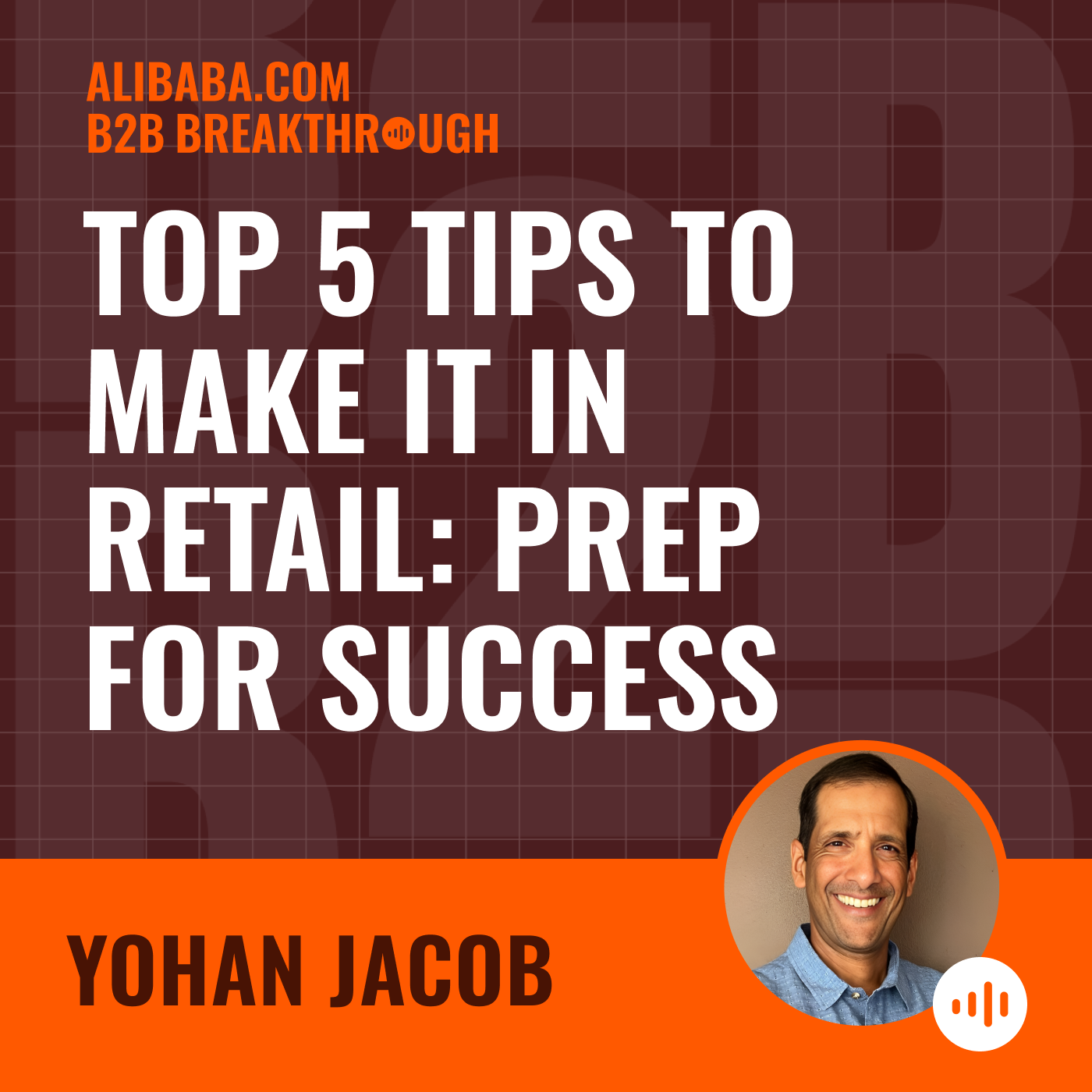
B2B Breakthrough Podcast
Top 5 Tips to Make it in Retail: Prep for Success with Yohan Jacob of RetailBound
00:30:15
On this episode of B2B Breakthrough, host Ciara Cristo chats with Yohan Jacob, founder of Retailbound, to uncover essential strategies for thriving in the competitive retail landscape. With over 30 years of experience mentoring 4,000+ clients, Yohan shares tips on product differentiation, meeting buyer expectations, and streamlining supply chains. From mastering negotiations to crafting standout marketing strategies, this episode is packed with actionable insights for entrepreneurs and established brands aiming to break into big-box retail and succeed confidently.
Loading summary
Transcript70 lines
- [00:01]
A
It's like a marriage after the honeymoon phase. What do you do to build that relationship with your wife or husband? Same thing. Once you get into bed with a retailer, what do you do to keep that burning? Love life? You gotta find ways to grow the business.
- [00:16]
B
Welcome to the B2B Breakthrough Podcast. We're here to bring you all the best knowledge, insights and strategies from e commerce experts, successful business owners, and the team@alibaba.com that you'll need to grow your business and achieve your next big breakthrough. I'm your host, Sierra Christo. On today's episode of the B2B Breakthrough podcast, we're joined by Johan Jacob, founder and president of Retail bound. With over 30 years of retail experience and a track record of mentoring more than 4,000 clients worldwide, Johan has seen it all. From navigating the consumer electronics world to helping brands build winning retail strategies, his insights are a masterclass in staying ahead in a constantly shifting industry. Johan, welcome to the show.
- [00:57]
A
Thank you. Pleasure to be here.
- [00:59]
B
We're really happy to have you. We have so much we want to get into. We've spoken with a lot of entrepreneurs in the past about their strategies, taking their products and their inventions into a retail space. And we kind of want to break down what those strategies look like from your perspective and as you've worked with clients before we get into the nitty gritty here, just lay a quick foundation for us on what Retail Bound is and how it helps the entrepreneurial community.
- [01:23]
A
So retailbound. We're a full service retail Solutions agency around 17 plus years and our jobs help young brands of the time or experience not just launch in retail, but stay and grow in retail. A lot of our clients are Internet product brands that have cool tech but just need a little help. And that's why Arkham was founded in 2008 to help these brands get the extra leg over their competition.
- [01:47]
B
By the way, before we break it down tactically, can you just lay a very basic beginner foundation on how it looks to have a conversation with a retail buyer and how to even get your foot in the door before we start talking about what you need to have prepared?
- [02:01]
A
Great question. So before you talk to a buyer, you have me ready for retail estimate. From having a 3 PL and logistics strategy already baked to having finished retail, packaging, pricing, marketing strategy, all those kind of things necessary because I always tell potential clients, like a job interview, there's one job opening and 20 applicants, there's one slot on the shelf and there's 20 great brands, right. And like a job Interview, we, the buyer can tell which brands are working with them and which aren't. The ones aren't waste their time, waste the buyer's time and don't get a second chance of making a personal impression. So before you pick up the phone, before you send an email, before you exhibit a trade show, it's really important to have those things necessary in place from logistics, marketing, retail, packaging and so forth before you actually talk to a buyer and say, hey, I love to work at Best Buy or Apple or Costco. There's something you need to get done before you talk to those retail buyers, by the way.
- [02:59]
B
Cool. And to get those conversations started that you mentioned, email, phone call, trade shows, this is where we're finding them. We're cold calling, we're showing up at local trade shows, national trade shows. That's how you get in front of these people.
- [03:11]
A
If you didn't have a retail bound, right, it has their relationships or you're using a broker or distributor. Yes. The methods would be cold emails, it'd be trade shows, it'd be networking like LinkedIn. Right. But those are the things most brands use. It didn't have a reach like read a bound in their corner, helping them out.
- [03:31]
B
So it's a lot of hustling to even start these conversations and find out how to get in the right places.
- [03:37]
A
It is tough. I mean, retail buyers, they get hundreds and hundreds of unsolicited applications to be a vendor of record. Obviously they can't talk every time they can hear it. So they have to be selective on who they can work with. And if they do get a meeting or a phone call to buyer, you got to be prepared not just to sell the retailer. It's like a marriage at the honeymoon phase. What do you do to build that relationship with your wife or husband? Right. Same thing. Once again, do the bed with a retail at Best Buy. Again, what do you do to keep that burn love live? Right. You got to find ways to grow the business because in the beginning Best Buy is very busy. Right. So rely on you to drive the traffic, you to ship the product, you do xyz and then once business is rock and roll and then Best Buy will reciprocate and help grow your business on their shelves, on their website.
- [04:25]
B
Cool. That's when you can get into performance analysis and understand who your audience is when they're buying from the retailer perspective.
- [04:32]
A
That's correct.
- [04:33]
B
Cool. So let's get into those steps to prepare. You mentioned starting with product differentiation. So why is that such a crucial stage in preparing for a conversation with.
- [04:44]
A
A retail buyer, it's very important because honestly, if you're the same product like the other 20 products he has on your shelf, why should I pick you? If you have an iPhone case and there are Bluetooth speaker and our massage gun, these are all great products but they are very saturated categories. If a buyer has 20 on the shelf, why should I pick you? Those things that you want how already predetermined or laid out before you actually again knock on that door with that retail buyer for products that are more unique. And that's where we kind of to focus on products that are less saturated, more first to market which I'll again explain on this call today. Those have a little easier time of talking to a retail buyer because there aren't 40 XYZ. They're the only one in their space because brand new we're a brand that as massage G or iPhone case it it's very tough to stand because again it's hard for a buyer to change in store. Hey, I have 20 iPhone cases and I might change out one for another unless there's a major issue like says there's a service and supply issue. There are three PR logistics. I have an issue of shipping products on the right time. Their costs are going up. Not doing the marketing to drive traffic at the point of reason why a retail buyer would cut or fire an existing supplier in a saturated space like iPhone cases or massage guns. So again, if you're going to get in you're in that kind of space, you have a really compelling story while you're better than other 40 brands that you already have on their shelf or their website.
- [06:11]
B
And so it's about optimizing and improving along the way as well to stay relevant for those buyers.
- [06:17]
A
That's correct. In any day I do a lot of these podcasts and webinars seminars and there's really one secret and be successful in retail. And it's pretty simple. But a lot of people have a hard time executing. It's basically making the buyer look good, making a job easier. See, it's common sense stuff. But a lot of young brands or brands in general, not young, but brands in general forget that such as providing timely communication where it's by email or by phone. Right. Hey, if there's a cost increase, there's a product delay. I need to know. Right. Or if I need a sample shipped at a certain time. Right. Are certain things that buyers get irritated about. And the biggest thing is that a lot of the brands make their job Harder. And those brands that make the job harder probably going to make next year's sort interesting.
- [07:03]
B
So do you have an example that you can share with us of a brand that was able to cut through a saturated market really nicely in this differentiation conversation.
- [07:13]
A
So we have a client or past client. We just ended with them literally last month. They were for about and a half years. One of the products they made was a product called the Bloom which basically a indoor air purifier. Now in 2020, air purifiers basically grew because you were at home. Right. And indoor air can be up to five times more worse than outdoor air. So they stand out from a crowd market of air purifiers. They actually made an air purifier that doubled as a planter. They also for Costco because we did a bun for Costco also made a tabletop like a nightstand. So maybe more of a multi use product than just a air purifier. Here's a product that in a saturated category, air purifiers. But find a different way around that Commoditized or saturated product space by the way. But whether it looks like a piece of furniture, piece of art. Right. So yes, they did a nice job of incorporating like where it's a nightstand or a planter in their existing product by the way.
- [08:09]
B
So variety in a one cohesive brand line of products is also helpful to differentiate.
- [08:16]
A
Yeah. And definitely buyers like this is kind of cool. I might see a lot of these air purifier. But here's something unique.
- [08:21]
B
Sure.
- [08:22]
A
Different. And those are the reasons why the buyer like hey, let's give it a shot. Because they're willing to do it takes to make the buyer's job look easier. Yeah.
- [08:30]
B
You got to make them look good.
- [08:31]
A
I mean look good. You name good. They get promoted. They get promoted. Remember the ones that that kind of wash their back. They'll wash their back later on.
- [08:37]
B
I like it. So as we're talking about these buyers and the expectations that they have, I think that helps us transition into the next big tip here to be successful in retail. So can you talk to us a little bit more about the buyer expectations?
- [08:50]
A
So buyers overall, I would say that they look at products. Right. They look at a couple things. One, they look at market trends. Air pure buyers. Not a growth category was back in 2020. It's probably more of a flat or category. But what are categories are hot that are growing. They look at financial budgets just like you and I. We have a budget. Right. I can't keep spending if I don't have the money in my bank. Right. So they have a budget in mind. Store policies. There are maybe certain products that are out the display in store or online based on policies. Right. So these are things they look at generally speaking. Right. Does your product get a market trend? Can they afford to have it in their stores as a certain store policy that restricts honestly retail, give or take. Especially that as it gets competitive for the last couple of years in retail, a buyer decision making process is will your product hit all three criteria? One, will your product drive top line sales growth? Two, will drive all my profits. That's how I pay the bills. And three, it's really important. Will your product sell through what we call inventory turns? Basically, If I buy 100 pieces on day one and I don't replenish that till day 100, probably not good. I buy a product on day one and I replenish on day 10, day 30, not bad. And I keep doing it. So they want to make sure the product is selling through and just sitting there on the shelf hunting dust.
- [10:14]
B
Interesting. So it's the sales growth, the profitability and the turnover and the replenishment rate.
- [10:21]
A
That's correct.
- [10:22]
B
Really interesting. Now, as you're working with these retail buyers in this conversation, how much negotiation goes into this? Is it more of a very clear cut? This is what I'm willing to buy? Sure, let's go through with it. Or is there more of a push and pull and room for negotiation as you get into this?
- [10:40]
A
So depending on the retailer and the category, there is a negotiation that's empowers decide, hey, here's my cost. Best Buy, take it or leave it. Obviously, if you're a newbie. Right. It's probably very, very challenging. I had a call with a brand literally a couple days ago who's interested in our services. They're already starting to talk to retailers and they actually got an opportunity to work with Chewy.com, another great retailer. Right. That's awesome. I said, well, tell me about the program you did. You agreed for. All right. Without me learning about. Well, it's drop ship. Okay, that's fine. What the terms is it probably, you know, like 30 days or less? No, it's 90 days. What? So I sell one dog bone. You don't get paid for 90 days. Who would sign that? We did. Who pays for freight? We do. What about marketing? We got do that too as well. So again, a lot of entrepreneurs I work with think they're matching negotiators. They're the Mark Cubans the Donald trumps the world. And maybe they are. But if you've never been a buyer, never been in their shoes, it's very tough to understand what tricks or what various buyers use to negotiate small brands like the one I just mentioned the last five minutes, by the way.
- [11:46]
B
Yeah, I mean it's important to have a partner like you in their corner then to vet these contracts and make sure that everyone is coming out of this a winner.
- [11:53]
A
Yeah. And same way buyers like us in between because we don't have time to talk to every time they can hear, as I mentioned, and we bring the best. The best. They know that we as former large buyers have already done the hard work of ven out these brands by making sure they have the right go market strategy.
- [12:09]
B
Yeah. Okay, cool. There's so much more nuance in the negotiation phase, in the contracting phase that I've never experienced it, I've never gone through it personally. So it's hard to know, especially if you're a first time entrepreneur trying to figure out the ropes here. It's a lot to consider and some things that I wouldn't have been prepared to have in my back pocket, especially trying to be accommodating to a certain extent, knowing that I want to get my product in front of people. You may be willing to take less than you probably should to just get that exposure in the first place. And that's not always the sustainable way through.
- [12:44]
A
There are certain things that maybe you could do great are things like you shouldn't do. Outsource it. Like again, can I pay my house? Probably could. But do I have the skill or the patience? Probably not. That's why I outsource Someone needed to make my house because I don't have the time or the patience to up and down left and right and all that kind of stuff. But I would say that a lot of our clients, they think they are my negotiators. And there's a lot of emotion when you try negotiation. It's your baby, right? Your brand. You spent blood, sweat, tears. And when the buyer says cost is too high, I don't like your product. It's not what I'm looking for. You take it personally by having a usual third party like we can bound. There's been actually both sides of that. That's one of our unique, our teammate, our consultants like myself. We're large retail buyers. We're also even manufacturers who actually sold to retailers. So it makes it look like that we've been in your shoes as a young brand trying to pioneer into retail. But we also in the shoes of your customer, the large buyer that sees a lot of brands try to sell them their product.
- [13:44]
B
Now you mentioned the manufacturing side of this and being prepared to meet those profit margins. Part of that is making sure that your supply chain is out fitted to accommodate those demands. So tell me a little bit about your third tenant here on making sure that your supply chain is prepared for this conversation.
- [14:01]
A
So a lot of our clients, you know, make their products overseas. Very few products are made here in the US obviously. Right. So having a partner like Alibaba or a partner that can ship goods on a holly matter is very important because now if products arrive late to a retailer's warehouse, you get charged, they call it penalty charge, what I call punk chargers. Right. So it's very important they have a partner where it's a free pl, a distributor or any type of legitimate agent. They get products to the right retailer at the right time. Right. At the right cost. Right. And if you don't do that, it's going to cost you. And I see a lot of brands in the beginning because they're starting up, you know, a lot of excess funds. They'll find the cheapest solution. Just because they're the cheapest doesn't mean they're the best. And there have been times where, where we come on board, I see at the fire our client, existing 3 PL or logistics partner. Because end of day, if it's not shipping on the right time, right place. Yeah, the, the brand gets slapped in the hand by the retailer. But I'm the one who gets yelled at because I'm in between the brand and the retailer. So since my relationship, my stamp of approval, you do a good job of ven out the good the bad when it comes to logistics. Again, ship with the right barcode label, pack and slip. It's short shipped. Right. It's up 20 pieces, it's 19 pieces shipped the wrong warehouse. Things that cause issues with retailers and they will definitely penalize the brand for making those mistakes. It's the brand that shows that three pl or logistics partner, by the way.
- [15:34]
B
So it's, it's making sure that you're vetting your partners thoroughly to make sure that they have the track record to efficiently ship your products and do it on time. Now can you take us Back to Logistics 101 for a second here again for the beginners. Can you break down what a 3 PL is and how to identify the right partners that actually help you get over the finish line here?
- [15:55]
A
Sure. So a3PL is called third party logistics. It could be a warehouse, one warehouse or multiple warehouses. The purpose of a3PL is to basically stack your product and fulfill it on demand. There are two types of three PLs. One is really that does more D to C and there's plenty of ship Bob ship, Monk ship, this ship. There's plenty of those out there. Right. Then there are I call 3PL, do more B2B. So instead of drop shipping when you choose these receiving case packs and then next is a third one called three plus. A three plus combines the fulfillment and logistics or fulfillment and warehousing that a normal 3 PL would BSC or B2B. But the plus includes other things. You could be kidding doing bundles, right? So maybe you have product A and product B separate and it's gonna be drop shipped to a consumer. They can put it in one box and it's a bundle, it's a soft bundle online. But they also put two sort of product in a box. They can have point first displays. Maybe they actually create organized shippers and then pre filled and ship it to a retailer. Another plus could be having edi. EDI is basically a electronic data interchange or how large retailers can transmit purse orders to a manufacturer and other nice things is they can be a distributor. They may have some vendor code, vendor numbers with a Target, a QVC or a Walmart. Let them look like they're a quasi distributor. Right. So when we're evaluating 3PL, B2B or 3 + that includes the Disney. Right. Again like I said before we look at those criteria. What's the cost, what's the reliability and is there any flexibility if There's a urgent DEFCON 6 request from a retail buyer.
- [17:48]
B
Cool, that's really helpful. I think knowing what kind of logistics strategy logistics services will best suit your business is so crucial and there's so much more in that plus category than meets the eye at a first glance. As you try to evaluate what makes.
- [18:03]
A
The most sense then there's times where our clients, thanks to our help we've grown their sales as we expand our retailers. And that three PL they hired maybe a year ago or three years ago isn't situated or set up to help those growing. So now it's time to maybe look at a bigger 3PO that can handle our clients needs and certain wants.
- [18:22]
B
Very cool. Growth is always good. We love that.
- [18:25]
A
That's a good thing, right?
- [18:26]
B
Yeah, absolutely.
- [18:27]
A
Double edged sword but yeah, longer growing the business we can find other ways to maintain that growth.
- [18:35]
B
Is the complexity of sourcing holding you back? Are you getting overwhelmed by information in an endless search now? Sourcing for your business has never been easier. Meet Axio, the world's first AI sourcing engine that helps you source like a pro with five key features. You'll get product inspiration that leverages real time market data from comprehensive web insights, social media trends and B2B knowledge. Generate detailed requirements to find the perfect match from AI verified products and suppliers through Axio's multimodal search. Use supercomparison to easily discover and compare millions of products from leading suppliers, focusing on the best selling and most competitive options. With Axio Page, you'll get AI generated encyclopedia pages that compile verified product information for each SKU and and finally leverage Axio Agent to streamline negotiations with conversation guidance, real time summaries and direct answers about products and suppliers without having to browse detail pages. Head over to Axio AI today, that's Accio AI to try Axio for free and start sourcing like a pro. Now I want to transition into number four here because having all the backend stuff is great, is absolutely necessary. But making sure that you have that comprehensive marketing plan to make your product attractive to the buyer is massive. So tell us a little bit about the importance of that in these conversations with buyers.
- [19:58]
A
So you know marketing is very important, right? Marketing can be for many different things. And I say marketing, I mean like digital ads and paid search. Those are things that hopefully were nice to have. When I say market could be promotions, probably the biggest thing, right? Where okay, was 199 on sale for 149 say 50 bucks. I'm a big fan of not promoting often because it does a couple of things. It dallies your brand, you make less money from a gross profit and third, you're training customers to wait, there's a deal. I have a client that I think I after a year of going back and forth, they were on sale in 2024. This is not a joke on their own website, which affects retail by the way, but they were on sale for 317 days of the year. That's nuts. That's a long sale at the long sale. Maybe this week it's save 15%. Next week is buy one, get one, next one is whatever, right? You're basically competing against yourself on Best Buy and Apple and Target. So you know, if you do a promotion at key times like Back to School or Black Friday, you want to show all your retail partners are on the same level playing field. If one retailer, Amazon or Best Buy or yoen.com is below the market Nike cause we call child conflict. That's not good for both the retailer as well as consumers like you and I. But promotions are probably the most basic form of marketing that our clients fit in a key time here to build awareness and drive sales. Other things that are more. I call it more nice to have, not required. But it's nice to have in store education where it's in store demo events if requests are allowed. Point of purse displays because you can't rely on a sales associate all the time because they're busy. So having a display where it's a an acrylic display or one with a video that kind of explains. So for example, I was traveling from CES two weeks ago and when I arrived in Chicago O'Hare Airport and then walking towards the baggage pickup, I stopped by a Brookstone airport store. There was one of our clients, a client called Ultra Human which makes a smart ring and they had in that Brook Airport store a display. So now you actually can see what size am I, am I size 9, am I size 8 or my size 10? And then also that inventory you could grab and try it out and demo. Right. But having displays is a great way to sell products. Right. A lot of the major retailers have a call it a cafeteria menu of marketing leverage where it's offline or online. So online could be paid reviews, paid search, banner ads, email blasts, social sales events. Right. Those are things that you can invest in or some may be free depending on the buyer and the retailer. But if those are things that we ask our clients to speak because if you don't do that, you're not going to last very long on the shelf.
- [22:46]
B
Interesting. So it's, it's the elevator pitch for your product that you need beyond getting onto the shelf. You need it to make sure that it's clear and concise in all of your messaging, whether it's a physical display in the store or talking to sales associates to make sure that all of the humans in the store are able to communicate this point as effectively to your audience as you can online as.
- [23:09]
A
Well as the copy that you have on the retailers website to the retail bot itself. Easy, because as I seen hotspots where the website doesn't match the box doesn't match the sign and then the sales is confused. So make sure your marketing and brand strategy are the same and all depending on what the platform could be.
- [23:27]
B
That's a really good point. Making sure that it's consistent from location to location.
- [23:32]
A
Correct.
- [23:32]
B
And Part of that is in the retail packaging itself. That as we were Talking about the three PLs who are making sure that you've got the in store displays and the marketing, it all comes together with the packaging. So how can you make sure that your retail ready packaging strategy is exactly where it needs to be to compete in these shelves in these saturated markets?
- [23:53]
A
I'm answering your question two ways.
- [23:54]
B
Please do.
- [23:55]
A
Because I think it's not just retail packaging, it's also the packaging. How you ship to the retailer or the three is just as important. So let's talk about how you ship to a retailer or distributor or warehouse. Some of our clients when we first meet, like I said, what's your case pack? Well, the problem is that in retail, every time the Best Buys warehouse has to open a box and count four units to be shipped out to that one store in Chicago actually cost the buyer money that someone's actually at the count. If you know that on a Best Buy shelf that they could fit three units on the shelf and then you have one unit in the back stock room for replenishment, that's four. All right, maybe your inner case back should be four. Maybe your metric case back should be 24. So you have six cases of four each. Now when Best Buy needs to replenish, the logistics person at Best Buy opens one big box and in a case box of four, boom. It reduces cost, it improves accuracy of not counting 1, 2, 3, 4. Right. But a lot of our clients before they meet us, it's one big giant box. You know how much. So we actually spent a lot of time with our client of optimizing the message case back so not shipping more or less than you need to. And two, that, that it also it maximizes the efficiency of the retailer. Right. Again, we talked about the first point making the buyer's job easier. Having the magic case back already predetermined as well as your inner case pack will save both time effort for you as well as the retailer. As for the retail box, you need a four color retail box that tells a story that has maybe some icons because you really have two to three seconds when someone's walking by the shelf to grab their attention. If you don't have a display out there, especially if English is not your first language. And two, the guys some of our clients based for our first to market, it's something that totally brand new. You only put so much copy till you overdo it. So a lot of our clients are adding QR codes to the front of the box. Why the front of the box versus the back of the box or side of the box, because we as manufacturers have no control how the box is displayed. Yeah, we want a face like this that may in reality, maybe it's turned backwards, maybe it's on the side, maybe it's upside down. Right. But having the QR code on the front, that if it's, it's visible or it's locked up in a glass case, easy for someone to take their iPhone or phone itself and get more information about the product before they ask the associate to unlock the glass case to buy the product.
- [26:20]
B
So, I mean, in a perfect world, we follow all these five steps and we succeed, we're growing, we're optimizing along the way in our relationship with our retailer. Hypothetically, though, it doesn't go our way. How do you help your clients overcome rejection and prepare to get back on your feet and hopefully hit a home run with your next pursuit?
- [26:42]
A
So generally speaking, right, you'll get nine no's and one yes. Right. That we've heard in sales. We work over 150 retailers across U.S. and Canada. We are the largest retail shamans in North America. So if a retailer where one of our clients says, is it used best by says no, that's fine. We'll talk to Target, we'll talk to qvc, we'll talk to Apple. Right? So for our clients, when there's a no or no, I'm not ready yet, that's fine. We have a plethora of the retail or verticals to go after for brands that don't use retail bound for a reason. Right. If the retailer says, no, not now, it's not in the world for a couple of reasons. Any day buy is more subjective than objective. Mean that that buyer that didn't like your product today, wait 12 months to 18 months, that buyer may be gone, he may get promoted, he may leave. So, and the new buyers come in, said, God, I love your Prague. Where you been all my life? So I tell our client, if by chance the buyer says no, we have other retailers to pursue. But again, in a year or 18 months, that buyer that said no may be gone. And we have another chance to present again to that reit. As long as we don't burn any bridges along the way.
- [27:55]
B
Right, that's cool. You know, we, we heard a similar refrain from one of our other guests. Natalie came on and she said, no's can be not right nows. And it's a helpful piece of advice to keep in your, the back of your Mind to not get discouraged. For sure.
- [28:08]
A
Yeah. Last year at CES 2024 we move with Apple, one of our clients. The product was much peer than what they had in their store and website. Everybody said I like the product however, so wasn't a no, but said hey, however can you do X, y and Z? 11 months later we have a prototype to show Apple and now we're in discussions with Apple and in stores later in 2025.
- [28:32]
B
Awesome. It's all data to work with. That's great. Well, all right. I know we're coming up on time here, so I just want to ask you what's next for you in Retail Bound in the coming months and what are you looking forward to in 2025?
- [28:44]
A
For us as a company, we launched a new service called Read Accelerator. It basically it's like almost like a group format of 8 to 10 startups per class that are kind of learning in the trenches with us. We kind of say we take 18 years of engine experience and create an 8 week intensive boot camp helping brands get ready for retail like go market strategy, pricing, logistics, packaging, marketing. And after the the eight week course, we'll actually introduce them to about three distributors from the pitch their product too by the way. So it's a new product.
- [29:19]
B
Oh, that's great.
- [29:20]
A
We're actually taking admissions right now as we speak and hopefully our first class start in April of 2025.
- [29:26]
B
Awesome. That's a really great opportunity for entrepreneurs. Where can they find you? Where can we look you up online?
- [29:32]
A
It's retailbound.com that's where you can find us. If you're on LinkedIn, look me up. Johan, Jacob, love to connect. Hopefully we can find a way to do business with you in the future.
- [29:42]
B
Thank you so much, Johan. This has been really helpful advice for our entrepreneurs.
- [29:45]
A
Thank you for the time by the way.
- [29:47]
B
My pleasure. It was great chatting with you.
- [29:49]
A
Thank you.
- [29:50]
B
B2B Breakthrough is produced by Alibaba.com to find out how Alibaba.com is empowering its customers with the tools, services and resources they need to grow their business. Visit Alibaba.com and then make sure to search for B2B Breakthrough on Spotify, Apple Podcasts or wherever you find your podcasts. Make sure to follow us so you don't miss future episodes. On behalf of the team here@alibaba.com, thanks for listening.