← B2B Breakthrough Podcast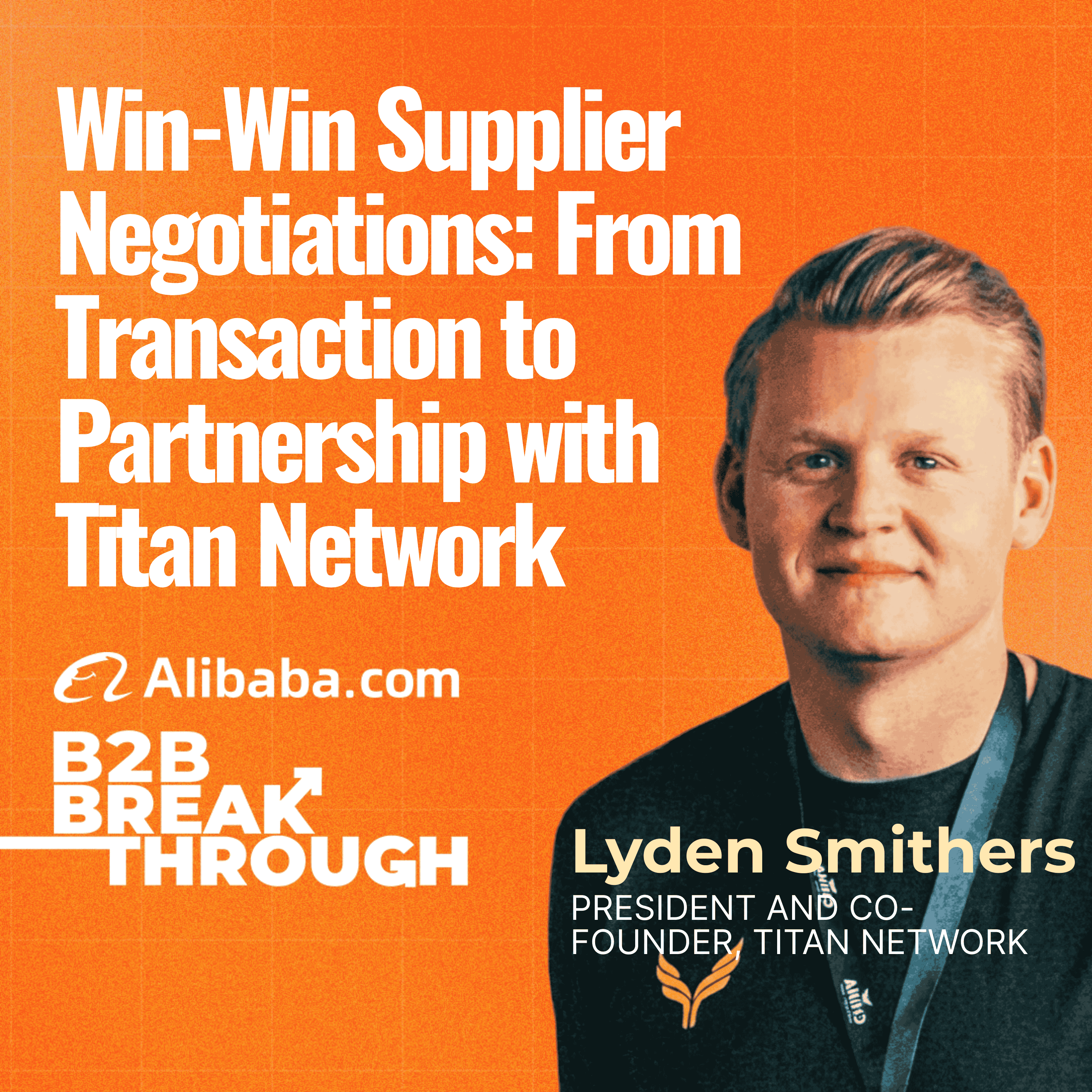
B2B Breakthrough Podcast
Win-Win Supplier Negotiations: From Transaction to Partnership with Titan Network
00:29:14
Why do successful entrepreneurs negotiate payment terms even when they have millions in the bank—and what does it reveal about building lasting supplier partnerships?Negotiating with suppliers isn't about winning—it's about creating partnerships where both sides thrive. In this episode of B2B Breakthrough, host Ciara Cristo chats with Lyden Smithers (https://www.linkedin.com/in/lyden-smithers/?originalSubdomain=au), President and Co-Founder of Titan Network (https://discover.titannetwork.com/) and founder of China Magic (https://www.chinamagictrip.com), about transforming supplier relationships from transactions into strategic partnerships. Learn how asking the right questions, building face-to-face relationships, and focusing on cash flow can unlock better payment terms, pricing, and long-term growth. Whether you're sourcing your first product or scaling to seven figures, Lyden shares practical strategies for negotiating like a pro and building supplier relationships that weather ...
Loading summary
Transcript43 lines
- [00:00]
A
I just wrapped up with Leiden Smithers, the sourcing strategist behind the Titan Network, who helps founders meet, vet and negotiate with factories. And he shared some of the most practical negotiation advice I've heard in a long time, especially around locking in strong payment terms and asking the right questions so that suppliers take you seriously from the start. I'm Sierra Christo and this is B2B Breakthrough. Welcome to the B2B Breakthrough podcast. I'm your host, Ciara Christo Lyden. Welcome to the show.
- [00:29]
B
Hey, good to be here. Thanks for having me.
- [00:31]
A
Oh, it's our pleasure. I'm so happy to have you. We've got a lot to get into today. I know we want to talk about negotiations and ROI and how to make the most of your sourcing strategies. But first I just want to invite you to take a minute and tell us a little bit more about the Titan Network. I just gave a very high level overview, so if there's anything more that you'd like to share, we'd love to hear.
- [00:50]
B
Yeah, so Titan Network, I think we've been going about six or seven years now, but yeah, we just come off a webinar actually talking about the future of Titan Network. So really exciting. But we're an online mastermind community for e commerce sellers predominantly, all those years ago, focusing very much on Amazon, but as the world evolves into AI and social commerce, really tackling those different pillars and yeah, diving into some exciting stuff in there in the years, in the years to come. So yeah, that's Titan Network. And then aside from that, I run China Magic, which is a part of Titan Network, where we take 50 to 100 students every six months to Canton Fair and teach them how to find good suppliers and meet, meet their suppliers in person and factory tours and negotiate better payment terms, pricing, MOQs and all that good stuff.
- [01:37]
A
So you mentioned that negotiation is a key part of the process when starting off with your business and getting folks set up with new suppliers. I want to start off there and kind of break down negotiation. We've talked a lot on this podcast about finding and vetting suppliers. But to, to really dig into how to negotiate appropriately, how to, to get the right terms, what are you needing to do as a founder? What mindset shifts do you need to make to get in the right space and have the right conversation with the right people?
- [02:07]
B
I think asking the right questions, presenting yourself in the, in the, in the correct way and approaching it to try and create a win, win situation. Too many people go into a negotiation trying to win that negotiation. When it comes to business, particularly this type of business, you can't win. If one person wins, the other person loses. We have to find a situation and stop trying to tackle each other and fight each other, but put the problem on the other side of the table, sit on the same side of the negotiating table and figure out how we solve the problem together. So it's a big mindset shift. When people come with me to China and say, oh, I want to beat them, it's not beating them, it's joining them and beating the problem together, I suppose.
- [02:48]
A
So what are some of those signals that you're looking for to tell that you're talking to the right person in the first place? To know that this is someone who I want to sit on the same side of the table with, to have this conversation? Just like those early green flags, what do they look like to begin that negotiation?
- [03:05]
B
One of my favorite questions to ask, or a couple of questions, one of them is, how many workers do you have? It's a telltale sign of how big the company is. And at this point, I'm gathering information. It's not necessarily a right answer or wrong answer on whether they're big or a small company, but if they've got 50 workers, perhaps they're a bit smaller. If they've got a thousand workers, they're bigger. Now, that can work in your favor either way. But what I'm doing is gathering information to see what might work for me. And if the main thing for me, which typically is for expediting the growth of your business is cash flow and it's better payment terms, then somebody who's got a smaller company might not have the cash flow themselves to be able to support you. They might want to. And I've never really had anybody that doesn't want to support, but in some cases people can't. Right. Because the size of their business, that isn't always the case, though. It might be that because they're smaller, they're more willing to help you because you're going to be quite a big company, quite a big client, and you're going to grow together. And when you talk to a bigger company, maybe they'll say, well, why would we give you the terms when we don't give that to some of our bigger customers? Or they might believe in you. So it's all about asking the right questions and finding out that information. And then another question I like to ask pretty quickly, which helps me engage them, whether it's on Alibaba, when You're finding a supplier and in writing, or whether it's in person if you, if you've met them. I like to ask, can I visit the factory? And whether I'm planning immediately to visit the factory, but I always want to lock that one in. And it's a red flag if someone says to me, oh no, not really, it wouldn't be suitable. And I'm like, why is that? Because you're not necessarily the factory. Is it because you're a trading company? Which there isn't an issue with trading companies. But if they're not willing to be open and transparent, that's a red flag. But normally what it does is send an indication that you're a serious buyer. You're not going to go into business with them without visiting the factory. And in culture around the world and all the different places we source from, but in particular China, it's a really important part of the, of the process of meeting face to face, sharing, breaking bread and sharing a dinner together or drinks and building that relationship. So letting them know early doors you want to visit the factory engages them in conversation with you because they automatically hold you higher in higher regard that you're a serious buyer.
- [05:16]
A
Yeah, that's interesting. And it's, it's something that I've heard before about the trading companies versus the factories and something to watch out for. Is that something that you find to be common, that people are trying to pass off their trading companies as factories? I just, you know, it's. It's something that, especially if you're a green business owner and are just getting into this world. Why, why should you be looking for a factory over a trading company or what, what should you be prepared for in those conversations?
- [05:42]
B
Yeah, it's less common now that they try and hide the fact if you ask them outright, like they're not going to lie to you because they'll lose a client if you. Because you're going to find out. Right. But typically we ask them at your trading company or factory. Sometimes I don't like answering fully honestly. I like to tell people, I don't care if you're a trading company or a factory. I just need to know. And if you are a trading company, can I have access to the factory? Will you take me to the factory? I'm not trying to cut you out. I'm not trying to go around you. I want you to take me to the factory. I go and visit every factory so I can understand the production line and I can give input on how I make things More efficient. So for trading companies willing to do that, a trading company might be able to, through economies of scale, through working with a particular factory, be able to get you cheaper pricing or better payment terms. And they might be able to financially support you in place of the factory being able to. So there are benefits sometimes. Overall, I would rather work directly with the factory because I like that bond that we can have in the friendship and the relationship that we can build to be able to grow together directly with the factory. But there's other situations. For example, if I'm creating a bundle of a product, let's say it's a wine set that has glasses and a bottle opener and a decanter and an aerator and all these different things, then if I was to try and create that, I'd have to find five or six different factories plus a packaging factory. Whereas I might be able to leverage a trading company to be able to help me source that and not have such high MOQs. So there's times and places for both. The majority of the time I'd rather deal direct with the factory and build a direct relationship. But I don't write off working with a trading company. In certain situations it can be a benefit.
- [07:25]
A
That's really a helpful distinction to know, especially in that example you just gave. And bundling products, I think that's becoming a more and more common way to sell a hero product is to have that, you know, that bundle available to their consumers. So I think a trading company is a great hack to kind of figure out how to navigate that process.
- [07:44]
B
Yeah. At least to get you started. Because otherwise, if you've got six factories and there's an MOQ of a thousand on each of them, then maybe you might be able to get lower MOQs to be able to test and stuff like that. And yeah, just go over translation issues as well. So there are benefits for sure.
- [07:58]
A
Now, conversely, if I am a supplier, if I am a factory owner, someone on that side of the world, what am I looking for in terms of green flags, red flags from a small business owner who is coming into this negotiation? What is going to immediately put a bad taste in my mouth?
- [08:16]
B
Absolutely. I touched on this at Alibaba Co Create in London a couple of weeks ago. And he's asking the right questions. I see too many people go to alibaba.com find a few factories and go, what's the lowest price? What's the lowest moq? And then they wonder why they don't get a response. Right. So factory owners aren't looking what I've just said, they're looking for the same stuff as us. They don't want a thousand customers buying 20, 30 units. They'd rather one customer buying million units. Right. They don't want to deal with loads of people just in small orders. Like it costs money to set up a new production line and, and supply chain. So they're looking for people committed. And I think people struggle with that when they're just starting out. And the important thing is, and what I teach with people who come to China with me and, and, and again into this, it's important to talk about yourself and why you're selling yourself as much as you're, you're selling the idea of your products. Right. And you're also selling the future of what this relationship looks like. So maybe you only want 500 units now because you're testing a new innovative product in the market. Right. And maybe we need to try and negotiate that moq down. I wouldn't start with that. I'd start with, okay, cool. I've got this great product idea. I see an entry point to the market. In fact, I've built and sold a business before, or here's my history in the corporate world. This is what my life's looked like so far. I'm going into this. I have cash to back it. I also have a social media channel and I've been on these podcasts and I'm able to work with influencers to promote. And over the next 1212 months, I intend to order a hundred thousand units, but I need to test it with 500 units. So it's talking about the future and what it's going to unlock if we can come to some sort of agreement now. And then they'll negotiate and say you need to do at least a thousand. You end up at 750 and we're all good. But going in, negotiating on today's order, particularly when you're first starting out, I'm not talking about the future is a big red flag for them because they don't know what, what's to come unless you tell them. Right. So you're trying to present an opportunity and think about it a little bit like going on Shark Tank or Dragon's Den or whatever. Right. You're, you're trying to engage with this factory and convince them to invest time in you because I can guarantee you on the first order, they're going to lose money and they'll be willing to if they think that the upside is worth it.
- [10:27]
A
Yeah. So it's about projecting staying power without getting, you know, unethical with the details. It's, it's about just showing, you know, your, your prowess in the arena without necessarily having the sales to date to back you up just yet.
- [10:41]
B
Absolutely, yeah. If you've got sales today, great. But it's all about the future. What does this partnership look like? If we're able to get the quality right, the moq right, the pricing right, we can hit all those things. You can trust me to do the marketing because that's what I'm good at. This thing, look, this thing blows up and this is one product and we can launch multiple products together and. Yeah. And have a prosperous partnership.
- [11:04]
A
That's great. And I think just being able to nurture and keep that relationship going is, is so key because you are able to find efficiencies down the line, I'm sure, depending on, on your relationship with your supplier. So as you're starting to grow and, you know, you're scaling together, how do you approach renegotiating or like I said, finding those efficiencies without damaging the relationship that you have in place? What, what kind of opportunities do you see there for small business owners to improve their margins over time as they scale?
- [11:36]
B
Yeah, absolutely. And I tend to negotiate on most orders. Right. If I'm placing orders quarterly and they're getting bigger and they can see they're getting bigger, I know they're going to benefit from the economies of scale. I think the important thing is if you've promised something in a negotiation, make sure you hit that. And one of the small tips that I can give when negotiating payment terms, for example, if they give you 60 days to pay, then paying 50 or paying 55 before you ask for 90 on the next order. So I think just sticking to your end of the bargain, not getting to the end of the 60 days when you're meant to pay and go, oh, I need another 30. Let's make sure that we continue to prove our worth and prove that we're trustworthy when it comes to delivering what we say we're going to do. I think transparency as well. So something that has been helpful to me in the past as an Amazon seller is they see that you're selling the product for $25 and only paying a couple of dollars for it, Right? What, what's really good is to show them where the money's going. It's like, well, we had to pay the shipping, which is this much, and then Amazon actually take these fees and then we have to invest 20% or 15 to 20%, whatever it might be, into advertising. And then I'm also getting influencers doing this. And then I have employees and I have an office space and this is expensive and this. And just say, look, the margin is actually really small. So whilst it looks like I'm buying at $2 and selling at 20, it's not actually the case when you, when you figure out what the. And I think being open about that and sharing, sharing what it is as a partnership, rather than trying to hide your numbers and argue over cents and on the dollar and stuff, I think just being open about the situation, explaining why, like, my favorite question in any, in any situation is why? Like, can I have better payment terms? No. Okay. Why? Well, it's because of this. Okay. So if we fix that, I can get them, right? Or how do we get the price down? Oh, we can't because of this. Why? Oh, because it's a very manual process. Okay, how do we automate that? Can I invest in a machine with you to be able to automate that and then bring the cost of the product down? Yeah, absolutely. So it's about unlocking those different situations and really understanding what's going on. And if you're transparent, they're going to be transparent. And again, you're going to see what the problem is. I need to get this for $2. How do we get there? Like, let's work together on it. Rather than just hard negotiation that makes them have a small margin, the relationship will break down and, and you'll, they'll cut corners, quality will drop, and you've killed the product.
- [14:03]
A
Let's say hypothetically that that is the situation you find yourself in where you, you did conceal numbers. Something was just not going the right way. Or maybe they did, you know, something was just not not aligned in your relationship. How do you recover from a partnership that was not serving you and your business? Is it worth recovering? Or how do you evaluate whether or not to pivot?
- [14:25]
B
Yeah. If there's been a good history and something's changed, then we have to look back at why it's changed. Right. Again, that question. Why? Right. So why has it changed? Is it because we're dealing with a different sales manager? Is it because they've grown, we've both grown together and there's new employees, which has killed the quality? Or is it because you're too small and they don't care anymore? Now, depending on what, what it is, potentially you can save some of them. But what I will say is there's A lot of options out there. You might have put a lot of effort into getting things right with that particular, particular factory, but there are other options. A good leverage point is having another option. When you go into a negotiation, it's not something I bring out straight away, particularly with the Chinese suppliers, it's something I've got in my back pocket. I do my negotiations, then I bring out and go, well, actually. And typically in China, for example, most of the factories that create the materials are all made in the same town. Right? They normally know their competitors pretty well. If I bring out a quote from another competitor with better payment terms about price and go, look, I appreciate what you've done, but can you explain why? Again, the question why is this lower and why can they give me better payment terms and get into that? So having another option, having a backup option is something I always try and have when, when going into trying to fix it, you don't want to threaten to walk away. And then when they tell you to walk away, you don't have anywhere to.
- [15:47]
A
Go that's super fair. You gotta have something lined up. So, you know, as you're having those conversations and we're talking about something not fitting quite right, what, what is a surefire sign? You know, you mentioned quality's gone down, responsiveness may be shifting. What is a sign that says, nope, gotta get out? We started off on the right foot. We had a great terms, you know, upfront, but it's just not working in reality. Is that something you come across? And if it is, how. How do you say, yeah, now's the time.
- [16:20]
B
I think I mentioned earlier about, obviously the different sizes of factories. Sometimes it happens when you outgrow a factory. If we're talking about, as an example, delays in the, in the production line, which can't happen because running out of stock, Amazon, TikTok, shop, wherever you sell your product, running out of stock is huge. We don't want to do that. And if there's delays in production time, it could be that we've outgrown them. It might be that the quality is good, the people are good, but they simply can't keep up with the demand, then that would be a case where I don't want to, but I'm going to have to go somewhere else for the greater, greater good of the business of my own. God protects my own interests. Right. It wouldn't be that I would burn bridges. It would be that if I can give you some orders for the Australian market versus the US market, or if I can do something to support you or if I can bring you other customers because I've enjoyed my time with you, but we've outgrown you and we're moving to another. Another factory. The thing is that it's not going to be taken in a bad way. You're not going to burn bridges. You're going to be honest about why you're moving. And if that is one of thousands of reasons you could move, then I think it will be received well. If it's a quality issue, you've probably got a better chance of staying with them because you can go and see the factory and understand why. Like, here's all of the reasons. We're getting returns or bad reviews and it scratches. Let's fix the production line together to make sure it doesn't happen in the future or as we've grown. Have you employed new people? Let's get the training on how to manufacture with the new employees better. So there's always an answer when it comes to quality, but delays on production time and outgrowing a supplier is a situation where I'd have to pivot and move somewhere else.
- [18:01]
A
How do you balance the negotiation tactics or differentiate between negotiation tactics? When you're dealing with a factory or a trading company for that matter, online via Alibaba.com, versus being with them in person, how does that conversation change and what should you be more attuned to in each scenario?
- [18:20]
B
Yeah, so I don't really like to do negotiations over WeChat or over Alibaba or written down. I should say is that is what I want to say. What I want to try and do is jump on a call because then I can see the reaction. It's softer. You can see each other. We can have a conversation to start with. We're not going straight into, I want this from you. And I always give before I take like, look, here's where we're at so far. I'm appreciative of this, the relationship, how you've supported us. These things are good. We're growing fast. The biggest challenge is potentially cash flow or quality or price or whatever it might be that you're negotiating. I want to give you a bigger order. For example, if you can give me better payment terms, I'll give you a bigger order. So you always have to give something in return. Like don't just go in and ask for something in a written email. You're just going to. They're going to say no, right?
- [19:10]
A
Right.
- [19:10]
B
What. What are they getting out of the deal? This is we have to, we have to present the win win and how you're both going to benefit from this and grow together. So I think that's important. But as I said, I like to do it on video where possible because when I ask for some pretty hefty payment terms, I would like to see whether they move back in their seat or they laugh or they laugh or they get angry or whatever that may be. So. But I think in this particular business and particular China, like, I always joke that the national sport of China is negotiations, so they like doing it. And I have loads of students that come to China with me and are scared to ask. Don't be scared to ask. They can only say no. Right. And I feel like they're disappointed when you don't ask.
- [19:55]
A
Yeah, that's a great point. Take the time, invest in the conversation and be present with your counterparts. Yeah, totally.
- [20:02]
B
Don't get me wrong, I've written emails before and they're like, yeah, no problem, that's fine. So listen, it can happen, but depends.
- [20:10]
A
On what you're asking for.
- [20:11]
B
I bet it depends on how important you are to them and how much they value the relationship. But typically I like a presentation to show where things have come so far and why they should trust you to sell as many units as you're telling them that you're going to sell. And then what your ask is like, if I can sell these units as long as you can give me these terms.
- [20:32]
A
Do you have any anecdotes of a really successful negotiation either that you led or that one of your clients or students embarked upon? How can you share with us an example of what worked really well?
- [20:45]
B
The biggest ones for me have just been like. And I learned this a long time ago, 10 years ago, when I first started this out. And trying to get these payment terms is always important to me because when I started, I had no money and I just moved from Spain to the uk, I had no credit history. So it's very difficult for me to get any loans or anything like that. And everybody in the industry, I've done an Amazon, everybody. You need to get a loan, you need to get a credit card. I'm like, well, this is not really an option for me. So I'm like, how do I grow this business? I don't want to go and get a job, I want to do this. So it was, how do we, how do we get payment terms? And that was a big one for me. But. And then from that point, over the next couple of years and going to China and visiting people in person and negotiating, getting 90 day payment terms, 120 days. And then a few years ago I went to China and said, right, I'm going to try and get like 180 days. Like it's going to be a push, but what a story that would be. And I went through about eight factories in four days. And then I was trying to get them, I was getting good terms, 120, I got 150. I'm like, I really want the 180 days. But. And then I went to a factory. There's a huge factory factory. They had six different factories that create all different types of products and they were huge. And I didn't get to speak to the boss. Speaking with the boss is something that I always try and do because they're the decision maker. I spoke with someone else, but they were huge, thousands of thousands of employees. And I thought, well, I'm going to go through the process and ask anyway. But I'd sort of given up on my hope of my, of my ego of getting the six month term. But yeah, I managed to land them and they were just, I went through the process, went, yeah, yeah, you can have that, no problem. Then that gave me the confidence and the next one I got, I got them as well. But it was, it was strange. You know, I talk about the different sizes of factories. It's not always I thought that was very small for this huge medical factory I was dealing with and, but I presented it, we built a relationship. They could see the future of the brand. They liked my experience in being able to sell and they took a gamble on, on a smaller company because they will get the benefits in the future and gave us 180 day payment terms. And then the next factory I went to, much smaller 100 employees and much smaller office and I thought, oh, they're not going to have the cash flow to support me. But they did. We've managed to expedite the growth of our businesses by essentially selling the product twice before we have to pay for it. So you can imagine how impactful that's been for those two businesses that we've grown very fast.
- [22:58]
A
Wow, that's huge. I love that tale of, it's kind of a David and Goliath tale. Taking on the big factory, getting that 180 goal. That's incredible.
- [23:10]
B
But I think it's important when people listen to me speak about this stuff and follow my training to the letter and go, I didn't quite get what I wanted out of it. If you follow my training My six step process on negotiating better payment terms. You won't find anyone who doesn't want to give them to you, but you will find people who can't just because they're unable to get their boss to agree to it or they don't have the cash flow to do so. So the way that I present it is that it's a huge benefit for them to do it and if they can, they will. So build the relationship, understand the production line, sit down and have dinner, create a presentation about what the future looks like and put in your ask face to face. And yeah, in China they have a word called guanxi which means relationship. But as it relates to business relationships, the face to face value is very, very important. And I've had people that have done presentations and followed it to the letter online four, five, six times on a video call, got nowhere, come to China within seconds, they've got the payment terms just by traveling. There's something to be said for traveling to China and building a relationship, but there's something to be said for just telling them you're going to China and you're going to be going to Canton Fair. I've had people offer me discounts and payment terms just because they know I'm going to Canton Fair, because they know that I've got 30,000 booths that I can walk up and down and all their competitors are going to be there and they know that I'll be building relationships with them face to face. And so just telling them you're going to Canton Fair will, as a small negotiation hack, if you like, say that you're planning to go to Canton Fair and they know their competitors are going to be there and they normally sharpen their pencil pretty quick.
- [24:45]
A
That's a smart tip. I like that. That's not one that I've heard before.
- [24:49]
B
I'm normally one for teaching strategies rather than hacks, but if you want to hack, that's a good one.
- [24:56]
A
That's. Yeah, that's. That's great. As we're heading into a negotiation, what is, you know, we talked about the terms that you want to set yourself on the right foot. What are the strongest terms that you can ask for as a business owner at the beginning that is going to serve you as you grow. What is going to have the longest staying power and impact over the, the course of your business?
- [25:19]
B
When we're coming to the end of a negotiation, what I like to try and do is make sure that we have everything in writing because especially when we're dealing with other countries and things can get lost in translation. And I've had people do this and they've gone to Canton Faire and they've had like, oh, they've promised to do this and this and this, and then it hasn't actually transpired because they never got it in writing. So I do think that having a contract is important, but I really want to just make sure that we're not going into huge legalities in a contract and ruining that soft connection that we had and that relationship and enforcing big legal documents and having them translated and all that stuff. So I do think that there's a need to have everything in writing. But I just be careful you don't undo some of the good work that you've done with building relationship and asking about family and history of the company and what their hobbies are and what their goals are for life and having this nice soft agreement and handshake and then going, right, I need you to sign every page of this 42 page document, right? So I just think there needs to be a balance there. But absolutely get everything in writing because normally we're dealing with people the other side of the world and whose first language isn't the same as ours. So I think it's important to have everything in writing. If we talk about a particular thing that we negotiate, it depends on what you're looking for. Even if you've got a load of money sat in the bank or you've got your uncle, your rich uncle that's going to support you, I think it's very important to have payment terms as a supplier because whilst we talk about winning together, we also lose together. And if you've paid for all the products up front and it lands in the US or wherever you're, you're selling the product and there's an issue with it, then they've already been paid for it, right? Now you've built a good relationship with them and you hopefully they're going to fix things, but if they decide not to fix things, they've already had their money. So even if you have all the money in the world, even if you have great investors, I will always try and get better payment terms because it does turn it from a transaction into a partnership. Because if you haven't paid for it when it's there, then you're both on the hook for it. So we share in the risk, but we also share in the rewards. And I think that's very, very important. So I. It doesn't happen often, but some people say to me, well, I don't need payment terms. It doesn't matter. I'm like, well, you do, because if you don't have payment terms, it's a transaction, not a partnership.
- [27:35]
A
That's a great point to drive home. I think, you know, just making sure that those payment terms are agreeable to both parties is, of course, you know, the, what we're doing here, you know, that's the, that's the very crux of negotiation. But I think it's, it's worth repeating. So thank you for, for your advice on this. I think it's going to set people up for strong negotiation strategies moving forward. And I know you are providing a ton of resources for small business owners. Do you have any links or resources you'd like to plug?
- [28:03]
B
Just check out chinamagictrip.com I think building a relationship online and through alibaba.com is a great way to find, find suppliers. But when you're ready for that next step and you want to, you want to take the negotiations to the next level, the only way to do it is in person, in my opinion. So I run a trip to Canton Fair every spring and autumn. And yeah, if anybody wants to come along and learn how to negotiate those terms and pricing, moqs, exclusivity deals and all that good stuff, then check out chinamagictrip.com Sounds good.
- [28:37]
A
We'll make sure that's linked in the show notes so everyone can find it. In the meantime, thank you so much, Leiden. This was an amazing conversation. I appreciate all that you've offered.
- [28:45]
B
Thanks for having me. It was a lot of fun.
- [28:46]
A
B2B Breakthrough is produced by Alibaba.com to find out how Alibaba.com is empowering its customers with the tools, services and resources they need to grow their business. Visit Alibaba.com and then make sure to search for B2B Breakthrough on Spotify, Apple Podcast Podcasts, or wherever you find your podcasts. Make sure to follow us so you don't miss future episodes. On behalf of the team here@alibaba.com thanks for listening.