← B2B Podcasting Insights - business strategy podcast for founders and brands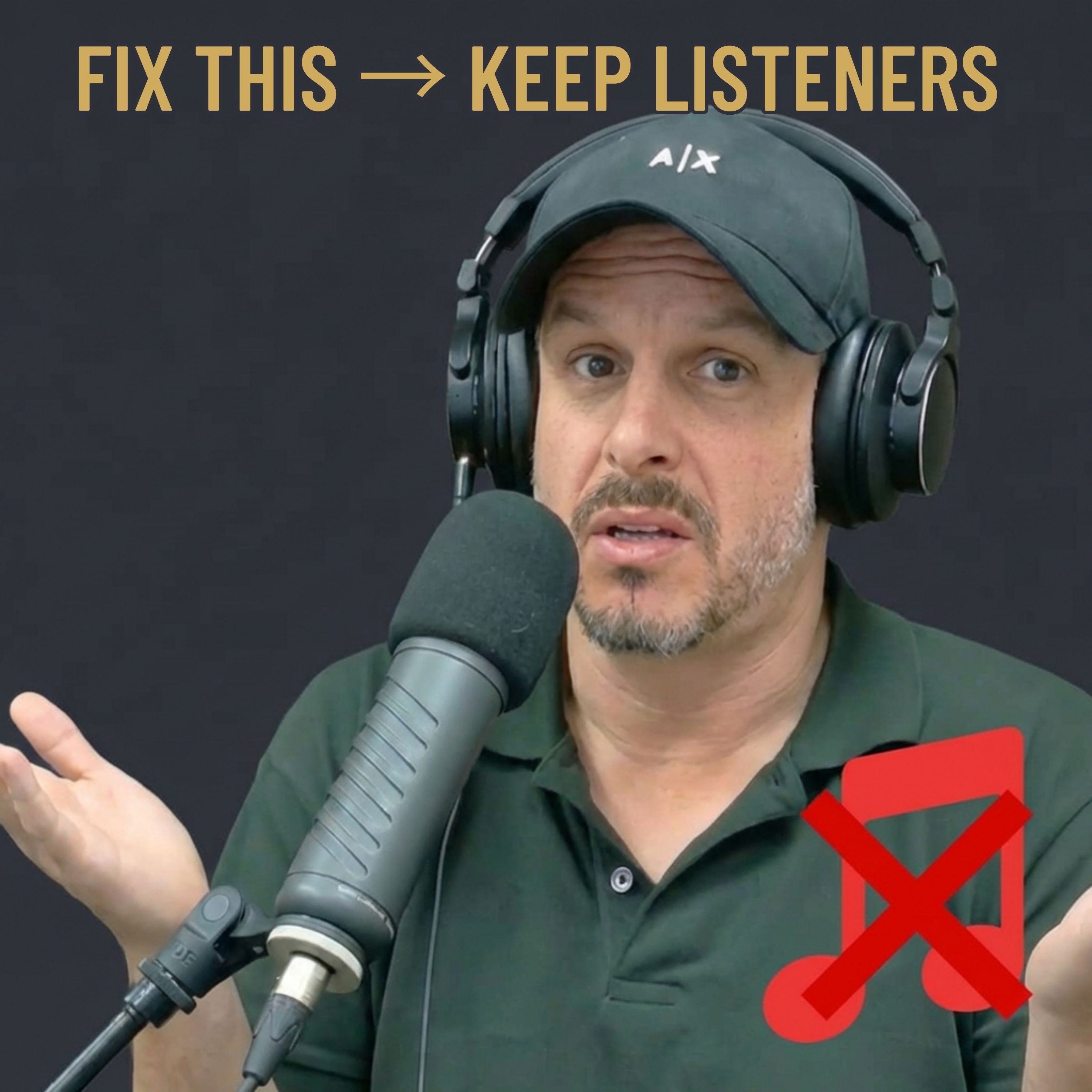
B2B Podcasting Insights - business strategy podcast for founders and brands
This B2B Podcasting Intro Problem's Costing You Expert Positioning
00:17:21
Loading summary
Transcript7 lines
- [00:00]
A
Do you hear that? You know what that sound is, right? That's the sound of your future ideal audience disappearing on you. F this, I'm out. Yeah, I'm gonna save you right now from the single most common thing that is driving listeners away from your podcast episodes within Those first crucial 10 seconds. No, it's not bad audio. It's not even a bad topic. It's your intro music, Marty. Something has to be done about your intro music or more specifically, your obsession with it. Let's talk about that.
- [00:43]
B
Welcome to B2B Podcasting Insights with Neil Velio, founder of PodKnows, a podcast agency, helping you get better results from podcasting.
- [00:54]
A
Okay, we're gonna do a really practical exercise in this episode. So I want you to right now, pull up your podcast and go to an episode. Doesn't matter which episode, go to the latest button. If you like, press play. Count the seconds until you say something the listener actually needed to hear. You know, something specific, something that makes them think, okay, that's all about me. I'm gonna stay around on this episode. If you get to 15 seconds or 20 seconds or perish a thought, maybe 30 seconds, and you're still wading through the intro music, as much as you might like that intro music, or maybe there's a voiceover that's currently speaking, or God help you, welcome back to the show. And here is all about me. That's not branding, that's repulsion. And repulsion at the start of an episode costs you listeners that you'll never get back. I want to be really clear about something from the get go here because I know what you're probably thinking, but, Neil, my intro music is part of my brand identity, right? And a dentist's waiting room has music too. Nobody's requesting it on Spotify though, are they? Here's what your music in your intro is actually signaling to a brand new listener. Someone who's just pressed play for the first time because a trusted colleague, a Google search, or a LinkedIn post pointed them to you. They specifically told them to check you out. And in that crucial first moment of them discovering you and listening to you, what your podcast episode's intro music is saying to them is, wait there just a second. I'll be with you in a moment. And that's not authority, that's a cue. I know that we British people do love a queue, but you know what we love more? Not having our time wasted. And specifically, B2B buyers don't queue for podcast intro music. And that's kind of what you're trying to get them to do, right? Here's what a B2B buyer is experiencing while they're listening to your podcast episode. They've got 12 tabs open, a 3pm call that they're already dreading about five seconds before they decide whether to stay or bounce. And also an acute awareness that you might be about to waste their time because you're going to talk about the thing that they're not actually that interested in. And while they're going through all that internally, you're adding another 35 to 40, maybe even 60 seconds on a drum loop that has absolutely nothing to do with their current problems. Now, I of all people, understand exactly why this happens. Intro music and sonic branding is a hangover from radio I, as a former morning show radio personality, used to invest a lot of time in the production and sound of when I started my show and when I ended my show. And all the stuff in the middle of the show. Of course, it was a pretty big deal. It made it sound more showbiz. But radio is very much a passive medium, and that's why it has to really rely on lean in moments. So back in the day, it was prank phone calls that stop people just lazily hanging back listening to songs. They had something really entertaining, hopefully funny, that they could lean in to engage with. You know, radio bits, jokes, skits, all that kind of stuff was really designed to get the passive listener. Being an active listener. When you're listening to the radio, you're driving, you can't skip. You're pretty much captive. So the jingle, the drop, the sweeper, all of that made sense. That's why radio ads can get away with being about three, five, seven minutes long. And people will tolerate them because they're doing something else at the time. They're not making an appointment to listen. As much as the radio industry would like to think that you are as a listener, all of this stuff on the radio built familiarity because you are going to hear it around 60 times a week, whether you liked it or not. Your podcast listener is somewhat different. They are active. They're intentional. They're an on demand audience. They pressed play intentionally. They chose your show intentionally. They didn't want to hear 60 minutes of Britney Spears or Ed Sheeran. They wanted to hear anything between 15 minutes and 60 minutes of you sharing business insights. So they don't need warming up with sonic branding. They're already warm. What they need is for you to immediately prove that pressing play was worth their time. Let's demonstrate to you what the wrong version of doing this sounds like. And I'm not making this up out of nowhere. This is literally a composite of the last dozen or so branded podcasts that I have audited for clients.
- [06:46]
B
Welcome to the insert Brand name podcast here. I'm your host, and today we're talking about growing your business. Whether you're a founder, a marketer, or just interested in leveling up, this episode is for you. So let's talk all about everything to do with the niche of insert brand name podcast here. Let's get to it.
- [07:11]
A
Okay, so you've just heard there, that is the kind of thing that most branded podcasts are doing in the beginning of their episodes. And that's cool, but who's that not for? Because that episode is for everyone, which means it's effectively for no one. And the listener who might have been the perfect prospect for for you to buy your stuff, the one with the exact problem that you were probably gonna solve, already bailed during that music because they thought, well, this isn't for me. So we've given you a demonstration of what the wrong version sounds like. Let's talk about what the right version sounds like. If your last three sales calls started with the prospect saying, so tell me a bit about what you do, please. This episode will tell you exactly what, why that's happening and how to stop it. That's it. That's your first 12 seconds. No music, no fanfare, no sonic branding, no welcome back. Just a specific high stakes statement that speaks directly to that person that you're trying to specifically reach. And because you're doing that, that person knows immediately, oh, this episode is for me. Now, that's authority. Not the music that doesn't have any. Not the production value that doesn't have any. Not even the sonic branding jingle. It's the precision, the specificity, the immediate, undeniable relevance. Now, if you're struggling to get your head around what I'm talking about here, think about the best sales call you've ever had. The one where the prospect said to you, wow, it's like you already knew exactly what we were dealing with. That didn't happen because you opened with a logo animation. It happened because you got straight to the pain. And your podcast Cold Open is exactly the same thing. It's your first sentence in a sales conversation that your prospect chose to have. So what are the ingredients then of a proper cold open? Well, here are a few principles that I share with every client I speak to about this. 1. Make a specific, uncomfortable claim not in this episode we're going to discuss X general topic, but something more like here's the thing that's costing you every time a prospect gets on a call with you, make them feel something before they've consciously agreed to listen. 2. Make it about them, not you. Welcome back to the show is kind of all about you. Whereas if you've been sending your podcast link to prospects and wondering why it's not converting, that's about them. 3. If you use a show intro 5 seconds or under, you can talk over the tail of it. Five seconds of flourish. That's all you need. Your regular listeners have already heard your intro and even if they like it, they're not wanting to hear it like it's a Spotify playlist and your brand new listeners just don't care yet either way, get back to the actual main content as fast as humanly possible. You know, the psychology of this is actually fairly straightforward. When someone presses play on an episode, they're in a state of uncertain investment. They're not sure yet if it was worth their time. The fastest way to resolve that uncertainty in your favor is to immediately prove that you understand exactly what they're going through. It's a signal. It says, I'm not going to waste your time, mate. I know your problem. Stay with me and and I'm going to tell you exactly how to fix your problem. So if your podcast still opens with a 22nd music bed and a generic welcome, by the time you've digested this episode, understand this. You're not building authority, you're postponing it. And in the attention economy, postponing authority is the same as never actually having it.
- [11:39]
B
And now founder FAQs.
- [11:42]
A
Well, as you may now know, each episode, I dig into questions from founders who are trying to get more from their B2B podcast. This one came in from a founder running a consultancy in the logistics space. And the way that people are getting hold of me, by the way, is they're emailing neilodnose.co.uk that's n e a l odnose.co.uk. this particular person asks my podcast episodes run to about 35 to 40 minutes. Is that too long or should I be cutting them down to improve completion rates? That's a really good question. And the honest answer is the episode length isn't your problem. The relevances and completion rates don't drop because an episode is 40 minutes long. They drop because somewhere in those 40 minutes, the listeners stop feeling like you actually talking to them the moment your content becomes generally quite dull. Maybe it's a long, drawn out interview or the guest starts meandering off into a topic they're just not interested in. That's the moment they start checking their phone. And Honestly, I've seen 10 minute episodes with 20% completion rates and I've also seen 45 minute episodes with 80% completion rates. The difference is never anything you can count on the clock. It's whether every single moment earns its place in the MP3 file. So instead of cutting time, cut the waffle, cut the preamble, cut that bit where you politely explain what you're about to say before you go ahead and say it again. If you do all that, you know, cut all the filler words, the ums, the ers, the ahs, the you knows, the repetitions, the mistakes, all the stuff that you kept in because some idiot podcast guru told you it's all about being authentic and sharing every mistake. Because that's what humans do. If you cut all that and your episode is still 40 minutes long, brilliant. It's earned those 40 minutes. If it trims down to 25 minutes, then that's telling you something. Either way, don't set your edit target at a runtime, set it at every minute has to justify itself. You'll find your answer is right there. I always tell people when they say how long should my podcast episodes be? I say your podcast episode should be as long as it needs to be to get the point across clearly, cleanly, and in a way that someone can take action with it and no longer. Here's my quick tip for this week's episode. Before your next discovery call, send that prospect two or three specific podcast episodes that speak to their problem. Not your most popular ones. The ones that speak most directly about the very thing they've mentioned when they've booked in with you. You don't even need a really elaborate cover note, just hey, I thought these might be relevant ahead of our call. What you're doing there is shortening the trust building portion of that conversation before it even starts. And they're going to arrive pretty much pre sold on your thinking your 60 minute discovery call might become a 30 minute call that ends with okay, great, when can we start? And that is your podcast doing its actual job. Well, thanks so much for listening to this episode. And if you've been nodding along while listening, thinking to yourself, oh my God, yeah, I need to rewrite my cold opens. Good start there. It's the highest leverage change that you can make to your podcast today that might be the difference maker for your show doing its job. To help you along, I've actually come up with a free resource that you can use to help with walk you through how to improve that podcast intro. Go to podnos.co.uk intro-guide. That's P O-kn o-s.co.uk intro-guide and if you want to understand whether the rest of your podcast is actually doing the job that it should be doing for your business, not just the intro, but the whole strategy of the show, that's exactly what my Podnos Growth Diagnostic is designed to help with. It's a single session and we get specific about how to answer that question. Is the podcast actually working for my business or is it just existing? The link for that is also in the episode description. Wherever you are listening to this now or go straight to podnos.co.uk diagnostic if you got something useful for this episode, please do. Feel free to share it with another B2B employee, founder, CMO, someone that works at a marketing team, or maybe even someone that you know is still hiding behind their long drawn out intro music. And we all know who they are. Thanks again for listening or watching. And until next time, best of luck with your B2B podcasting.