Podcast
Bare Knuckles and Brass Tacks
Hosted by BKBT Productions · EN
Bare Knuckles and Brass Tacks is the tech podcast about humans. Hosted by George K and George A, this podcast examines AI, infrastructure, technology adoption, and the broader implications of tech developments through both guest interviews and news commentary.
Our guests bring honest perspectives on what's working, what's broken, and new ways to examine the roles and impacts of technology in our lives.
We challenge conventional tech industry narratives and dig into real-world consequences over hype. Whether you're deeply technical or just trying to understand how technology shapes society, this show will make you think critically about where we're headed and who's getting left behind.
30episodes
Episodes
Newest firstAll episodes
Designing compute for the edge: Out of the cloud and down on the ground,
2d ago00:41:59Tap to summarizeCloud computing solved for scale by centralizing everything into a handful of massive buildings. Edge computing is the argument that scale was never the only thing worth optimizing for.On this episode, Jeff MacMillan of Green Edge Computing Corp makes the case that sovereignty was never really about geography. It was about how many entities you'd have to strong-arm before someone gave in.The conversation moves from mining sites with unreliable wireless to a Cloud Act clause most people have never read. It lands on an uncomfortable question: when decentralizing compute means decentralizing oversight too, who ends up accountable for what happens in the box nobody's watching.The same hardware standard the U.S. military spent fifteen years refining now sits in clinics and 7-Elevens, and has implication and applications for bringing cutting edge software to the most remote areas. What does it mean when you can bring your own compute literally anywhere?Mentioned: Jevon’s paradox
Transcribe →
Designing Human-AI collaboration to make people heroes not cogs
2w ago00:47:45Tap to summarizeNo one gets fired for doing what McKinsey says. That's not a joke, it's the actual product being sold in half of enterprise consulting: credibility a board can point to when a decision goes wrong. This week, Tim Lidman, founder of Clyde and formerly of a collaboration platform absorbed into Accenture in 2021, argues that AI won't replace that function — and says so without flinching, even though it means some prospective customers will balk.Tim also shares why he thinks “human in the loop” is such a dehumanizing turn of phrase.The conversation moves through the politics that quietly derail group decisions, the trap of building for experts at the expense of everyone else, and a real case where a district court judge canceled a trial because both sides had submitted AI-generated arguments neither side had bothered to check.And this episode ends somewhere unexpected: a founder building frontier AI for a living who gives his own children zero screen time, and why he thinks boredom is the skill nobody is protecting anymore.Mentioned: Deloitte Canada’s GenAI snafu citing made up research• • Judge cancels trial after finding out both sides use AI
Transcribe →
Deep learning vs Intuition: AI models for VC investing [Replay]
3w ago00:47:14Tap to summarizeThis past week George K and A were off for the holidays. We revisit an episode from earlier this season. What if the best investment decision is one where no human is involved?Brant Meyer, partner at Trac VC joins the show this week to talk about the firm’s approach, where algorithms — not partners in puffer vests — make every single call. Over 115 investments to date with zero human investment decisions. An 8.5% loss ratio, orders of magnitude less than traditional VC, would seem to suggest they’re on to something.George K. and George A. wanted to know, if machines make the decision, what exactly is Brant’s job? But the more interesting conversation isn't about the wins. It's about what the model forces you to confront. We assume removing the human removes the bias — but Trac's algorithms are trained on data with its own biases.Then there's the psychological dimension. Brant makes the case that most resistance to algorithmic investing is emotional rather than rational. VCs resist algorithms because the discretionary call is the whole point. The juice, as he puts it, is the feeling of knowing. Strip that away and you're threatening an identity.Which raises the question George K. and George A. keep circling: how did venture capitalists acquire oracular status in the first place? The hit rate doesn't justify it. The pattern recognition, Brant argues, was never really theirs to claim.And yet , no founder wants to take money from a robot. The relationship still matters. The question is just whether we've been confusing that relationship with the thing it was never actually doing.Mentioned:Trac VC’s video
Transcribe →
Token math, YOLO business strategies, and the true cost of your attention
Jun 2900:40:25Tap to summarizeWhen companies mandate AI adoption without a use case, without a strategy, and without a business outcome in mind, they don't get transformation. They get jazz hands and nightmare token bills.This month's System Update pulls apart what's actually happening beneath the headlines: Oracle's 21,000 layoffs attributed to "AI adoption," Amazon arming junior developers to replace senior engineers, and enterprises burning through AI budgets they cannot predict or control.The deeper argument George K. and George A. make is harder to dismiss than the headlines. You cannot drive deterministic business outcomes with probabilistic means of production. The CEOs and CTOs who greenlit LLM adoption at scale are now facing a math problem that no earnings call language can paper over.The free water is now a metered utility. Will the bill ever be worth paying?The episode also turns to labor theater and what we’re giving our attention to: what we lose when institutions optimize for engagement over depth, and what it costs when an entire generation learns to consume rather than think.Mentioned: NYT on Schneider Electric’s AI adoption without layoffs Amazon tokenmaxxing mandate goes sideways Oracle sheds 13% of its workforce amid so-called AI adoption Amazon still hiring junior employees while also doing layoffs…? The Intellectual Life of the British Working Classes, by Jonathan Rose Snap’s intentional targeting of teens' attention Denmark invests in de-screening its schools
Transcribe →
Who is served & who gets protected when leaders only look up?
Jun 2200:54:05Tap to summarizeWhen an institution says it's changing, how do you tell the difference between real reform and a vocabulary update?Charlotte Duval-Lantoine has spent years studying organizations that adopt the language of culture change while leaving intact the structures that made change necessary in the first place.The tells are subtler than most leaders want to believe, and they show up earlier than most are willing to look.In this episode, Charlotte joins the show to talk about what organizational failure actually looks like from the inside, why decentralizing blame onto individual character is one of the most reliable signs an institution isn't serious about change, and why the absence of a feedback loop is the red flag most executives mistake for resistance.The conversation moves from military culture into the executive boardroom quickly. We explore why the same pattern runs through both.Mentioned: Operation Honour Female representation in Canadian Armed Forces Cyberstarts scandal Big Man in Melanesian cultures
Transcribe →
If US politics is rigged, can we build a new civic internet?
Jun 1500:37:53Tap to summarizeWhat if the problem with American democracy isn't that the system is broken, but that it's working exactly as intended, just not for you?Travis Misurell, founder of FiNC (Future is Now Coalition), has spent years watching civic tech efforts try to fix democracy by building better tools. Every one of them failed. His argument: they got the sequence wrong. You don't build the technology and hope a movement follows. You build the movement first and let the technology follow.In this episode, Travis walks us through the FiNC framework — the Digital Politics Hub, the Up/Down lens, the citizen survey, and the long-term vision of a citizen-owned civic internet where no billionaire, party, or corporation can ever take control. One share per person. No exceptions.But we also push on the harder questions. If the system is rigged by design, what does building inside it actually accomplish? When AI aggregates open-ended citizen responses into actionable insights for candidates, what gets lost in that translation? When you surface every candidate with equal presentation, are you being neutral or are you making a choice about what equivalence means?Travis comes back to the same place: intention. Not left or right. Not the policy. The intention. Whether a candidate is in it for you, or in it for the people writing the biggest checks.FiNC is betting that if citizens can actually see that distinction clearly enough, the rest follows.It's an ambitious bet. This is the conversation around it.Learn more about the Future is Now Coalition: https://futureis.org/ Discord community Digital Politics HubMentioned:• • OpenAI donating to stop Alex Bores’s campaign for NY congressional seat
Transcribe →
Leveling Up is about fixing your own broken code (REPLAY)
Jun 800:43:03Tap to summarizeThe travel schedules and time zone tango is real. This week, revisit one of the most downloaded episodes this season, with Rachelle Tanguay. What if your biggest career obstacle isn't external—it's the “broken code” running in your own head?Rachelle Tanguay joins the show to unpack the difference between consuming self-help content and actually doing the uncomfortable work of rewiring your internal programming.From advising deputy ministers to coaching professionals across sectors, she's seen what happens when high-performers hit the wall between knowing what to do and actually being able to execute.This conversation cuts through the dopamine-hit culture of five-minute reels and quick fixes. Rachelle breaks down why most people confuse consuming content with doing the work, how imposter syndrome is not your own voice “chirping in your ear," and why even the most senior leaders need help to see the forest through the trees.If you've ever wondered why smart people with all the right information still can't break through their own barriers, this episode is for you. No buzzwords, no corporate speak—just an honest look at what it takes to level up when the real bottleneck is you.Mentionedhttps://www.kornferry.com/about-us/press/71percent-of-us-ceos-experience-imposter-syndrome-new-korn-ferry-research-findshttps://www.mogawdat.com/solve-for-happyhttps://jamesclear.com/atomic-habits
Transcribe →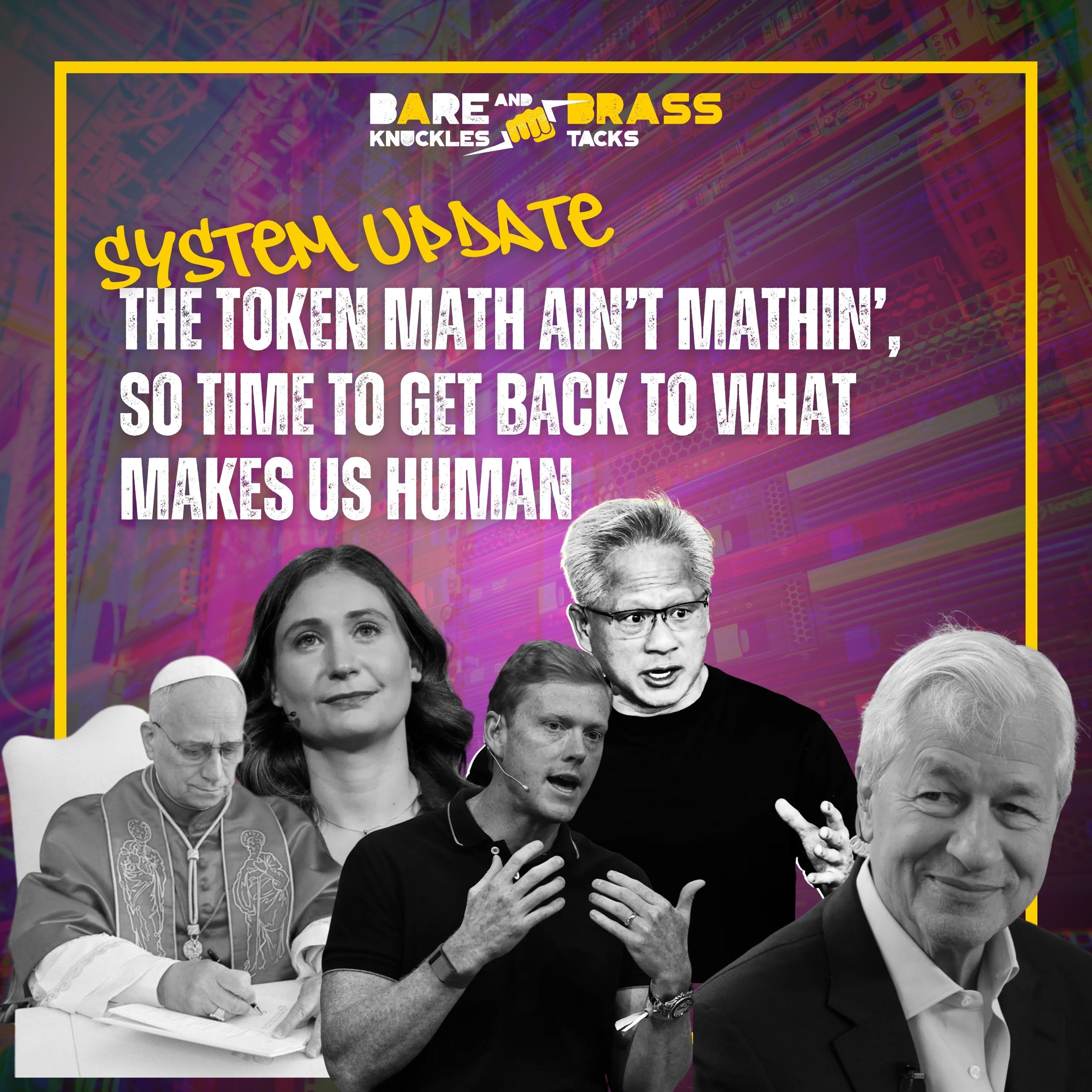
The token math ain't mathin', so time to get back to what makes us human
Jun 100:40:56Tap to summarizeThe hype machine spent two years telling us AI was coming for your job. Now it's quietly walking that back. Why now? Follow the money.On this week's system update, George K. and George A. pull apart the vibe shift happening at the top of the AI economy: from Uber's COO admitting he can't draw a line between token spend and shipped features, to the broader reckoning hitting every CFO who signed a three-year AI contract without modeling what agentic workflows actually cost.The subsidized era is over. The bill is due. And nobody has a clean answer.But the harder question underneath all of it isn't economic. It's human.What happens when an industry skips straight from "how big can we make it" to "what are humans even for" without stopping to answer either?The two Georges reckon with soft skills being repackaged as vital skills, the neoliberal bargain sold to a generation of college graduates, and what Pope Leo's 42,000+word encyclical on human dignity in the age of AI gets right that most boards and governments haven't.A tech podcast about humans. This week, more than ever.Mentioned: Jensen Huang on irresponsible proclamations Uber COO on lack of ROI from tokenmaxxing Ed Zitron on OpenAI and potential collapse of Oracle Daniela Amodei on the importance of the humanities Jamie Dimon on future job skills What 2026 hiring managers are looking for Pope Leo XIV’s encyclical, Magnifica Humanitas Marissa Alert on business outcomes planning first David Homan on how to build real human networks Sharon Goldman on the small town impact of the datacenter buildout
Transcribe →
Why your network is shallower than you think, and how to change it
May 2500:41:18Tap to summarizeWhat if the reason most people struggle to build meaningful professional relationships isn't effort — it's that they've mistaken a transaction for a foundation?David Homan has spent thirteen years building the largest private network of super connectors on the planet. Not by being the most impressive person in the room, but by being the most useful one — long before anyone asked. His thesis is that trust operates on a time horizon most people aren't patient enough to respect. That the introductions that change lives rarely pay off in weeks. They pay off in years, through chains of three to five people that no existing technology has ever been able to track — until now.In this episode, David walks us through the architecture of real community: why action is the only currency that matters, what it actually means to honor a chain of connections, and how a moment of genuine vulnerability can outperform a hundred polished elevator pitches. He also makes a case that most of us have at least two phone calls we should have made by now — and haven't.Learn more about David's work: Orchestrating Connection SOAR Connect
Transcribe →
What the AI datacenter build out looks like from the ground up
May 1800:42:19Tap to summarizeWhat happens when a community votes no…but the #AI datacenter construction starts anyway?That is not a hypothetical. It’s what happened in Saline Township, Michigan, when a $16 billion OpenAI-Oracle data center was rejected by the local planning commission, rejected again by the township board, and broke ground weeks later anyway. The developer sued. The town settled. They had no real choice.Sharon Goldman has been covering the AI data center buildout for Fortune — not from boardrooms, but from township halls, planning commission meetings, and rural communities that had never imagined something like this landing in their midst. What she’s found is a story that the technology press largely isn't telling: the buildout is a bottom-up crisis dressed up as a top-down triumph.The numbers tell part of it. Saline Township received $14 million in community benefits from a $16 billion project, against an annual budget of $1 million. In Richland Parish, Louisiana, the land where Meta's Hyperion facility now sits was once pitched for an auto plant that would have created two to three thousand permanent jobs. The data center is promising 500. The construction workers are mostly from out of state.And the justifying ideologies — the race with China, the national security imperative — has no finish line. This race has a vague one-upsmanship and a $700 billion spend with no clear end in sight.What Sharon sees coming, and what she thinks the press is missing, is the backlash that is quietly becoming a political force — showing up in recall elections, in governor's races, and in the kind of conspiratorial thinking that emerges when people have lost trust and no longer believe that democracy is working for them.You can read more of Sharon's reporting here: A Michigan farm town voted down plans for a giant OpenAI-Oracle data center. Weeks later, construction began | Fortune Meta's $27 billion AI data center is causing chaos in small town Louisiana | Fortune At the edges of the AI data center boom, rural America is up against Silicon Valley billions Huge AI data centers are turning local elections into fights over the future of energy Elon Musk is pushing to build data centers in space. But they won’t solve AI’s power problems anytime soon Big Tech will spend nearly $700 billion on AI this year. No one knows where the buildout ends Inside a multibillion dollar AI data center powering the future of the American economy
Transcribe →