← Believer's Voice of Victory Audio Podcast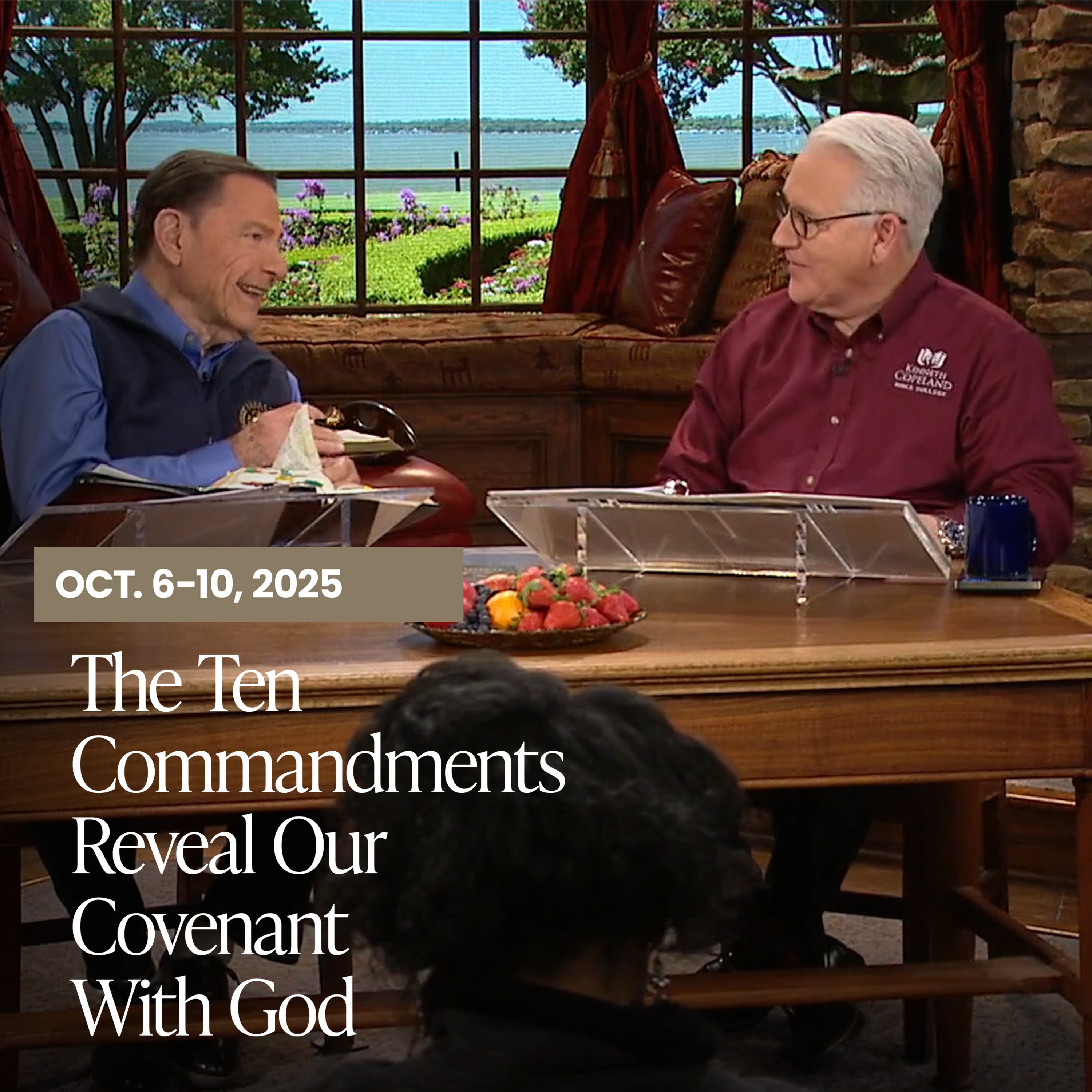
Believer's Voice of Victory Audio Podcast
The Ten Commandments Reveal the Faithfulness of God 10/08
00:28:30
Loading summary
Transcript74 lines
- [00:03]
Professor Greg Stephens
I move by what I feel. I don't live by what I see.
- [00:12]
Kenneth Copeland
Because my God has made a way for me. Hello, everybody. I'm Kenneth Copeland. This is Professor Greg Stephens. And now, you remember when the professor and I in the class did a whole series of covenant and out of that came.
- [00:45]
Professor Greg Stephens
God the covenant.
- [00:45]
Kenneth Copeland
God the covenant and a contradiction. Right. And so. And by the way, if you don't have that, get it Anyway, here, let's go. Deuteronomy, chapter 5. And Moses called all Israel and said unto them, hear, O Israel, the statutes and judgments which I speak in your ears this day that you may learn them and keep them and do them. Oh, and you were saying that the Rabbis say he's 120 years old by this time.
- [01:29]
Professor Greg Stephens
Moses is in the last of his days. He'll die on his 120th birthday.
- [01:33]
Kenneth Copeland
Yeah, but he let him climb that.
- [01:34]
Professor Greg Stephens
Mount Nebo and he saw all of the promised land. That's right.
- [01:39]
Kenneth Copeland
Do you know what I started praying this morning? No, sir. And I was just praying over these today. And I was just sitting there and I said, oh, hallelujah. I believe I climbed Mount Nebo today. Anyway, the Lord our God made a covenant there. It is a blood covenant. This is actually the first covenant and the new covenant.
- [02:26]
Professor Greg Stephens
Right.
- [02:27]
Kenneth Copeland
Anyway. Because we had to have a virgin birth.
- [02:32]
Professor Greg Stephens
That's right.
- [02:33]
Kenneth Copeland
So animals, circumcision. And Abraham, Isaac and Jacob, whose name was changed to Israel. Praise God. Anyway, here we go. I stood between the Lord and you at that time to show you the word of the Lord. For you were afraid by reason of fire and went not up unto the mountains, saying, I am the Lord thy God, which brought thee out of the land of Egypt from the house of bondage. Thou shalt have none other gods before me. You will make no graven image, any likeness of anything that is in heaven above and earth beneath that in the waters beneath the earth. Thou shalt not bow down thyself unto them, nor serve them. For I, the Lord thy God, am a jealous God visiting iniquity. And remember we talked about this. Now, fathers, upon the children, the fourth generation. Now I want you to go to the 15th verse. Remember that you were a servant slave in the land of Egypt. And that the Lord thy God brought thee out there. And through a mighty hand and by a stretched out arm, therefore the Lord thy God commanded thee to keep the Sabbath day. Honor your father. And you can't just read that 10 and get all that. Now, Greg, tell me what you were talking about that the rabbis teach. He just Said it all at one time.
- [04:26]
Professor Greg Stephens
Okay? So they teach that when God, he said all of them at once. Now, how is that possible? I don't know how that's possible, but he did. I'll tell you how it's possible. In the Hebrew, it says Elohim spoke to them. So when I mentioned that, the rabbis teach that all the earth stood still. Not just the earth, but the heavens, the cosmos, universe, Milky Way, everything stood still because he made it all with his words. He spoke the words into existence. And this is, I believe, the first time Elohim is speaking again in this planet. But now he's giving them what we call the Ten Commandments. They're actually called the Words. And so he gives them the 10 words that they're to follow.
- [05:07]
Kenneth Copeland
That's the way John started his gospel in the beginning was the Word. The Word was with God.
- [05:15]
Professor Greg Stephens
That's right.
- [05:15]
Kenneth Copeland
And the Word and took upon itself flesh.
- [05:18]
Professor Greg Stephens
So when that means the rivers stopped flowing, the ocean didn't. There were no waves. Everything stood still. It scared them because they heard all of I am. Come at them from the cloud. And they thought they were. Just because they were born of Abraham, Isaac and Jacob, who became Israel. And God had brought them out. He introduced himself to them. They just thought they were good, you know? Well, they're going to make a golden calf before Moses even is down. So they're not good. And so he gives them these things. This is. You want to see the standard of holiness? You want to see the standard that I expect you to live by? Here it is. And it will begin to govern so. But back in Deuteronomy 5, let me show you this. The Lord made not this covenant with our fathers. Now, this is the second generation. Deuteronomy 5 is the children that came out of Israel, Remember the older generation, because they wouldn't believe Caleb. Joshua went in. They died in the wilderness. And this group are the ones that survived. And they're the ones that are going to go into the Promised Land. They're going to cross Jericho, cross the Jordan, rather go to Jericho. Then they'll go to the Blessing and Cursing mountain with Joshua. Moses won't go in. And the reason Moses won't go in. I'll show you later. It's commandment number three is what cost him from going in. But look at this. So the second generation, the Lord made not. The Lord made not this covenant. Verse 3 of chapter 5 of Deuteronomy, with our fathers, but with us. Even us who are all here alive today. Remember their parents Died. So which shows us something about the Ten Commandments. It passes down.
- [07:07]
Kenneth Copeland
11Th chapter of Hebrew.
- [07:10]
Professor Greg Stephens
It wasn't just for that group.
- [07:13]
Kenneth Copeland
A great cloud of witnesses.
- [07:14]
Professor Greg Stephens
Exactly right. Look at this. The Lord talked with you face to face in the mount of the midst of the fire. I stood between the Lord and you at that time to show you the word of the Lord. For you were afraid by reason of the fire and went up, not up, into the mountain. I am thy God, which brought thee out of the land of Egypt. So he's retelling the story to this generation. He's retelling what happened in Exodus chapter 20. Some what, 40 years later is when this. When this is all happening. And so what I want you to get across to you is this passes down. These were not just suggestions I'll give you. Let's see what Jesus said about it. What did Jesus say about the Ten Commandments and the law? Matthew 5:17. Think not that I am come to destroy the law or the prophets. I'm not come to destroy, but to fulfill. For verily I say unto you, till heaven and earth pass away, one jot or one tittle shall nowise pass from the law till all be fulfilled. So it's still in the earth today, Brother Copeland, this is still operation. This is in operation today. Now, if you're in Christ Jesus, you're in the fulfillment. You're in a different covenant than that covenant. But this is still in operation and still applies to you. Whosoever, therefore, shall break one of the least of these commandments and shall teach men so, he shall be called the least in the kingdom of heaven. But whosoever shall teach them, that's what we're doing today. The same shall be called great in the kingdom of heaven. For I say unto you, except your righteousness shall exceed the righteousness of the Scribes and the Pharisees, you shall no case end. Now, that was a shock statement to the disciples and everybody. The Pharisees are the most righteous people. They know. No, it's a different kind of righteousness. See, that was self righteousness. They added to the law things that were not part of the law Jesus came to fulfill. They were always accusing Jesus of healing on the Sabbath. Well, he's the Lord of the Sabbath. Sabbath's all about him. We get to that. I'll show you that. But if it's okay, let's pick up three commandment number three, Exodus 27. If I had to have a favorite of the Ten Commandments, I don't know if you have A favorite. I have a favorite. This is my favorite. This speaks to my position in him. It speaks to my authority that I have in him, his authority in me. Moses will not enter the promised land because of three Thou shall not take the name of the Lord thy God in vain, for the Lord will not hold him guiltless. Didn't with Moses that taketh his name in vain. In biblical tradition, the name, or the name in Hebrew is shem. That's literally what it means, shem. When I say the name, it refers to the character and reputation of the one who carries it. Let me say that again for you. It refers to the character and reputation of the one who carries it. So in the Hebrew, it's the word lotusa. It literally means, you shall not carry the name of the Lord your God in vain. I'm a carrier of his name. He's given me his name, which means I can't carry his name in vain. So what does that vain mean?
- [10:42]
Kenneth Copeland
Stop here.
- [10:42]
Professor Greg Stephens
Moment.
- [10:43]
Kenneth Copeland
Yeah. For years I would say, my goodness. Oh, no, Jesus, my goodness. There's nothing good but one, and it's you, God.
- [11:04]
Professor Greg Stephens
Jesus said that? Why do you call me good?
- [11:06]
Kenneth Copeland
My goodness. Not my goodness, his goodness. Boy, that's thin ice. Please forgive me for it. So what do I say? God's goodness. You're just in the habit of the other one. That doesn't sound quite right. God's goodness. Yes, is the reason this is that way. Go ahead.
- [11:36]
Professor Greg Stephens
So in the Hebrew, it says lo tesha. Lo is the Hebrew word for no, no, carry. We won't carry his name in vain. The scripture does not say lot hasheva, which means swear. It doesn't say swearing. It's not about swearing, but swearing his name would be bad as well. You're carrying. You're misrepresenting his character nature. Vain means empty or in an untrue manner. So you will not carry the name of the Lord your God in an empty or untrue manner. Oh, my goodness. That changes everything. What it means to me, since he gave me his name, since he gave me his authority. I can't flippantly. Once I know this. I can't flippantly say, I swear to.
- [12:23]
Kenneth Copeland
God.
- [12:26]
Professor Greg Stephens
If that child does that one more time. No, you just committed God to something. Oh, my goodness. We've all broken this. See, I had the Lord ask me one time, Brother Copeland, when I was first learning this. Why do you take my name in vain? Sir, I don't do that. I used to do that. I GD everything all the time, and he Said, well, who did I say that I am? I am that I am. Are you and me? Yes. Am I in you? Yes. Then why do you say I am sick? I'm not sick.
- [13:03]
Kenneth Copeland
I am blessed and not a favor.
- [13:05]
Professor Greg Stephens
Why do you say I am broke? Why do you say I'm depressed? Why do you say I'm anxious? I'm none of those things. And I realized I'm taking his name in vain every time I say I am something that he's not. Let that sink in for just a second.
- [13:23]
Kenneth Copeland
And I heard you teach that.
- [13:25]
Professor Greg Stephens
I can't say as God is my witness.
- [13:27]
Kenneth Copeland
No, I heard you teach that. Yeah. So I am blessed and highly favored. How are you, Brother Copeland? Blessed and highly favored. That's all you need to know.
- [13:48]
Professor Greg Stephens
I'll say sometimes. I'll say, I'm a blessing. I'm blessed. I am pain free.
- [13:54]
Kenneth Copeland
Yes.
- [13:57]
Professor Greg Stephens
I am full of the mind of Christ. I just start saying those things I heard. I think it was Terry Savelle say, when you say something negative, just say right behind it. And that's the way I like it. And I caught myself. I began to say that. I said, I tell you what, I just can't figure this out. And then I said, and that's the way I like it.
- [14:21]
Kenneth Copeland
No, no, that sounds like a sevelle.
- [14:24]
Professor Greg Stephens
Yeah. No, no. It put a check in me because I'm making an empty, untrue statement about who I am in Christ. This is why your authority isn't working, is because you've been making a lot of untrue statements that are against his character and his nature. We can't say, as God is my witness, I got to be certain that he's going to back what I'm witnessing and what his character and nature aligns with that. So he told, well, I'm going to go there. We got to be careful with this. In church, saying, thus saith the Lord. People that operate in the gift of the prophecy are prophetic. You better be careful that thus saith the Lord, because I can prophesy, but I'm not a prophet. You stand in the office. It's a heavier thing for you to do. That he told Moses, I am. So since he's in me and I'm in him, I can't say the things that I used to say. Now what? Where did Moses miss it? With this? God told him, I want you to go strike the rock and the water will come out. And he went and he struck the rock and water came out. And then the second time, he didn't Tell him to strike the rock. He said, go speak to it.
- [15:42]
Kenneth Copeland
Yes, he did.
- [15:43]
Professor Greg Stephens
And Moses, in his anger at the people, struck it again. It cost him. He misrepresented the character and nature of God. He's trying. You know what he's trying to prove to them? Mark 11:23. The first time the rock will be struck. That would be Jesus. From that moment forward, we don't have to strike him again. We now speak to him in faith.
- [16:06]
Kenneth Copeland
And he said whatsoever things you say, he said, you rebellious people, you. Do I have to keep doing this for you? Do I have to keep doing this?
- [16:19]
Professor Greg Stephens
Because it became him then.
- [16:22]
Kenneth Copeland
And the Lord said, you're not going over.
- [16:24]
Professor Greg Stephens
Cost him.
- [16:28]
Kenneth Copeland
So he let him climb Mount Nebo. Let him see it, so he could see it.
- [16:35]
Professor Greg Stephens
That's the mercy. That's the hesed of God. And let him see it. But he can't let him go over because he broke it. He knew. He's the one that went and saw God saw him. God placed him. Moses asked for something he's not entitled to. He said, let me see your glory. And God responds to him. No one can say I'm paraphrasing, can see my glory and live. And he said, but nevertheless, there is a place by me where you can stand. Wait a minute. A place by me where you can stand. And he placed him in the cleft of the rock. For a moment in time, God put him in our covenant so that he could pass by. Because where are we now? Jesus is at the right hand of the Father. The place by me. Well, that's Christ. For a moment in time, he put him in Christ so that he could fulfill the man's request.
- [17:24]
Kenneth Copeland
The way I read that, I kept reading that. I kept reading that. I said, father, I pray well for the same thing. He just said, I want to see your glory. Yeah, right in the middle of the conversation. Very well.
- [17:49]
Professor Greg Stephens
Okay, here's the way you're going to do it. Here's how we do it. Now let's look.
- [17:53]
Kenneth Copeland
Remember what he said. Let my goodness pass. You can't look up on my face. And you.
- [18:06]
Professor Greg Stephens
So he saw the hinder parts. He saw the history of all of that, where God had been. Let me show you Jesus talking along the same line about taking the name in vain.
- [18:18]
Kenneth Copeland
Yes.
- [18:19]
Professor Greg Stephens
Matthew, chapter five. Yeah, well, of course, Matthew, chapter five. And let's take a look at verse 34 through 37 here. Matthew five. But I say unto you, this is verse 34, swear not at all, neither by heaven, for it is God's throne nor by earth, for it's his footstool. Neither by Jerusalem, for it's the city of the great king. Neither shalt thou swear by the head, because thou canst not make one hair white or black. We got it covered there, brother. But let your communication be yea, yea, nay, nay, for whatsoever. Whatsoever is more than these cometh of evil. He's talking about that commandment.
- [19:04]
Kenneth Copeland
No. Yes. I think I told the class before, oh, this is years ago, and there was a man that wanted me to come preach in his church. And I went before the Lord about it. And the Lord said, no, I don't want you to go there at this time. And so he called me back. He said, did you pray about it? I said, yes, sir. He said, what's the answer? No. Why? I don't want to. Well, brother Copeland, maybe sometime he just heard yes or no and didn't know how to handle it.
- [20:05]
Professor Greg Stephens
Probably never been told that before.
- [20:08]
Kenneth Copeland
On the other hand, had it been from me and someone had said no, all right, praise God. And you and I will pray about it. Maybe someday the Lord will allow it.
- [20:21]
Professor Greg Stephens
Absolutely.
- [20:22]
Kenneth Copeland
So let's agree on that. Not class and radio and television audience. Let me tell you how far that's gone. A parent saying, now, sweetheart, don't do that anymore. Okay? Okay. You don't have to ask that four year old's permission.
- [20:59]
Professor Greg Stephens
My dad used to say, because I said so.
- [21:02]
Kenneth Copeland
Now that's what John's daughter Alex, he said the same thing. She said, why? He said, I'm boss. She said, I want to be boss. No, he said, now you're not old enough to be boss.
- [21:22]
Professor Greg Stephens
I gave you one verse in Matthew of that. Let me show you. James, chapter five. James, chapter five. This is the half brother of Jesus, so he ought to know something about this. Verse 12, James 5:12. But above all things, all things, my brethren, swear not. Neither by heaven, neither by the earth, neither by any other oath, but let your yea be yea, and your nay, nay, lest you fall into condemnation.
- [21:53]
Kenneth Copeland
Now that's five.
- [21:54]
Professor Greg Stephens
What verse? Chapter 12, verse 5. 12. 5 12, verse 12. Do you see? This is New Covenant, guys. This is the church age. This is the age of grace. But I got the same commandment said in a different way here. For us, we better pay attention to taking his name in vain and misrepresenting his name and his character and his nature, not with just our words, but with our actions and our deeds as well. Let me say a word with our works. James, chapter five. But above all, above all these things my brethren talking to believers swear not. Neither by heaven, neither by the earth, neither by an oath, lest you fall into condemnation.
- [22:42]
Kenneth Copeland
Okay, I want to get this out of here. That's in.
- [22:46]
Professor Greg Stephens
I got James, James 5, verse 12. Right there.
- [22:52]
Kenneth Copeland
James 5:12 and James 5:12. But above all things, my brethren do not swear either by heaven or by earth or any other oath. Let your yes simply be yes and your no simply be no that you may not come under condemnation. This is so good.
- [23:29]
Professor Greg Stephens
There's therefore now no condemnation of those in Christ Jesus. If we'll stay with him and his character and his nature, his command for us, you won't have condemnation. It's when you get out from under it that you're getting condemnation.
- [23:46]
Kenneth Copeland
We're out of time. We'll be back in a minute.
- [23:56]
Larry Warren
Take the word of faith wherever you go with the Believer's Voice of Victory magazine. Build your faith through powerful articles from Kenneth and Gloria Copeland and other guest authors. Read encouraging stories in testimonies of real life victory and equip your kids for spiritual growth in Commander Kelly's corner. Download a digital copy for your tablet or mobile device. Sign up for your free monthly subscription or download your copy today@kcm.org the Believer's.
- [24:27]
Professor Greg Stephens
Voice of Victory broadcast study notes will help you dive deeper into these powerful word based teachings. Get all 5 days of notes at one time. Use them during the week for your personal study time. Download them free@kcm.org notes create a special family devotional time to follow along with the notes as you watch the broadcast. Study the scriptures with your children and begin instilling God's word. Now use these notes to build your faith library and build up a heritage of faith.
- [24:57]
Larry Warren
Hello, I'm Larry Warren. God so loved the world that he gave his only begotten son Jesus. Now you may not know this, but that's a Covenant declaration. Hebrews 8:6 says this same Jesus is the mediator of a new covenant with better promises. And one of the promises says Jesus gave his life for us so that we could be delivered from this present evil world according to the will of God. Oh my goodness. You want to talk about a blessing of the Lord? We have covenant rights by the sacrifice of our Lord Jesus to be free from any every evil work that's in this world. I confess this every day, Jesus. You gave your life for me so that I could be delivered from all evil. Amen. Now, by simply asking Jesus to come into your heart and be the Lord of your life, you can have this too. So pray this with me, Lord God. I believe you gave your life for my sins. I confess that I am a sinner. Right now. I receive forgiveness. I believe from my heart that you were raised from the dead. And this day, I choose to declare you as my Lord. By the confession of my mouth and the belief of my heart. Today, I am saved. I am born again. I am a child of God. I am no longer a sinner. Today, everything is made new. I am saved by grace. Amen. Praise God. Welcome to the family. Your new spirit is alive. And you'll never, ever be the same again. Now, this is just the beginning. There's so much more to this new life in Christ that you've received today. And Kenneth Copeland Ministries want to send you this free book that will help explain what just happened to you today. It's called the Salvation Package. And it has a book by Kenneth and Gloria Copeland called He Did It all for your. And so you can take your time with this. It'll help you take your next steps in God. Dear Lord, when you learn how to be filled with the spirit and walk in love and live by faith, I promise you, you'll never be the same again. So read this with your Bible and begin your journey through God's word and discover who you are in Christ and what belongs to you as a child of God. Ask for your salvation package today. Free on kcn.org.
- [27:49]
Kenneth Copeland
Praise God, everybody. Isn't this good? Particularly this. Thank you, Jesus. We'll see you tomor. Until then, this is Kenneth Copeland and Professor Greg Stephens and all the class reminding you that God loves you, we love you, and Jesus is Lord. Hallelujah. Hallelujah.
- [28:12]
Larry Warren
If you receive Jesus as your Lord and Savior.
- [28:14]
Professor Greg Stephens
Request the Salvation Package from Kenneth Copeland ministries. Free on kcm.org salvation sam.