← Big Ideas Lab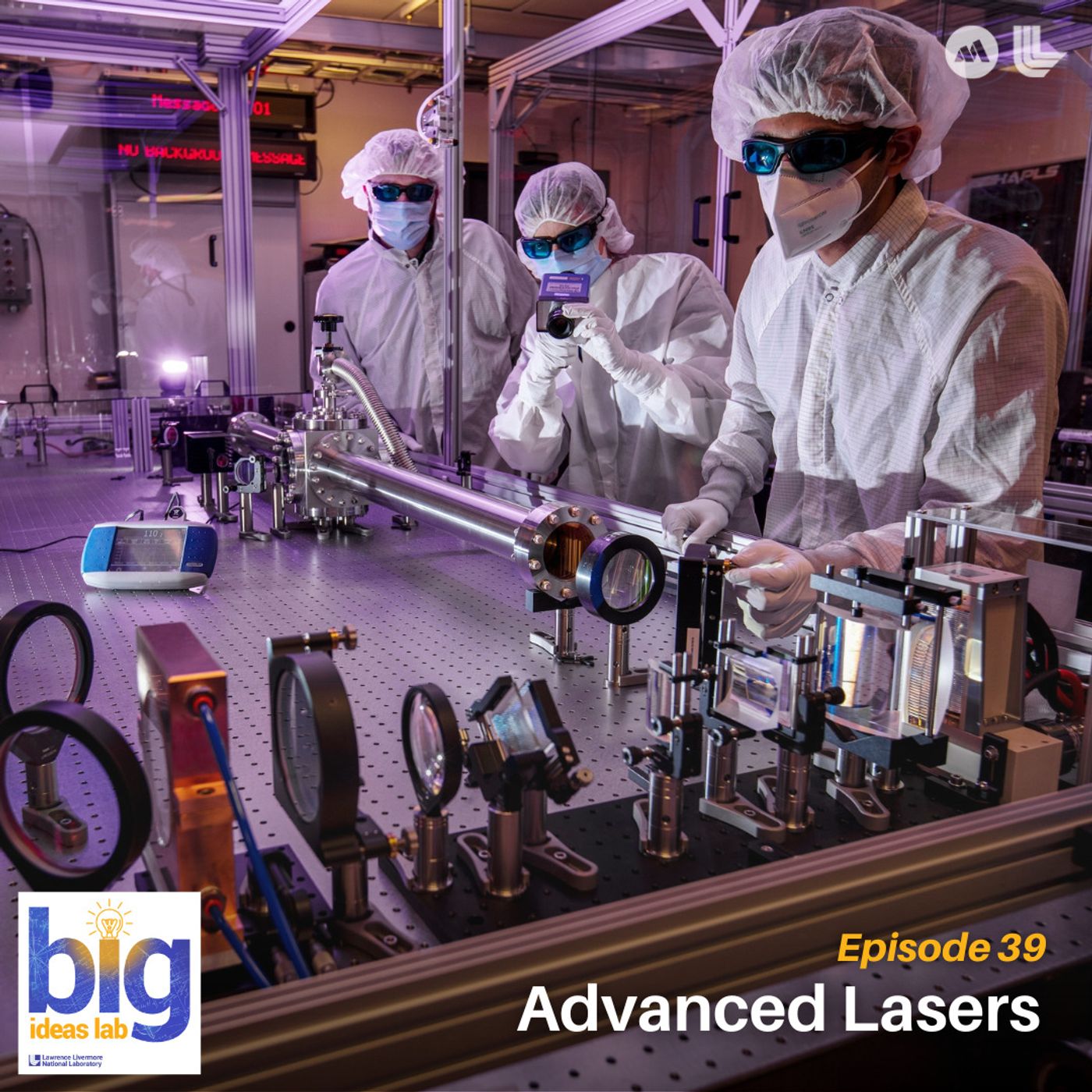
Big Ideas Lab
Advanced Lasers
00:14:57
At Lawrence Livermore National Laboratory, scientists are developing high-repetition-rate lasers that fire thousands of times per second.
Loading summary
Transcript46 lines
- [00:03]
Narrator
Extreme ultraviolet light, a ghostly shimmer just beyond human sight. Wavelengths so short they can sculpt matter at the scale of atoms. Not long ago, it lived only in theory. Now you see the results of it every day. The efficiency of electric cars gliding quietly down the road. The speed of high end laptops clicking away in coffee shops. The power of the latest smartphones that can still slip into our pockets. Each one advanced by the chips inside. Chips imaged with extreme ultraviolet light.
- [00:42]
Jackson Williams
All of those systems start with a plasma. You get the plasma very hot and it starts to emit a radiation band that is further beyond the visible light and into the extreme ultraviolet.
- [00:55]
Narrator
This process, called extreme ultraviolet lithography or euvl, is made possible by a laser. Laser created plasma heated to 100,000 degrees. It revolutionized chip making and is just one of many advanced laser techniques Lawrence Livermore National Laboratory helped develop that not only enhance everyday life, but are also reshaping health, energy and national defense.
- [01:23]
Jackson Williams
Medical applications. Radiotherapies, X rays, protons or ions that are used to treat cancer. Lasers have a potential of being the best version of those devices in the world.
- [01:35]
Narrator
And scientists at Lawrence Livermore are pushing that technology even further.
- [01:40]
Jackson Williams
The lasers that we're producing now are useful in scaling to the next generation of computer chips that will extend Moore's Law for another 30, 40, 50 years.
- [01:50]
Tom Spinka
What we are developing in our group is new laser technologies that actually will really impact people's everyday lives.
- [01:57]
Narrator
Welcome to the frontier of light. Welcome to the Big Ideas lab. Your exploration inside Lawrence Livermore National Laboratory. Hear untold stories, meet boundary pushing pioneers and get unparalleled access inside the gates. From national security challenges to computing revolutions. Discover the innovations that are shaping tomorrow. Today. Join a team where expertise makes a difference. Lawrence Livermore National Laboratory is hiring for a safety basis analyst, a full stack developer and a target diagnostics engineer. And the list of open positions doesn't end there. There are more than 100 job openings across science, engineering, engineering, IT, HR and the skilled trades. This is more than a job. It's an opportunity to help shape the future. Explore all open positions and start your next career adventure today@llnl.gov careers that's llnl.gov careers the National Ignition facility at Lawrence Livermore National Labs has made headlines as the largest and most energetic laser in the world.
- [03:33]
Tom Spinka
California scientists made a major breakthrough. History making projects is underway right now.
- [03:38]
Narrator
Massive laser able to recreate the temperatures and pressures close to what exists in the core of stars. But close by is a quieter revolution. Engineers and physicists at Lawrence Livermore have been working on something very different. Lasers that fire thousands of times per second to create systems that are faster, cleaner, and more efficient than ever.
- [04:03]
Tom Spinka
Lawrence Livermore national laboratory is world renowned as one of the places to be, if not the place to be, for big lasers.
- [04:10]
Narrator
Tom Spinka is a laser physicist at the lab.
- [04:14]
Tom Spinka
My group is called advanced photon technologies, and we develop laser sources and applications of those lasers. For me, it's being on the cutting edge, being able to demonstrate in the laboratory, develop new materials, new concepts for how lasers work.
- [04:30]
Narrator
The advanced photon technologies program, or apt, designs high repetition rate laser systems that deliver short, powerful pulses of light repeatedly and with incredible precision. These lasers are engineered to run fast, stay cool, and perform reliably, both in experiments and real world environments. Apt's lasers are advancing the state of the art for high repetition rate lasers that could be used for applications like advancing cancer treatment, supporting cutting edge materials and aerospace research, and powering semiconductor manufacturing, such as the extreme ultraviolet lithography process. And they are opening up new application spaces. Their impact reaches far beyond the lab.
- [05:18]
Tom Spinka
One of the distinguishing characteristics that makes an advanced laser, or something on the cutting edge is being able to produce those laser pulses multiple times per second, as opposed to one shot every couple of hours.
- [05:30]
Narrator
But what could these advanced lasers actually do?
- [05:33]
Jackson Williams
Cancer is treated generally with x rays.
- [05:36]
Narrator
That's Jackson Williams, a physicist in the advanced photon technologies group at Lawrence Livermore.
- [05:42]
Jackson Williams
You shoot an x ray beam into the cancer, and you try to kill as much of that tissue as possible. That's a bit of a sledgehammer when it comes to medical therapies.
- [05:51]
Narrator
X rays, while effective, tend to hit everything in their path. Healthy tissue, organs, bone. But new technologies aim to change that by swapping force for surgical precision.
- [06:05]
Jackson Williams
You can use things like protons or other heavier element ions, things like carbon atoms, and those are like scalpels. Those are the ability to deposit that energy in a very small space. And so you try to only kill the tumor and nothing of the healthy cells around it. People have been doing this, actually for the better part of 20, 30 years.
- [06:26]
Narrator
This kind of therapy, known as ion beam therapy, has been used clinically for decades in some parts of the world. But the potential to generate and control these beams using high repetition rate lasers could dramatically expand access, helping bring cutting edge treatments to more hospitals and more patients.
- [06:46]
Jackson Williams
We build lasers in a way that we are trying to solve the technical paths.
- [06:50]
Narrator
Another promising area is in advanced manufacturing. High repetition lasers are transforming how we inspect parts made through additive manufacturing. The intricate layered components used in Aerospace, automotive and energy industries.
- [07:05]
Tom Spinka
It's also important to be able to see inside of those parts. Where are the defects? How might you need to post process that part and how can you qualify that part? If you're making a beam for a bridge, how do you know that there's not a critical defect in that part that might cause it to fail?
- [07:22]
Narrator
By generating ultra precise high energy x rays, advanced lasers can image dense materials from the inside out without damaging or altering them. This lets engineers catch hidden flaws early to make sure every part is solid. There is no shortage of ways that advanced lasers could transform many fields beyond medicine and advanced manufacturing. The challenge is in building lasers that are precise and powerful at a reasonable cost. Looking for a career that challenges and inspires, Lawrence Livermore National Laboratory is hiring for a safety basis, analyst, research scientist, cell biology, and an electrical designer, along with many other roles in science, technology, engineering and beyond. At the lab, every role contributes to groundbreaking projects in national security, advanced computing, scientific research, all within a collaborative, mission driven environment. Discover Open positions@llnl.gov careers where big ideas come to life. One of the key engineering challenges particular to high repetition rate lasers is managing heat. With the laser firing so quickly, there is no chance for the system to cool down.
- [08:56]
Tom Spinka
The most important aspect that needs to be thought about and engineered and taken great care for is heat. So every time that you store a little bit of energy in a laser gain material and then extract that energy, it leaves behind a little bit of energy in the laser gain material and that little bit of energy turns into heat. And when materials change temperature, some of their material properties also change. Some of those things impact the laser performance.
- [09:28]
Narrator
Whenever a laser fires, not all the energy makes it out the front door. Some of it lingers as heat inside the system itself. And even tiny shifts in temperature can subtly warp the very material the laser relies on, changing how it behaves with each pulse.
- [09:46]
Jackson Williams
The types of lasers that we plan to build have power outputs that are equivalent to a race car engine. And the cooling is about the same. So you need to be able to extract all of that heat that's being made in the engine or the laser in this case, and being able to send power to the wheels or being able to deliver the laser pulse to.
- [10:06]
Narrator
Its target, too much heat can blur the beam or break the system entirely.
- [10:11]
Tom Spinka
How do you extract all that heat? And one of the major contributions that Livermore has had to this field is the development of a technology called gas cooling.
- [10:20]
Narrator
The principle behind gas cooling is something we all use, especially when our food or Drinks are too hot.
- [10:27]
Tom Spinka
I think pretty much everybody knows that if you blow air over a surface, the surface can be cooled down, right? I mean, people are familiar with soup, right? You blow on it a little bit, cools down, then you can eat your soup. One of Livermore's innovations was being able to adapt that same concept to solid laser materials. And so we basically chop up the laser material into a number of different slabs and then flow gas through the gaps between those slabs. And we do that at very rapid speeds, basically approaching that of how fast an airplane flies. And then you can use that very rapid exchange of gas and the gas interacting with the solid materials to extract the heat.
- [11:10]
Narrator
To truly unlock the potential of high energy, high repetition rate lasers, scientists also need the right materials, ones that can be easily and cheaply energized and can handle the heat while maintaining good beam quality. But finding a laser material that can deliver in these areas without other serious downsides is a significant challenge. The BAT laser answers that challenge.
- [11:36]
Jackson Williams
The bat laser, or a big aperture thuleum, is a laser that is a new gain media that allows us to be more efficient and run at faster repetition rates.
- [11:48]
Narrator
The bat laser was designed at Lawrence Livermore and represents a new generation of high repetition rate systems built to deliver precision, speed and endurance.
- [12:00]
Jackson Williams
So Instead of the NIF, which is one every four hours, this laser system can run at 10,000 times per second.
- [12:06]
Narrator
The BAT laser is one of the most advanced systems to come out of the APT program and contains a new kind of medium, thulium. Thulium is a rare earth element that is mixed or doped into a common laser crystal known as yttrium lithium fluoride, or yilf, creating a goldilocks material. For the bat laser, Its material properties, like strength and thermal conductivity are very good, not outstanding, but its energy storage lifetime is exceptional. Most importantly, thulium doped yilf doesn't have a significant weakness as it's used in the bat laser. There is no other known material with this combination. Beyond the technical advantages, there's beauty.
- [12:53]
Tom Spinka
A lot of laser crystals are really beautiful physically. If you pick them up and hold them, they're just stunningly perfect pieces of material, actually kind of like people use in jewelry. And actually, many of the same crystals that are used in jewelry are good hosts for the atoms that you can use to store energy and then extract energy.
- [13:13]
Narrator
In lasers, innovation can come with remarkable surprises. And today, advanced lasers are powerful, complex research platforms operated by expert teams in controlled environments, eventually coming into mainstream use. The challenge ahead is transitioning These systems, from the lab to the real world.
- [13:33]
Jackson Williams
Right now, they are very much scientific research tools. These are lasers that only really work in the hands of experts and usually a team of experts. And so one of the places that Lawrence Livermore really shines is being able to take a idea on paper and develop it to the place where we know it will work and have a pathway towards a full system engineer. And then we are the partners to industry to be able to say here's how we did it, here's the pathways we think that can be economically feasible going forward. And then it's a technology transfer out into industry for them to be able to offer that as a product.
- [14:13]
Narrator
So what does the near future look like for advanced lasers?
- [14:16]
Tom Spinka
Laser technology. And laser technology development is absolutely directly applicable to inertial fusion energy and being able to use the same power source that powers the sun here on Earth. So lasers and laser technology developments are going to be needed.
- [14:31]
Narrator
Similar to the experiments at the National Ignition Facility that create energy gains, inertial fusion energy uses lasers to generate the extreme heat and pressure required for fusion. Translating that approach to a fusion power plant presents many challenges, including the use of extremely robust and reliable lasers. But the work being done through APT research is laying the groundwork for that essential laser science of the future. From powering future energy systems like fusion, to exploring unimagined ideas, Lawrence Livermore National Laboratory is where scientific creativity meets world changing potential.
- [15:12]
Jackson Williams
The best part about working at the lab is being able to test wild ideas and being able to go out and have a nugget of an idea and to develop that into a place where it's a hypothesis. And then you test that hypothesis and have a finding. Whether it works or it doesn't work, at least you know that there's an answer there.
- [15:34]
Narrator
Advanced lasers are being built, tested and refined every day. The work is complex, but the direction is clear. More precision, more power, and more potential to impact the world. Looking for a career that challenges and inspires, Lawrence Livermore National Laboratory is hiring for a safety basis, analyst, research scientist, cell biology and an electrical designer, along with many other roles in science, technology, engineering and beyond. At the lab, every role contributes to groundbreaking projects in national security, advanced computing and scientific research, all within a collaborative, mission driven environment. Discover Open positions@llnl.gov careers where big ideas come to life. Thank you for tuning in to Big Ideas Lab. If you loved what you heard, please let us know by leaving a rating and review. And if you haven't already, don't forget to hit the follow or subscribe button in your podcast app to keep up with our latest episode. Episode. Thanks for listening.