← Big Ideas Lab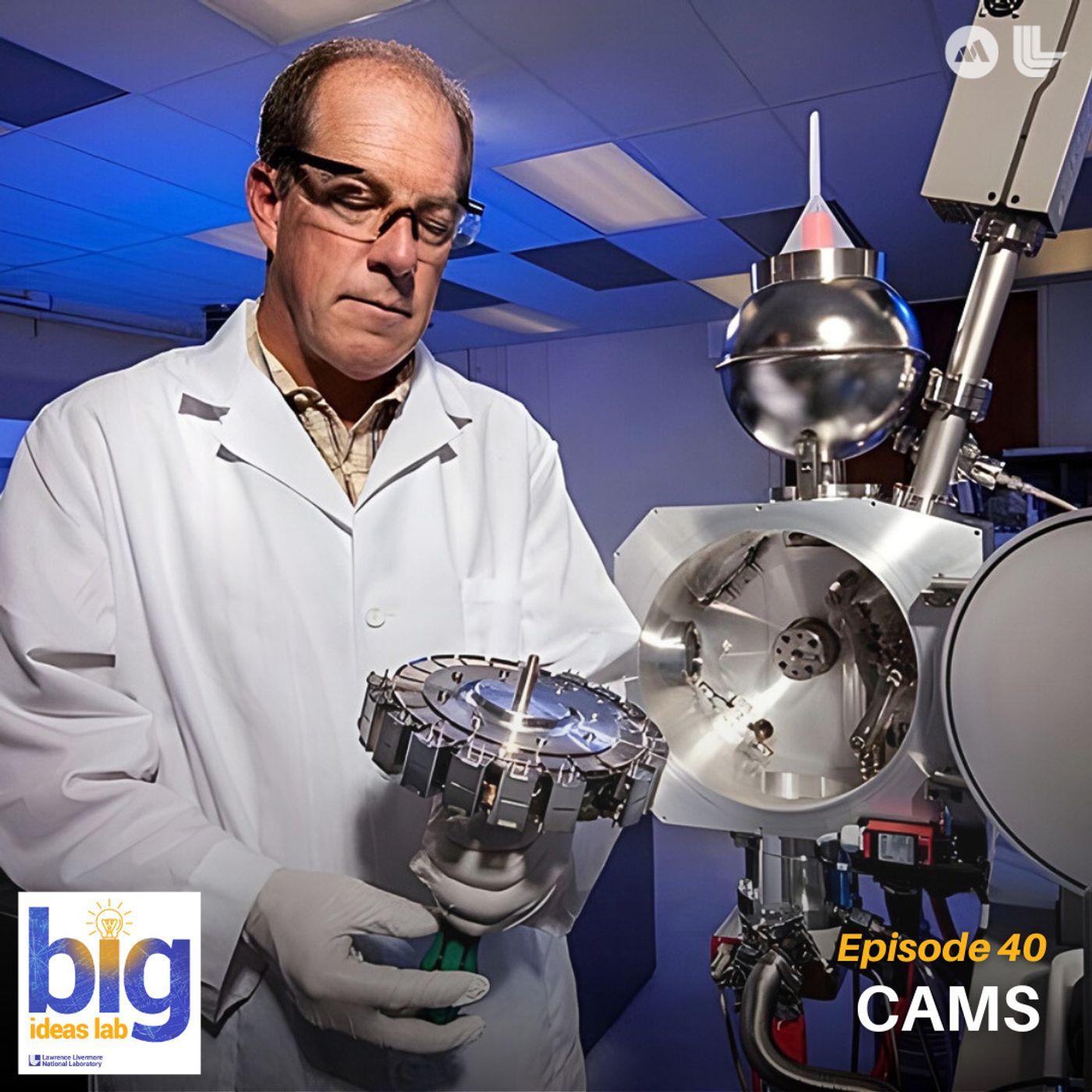
Big Ideas Lab
CAMS
00:17:07
Ancient footprints, unidentified remains, brain cells - they're all part of the story told through atoms.
Loading summary
Transcript80 lines
- [00:04]
Narrator
British Columbia, 1968 detectives were at a loss. Come in Dispatch. I think we found something. A child's remains were discovered along the riverbank with no clear cause of death and no indication of who the child was. Copy that, Dispatch.
- [00:21]
Bruce Buchholz
Alert Central. They couldn't figure out where the child was from.
- [00:24]
Narrator
Initial forensics at the time concluded that they had found the body of a 7 to 9 year old and there.
- [00:30]
Bruce Buchholz
Wasn'T anybody in the area that match that. There was no DNA at that time.
- [00:35]
Narrator
With no name, no missing persons match and no DNA analysis available, the case faded into the archives of the John and Jane does stories suspended in silence. Years passed. But in 2005, a forensic DNA analysis at Simon Fraser University reopened the case with a new discovery.
- [01:00]
Bruce Buchholz
They misidentified the age.
- [01:03]
Narrator
The child wasn't even seven years old. He was about four and a half. Hundreds of miles away, Lawrence Livermore National Laboratory took the next step with an advanced radiocarbon dating technique. Scientists used the atomic signature of Cold War nuclear tests to pinpoint when the child was born and when he died. Key information that led to the end of the search and a legal identification for the child finally declared.
- [01:34]
Bruce Buchholz
And it was like 40 years from the time that they found it. It was actually amazing.
- [01:39]
Narrator
It wasn't guesswork, it wasn't luck. It was a technique that hadn't even existed when the child's remains were first discovered. A technique perfected with the ultra precise instruments at the center for Accelerator Mass Spectrometry. Welcome to the Big Ideas Lab.
- [02:02]
Recruitment Announcer
Your exploration inside Lawrence Livermore National Laboratory. Hear untold stories, meet boundary pushing pioneers.
- [02:11]
Narrator
And get unparalleled access inside the gates. From national security challenges to computing revolutions, discover the innovations that are shaping tomorrow. Today.
- [02:28]
Recruitment Announcer
Lawrence Livermore National Laboratory is hiring. If you're passionate about tackling real world challenges in science, engineering, business or skilled.
- [02:39]
Narrator
Trades, there's a place for you at the lab.
- [02:43]
Recruitment Announcer
Right now, positions are open for a field engineer, safety basis analyst and and an electric utility distribution electrician. These are just a few of the more than 100 exciting roles available at Lawrence Livermore. You'll work on projects that matter. From national security to cutting edge scientific advancements. Join a team that values innovation, collaboration and professional growth. Explore opportunities at LLNL where your next career move could make history.
- [03:24]
Narrator
The center for Accelerator Mass Spectrometry, or CAMS at Lawrence Livermore National Laboratory is one of the most advanced and prestigious facilities in the world for measuring various ultra rare isotopes and investigating the information they provide. It houses an array of powerful machines that analyze Tiny atomic markers and discover answers to questions that have long eluded science, from archaeology to national security to public health and forensic investigation. But one of cam's most unique strengths comes from its people.
- [04:01]
Bruce Buchholz
We all come with different scientific backgrounds.
- [04:03]
Narrator
That's Bruce Buchholz, a staff scientist at.
- [04:06]
Recruitment Announcer
Lawrence Livermore National Laboratory and a lead on multiple CAMS research initiatives.
- [04:11]
Bruce Buchholz
We have some very specialized things that we can do.
- [04:14]
Narrator
The lab operates with a flat structure where a dozen PhDs from a wide range of disciplines all work hands on with the machines, pursuing their own lines of scientific inquiry and creating a diverse, multifaceted team.
- [04:29]
Bruce Buchholz
It could be soil, it could be coral, wood, charcoal, anything. And the reason carbon is so useful is that everything that's alive has carbon.
- [04:39]
Narrator
Carbon 14 in particular plays a key role in radiocarbon dating. And that's where accelerator mass spectrometry, or AMS, comes in.
- [04:49]
Bruce Buchholz
99% of carbon is carbon 12. About 1% of carbon is carbon 13. About 1 part per trillion of carbon out in the environment is carbon 14. So we're measuring variations off the one part per trillion natural concentration of carbon 14.
- [05:08]
Recruitment Announcer
AMS is designed to detect and count those rare atoms by turning them into.
- [05:13]
Narrator
Charged particles, accelerating them and separating them based on their mass. When traveling through a magnetic field, heavier isotopes like carbon 14 bend less, while lighter ones like carbon 13 and carbon 12 bend more. By measuring how much radioactive carbon 14 is left compared to stable carbon 13 and carbon 12, scientists can determine a sample's age, whether it's 400 or 4,000 years old. However, Bruce and the other CAM scientists use this process for far more than dating ancient charcoal or wood.
- [05:51]
Bruce Buchholz
And I will do nuclear forensics and bomb pole stuff and a wide variety of things.
- [05:56]
Recruitment Announcer
In many cases, AMS can help unlock.
- [05:59]
Narrator
The hidden history of human remains, breathing new life into cold cases and long forgotten lives. That's exactly what happened in 2007, when police from Newfoundland, Canada, were six years into an investigation with nothing but dead ends.
- [06:20]
Bruce Buchholz
I was approached by inspector in Newfoundland about a case. Hunters found some remains in the woods somewhere in Newfoundland. They knew it was a murder Based on other information. They had no idea who the person was.
- [06:36]
Narrator
The body had been deep in the Canadian woods for six years. Local investigators had done everything they could, but the leads had dried up and the evidence, what little there was, was inconclusive. Authorities decided to try something different. Investigators in Newfoundland contacted Bruce after encountering research he had published alongside collaborators from the Karolinska Institute in Sweden on using carbon dating to estimate the age of human remains. Bruce Used the advanced machines At Lawrence Livermore national laboratory not to analyze fingerprints, but to analyze the atoms that history had left its fingerprints on. Beginning in 1955, above ground, nuclear testing Released Increased amounts of neutrons into the atmosphere. These neutrons reacted with nitrogen to create carbon 14, which created a spike in the atmosphere, the radiocarbon bomb pulse. In 1963, the partial test ban treaty was signed, and the carbon 14 supply began decreasing.
- [07:39]
Bruce Buchholz
That pulse basically started in 1955, went up and reached a peak in 1963, and has been coming down since then.
- [07:47]
Narrator
For scientists like Bruce, the bomb pulse acts as a timestamp. The surge in carbon 14 gives post1955 samples a precise fingerprint that narrows the age range of an organic sample as close as a few months. It's a level of chronological precision Otherwise impossible With older remains, where timelines blur and the age uncertainties can stretch across decades.
- [08:13]
Bruce Buchholz
We were able to determine that date of Death was about 1996, approximately dated a couple of teeth. And we were able to determine a date of birth was 1958 to 1962.
- [08:25]
Narrator
The unidentified person in Newfoundland was likely born in 1958, plus or minus a few years, and died sometime between 1994 and 1997, placing him in his 30s at the time of death. Combined with advances in genetic genealogy, Investigators were eventually able to identify the unidentifiable Temistoko Fernandez Casas, A man originally from Cuba. A case spanning 15 years could finally be closed. The machines that made it possible Contain their own history. A powerful lineup of accelerator systems, each one designed to perform A different kind of scientific investigation.
- [09:07]
Recruitment Announcer
Their principal Machine is a 10 MV.
- [09:10]
Narrator
Particle accelerator, the most versatile and productive AMS system in the world. Susan Zimmerman is a staff scientist At Lawrence Livermore National Laboratory.
- [09:20]
Susan Zimmerman
The big accelerator that we have, the 10 MV machine, is a kind of equipment that was used by nuclear physicists.
- [09:28]
Narrator
Accelerators like this underground installation. In the late 1960s, nuclear physicists moved on to bigger facilities, Leaving machines like the 10 MV to find new missions.
- [09:40]
Susan Zimmerman
Some of the big machines like that Were modified From their nuclear physics backgrounds to do ams.
- [09:47]
Narrator
Most radiocarbon work is done in universities and institutes that are focused on doing science, not nuclear physics and other national security work, Positioning cams to take on more unique challenges.
- [10:00]
Susan Zimmerman
So our mission and the kinds of things that we do and the support that we have from engineering and from the safety people Is all, I think, different from other labs that do AMs.
- [10:09]
Narrator
The diversity of tasks CAMs accepts extends far beyond cold cases. The same scientific techniques that Help law enforcement identify a missing person can also reach far deeper into the past. Sometimes the mystery isn't who someone was, but when someone was. That was the question geologists were trying to answer when they turned to Susan, who led the team at CAMS on investigating the age of the footprints discovered at White Sands National Park.
- [10:40]
Susan Zimmerman
Radiocarbon is the most widespread fundamental way of dating things that happened in the last about 50,000 years.
- [10:48]
Narrator
A set of fossilized footprints were originally discovered in the park in 2006. Footprints that told a story far more complex than we imagined about the first humans in North America.
- [10:59]
Susan Zimmerman
The biggest thing when you're trying to reconstruct the past is to understand the timing of things. That would turn out to be much harder than we actually anticipated.
- [11:06]
Narrator
For the U.S. geological Survey team invited by the Park Service to investigate, dating the White Sands footprints presented a huge challenge. Researchers needed to find organic material that was not only reliable, but also clearly connected to the event itself.
- [11:23]
Susan Zimmerman
This is, from my perspective as a geochronologist, one of the really hard things about archaeology.
- [11:28]
Narrator
You can't just date the dirt around a footprint. The most accurate radiocarbon dating requires an organic sample that was growing using carbon from the atmosphere around the time the print was made.
- [11:40]
Susan Zimmerman
If you find an arrowhead or something, the arrowhead is made of stone and you can't date the arrowhead with radiocarbon. And so you date a little piece of plant material from the rope that was associated with the arrowhead or some other organic material.
- [11:53]
Narrator
Without organic material containing carbon, radiocarbon dating can't be done. But buried in the same sediment layers containing the footprints, scientists discovered something small and powerful. Seeds from an aquatic plant called Rupia serosa that were both directly associated with the fossilized footprints and radiocarbon dateable.
- [12:16]
Recruitment Announcer
These seeds were the key.
- [12:18]
Narrator
They became the organic timestamp that scientists could use to peer into the past. And when the analysis was complete, the dates shocked everyone.
- [12:34]
Recruitment Announcer
Join a team where expertise makes a difference. Lawrence Livermore National Laboratory is hiring for a safety basis analyst, a full stack developer, and a target diagnostics engineer. And the list of open positions doesn't end there. There are more than 100 job openings across science, engineering, IT, HR and the skilled trades. This is more than a job. It's an opportunity to help shape the future. Explore all open positions and start your next career adventure today@llnl.govcareers. that's llnl.govcareers.
- [13:22]
Narrator
New evidence confirms that humans were walking.
- [13:24]
Susan Zimmerman
Across North America more than 20,000 years ago.
- [13:28]
Narrator
According to the rupiah seed measurements, the footprints found in White Sands national park were between 21,000 and 23,000. For decades, the scientific consensus had been that humans crossed into the North American continent around 13,000 years ago. After the last ice age began to thaw, newer investigations at various sites had begun pushing that date back to about 16,000 years ago. However, the new evidence that emerged from dating organic material showed these footprints were laid down during the ice Age, not after.
- [14:02]
Susan Zimmerman
No one was expecting dates 23,000 years old.
- [14:05]
Narrator
It sparked immediate debate. Academic minds questioned whether the plant material truly reflected the age of the footprints or if it had been affected by a chemical disequilibrium between the water the root beer was growing in and the atmosphere. The U.S. geological Survey had to go deeper. The team continued searching for terrestrial materials that could be dated using ams, and eventually they found it. Pollen the carbon trees use to make pollen comes from the atmosphere, one way of assuring reliable radiocarbon dates. But analyzing pollen isn't simple. It's a delicate, complex process that requires both precision and patience. This is when the U.S. geological Survey team called Susan. They knew she had been working on developing pollen dating for years.
- [14:57]
Susan Zimmerman
The really critical thing about dating the pollen is you have to have really pure pollen. You can't have a bunch of algae or other aquatic material or carbonate minerals are things that are made in the lake water.
- [15:09]
Narrator
To perform AMS measurements on pollen, scientists need at least 50,000 pollen grains. And the more grains, the more precise the date. Thankfully, with the help of a flow cytometer, a machine that separates grains individually, producing pure pollen samples, the team at CAMS was able to isolate clean samples and send them to Susan for, for analysis.
- [15:30]
Susan Zimmerman
It turned out that the pollen dates pretty much confirmed the rupia seed dates. And so the footprints really are, as far as we know, at the moment with the evidence we have something like 23,000 years old.
- [15:40]
Narrator
Thanks to the ultra sensitive isotope work at cams, these footprints are now considered the oldest reliable evidence of human presence in North America, rewriting a key chapter in the story of human migration and adding 7,000 years to of their history living there.
- [15:57]
Susan Zimmerman
There has to be so much humility to say we don't know anything, anything about what people were doing in the Western hemisphere for those 7,000 years and what other people were doing 23,000 years in other places, right? Suddenly we have to go, oh, we know almost nothing. And that is pretty cool.
- [16:18]
Narrator
Members of the CAMS team at Lawrence Livermore National Laboratory aren't just a unlocking the past, they're contributing to the future. Their work extends into biomedical research and drug development like the new compound to aid in fentanyl recovery and prevention mentioned in part two of our Forensic Science center episode, or the biomedical breakthrough on what most scientists assumed was dating DNA.
- [16:44]
Bruce Buchholz
No one had ever tried to date DNA because we always said, oh, it's too small, there's not enough there, you can't purify it.
- [16:50]
Narrator
However, Bruce Buchholz and his collaborators Jonas Friesian and Kirsty Spalding at the Karolinska Institute decided to try. By dating DNA in the brain, they found that neurons don't turn over. The neurons you're born with are the ones you keep. With one exception, neurons in the hippocampus.
- [17:11]
Bruce Buchholz
Do turn over, and hippocampus is where memories get transformed from short term to long term.
- [17:16]
Narrator
By using accelerator mass spectrometry, scientists can trace the lifespan of brain cells with incredible precision, revealing when neurons are formed, how they age, and whether they regenerate. This discovery has helped shape how scientists understand the brain.
- [17:34]
Bruce Buchholz
Some of the projects that we've been involved in really changed the way people think of things.
- [17:39]
Narrator
Accelerator mass spectrometry is helping scientists navigate concepts that find feel unreachable, identifying unknown individuals, rewriting human history, tracing how our brains age and beyond.
- [17:52]
Bruce Buchholz
There's just lots of things that can be done now that couldn't be done 20 years ago. They're new tools all the time.
- [17:59]
Susan Zimmerman
We're always trying to figure out what we can do better, what kind of scientific measurements we can make that we can't do now. If we would just modify or improve the accelerator system, what new science, what more science, what better science we can do?
- [18:23]
Recruitment Announcer
Lawrence Livermore National Laboratory is hiring. If you're passionate about tackling real world challenges in science, engineering, business or skilled.
- [18:34]
Narrator
Trades, there's a place for you at the lab.
- [18:38]
Recruitment Announcer
Right now, positions are open for a field engineer, safety basis analyst and an electric utility distribution electrician. These are just a few of the more than 100 exciting roles available at Lawrence Livermore. You'll work on projects that matter, from national security to cutting edge scientific advancements. Join a team that values innovation, collaboration and professional growth. Explore opportunities@llnl.gov careers where your next career move could make history.
- [19:21]
Narrator
Thank you for tuning in to Big Ideas Lab.
- [19:23]
Recruitment Announcer
If you loved what you heard, please.
- [19:25]
Narrator
Let us know by leaving a rating and review.
- [19:28]
Recruitment Announcer
And if you haven't already, don't forget to hit the Follow or Subscribe button.
- [19:32]
Narrator
In your podcast app to keep up with our subscribe Latest episode. Thanks for listening.