← Big Ideas Lab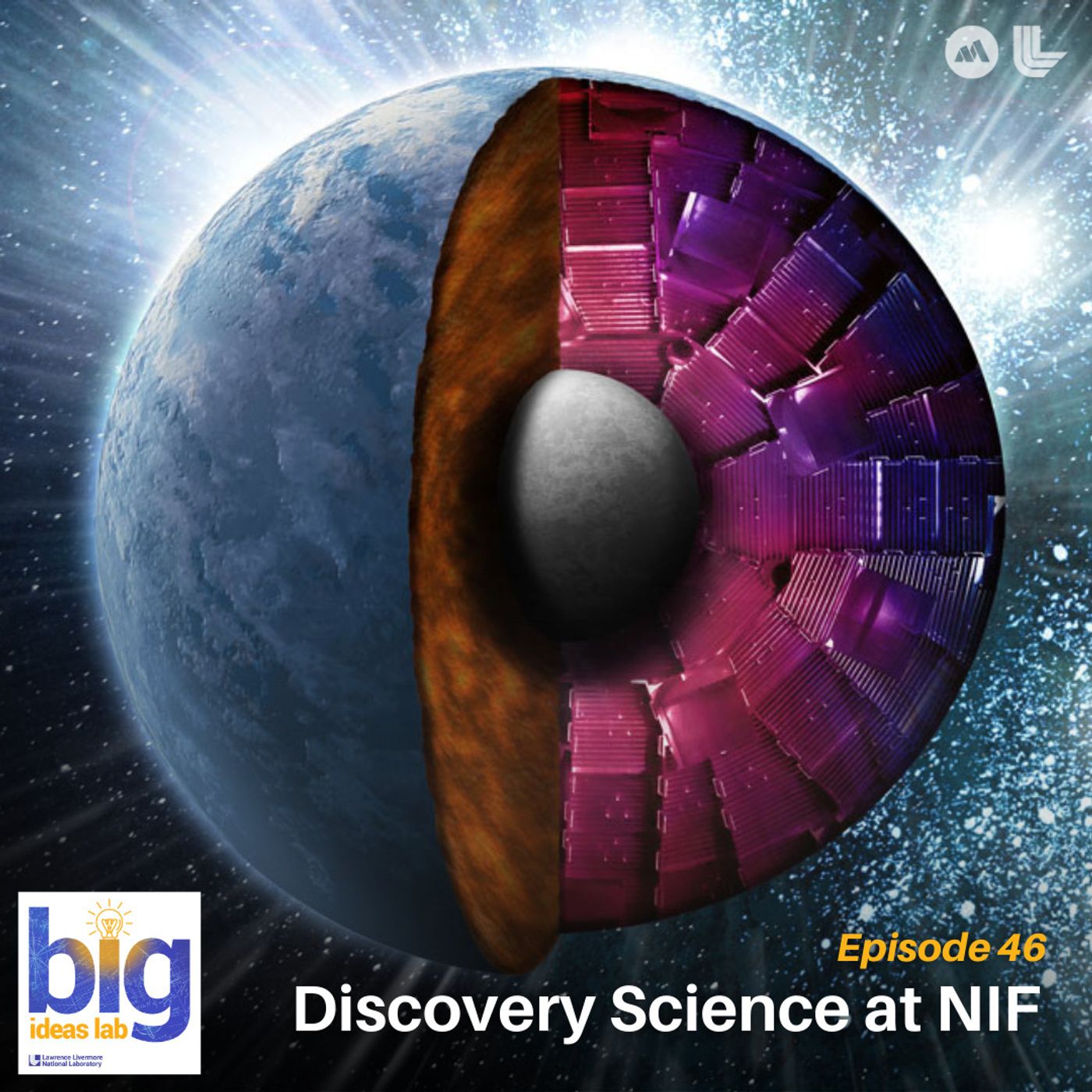
Big Ideas Lab
Discovery Science at NIF
00:14:48
Researchers and students gain access to the most extreme conditions in the universe.
Loading summary
Transcript51 lines
- [00:03]
A
In a laboratory for the first time, the nearest star to the Earth was in California. There's no place on Earth like the Lawrence Livermore National Laboratory's National Ignition Facility.
- [00:16]
B
Nif, or the National Ignition Facility, is the world's largest, most energetic laser.
- [00:22]
C
Main laser operation will begin in approximately one minute.
- [00:26]
A
A laser with reactions once thought unachievable that have been achieved again and again. Shot Director ready.
- [00:35]
C
Back in December, California scientists made a major breakthrough. A nuclear fusion reaction that produced more energy than was used to create it. Well, scientists have done it again, and this time, their results produced even more energy.
- [00:48]
A
And while these scientific advances are groundbreaking, they only highlight part of the story. Something else is going on at nif.
- [00:57]
B
There have been experiments where the results were surprising. There are topics being studied that impact our understanding of the universe.
- [01:07]
A
In these experiments, diamonds collapse under pressure so dense that they recreate the interiors of Jupiter and Saturn. Shock waves tear through targets at speeds faster than sound. Mimicking the aftermath of exploding stars, Ice rearranges itself into unfamiliar forms only found inside worlds missing millions of miles away. At nif, matter collapses, transforms and behaves in ways that cannot be recreated anywhere else on the planet. Extreme reactions like this are fundamental to helping Lawrence Livermore scientists understand our nuclear weapons, a research area of paramount importance to the nation. But access to these extreme conditions doesn't stop with Lawrence Livermore scientists. It extends to the next generation of researchers through a single program. Tomorrow, scientists are given access to conditions at the edge of physics alongside the people who built the experiment itself. Can you do it again?
- [02:11]
B
Absolutely.
- [02:13]
A
This is Discovery Science at nif. Welcome to the Big Ideas Lab. Your exploration inside Lawrence Lichtenstein Livermore National Laboratory. Hear untold stories, Meet boundary pushing pioneers and get unparalleled access inside the gates. From national security challenges to computing revolutions, discover the innovations that are shaping tomorrow. Today, Join a team where expertise makes a difference. Lawrence Livermore National Laboratory is hiring for a nurse practitioner, physician assistant, a senior health physicist, and a laser modeling physicist. And the list of open positions doesn't end there. There are more than 100 job openings across science, engineering, IT, HR and the skilled trades. This is more than a job. It's an opportunity to help shape the future. Explore all open positions and start your next career adventure today@llnl.govcareers. that's llnl.govcareers. A few nanoseconds is all it takes to crush, ignite or distort matter into its rarest forms. At the National Ignition Facility, a laser system the size of a football stadium makes those conditions possible. Each experiment shrinks the hidden mechanisms of planets and stars down to something scientists can build, measure and test. Thanks to the Discovery Science program, these experiments aren't confined to the walls of nif. Access is open far beyond the laboratory itself.
- [04:12]
B
There is no limit as to who can submit a proposal.
- [04:15]
A
That's Dan Callantar, the chief systems engineer for experimental systems at nif.
- [04:20]
B
The Discovery Science program at NIF is focused on external and internal users proposing and competing for NIF experimental time. It brings in outside users. It allows for collaboration between laboratory employees and academics from external institutions, both within the United States and internationally. It provides an interaction and partnership.
- [04:48]
A
Participation isn't limited by a Lawrence Livermore badge. Any qualified scientist can bring their ideas to the laser.
- [04:55]
B
Our collaborating with scientists outside the lab, the best scientists in the field, improves overall the laboratory's expertise. We have that open exchange. We have that opportunity to interact with other scientists. We have the benefit of that mutual information, investigation and knowledge base.
- [05:13]
A
For students, it's a direct path into the frontiers of high energy density science.
- [05:19]
B
It also provides an opportunity for graduate students at outside institutions, universities, to participate in experiments, to see what the laboratory is about, to learn how to do an experiment at nif. And in many cases, those graduate students become postdocs and become staff members at the lab. It's partly a pipeline for staff. As the lab looks to the future.
- [05:43]
A
Gaining access to NIF is competitive. Only around 40% of proposed experiments are accepted, and they're planned months in advance.
- [05:52]
B
Between a proposal being accepted and an experiment taking place. It takes on the order of 12 to 18 months.
- [06:01]
A
Only the experiments with the potential to make a real impact across physics, astrophysics or planetary science ever make it in.
- [06:09]
B
Do we think this is executable? What level of resources does it take? Can we support it?
- [06:15]
A
But once the experiment begins, meticulous planning gives way to something else entirely. Months of modeling, years of design, endless simulations, careful calculations. All of it collapses into a single moment. The moment the laser fires. And suddenly the experiment is no longer about what was supposed to happen, it's about what actually did. Whether the diagnostics survived the explosion they're built to measure whether the data comes back clean enough to observe whether matter behaves the the way decades of physics predict or reveals behavior no one expected. For Tilo Doppner, this is the moment his work is tested.
- [07:03]
C
NEF is the only facility where you one, can create these states of matter and two, have the capability to measure them with the precision we do.
- [07:14]
A
Tilo Doppner is an experimental physicist at Lawrence Livermore National Laboratory.
- [07:19]
C
My main scientific interest is in developing X ray Thomson scattering as a diagnostic for dense plasmas.
- [07:27]
A
When scientists need to observe things at the molecular level, precision measurement is the only way forward. X ray Thompson scattering does just that. And developing diagnostics like it is a core part of the Discovery Science program.
- [07:42]
C
It's a very challenging diagnostic because the cross section for the X ray scattering process is very small. You essentially send about one megajoule of laser energy onto a target into a volume of about 1 cubic centimeter. You essentially heat it up and blow it apart.
- [08:01]
A
When the X rays pass through the plasma, a tiny fraction scatters, changing direction and shifting energy.
- [08:09]
C
And you can look at these photographs where the whole target chamber is lightening up. And from that, we Collect, on order 10,000 to 50,000 x ray photons and measure them.
- [08:23]
A
The detected X rays contain valuable information about the plasma, like temperature, density, ionization and electron motion. Each photon is a clue to forces no one else can see.
- [08:36]
C
Really curious and interesting states. The same process governs how radiation from inside the sun can propagate outwards.
- [08:46]
B
It's like an initial confinement fusion experiment. The conditions that we can achieve by generating these high pressures are similar to what is thought to exist in outer space. In astrophysical environments, at the moment of.
- [09:00]
A
The highest compression, X rays are scattering from electrons. It's similar to an ambulance passing by. Imagine standing on a street corner as it races toward you. The siren is sharp and piercing. As it speeds past and disappears down the block, the pitch drops and the sound fades.
- [09:19]
C
If you scatter off of these electrons due to energy and momentum conservation, there will be an energy shift of the photon that's scattered off, similar to when you hear an ambulance approaching you or driving away from you. The frequency of the X ray photon will be up or downshifted.
- [09:39]
A
The up or down shift is the clue to what's happening inside the plasma, revealing how electrons move when matter is pushed to its breaking point. But seeing inside an explosion comes with risks. Lawrence Livermore National Laboratory is hiring. If you're passionate about tackling real world challenges in science, engineering, business, or skilled trades, there's a place for you at the lab. Right now, positions are open for a senior Labor Relations Advocate, Operations Cybersecurity Manager, and a senior Database administrator. These are just a few of the more than 100 exciting roles available at Lawrence Livermore. You'll work on projects that matter, from national security to cutting edge scientific advancements. Join a team that values innovation, collaboration and professional growth. Explore opportunities@llnl.gov careers where your next career move could make history.
- [10:55]
C
When you shoot a target, it explodes and hopefully everything is vaporized. But we are sometimes not really sure. And if you create a couple little droplets, they can be very damaging to the diagnostics. We have to really make sure we don't break detectors because there are only a few of them and they are obviously very expensive and hard to replace.
- [11:16]
A
It would be like trying to take a photograph.
- [11:18]
B
Okay, let's see.
- [11:19]
A
Put that there. This will be here. From inches away. Ah, this is way too close. While a firework explodes in your face.
- [11:28]
B
How am I going to light.
- [11:29]
A
Ah, dang it. Without scratching the lens. Designing and building a new plasma diagnostic for NIF can take a very long time.
- [11:39]
C
So there was a lot of iteration. How you build the entrance window to make sure it withstands anything that could come from the target. I remember that took a lot of work. They run large scale simulations and can estimate what's emanating from that explosion and then design mitigation strategies for those. And then gets tested on one or two shots and you take pictures of the debris shields after the shot and make sure they behaved as expected. The whole process, I'd say took probably two years, maybe three years.
- [12:19]
A
It's a process that could only exist because the Discovery Science program allows risk iteration and external collaboration. It ensures that future experiments are possible, allowing scientists to return to the machine shot after shot, trusting that it will fire consistently. That commitment to precision didn't begin with the first experiment. It was built into the Discovery Science program from the very start.
- [12:45]
B
I have been involved with NIF since. Well, actually since NIF didn't even. I have had experiences where, for example, I participated in a walk around to survey electrical grounding and shielding in the target bay. Before the target bay had concrete poured, which meant climbing scaffolding 80ft up because there were no stairwells.
- [13:07]
A
NIF was built with extraordinary care. Care so that diagnostics could survive explosions, so that matter could be accurately measured at its breaking point point so that shock predictions could be trusted. All this for data that could serve planetary discovery and in turn, national security. These diagnostics that help us understand the interiors of stars also help shape the materials we depend on here on Earth.
- [13:34]
B
It's related to stockpile stewardship interests.
- [13:37]
C
Having confidence in our predictive capabilities through theoretical modeling is crucial for making predictions.
- [13:46]
B
There were a number of experiments that were done under the Discovery Science program looking at equation of state of materials with a velocity interferometer, looking at the state of materials using what we refer to as the TARDIS or In Situ X Ray Diagnostic and looking at temperature and density conditions by Thompson Scattering. Each of those has interest in a wide variety of configurations and conditions and has been used for many programmatic experiments as well.
- [14:20]
A
The science that bends matter under unimaginable pressures also helps safeguard the tools and technologies we rely on, and once the experiment ends, the lessons continue, passed on to the next generation.
- [14:34]
C
I personally really enjoy this interaction mentoring young scientists, and I enjoy watching them succeed and making progress in their career, helping them to write papers and possibly getting hired or getting postdoc positions not only at the lab, but also otherwise. One of my first postdocs that I mentored was part of developing that X ray Thompson Scattering platform and after two and a half years he he moved back to Germany and he's now a professor. Every time you get one of these summer interns and you see that glowing in their eyes reminds me what awesome stuff we are doing.
- [15:14]
A
The National Ignition Facility enables scientists to recreate the interiors of planets, probe the physics of stars, and push matter beyond the limits of theory. The Discovery Science program opens that capability to researchers and students beyond the laboratory, creating new opportunities for collaboration, experimentation and discovery. The result? New scientists shaped by the rare chance to test ideas where theory meets reality at the only facility in the world built to do it. Foreign. Join a team where expertise makes a difference Lawrence Livermore National Laboratory is hiring for a nurse practitioner, physician assistant, a senior health physicist, and a laser modeling physicist. And the list of open positions doesn't end there. There are more than 100 job openings across science, engineering, IT, HR and the skilled trades. This is more than a job, it's an opportunity to help shape the future. Explore all open positions and start your next career adventure today@llnl.govcareers. that's llnl.govcareers. Thank you for tuning in to Big Ideas Lab. If you loved what you heard, please let us know by leaving a rating and review. And if you haven't already, don't forget to hit the Follow or Subscribe button in your podcast app to keep up with our latest episode. Thanks for listening.