← Big Ideas Lab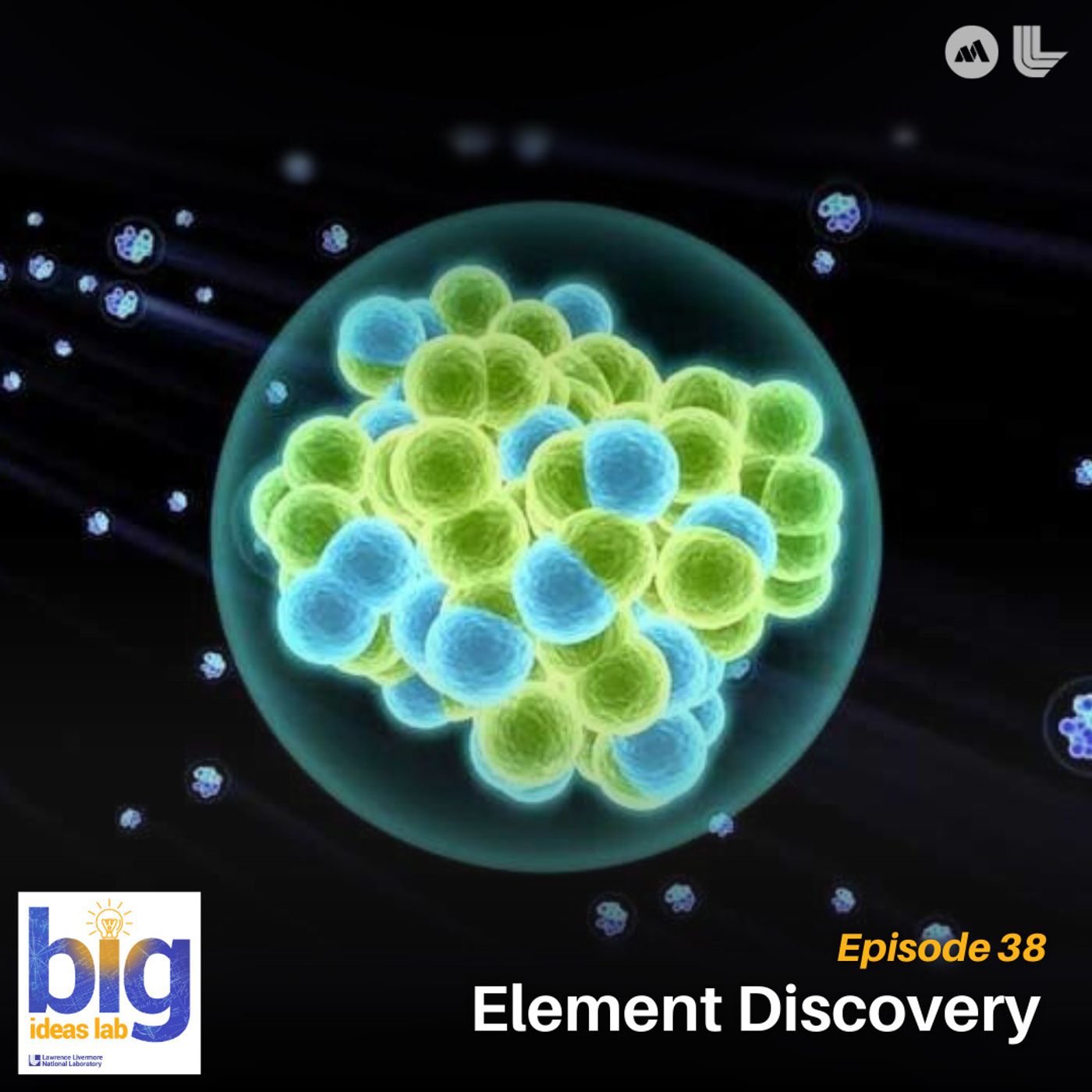
Big Ideas Lab
Element Discovery
00:17:48
That periodic table is not just decor. It’s a map... and it's not finished.
Loading summary
Transcript64 lines
- [00:00]
Podcast Host / Narrator
Looking for a career that challenges and inspires, Lawrence Livermore National Laboratory is hiring for a safety basis, analyst, research scientist, cell biology, and an electrical designer, along with many other roles in science, technology, engineering and beyond. At the lab, every role contributes to groundbreaking projects in national security and advanced computing and scientific research, all within a collaborative, mission driven environment. Discover Open positions@llnl.gov careers where big ideas come to life.
- [00:47]
Narrator / Science Communicator
You're standing in your kitchen and you reach for that little white shaker, the stuff we sprinkle into everything from pasta, water to roasted vegetables to soup salt. Inside that pinch of salt is a chemistry paradox hiding in plain sight. Salt is made from sodium, a soft metal so reactive it can catch fire when it touches water.
- [01:16]
Scientist / Researcher
In its elemental form, sodium will be highly reactive and you will deeply regret licking it.
- [01:22]
Narrator / Science Communicator
Burning my tongue. Salt also contains chlorine, a toxic greenish yellow gas that was weaponized in World War I. These elements are hazardous on their own, but bond together to form something safe, stable and essential.
- [01:38]
Scientist / Researcher
There's a periodic table that's titled Can I lick it?
- [01:42]
Don Shaughnessy
Hey, can I lick this?
- [01:44]
Narrator / Science Communicator
This transformation, dangerous elements becoming safe compounds represents fundamental chemistry. But it's elementary compared to what's happening in laboratories today where scientists are creating elements that don't occur in nature. These entirely new elements must be built by forcing smaller atoms together. As a result, they are large, unstable, and exist for only fractions of a second before they break apart, leading to extremely rare discoveries.
- [02:21]
Scientist / Researcher
If you go to Stinson beach and you want to search for the one perfect grain of sand on the entire beach, there's a lot of grains of sand out there. That's kind of the whole heavy element discovery experience. And maybe that helps blow somebody's mind as to just exactly how difficult that is.
- [02:46]
Narrator / Science Communicator
These super heavy elements challenge our understanding of matter itself and teach us how atoms hold together at the very edge of steel. In those fleeting moments before they vanish, they reveal secrets about the building blocks of the universe. These new elements help scientists explore the forces inside atomic nuclei and expand the boundaries of the periodic table. But how do scientists create these short lived particles? This is the story of element discovery. Welcome to the Big Ideas Lab.
- [03:31]
Podcast Host / Narrator
Your exploration inside Lawrence Livermore National Laboratory. Hear untold stories, meet boundary pushing pioneers, and get unparalleled access inside the gates.
- [03:43]
Narrator / Science Communicator
From national security challenges to computing revolutions, discover the innovations that are shaping tomorrow.
- [03:50]
Podcast Host / Narrator
Today, Lawrence Livermore National Laboratory is hiring. If you're passionate about tackling real world challenges in science, engineering, business or skilled.
- [04:08]
Narrator / Science Communicator
Trades, there's a place for you at the Lab.
- [04:12]
Podcast Host / Narrator
Right now, positions are open for a field engineer, safety basis analyst and and an electric utility distribution electrician. These are just a few of the more than 100 exciting roles available at Lawrence Livermore. You'll work on projects that matter, from national security to cutting edge scientific advancements. Join a team that values innovation, collaboration and professional growth. Explore opportunities at LLNL where your next career move could make history.
- [04:54]
Narrator / Science Communicator
Remember the periodic table on the wall of your high school science classroom? It's actually not finished. Scientists are still discovering new elements.
- [05:05]
Scientist / Researcher
They constitute everything that you see in life. Everything that's around you, everything that you breathe consists of elements.
- [05:14]
Narrator / Science Communicator
Roger Henderson is a senior radiochemist at Lawrence Livermore National Lab.
- [05:19]
Scientist / Researcher
There's a whole array of things that elements do for us in our everyday lives. Carbon, hydrogen and oxygen when combined into gasoline, power internal combustion engine vehicles. Now the electric vehicles that we use, you're just pumping electrons into the battery so that they can then turn that into kinetic motion. But now lithium, which is related to sodium, is a major component in typical lithium metal battery elements like I have in the bottom of my Tesla.
- [05:55]
Narrator / Science Communicator
These familiar elements represent part of the periodic table. On that table, every element gets a number. Hydrogen is number one. It has one proton in its nucleus. Carbon is number six. Six protons, oxygen, eight. With eight protons, the number is literally a head count of how many protons are crammed into the center of each atom. Most of the elements we know fall somewhere in the middle. The basic naturally occurring elements, from hydrogen at number one to uranium at 92, fall form the foundation of chemistry, biology and everyday materials. But then there's a gap. Elements 93 through 103 exist, but they're all synthetic, human made. And once you get past 104, you enter the realm of super heavy elements. Atoms with extremely large unstable nuclei that don't, don't occur naturally.
- [06:59]
Scientist / Researcher
Super heavy elements live beyond the normal realm of the periodic table that anybody would encounter on a daily basis.
- [07:08]
Narrator / Science Communicator
These elements are created in a lab through nuclear reactions or witnessed from far away in other galaxies. Don Shaughnessy leads the Nuclear and Chemical Sciences division at Lawrence Livermore National Labor.
- [07:24]
Don Shaughnessy
When there's stars that explode and we can catch glimpses in these telescopes, they're seeing evidence of heavy element production in these supernovas.
- [07:33]
Narrator / Science Communicator
Every atom is essentially a miniature solar system. But instead of planets orbiting a sun, you have a dense core, the nucleus packed with particles. The nucleus contains protons, positively charged particles that shape should, by all rights, explode apart instantly. It's like trying to hold together a Bunch of identical magnets and heavier elements have more magnets. But the nucleus does hold together because of two stabilizing neutrons, which dilute the electromagnetic repulsion, and a strong nuclear force, the most powerful force in nature, but only at extremely short distances.
- [08:20]
Scientist / Researcher
But the cool thing there is that now we're dealing with nuclear theory, which is a description of why elements exist.
- [08:30]
Narrator / Science Communicator
Nuclear theory is the scientific framework that explains how atomic nuclei hold together and why some combinations of protons and neutrons can exist even briefly, while others immediately disintegrate.
- [08:45]
Scientist / Researcher
Why don't they just fall apart? Principal components of an atom are neutrons, which are neutrally charged particles, and protons, which are positively charged. Now, the protons, of course, since they have the same charge, they want to repel each other, and so they would rather not be right close to each other. The neutrons help to remediate that effect, as then you also have the nuclear strong force that kind of holds everything together.
- [09:15]
Narrator / Science Communicator
It's a precise balance of competing forces. As atomic numbers increase, more protons mean greater electromagnetic repulsion. The strong nuclear force remains constant, but the repulsive force grows exponentially. Eventually, no amount of neutrons can maintain stability. Scientists use theoretical models to explain how these atoms stay together, even though their nuclei are packed with many positively charged protons in an extremely small space where electromagnetic forces are constantly pushing them apart.
- [09:54]
Scientist / Researcher
The super heavy elements exist because nuclear theory says, yeah, that'll hold together at least four, maybe a couple of milliseconds before it starts falling apart.
- [10:07]
Narrator / Science Communicator
Super heavy elements are synthetic and born from controlled chaos. Smashing atomic nuclei together, hoping they stick, even if only for a moment. The challenge is keeping them together long enough to detect, study, and confirm that the atom ever existed. These nuclei don't want to exist, exist. Every force in the universe is screaming at them to tear themselves apart.
- [10:33]
Podcast Host / Narrator
But occasionally, in a moment that defies.
- [10:36]
Narrator / Science Communicator
The most probable outcome, nuclei crash together at exactly the right angle, at exactly the right speed, with exactly the right energy. And for one infinitesimal instant, something new appears in the universe, Something that has never existed before. The question is, can scientists catch it before it disappears forever?
- [11:08]
Podcast Host / Narrator
Lawrence Livermore National Laboratory is hiring. If you're passionate about tackling real world challenges in science, engineering, business, or skilled.
- [11:19]
Narrator / Science Communicator
Trades, there's a place for you at the lab.
- [11:23]
Podcast Host / Narrator
Right now, positions are open for a field engineer, safety basis analyst, and an electric utility distribution electrician. These are just a few of the more than 100 exciting roles available at Lawrence Livermore. You'll work on projects that matter, from national security to Cutting edge scientific advancements. Join a team that values innovation, collaboration and professional growth. Explore opportunities@llnl.gov careers where your next career move could make history.
- [12:10]
Don Shaughnessy
To make a new element, we actually have to take two existing elements and basically just smash them together so that they combine all of their particles and.
- [12:19]
Narrator / Science Communicator
Atoms aren't eager to collide.
- [12:21]
Don Shaughnessy
That is not easy to do because they don't want to do that under normal circumstances. So we have to accelerate them to very high energies and speeds to basically get them to smash together. We don't have a particle accelerator here at Livermore, so we collaborated with the Dubna Laboratory, which is in Russia.
- [12:42]
Narrator / Science Communicator
Just in the late 1980s, Lawrence Livermore partnered with the Joint Institute for Nuclear Research in Dubna, Russia, an international collaboration which lasted for over three decades. While Livermore provided rare and carefully prepared target materials, Dubna had the particle accelerator to run the experiments. Lawrence Livermore supplied specially prepared samples of heavy elements, rare, highly radioactive materials that required expert handling and precise manufacturing. But getting it there wasn't easy.
- [13:17]
Don Shaughnessy
The other challenge, I would say is getting material there because it has to go on a plane. We don't charter a plane specifically for these things, so it has to go kind of commercial freight. And then you find out that it's up to the pilot of that plane to come out and look at it and decide if they want to take the risk of having that plane.
- [13:36]
Narrator / Science Communicator
Once the material was safely on its way to Russia, a decades long scientific partnership built on trust, precision and a shared pursuit of discovery blossomed. This is the captain speaking. We are on our final approach.
- [13:49]
Don Shaughnessy
Finally, it made it. And the experiment went. It was successful. But there was a chance there that that material would never leave the San Francisco airport. And we used to joke, was it like on one of those luggage things just spinning around this drum with all these radioactive tags on it and no one wanted to touch it? But it finally went. Luckily, that material's long lived, enough that the delay didn't really dampen the experiment. But it did dampen the timeline that our Russian colleagues had to do that experiment.
- [14:15]
Narrator / Science Communicator
Despite the shipping delays and logistical hurdles, experiments ultimately moved forward.
- [14:20]
Don Shaughnessy
It was a great partnership for many years where we supplied target material and data analysis, detection equipment. They had the accelerator and so we would run experiments there where you would then accelerate one atom into a target of a different atom and smash them together.
- [14:40]
Narrator / Science Communicator
These experiments demand careful setup, constant tuning, and most important, patience. Discovering a new element can take months or often years.
- [14:51]
Don Shaughnessy
There's a lot of trial and error with these because you have to get the right energy of the, the beam coming into your target. You can sometimes see weeks without a positive result, and you start to doubt, right, is this the right energy? Are we doing the right thing? And it can be very frustrating. And so really, the one thing that we absolutely have and need for these experiments is patience, because you have to just sit and wait and see if you're going to get the result that you think you're going to get.
- [15:19]
Narrator / Science Communicator
Once the experiment is up and running, the focus shift shifts to careful observation, looking for any signal that a super heavy element may have formed.
- [15:28]
Scientist / Researcher
Once you have everything in place and the accelerator is running, then you're basically just watching the readout from the instrument that is trying to detect the creation of a super heavy element. It might be a bit boring, but on the other hand, when you do get an indication from the instrument that, hey, I just caught something of interest, then it can get pretty exciting.
- [15:51]
Narrator / Science Communicator
Even when the scientific experiment works, the new atom is too small and too unstable to observe before it starts to fall apart. Instead, scientists track the particles and energy it releases as it decays, looking for an indication that proves it existed.
- [16:07]
Don Shaughnessy
And what you're looking for then at the end are just electronic signals of something decaying through radioactive decay that's indicative of that new element.
- [16:16]
Narrator / Science Communicator
That decay happens in a predictable pattern. Each new atom, if it forms, sheds particles and energy as it tries to stabilize, Leaving a kind of fingerprint.
- [16:27]
Scientist / Researcher
When we did discovery experiments for element117, we were looking at an element that hit our detector system, and then we watched it literally fall apart by spitting out helium atoms or alpha particles one at a time, until finally the system says, I've had enough of this. And then it splits in half, roughly speaking, and then it's all done. But the fission at the end was a couple of hours and it's gone.
- [16:57]
Narrator / Science Communicator
Element 117, later named Tennessine, was one of the last elements added to the periodic table. Like some other super heavy elements, Tennessine was created by fusing a radio rare isotope of berkellium with a calcium beam in a particle accelerator. The resulting atom appeared in Livermore's detection system and began to decay one particle at a time. Those decay steps and the time between each one matched predictions for element117. And even though the atom of element117 lasted less than a second, the pattern it left behind confirmed tennessine's creation. The group did this four other times.
- [17:39]
Podcast Host / Narrator
Discovering elements 114 through 118 with element 116 being given the name Livermorium in.
- [17:46]
Narrator / Science Communicator
Recognition of the role the laboratory had in these experiments. But why bother creating new elements if they're so short lived?
- [17:54]
Don Shaughnessy
What it is doing is allowing the next generation of people to understand how materials interact with each other and how elements behave and basically how our universe is put together. It's about understanding the universe around us, which sounds very big and kind of out there, but it's real. Trying to understand why are we here? Why do things on Earth look the way they do?
- [18:18]
Narrator / Science Communicator
By recreating cosmic processes here on Earth, scientists can better understand the structure of matter. Which brings us back to something central to, to this work. The periodic table.
- [18:30]
Don Shaughnessy
That periodic table is not just a wall decor in the high school classes. It actually is a map and a guide for us of how elements behave and how they're predicted to behave based on that chart. So it's important we get that chart right, and it's important we understand how things work. If we're going to continue to push the envelope on materials, scientists are chasing.
- [18:53]
Narrator / Science Communicator
Something they'll never see or hold.
- [18:55]
Don Shaughnessy
You've made something that you will never see, touch, or be able to manipulate at all. You're basically looking for an electronic signal that says, hey, this thing existed and it was gone. These things undergo radioactive decay, and every time they do, they emit a signal that we can see in a detector.
- [19:12]
Narrator / Science Communicator
Despite how rare, how fragile, how fleeting these discoveries are, scientists keep searching. Even now, at this very moment, there's a race happening. Labs in California, Russia, Germany, and Japan are all hunting for the same prize. Elements 119 and 120. Because every new element adds a missing piece to the puzzle of how matter is built and how the universe came to be one impossible atom at a time.
- [19:59]
Podcast Host / Narrator
Thank you for tuning in to Big Ideas Lab.
- [20:02]
Narrator / Science Communicator
If you loved what you heard, please let us know by leaving a rating and review.
- [20:07]
Podcast Host / Narrator
And if you haven't already, don't forget.
- [20:09]
Narrator / Science Communicator
To hit the follow or subscribe button in your podcast app to keep up with our latest update episode. Thanks for listening.