← Big Ideas Lab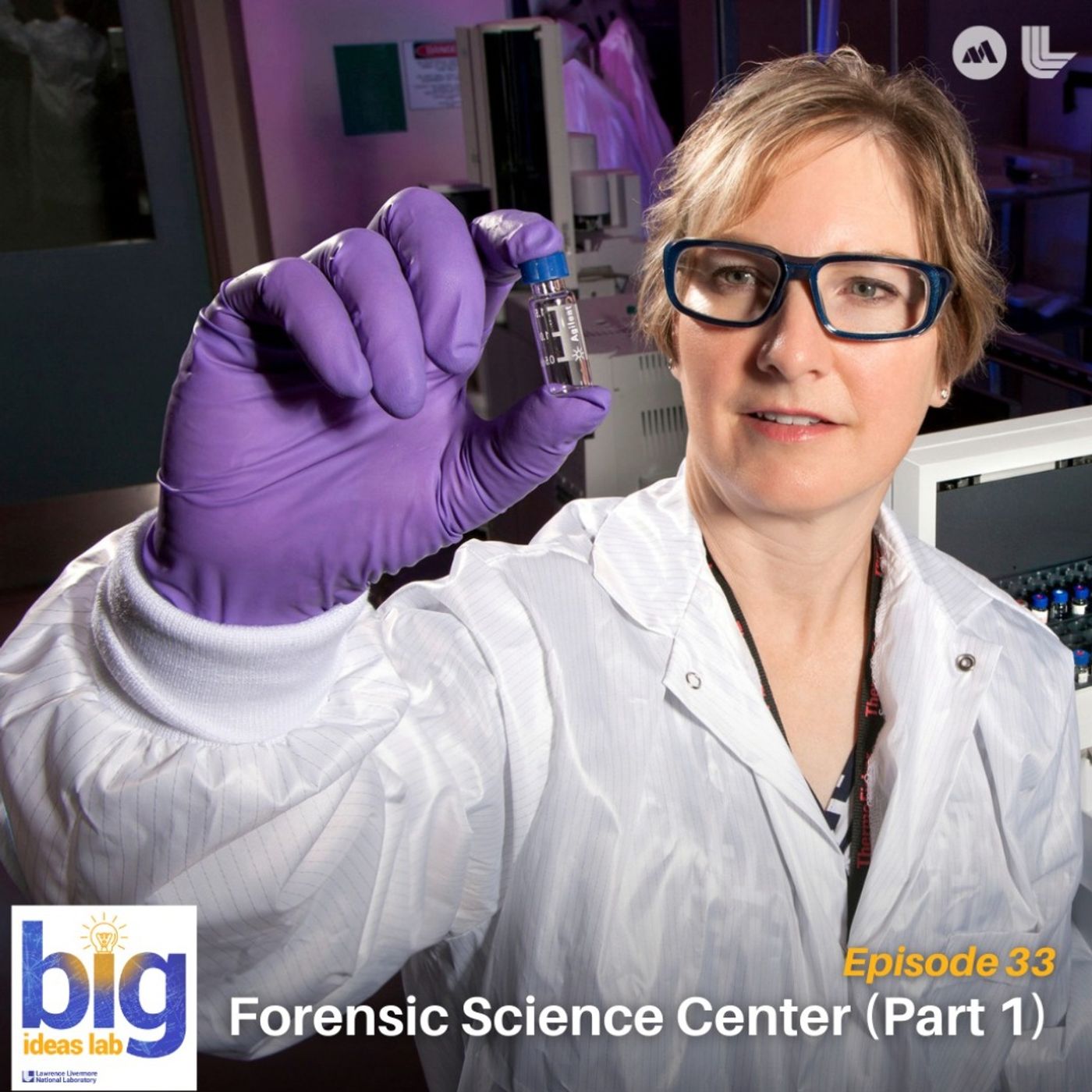
Big Ideas Lab
Forensic Science Center (Part I)
00:22:38
From moon rocks to murder cases, drug overdoses to nuclear smuggling, meet the scientists who turn microscopic clues into courtroom evidence.
Loading summary
Transcript96 lines
- [00:03]
Narrator
On a routine morning in 1978, a security guard was making his rounds at a college campus in the Midwest. The halls were quiet, mostly empty. Then he noticed a package. No return address on it, just sitting there. He opened it. Not long after, a phone rings at Lawrence Livermore National Laboratory. Usually it's another scientist, a university, maybe someone from the US Department of Energy. But today it's law enforcement. Not about a bomb that might go off, but one that already did. Over the course of nearly two decades, bombs like these appeared in mailrooms, airplane, cargo holds, campus offices. The bomb on the Yale campus today.
- [01:02]
Armando Alcaraz
Blew up in the computer sciences building.
- [01:04]
Narrator
They were crude, but somehow also meticulous. And nobody knew why.
- [01:11]
Armando Alcaraz
So far as I understand, there's been.
- [01:13]
Brian Andreessen
No credit taken, no motive that's been expressed.
- [01:15]
Narrator
Shortly after the mail bomb exploded at Yale, a threatening phone call was made to the VA Medical center in West Haven.
- [01:21]
Armando Alcaraz
About mid morning, we received an anonymous telephone call saying, you are next.
- [01:27]
Narrator
And in the absence of a suspect or a motive, investigators turned to the only clues they had left. Bits of exploded bomb residue. Dust reported by law enforcement as a unique type of aluminum powder. Materials barely visible to the human eye. Along with traces of another explosive material.
- [01:52]
Brian Andreessen
And the explosive material was a perchlorate. You mix the two together in a sealed container like a metal pipe, it can make quite an explosion.
- [02:02]
Narrator
This was just one piece of the puzzle that led to the eventual arrest and conviction of the Unabomber. And a single case in a library of dozens more that the Forensic Science center at Lawrence Livermore National Laboratory played a key role in solving. Today we're not chasing a killer. We're chasing a question. How much can a particle of dust tell you? Welcome to the Big Ideas Lab. Your exploration inside Lawrence Livermore National Laboratory. Hear untold stories, meet boundary pushing pioneers and and get unparalleled access inside the gates. From national security challenges to computing revolutions, discover the innovations that are shaping tomorrow. Today.
- [03:08]
Armando Alcaraz
We found residue like that on glass shards taken out of.
- [03:10]
Narrator
If you've watched television in the last 20 years, chances are you have a basic understanding of forensic science.
- [03:16]
Armando Alcaraz
Looks like galvanized metal.
- [03:18]
Narrator
TV shows like CSI have brought the concepts of fingerprinting, ballistics and toxicology into the mainstream. But this wasn't always the case. Back in the 1960s, forensics was a virtually unknown form of investigation. Thanks to Brian Andreessen, the founder and former director of the Forensic Science center at the Lawrence Livermore National Laboratory, that would soon change.
- [03:45]
Brian Andreessen
It all goes back to graduate school. When I was at mit, we were Working with a new technology back in the 60s called gas chromatography and mass spectrometry.
- [03:55]
Narrator
Those are two different analytical chemistry techniques utilized to identify the components in a material or unknown substance. At the most basic level, it's kind of like using a colander to figure out what vegetables were used in a soup, except instead of potatoes and carrots, they're identifying different compounds in the material. And chromatography and mass spectrometry can analyze nearly any organic material.
- [04:25]
Armando Alcaraz
That's one small step for man, one.
- [04:28]
Brian Andreessen
Giant leap for mankind. When the astronauts went to the moon, they brought back moon samples, and they were able to bring them to our lab.
- [04:37]
Armando Alcaraz
Surface is fine and powdery.
- [04:39]
Brian Andreessen
I can pick it up loosely with my toe.
- [04:41]
Armando Alcaraz
The pivot adhere into fine layers, like.
- [04:45]
Brian Andreessen
Powdered charcoal to the sole and sides of my boots. We analyzed the moon samples for any organic chemicals that were indicative of life, which we didn't find any. But we did find the smell of the O ring that sublimed under a vacuum onto the rocks.
- [05:01]
Narrator
They brought this discovery to the public, explaining their findings via television broadcast in Boston, Direct from Alexium in New York, in color.
- [05:10]
Armando Alcaraz
This is the CBS Evening News with Walter Cronkite.
- [05:13]
Brian Andreessen
I said the technique called mass spectrometry is so sensitive, if I had a drop of blood, I could tell you all the chemicals in it.
- [05:20]
Narrator
The publicity was massive, and it caught the attention of a doctor with a medical mystery on his hands.
- [05:27]
Brian Andreessen
A physician at Mass General Hospital heard that presentation, and then he said, you know, I have a woman who's overdosed on some unknown drugs. And he called and he said, could you just take a look at her blood and tell us what it is? That day got a tube of blood, extracted it, analyzed it, and it was Darvon. She'd taken a massive amount of Darvon.
- [05:49]
Narrator
The medication, which was a narcotic pain reliever, could have killed her, but they identified the drug before that happened.
- [05:57]
Brian Andreessen
So he was able to then give an antidote for the Darvon and treat her. And she was recovered and saved.
- [06:03]
Narrator
That single analysis set off a huge chain reaction.
- [06:07]
Brian Andreessen
Little did I know, he went to the American Medical association and gave a talk on the analysis of a blood sample from a patient. And he said it was done quickly and exactly. And he mentioned this to a international meeting. And within the next week, all of a sudden, I started getting calls about forensics from around the world.
- [06:29]
Narrator
It fueled Brian's work throughout the next two decades.
- [06:32]
Brian Andreessen
And so that's launched me into doing forensics for identifying materials that people just didn't know what it was, a drug, a toxin, a poison, environmental sample. And I kept doing that in the medical community.
- [06:45]
Narrator
By the early 90s, demand for forensic analysis was through the roof.
- [06:50]
Brian Andreessen
I was getting more and more sample requests from around the country, from different intelligence as well as law enforcement organizations. And it just seemed reasonable to try to make a center where everything could be done in one area quickly and securely so that we could turn the results over quickly and not have to worry about going to another building or working with other people.
- [07:13]
Narrator
So in 1991, Brian spearheaded the formation of the Forensic Science center, or FSC at the Lawrence Livermore National Laboratory.
- [07:22]
Brian Andreessen
I came to the Lawrence Livermore lab, started doing analysis out there, and then said, we need to have a forensic science center at the Livermore Labs that have all this great equipment, great people. We can make a real mark in forensics around the world.
- [07:36]
Armando Alcaraz
I was fortunate enough to be able to meet Brian just when he was starting the Forensic Science Center. He goes, hey, would you like to be part of this team to start building this forensic science center? And I said, absolutely.
- [07:50]
Narrator
That's Armando Alcaraz. He's the international programs lead at the fsc.
- [07:55]
Armando Alcaraz
My background is gas chromatography, mass spectrometry, similar to what Brian did.
- [07:59]
Narrator
But Brian and Armando had to expand beyond just blood and chemical analysis. They had to be ready for anything.
- [08:08]
Armando Alcaraz
Well, in many cases, you really don't know what kind of sample is going to be coming through the door.
- [08:13]
Brian Andreessen
Sometimes there was nuclear material to look at, sometimes there were drugs, sometimes explosive residues. All of these different samples would come into the new facility, the center.
- [08:23]
Armando Alcaraz
We also have synthesis chemists on our teams. We may find something. As an analytical chemist, I'll see the compound. I go, you know, this looks kind of strange. It looks kind of like an explosive. And so then I'll show that to our synthetic chemist. And he goes, oh yeah, that's a second precursor to be able to make tnt. So having their knowledge in our team is extremely valuable.
- [08:44]
Narrator
This array of specialists enabled the team to expand their work.
- [08:48]
Brian Andreessen
We were doing all sorts of unique analyses. It was just to help domestic and foreign law enforcement to help epa, osha. They were just helping people and they liked it and appreciated it. The FSC started getting a reputation for doing great work in a timely manner and then having the people to back up their results. So it just kept growing as we get more samples and more people knew about us.
- [09:12]
Narrator
So the operation expanded. What started as a small squad of scientists quickly developed into a world renowned crew of Forensic experts.
- [09:21]
Armando Alcaraz
We got a call from the Polish police department asking us how exactly did you do the LC work?
- [09:28]
Narrator
That's liquid chromatography.
- [09:30]
Armando Alcaraz
And so we explained it, of course. We said, you know, why? What's going on? And they said, well, we had some ambulance drivers that were going to critical automobile accidents where a person was right on the edge of not making it life threatening.
- [09:46]
Narrator
Car crashes happen every day. But the number of deaths was increasing at an alarming and abnormal rate. Were these accidents truly more severe than normal? Were the paramedics incompetent? Was it just bad luck to find the answer? The FSC helped Poland's police department analyzed samples taken from some of the deceased by providing them details on how the FSC analyzed for pavilion in human tissue. What they found was haunting. The evidence led them back to the paramedics.
- [10:23]
Armando Alcaraz
They had an arrangement with one of the mortuaries where they would then get a kickback because they thought, this guy's not going to make it, so we'll do that.
- [10:30]
Narrator
Paramedics were intentionally injecting the critical patients with a muscle relaxer called Pavilon, the same drug used for euthanasia. In the end, authorities attributed numerous deaths to this scheme. But thanks to liquid chromatography mass spectrometry, the EMTs, doctors and morticians involved were stopped and apprehended. And after that, the Forensic Science Center's involvement with international cases continued expanding.
- [11:02]
Brian Andreessen
We were starting to get more and more involved more and more in international affairs, like looking at chemical weapons, developing techniques to analyze chemical weapons, inorganics for looking at nuclear materials.
- [11:15]
Narrator
One of these cases took place in 1999 when Bulgarian border guards stopped a suspicious looking vehicle attempting to enter the country from Romania. When authorities searched the car, they found a glass, a glass vial filled with an unidentified powder stored inside a lead.
- [11:33]
Armando Alcaraz
Container that was actually a multidisciplinary type of sample. So our nuclear folks were able to analyze the actual material and have an idea of what type it was.
- [11:44]
Narrator
The substance turned out to be highly enriched uranium, which in large quantities is used to create nuclear weapons. But with something new this dangerous, simply identifying the material isn't enough.
- [11:58]
Armando Alcaraz
It's not just the threat chemical itself, but all the other forensic information. What's the purity of that compound that was there? Maybe this is a unique chemical that can only be present in a certain type of manufacturing process. Why is it there?
- [12:14]
Narrator
Was the sample reactor grade? Weapons grade? Where did it come from? To answer these questions, the FSC ran more forensic testing on a second substance associated with the Sample, a mysterious yellow wax.
- [12:30]
Brian Andreessen
Talking about how to characterize a sample and in what order you work up the sample is also important because one technique might destroy it for another technique.
- [12:39]
Armando Alcaraz
Is there some instrumentation where we maybe don't have to manipulate that sample very much? So one of the things we did with that sample was to look at it with infrared. Then you take a more advanced approach and go, okay, well, let's now dissolve it.
- [12:53]
Narrator
Dissolving a sample is the first step in gas chromatography, mass spectrometry, a technique used to identify individual molecules contained within a sample. To run this test, Armando and his team first experimented with a number of solvents like acetone or methanol to see what effectively breaks down the sample. After that, it's about heat.
- [13:18]
Armando Alcaraz
It volatilizes all of those organics, and they go into a gas chromatographic column and separate. So now, instead of having a thousand chemicals all in one bunch, you get each one individually.
- [13:33]
Narrator
So what secrets did that wax reveal?
- [13:35]
Armando Alcaraz
It turns out that it had a particular inorganic element that most countries don't use anymore. There was also paper in that, and that also pointed to a tree pulp that was in a certain region in Bulgaria.
- [13:51]
Narrator
This information, gathered from examination of everything associated with the sample, was vital to authorities and their attempts to crack down on nuclear smuggling. And that was back in 1999. Forensic techniques have advanced so greatly in the last 25 years that now a single fingerprint can change the course of an investigation.
- [14:21]
Brian Andreessen
When I was early in the career, trace analysis was like a few hundred micrograms, which is like a few hundred grains of salt. Nowadays we look at nanograms, which is a billionth of a gram.
- [14:35]
Narrator
That's about the weight of the average single human cell. But the equipment at the FSC can run analysis on even smaller samples, down to pico, or femtograms. That's one quadrillionth the weight of a paperclip.
- [14:52]
Brian Andreessen
It's ultra trace analysis.
- [14:54]
Narrator
This precision is what allows for examination of such small amounts of evidence.
- [14:59]
Brian Andreessen
You can almost take one fingerprint, take the oil off a fingerprint, and see all the chemicals that the person has in their body.
- [15:05]
Armando Alcaraz
Now you look for the other part of the fingerprint. Who's the culprit? Do they have things in their garage where they're making it?
- [15:11]
Narrator
That trace evidence could be enough to narrow in on a suspect. If this was an episode of television, that might be the end of the story. The cops come in, arrest the bad guy. The end. But in real life, the evidence still has to hold up in court.
- [15:28]
Brian Andreessen
That's a lot of detail that most people don't realize. They just think you take a sample, analyze it, and that's it. But no, you've got to be absolutely sure, Especially if you go to court and you get cross examined. That's a really important thing. To have all the data correct in your mind as well as on paper, it has to be written up. A judge looks at what you've written, and they may even give it to someone else and challenge your findings to make sure that what you put down is correct.
- [15:55]
Narrator
It's not enough to only solve a mystery. The solution has to be airtight for a judge and jury.
- [16:01]
Armando Alcaraz
With our current quality control system, we won't generate a report unless we can verify. So this way there's no doubt this evidence is solid.
- [16:13]
Narrator
Ensuring that accuracy highlights the difference between television and real life.
- [16:17]
Brian Andreessen
They seem to come to a conclusion in the case in about 30 minutes, minus commercials. And it takes us a lot longer to do that kind of activity. It takes sometimes days and days to do these analyses. And most people don't realize that a lot of it is just being very thorough and analyzing samples correctly and doing it not just once, but doing it multiple times to make sure that the samples are just perfectly characterized. So when you write it up and report it, it's very accurate.
- [16:48]
Narrator
So is the forensic science work at the FSC anything like TV1?
- [16:54]
Armando Alcaraz
We don't have sunglasses on during, you know, we're in the laboratory and we don't wear all the fancy clothes either.
- [17:00]
Narrator
But Brian, Armando and the rest of the crew share one thing in common with their fictional counterparts. The satisfaction of solving a crime that puts away a criminal. And sometimes there's an adrenaline rush that comes from cracking cases that are just plain bizarre.
- [17:20]
Brian Andreessen
People like the fact it's a challenge. It's a puzzle. You're trying to solve these unknown cases, you're looking for that needle.
- [17:27]
Narrator
One such puzzle revolved around what started as a simple hospital visit. A woman named Gloria Ramirez was battling late stage cervical cancer when she checked into the emergency room. Shortly after her arrival, a number of hospital staff began experiencing strange symptoms. Some just had shortness of breath. Others developed muscle spasms. A few even fainted, and five required serious intensive care. What was it about this woman? The nurses and doctors treating her said her skin seemed oily and that her breath smelled like garlic. Did she have a virus or strange alien disease that was infecting others? Was there a curse following her?
- [18:15]
Brian Andreessen
So we got some of the samples brought it back to the lab and analyzed it and saw what was going on.
- [18:20]
Narrator
The answer was not science fiction or magic. It was a treatment she had used to lessen the pain of her metastasized cancer.
- [18:29]
Brian Andreessen
She was taking dmso. Dimethyl sulfoxide. You rub it on your skin and the DMSO immediately dissolves into the skin. But it carries anything that's mixed with it through the skin also, then into the bloodstream.
- [18:43]
Narrator
She was also taking codeine, a narcotic painkiller.
- [18:47]
Brian Andreessen
What happens again? When the body sees things like dimethyl sulfoxide, it immediately wants to detoxify it. It would then add an oxygen to it, make dimethyl sulfone, and then it can oxidize it again and make dimethyl sulfate, which is a very volatile, toxic chemical. It can cause all sorts of nausea, eye watering, just in general. It's a toxin. And it came into the emergency room of the hospital.
- [19:15]
Narrator
So it wasn't a case of mass hysteria among the hospital staff, like some people thought, it was a simple drug interaction. Thankfully, none of the hospital staff died from the exposure. The FSC's dedication and impressive level of analysis in this case is a great example of what makes their team a world leader in forensics. But they don't simply rest on their laurels. They maintain their reputation by yearly evaluations and a constant dedication to quality work.
- [19:48]
Armando Alcaraz
We're currently going through testing every year to verify we are qualified to do this. And these tests that they provide us are complex. They could be anything from a soil sample to even a piece of metal that has these chemicals on there. And we have to identify them all to be able to get an A grade. The folks who prepare these samples, they all think of things that they've come across across to make things tricky. And they'll put them in the tests. You always have to be on top of it, because in the samples that they give us, these proficiency tests, they try to make them as realistic as possible. Because when you think about it, people who did this may want to cover it up. And they're going to put diesel fuel on top of it. Bleach. But there's always a smoking gun. You only have 15 days to analyze a set of six samples. And so we're here to day and night analyzing these samples to make sure we got the answer right. And if you put an answer that's incorrect, you lose your designation.
- [20:49]
Narrator
That's a lot of pressure. But the challenge and the difficulty is exactly what makes it thrilling. And when you're working alongside other passionate, committed scientists that energy just compounds.
- [21:03]
Brian Andreessen
Forensic is still a people thing. And you want to have them enthusiastic and supporting each other and being a team effort. Because again, that's what we were really found on, being that team effort.
- [21:13]
Armando Alcaraz
It's really that camaraderie, that secret sauce that's been keeping the Forensic Science center going for years now.
- [21:20]
Brian Andreessen
In the future, what I think will keep it going is the best equipment and the best people in the world.
- [21:25]
Armando Alcaraz
That's the beauty of it. You're part of a bigger team, and the people who join the Forensic Science center see this and they go, you know what? I want to be part of this. I'm hoping that the new generation of scientists come on board, that they carry that through and continue to work together well and achieve things.
- [21:41]
Narrator
It may not be exactly like television. You may not wear sunglasses inside the laboratory, but you would solve crimes, prevent disasters, and save lives. The Forensic Science center is waiting. Will you answer the call? Thank you for tuning in to Big Ideas Lab. If you loved what you heard, please let us know by leaving a rating and review. And if you haven't already, don't forget to hit the Follow or Subscribe button in your podcast app to keep up with our latest video episode. Thanks for listening.