← Big Ideas Lab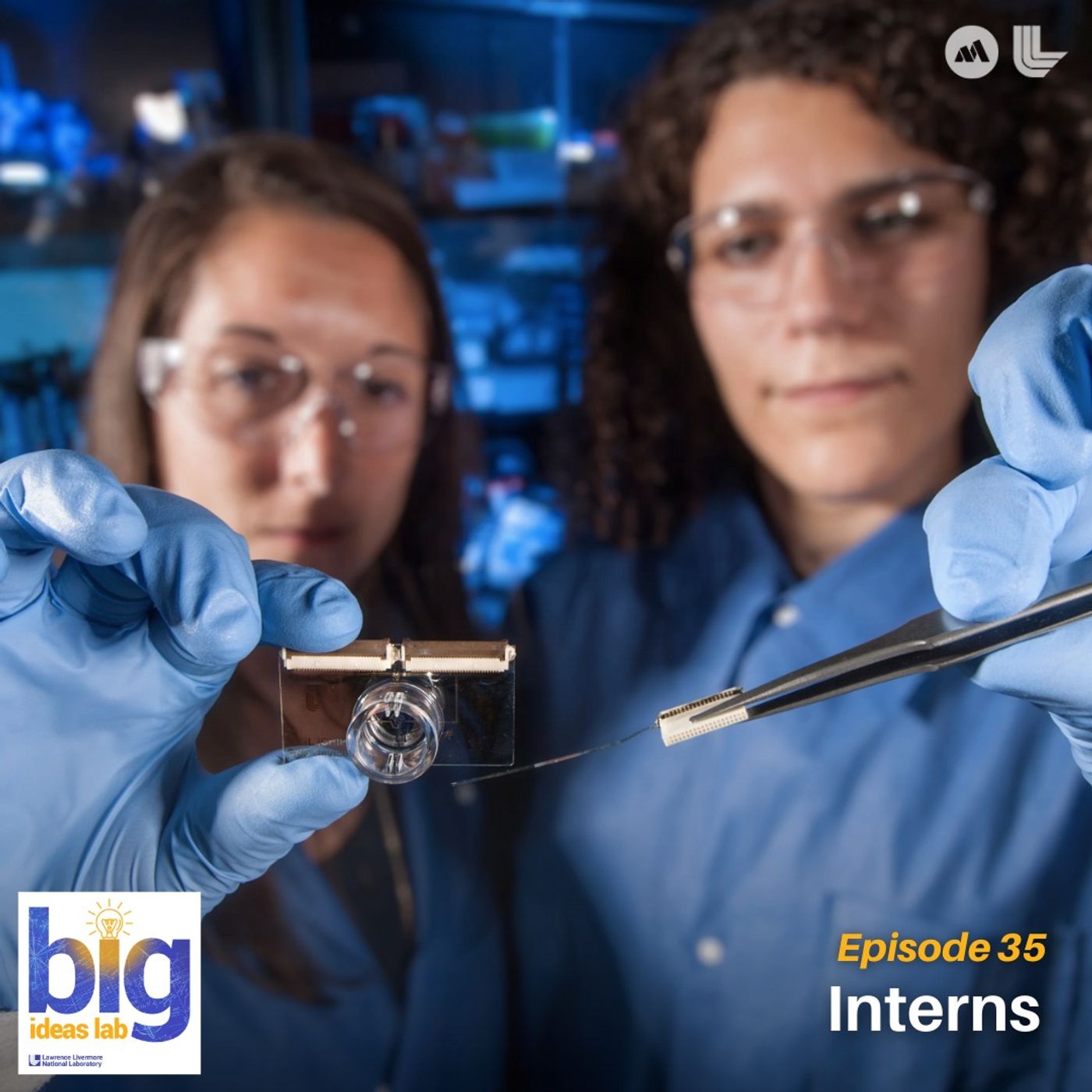
Big Ideas Lab
Interns
00:16:20
What’s it really like to intern at one of the nation’s premier science and national security labs?
Loading summary
Transcript39 lines
- [00:07]
Narrator
It's your first time in this parking lot and you made sure to show up 15 minutes early. But your heart is racing like you're late. Your key card feels weird clipped to your shirt pocket. You scan in. The smell of coffee hangs in the air. And something else that smells like metal. Suddenly you realize that you've walked into one of the most advanced science labs in the world. There's a chill on your skin, either from the nerves, the caffeine or the air conditioning keeping the high powered instruments and specialized equipment running. Your stomach does a little flip like you swallowed undercooked eggs. It's your first day as an intern, and although you're physically in the right place, your brain is wondering what you're actually doing here. As you walk down the hallway, you pass portraits and displays of the giants who built this place. Edward Teller, co founder and father of the hydrogen bomb, a weapon that remade the world. John knuckles, who in 1972 wrote the paper that founded an entire field of science proposing to recreate the power of stars using lasers. A photo of the whole ignition team who just two years ago achieved. Achieved what seemed impossible. Fusion ignition. The first time humans produced more energy than they put in, literally harnessing the fire that powers the sun. You're surrounded by multimillion dollar instruments, seasoned scientists, and experiments with national security implications. These legends watch from the walls, Masters whose work redefined what's possible. You take a deep breath, then a few steps forward, wondering how you could possibly belong in the same building where such titans once walked. But fast forward a few weeks and you're running simulations. You're crawling inside target chambers. You're helping design an instrument that will be used in a potentially groundbreaking laser experiment. Interns at Lawrence Livermore National Laboratory don't just learn from legends, they become them. Today we'll explore how the lab's greatest achievement isn't fusion or lasers or supercomputers. It's the curious minds that make all those scientific breakthroughs possible. Welcome to the Big Ideas Lab. Your exploration inside Lawrence Livermore National Laboratory. Hear untold stories, meet boundary pushing pioneers and get unparalleled access inside the gates. From national security challenges to computing revolutions, discover the innovations that are shaping tomorrow. Today, Jaya Sicard had a background in physics and curiosity about fusion. Like a lot of other students, she'd been following the news coming out of Lawrence Livermore.
- [03:42]
Jaya Sicard
It was a few things that made me choose Lawrence Livermore. So the first, we saw a lot of exciting news about fusion breakthrough at the lab. And so instantly I was really Captured by the idea of being able to be a part of a place where such cool, groundbreaking research is happening.
- [03:59]
Narrator
She got her wish, secured a fellowship through the Livermore Lab foundation, an independent non profit organization dedicated to inspiring the next generation of scientists and engineers at Livermore. Her Livermore Lab foundation fellowship included a full time paid internship and provided a ready cohort of peers to facilitate networking, career development, opening the door to all the lab has to offer. Most internships, you're making copies, fetching coffee, maybe doing some data entry if you're lucky. But Jaya's internship took her to France for five weeks to run an actual experiment.
- [04:47]
Jaya Sicard
They allowed me to be a part of an experiment. It was five weeks, so super long experiment. And it was also happening abroad. So I got to go to France for that time.
- [04:56]
Narrator
France for an experiment as an intern. This isn't an accident. According to Jared Farmer, the Scholar Program Manager at Lawrence Livermore. This is exactly the point.
- [05:11]
Jared Farmer
We're not just hiring interns to do any sort of grunt work and the things that we don't want to do, we're hiring interns because we have a tremendous amount of work to accomplish and we need the best and the brightest to come here and assist us with that. And we see a ton of that talent within that next generation.
- [05:28]
Narrator
So what exactly is this program? Lawrence Livermore's internship program matches students to projects that align with their interests and the lab's mission. They work alongside scientists and engineers in areas like national security, fusion, energy and advanced manufacturing. And here's the kicker, they pay their interns.
- [05:51]
Jared Farmer
The mission of LL&L's internship program is to inspire and prepare the next generation of scientists, engineers and professional. What we want to do is provide them hands on experience in cutting edge research and development.
- [06:02]
Narrator
The internship program at Lawrence Livermore gives students responsibility.
- [06:06]
Jared Farmer
The program aligns with our broader objectives by fostering innovation, cultivating talent, and contributing to the lab's missions by solving the nation's most pressing scientific and technological challenges.
- [06:17]
Narrator
And when Jared says the nation's most pressing challenges, he means it. The breadth is staggering.
- [06:26]
Jared Farmer
We have physical life sciences, we have engineering, we have computing, we have global security, strategic deterrence, environment, safety and health. We have all these different areas where we are looking for different interns.
- [06:37]
Narrator
Lawrence Livermore isn't just running an internship program. They're conducting an experiment in human potential. Because the scientists who built this place, who solved problems others thought impossible, have figured out something crucial. They won't be around forever. The future of American science depends on whether they can spot genius early enough to shape it, passing on not just what they know, but how they think to the people who will have to solve problems that don't even exist yet. Whether they're writing code, analyzing data, or building diagnostics, interns are involved in important work.
- [07:32]
Jaya Sicard
I get to work with a lot of fast ignition problems, which is like an alternative approach to inertial confinement fusion. I was really fortunate that that summer I had a very balanced internship in the sense that I was able to do a lot of simulations and coding, but also allowed me to participate in an experiment that was happening at the Jupiter laser facility.
- [07:54]
Narrator
The Jupiter laser facility uses ultra intense lasers to create some of the most extreme conditions achievable on earth.
- [08:02]
Jaya Sicard
So I was crawling around in target chambers using different diagnostics and things like that. So that was really valuable to me, figuring out if I wanted to be an experimentalist or a computationalist, because I got to experience both.
- [08:14]
Narrator
And of course, when your colleagues are casually discussing how to recreate the conditions inside stars, the conversations can get a little surreal.
- [08:25]
Jaya Sicard
They'd be going back and forth, and I'd be like, this doesn't sound real. This sounds like Star Trek dialogue.
- [08:32]
Narrator
The payoff can be worth it.
- [08:33]
Jaya Sicard
I got very comfortable very quickly being like, I understand this concept, or I understand how to do this piece of it, but this, this is really foreign to me, or this is super new, and that's okay. They want you to learn. So it's not as scary as it first seems.
- [08:47]
Narrator
That welcoming environment Jaya experienced doesn't happen by accident. It's created by people like Monica Moya. She's a group leader in the materials engineering division at Lawrence Livermore. She's both a scientist and a mentor.
- [09:04]
Monica Moya
I mentor students for the projects that I run, but also help with making connections with other folks in the group. And some of these folks came into our group because they were interns themselves, too. And so it sort of creates a culture of continuing to give back, but also they see the value in developing sort of the next generation of scientists and researchers.
- [09:26]
Narrator
Monica leads work at the intersection of biology, engineering, and advanced manufacturing. Her team designs systems that interact with or mimic living tissues. Work that requires interns to help test materials, build components, and analyze how living cells respond to different environments.
- [09:48]
Monica Moya
When you're trying to design biology, you have the added challenge of things have to be kept alive in the process that you're working with, or they have to be compatible with life. It's just kind of exciting to see that you can manipulate an environment and something happens, right? Like you're able to coax the cells to build things or to respond in a way. And it's just kind of fun to have that ability to be like a puppet master of biology. Of course, all of it is with the end goal of helping people.
- [10:17]
Narrator
Interns in Monica's group are in a space where high tech tools and human impact connect. They help test materials, build components, and analyze biological responses.
- [10:29]
Monica Moya
There's people at the end of that goal.
- [10:31]
Narrator
An internship at Lawrence Livermore is about determining your path and having the space to chase it.
- [10:37]
Monica Moya
People come to the lab for different reasons. I think almost all of them learn something about what it is that they really want to do. And so I do think it's important for folks to try things out.
- [10:48]
Narrator
That discovery, finding what you really want to do, that's the real breakthrough.
- [10:55]
Monica Moya
The lab specifically is great because there's just so many different opportunities.
- [10:59]
Narrator
With freedom comes unexpected discoveries about science and themselves.
- [11:05]
Monica Moya
When I am talking to them, we'll have a conversation about, what is it that you're really hoping to get out of this? And I tell them there's no correct answer. I just really want to know what it is that you're looking for, so I could tailor it to your experience. And sometimes they know what they want, but most of the time, they don't.
- [11:22]
Narrator
And that openness, that willingness to explore, is exactly what makes breakthrough science possible.
- [11:30]
Monica Moya
They say they're pretty much open to everything. And then as the internship progresses, if I see that a student is really just taking to a certain project will give them either more independence or more responsibility. Or if they are struggling, then I'll pull back on what the task was and reevaluate if that's still what they're interested in, or if a different part of the project might be a better fit for them.
- [11:53]
Narrator
This is how potential becomes purpose, through careful attention to where curiosity leads. So whether you arrive with a plan or just an interest, internships at Lawrence Livermore are designed to help you grow, connect, and discover.
- [12:10]
Monica Moya
I am the daughter of two immigrants that came to this country, and I mention that because they did not come from any kind of scientific background. I got to where I am because I had a lot of really good mentors along the way, and I had people that gave me opportunities that let me ask all the dumb questions. And so you can see where that now has become. Why I am really passionate about being a mentor to interns, because I know that, without a doubt, I would not be where I am today if I didn't have people that allowed me allowed me to ask the dumb questions.
- [12:42]
Narrator
Monica's story isn't unique at Lawrence Livermore. It's part of a pattern that's been repeating for decades. Take Jonathan Toledo. He didn't even know the lab hired people outside of stem. But that first internship turned into multiple internships, which turned into a full time career in supply chain management. Ten years later, Toledo is approaching his decade mark at the lab with a master's degree the lab helped fund. Then there's Maria Martinez and Paige Jones, who both started as interns in the lab's Information technology department.
- [13:18]
Monica Moya
I loved my internship because I've got to explore things that I didn't even realize I had an interest in.
- [13:23]
Narrator
Now they're software developers who spend their time not just writing code, but traveling to schools and community centers, introducing young people to programming through interactive games. They've become what Monica was talking about. Mentors who make time, who let people ask questions, who see potential and nurture it. These aren't feel good stories. They're the deliberate result of something Lawrence Livermore figured out long ago. Breakthrough science doesn't just require brilliant minds. It requires brilliant minds that have been carefully developed, supported and given room to grow. Like Jaya, who is now a full time Lawrence Livermore employee, the lab offers a range of internships that provide students with hands on experience, mentorship, and the opportunity to tackle real world challenges. Pathways include science and engineering internships, the National GEM Consortium, veteran and military programs, and programs from partners like the Livermore Lab Foundation, Department of Energy, and the National Nuclear Security Administration. Whichever route you choose, a Lawrence Livermore internship means joining a collaborative team, receiving valuable mentorship, and making a real impact in science and national security. Those portraits on the wall, teller knuckles, the Fusion Ignition team all understood their discoveries were never just about their individual genius. They were about creating where the next person could walk through those doors feeling exactly like Jaya did on her first day, and find not just cutting edge science, but mentors who would help them become part of the next chapter of Discovery. The future of American Science. The next fusion breakthrough. The solution to challenges we haven't even identified yet. It's walking through Lawrence Livermore's doors right now, probably wondering what they're actually doing there. And that's exactly how it should be. Thank you for tuning in to Big Ideas Lab. If you loved what you heard, please let us know by leaving a rating and review. And if you haven't already, don't forget to hit the Follow or Subscribe button in your podcast app to keep up with our latest episode. Thanks for listening.