← Big Ideas Lab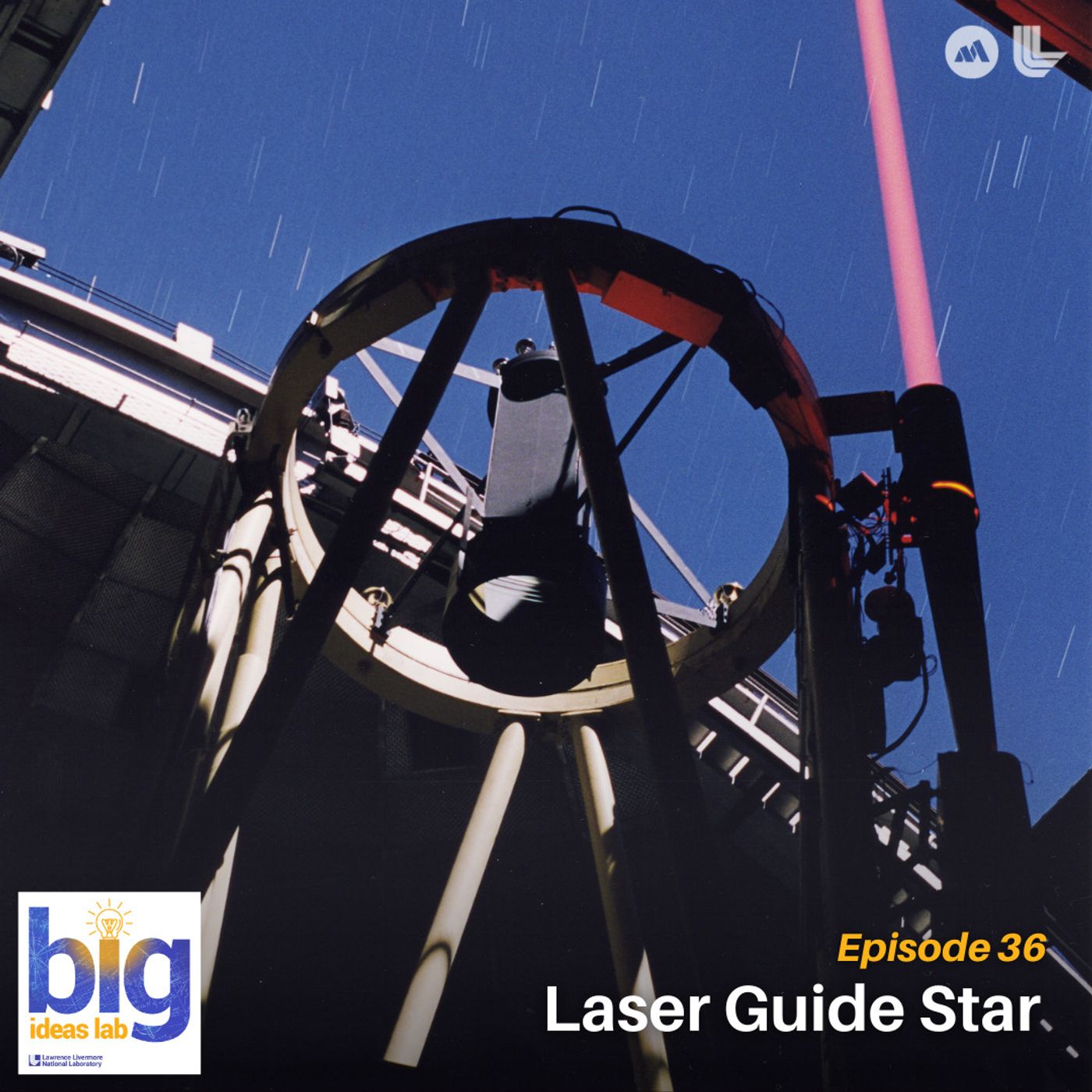
Big Ideas Lab
Laser Guide Star
00:22:20
For decades, Earth’s atmosphere has blurred images of both stars and galaxies, greatly restricting our ability to see the universe clearly from the ground. But that all changed with the invention of the laser guide star.
Loading summary
Transcript48 lines
- [00:01]
Claire Max
There was a lady in a nearby town called Pleasanton, which was maybe 10 miles away from Livermore, and she would call 911. She would say, there's a UFO hovering over the lab, sucking up its lab secrets with a laser, and you have to go shoot down the UFO right away.
- [00:23]
Dee Pennington
But it wasn't a ufo. When you look up at the stars, you're not actually seeing them clearly. Even the most advanced telescopes on Earth struggle to focus finely through our atmosphere. The air above us is shifting, warping starlight and blurring what should be sharp. The solution? Build your own star. The woman who called 911 didn't see aliens above Pleasanton. She saw a technological advancement developed at Lawrence Livermore National Laboratory. A laser to create a guide point in the sky enables telescopes to establish clarity through our chaotic atmosphere and eventually opens doors to exploring some of the most profound mysteries of the cosmos. Born from classified military research and tested under the California night skies, this is the story of the laser guide star. Welcome to the Big Ideas Lab. Your exploration inside Lawrence Livermore National Laboratory. Hear untold stories, meet boundary pushing pioneers, and get unparalleled access inside the gates. From national security challenges to computing revolutions, discover the innovations that are shaping tomorrow today. Since the beginning of time, we've looked up at the night sky and been mesmerized by a familiar shimmer. The gentle twinkle of a star. Poets wrote about it, sailors used it as a compass to guide their ships at sea, and children still sing songs about it. But the twinkling of a star isn't actually coming from the star at all. It's the Earth's atmosphere. More specifically, it's the constantly shifting layers of air above us. When we see the twinkling of a star, there's a scientific phenomenon at play called atmospheric turbulence. Hot and cold pockets of atmosphere have the ability to bend and blur starlight as it travels to the Earth. And just like a spoon in a glass of water, the image moves. It twinkles. And if you're trying to study a distant galaxy or track the orbit of stars around a black hole, a twinkle isn't charming, it's frustrating.
- [03:06]
Claire Max
There's turbulence in the air and the Earth's atmosphere.
- [03:09]
Dee Pennington
That's Claire Max, an emeritus professor of astronomy and astrophysics at UC Santa Cruz, as well as the director of the University of California Observatories, who led the laser guide star development at Lawrence Livermore National Laboratory.
- [03:25]
Claire Max
We've all seen stars twinkling, or roads jiggling in the heat. That's due to air turbulence. And for very big Telescopes. The turbulence not only makes stars twinkle, but it blurs out the image of a star.
- [03:38]
Dee Pennington
That's why the field of adaptive optics has become so important in recent years. Adaptive optics is a cutting edge system that senses and corrects atmospheric distortions. It allows telescopes to produce sharper, more accurate images of stars. And is at the forefront of many revolutionary astronomical discoveries made in our time.
- [04:01]
Claire Max
So what we do in the technology called adaptive optics is we measure that blurring hundreds or thousands of times a second, and we then have a special little deformable mirror that changes its shape in exactly a way to cancel out the blurring that the telescope mirror sees.
- [04:19]
Dee Pennington
To do this successfully, telescopes require what scientists call a guide star. Originally, astronomers would find a natural star in the sky, One closest to the star they wanted to study via telescope and utilize it as a point of correction. In theory, the help of a natural guide star as a correcting agent allows telescopes to capture sharper and clearer images of the night sky. However, there's a problem when it comes to relying on natural guide stars. Natural guidestars only help if they're very closely aligned with the object you want to observe Close enough that their light passes through nearly the same column of atmosphere. That level of precision is rare, and even when it works, it only allows you to correct the turbulence very close to the direction of the guidestar. Since there are not enough bright stars in the sky to be close enough to every astronomical object. That left 99% of the sky blurred and beyond reach Until a team of multidisciplinary scientists proposed a bold idea for a new kind of guide. One that they built themselves, their own star. When Claire Max appeared before the laboratory directed research and development committee to request funding for laser guidestar, she said if successful, this technology could revolutionize the field of astronomy. And she was right.
- [05:56]
Claire Max
It's pretty amazing. I remember walking over to give an oral presentation to the committee that was going to provide the funding, which was very competitive. You've never built anything in your life. You're telling these people that you're going to revolutionize ground based astronomy, or you're telling them that you're going to see as well on the ground as we do in space. Nobody's going to believe you if you say that. But Livermore was amazing. They took a chance. They believed me, and they thought it was important and they stood by our efforts.
- [06:24]
Dee Pennington
It was the answer to the astronomical issue scientists were facing. It started in a defense think tank with a top secret mission and a Lawrence Livermore national laboratory astrophysicist in the early 1980s, Clair Max was invited to join an elite scientific advisory group known as jason. This collection of researchers was tasked with solving some of the US Government's most complex national security problems.
- [06:54]
Claire Max
I actually got into adaptive optics via a consulting group that I belong to called the jasons, which meets for seven weeks every summer and San Diego on topics that are of interest to various government agencies ranging from the National Science foundation, the Department of Energy, Department of Defense. We did studies for the Bureau of the Census, all sorts of things.
- [07:17]
Dee Pennington
But that summer, their assignment wasn't space exploration. It was surveillance. Russian satellites and the technological advancements invented would eventually open the door to a discovery that spanned far beyond Earth's orbit.
- [07:46]
Claire Max
The Russians were launching hundreds of satellites a year. We didn't know what a lot of them were doing. And the idea was if you could get good images of them, you could figure out a little more about what their mission was.
- [07:57]
Dee Pennington
To solve this, researchers proposed using a laser beam to create an artificial guide star just ahead of the satellite's path. When the satellite passed by, they would already have turbulence data for that region of the atmosphere. Claire saw another opportunity.
- [08:15]
Claire Max
I was thinking to myself, well, satellites move very fast and that makes this hard. But gee, stars don't move very fast. It must be easier if you did this for an astronomical target rather than an artificial satellite. So we decided to try and use this to help astronomers. And I wrote a chapter and report that summer, which was classified for the next eight years.
- [08:37]
Dee Pennington
What began as a Department of Defense effort to image fast moving Russian satellites soon revealed a broader potential. The same challenge of correcting atmospheric distortion when your target is dim or in motion. Or also applied to astronomy. But unlike satellites, stars don't streak across the sky. The difference sparked a new idea. This artificial star technique could be repurposed to help astronomers see deeper into space. That insight led to adapting the artificial guide star concept for astronomy. Early experiments attempted to use green lasers for guidestar creation, shooting a laser beam about 15 kilometers into the atmosphere. However, there were some issues. Green lasers could not measure atmospheric aberrations above 15 km into the atmosphere, which.
- [09:31]
Claire Max
Created a problem for astronomy. You really wanted to be high because stars are high, right? And you wanted to be above all the turbulence in the atmosphere.
- [09:39]
Dee Pennington
There was missing data at high altitudes. In 1982, Claire's colleagues, Will Happer and Gordon MacDonald proposed a game changing idea.
- [09:49]
Claire Max
So we thought, well, we have this dye laser that can lase at any wavelength. So what if we tell it to lase at this yellow laser Wavelength that would excite the sodium atoms.
- [09:59]
Dee Pennington
The team repurposed an existing laser facility at Livermore that was originally used for uranium experiments by turning a dye laser pumped by green lasers to emit the precise yellow wavelength needed to excite sodium atoms. Eight years later, in 1991, Claire's work with Jason on the concept was declassified. Yet no one had tried to build a functioning laser guide star of the right wavelength.
- [10:28]
Claire Max
Herb Friedman is a laser engineer at Livermore. And he and I were eating lunch together at a cafeteria outside on a lovely spring day, and we were talking about how nobody had even tried to build one of these laser guide stars, Even after it was declassified. And after we finished our lunch, we looked at each other and said, well, if nobody else is going to do it, we can do it. Larry Moore knows how to do lasers.
- [10:51]
Dee Pennington
Creating a laser guide star wasn't just a breakthrough idea. It was an engineering puzzle of the highest order. The early laser systems being tested at Lawrence Livermore weren't designed for astronomy. In fact, the original laser filled an entire building. So how do you take something that massive and make it small, safe, and reliable enough to mount on a telescope?
- [11:19]
Claire Max
The first thing we wanted to do was to be sure that we could actually measure the turbulence. Well, the next challenge was to make a laser that could actually go to a telescope. Because this laser was taking up most of a building at Livermore, the laser engineers re engineered this laser so that it was pumped by much smaller green lasers, and the dye laser was much more compact, and it could actually fit on the side of a telescope.
- [11:45]
Dee Pennington
To make that possible, the Lawrence Livermore national laboratory would have to overcome some significant engineering hurdles, including adapting the laser system for use in a new environment. The laser guidestar works by shooting a high powered sodium laser into the sodium layer of the atmosphere, which resides around 90 kilometers from the Earth's surface at a wavelength of 589 nanometers, roughly half a millionth of a meter. The yellow laser light triggers the sodium in the atmosphere, which then creates a fluorescence and looks just like a real star. Dee Pennington is a senior scientist with the global security directorate at Lawrence Livermore National Laboratory.
- [12:31]
Herb Friedman
So I think one of the things that most people don't understand about lasers is that what makes them so unique is that if you have a flashlight, it comes out in all directions, right? It gives you a very broad beam. With a laser, it's coherent, so it propagates in a straight line. It doesn't go out to the side. It will expand over Time, but it allows you to get that power over a really long distance that you wouldn't be able to do with any other type of light source. So from that perspective, it gives you a way of actually getting it to the stars.
- [13:10]
Dee Pennington
It stays precise and focused, allowing the laser beam to travel long distances and deliver light exactly where it's needed. The fluorescence generated by the sodium atoms interacting with the laser in the upper atmosphere mimics light given off by a star. That kind of scientific transformation, Shrinking a room size system into something that could attach onto the side of a telescope, was anything but straightforward. It had to run consistently, cool efficiently, and fire safely without damaging equipment or eyes. The road from idea to implementation was filled with trial and error. But with every iteration, the team got closer to a functional laser system. The team began field deployment by starting with the Lick observatory in California. It was here that the laser guide star would first be tested under real world astronomical conditions, Paired with adaptive optics to sharpen the view of the cosmos.
- [14:13]
Claire Max
Once we showed that you could do good astronomy with a laser at Lick observatory, which is near San Jose, near us, we just applied for funding and got some funding to bring it to Keck.
- [14:24]
Dee Pennington
This is where the problem solving began in earnest, and it's where scientists had to get creative. It wasn't just about building something smaller. It was about making something precise, something that could hold up to the demands of adaptive optic systems, Working all night, every night, even in below freezing weather, and work in harmony with other complex technologies. That's where Dee's extensive background and experience, both in optics and in building boutique lasers for scientific experiments, became invaluable.
- [15:00]
Herb Friedman
I had that background and expertise for the adaptive optics component of it, for correcting laser system distortions. And I also had spent 18 years building boutique lasers for different types of experiments.
- [15:16]
Dee Pennington
Even once the laser was made smaller, that didn't mean it was problem free. In fact, the very heart of the system, the laser medium itself, posed one of the most persistent challenges. The specialized dye for the laser wasn't a commercial product. And over time, it started showing a serious vulnerability.
- [15:36]
Herb Friedman
And with the dye laser system, one of the reasons that system initially had issues was that it was using a dye that was developed for Avlis by a chemist at the lab, Not a commercial product. And as it gets exposed to light, it starts to degrade. And when it degrades, it burns on optical components. And you don't always know exactly what's happening, but once it does that, it burns and it stops working. We changed it all out. We put in Lots of diagnostics. We realigned the system. We.
- [16:12]
Dee Pennington
The Keck Observatory was home to some of the most powerful telescopes in the world. But it was located in Mauna Kea, Hawaii.
- [16:20]
Herb Friedman
From the snow capped peak of Hawaii's Mauna Kea volcano, the Keck telescope has one of the clearest views of space anywhere on Earth. But that view is getting dramatically better with the help of researchers at the Lawrence Livermore Lab.
- [16:33]
Claire Max
And for that, we had to take it apart, send it over by FedEx. It arrived in a barge at Kauaihai harbor, which is the closest dock to the summit of Mauna Kea. And then they put it all on trucks and put it together again in a laser lab at the summit of Mauna Kea.
- [16:49]
Herb Friedman
It was really incredible installing something like this on the telescope that costs $100,000 a night to operate. They actually took the telescope down for six weeks. For us to install that. We really had to push, but it was incredible. When we were first doing the alignment and we could see the laser going up, I was actually in a fall harness hanging on the side of the telescope imaging a star, coming down to get the focus aligned with the rest of the system. It was a really exhilarating experience. So it's been really incredible to see the images that people have seen.
- [17:27]
Dee Pennington
But even with years of innovation and problem solving, the original laser guidestar design still had limitations. The system was complex, maintenance heavy, and ultimately not reliable enough for long term astronomical use. So Claire asked the team for a next generation laser.
- [17:48]
Herb Friedman
Can you make me something smaller, something reliable, something compact? And we had a fiber laser program at that point. It's used in the front end of NIF now. Fiber lasers can be highly reliable. They weren't so reliable at that point in time, and they didn't lase at the frequency we needed for the sodium guidestar.
- [18:07]
Dee Pennington
Hence began the quest for a fiber laser guidestar. In the end, the Lawrence Livermore design wasn't the final solution, but it was a critical first step that laid the groundwork for global collaboration. US Scientists began working close closely with the European Southern Observatory, an international partner that helped refine and improve the technology. In 2015, Keck subbed out the dye laser for a commercial fiber guide star laser system that was more compact, more stable, more efficient, and automated.
- [18:42]
Claire Max
That was commercialized and is now used on almost every major telescope in the world.
- [18:48]
Dee Pennington
Over the course of decades, astronomers at the Keck Observatory used adaptive optics powered by laser guidestar systems to follow the positions of the stars in the center of our Milky way galaxy in exquisite detail. Eventually, their orbits revealed something extraordinary. A massive compact object, too small to be a cluster of stars, yet too massive to be anything else.
- [19:15]
Herb Friedman
A local astronomer is now a winner of the prestigious Nobel Prize. Andrea Gaze has been using the Keck Observatory for more than 20 years. Years her research proving the existence of a supermassive black hole at the center of our Milky Way galaxy is what won her the 2020 Nobel Prize in Physics.
- [19:34]
Dee Pennington
The black hole discovery that won the Nobel Prize in 2020 wouldn't have been possible without the laser guide star, which turned shimmering pinpoints into precise data.
- [19:45]
Claire Max
There was a big black hole, maybe a million times more massive than the Sun. We didn't really know exactly how massive it was, but with this laser guide star technology, we could get very, very clear images of the stars in orbit around that black hole.
- [20:01]
Dee Pennington
By precisely tracking the motion of 20 to 30 of these stars, UCLA's Galactic Center Group, led by Andrea Ghez, was able to calculate the mass of the hidden object based on the stellar orbits. From Cold War satellite tracking to sodium lasers aimed at the sky, Lawrence Livermore helped transform an audacious theoretical concept into one of the cornerstones of modern astronomy. But it didn't stop there. The technology created for the laser guide star has seen potential in other sectors, including its origin point. At the United States Department of Defense.
- [20:38]
Herb Friedman
I was asked to take a three year assignment at the Air Force Research Laboratory Directed Energy Directorate as their senior scientist for laser systems. And so when I was there, they had a large telescope that also had a guide star system on it that's being used by the Department of Defense. The Navy has a fiber laser system that they can do defensive capabilities without having to use a major missile.
- [21:05]
Dee Pennington
The stars have always guided us through stories, through navigation, through curiosity that spans generations. Ironically, the twinkle we admire is also what gets in the way. The invention of the laser guide star did something incredible.
- [21:22]
Herb Friedman
We're taking the twinkle out of the stars.
- [21:24]
Dee Pennington
It turned a stargazer's wish into an engineer's blueprint. That yellow beam a woman once mistook for a ufo. It wasn't an alien invasion. It was humanity inventing a way to to see the universe more clearly. Thank you for tuning in to Big Ideas Lab. If you loved what you heard, please let us know by leaving a rating and review. And if you haven't already, don't forget to hit the follow or subscribe button in your podcast app to keep up with our latest episode. Thanks for listening.