← Big Ideas Lab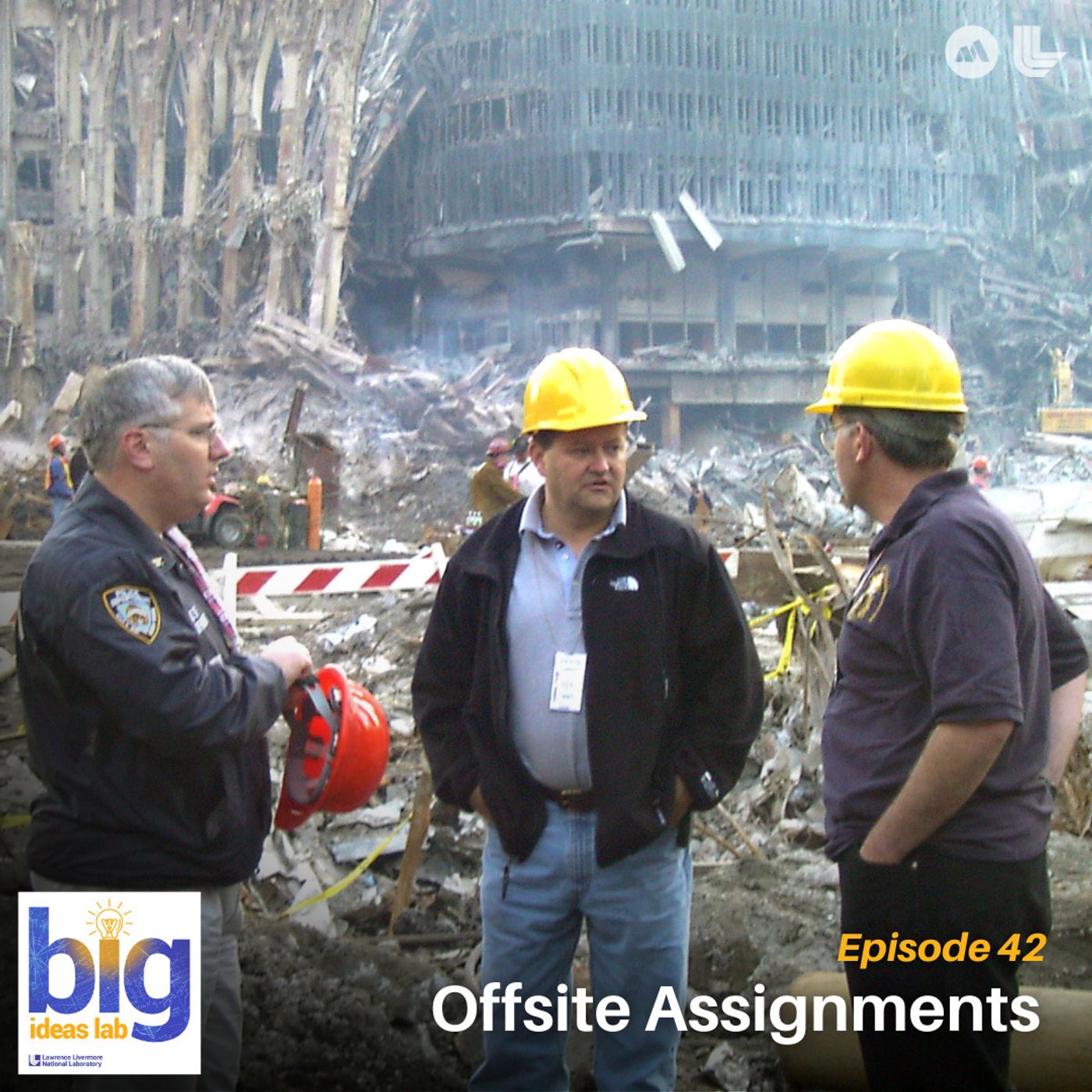
Big Ideas Lab
Offsite Assignments
00:18:19
Every decision in national security hinges on knowledge, insight, and expertise - some of that expertise starts in a lab in Livermore.
Loading summary
Transcript50 lines
- [00:10]
A
Stephen Creek had just arrived in Washington D.C. for his first D.C. assignment, suitcase in hand, badge, freshly enrolled to access Forrestal Building, ready to begin his first day with the nnsa, the National Nuclear Security Administration. Stephen is a nuclear and radiochemistry scientist from Lawrence Livermore National Laboratory. And he was prepared to tackle nuclear proliferation threats working for Defense Nuclear non proliferation in NNSA alongside the Department of Defense. But this wasn't your average first day heading to a new work site. It wasn't an average day for anyone.
- [00:57]
B
Another plane has just hit, it hit another building, flew right into the middle of it.
- [01:02]
A
Explosion. It was September 11, 2001. By the end of that morning everything had changed. There are quote, good indications that people.
- [01:14]
B
With links to the Osama bin Laden.
- [01:17]
A
Organization are responsible for today's attacks. Citizens grieved, the nation reeled. And the government sprang into action less.
- [01:26]
B
Than 40 miles from downtown Manhattan after major concerns over safety in the possibility of the facility being affected.
- [01:33]
A
Thousands of utilities, chemical plants, nuclear plants, all being told they could be Al Qaeda target. Many of the security measures now in.
- [01:39]
C
Place came about after the 911 attacks.
- [01:43]
B
I've asked the highest levels of our.
- [01:44]
A
Government to come to discuss. A few days after 9 11, Stephen was swept into the urgent effort to support the White House and worked with U.S. customs, the new York Port Authority and commercial mail carriers to help them understand and mitigate potential nuclear and radiological threats to our airports, bridges, ports and other critical infrastructure.
- [02:06]
B
And we are in an elevated global threat environment.
- [02:08]
A
The threat has evolved and there are new challenges. Dhs, dni, tsa, agencies created in a.
- [02:14]
C
Reinvention of America's security.
- [02:16]
A
He also supported first responders that might deal with nuclear materials or respond in the aftermath of an attack. First responders have to be prepared for just, just about anything these days, including nuclear emergencies. Being tasked with more and more things.
- [02:29]
C
Homeland security being one of them. Radiation's a definite concern.
- [02:32]
A
Those efforts helped lay the foundation for what would eventually become the radiological and nuclear countermeasures program in the Department of Homeland Security's Science and Technology Directorate. His nuclear threat reduction efforts were one of the few named programs to be transferred from NNSA to the newly established DHS in the Homeland Security Act. But why was Stephen in D.C. in the first place? When his office was across the country in California, he was there to fulfill his first off site assignment through the Lawrence Livermore National Laboratory. Walk through any federal building and you might spot them, a Livermore face among the crowd. Not visitors, not consultants, fellows. Some are sent to Washington Others remain local in Silicon Valley, and a select few even concentrate their efforts toward the final frontier space. But whether DC or deep space, Lawrence Livermore brings its expertise where it's needed most through the Off Site Fellows Program. Welcome to the Big Ideas Lab. Exploration inside Lawrence Livermore National Laboratory. Hear untold stories, meet boundary pushing pioneers and get unparalleled access inside the gates. From national security challenges to computing revolutions, discover the innovations that are shaping tomorrow. Today, Looking for a career that challenges and inspires, Lawrence Livermore National Laboratory is hiring for a safety basis, analyst, research scientist, cell biology and an electrical designer, along with many other roles in science, technology, engineering and beyond. At the Lab, every role contributes to groundbreaking projects in national security, advanced computing and scientific research, all within a collaborative, mission driven environment. Discover Open positions@llnl.gov careers where big ideas come to life. When you think of a scientist's career, your mind might flash to a white lab coat. The careful pouring and measuring of chemicals and the thrill of a groundbreaking experiment. At Lawrence Livermore National Laboratory, those things are certainly present. But the work of a scientist also extends far beyond the conventional laboratory into more surprising non traditional collaborative spaces. The Off Site Fellows program allows Lawrence Livermore employees to accept temporary assignments in governmental host offices and agencies to lend their guidance, expertise and and knowledge on complex national security issues. Working side by side with the United States Federal government isn't optional, it's essential.
- [05:50]
B
So the Offsite Fellows program is this gem of a program at the Lab. We help connect the Lab with agencies, mostly in Washington D.C. through these short term fellowships.
- [06:00]
A
That's Katie Shaper, the Offsite Fellows Program Manager. Like a compass, she helps guide lab experts toward the government agencies that would benefit from their knowledge most.
- [06:11]
B
One of the things that was really, I think, attractive for me about this position in particular is that I kind of get to help the Lab connect with agencies in Washington D.C. and help them kind of speak the same language.
- [06:21]
A
From supporting nuclear strategy at the Pentagon to advising Congress, to helping create and working alongside of the Department of Homeland Security, these Fellows act as the Lab's frontline employees. They both represent Livermore and help build the bridge between science and policy, ensuring one informs the other and that the two remain closely linked. But these ideals didn't start with the program. They began with the creation of the lab itself in September of 1952 at an abandoned naval air station near Livermore. Since its inception, Lawrence Livermore has held a strong commitment to ensuring science reaches beyond its doors. They've been sending lab employees into government agencies to lend support Support for years. However, in 2018, the lab officially formalized decades of governmental collaboration by creating the offsite Fellows program. What had long been an informal tradition of sending scientists into host agencies transformed into a structured initiative. Since then, the program and its impact have only grown both in size and in breadth.
- [07:31]
B
We place employees in agencies typically Department of Energy, National Nuclear Security Administration. Our employees are placed in those agencies for typically two or three years.
- [07:42]
A
Each department is unique and each has a role in our national security. That support Fellows give can play out in many different ways.
- [07:51]
B
I think that's what makes this program really critical is that the lab is kind of directly lending its expertise in the rooms where major decisions are being made. We're helping the government respond better to threats and maintain its security.
- [08:04]
A
And for the fellows, off site assignments build skills that last long after a placement ends.
- [08:10]
B
It's a really unique opportunity, I think, for the employees. They get to see how these agencies operate, how decisions are being made, and it gives them kind of the broader context that the lab is operating in, so they see kind of the bigger picture of the national security complex and how olivermore fits into it.
- [08:23]
A
While being an off site Fellow provides career development and exposure for scientists, it also requires more than simply expertise in their scientific field.
- [08:33]
B
I would say there's two things that I think are really important regardless of what assignment we're looking for. The first is having a really strong understanding of the lab, like a really solid network that they can draw back on and to just have spent enough time to know not only their area of expertise, but what other areas of expertise are at the lab and how to tap into those if something were to come up while they were on assignment. The second area I would say is communication skills. It's so important for folks on assignment to be able to really connect with their host offices. And typically that means that taking a really technical and scientific concept and translating it into something that someone that does not have a scientific background at all can really understand and utilize.
- [09:09]
A
Some of those complexities take Fellows into the depths of arms control and global security. Others take Fellows to explore the future of national defense on a cosmic level. Looking for a career that challenges and inspires, Lawrence Livermore National Laboratory is hiring for a safety basis, analyst, research scientist, cell biology, and an electrical designer, along with many other roles in science, technology, engineering and beyond. At the Lab, every role contributes to groundbreaking projects in national security, advanced computing and scientific research, all within a collaborative, mission driven environment. Discover open positions@llnl.gov careers where big ideas come to life from 2021 to 2024 Livermore offsite fellow Barry Kuykendall served as technical Director for the Defense Innovation Unit's Space Portfolio, where he led efforts to bring emerging commercial space technologies into national defense. The Defense Innovation Unit, or diu, acts as the Pentagon's innovation hub for adopting and developing commercial technology for national security purposes. Stationed in Silicon Valley, industry and military leaders arm their posts and help identify, adopt and apply commercial solutions to Department of Defense problems. And while there are a myriad of unique obstacles to overcome in space exploration, the greatest isn't imagination or technology. It's funding.
- [10:57]
C
With space, it was totally undoable. You couldn't do it, you couldn't afford it. It was not possible.
- [11:02]
A
Breakthroughs wait on the launch pad. But without investment, even the most promising innovations remain grounded. However, coupling commercial innovation with space exploration begins to unlock possibilities. Space suddenly becomes more affordable, not because challenges are smaller, but because costs are shared.
- [11:22]
C
When you mix in space with commercial, now you can start affording it, because when you're dealing with a company, venture capital funded, the government doesn't have to foot all the money.
- [11:33]
A
Barry's mission was to connect the then Department of Defense, now called the Department of War, with non traditional companies developing technologies that could secure America's presence in the cosmos. If the government can map the route and private firms can carry supplies, together they can explore uncharted frontiers. This kind of collaboration forms a joint expedition that pushes the bounds of technological innovation. It advances space exploration and as a result, strengthens national security at a rocket powered pace. An example of this is the hypersonics program that Barry started during his time at diu.
- [12:10]
C
They said, hey Barry, can you look into the role of commercial companies for hypersonics?
- [12:17]
A
Hypersonic vehicles fly faster than the speed of sound and are incredibly useful when it comes to leveraging missile infrastructures for national defense purposes. So developing a hypersonics program had been a national security priority at the Pentagon for a long time. But private companies were already pouring money into hypersonic transportation for passengers and cargo.
- [12:39]
C
We have a lot of great things for our conventional and nuclear deterrent, obviously here in the US and so our role for hypersonics is different. And a lot of ways the commercial side was that we're falling behind, that we need to get more success.
- [12:52]
A
The pace of research in the hypersonics field had increased, but the facilities for testing new technology weren't able to keep up due to budget constraints. Building new testing ranges wasn't an option. Barry and his team proposed a create the Hycat hypersonic and high cadence airborne testing capabilities. The goal of the program was to find commercial partners who can deliver a prototype aircraft that can fly faster than Mach 5, carry experimental payloads, and generate the performance data America's hypersonics program requires. This was made possible when Barry began blending commercial companies with governmental initiatives. He also aligned another hypersonics program to further our national security development in space.
- [13:40]
C
There's a program called Mock TB that is basically a government test bed that's been set up to use commercial equities to drop the cost of testing and increase the cadence of testing. And I got this program at DIU aligned with that effort, and we've got launches coming up immediately for that.
- [13:56]
A
For Barry, participating in the Off Site Fellows program meant leveraging commercial innovation to innovation increase hypersonic testing. But that's not the case for every lab employee. For Heather Whitley, being a fellow meant accepting a remote role in the throes of the COVID 19 global pandemic with the NNSA's Office of Experimental Sciences. This office manages funding for a diverse portfolio of NNSA resources for experimental studies ranging from the National Ignition Facility to expanded capabilities for hydrodynamic and subcritical testing. The offsite Fellows program opens doors to remarkable opportunities for every employee that participates. But federal collaboration is a maze full of twists, turns, and hidden challenges that require careful navigation. Fellows must adapt learning to translate complex science into accurate, relevant advice.
- [14:50]
B
I think there's a challenge in adapting the style of communication from at the lab, where I think people are really interested in all of the details, to an environment in D.C. where the policymaker might need to know just the most important thing.
- [15:03]
A
And for specialized assignments, they often require training.
- [15:06]
B
With the Pentagon, we find that folks just don't have as much exposure to that world while they're at the lab. It's just a little harder to access. It's not necessarily something that people would come across in their day to day work. Here.
- [15:17]
A
The training program aims to prepare fellows for a new, typically uncharted environment that differs significantly from day to day laboratory operations. The Off Site Fellows program also reaches a multitude of different agencies and each with its own individual cultures and priorities.
- [15:36]
B
One of the biggest challenges of this program is that there's so many different bureaucracies to align at a given time. We probably work with maybe 10 different organizations.
- [15:44]
A
Before 2018, the lab sent its scientists to just a few key organizations like the Nuclear Weapons Council and NNSA Science Council. But once the program was formalized in 2018, its reach began to expand. Before the program was officially established, the Lab supported around 15 assignments per year. In the past seven years, that number has tripled to around 45 assignments annually. Today. While NNSA and the Department of War remain core partners of the Offsite Fellows program, the Fellows have also served in the Executive Office of the President, the House of Representatives, the Department of Homeland Security, the State Department, the Office of the Director of National Intelligence, and even the Governor's Office of California.
- [16:31]
B
We're constantly considering new opportunities. We've participated in the Embassy Science Fellowship, which is a State Department program that places scientists with embassies to help work on specific projects. We frequently get requests from a number of agencies and we kind of evaluate them to determine which ones are really best aligned with the Lab's priorities and interests.
- [16:49]
A
This ensures that the nature of each assignment is different and each Fellow's journey is unique. But the mission never changes to deliver Livermore expertise where it matters most, strengthening national security at every level. When Barry Kuykendall returned to Livermore in May 2025, he didn't just carry the experience from launching national security initiatives into orbit. He brought vision, new relationships, and a deeper understanding of federal priorities. From his time spent with the Pentagon.
- [17:20]
C
I've come to see that it's critical thinking that the government really needs. There's a million different ideas. They need to know what should I do? There's a million things I could do, what should I do? And that ability. What we do here, we critically think.
- [17:32]
A
By placing expert scientists at the heart of government, it ensures imperative national security decisions are guided by real knowledge, not guesswork.
- [17:42]
B
Just recently I was in the Pentagon visiting with one of our folks on assignment and his manager stopped by and was just like, thank you so much for lending him. You have no idea how impactful his time in our office has been. We could not have done any of the things we wanted to do this year without having him here.
- [17:56]
A
When Stephen Kreek returned from that first off site fellow's assignment in 2005, he wasn't the same scientist who had walked out the door. Navigating the aftermath of 911 and creating a new government agency gave him hands on experience that developed leadership strategy and adaptability. He then held a number of leadership roles in nuclear threat reduction and then took a second DC assignment to NNSA in 2019 working for a political appointee. Upon returning from that second assignment, he helped lead the lab's Return to New Normal team, launching the lab's hybrid work posture. And today as HR Deputy Associate Director, he applies that leadership and technical management experience every day to helping oversee a major technology transformation of the Laboratory's personnel management business systems. The Offsite Fellows Program at Lawrence Livermore National Laboratory is more than a temporary assignment. It's a way to share ideas, perspectives and purpose, clarity for the agencies, perspective for the scientists, and real technical knowledge at the heart of America's critical national security decisions. Thank you for tuning in to Big Ideas Lab. If you loved what you heard, please let us know by leaving a rating and review. And if you haven't already, don't forget to hit the Follow or Subscribe button in your podcast app to keep up with our latest episode. Thanks for listening. Looking for a career that challenges and inspires, Lawrence Livermore National Laboratory is hiring for a safety basis analyst, research scientist, cell biology and an electrical designer, along with many other roles in science, technology, engineering and beyond. At the Lab, every role contributes to groundbreaking projects in national security, advanced computing and scientific research, all within a collaborative, mission driven environment. Discover Open positions@llnl.gov careers where big ideas come to life.