← Big Ideas Lab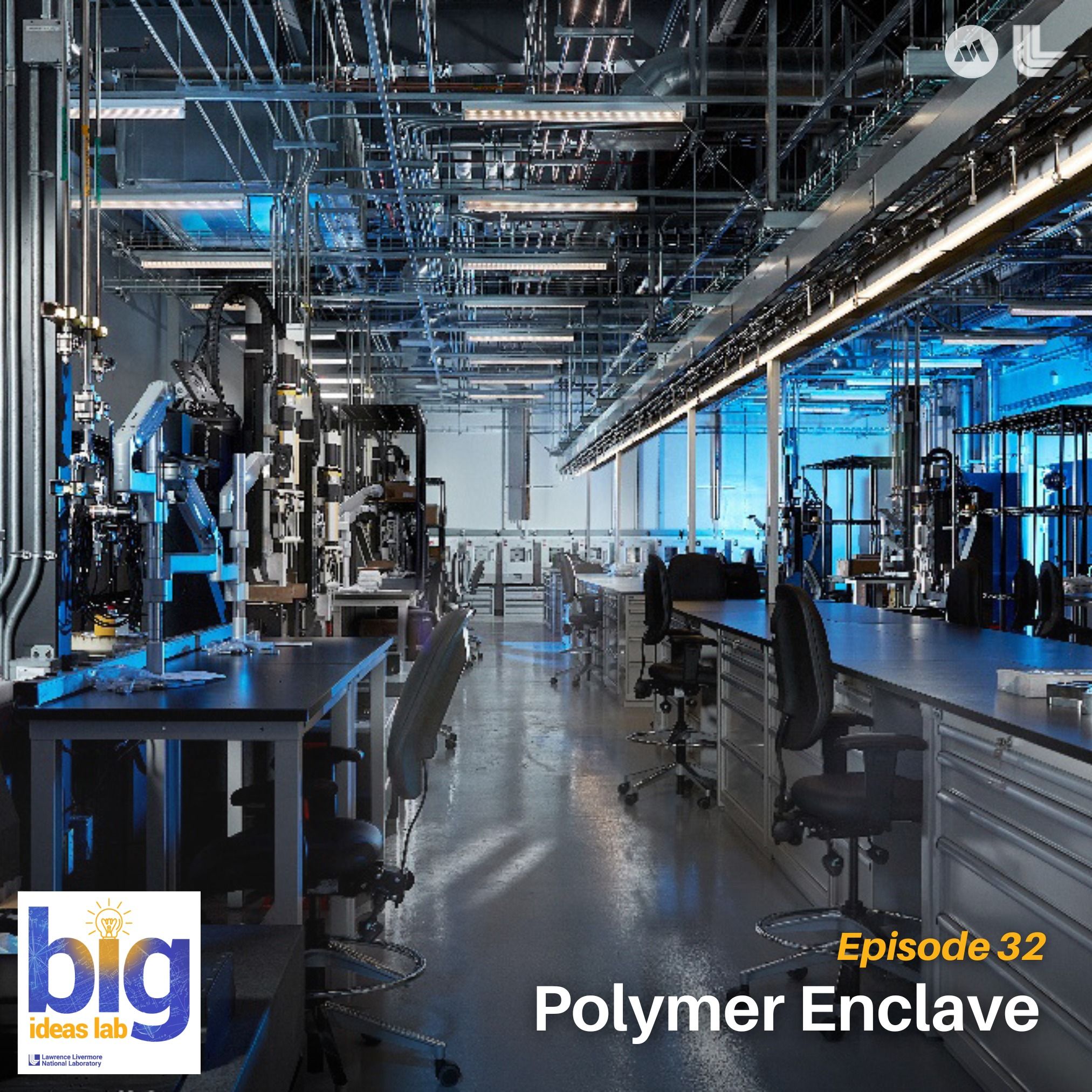
Big Ideas Lab
Polymer Enclave
00:18:01
Learn how engineers and scientists are reimagining the way critical components for the U.S. nuclear stockpile are designed, tested, and produced.
Loading summary
Transcript35 lines
- [00:02]
Narrator
Imagine you're an engineer designing one of the most secretive and precise machines in the world. Not a car, not a rocket, a nuclear warhead. It's small, deadly, designed to ride atop a missile. The kind of thing meant to end wars before they begin. You've got the blueprints, you've run the models. Every bolt, curve and layer of material is dialed in with mind melting precision. But then reality hits. The materials don't behave the way they're supposed to. The manufacturing techniques, the welding, the machining, the shaping of certain materials can't keep up with the design. The tooling isn't built yet. And every tiny change takes months. Years pass and costs overrun before production is ready. All because a warhead's complexity proved harder to realize than to model. But today, in a windowless lab at Lawrence Livermore, engineers are trying something different. They're aiming to cut that years long slog down to months using a high speed, high precision approach known as the polymer enclave. They're changing how we build with tools that let scientists and machinists prototype in real time together. The goal, close the loop between design deployment. Because progress happens not in silos, but when experts build together each step of the way. Welcome to the Big Ideas lab. Your exploration inside Lawrence Livermore National Laboratory. Hear untold stories, meet boundary pushing pioneers and get unparalleled access inside the gates. From national security challenges to computing revolutions, discover the innovations that are shaping tomorrow today.
- [02:36]
Robert Maxwell
I've been here for almost 30 years and it has not been boring. One day.
- [02:40]
Narrator
The polymer enclave at Lawrence Livermore National Laboratory is a dedicated facility for developing and producing critical polymeric components for the US nuclear stockpile. It's a collaboration between the lab where engineers and scientists design, test and perfect cutting edge technologies and the Kansas City National Security Campus, the production side of that partnership which turns those complex designs into field ready components. These components can include seals, shock absorbers and thermal barriers. Parts designed to withstand extreme conditions while protecting sensitive electronics. Robert Maxwell is the program director of manufacturing and Materials transformation at Lawrence Livermore.
- [03:31]
Robert Maxwell
The Palmer Enclave is a about 15,000 square foot facility here at Lawrence Livermore National Laboratory dedicated to maturing next generation additive manufacturing polymeric components for the nuclear deterrent. This is a collaboration with our partners at the Kansas City National Security campus who owns the production mission for such parts.
- [03:51]
Narrator
So what exactly is a polymer?
- [03:54]
Robert Maxwell
We see polymers everywhere. Your headphones are made mostly out of polymers plastics. Polymers are organic components, long chained organic materials that have tailorable properties so they can be soft, they can be hard.
- [04:07]
Narrator
Polymers are all around us. They make up the plastic in your headphones, the insulation in your car, and even the fibers in your clothing. These are long chains of organic molecules that can be engineered to have a wide range of properties. They can be soft and flexible, like the silicone grips on a power tool, or tough and heat resistant like a protective phone case.
- [04:33]
Robert Maxwell
As they go through their daily lives, they are experiencing all sorts of different stresses. Temperature rises, temperature falls. As they do that, the other materials will grow or shrink. That can create a lot of stresses on those components if there isn't a cushion in between them. And so we use these polymeric components as essentially springs in between different components to keep them in place, but then to keep them from rubbing against each other. It's very similar to parts in your car, the O rings, for example.
- [05:06]
Narrator
But when the stakes are higher, when you're designing components for nuclear weapons or stealth bombers, that kind of seemingly small material decision can ripple outward, turning into a multi billion dollar problem. In the late 1980s, the US Air Force unveiled one of the most ambitious aircraft ever built, the B2 Spirit, a sleek jet black flying wing engineered to slip past radar undetected. The plan was to build 132 of them. But the problem wasn't the shape, it was the skin. The B2 Stealth depended on a special radar absorbent coating, A high tech material meant to soak up radar waves rather than reflect them. But in practice, that coating was fragile, temperamental, and incredibly expensive to maintain. A single raindrop could damage it. Reapplying it meant disassembling sections of the aircraft and re coating them by hand in climate controlled hangars, using custom techniques. Maintaining the coating became a painstaking manual process, Slow, delicate, and costly. By the time the full scope of the problem became clear, it was too late to redesign the aircraft and too expensive to proceed at scale. Instead of 132 planes, the Air Force ended up with just 21. The polymer enclave was designed to avoid this type of mishap. By tightly coupling design and manufacturing and giving scientists and machinists the tools to iterate in real time, the Enclave helps uncover material challenges before they snowball and before a small choice becomes a billion dollar mistake. Lawrence Livermore National Laboratory established the polymer enclave in 2021 to radically accelerate the design and testing and production of polymeric components for the US Nuclear stockpile. The cornerstone of national security, A reliable, effective and modernized nuclear deterrent reduces the likelihood of conflict, stabilizes alliances, and strengthens diplomatic leverage. The enclave was created to bring designers and manufacturers together, eliminate Costly delays and compress the path from concept to deployment.
- [07:48]
Robert Maxwell
Early on in any kind of design cycle, you have a feedback with your designers. Well, we'd sort of like this, we want this shape or we want these properties. And then as they refine the rest of their design, they may change those. And so the faster that you can respond to their changing requirements, the faster the overall design can evolve from something written on a back of an envelope to the actual final design.
- [08:12]
Narrator
Before the enclave existed, manufacturing polymer components for the US Nuclear stockpile was slow, fragmented, and expensive. These parts are custom engineered to survive extreme conditions like intense heat, high pressure, and rapid mechanical shock. They have to withstand the punishing environments of nuclear systems where a single failure can compromise an entire mission. And in the past, moving a design from the drawing board to a fully realized part could take up to eight, eight years, far too long for national security needs. The Enclave was built to break this cycle. It brought designers and manufacturers together in real time, cutting out the long back and forth, eliminating bottlenecks, and reducing timelines from years to months.
- [09:08]
Robert Maxwell
These parts were custom made to meet specific engineering and physics requirements. There is no commercial, easily manufacturable other option to do this. So it was homegrown innovation here at Lawrence Livermore and then developed and matured in partnership with our production partners at Kansas City National Security Campus.
- [09:29]
Narrator
The Kansas City National Security Campus is one of the largest manufacturing and engineering facilities in the National Nuclear Security Administration network. Here, the complex designs developed at Lawrence Livermore are scaled up into reliable field ready components for the U.S. nuclear stockpile.
- [09:48]
Jessica Bailey
I think back 20, 30 years ago, design designed and then there was this wall and once the design was done, it was thrown over the wall and then the production agency got it and needed to figure it out.
- [10:03]
Narrator
Jessica Bailey is the director of advanced manufacturing engineering at the Kansas City National Security Campus.
- [10:09]
Jessica Bailey
The polymer enclave is actually a joint idea and a joint opportunity for us to work together.
- [10:17]
Narrator
This partnership is about breaking down barriers between design and production, creating a more connected, agile approach to manufacturing.
- [10:27]
Jessica Bailey
The design agency, Lawrence Livermore, is responsible for the design of the components that we're making. Kansas City is the production agency. And so we produce those designs once they they are finalized. The Enclave itself pulled us together and joined us together so that we were able to see each side of the business for the complex and how we could get there faster.
- [10:52]
Narrator
When both sides understand the challenges and strengths of the other, it leads to faster problem solving, fewer surprises, and more innovative solutions.
- [11:03]
Jessica Bailey
When you're working together, partnering together, understanding the challenges together from Both sides, you can get there quicker because everybody had to give along the way. Having been in the complex for 21 years, being able to reinvent some of those relationships and being able to break down some of those barriers is very exciting. Of course, I'm an engineer and I get a little bit nerdy. So anytime we're doing new technology types of things, that's exciting for me, especially within our environment, with what we support from a national security perspective, that is also obviously so exciting for me as well.
- [11:53]
Narrator
One of the first big challenges at the polymer enclave was moving from 2D to 3D printing. In the beginning, researchers were only printing flat parts, simple two dimensional shapes. But their mission called for complex three dimensional components that could handle extreme conditions.
- [12:13]
Robert Maxwell
When we were first given our first challenge problem, we had 18 months to produce it. We were only printing 2D flats. We had to create the ability to manufacture parts in three dimensions. We had to create the ability to mix multiple different feedstocks into the final part. All that had to be created to hit our first target in 18 months.
- [12:32]
Narrator
In the past, a request like this might have taken several years.
- [12:36]
Robert Maxwell
One of the designers called us into his office. He said, I have this challenge problem. I want to do this, but I have no idea how to make it. We said, I need the part in 18 months. We're like, oh, oh geez. Normally this would have taken like three to five years, particularly given the infrastructure investments that were needed. But we actually succeeded. We had a great team that did that first demonstration, and we successfully delivered a part and executed the test. And it's been sprinting ever since.
- [13:05]
Narrator
But how? Within the polymer enclave, engineers and manufacturers work side by side, using mirrored setups at both Lawrence Livermore and Kansas City, ensuring that every tool, process and piece of equipment is identical, even though they're separated by 2,000 miles.
- [13:27]
Robert Maxwell
We have four different sites. We have four different pieces of equipment. We don't know yet which set of equipment is going to be the right piece of equipment to make the part. So we split the work between those four different locations and those four different sets of equipment. And then by then combining the results, we can make a better choice on how to actually produce the parts.
- [13:47]
Narrator
This approach reduces delays, eliminates miscommunication, and creates a shared understanding of the challenges each site faces. A model built on trust and transparency. It's about creating a seamless workflow where insights from one site can immediately inform decisions at the other. The polymer enclave has fundamentally changed how the US Nuclear stockpile is modernized by reducing development timelines from years to months, scientists have set a new standard for responsiveness. When designs need to adapt to new threats or emerging technologies, they can do so without years of costly delays.
- [14:32]
Jessica Bailey
You really have to think differently, because it's a completely different technology and a different approach, both from a manufacturing and a design perspective.
- [14:42]
Narrator
At its core, the polymer enclave is about people, about breaking down old silos and building a culture where collaboration is essential.
- [14:52]
Robert Maxwell
That culture of breaking down the old roles and responsibilities and working collaboratively closely had to be created. And that's actually the single most important thing about the enclave model. It isn't the technology that's really cool. It isn't the parts that we make. It is the culture of collaboration from as early as possible to actually work together to produce what the country needs to underpin the deterrent.
- [15:18]
Jessica Bailey
It is putting the past behind us. It is putting old ways of doing work in the past, opening our eyes up to each other and learning from each other and having the best interest and the whole complex in mind. All that speaks back to partnership, teaming, collaboration, all those words, and I know it sounds cliche, but that is what it is.
- [15:44]
Narrator
As they look to the future, the spirit of the enclave remains a driving force, pushing engineers and scientists to find new ways to work together and solve problems faster.
- [15:56]
Jessica Bailey
Being able to support our national security quicker, faster, more reliably with the highest quality is so incredibly important and inspiring for folks that that's something very easily we can get behind as we go forward. Enclave isn't done, in my opinion, like the building, the facility. It's there. But the spirit of the enclave, our ability to do what we have done, is alive and well and working every single day today, which is helping us for the future.
- [16:26]
Robert Maxwell
One of the keys to our success has been bringing those human expertise all to the same table. We have human designers working side by side with chemists and material scientists, with precision engineers on the R and D scale, but then also precision engineering at the production manufacturing scale. You can't be successful if that community of skill sets isn't working. Highly collaborative, we talk a lot about Kansas City and Livermore working collaboratively together, but the communities, even within one side or the other, have to be working together.
- [16:59]
Narrator
The polymer enclave is more than a facility. It's a bridge between ideas and impact, a platform for innovation and a catalyst for breakthrough. As new challenges emerge, this model of tight collaboration, rapid iteration, and fearless problem solving will continue to evolve, ensuring the nation's most critical components are ready for whatever comes next. Thank you for tuning in to big ideas. Lab. If you loved what you heard, please let us know by leaving a rating and review. And if you haven't already subscribed, don't forget to hit the Follow or Subscribe button in your podcast app to keep up with our latest episode. Thanks for listening.