← Big Ideas Lab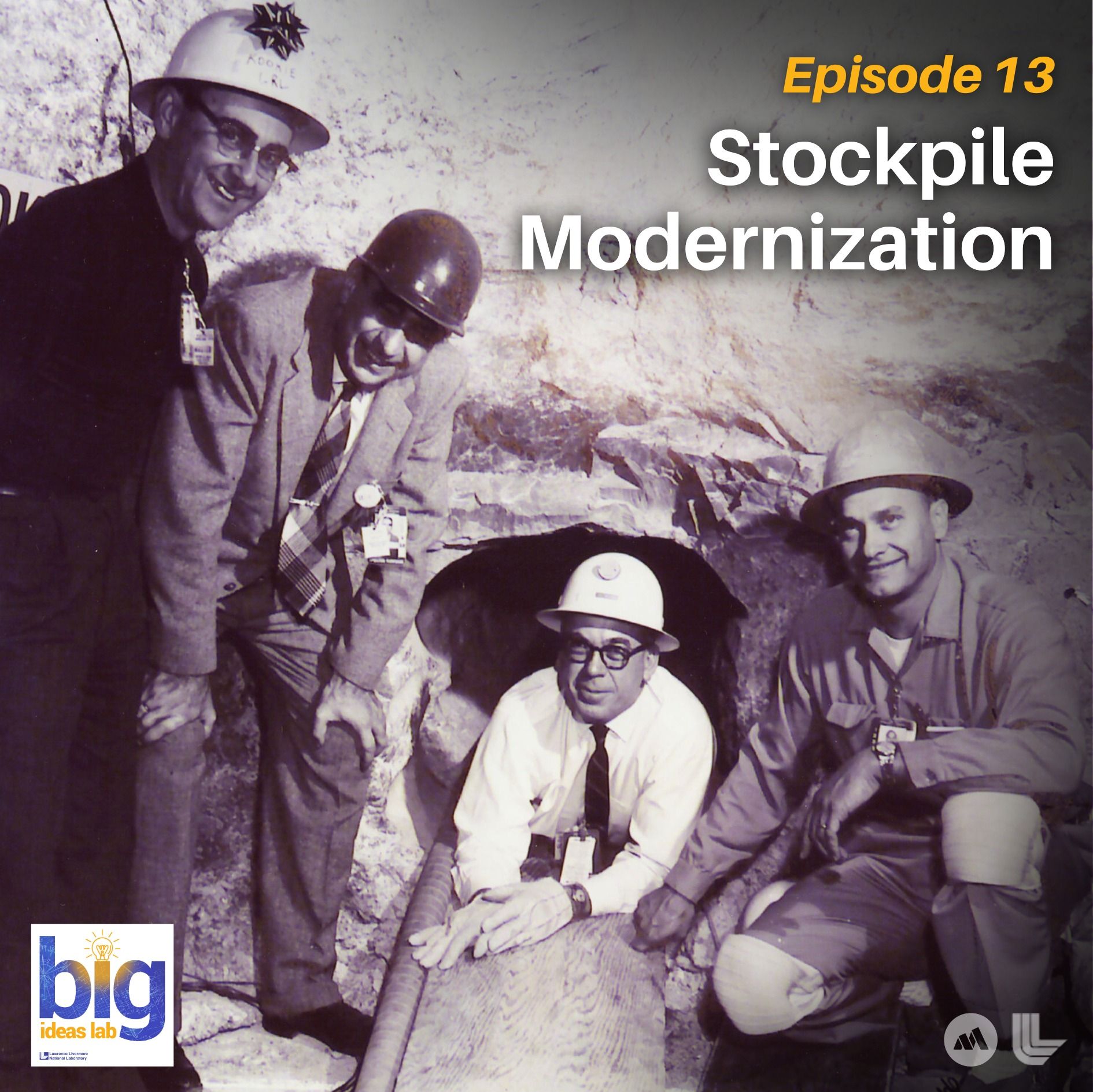
Big Ideas Lab
Stockpile Modernization
00:18:30
In the mid-1990s, global treaties and a U.S. moratorium on nuclear testing marked a turning point in reducing the nuclear threat. As Cold War tensions eased, U.S. nuclear test and production sites fell silent for the first time since 1945. But, as the years passed, a new threat to U.S. nuclear deterrence emerged—one that no technology has ever escaped: time.
Loading summary
Transcript44 lines
- [00:02]
John Doe
What if there is a bombing? A bombing that comes without warning?
- [00:05]
Derek Watman
From 1947 to 1991, the United States and the Soviet Union were locked in a tense geopolitical standoff that shaped much of the modern world.
- [00:16]
John Doe
Find cover immediately. Don't look at the flash.
- [00:21]
Derek Watman
Known as the Cold War. Two superpowers built vast arsenals of nuclear weapons designed to deter one another from launching a first strike.
- [00:30]
John Doe
Shed your outer garments. They may have radioactive particles on them.
- [00:34]
Derek Watman
The world, held in a delicate balance by these nuclear deterrents, managed to avoid the catastrophic consequence of nuclear war. With the Cold War's end, many assumed that the nuclear arms race had come to a halt. But what happened next was just as critical. While new nuclear weapons were no longer being produced in the United States, the challenge shifted to ensuring the safety, security and reliability of the weapons that remained. That's where the modern story of the US Nuclear stockpile begins, an effort known as stockpile stewardship.
- [01:14]
John Doe
Weapons systems are really chemistry experiments on a shelf and they have been around for quite a long time.
- [01:21]
Juliana Hsu
What is your job then?
- [01:31]
Derek Watman
Welcome to the Big Ideas Lab, your weekly exploration inside Lawrence Livermore National Laboratory. Hear untold stories, meet boundary pushing pioneers, and get unparalleled access inside the gates. From national security challenges to computing revolutions, discover the innovations that are shaping tomorrow today. In the mid-90s, a series of treaties were introduced to reduce the worldwide nuclear threat. Since then, the United States has observed a unilateral moratorium on nuclear explosive testing. With the end of the Cold War and the cessation of testing, US Nuclear weapon test and production sites grew quiet for the first time since 1945. As the years passed, a new threat to US nuclear deterrence emerged, one that no technology has ever escaped time.
- [02:39]
John Doe
Originally, the weapons systems that we put into the stockpile, they were supposed to be in about 20 years and then they would be coming out because new systems would be developed and made and put into the stockpile. That all ended at the end of the Cold War in 1992.
- [02:55]
Derek Watman
Derek Watman is the Associate Deputy director for stockpile modernization at Lawrence Livermore National Laboratory.
- [03:02]
John Doe
We're continually assessing the health of the system. So you're looking at are parts degrading because some chemical reaction so they won't perform or won't perform as designed? Have they completely broken? Is there something that is going to make them no longer safe or no longer secure?
- [03:21]
Derek Watman
It was with these concerns in mind that the US Government, in collaboration with the Lawrence Livermore, Los Alamos and Sandia National Laboratories, established a rigorous and Ongoing effort to monitor and modernize the US Nuclear stockpile.
- [03:37]
John Doe
And then there was a transition into the scientific stockpile stewardship program in the 1990s.
- [03:44]
Derek Watman
The stockpile stewardship program represents a critical shift in how the US approaches its nuclear arsenal. Instead of building new weapons, the program uses science based methods to monitor and assess the aging weapons in the stockpile, ensuring their safety without the need for nuclear testing.
- [04:03]
Peter Raboin
Congressionally mandated Nuclear Posture Review.
- [04:07]
John Doe
We go through what we call an annual assessment process, and every year it's an ongoing, continual thing.
- [04:14]
Derek Watman
By regularly evaluating these systems and upgrading components where necessary, the US ensures that its arsenal remains a credible deterrent against modern threats. These aging systems have long surpassed their original intended lifespans, yet remain safe, secure, and effective in a rapidly changing world. There are several ways scientists and engineers at Lawrence Livermore approach stockpile modernization. The first is by upgrading and retrofitting a weapon system with the latest technology. For many years, the systems supporting these powerful weapons relied on technology more commonly associated with an earlier era. For instance, until 2019, the DoD's Minuteman III Intercontinental ballistic missile system, an essential component of America's nuclear deterrent, still utilized 8 inch floppy disks in its launch control centers. This hardware, first introduced in the 1970s, remained in use well into the 21st century. The software supporting these systems was built on outdated technology, with much of the command and control infrastructure for nuclear warheads still relying on legacy systems. However, the shift to modern digital storage represented a significant leap forward, underscoring the need for critical infrastructure to catch up with technological advancements. Another method of stockpile modernization is life extension. These life extension programs, or LEPs, extend the service life of the existing weapon. This may involve refurbishing or replacing parts. Peter Raboin, program manager for one of the lab's life extension programs, gives us an inside look at the LEPs.
- [06:11]
Peter Raboin
Most weapons had original lifetimes on the order of about 20 years. They were mostly built in the mid-80s. And so around the year 2000, life extension programs really began in earnest. And we've been working our way through all of the legacy systems that are in the US stockpile.
- [06:30]
Derek Watman
The W80 warhead, for example, entered the LEP process in 2016, more than 30 years after its introduction. Through these programs, aging components are replaced and the warheads are recertified, ensuring they remain reliable and safe for an additional 20 years or more. This methodical work is essential to maintaining a credible nuclear deterrent.
- [06:55]
Peter Raboin
The W80's turn came up, if you will, in about 2016. So at that point, the weapon was already in its mid-30s. And so that's a long time to expect a nuclear weapon to operate with high reliability, high safety. So the idea is to bring it back out of the stockpile, tear it down, rebuild it, replace those materials which have aged and replace them with newer materials. And basically then after refurbishment, recertify that weapon. We know what nuclear weapons can do in terms of aging and still performing. And so now we have lifetime requirements on the order of 30 plus years. And so it's designing a weapon to last this time with the intent of making it last 30 years, as opposed to having been fortunate that the designs of 20 years did manage to survive out to 40 plus years.
- [07:51]
Derek Watman
Two of the weapons currently undergoing intense modernization programs at Lawrence Livermore are the W84 Warhead and the W87 1 Warhead. The W84 will be updated so that it can be paired with a new long range standoff nuclear capable cruise missile. The first warhead to be paired with a new delivery system since the end of nuclear testing in 1992. Production of the new W84 is scheduled for 2027.
- [08:23]
Peter Raboin
The 84 is a more typical life extension program because there are major components, mainly the nuclear components within the 80 which we are reusing. And so in that sense we are refurbishing the design, but still using quite a number of the original components of the 81. So if you think about that, a weapon made in the early 80s, it's going to have some parts in it that are going to last for essentially about 70 years.
- [08:54]
Derek Watman
The W87 one, on the other hand, is undergoing what's called a modification program. It will be paired with the new Sentinel intercontinental ballistic missile. This is the first complete rebuild of a nuclear warhead in that same quarter century timeframe.
- [09:11]
Peter Raboin
The 87 modification program, on the other hand, it's all new parts, but with a lot of design reuse. And so they will be making newer versions of the old design. Now, there are still lots of areas in refurbishment where the designs can change. It's not 100% refurbishment, but it's pretty close. And an example of that is really for the first time, we're using advanced manufacturing. So we're going to have some AM parts that are in the 84. And I believe also for the 87, with those advanced manufacturing capabilities, we're able to do some stuff that couldn't be done in the original 80s. The basic design is the same, but the way in which we did the manufacturing has been modernized and improved.
- [09:59]
Derek Watman
Another big hurdle will be reestablishing the capability to manufacture plutonium pits or the cores of nuclear weapons.
- [10:07]
Juliana Hsu
A pit is that amount of fissile material that enable the fission energy to be produced.
- [10:13]
Derek Watman
Juliana Hsu is the program Manager for the W87 1 Warhead Modification Program at Lawrence Livermore National Laboratory.
- [10:21]
Juliana Hsu
It's a very critical component in a nuclear weapon. Pit production is something that the nation's been trying to reestablish for quite some time. When Rocky Flats shut down in the early 90s, we were without a pit production agency. And Los Alamos has some pit built capability as a design agency be able to make a few pits. But it was decided at that time that they could become a production agency. So they did make some pits for the W88, but we haven't been in what's called rate production, Meaning that you can make some consistent quantity of pits per year. To be a robust production agency, you need to be able to make pits consistently over time.
- [11:07]
Derek Watman
After the Cold War, the production of nuclear weapons came to a halt and the US Went into preservation mode. Now, decades later, facilities like Lawrence Livermore National Laboratory are tasked with reestablishing and mastering these systems to ensure the stockpile remains secure and effective.
- [11:27]
John Doe
So the end of the Cold War, what ended up happening is that the whole complex shrunk considerably. The scientific stock college stewardship program was intended to really preserve the intellectual capital at the design laboratories because there wasn't a production demand for making parts and making systems and putting them into the stockpile. We were out of that cycle completely. It was preserve what you have. And then we have to have that intellectual capital in order to assess that the systems that we do have, that they're safe, secure, and they're going to perform if you ever have to use the things. And as a consequence, a lot of the focus went off the production plants and a lot of the capability that the production plants had either shrank or just completely disappeared.
- [12:15]
Derek Watman
Rebuilding and replacing aged materials, followed by the refurbishment and recertification of nuclear weapons, ensures that these systems can continue to perform reliably for an additional 30 years or more. This shift towards designing weapons with longer lifespans reflects an ongoing battle against the relentless passage of time, not only in maintaining the physical hardware, but also in preserving the critical expertise needed to sustain these systems.
- [12:46]
John Doe
The other aspect is the human side of the equation is that when I came long time ago, hiring was going on, but the number of us that were hired was like a drop in an ocean. Because you had a very experienced cadre of people. Engineers, scientists, technicians, administrative Staff, operations, people, just keeping the plant, the facility functioning at the laboratory. And this was true at Los Alamos, Sandia, all the plants. You had very experienced people, people from there who had been there probably since, in some cases from the 1950s and 1960s. That's not the case today at all.
- [13:25]
Derek Watman
As the weapons age, so too does the workforce that once brought them to life. During the peak of nuclear development, labs like Los Alamos and Livermore were filled with experts whose deep experience was integral to sustaining the nuclear arsenal. Now, as many of these pioneers retire, the gap in expertise grows more pronounced, making the need for developing new talent increasingly urgent.
- [13:50]
John Doe
The situation for Livermore, it's not any different than any of the other sites is that Certainly within engineering, 50% of the people that we've hired have less than five years experience. And what compounds the challenge is that the number of senior people who are experienced, particularly putting things into the stockpile, is not very large. And every site is challenged in this regard. Now, part of it is just the nature of how the program kind of evolved in the 1990s and in the early 2000s.
- [14:25]
Derek Watman
These internal challenges come at a time when the global landscape is becoming increasingly volatile. As the US Grapples with the loss of experienced scientists and the need for modernization, it also faces growing external pressures from nuclear powers like China and Russia. The evolving capabilities of these adversaries underscores the critical importance of maintaining a robust and credible nuclear deterrent.
- [14:52]
Juliana Hsu
We have been basically doing life extension programs for the deterrent about three decades now, and also the warhead was designed much longer before that. As the world evolved, our adversaries said, increase their capabilities. And so for our deterrent to continue to work, we also need to modernize our capabilities. And since the cessation of testing, what's happened is that we haven't been modernizing either our delivery platforms or the warheads. So it's been a long time coming. And then with the world as it is today, it's not getting any safer.
- [15:32]
Derek Watman
In 2023, the Congressional Commission on the Strategic Posture of the United States issued a critical report warning that the nation is on the brink of facing two formidable nuclear Russia and China. The report emphasized that maintaining a fully operational and ready nuclear arsenal is not just important, important, but an absolute priority for national security.
- [15:59]
John Doe
It's a consensus report, mix of liberals, conservatives, Democrats, Republicans. It's disconcerting in a lot of ways, and so it's really a motivator.
- [16:10]
Juliana Hsu
Our nuclear deterrent is very important for the safety of the country, for the nation. We have to make sure our nuclear deterrent works, our warhead works, and we have the platform to deliver them.
- [16:21]
John Doe
For any of us who are doing this, they are the absolute last resort that everything else has failed, and it is really intended that we have some way of protecting the country and our allies. You've got this almost perfect storm of a lot of challenges coming together all at one time, particularly now when you look at the geopolitical threat that the country is under and how that is driving things in a very, very different way.
- [16:48]
Derek Watman
The passage of time can turn even the most powerful weapons into significant liabilities if they are not properly maintained. As weapons like the W80 and W87 approach their original service lives, the necessity for programs and people to extend the life of and modernize these weapons grows. And as other global powers continue to expand and modernize their own nuclear capabilities, the US Must not fall behind.
- [17:20]
Juliana Hsu
We're recognizing there's an urgency, recognizing what we need to do to have a viable deterrent. And my hope is that we keep at it. And if it were easy, we wouldn't be doing it. Even though at the moment it feels hard, we'll be better for it.
- [17:37]
Derek Watman
Despite the countless challenges, Lawrence Livermore National Laboratory is committed to its core mission of stockpile stewardship, ensuring that our nuclear deterrent remains a cornerstone of our national security for generations to come. Thank you for tuning in to Big Ideas Lab. If you loved what you heard, please let us know by leaving a rating and review view. And if you haven't already, don't forget to hit the Follow or Subscribe button in your podcast app to keep up with our latest episode. Thanks for listening.