← Big Ideas Lab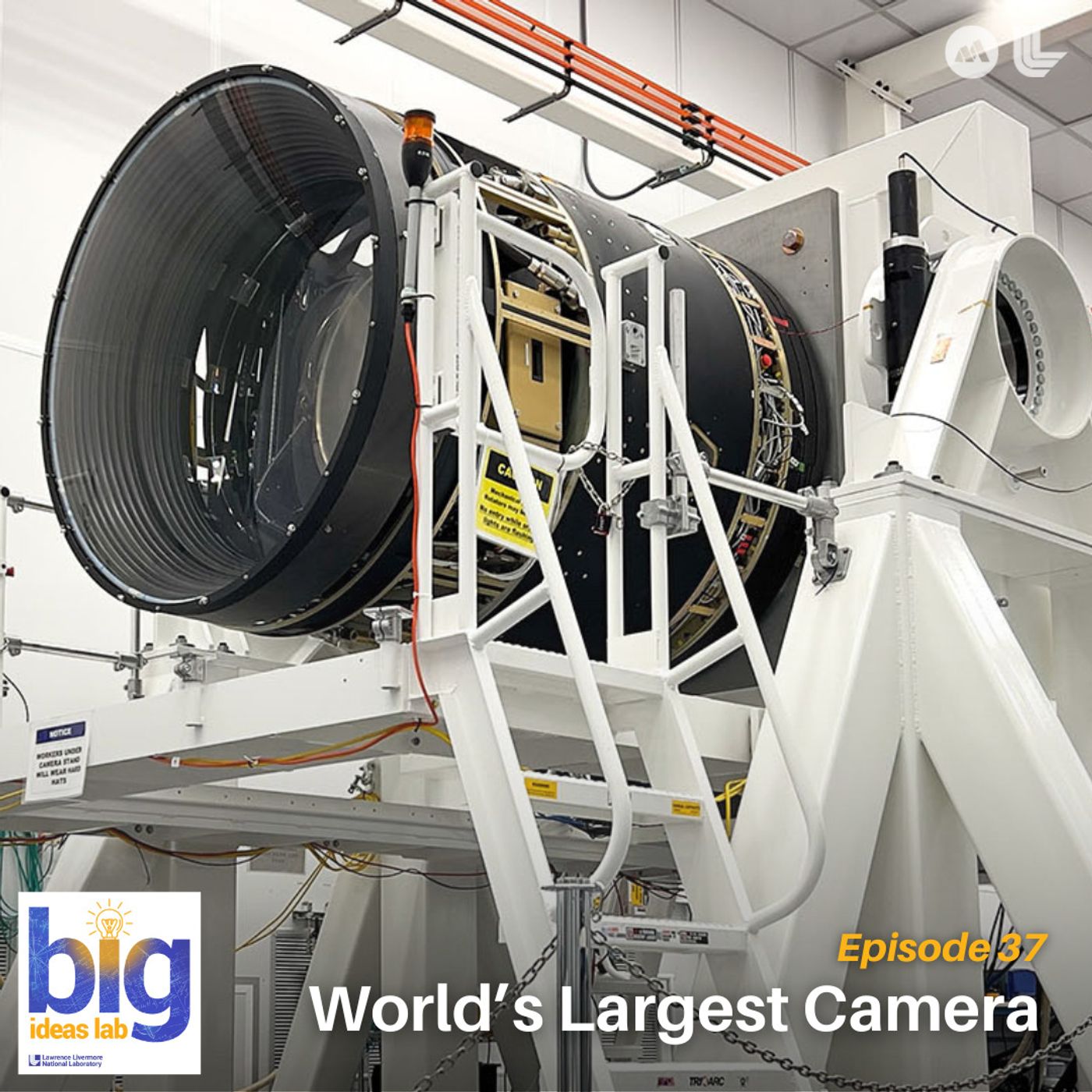
Big Ideas Lab
World’s Largest Camera
00:14:22
Supernovas, asteroids, dark matter, and dark energy… space is alive. And the way we observe it is about to change.
Loading summary
Transcript39 lines
- [00:01]
A
For centuries, astronomers have studied the cosmos as a series of still frames. Single snapshots frozen in time. But space is alive. Supernovas erupting in distant galaxies. Asteroids drifting silently towards Earth. Immense black holes pulling matter into their depths. And the way we observe it is about to change. On June 23, 2025, the most efficient and effective solar system discovery machine ever built released its first images. The beginnings of a 10 year mission to relentlessly observe the night sky and see our universe in motion.
- [00:49]
B
The first images from a new observatory.
- [00:51]
A
Have been released, and astronomers say they're unlike anything they've seen before. This is the Vera C Rubin Observatory. Equipped with the world's largest astronau camera, it will record more data in its first year of operation than the sum of all other optical observatories. The universe is never still. It's constantly moving, transforming, revealing. Today, we will look at how the scientists at Lawrence Livermore National Laboratory have played a role in bringing this evolving night sky a little more into focus. Welcome to the Big Ideas Lab. Your exploration inside Lawrence Livermore National Laboratory. Hear untold stories, meet boundary pushing pioneers, and get unparalleled access inside the gates. From national security challenges to computing revolutions, discover the innovations that are shaping tomorrow, today. Lawrence Livermore National Laboratory has been involved in space science for decades, with efforts in astronomical research, planetary science and instrumentation spread across different research groups. To unify this work and bring experts together to drive new discoveries, an organization was created, the Space Science Institute.
- [02:26]
B
The institute is not a specific place or building.
- [02:30]
A
That's Megan Eckert, a physicist at Lawrence Livermore and the director of the Space Science Institute.
- [02:37]
B
It's an organization to bring people together to establish strategy for space science activities, to build up new proposals and projects, to host students, to build partnerships, and to really support our workforce.
- [02:54]
A
One of the lab's earliest breakthroughs in astronomy was in computational astrophysics.
- [03:00]
B
Back in the 1960s, there were seminal contributions in computational astrophysics.
- [03:06]
A
Livermore researchers used the most advanced computers of their time to model supernova explosions, the dramatic deaths of massive stars that release immense energy in a sudden burst. This early work helped scientists understand how stars evolve, collapse and shape the universe. Then, in the 1990s, Lawrence Livermore was leading a pioneering large area optical astronomical survey.
- [03:34]
B
So this is where you have a telescope that's not staring at a particular object. It's just looking at a blank part of the sky and mapping out the sky and then doing it again and again to see what changes or to get deeper images.
- [03:49]
A
This survey was called the Macho Project and a first of its kind investigation.
- [03:55]
B
The lab was one of the pioneering institutions in doing this with the Macho Survey, where we were leading one of the first large area optical surveys to look for dark matter.
- [04:05]
A
Dark matter, acting as a cosmic glue, Its gravity holds galaxies together and shapes the large scale structure of the universe.
- [04:15]
B
Dark matter, it behaves similarly in terms of gravity. So we can see the gravitational effects of dark matter, but it's not interacting in a way that we can see it.
- [04:25]
A
Though we can't see it directly. Scientists detect its presence through its gravitational influence on stars and galaxies. Without dark matter, galaxies would fly apart, unable to hold themselves together based on visible matter alone.
- [04:40]
B
And so, understanding the nature of dark matter, what is it? Is one of the big questions in modern physics.
- [04:46]
A
In the pursuit of this question, lab scientists and the broader astronomical community began envisioning a dedicated large facility designed specifically to pursue astronomical science and cosmology through large area surveys of the sky. Those early discussions eventually led to the creation of the Vera Rubin Observatory, an observatory with an unwavering mission. Vincent Rio served as the LSST Camera Project Manager and Vera Rubin Observatory Deputy Project Manager. He worked on the project from 2011 through 2023.
- [05:25]
C
The Vera Rubin Observatory is basically an observatory that is dedicated to doing what's called a survey, which is very different than other observatories.
- [05:33]
A
While other observatories respond to individual research requests, the Vera Rubin Observatory is dedicated to a decade long sky survey. Every night for 10 years, it will capture a continuous movie of the sky, tracking changes over time.
- [05:51]
C
The main reason why it was originally developed is to try to understand dark matter and dark energy. The dark matter is trying to explain why things are being pulled toward each other in a way that we can't see. The dark energy, on the other hand, is trying to explain why things are moving away from each other.
- [06:08]
A
Dark energy counteracts gravity, expanding space itself and accelerating the universe's growth. Together, dark matter and dark energy make up 95% of the universe, yet remain largely unknown. By continuously surveying the cosmos and observing what can be seen, be influenced by what can't be, the Vera Rubin Observatory will help scientists make sense of the unseen forces shaping our universe. The observatory is uniquely designed to be both deep and or able to see faint objects and fast, capturing vast areas of the sky quickly and repeatedly. How? With the world's largest astronomical camera. Some of Livermore's most enduring contributions to space science come from its innovations in optics technology that continues to shape modern astronomy. A well known example is the LAB'S leading role in developing adaptive optics, as discussed in our recent episode on Laser guidestar, which corrects the blurring effects of Earth's atmosphere in real time.
- [07:28]
B
The Earth's atmosphere is moving, is turbulent, and it blurs the images. But if you can couple adaptive optics and laser guide star adaptive optics, then you can reduce this blurring or correct out the blurring, and the observatories can perform up to their potential.
- [07:47]
A
Although the Rubin observatory doesn't use a full adaptive optics system, Researchers from the lab contributed to the Rubin system that keeps the camera precisely aligned and tracking the sky during each 15 second exposure.
- [08:02]
C
Over time, the earth rotates. So when you point for 15 seconds, it actually rotates enough that if you were to not move the camera a little bit to accommodate for that, it would get blurry. I was responsible for the guidance system, the software and the hardware in place to know by how much you have to adjust this camera during this 15 second exposure. Over time took on multiple roles. In particular, I started being responsible for the optics of the camera, which includes the largest lenses in the world ever made.
- [08:28]
A
Rubin's massive telescope houses the largest digital camera ever built for astronomy, Designed to capture an unprecedented time lapse of the universe over the next decade.
- [08:39]
C
We actually have a world record on that. We are on the Guinness world record books.
- [08:43]
A
This camera is called the Legacy Survey of space and time, or LSST Camera. Livermore contributed significantly to the camera's development, Providing essential hardware, lenses, filters, and project management expertise to bring this SUV sized instrument to life.
- [09:03]
C
It has many, many more pixels on your camera. Just as an example, this camera at 3.2 gigapixel.
- [09:08]
A
By comparison, a modern smartphone camera Typically has only tens of megapixels.
- [09:14]
C
It's about 100 times more pixels than what you have. So that's one of the difficulty. The other difficulty is that it's going to be all in the noise.
- [09:23]
A
In low light, cameras have to amplify weak signals from their sensors, creating noise.
- [09:29]
C
That means that those sensors have to have very large pixels.
- [09:32]
A
Pixels that are 16 times more area than the pixels in your phone camera.
- [09:37]
C
Which is also why when you look at picture of the actual camera, this thing is like the size of a table, Just a sensor as opposed to in your camera. You can barely see it with your eye.
- [09:46]
A
To create this table sized sensor array, Individual chips had to be precisely positioned and securely placed side by side, Forming an exquisite network of sensors.
- [09:59]
C
We were actually joking when we were building it that when we were putting these sensors next to each other, it was the same as parking Lamborghinis in terms of cost less than an inch away in terms of ratio about their place, you probably would be like, I'm not going to do that. I don't want to wreck it. But it's what we had to do on the camera.
- [10:15]
A
The LSST camera is a marvel of precision engineering. And key parts of the required expertise come from the National Ignition Facility at Lawrence Livermore National Laboratory. At nif, the lab developed cutting edge techniques for crafting and handling large, incredibly precise optical surfaces to guide powerful lasers. That experience proved invaluable for Rubin's massive lenses, which require sub micron precision across surfaces larger than a meter. One of the biggest challenges wasn't just making these optics. It was verifying their accuracy. Livermore's expertise in designing optical prescriptions that could be measured with advanced measurement techniques made this possible. These methods allowed the team to confirm the precision of the optics without exceeding budget constraints.
- [11:08]
C
But what's even more difficult is to know that what you made is right. And one of the knowledge that we tapped on from NIF is how do you design an optics prescription? So it's kind of like your glasses prescription. You, you probably be given a prescription, so you can go to buy glasses and you say, here's my prescription, and they give it to you. So, you know, one could say, well, this is a prescription, but when you have something that's over a meter large and has to be sub micron precision, how do you actually verify that it's right? And because, you know, if you try to measure with a probe, you can't really measure at that level. And so one of the things for these large optics that was done is that it was designed in such a way that it can be measured easily with using some interferometers technology and actually some holographic technology. To be able to measure the way you built was actually correct. And that was actually a huge deal.
- [12:00]
A
The Rubin project truly benefited from the decades of innovation and knowledge developed at Livermore for nif, showcasing how expertise in one groundbreaking project can fuel success in another. Beginning in late 2025, each night, Rubin will use the LSST camera to scan the sky, tracking the cosmos in real time, revealing its movements, its cycles, and what mysteries still lie hidden in the dark. Livermore's scientific interests in the Rubin survey go beyond distant galaxies and cosmological phenomena, like the nature of dark energy. Closer to home, researchers are focused on something even more urgent. Protecting Earth itself. Because the observatory constantly monitors the night sky, it also helps track asteroids and other objects moving near Earth's orbit. This real time view enhances our awareness, making it easier to detect potential collisions and as discussed in our two part episode of Planetary Defense, avoid them. Space science is about expanding our understanding of the universe and uncovering new, new possibilities. Next generation telescopes will deepen our knowledge of space. Whether mapping the sky to study dark energy or detect asteroids, scientists and engineers are driving innovation to reshape our understanding of the cosmos. At Lawrence Livermore, this means developing powerful tools, building partnerships, and bringing the moving universe into shape. Sharper Focus thank you for tuning in to Big Ideas Lab. If you loved what you heard, please let us know by leaving a rating and review. And if you haven't already, don't forget to hit the Follow or Subscribe button in your podcast app to keep up with our latest episode. Thanks for listening.