Loading summary
Transcript69 lines
- [00:01]
IBM Representative
The thing about AI for business? It may not automatically fit the way your business works. At IBM, we've seen this firsthand. But by embedding AI across hr, IT and procurement processes, we've reduced costs by millions, slash repetitive tasks, and freed thousands of hours for strategic work. Now we're helping companies get smarter by putting AI where it actually pays off, deep in the work that moves the business. Let's create smarter business.
- [00:29]
Optum Representative
IBM Healthcare doesn't always work great. If you've ever waited on a refill or couldn't schedule an appointment, you get it. That's the kind of stuff Optum is changing. They're using data and technology to integrate patient care, pharmacy and everything else. So healthcare is connected, not complicated. What's that look like? Cheaper prescriptions that are easier to get, and care that looks at the whole person how you need it. Optum is helping make healthcare work as one for everyone. Learn more@business.optum.com wise is the smart way
- [01:01]
Wise/Boost Mobile Advertiser
to manage the currencies you need around the globe. When you send money abroad using your bank, you could get hit with hidden fees and exchange rate markups. There's a better way. Try Wise. Wise uses the exchange rate you'd usually find on Google, with no unwelcome surprises. Plus, most transfers happen in under 20 seconds, which means your money arrives in less time than you've been listening to me. It's simple and free to sign up when you download the Wise app. Be smart, Get Wise T's and C's Apply.
- [01:33]
Optum Representative
Bloomberg audio studios podcasts radio news.
- [01:45]
Wan Ha (Bloomberg News Host)
The final stage is still being set. But even before the confetti rains down on this weekend's 2026 FIFA World Cup Champions, one thing is certain, this tournament has been unforgettable. And no, I'm not talking about deficiating. 2026 marked the first time that the games were split across three host nations, the first time in nearly 20 years that the field expanded to allow additional teams, and the first time that nine Asian Football Confederation members made the cut. And while all teams from Asia have since been eliminated, their presence in the tournament was more than a statistical milestone. It was electric for fans. History in the making.
- [02:32]
Tony Ayo (The Real Report Host)
It's history, and a very proud moment for Uzbekistan as they play at a World cup for the first time ever.
- [02:38]
Wan Ha (Bloomberg News Host)
In 2002, just four teams from Asia made it into the World Cup. Today, that number has more than doubled. Supercharged, of course, by FIFA's decision to expand the field to 48 teams. But even with that expansion, there's one glaring absence from the pitch, China.
- [02:56]
Mark Dreier (Sportswriter)
China defeated.
- [02:58]
Wan Ha (Bloomberg News Host)
Every four Chinese football fans asked the exact same question. Where's team China in soccer?
- [03:02]
Public.com Advertiser
China's got 1.4 billion people. Y' all couldn't find 11 people to kick a ball.
- [03:08]
Wan Ha (Bloomberg News Host)
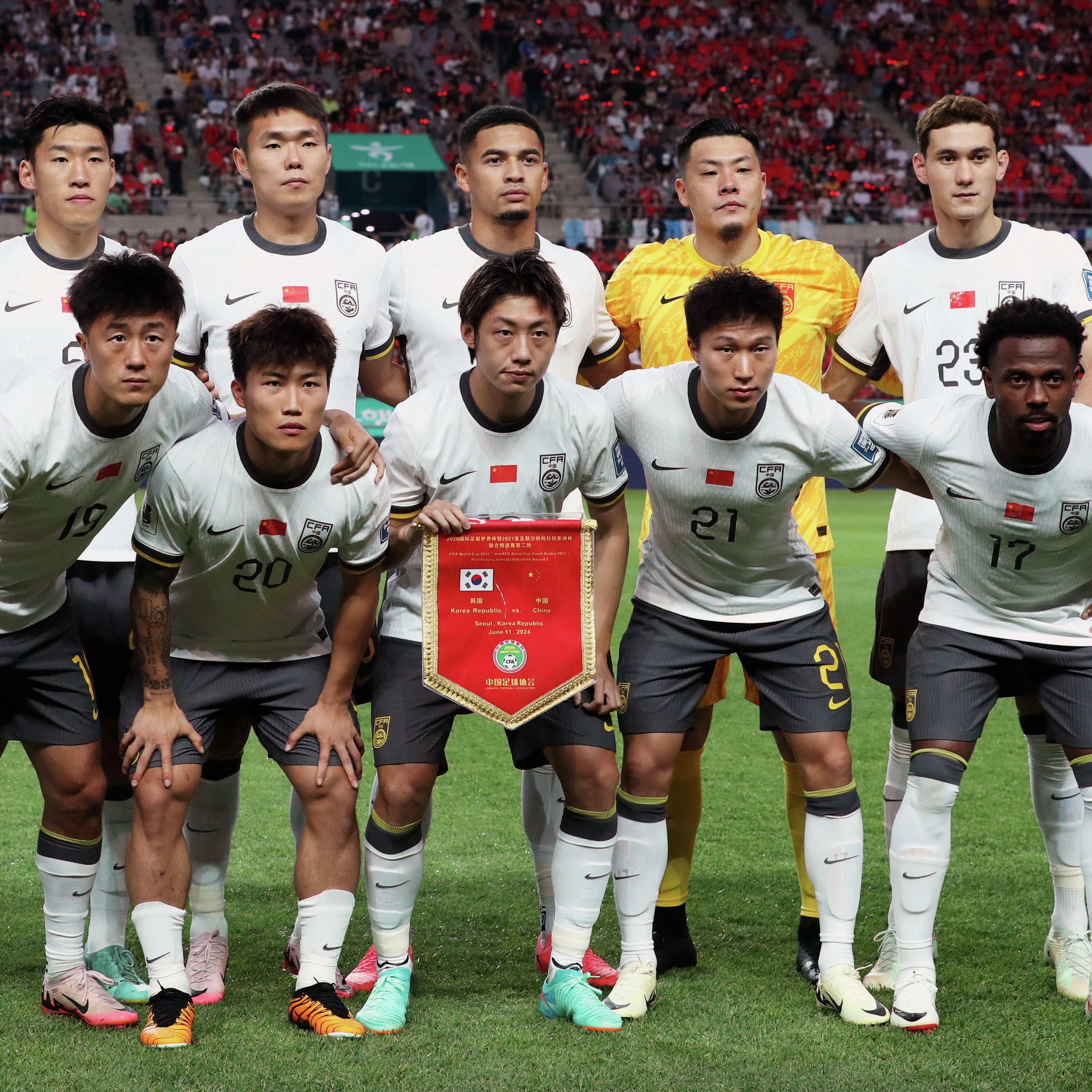
Since the first World cup in 1930, China's men's team has qualified just once, in 2002. It's a staggering drought, and it comes even as Beijing has poured millions, if not billions, into growing the game, one that holds a special place in the heart of its leader.
- [03:28]
IBM Representative
I used to play football here, but that was over 50 years ago. The pitches were all dirt back then.
- [03:34]
Wan Ha (Bloomberg News Host)
That was Chinese President Xi Jinping during a visit to his former school in Beijing in 2016. Xi rarely speaks publicly about his personal life, but over the years, he's made no secret of his love for football and his hopes for its future in China.
- [03:50]
Mark Dreier (Sportswriter)
Xi Jinping's three wishes for Chinese football go back to 2011, the year before he became the president.
- [03:56]
Wan Ha (Bloomberg News Host)
Mark Dreier is a veteran sportswriter who splits his time between Beijing and the
- [04:00]
Mark Dreier (Sportswriter)
uk and they were to qualify for the World cup, to host the World cup, and to win the World Cup.
- [04:06]
Wan Ha (Bloomberg News Host)
But more than a decade later, none of those goals has been achieved. That's despite China making football a national priority in 2015. The struggle has become so visible that even Xi himself has acknowledged it. Here, he's speaking to Thailand's prime minister in 2023, after China's men's team beat Thailand in a World cup qualifier.
- [04:31]
Tony Ayo (The Real Report Host)
Oh, really?
- [04:32]
IBM Representative
China won. I think that was mostly a fluke. I'm not too confident in the national team's level.
- [04:40]
Wan Ha (Bloomberg News Host)
Over the years, China has invested heavily to become a sporting powerhouse. At the Olympics, it regularly tops the medal tables, which makes its struggle on the pitch all the more striking.
- [04:51]
Mark Dreier (Sportswriter)
There's nothing really that compares to the lack of success that China has had there. And I think for the people, it is embarrassing because there are a lot of football fans in China.
- [05:01]
Eric Zhu (Bloomberg Economics)
During China's booming year the past three decades, economy is rising so fast that it's every opportunity outside football.
- [05:08]
Wan Ha (Bloomberg News Host)
Eric Zhu covers China's economy for Bloomberg Economics. He says China's football woes are tied to people wanting to cash in on the country's economic boom rather than dream big about becoming a pro athlete.
- [05:23]
Eric Zhu (Bloomberg Economics)
As long as you have a good education, it's very easy to make money.
- [05:26]
Wan Ha (Bloomberg News Host)
But Eric says this isn't just about individual choices. The bigger question is why a country that's excelled through planning, investment, and state support hasn't been able to apply the same formula to football.
- [05:40]
Eric Zhu (Bloomberg Economics)
You have seen China has made huge success in everything, right, mostly everything right from infrastructure, high speed training to robotics to AI on the sports at least they have made great success in Olympic games. So it looks like China model is so successful in everywhere. So it's a top down engineering approach, but it doesn't work for football.
- [06:11]
Wan Ha (Bloomberg News Host)
This is the big take Asia from Bloomberg News, I'm Wan Ha. Every week we take you inside some of the world's biggest and most powerful economies and the markets, tycoons and businesses that drive this ever shifting region. Today on the show, why China struggles to crack the formula for football and what that reveals about the limits of state power. In a game that thrives on grassroots participation. In the world of Olympic sports, China has perfected a science identifying talent early, controlling variables and refining performance over years. It's a top down system that's produced generations of champions in diving, gymnastics and weightlifting. But sports writer Mark Dreier says when it comes to football, that state engineered top down formula has fallen flat.
- [07:08]
Mark Dreier (Sportswriter)
And I want to be very clear. I hate, they hate the stereotype that paints some of these Olympic athletes as robots. I think that's, it's not helpful at all. But the reality is that if you're talking about gymnastics, if you're talking about diving, the training and the rigor and the discipline is incredible. And Chinese people excel in this and they win gold medals and so the authorities just think we can take this and just simply move it over to football.
- [07:35]
Wan Ha (Bloomberg News Host)
Mark says one reason the Olympic approach doesn't work for football is that it's too intense for those still learning to love the beautiful game. The pressure knocks the fun out and kids lose interest or coaches smother talent before it has a chance to grow.
- [07:50]
Mark Dreier (Sportswriter)
China has this tendency sometimes to take everything too seriously too quickly. There's a story that I think resonates and shows you how difficult that is in China. It was a Spanish coach who was playing at one of the football academies in the south and they had some fantastic facilities. And he mentioned that when he watched the kids, the Chinese kids play, he wasn't struck by their technical ability or lack of. It wasn't about that. He was struck by how quiet the sport was being played. They were almost silent. There was no communication between the players. But also when they scored a goal, they would just quietly turn around and go back for the restart and play again. And that I think for most of the rest of the world, football at its core is fun. It's the beautiful game for A reason it brings so much joy and passion and to billions, literally billions of people around the world.
- [08:41]
Wan Ha (Bloomberg News Host)
The academy Mark mentioned is one of three avenues for young players in China. It's a professional academy, similar to what you'd see in English Premier League. Top talent is identified and funneled into boarding schools to train full time. Beyond that, there are local associations which run training camps and thousands of public schools where football is incorporated into the school curriculum with the goal of getting kids to play regularly. But Mark says those efforts won't do enough to capture the grassroots magic needed for the game to thrive, especially when culturally, sports are often seen as a distraction from the main priority. For many Chinese families, I think what's
- [09:23]
Mark Dreier (Sportswriter)
fundamentally missing is the huge base which is the foundation for everything else, and that's participation, but that's amateur, enthusiastic people playing because they want to play. And unfortunately, much of that has been squeezed out in China because there's no space in the system. When academics are prioritized so early, China's
- [09:45]
Wan Ha (Bloomberg News Host)
education system is considered one of the most competitive in the world. And that race for academic survival begins almost at birth. From toddler prep schools to high school boot camps, millions of students are funneled into a single track, all leading up to one life defining college entrance ex the gaokao.
- [10:05]
Eric Zhu (Bloomberg Economics)
Traditionally every parent was seen going to college, going through the gaokao college entrance exam. That's the most typical way to get success in China. They don't believe they're playing football. Being very good at sports is a very successful career. I think the key issue is not they don't have Messi or Ronaldo. The key issue is probably in China, if Messi was born in China, I guess he would probably end up like the school team in Tsinghua instead of national Chinese team. So I think because most of the kids eventually they have to go to the education track, even if you are very gifted in football, I guess very few of them will stick to the end.
- [10:48]
Wan Ha (Bloomberg News Host)
Eric says part of that mentality can be traced to China's modern history. For much of the 20th century, China was simply too poor and too focused on survival to invest in sports. Then not long after the country opened its economy in the late the one child policy was introduced that limited most families to a single child and made it unlikely that you'd bank your child's future on pro sports.
- [11:14]
Eric Zhu (Bloomberg Economics)
If you have two children, three children, so you have more diversity, right? So now they cannot risk putting their only child on a very uncertain, on a very risky career path. So education going through the entrance exam that's most most desired way to move up to social ladder.
- [11:39]
Wan Ha (Bloomberg News Host)
After the break. Whether Beijing's latest efforts to move the needle might finally bring the change and World cup success that's eluded China and President Xi for so long.
- [11:55]
Public.com Advertiser
Support for the show comes from public.com, if you're actively involved in your portfolio, you probably catch yourself repeating the same actions. Buying the dip, manually sweeping idle cash, putting on a hedge on Public. You can now create AI agents that handle all these tasks on your behalf. Just describe what you want to do in plain English like if the Vix hits 25, buy a put option on the S&P 500 or if my cash balance goes above $20,000, move the excess into my direct index. You approve the workflow and your agent handles the risk, monitoring the market, watching for your conditions and executing your strategies exactly as defined. An investing platform driven by your intent, not just your clicks. You can also get full read and write access to your account via the public API. Go to public.com market and fund your account in five minutes or less. That's public.com market market paid for by
- [12:51]
Tony Ayo (The Real Report Host)
Public Investing Brokerage Services by Open to the Public Investing Inc. Member FINRA and SIPC Advisory Services by Public Advisors, LLC, SEC registered advisor complete
- [13:02]
Public.com Advertiser
disclosures available@public.com disclosures the official language of
- [13:06]
Wise/Boost Mobile Advertiser
football is trash talk, late night group chats, memes and unbelievable highlight clips. That's why Boost Mobile brings you our new new Global Connection plan, the first plan ever made for WhatsApp. Get unlimited data, talk and text, international roaming and calls to over 100 countries for just $40 a month. $40 price includes $5 a month auto pay discount after 40 gigabytes of premium high speed data speeds will be lowered. Coverage not available everywhere. Visit Store or BoostMobile.com for details.
- [13:36]
Tony Ayo (The Real Report Host)
Amazon Health AI presents Painful Thoughts why
- [13:41]
Wan Ha (Bloomberg News Host)
did I search the Internet for answers
- [13:43]
Optum Representative
to my cold sore problem?
- [13:45]
Wan Ha (Bloomberg News Host)
Now I'm stuck down a rabbit hole
- [13:47]
Optum Representative
filled with images of alarmingly graphic source
- [13:50]
Wan Ha (Bloomberg News Host)
in various stages of ooze. I can clear my search history, but I can never unsee that.
- [13:59]
Tony Ayo (The Real Report Host)
Don't go down the rabbit hole. Amazon Health AI gets you the right care fast. Healthcare just got less PA.
- [14:14]
Wan Ha (Bloomberg News Host)
Since reaching the high point of qualifying for the World cup in 2002, it's been largely downhill for China's men's football team. China's women's side has qualified for nine World Cups and was even a runner up in 1999. That's when they lost a heartbreaking final to the US team and Brandy Chastain's famous penalty K. But they too have struggled to find consistent success. And so in 2015, two years after taking office, President Xi made it his mission to change the narrative around Chinese football. He announced that his government would make football a national priority.
- [14:58]
Mark Dreier (Sportswriter)
That was a key time in the development of the sports industry because China looked towards the US and I think it realized that about 3% of the US GDP was coming from sports. China had. It was. The equivalent was a fraction of 1%. So they thought, wow, if we can recreate something similar or even bigger than the US has, we can have this new driver, a new genuine driver of economic growth. So in 2014, they put out a big policy document which was to develop the sports industry as a whole. Now, the first area that they looked at was football. And in 2015, there was a 50 point plan that was released to overhaul and oversee the redevelopment of Chinese football. Now, with one or two exceptions, perhaps on, you know, points of ideology here and there, it was a very, very sensible plan. If you took all the top international football consultants and said, what does China need to do? All the points were in there. The problem has been implementation.
- [15:57]
Wan Ha (Bloomberg News Host)
On paper, China seemed to have a clear roadmap. The 50 point plan listed out ways to revive the sport, from expanding football programs in school and building thousands of new pitches to overhauling the way professional football was governed and run. But turning that vision into reality has proven difficult. China's top professional football league, the Super League, has been plagued by corruption for decades, from scandals involving bribery to match fixing and financial misconduct that stretches back to the 1990s. Its most famous players have also been swept up in corruption scandals like Li Tia, China's former national team coach. Li, who once played in the English Premier League for Everton, was sentenced to 20 years in prison for corruption in 2024. Beijing has launched repeated anti corruption campaigns to clean up the sport. But Mark says the same problems keep resurfacing and they still plague China's domestic league today.
- [16:58]
Mark Dreier (Sportswriter)
Well, I think it's been a series of false starts, to be honest. And a lot of that has stemmed from some of the corruption and the match fix. And every few years we've had investigations into this and people get penalized and, and officials and players and, and referees as well get banned from the game or get sent to jail. At the moment we have the Chinese Super League in this farcical situation where more than half of the teams, nine of the 16 teams started the season on minus points because of various penalties. They'd been given. This is unheard of in any other country in the world. And it makes it, in my opinion, a bit of a mockery of this year. It's not about who's the best on the on the pitch. It's about who can navigate the point differential better than the others. I'm not saying they shouldn't have given the penalties. You have to crack down and stamp to try to stamp this stuff out. But the fact that we've seen yet another cycle, I think that is probably the one of the largest underlying issues that they still haven't been able to truly get out of the sport in China.
- [18:00]
Wan Ha (Bloomberg News Host)
For Mark, one of the biggest obstacles is how the sport is governed. While China has taken steps to give its professional leagues more independence, the broader football system remains closely tied to the state through the Chinese Football Association. That's an arm of the Chinese government. And that means football is often shaped by political priorities in ways that would be unusual in the rest of the world.
- [18:26]
Mark Dreier (Sportswriter)
The whole Chinese FA is de facto part of the Sports Ministry. I mean, if that isn't government interference, I don't know what is. But China gets a free pass from FIFA on this, and so you have political people making football decisions, and that fundamentally is not going to work long term.
- [18:44]
Wan Ha (Bloomberg News Host)
Ultimately, Mark says developing football in China requires a cultural shift. More people need to embrace the everyday lifestyle of the sport, not just chase conventional markers of success like money or status. He says without a grassroots base of casual players, there's no foundation to build talent upward. In countries like the uk, even pub and village teams are part of a connected system that allows players to rise or fall naturally. China, on the other hand, lacks that structure, leaving too few pathways for players to progress from the bottom up.
- [19:22]
Mark Dreier (Sportswriter)
What we need is that huge base at the bottom of the pyramid, which is just grassroots, organic people playing because they want to play. In China, certainly historically, people were selected from that base and put into a much more serious track far too early and really focused on just the top elite professional things, which is the tiny little triangle at the top of this larger pyramid.
- [19:47]
Wan Ha (Bloomberg News Host)
And to get that bigger base of players, China needs to change incentives for parents, convince them to buy in. Here's Eric Zhu again.
- [19:55]
Eric Zhu (Bloomberg Economics)
In the near term, I think that some good fixes from the social background, you know, improve the social safety net, give more protection to parents who want to invest in football. Even if their children cannot make gaoka or cannot, you know, make into a good quality, they can still get something. But in the longer term, I think it has to be something about parents need to focus less on education and want to encourage their children to play football or other sports. But this should be market based instead of from the government intervention, government direction to give them more incentives and change the system.
- [20:33]
Mark Dreier (Sportswriter)
Now the problem is China's system is such that you just can't really operate outside of state control. And so it's not a realistic solution for China without changing the system. And they're not going to do that. What they could do is perhaps, perhaps to make football for example, part of Gaokao achievement. So you know, maybe 10% is your performance in football or in sports or in something non specifically academic. It would prevent for example this cliff that we talk about the age of 12 or 13 where the young youth sports just see a massive drop in participation as these outside distractions are dropped so that people can focus on the academics and that would just create that larger base. And then naturally you have more people just float to the top and you have more people achieving at the top, top levels.
- [21:25]
Wan Ha (Bloomberg News Host)
Do you guys, either you guys see any signs or data points that suggest China can change, that China can improve when it comes to football? You know what's one hopeful sign and maybe a caveat that you see there?
- [21:39]
Eric Zhu (Bloomberg Economics)
I guess one hopeful sign for football, but it looks like a bad sign for the economy and not a very good sign for youth people because the economy is slowing down and actually the job prospects, the career prospects for fresh college graduates is actually looking not very good right now, especially given the AI era. But from football perspective that could be a good thing because no parents will realize, okay, the education is not necessarily so important in the longer run career. So they might rethink. If my child is a very good football player, why not let him or her try football?
- [22:23]
Wan Ha (Bloomberg News Host)
This is the big Take Asia from Bloomberg News. I'm wan ha to get more from the Big Take and unlimited access to all of bloomberg.com subscribe today@bloomberg.com podcastoffer if you liked the episode, make sure to subscribe and review the BigTick Asia. Wherever you listen to podcasts, it really helps people find the show. Thanks for listening. See you next time.
- [22:52]
Optum Representative
Healthcare doesn't always work great. If you've ever waited on a refill or couldn't schedule an appointment, you get it. That's the kind of stuff Optum is changing. They're using data and technology to integrate patient care, pharmacy and everything else. So healthcare is connected, not complicated. What's that look like? Cheaper prescriptions that are easier to get and care that looks at the whole person how you need it. Optum is helping make healthcare work as one for everyone. Learn more@business.optum.com this is Tony Ayo from
- [23:22]
Tony Ayo (The Real Report Host)
the Real Report with Tony Ayo and Uncle Murder. You ever notice how everything keeps going up? Rent, streaming, even extra Sosa at your favorite burrito spot. But with Boost Mobile, you don't have to play the Willis Go up soon game. Boost Mobile offers an unlimited talk, text and data plan at a price that'll never go up. It's the same price you'll pay for Life. Switch now for unlimited wireless at a price that'll never go up. Only at boost mobile. After 30 gigabytes, customers may experience slower speeds. Customers will pay $25 a month as long as they remain active on the Boost Unlimited plan.
- [23:53]
Wise/Boost Mobile Advertiser
It's called soccer. It's called football. Soccer. Foot Bowl Domino's Best deal ever. Lets you get any pizza, including stuffed
- [24:03]
IBM Representative
crust with any toppings for 9.99.
- [24:07]
Wise/Boost Mobile Advertiser
Okay, we can agree on that.
- [24:08]
Mark Dreier (Sportswriter)
Yeah, fully.
- [24:09]
Wise/Boost Mobile Advertiser
So pineapple? Don't ruin it. Get any pizza, including stuffed crust with any toppings for 9.99. Finally, something everyone can get behind. And if the refs disagree, that's between them and Domino's. Which means the only thing left to fight over is who's ordering. Dom Mino Prices higher for some locations. Excludes XL and specialty pizzas. Select this offer from 6:15 to 7:26 online only. Size availability varies by crust tank max 7 toppings 6 for pan and New York style crust. Minimum purchase required for delivery prices, participation, delivery area and charges may vary.