Loading summary
Transcript48 lines
- [00:00]
IBM Representative
So there's a lot of noise about AI, but time's too tight for more promises. So let's talk about results. At IBM, we work with our employees to integrate technology right into the systems they need. Now a global workforce of 300,000 can use AI to fill their HR questions, resolving 94% of common questions, not noise. Proof of how we can help companies get smarter by putting AI where it actually pays off, deep in the work that moves the business. Let's create smarter business IBM when you're
- [00:31]
The Hartford Representative
running a business, the best days are the ones where priorities stay on track. For midsize and large companies, risk can affect multiple parts of the organization at once, from property and liability to cyber and regulatory challenges. At that level, managing risk becomes an ongoing discipline. At the Hartford, the focus is on helping businesses manage risk before it turns into something more disruptive. And when losses do happen, that work is paired with insurance coverage shaped by years of underwriting, risk engineering and claims experience. Learn more@the Hartford.com riskmitigation policies provided by Hartford Fire Insurance Company and its property and casualty affiliates Hartford, Connecticut when you
- [01:11]
Bloomberg Daybreak Hosts
own your own business, you own every decision. Now own the card that rewards you for it. Chase Sapphire Reserve for Business is a pay in full card that elevates your travel experience and offers premium benefits that will take your business to the next level. Sapphire, Reserved for business offers 8x points on all purchases through Chase Travel, 3x points on social media and search engine advertising, airport lounge access, and more. Chase Sapphire Reserved for Business it's the card that gives back all you put in. Learn more@chase.com ReserveBusiness Chase for Business make more of what's yours. Accounts subject to credit approval restrictions and limitations apply. Cards are issued by JPMorgan Chase Bank. Naomi Member, FDIC Bloomberg Audio Studios Podcasts Radio news
- [02:03]
Michael Shepherd
It's really coming at us all at once this year.
- [02:07]
David Gura
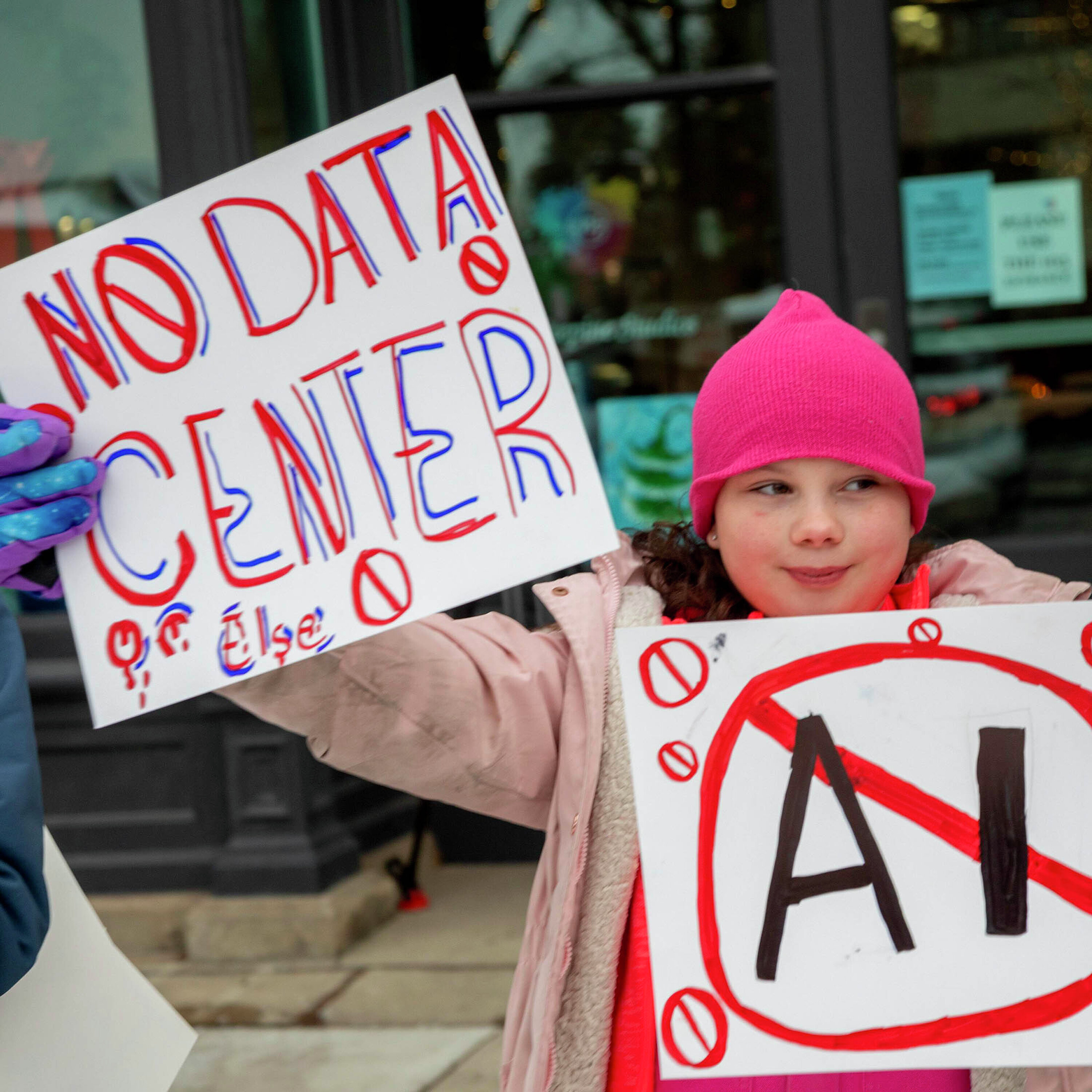
In this election cycle, artificial intelligence is on the ballot in many 2026 midterm elections, how to regulate it, what it means for jobs and for energy prices. And hundreds of millions of dollars are pouring into election races from competing super PACs vying to steer the AI conversation. Voters more and more election information from AI, and they're seeing campaign ads made with it. As one former U.S. official recently told Bloomberg, this is the first AI election.
- [02:35]
Michael Shepherd
We're seeing it in the campaign financing. We're seeing it in AI as an issue itself, in the way that people are now becoming truly and acutely aware of its impact on the economy. And it's also becoming a campaign Tool.
- [02:51]
David Gura
Michael shepherd is a Bloomberg senior editor for Technology and Strategic Industries who focuses on artificial intelligence.
- [02:57]
Michael Shepherd
It's rewriting the playbook for how candidates seek office and the strategies that they can use to gain an edge in competitive races.
- [03:06]
David Gura
Mike says the concerns about AI that are coming out this election season mirror the ones across our society at a moment when AI can tell us just about anything short of where the AI revolution will take us. This is the big take from Bloomberg News. I'm David Gura. On today's episode, the first AI Elections, what's at stake and who's working on the answers? Mike, let's start with campaign advertising. How has AI changed the kind of ads that the people see?
- [03:41]
Michael Shepherd
This is actually, David, a great place to start because this is one of the most visible areas for voters and the public to see AI AI shaping the elections. Candidates are deploying it effectively on the campaign trail. And in the past, to get an advertisement or a message out, you would have to get a radio spot, a newspaper ad, very expensive television advertising. And, you know, for candidates that were on a shoestring budget or just starting out or didn't have a name, that was tough. But AI is enabling them to create images and curate them very quickly. It's also allowing candidates to develop deepfake ads, you know, some that portray candidates in unfavorable lights to gain an edge in a race.
- [04:26]
David Gura
I got to imagine it's changing the way that voters research candidates, learn about candidates as well.
- [04:32]
Michael Shepherd
Oh, it sure is, David, because what we see is the same thing with politics that we see elsewhere in the economy. And there's some research by a progressive aligned group called Data for Progress that indicates that voters under the age of 45 are more likely to use AI as a tool to find out about candidates. And what that suggests also is that AI as a tool for political research is here to stay.
- [04:59]
David Gura
Mike, in your role helping to lead Bloomberg's coverage of AI, you have a special vantage. You're based in Washington, so you're looking at the way these companies are trying to influence politics and the political conversation. This is an election in which a lot of these companies and their affiliates are pouring a lot of money into these races. What does that look like in broad terms?
- [05:19]
Michael Shepherd
Well, in broad terms, it looks like a lot of cash. And, you know, to give you an idea, the pledges so far that we've, you know, gathered from across the industry amount to 275 million across the U.S. and, you know, that if fulfilled, would dwarf the amount that the crypto industry spent during the 2024 election when the digital currency industry was able to topple a number of Democratic incumb. And the AI industry is certainly trying to repeat that same playbook to its advantage.
- [05:58]
David Gura
Mike, I want to ask you about one race in particular. A primary race that took place here in New York City involving Alex Boris. He was one of the candidates running in this primary, running to be the Democratic candidate in the 12th congressional district, which includes a big part of Manhattan. Alex Boris lost that primary, but there was so much money in this one race. And I should say Michael Bloomberg, the owner of Bloomberg lp, the parent company of Bloomberg News, endorsed and contributed to the winning candidate Michael Lasher's campaign. But there was a lot of AI money in this race as well. What about it attracted so many big backers?
- [06:32]
Michael Shepherd
Well, it was Alex Boris, really, who drew all of that attention, and that was because as a New York State assemblyman, he had sponsored a number of bills that sought to rein in the industry. Governor Hochul just signed my raise Act. New York has the strongest AI safety law in the country. He pushed safety legislation. He also pushed a data center moratorium that ultimately passed. And so he came into this race with kind of a target on his back for a number in the industry who see the kinds of bills that he was proposing and the kinds of policies that he was advocating as a threat to their attempt to build out the industry at a breakneck pace. I mean, if people think I've been too friendly to tech, someone should tell
- [07:20]
David Gura
the executives at Palantir that are funding the super PAC against me.
- [07:23]
Michael Shepherd
And so, as a result, Alex Boris ended up drawing a lot of IT attention, but also a lot of money into this race. We estimate that $29 million were spent by all sides in industry, in the competition. Of course, he ultimately lost to the candidate who was favored to win, but it still drew a significant attention to the issue and made New York 12 kind of a proxy battle for the industry.
- [07:49]
David Gura
What's so fascinating to me is there was AI money on both sides of this race. Your team just reported that a super PAC called Leading the Future spent about $8 million opposing Boris. That super PAC supports softer regulation on AI, and it's funded by an OpenAI co founder, among others. Then on the other side, $15 million came in to support Boris from Public First Action, whose funders include Anthropic. Why were Anthropic's interests kind of aligned with Boris interests? And what have you seen from other companies in that regard?
- [08:20]
Michael Shepherd
Well, I'm glad you brought that Up, David, because it really does highlight that Silicon Valley is not of one mind when it comes to AI. There are a lot of people in the industry who also favor some restraint on the technology. And Anthropic is one of the leading voices. In fact, part of its branding is that it professes itself as a more responsible AI developer, one that places a higher priority perhaps in its competitors when it comes to safety. So they naturally lean toward a candidate who would favor more regulation. And that was Alex Bor's.
- [08:55]
David Gura
That race, the New York 12th primary, might have been an outlier in terms of how much money was, was poured into it. But stepping back, I wonder sort of how much of an outlier it is in terms of just the way that AI is a campaign issue going forward here, I think about the kind of broader zeitgeist, how people feel about AI, its prospects, its potential perils. How is that manifest in other races across the country?
- [09:17]
Michael Shepherd
Well, it's manifesting itself not so much as like the headline issue. Like people are not voting up and down on AI per se, but they are wrapping AI into all sorts of other questions, principally affordability. Because when you think about affordability, all you have to do is look at your electricity bill, if you live in certain parts of the country and see that, yes, it has gone up. We had a big take recently that looked at how electricity prices had more than tripled in some areas, up 267% as a result of all the AI data centers that are being built with all the investment from Silicon Valley. So people are looking at that and thinking, hey, you know, this is hitting my pocketbook. I feel it for real. They're also worried about their jobs. Will artificial intelligence come in somehow and change the way I do my job on a daily basis? Or perhaps eliminate it altogether, or maybe eliminate that entry level opportunity that might be awaiting my son or daughter, because that kind of lower level, maybe grunt work that was good for us when we were starting out could now be done by a machine. And then there is also just the distrust of Silicon Valley because policymakers here in the US have never really gotten around to resolving some of the key questions surrounding social media and how it should be overseen. And AI is an extension of that in a way, in many voters eyes. And they are concerned that the government is not going to be ready to step up here. And polls are showing, and we identified this in our big take, that they think that the government needs to do more.
- [11:00]
David Gura
Regulation isn't keeping up with advancements in AI and in the breach the US Government and companies like Anthropic are laying down rules as they go. That's next.
- [11:14]
The Hartford Representative
Support for the show comes from public.com if you're actively involved in your portfolio, you probably catch yourself repeating the same actions. Buying the dip, manually sweeping idle cash, putting on a hedge on Public you can now create AI agents that handle all these tasks on your behalf. Just describe what you want to do in plain English, like if the Vix hits 25, buy a put option on the S&P 500 or if my cash balance goes above $20,000, move the excess into my direct index. You approve the workflow and your agent handles the risk, monitoring the market, watching for your conditions and executing your strategies exactly as defined. An investing platform driven by your intent, not just your clicks. You can also get full read and write access to your account via the public API. Go to public.com market and fund your account in five minutes or less. That's public.com market market paid for by
- [12:10]
Michael Shepherd
Public Investing Brokerage Services by Open to the Public Investing Inc. Member FINRA and SIPC Advisory Services by Public Advisors, LLC. SEC Registered Advisor Complete disclosures available at public.com disclosures get the news you need
- [12:24]
Bloomberg Daybreak Hosts
in just 15 minutes.
- [12:26]
David Gura
Start your day with Bloomberg Daybreak, the podcast with a global view on the stories that matter. I'm Nathan Hager.
- [12:32]
Bloomberg Daybreak Hosts
And I'm Karen Moscow. Join us each morning for curated stories on current events, politics, business and foreign
- [12:38]
David Gura
relations, plus one conversation on the day's biggest developments, all in just 15 minutes.
- [12:43]
Bloomberg Daybreak Hosts
Subscribe to Bloomberg Daybreak for a precise, thoughtful take on the stories that matter.
- [12:48]
David Gura
Listen to Bloomberg Daybreak each morning on Apple, Spotify, or anywhere you listen.
- [12:53]
Maria Hinojosa
Granger knows when you're a procurement manager for an office park, you're not managing one building, you're managing all of them. And to stay ahead, you need to see through walls and around corners. Lights about to fail. Filters ready to clog H Vac on its last leg. If you wait until something breaks, you're already behind. Count on Grainger for quality products, easy reordering and 24. 7 support. Call 1-800-GRAINGER click grainger.com or just stop by Grainger for the ones who get it.
- [13:28]
David Gura
Mike, you just went through a lot of the concerns that people have about AI, how it's going to affect their jobs and their family finances, their communities, their privacy, their security. I know you've been digging into how these questions have been playing out with one company in particular that's anthropic and anthropic stance has brought it into conflict with the US Government. Things really blew up earlier this year when Anthropic effectively set guardrails on how the Defense Department, the Pentagon, could use its technology. And the Trump administration hit back, saying it would designate Anthropic a national security risk and effectively blacklist that company from being a government supplier. What's the latest on this fight?
- [14:05]
Michael Shepherd
Well, David, there was another conflict that erupted in early June between the company and the Trump administration, and it centered on Anthropic's top two models, Fable 5 and Mythos 5. In essence, the government was warning the company that it needed to contain what officials saw as a so called jailbreak. And that refers to an ability to get a around the safety and security guardrails. And if those concerns weren't addressed, the company would need export licenses from the Commerce Department to be able to share that technology with any foreign national, and that included any foreign person on US Soil. In effect, that forced Anthropic's hand. The company had to immediately disable access to those two models starting on June 12th until the security concerns of the government were addressed. Now, at the end of June, if we fast forward a bit, Commerce Secretary Howard Lutnick goes back to the company to say, look, you have now taken steps to address our concerns and in effect, we will no longer require export controls on those models. The move in effect has allowed Anthropic to begin releasing Fable 5 as originally intended to a broad group of users globally without any limits. Mythos 5, however, has been restricted still to just US users, users and on a more limited basis. And you'll remember, Mythos is that cyber capable model that everybody had really wanted to be able to use to test their own networks for possible vulnerabilities that could be exploited by hackers. And you know, David, this whole episode does raise some broader questions too. And in essence, they boil down to where the government is heading when it comes to AI regulation. The Trump administration really from the start, has insisted it would take a hands off approach to AI, especially in the area of regulation. However, it is unfolding on a bit of an ad hoc basis as we are seeing with its handling of Anthropic and those two models. And what's unclear is what the roadmap is ahead for Anthropic and its rivals, OpenAI and Google's DeepMind. As they start to roll out equally sophisticated models, will they have to go through the same sorts of checks before the government gives their clearance for release? It is the very kind of thing that Silicon Valley have been worried about and warning against.
- [16:31]
David Gura
Your team at Bloomberg just had an exclusive report that Anthropic raised an alarm of its own about Chinese users. Walk us through what happened.
- [16:39]
Michael Shepherd
We were privy to a letter and were told about a letter that the company had sent to several US Senators and White House officials warning that Alibaba, which is one of the biggest tech companies in China, had been improperly extracting data from the company's Claude model. And you know, Claude is really the centerpiece of Anthropic's product line. It is something that we have seen adopted across the economy by businesses and even consumers are using it widely. But what Anthropic is saying is that Alibaba and operators affiliated with it use tens of thousands of accounts to make nearly 30 million queries to Claude in a bid to take those results and then build its own model, one that would compete with Anthropics, but one that would also not carry the same degree of safety guardrails. This is a process called distillation. And I don't know how wonky we want to get here, David, but you're going to start hearing more about this work because Anthropic and other topics, USAI Labs have been warning about distillation all year long. Now, distillation itself is not illegal, and a lot of companies even allow it and encourage it to a certain level. But the issue is when they are extracting data at an industrial and systemic scale and then using it to develop a rival frontier model, that is when a line is crossed. In Anthropic's view and also in the view of companies like OpenAI, I want
- [18:21]
David Gura
to pull back and clearly there's a lot at stake here in terms of what kind of role AI plays in our lives, in our national security, in our economy. Also, just a ton of money riding on AI in global markets with big IPOs coming down the pike pretty soon here, what is that funding going to allow them to do?
- [18:38]
Michael Shepherd
Well, the funding is really everything. They need that money to keep building AI is, I don't want to call it the perpetual machine, but they really are investing in the infrastructure that they need to keep running those models. And it's expensive. Those chips from Nvidia can be tens of thousands of dollars apiece from amd. They're expensive and they need those on a scale that it's really hard to describe in a podcast or radio format. You really have to see the pictures of these data centers just to get an idea of the footprint that they occupy and also the amount of computing power that they deliver. And if you think about all the businesses across the economy and as they try to adopt AI and employ it, well, think of how much more computing power would be needed to make that happen.
- [19:32]
David Gura
Mike, let me close by asking you just when we think about where we go from here, who or what has the most power to kind of influence the conversation about how we're going to steer our adoption of AI, what are the odds that in two years time, if you and I were to sit down, the general election of 2028 would also be the AI election.
- [19:52]
Michael Shepherd
David I am going to mark the calendar for two years from now because, yes, we will have this conversation again. The stakes are only going to grow bigger because, you know, whoever is to succeed Donald Trump as the candidate for the Republican nomination, whoever is vying for the Democratic nomination, they will have to address these issues. And if there is, for example, a market correction or pullback or some other negative externality related to artificial intelligence, that too will be on the ballot. And if lawmakers and the administration really can't get it together when it comes to regulation, the conversation will only intensify. So you can count on it. 2028 AI will once again be on the ballot. It'll be part of the conversation politically and really for the foreseeable future.
- [20:48]
David Gura
This is the Big Take from Bloomberg News. I'm David Gura. To get more from the Big Take and unlimited access to all of bloomberg.com subscribe today@bloomberg.com podcastoffer if you like this episode, make sure to follow and review the Big Take. Wherever you listen to podcasts, it helps people find the show. Thanks for listening. We'll be back tomorrow.
- [21:14]
Bloomberg Daybreak Hosts
Healthcare doesn't always work great. If you've ever waited on a refill or couldn't schedule an appointment, you get it. That's the kind of stuff Optum is changing. They're using data and technology to integrate patient care, pharmacy and everything else. So healthcare is connected, not complicated. What's that look like? Cheaper prescriptions that are easier to get and care that looks at the whole person how you need it. Optum is helping make healthcare work as one for everyone. Learn more@business.optum.com the Bloomberg Sustainable Business Summit returns to Singapore on July 22. Our fifth annual Asia Pacific Summit will explore how business and finance leaders are shaping the next phase of globalization by strengthening resilience and driving a multi speed energy transition across Asia's diverse markets. Join us for solutions, driven discussions and networking opportunities. Thank you to our Summit advisor, Bangkok Bank. Learn more@Bloomberglive.com SBS Singapore. It's Latino USA. I'm Maria Hinojosa. I sit down with New York City Mayor Zora Mandani to talk about sports,
- [22:20]
Maria Hinojosa
immigration, politics, and the serious question of
- [22:24]
Bloomberg Daybreak Hosts
what makes a great New York city taco.
- [22:26]
Maria Hinojosa
But Mr. Mayor, as a Mexican, what have I done?
- [22:30]
Bloomberg Daybreak Hosts
What makes the best taco in New York City?
- [22:32]
Michael Shepherd
Oh, my God.
- [22:33]
Bloomberg Daybreak Hosts
Listen to Latino USA on the iHeartRadio app, Apple Podcasts, or wherever you get your podcasts.