Loading summary
Transcript59 lines
- [00:01]
Bank of America Announcer
Introducing B of A Rewards a new way to reward your every ambition. It all starts with a Bank of America checking account and grows from there. You get cash back deals on brands you know and love, plus a credit card rewards bonus, helping you earn more rewards on things you buy every day. Join B of A Rewards today for rewards tailored to your lifestyle. What would you like the power to do? Bank of America Open or enroll your account@bankofamerica.com bfarewards bank of America Corporation all rights reserved.
- [00:31]
IBM Representative
So there's a lot of noise about AI, but time's too tight for more promises. So let's talk about results. At IBM, we work with our employees to integrate technology right into the systems they need. Now a Global workforce of 300,000 can use AI to fill their HR questions, resolving 94% of common questions. Not noise proof of how we can help companies get smarter by putting AI where it actually pays off, deep in the work that moves the business. Let's create smarter business IBM when you're
- [01:01]
The Hartford Representative
running a business, the best days are the ones where priorities stay on track. For midsize and large companies, risk can affect multiple parts of the organization at once, from property and liability to cyber and regulatory challenges. At that level, managing risk becomes an ongoing discipline. At the Hartford, the focus is on helping businesses manage risk before it turns into something more disruptive. And when losses do happen, that work is paired with insurance coverage shaped by years of underwriting, risk engineering and claims experience. Learn more@the Hartford.com riskmitigation policies provided by Hartford Fire Insurance Company and its property and casualty affiliates, Hartford, Connecticut
- [01:43]
Podcast Host / Narrator
Bloomberg Audio Studios Podcasts Radio news
- [01:51]
Sarah Holder
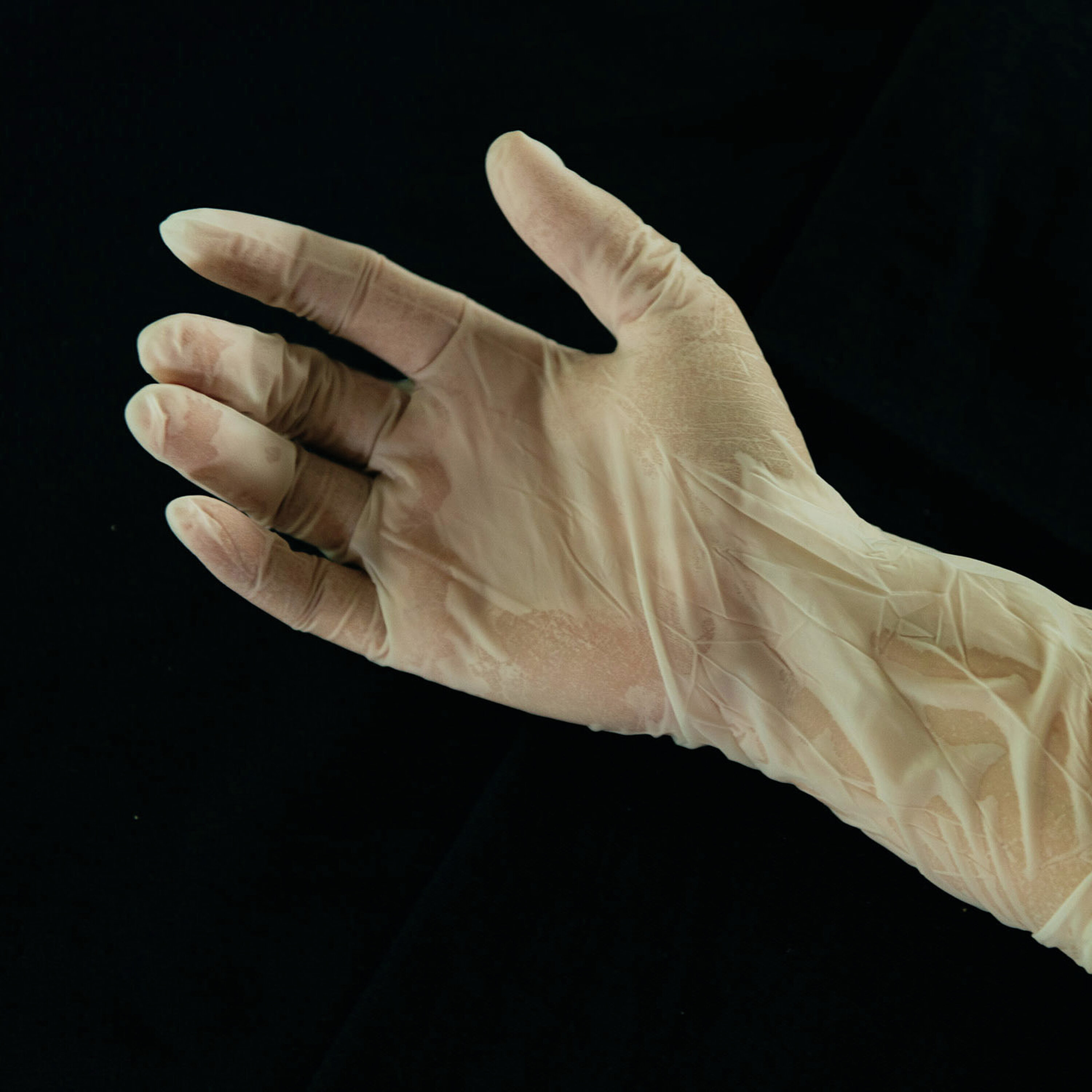
Nitrile medical gloves are supposed to be abundant and identical. They're all made out of the same material and engineered the same way so that medical professionals can use and remove them over and over throughout the day without skipping a beat.
- [02:05]
Anna Edney
These gloves are the ones you see in every exam room when you go to the doctor or the hospital.
- [02:12]
Sarah Holder
That's Anna Edney. She reports on the healthcare industry.
- [02:15]
Anna Edney
They're disposable. There are billions of these. There's about 120 billion that are used in the US annually.
- [02:24]
Sarah Holder
120 billion used every year in the US not only in the medical field, but in industries like food service, auto repair and pharmaceutical production. The US government alone buys around 2 billion of these gloves annually for federal workers like healthcare professionals and airport security. But only about 1% of these nitrile gloves are actually made in the U.S.
- [02:48]
Anna Edney
they are made in Malaysia, and the companies in Malaysia get the main ingredient for those gloves from China. That's where they get the petroleum product nitro butadiene rubber. So essentially, we are reliant on China for the medical gloves. And in addition to kind of the tensions with China, there's also the war with Iran.
- [03:12]
Sarah Holder
The war has disrupted ship traffic through the Strait of Hormuz, which has made it harder and more expensive to transport petroleum products.
- [03:26]
Anna Edney
Essentially, we're in this spot, which we sort of were in when Covid for different reasons, where the glove supply is kind of on thin ice and the hospitals are, you know, trying to make sure that they can get enough.
- [03:41]
Sarah Holder
When nitrile gloves were in short supply during the 2020 COVID 19 pandemic, the federal government came up with a plan to wean the US off of imported medical gloves and make more of them domestically. Since then, six American companies have been granted almost a billion dollars in government contracts to bolster the U.S. s manufacturing capacity and build more factories to produce NBR. Now the U.S. is staring down the possibility of another medical glove shortage, but Anna says the country still isn't prepared.
- [04:17]
Anna Edney
The companies are not making gloves and they're not making the rubber.
- [04:28]
Sarah Holder
I'm Sarah Holder, and this is the big take from Bloomberg News today on the show why the US couldn't stand up its own nitrile medical gloves industry in the years since COVID and what the failed push to make medical gloves says about broader efforts to reshore American manufacturing. So, Anna, you've been looking into the US's effort to ramp up domestic manufacturing of an extremely important product that often gets taken for granted. Nitrile gloves. Why are they so challenging to make in the us?
- [05:04]
Anna Edney
There's a really important key ingredient that's needed to make these. It's nitrile butadiene rubber, nbr. That mostly is coming from China. We do not make any of that NBR here. We used to make it here decades ago. It's just cheaper and easier with environmental regulations and things to do this in other countries.
- [05:30]
Sarah Holder
So that was the status quo for a long time. Right. The US would buy billions of these nitrile gloves a year, largely from other countries. But during the pandemic, the supply of medical gloves emerged as a real issue in the us. The US government had a plan for ramping up domestic supply. What was that plan?
- [05:47]
Anna Edney
Yeah, so we all learned, you know, that Covid was airborne. We wanted to protect ourselves. Certainly, you know, the medical professionals wanted to protect themselves. So the demand for medical gloves just skyrocketed. And, you know, hospitals weren't able to get them. What happened was the Trump administration, during the first Trump administration, during COVID was going to give out contracts to companies that were willing to set up glove factories or factories that could make the main ingredient in these gloves nitrile butadiene rubber. And then it was the Biden administration that actually gave out the contracts. So they gave out about $850 million to six companies to get that started.
- [06:39]
Sarah Holder
And how did that plan work out?
- [06:41]
Anna Edney
You know, some of them got started, they quickly folded. They shut down their glove operations. They weren't able to sell those essentially because they cost a lot more than the gloves made in Malaysia, where we get most of our gloves from. You sort of need more infrastructure than just the buildings and just the manufacturing. And during this time, you know, when the companies were were trying to get up and running, they quickly found out that already our ATT span had kind of switched in the US as it does especially with pandemics and kind of public health emergencies and the hospitals. Even the federal government were not buying what they were trying to make. The hard part about bringing an entire industry back to the United States or boosting it here, it's just that it costs more. And that's why manufacturing in a lot of instances has moved offshore. And to bring it back, you know, you sort of need more infrastructure than just the buildings and just the manufacturing. You almost need government subsidies to make it worth anyone's while to buy the products, to make sure they're there when the emergency happens
- [07:59]
Sarah Holder
after the break. What reshoring more nitrile glove manufacturing would really take.
- [08:07]
The Hartford Representative
Support for the show comes from public.com if you're actively involved in your portfolio, you probably catch yourself repeating the same actions. Buying the dip, manually sweeping idle cash, putting on a hedge on public. You can now create AI agents that handle all these tasks on your behalf. Just describe what you want to do in plain English like if the Vix hits 25, buy a put option on the S&P 500. Or if my cash balance goes above $20,000, move the excess into my direct index. You approve the workflow and your agent handles the risk, monitoring the market, watching for your conditions and executing your strategies exactly as defined. An investing platform driven by your intent, not just your clicks. You can also get full read and write access to your account via the public API. Go to public.com market and fund your account in five minutes or less. That's public.com market paid for by Public
- [09:03]
Anna Edney
Investing Brokerage Services by Open to the Public Investing Inc.
- [09:07]
Sarah Holder
Member Finra and SIPC Advisory services by Public Advisors, LLC.
- [09:11]
Anna Edney
SEC registered advisor.
- [09:13]
The Hartford Representative
Complete disclosures available at public.com disclosures Amazon
- [09:17]
Commercial Voice / Advertiser
Health AI Presents Painful Thoughts I I
- [09:23]
Bank of America Announcer
can't stop scratching my downtown. Yeah, but I'm not itching to go downtown and tell a receptionist I'm here to talk about my downtown. Some things you'd rather type than say out loud.
- [09:36]
The Hartford Representative
There's no question too embarrassing for Amazon Health AI. Chat your symptoms and get virtual care 24. 7 Healthcare just got less painful
- [09:47]
Commercial Voice / Advertiser
Innovation is what gets your business to market, and Wasabi is designed to give every business a shot at competition. How Break free from skyrocketing storage costs and unpredictable egress fees from old and top heavy legacy providers. You know, the big guys. Wasabi is the world's hottest cloud storage company and the go to provider for professional and collegiate sports teams and leagues around the world. And here's why. Innovation from Wasabi's AI enabled intelligent media storage, Wasabi Air to the industry's only cloud storage service with triple protection against cybercriminals, data deletion and ransomware. The world's top companies trust Wasabi. Remember, Wasabi is up to 80% less than market competition and doesn't charge a cent for businesses to access their own data. Wasabi Another championship story. Check them out for free@wasabi.com Wasabi Hot Cloud Storage proud partner of iHeart podcast network.
- [10:54]
Sarah Holder
Since the start of the US Effort to kickstart nitrile glove manufacturing domestically, the federal government has financed six companies with $850 million to build factories that make medical gloves, or NBR. One of the contracts went to a company called Blue Star NBR, which got $123 million in financing to help it build a huge NBR factory in southern Virginia. But the company's CEO, Scott Meyer, told Bloomberg's health care reporter Anna Edney that by now he's running out of money and the business still hasn't gotten off the ground.
- [11:35]
Anna Edney
The challenge that happened specifically for them in this case during COVID was that the price of construction went up and I think we all were sort of familiar with that and people trying to do projects at their houses or anything. The same applied to this factory. And so when they were in the middle, they had said to the federal government, we you know, we're not going to have enough money to basically plug it in and get it going. And it kind of sat in this limbo for a long time and the government has not, you know, wanted to fund it anymore to help them reach the end Point. The other issue is just if there weren't really companies making gloves in the country, then there's no one who's going to buy their nbr. They sort of didn't have that ability to have a revenue or anything to try to get going.
- [12:30]
Sarah Holder
I'm wondering, what does the Trump administration say about why the program didn't pan out?
- [12:36]
Anna Edney
Well, I was able to talk to a source who is familiar with the government thinking, with this Trump administration's thinking. And essentially they said that the administration felt that the Biden administration had made these bets on companies that didn't fulfill the promises of these contracts and they didn't want to keep putting money into that, which is why they told me they were stopping funding this, they weren't going to give any more money to try to get these companies up and running. And I did speak to Timothy Manning, who was with the Biden administration during this time, and he said actually, contrary to what that person had said was that those companies that they did fund, those six that they gave about 850 million, were sort of already picked out during the Trump administration.
- [13:28]
IBM Representative
Administration.
- [13:28]
Anna Edney
And the Biden administration was just, you know, continuing that program.
- [13:35]
Sarah Holder
Based on your reporting, what is your understanding of the biggest things that went wrong? The biggest failures in this program, the
- [13:41]
Anna Edney
biggest failures for the program were that there wasn't anything set up to make sure that these companies would be supported beyond just building the infrastructure to make gloves or to make nbr. What can happen too is they weren't all saying we definitely need more government money. They were saying we could get private capital. But no one wants to fund us because even the government won't buy our product. And so the biggest issue is sort of that a lot of industries in this way are heavily subsidized to get off the ground so that it makes it worthwhile for the American hospital system, the medical system, to purchase these gloves.
- [14:26]
Podcast Host / Narrator
Right.
- [14:26]
Sarah Holder
And the $850 million in contracts were meant to kickstart manufacturing, not actually purchase any of those gloves for government agencies. You also wrote about some of the US Based companies that make these gloves using imported materials.
- [14:43]
Anna Edney
How are those faring American companies that are making gloves with imported ingredients with imported nbr, they usually cost about double, sometimes even more than the Glo coming from Malaysia. These are, these are interesting companies. They also got started around Covid. There's about two or three. It depends on how you look at it. So they are starting to make headway in telling the government over and over. You know, some of them told me we are in D.C. several times a month. People I talked to in the government said we are surprised how often we are talking about gloves at this level because they're there constantly telling them, please buy our gloves. So that if you want this industry to be built up like this is what you have to do. And the government does seem to be recognizing that. The Office of Management and Budget told me that they were now going to start requiring that federal agencies purchase gloves from these companies that operate on US Soil.
- [15:55]
Sarah Holder
The OMB spokesperson also told Anna that the Department of Homeland Security has started coordinating purchasing instead of having individual agencies each make their own orders.
- [16:05]
Anna Edney
Another thing they are doing is there, it's a proposal, it's not yet finalized, but they are looking into Medicare giving higher reimbursements to private hospitals, other hospitals that aren't, you know, obviously government agencies, but that buy a certain percentage of gloves from these American companies.
- [16:26]
Sarah Holder
And the reason for that is because these gloves are more expensive to buy. And so if the government gets in this market, supports these domestic manufacturers, that will make it easier for them to break even.
- [16:39]
Anna Edney
It will make it easier for them, and it will be assigned to the market, to those private investors that they might need still for certain things, that there will be support there for them. The government's supposed to do this anyway. They're supposed to be prioritizing buying things made in the United States, to be perfectly honest.
- [17:02]
Sarah Holder
And Anna, there's new reason for urgency around this issue right now, right?
- [17:07]
Anna Edney
Yeah. I think the interesting question on this for me and one of the reasons I wanted to write it now, because the war is making it difficult for anything that's a petroleum based product. And as we talked about, the NBR is petroleum. So the price of the butadiene rose substantially throughout the war. A lot of the glove makers have fixed contracts with hospitals. So the hospitals aren't necessarily paying more right off the bat for these gloves when the ingredients cost more. The companies, the glove makers are the ones who get hit really hard. And there was a threat that they could close down. That even led to a lot of the hospitals being on what's called allocation. They were limited by how many gloves they could buy because they didn't want people panic buying. So, you know, the idea was if we had just gone ahead and done a better job and successfully been able to boost the glove industry and finished this NBR plant in Virginia, we might have been in a very different position.
- [18:13]
Sarah Holder
And in the end, none of the companies the government financed ended up being successful. You wrote that they, quote, either never got going or ceased operations and laid off workers when they couldn't find buyers. As for Scott Meyer in Virginia, does he see any hope or relief coming down the line?
- [18:32]
Anna Edney
I think he is, he's pretty dejected at this point in the sense that the government has said we will purchase from companies that are operating on American soil, but they did not say they would get these companies that weren't able to make it over the finish line. So Scott told me that he is contemplating selling the factory essentially for parts. It will likely go somewhere in China because that's who's making nbr. The building itself, the land where it's at, it was actually given to them, granted by the county government because it was supposed to bring a lot of jobs. And I think, you know, he's feels terrible that the jobs aren't there, that this didn't bring the infrastructure that he had hoped. And, you know, I think he's, he's, his contract that he did have is up at the end of July, so he doesn't really have that long. And the government has said, you know, this is it, like we aren't giving you more money. You know, this was a great example of how difficult it can be to reshore manufacturing. There are a lot of things to contemplate when we're trying to do that. And it's not just that, oh, we threw up a factory and we're able to start making. It's how can we actually support this industry down the road? How can, you know, we make sure that there's a way for it to be affordable, which can be very difficult and is one of the reasons that the offshoring happened in the first place. Place.
- [20:12]
Sarah Holder
This is the big Take from Bloomberg News. I'm Sarah Holder. To get more from the Big Take and unlimited access to all of bloomberg.com, subscribe today@bloomberg.com podcastoffer if you like this episode, make sure to follow and review the Big Take. Wherever you listen to podcasts, it helps people find the show. Thanks for listening. We'll be back tomorrow.
- [20:43]
Podcast Host / Narrator
Healthcare doesn't always work great. If you've ever waited on a refill or couldn't schedule an appointment, you get it. That's the kind of stuff Optum is changing. They're using data and technology to integrate patient care, pharmacy and everything else. So healthcare is connected, not complicated. What's that look like? Cheaper prescriptions that are easier to get and care that looks at the whole person how you need it. Optum is helping make health care work as one for everyone. Learn more at business.optum.com Big transfer news today.
- [21:15]
Commercial Voice / Advertiser
Who's moving me to the couch with Domino's? Best deal ever since they just added stuffed crust.
- [21:20]
Anna Edney
Any pizza?
- [21:21]
Podcast Host / Narrator
Any toppings?
- [21:22]
Anna Edney
Now with stuff Cross for $9.99.
- [21:24]
Commercial Voice / Advertiser
It's a long term contract with no
- [21:26]
IBM Representative
release clause only 9.99.
- [21:29]
Anna Edney
Yeah, that sounds like the move. I'm heading straight to dom.
- [21:34]
Commercial Voice / Advertiser
Price is higher for some locations. Excludes Excel and specialty pizzas. Select this offer from 615 through 726 online only. Size availability varies by crust type. Max 7, topping 6 for pan and New York style crust. Minimum purchase required for delivery. Prices, participation, delivery area and charges may vary across America. Money is being abandoned. By taking a few seconds to check Lyft before your next ride, you can give money a better home inside your wallet. Save the money. Check Lyft.