Loading summary
Transcript44 lines
- [00:03]
A
Bloomberg audio studios podcasts radio news.
- [00:16]
B
This past weekend, Chokwan Kitty Shopaka walked into a dispensary in a quiet residential neighborhood in Bangkok and picked up 10 grams of a marijuana strain called Wedding Cake. Chokwan, who goes by Kitty, is a cannabis rights activist. Just last year, she was on the other side of the counter running her own dispensary, but she shut it down after she couldn't secure the license required for a new location. And the business was already struggling.
- [00:48]
C
I was about to go into debt, so I decided, yeah, I think it's probably time for you to walk away.
- [00:54]
B
Kitty isn't the only dispensary owner to close shop lately. Ever since the Thai government tightened regulations last June, the more than 7,000 are expected to have shut down in 2025. It's a stark reversal for a sector that was once full of promise. In 2022, Thailand became the first country in Asia to decriminalize cannabis, sparking dreams of a booming market and a new era of tourism around marijuana wellness. Now, nearly four years later, that vision has largely gone gone up in smoke. Today, the fate of the Thai cannabis industry looks uncertain. This weekend, Thailand will hold a general election. The results could determine whether the country will roll back its short lived cannabis experiment.
- [01:43]
A
There's significantly less willingness to defend this flagship policy.
- [01:48]
B
Our colleague Papicha Tanaka Semphipat, known by her Thai nickname Best, reports on Thailand out of Bangkok. She says Thailand's cannabis industry is paralyzed by murky rules and a mounting social backlash.
- [02:02]
A
Cannabis became so rampant and ubiquitous that it's impossible to ignore. There were shops everywhere with unclear rules. There were growing concerns about access for children. People came to think that the government has lost control of this industry and felt that it was a threat to public health and social order. And so now the cannabis businesses are also getting really anxious that there would be no future for this policy after this election because no party is now willing to champion it, not even the original champion itself.
- [02:54]
B
This is the big Take Asia from Bloomberg News. Hi, I'm Wan Ha. Every week we take you inside some of the world's biggest and most powerful economies and the markets, tycoons and businesses that drive this ever shifting region. Today in the show, Thailand's chaotic cannabis experiment is at a crossroads. After a wild boom in dispensaries and green tourism, the marijuana high is fading fast. What's now at stake for businesses, consumers and Thailand's reputation? Thailand first legalized medical marijuana in 2018. Four years later, the government removed the drug from its narcotics list. Effectively opening the door for recreational use. Best says at the time, the mood on the ground was electric.
- [03:46]
A
It felt like Thailand was moving towards something of a more progressive country. And at the same time, we were also talking about gay marriage or civil union at the time. So it felt like the overall direction of Thailand was moving towards something progressive and modern.
- [04:04]
B
Cannabis has a long history in Thailand. People have used the drug for centuries. It was a popular ingredient in recipes and herbal remedies long before it was banned in 1925, Best says when the government decriminalized the drug in 2022, it was billed as a cash crop for farmers and a fast way to boost the struggling economy.
- [04:25]
A
It was pitched as a new way to revive the tourism industry, which contributes to about 20% of the GDP, but was ravaged by the COVID pandemic. There was a lot of hope pinned on this industry, and researchers at the time were estimating that it could become a $1 billion industry by 2025, which would have been now.
- [04:48]
B
And the country embraced the high almost overnight. Marijuana shops sprang up from Phuket to Chiang mai, eventually reaching 18,000 nationwide last year.
- [04:59]
A
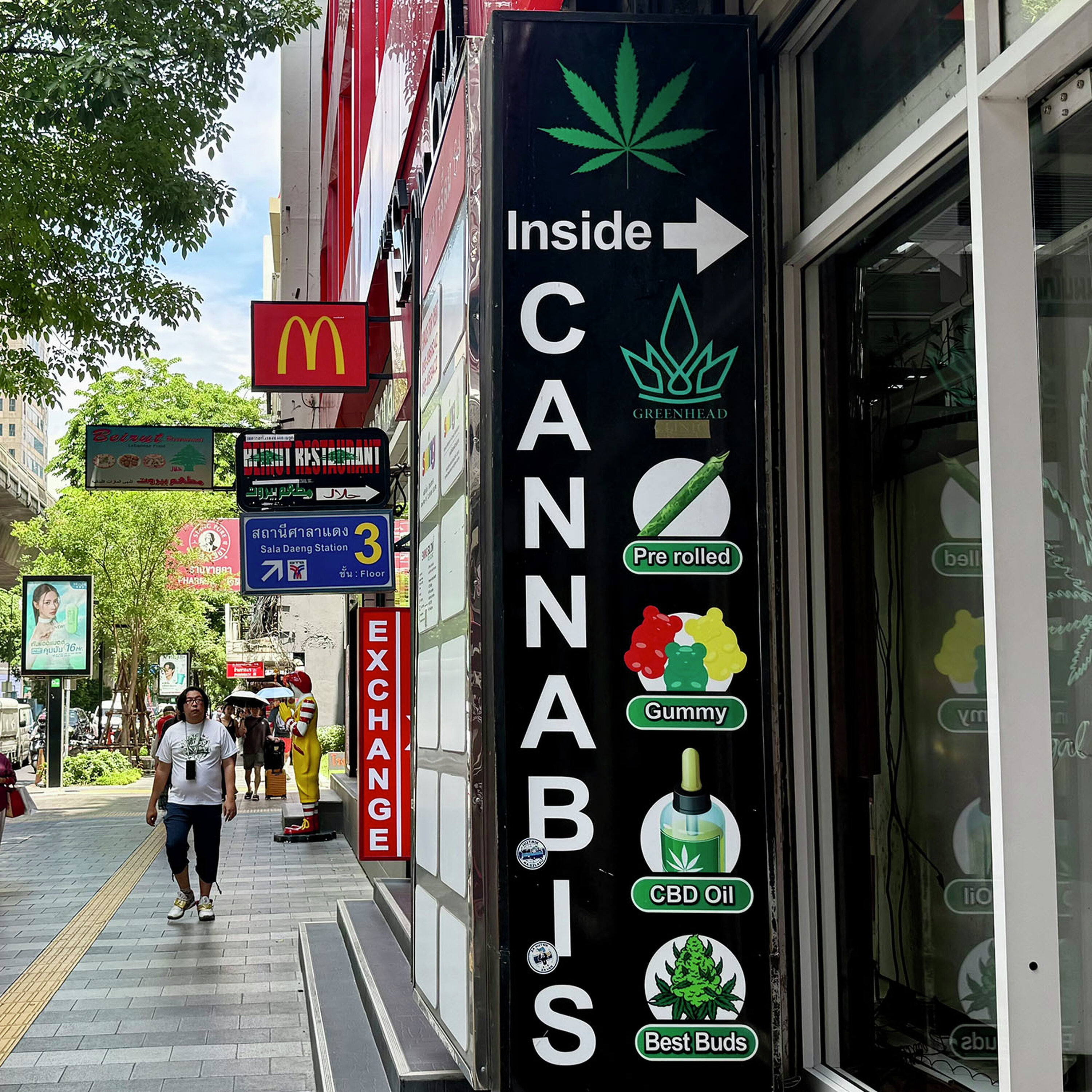
Everywhere you go, like every corner of the street you turn, there is at least one dispensary with green neon lit signs showing cannabis leaves or something similar. And they sell everything from cannabis buds in very fancy jars, ready rolled joints, edibles like gummies and cookies laced with thc.
- [05:20]
B
But Best says when Thailand decriminalized cannabis, it failed to put in place a legal framework to regulate this new explosive industry. All these businesses, from farms to dispensaries, operated with minimal oversight, and that sowed the seeds of the industry's unraveling.
- [05:38]
A
When cannabis was removed from the narcotics list in 2022, the government made it a controlled herb. And Thailand didn't immediately have a comprehensive law that was passed by parliament in order to govern or regulate the wider use of cannabis. It unleashed a mushrooming of an industry that was not yet regulated. And so this regulatory vacuum is what allowed so many dispensaries to keep popping up without clear compliance standards. And they were operating in what seems like a gray zone for a long time.
- [06:13]
B
Kitty Shopaka, the cannabis activist who we spoke to earlier, remembers the chaos of.
- [06:19]
C
Those early days, the day of legalization. Someone was calling me from the US and go, we already have a few tons in Thailand from the US ready to be distributed. Do you want to buy some? And that's not what I want legalization to happen for. That's not the people that I want to support. That is no different than going back to buying black market. And that was the thing that happened. It flooded our market until the price went down, which then kind of pushed a bunch of people out.
- [06:55]
B
The lack of clear law and enforcement didn't just allow illicit cannabis into the market. It also threw the industry's economics out of whack.
- [07:04]
A
There was also an oversupply of cannabis dispensaries, which are competing for a pool of smokers and consumers that are not growing at the same rate.
- [07:17]
B
In the absence of an overarching legal framework, the cannabis market is governed by a patchwork of rules and regulations that change with each administration.
- [07:27]
A
There have been various governments since 2020 to. So what the governments have had to do was release this series of ministerial regulations that did not need to be cleared by parliament. These ministerial regulations are very individual and specific, and they are revised every so often to keep plucking this vacuum. But what that means on the ground really, is that how cannabis should be used, how it can be produced, exported, who can hold the licenses, who can ask for one, what kind of certifications would they need? All that was very much up in the air.
- [08:07]
B
One big argument for decriminalizing cannabis and expanding it beyond medical use was that it would help boost tourism. Supporters said looser laws could draw visitors eager to try legal marijuana in Thailand. But Bess says that surgeon never materialized.
- [08:24]
A
At first, cannabis was included in a pitch for medical and wellness tourism. But cannabis proved to not be a strong enough reason to visit Thailand for that, because Thailand was already attracting tourists for its beaches and food and nightlife and wellness and luxury and affordability. But cannabis did not meaningfully expand that base. It just became sort of an add on experience for people who were already planning on visiting. But lately also that has started to fade.
- [08:57]
B
Last year, Thailand saw its first drop in tourist arrivals in years. A number of issues kept visitors away. Border conflicts with Cambodia, reports of scam center abductions, and a political crisis deterred international travelers. The tourism slump was just the latest blow to the cannabis industry. The market was already flooded with weed and unable to find enough buyers. Thousands of businesses were struggling. A study in 2024 found that only one in four companies surveyed was turning a profit. Here's kitty again.
- [09:32]
C
The changes was actually quite stark in terms of profitability. The ones who actually made real money is the one who got out at the end of that year, the one who sold their businesses, the one who did M and A when the price was high.
- [09:50]
B
Last June, the Thai government introduced new rules that ban cannabis purchases without a doctor's. Prescription. For many businesses, it was the last straw. By the end of last year, more than 7,000 licenses lapsed. That's nearly 40% of the entire industry. And the rest, their future depends on the results of the upcoming election. This Sunday. We'll dive into that political turmoil after the break. At first, the Thai people supported the decriminalization of cannabis. They hoped it would spur tourism and boost revenue and growth. They also saw it as a sign of Thailand's progressive modernization. But Bloomberg's Papicha Tanaka, Semphipat, or Best, says four years on, those hopes have faded. Public sentiment has done a U turn. Many people who supported the marijuana industry have become active critics.
- [10:59]
A
What we're seeing is a reaction to unintended consequences. We've seen parents, doctors, and conservative groups raising alarm about youth access to cannabis and effects on people's mental health. We've seen research by doctors that show increased cases of hospitalization and cannabis induced psychosis and dependence. So the public opinion swung the other way very, very quickly.
- [11:30]
B
A 2024 survey found that most Thais, more than two thirds, want cannabis to be reclassified as a narcotic. And Thailand's political parties have taken note of the change in public opinion.
- [11:43]
A
The issue is that cannabis became very politicized because it was tied to a political identity of one party that made it happen. And so when Thailand was hit with several bouts of political instability over the last few years, cannabis became something of a weaponized tool in order to gain leverage or undermine political rivals.
- [12:12]
B
In the 2023 election, cannabis emerged as a key campaign issue with several political parties including it in their policy platforms. But Best says this time around, it's become a political hot potato.
- [12:27]
A
No major parties are defending the free market cannabis boom anymore. It has become something that nobody wants to touch politically. It has become such a political liability because of the strong sentiments from the public about the issue.
- [12:44]
B
The tides turned so much that even the politician who championed decriminalization has now distanced himself from the issue that helped bring him into office. The country's prime minister, Anutin Chand Biragoon, known as the Cannabis King, is now staying silent. And so has his bum.
- [13:02]
A
Chai Thai party has itself transformed from a mid sized junior party with rural support to something of a leading conservative party for Thailand. And as it is trying to widen its appeal to more conservative voter bases, it has had to shed this image of being a pro wheat party.
- [13:29]
B
The ruling Pum Chai Thai party told Bloomberg that its cannabis policy has been, quote, distorted heavily. That the party's motive for decriminalization was hijacked by people who took things too far.
- [13:41]
A
Pungjae Thae says that they had only ever intended to decriminalize cannabis for medical use, but the runaway industry just went rampant with recreational use that they never intended to happen. The deputy leader of the Pum Ja Thae party that we spoke to said that if the party stays in power after the next election, they plan to regulate the industry with a cannabis bill to make it available only for medical purposes.
- [14:09]
B
The Pum Chai Thai Party is one of three that will dominate the general elections this weekend. The two other frontrunners are the Reformist People's Party and the populist Puotai Party. None of them are expected to win a majority of the 500 contested seats in Parliament. That means the parties will likely have to form a coalition government. Neither the People's Party nor Phu Thai have made any kind of formal pledge regarding cannabis.
- [14:37]
A
The poll favorite Reformist People's Party. The leader, Natapong Ren Bernhard, was recently asked on the campaign trail about what his stance is on cannabis decriminalization and he said that if the People's Party takes power, they will rein in recreational use and make cannabis available only for medical use. As for the anti drug Planetary Party, the answer is very simple. If they are in power again, they will rein in cannabis use by totally recriminalizing it.
- [15:16]
B
So it sounds like no matter who wins, we're going to essentially see a rollback of the cannabis industry whichever way.
- [15:23]
A
The election turns out. Cannabis seems set to be on a path for a rollback and the question is how much. And that depends on who the next governing coalition will be. Across the political spectrum, there's a general consensus that open recreational use should not continue as it did after decriminalization, and political parties are now competing on who can manage that restriction most effectively. The discussion is no longer on whether let recreational use stay on the way it is now.
- [16:00]
B
Regardless of the election results. Things don't look good for Ty Weed, Best says. It's still unclear how further regulation would play out for businesses on the ground.
- [16:10]
A
Just because the shops had to close, that doesn't mean that they will stop selling, period. Right? They will just go back to the channels that they had to resort to before decriminalization happens and this will just be force these operators to go back underground where cannabis will still continue to exist with no oversight.
- [16:33]
B
Best says the stakes go beyond the cannabis industry itself. How things unfold after the election and how the cannabis market is treated by the government could influence Thailand's reputation as a place to do business.
- [16:48]
A
Thailand's early cannabis experiment put it on the map as a sort of policy innovator. It became the first country in Asia to do this in 2022. But in Thailand's case, the decriminalization comes first, and that can be seen as reform. But regulation did not follow, and now the country is left trying to manage the response to the social and political consequences of the decriminalization. The subsequent tightening of regulations has also sent a message that reforms can be reversed very quickly if the public confidence isn't in place or isn't aligned with it. And this is not just about the cannabis industry, but also any other industry that might be vulnerable to volatile policy swings. And this might tell investors that they should look elsewhere to invest somewhere with stronger governance, somewhere with more legal regulatory certainty.
- [17:59]
B
Back in Bangkok, at the dispensary where Kitty picked up her marijuana, the mood is subdued. She's the only customer that day. Looking around the shop, Kitty talks about the early days with the staff and said she remembers well when the industry was flying high with optimism and shops were packed with customers. Those days, the shop attendant said, are long gone. This is the Big Take Asia from Bloomberg News. I'm Juan Ha. To get more from the Big Take and unlimited access to all of bloomberg.com, subscribe today@bloomberg.com podcastoffer if you liked the episode, make sure to subscribe and review the Bigtic Asia. Wherever you listen to podcasts, it really helps people find the show. Thanks for listening. See you next time.