Loading summary
Transcript35 lines
- [00:03]
Golnar Motavali
Bloomberg Audio Studios Podcasts Radio news.
- [00:09]
David Gura
The United States and Iran could return to the negotiating table this week. The two countries held a round of indirect talks on Friday, and both sides said that meeting was a good start.
- [00:19]
Unidentified Commentator
Looks like they want to make a deal very badly, as they should.
- [00:23]
David Gura
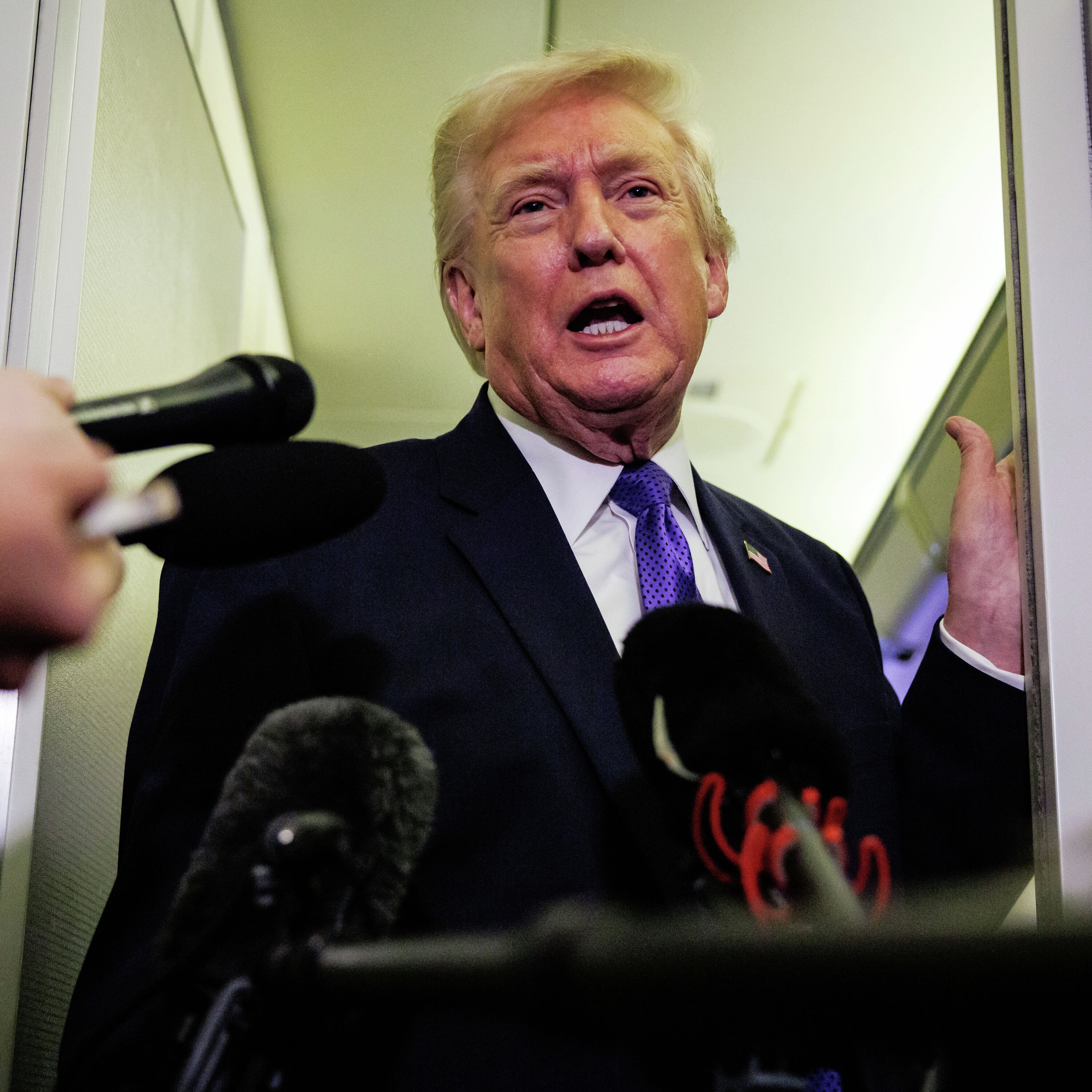
After those talks ended on Friday, President Trump spoke to reporters on Air Force One.
- [00:28]
Unidentified Commentator
Last time. They decided maybe not to do it, but I think they probably feel differently and we'll see what the deal is. It'll be different than last time and we have a big armada, we have a big fleet heading in that direction.
- [00:42]
David Gura
Trump said Iran knows what the consequences would be if it doesn't reach a deal with the US but he said for now at least, there's no rush. Iran's president described last week's negotiations as a step forward, but he also said Iran does not, quote, tolerate the language of force. These are bilateral talks with Oman mediating, but other countries are watching them closely. Israel's Prime Minister Benjamin Netanyahu is scheduled to meet with President Trump in Washington on Wednesday.
- [01:11]
Golnar Motavali
The issue is, as we turn our focus on geopolitics and diplomacy and what men in suits are saying or not saying is that we lose sight of what's going on on the ground in Iran.
- [01:25]
David Gura
Bloomberg's Golnar Motavali has covered Iran for more than a decade from Tehran and from London, where she's currently based. And Goldar says the situation that thrust Iran into this weakened negotiating position in the first place is not letting up. Economic turmoil that drove Iranians to nationwide protests.
- [01:42]
Golnar Motavali
The reality is, is that a large number of Iranians want to see change and they have been desperately making that point and making that case and risking their lives for that and giving their lives in large numbers.
- [02:02]
David Gura
Over the weekend, Iran's violent crackdown on dissidents and protesters continued with the arrest of several prominent activists. Security forces have reportedly killed almost 6,500 people, according to human rights organizations. President Trump previously threatened to use the US Military to support the demonstrators, but it's not clear if violence against dissidents would alone and at this point provoke a U.S. military response.
- [02:26]
Golnar Motavali
The Islamic Republic, if you look over the past nearly 50 years that it's been running Iran, it's never been in a situation as challenging and precarious as this. So I think within that context, these talks definitely provide an off ramp to this regime to try and hold on to power for longer.
- [02:54]
David Gura
I'm David Gura and this is the big take from Bloomberg News. Today on the show, diplomatic talks between the US And Iran are set to continue this week. What does each country hope to achieve and what's at stake if these negotiations fall apart? The United States and Iran have started talks again after a months long pause. The last round ended in June after the US Struck Iranian nuclear sites. I asked Golnar what brought them back to the negotiating table.
- [03:25]
Golnar Motavali
So right now, as far as Iran is concerned, it's in the middle of a unprecedented crisis. We had these huge protests that erupted on 28 December and grew into something much bigger than what looked initially like a reaction to a currency crash. It became a much more broader, wider, widespread rebuke against the Islamic Republic as a system of rule. And Supreme Leader Ayatollah Ali Khamenei.
- [03:56]
David Gura
Iran is still reeling from those demonstrations and from those U.S. airstrikes from back in June. And its allies in the region, including Hamas and Hezbollah, have been significantly weakened. All of that means Iran is negotiating from a position of relative weakness. But that doesn't mean these talks will be easy. For starters, the two countries have disagreed on the scope of the talks and even on where they should take place.
- [04:19]
Golnar Motavali
The other interesting dynamic in these talks is that they're indirect. And from what we could discern from the reports we were getting from journalists on the ground who were there, including Iranian state TV media reporters who had a camera on the location the whole time, they were very much very indirect to the point where it looked like they were taking turns to send messages to the Omani mediator and then waiting to get a response again via the Omani mediator. So it was a bit of a relay, physical back and forth between the two. But the other interesting thing that happened, given so much is at stake, particularly for Iran, is that both sides sounded cautiously positive using this word. Good.
- [05:06]
Unidentified Analyst
So do we have any indication if they plan to meet or what might be on the table if they were to meet once again?
- [05:12]
Golnar Motavali
Yeah. So they have said that they plan to meet. They haven't given a time or date. I have a feeling that may have something to do with the fact that the Israeli Prime Minister Benjamin Netanyahu is likely to want to talk to the Americans. And I think all eyes at this moment in time are going to be on how Israel reacts because we know that Netanyahu specifically is not a fan of a U S Iran negotiating process in which he is not involved in. At least if he's not involved in directly, he wants to know the direction it's going in and he tends to not like it to go in a direction that he feels benefits the Iranian regime as it currently stands. And I think one of the concerns is if he feels that the Trump administration is going to go ahead and secure some kind of deal from Iran, that he could possibly preemptively strike Iran again. And I think that would be very concerning and definitely escalating.
- [06:23]
Unidentified Analyst
And Prime Minister Netanyahu is scheduled to meet with President Trump on Wednesday of this week.
- [06:28]
David Gura
Could I ask you about the goals of each side?
- [06:30]
Unidentified Analyst
So, without oversimplifying, it seems like for Iran, it would be to forestall or take military action off the table. The US Wouldn't strike Iran, and maybe some sanctions relief. Does it go beyond that? Do we know concretely sort of what they want the outcome of these talks to be?
- [06:45]
Golnar Motavali
I think the only thing we can go by is what they've said so far. Officials said that Iran's priority is to protect its national self interests and to secure some sanctions relief, because a lot of the domestic problems, not all of them, but, but a fair amount, are either rooted in or at least exacerbated by the economic conditions inside the country. And so much of that comes down to sanctions relief. If they want to avert and stave off another eruption of massive unrest, I don't think they can achieve it in the long term, but they can put it off for a bit longer or try to prevent it from happening again is to very quickly do something that brings an injection of foreign exchange into the country.
- [07:42]
David Gura
For the US A clear priority is the cessation of Iran's nuclear program. Officials have also said these talks should address Iran's missiles and Tehran's support for regional militias. But I also wonder whether there's a bigger objective here, some march toward regime change. Gunnar, what is the U.S. s goal here?
- [07:59]
Golnar Motavali
I think there are a lot of people in the Trump administration who are very clear about the fact that they want regime change, and they have wanted it for a long time. But I think there is a sense in the Gulf amongst Gulf officials to an extent that a lot of what may happen may rest on not just Netanyahu, but what Netanyahu's supporters in Washington want to see happen to Iran and the extent to which they can influence Donald Trump's decision making. I mean, the crazy kind of situation we're in right now or the unusual situation, is that I think quite clearly countries in the region, and I'm thinking specifically about the Gulf Arab states, countries that are allies of the U.S. like Saudi Arabia, Qatar, they don't want a war, they don't want anything that's going to escalate tensions. That's going to be destabilizing. They certainly don't want chaos or civil war or, or some extraordinary, catastrophic situation in Iran. It's this huge country across a very narrow channel of water to their north, and it's not good for anyone.
- [09:13]
David Gura
President Trump has said if diplomacy fails, the consequences for Iran would be, quote, very steep. The likelihood of another US Strike on Iran and what could prevent that from happening is coming up.
- [09:39]
Unidentified Analyst
We've talked a lot about diplomacy, but looming in the background here is the threat of military action. And we've seen the president draw this parallel to what happened in Venezuela. How do you think about the prospects of that military intervention, what that would mean if the US Were to go that route?
- [09:55]
Golnar Motavali
I think it's possibly the worst case scenario from the point of view of a lot of other countries in the region. And I think the reason why the Gulf Arab states, particularly those that are allies of the US it leaves them extremely vulnerable. And we saw during the 12 day war with Israel, when the Trump administration joined that bombardment at the very end, effectively kind of like preempted a ceasefire. The Iranians retaliated by sending a barrage of missiles in the direction of the largest US Military base in the region, which is in Qatar, that really, really did not. I mean, obviously the Qataris were extremely, extremely worried and upset over that. And I can't imagine them tolerating something similar happening again along those lines. On the other hand, we also have the Iranians saying repeatedly over the past few weeks, basically, since this flotilla started to move in the direction of the, of the Red Sea, that any military action by the Trump administration would basically provoke the full rough of the Islamic Republic. They've made that very clear, that we will throw whatever we have at you and your allies and your assets in the region if you strike us.
- [11:24]
Unidentified Analyst
And the Supreme Leader has talked about a regional war as a necessary consequence of that.
- [11:27]
Golnar Motavali
Yes. And I think they are saying that because they want to change the strategic calculation on the side on behalf of the Americans and even the Israelis. I think that message also, because after the 12 day war, I think there was generally a feeling and a sense, not just in Tehran, but outside, that the Israelis may attack again. And I think the Iranians were genuinely concerned about that. So I think that's also a message.
- [11:57]
Unidentified Analyst
To the Israelis of those limited options. It seems to me there is still an economic one that could block the Strait of Hormuz. They could, with regional partners.
- [12:08]
David Gura
Perhaps do.
- [12:09]
Unidentified Analyst
Some blockade in the Red Sea. From an economic vantage, how much would that do? How much could that do to the global oil market?
- [12:18]
Golnar Motavali
I mean, I think that would be very worrying, right? I think if we had anything like that, I think even any mention by a senior Iranian official saying we will block the Strait of Hormuz if X, Y and Z happens. I'm not sure if that kind of language would immediately affect oil prices. But in the current climate and given what you have in the background, what's going on and how sensitive. Sensitive the situation is, it's more likely to drive prices up. And I think that's what Trump wants to avoid as well. I think this is also a question that we have to keep in the back of our minds is what his priorities are going to be going into the midterm elections in the US he probably doesn't want high oil prices more broadly in the country. No one wants that kind of inflationary pressure at that time, not, you know, as far as politics is concerned. And so I think that is something that he may think about for sure.
- [13:15]
Unidentified Analyst
I want to end with this conversation about regime change or the potential for regime change. So you've described the widespread dissatisfaction that I think a lot of us have seen in recent weeks, certainly in those protests. And drawing on your experience covering the country, does it feel like in this moment, that is closer than it has been, the prospects of there being regime.
- [13:36]
Golnar Motavali
Change in Iran, from speaking to people who are in Iran and mostly in Tehran, the biggest impression I get, or the most overriding sense I have is one of complete hopelessness. People are really sad. People talk of feeling depressed and again, this word hopelessness. And I think that's quite concerning. I think that can be quite dangerous for a country and for its leadership. But I do, I do think that, you know, in its current manifestation, the system of running Iran, which is a theocratic state that came in after the 1979 Islamic Revolution, this is no longer working for the population more broadly. I think that's quite clear. And I think the reality is that a large number of Iranians want to see change. And they have been desperately making that point and making that case and risking their lives for that and giving their lives in large numbers. They want change. And that tells you that whatever happens, the unrest is going to come back at some point. Unless there's a credible answer and a solution to the fact that a huge number of people in Iran, a large chunk of the Iranian population, feels completely adrift from its leadership, from the people who are running their lives, unless there's a credible way to address that properly, not just with sanctions relief here and there. That stuff is important to an extent, but it's the sticking plaster.
- [15:35]
David Gura
This is the Big Take from Bloomberg News. I'm David Gura. To get more from the Big Take and unlimited access to all of bloomberg.com, subscribe today@bloomberg.com podcastoffer if you like this episode, make sure to subscribe and review the Big Take wherever you listen to podcasts. It helps people find the show. Thanks for listening. We'll be back tomorrow.