Loading summary
Transcript71 lines
- [00:00]
IBM Representative
So there's a lot of noise about AI, but time's too tight for more promises. So let's talk about results. At IBM, we work with our employees to integrate technology right into the systems they need. Now a global workforce of 300,000 can use AI to fill their HR questions, resolving 94% of common questions, not noise. Proof of how we can help companies get smarter by putting AI where it actually pays off, deep in the work that moves the business. Let's create smarter business IBM Whatever your
- [00:31]
4imprint Advertiser
goal, trade show giveaways, client Gifts or Team Gear 4 imprint has the promo products to match with thousands of options. From apparel and drinkware to tech and totes, it's easy to find the right fit for your brand and budget. With standout choices at every price point and with their 360 degree guarantee, you can be four imprint certain your order will show up just right. Right on time. Explore more@4imprint.com 4imprint for certain when you're
- [00:58]
Public.com Advertiser
running a business, the best days are the ones where priorities stay on track. For midsize and large companies, risk can affect multiple parts of the organization at once, from property and liability to cyber and regulatory challenges. At that level, managing risk becomes an ongoing discipline. At the Hartford, the focus is on helping businesses manage risk before it turns into something more disruptive. And when losses do happen, that work is paired with insurance coverage shaped by years of underwriting, risk engineering and claims experience. Learn more@the Hartford.com riskmitigation policies provided by Hartford Fire Insurance Company and its property and casualty affiliates. Hartford, Connecticut
- [01:40]
Bloomberg Audio Studios Announcer
Bloomberg Audio Studios Podcasts Radio
- [01:44]
Sarah Holder
news When Matt Mahan officially entered the race for governor of California in late January, he wasn't exactly a household name. Mahan was the mayor of San Jose. A centrist with ties to Silicon Valley, he was polling around 4%. But on the morning Mahan announced his candidacy, he got a boost from an
- [02:07]
Liam Vaughn
unexpected place on polymarket, which is the preeminent political prediction market in the world. There's suddenly a trade for $44,000 that comes into that market to back Matt Mahan's candidacy.
- [02:23]
Sarah Holder
That's Liam Vaughn, a reporter and editor on Bloomberg's investigations team based in London. He's been covering prediction markets, which allow users to bet on the outcomes of real world events.
- [02:35]
Liam Vaughn
Suddenly, his odds go from like the low teens all the way up to 96%. It's this huge spike.
- [02:42]
Sarah Holder
If you bet 96 cents that Mahan would win, you'd get paid out a dollar if you did. But before that big bet, you only needed to bet about 12 cents for the same payout.
- [02:53]
Liam Vaughn
And essentially the price fluctuates between 0 and 100. And that reflects the apparent odds, you know, according to that market, of an event happening. So when Matt Mahan's odds go from like 12% to 96%, at least for a few moments, what that market's saying is there's a 96% chance that he's going to be the governor of America's largest state.
- [03:20]
Sarah Holder
Quickly, other traders on polymarket saw an opportunity to make money. They started taking the other side of the bet, wagering that Mahan would lose. That started pushing his odds back down.
- [03:32]
Liam Vaughn
But the interesting thing about this market is it doesn't bring it back anywhere close to where it started. It goes to 36%, which is still very high for this guy who hasn't got much name recognition in a market full of, like, you know, very big, big names. And so immediately you start to see press coverage. For example, in the New York Post, there's a piece that runs that afternoon that says the smart money is backing Matt Mahan for California governor.
- [04:01]
Sarah Holder
Mahan did not respond to requests for comment. Ultimately, his poly market bump wasn't enough to win him the primary.
- [04:09]
Liam Vaughn
But eventually kind of gravity caught up. Other candidates with more money and more name recognition prevailed and ultimately Mahan kind of quietly exited stage left.
- [04:21]
Sarah Holder
But the $44,000 question remained. Who had made the bet?
- [04:26]
Liam Vaughn
We don't know very much, and I think that that's telling in and of itself because polymarket is crypto based, so the authorities don't know who it is. And unless this individual comes forward, nobody else knows who it is.
- [04:38]
Sarah Holder
Whoever it was had shaped the conversation around a major primary race. With one big Polymarket bet. And with the US Midterms fast approaching, it's just one example of how prediction markets could be gamed in elections.
- [04:53]
Liam Vaughn
What's fascinating to me about this incident is that it highlights the inherent vulnerability of some of these markets to manipulation. And so the questions that I was keen to explore were like, well, how is that able to happen? What safeguards are in place to stop it happening? And as we go into the midterms and, you know, elections globally, is this something that we're going to see much more of?
- [05:22]
Sarah Holder
I'm Sarah Holder and this is the big take from Bloomberg News today on the show. The dangers of mixing prediction markets with politics. Until relatively recently, gambling on politics wasn't allowed in the U.S. previously, there was
- [05:42]
Liam Vaughn
only a couple of forums that were allowing kind of political gambling, and they were associated with universities. And so it was, you know, studied. Like can these things reveal good information and are they useful forecasting tools?
- [05:55]
Sarah Holder
For years that restriction on political betting was enforced by the Commodity Futures Trading Commission, the federal agency responsible for regulating derivatives markets in the US. But in 2023, Kalshi, the largest prediction market platform in the US and Polymarket's chief competitor, pushed for those restrictions to be loosened.
- [06:16]
Liam Vaughn
The CFTC undertakes a review and ultimately it concludes as its predecessors had, that this is a bad idea, that it's against the public interest, that it's going to potentially encourage people to, to either try and make money from democracy or try and influence the outcome of elections and therefore it should be banned. That then goes before a judge. But ultimately the judge decided betting on politics is not gambling or it's not gaming as it's written in the statute. So it's a kind of nuanced argument, but ultimately it means that Kalshi and its competitors are allowed for the time being at least, to allow mass scale gambling on U.S. politics.
- [07:00]
Sarah Holder
That opened the floodgates right before the U.S. presidential election.
- [07:05]
Liam Vaughn
And so in the presidential election of 2024, I think it's like $4 billion is traded. And when both Kalshi and Polymarket predict that Trump is going to get in and the polls again are sort of prevaricating in some sense a tie, and the prediction markets perform much better in that question. That kind of adds to this sense of that this is a good thing and this is something that should be
- [07:31]
Sarah Holder
embraced to prediction markets and their boosters. This outcome seemed to confirm something important, that by harnessing the wisdom of the crowds, crowds with real money on the line, these markets can predict the future more accurately than traditional polling can. What happens next when the Trump administration takes office? How does the regulatory approach to these markets change?
- [07:54]
Liam Vaughn
I mean, It's a complete 180. Essentially the Trump administration comes in, they put their own people in charge of the various regulators and at the CFTC they get rid of all the Democrats and essentially put in some conservative commissioners who are predisposed to and are supporters of prediction markets. Essentially you see a real kind of shift in the administration's attitude towards these markets and as a result they explode.
- [08:24]
Sarah Holder
In December 2024, the monthly trading volume on Kalshi was $226 million. A year later it was $6.4 billion. At this point, how do Kalshi and Polymarket's approaches to political wagering differ?
- [08:40]
Liam Vaughn
Yeah, they're kind of the yin and yang of approaches. Kalshi has spent a huge amount of time and energy trying to position itself as the official market. It does KYC know your customer. So anyone that signs up has to provide details of who they are, where they live. And so anything that goes wrong or any sort of attempts at manipulation, Kalshi should in theory know who's behind that. Polymarket is crypto first and you don't need to provide your bank details. And essentially you could do it all anonymously. You could see via sort of a numerical or a kind of username what that account is up to on a kind of rolling basis, but you just don't know who it is.
- [09:29]
Sarah Holder
So, Liam, there was another moment that really marked the entrance of prediction markets into sort of the polling mainstream. After the election, after the shifted regulatory approach, polymarket and Kalshi made a string of deals with major news outlets.
- [09:45]
Liam Vaughn
Yeah, So I would describe it as a kind of feeding frenzy of deal making between Kalshi and polymarket and the mainstream media companies. So Kalshi have done deals with cnn, with cnbc, with Fox and several others. Polymarket have done deals with the Wall Street Journal, Dow Jones X substack. So there was a real strong financial incentive for some of these media companies to be citing these prediction market odds. And that's a kind of contrast with polls, because even though they carry polls, they're not getting paid by the polls to carry them.
- [10:24]
Sarah Holder
We don't know the details of all of these deals, but in the agreement between CNBC and Kalshi, CNBC can earn a fee every time someone signs up for Kalshi from its website.
- [10:35]
Liam Vaughn
The other criticism which we get into in the piece is that quite often, because these markets aren't very big outside of the major political events, they're easy to manipulate, and yet they're still cited regularly, just to give one example. But they're far from alone. But CNN has got this show called the Odds, and they will regularly use Kalshi odds as a sort of frame to talk about current political events. But often they cite markets that are very small. So, you know, there's a discussion around who's going to be the next speaker of the House. And we looked, and at the time it had like a total of 16,000 betting across its lifetime. So you sort of talk about a market where every day there's like, you know, a couple of hundred or a few hundred amounts being traded. So the question is like, is that a market that's robust enough to really be cited by mainstream media organizations? And there's Some people that argue, no, absolutely not.
- [11:36]
Sarah Holder
Yeah, I mean, it's like the Matt Mahan example. The Matt Mahan market was vulnerable to being moved by this one big bet. Some major outlets ran that story about Mahan's Poly Market odds governor's race without additional context. Does that happen a lot?
- [11:51]
Liam Vaughn
I mean, it happens more than you'd think, definitely. And it's not helped by the fact that because they've done these deals, they're sort of obliged to consistently refer to these polls.
- [12:01]
Sarah Holder
CNN says that, quote, prediction markets offer just one source of data that journalists can use in telling a story, unquote, and that CNN staff are prohibited from trading. A Kalshi spokesperson says that its media partners have, quote, full control over what and how and we don't tell them which markets to cite, unquote. CNN and Kalshi both declined to comment on how much Kalshi pays CNN to cite its data. Bloomberg lp, the parent of Bloomberg News, provides polymarket and Kalshi data as part of its broader data offering for clients. What do prediction markets themselves say about their utility as forecasters of election results and these risks that they pose?
- [12:44]
Liam Vaughn
So in terms of their ability to forecast events, Cauchy and polymarket point to research that suggests that they are consistently very good. They are at pains to say that they should be viewed as additive to existing forms of forecasting, whether that's polls or reporting or whatever else. In terms of the issues that we raise in the piece around the vulnerability of these markets to manipulation, Kalshi would say we are not the same as polymarket and we take our responsibilities to identify our customers and monitor what they're doing very carefully. And if there is anything untoward going on, then we will find it. Polymarket would say a couple of things. One is that in terms of market manipulation, these markets have a sort of degree of ability to self correct which is demonstrated. And so even if there are attempts at manipulation, they'll be quickly remedied. And so they would say, I think that the Mahan example is testament to that because ultimately, whilst these odds did move, they did also come back as the market kind of responded to that.
- [14:02]
Sarah Holder
Coming up, how prediction markets can be used to help spread misinformation and so doubt in election results.
- [14:12]
4imprint Advertiser
Whether you're planning a big tech event, launching a new campaign or just stocking up on team gear, finding the right promotional products makes all the difference. 4imprint offers thousands of options from on trend apparel and premium drinkwear to tech totes and giveaways. So you can find the right fit for any audience, purpose or budget. You can customize it all. Your logo, your message, your look and many items come with no setup charge to help you save. And if you're really watching the bottom line, you'll find standout choices at every price point so you can make a real impact while staying on budget. Plus you'll get expert help, fast turnaround times and their 360 degree guarantee. So you can be four imprint certain your order will arrive on time and look exactly right. Whatever your goal, 4imprint makes it easy to find your perfect promo match. Explore the possibilities today@4imprint.com 4imprint for certain,
- [15:06]
Public.com Advertiser
support for this show comes from public.com if you're actively involved in your portfolio, you probably catch yourself repeating the same actions. Buying the dip, manually sweeping idle cash, putting on a hedge on Public, you can now create AI agents that handle all these tasks on your behalf. Just describe what you want to do in plain English like if the Vix hits 25, buy a put option on the S&P 500 or if my cash balance goes above $20,000, move the excess into my direct index. You approve of the workflow and your agent handles the risk, monitoring the market, watching for your conditions and executing your strategies exactly as defined. An investing platform driven by your intent, not just your clicks. You can also get full read and write access to your account via the public API. Go to public.com market and and fund your account in five minutes or less. That's public.com market paid for by Public
- [16:02]
Liam Vaughn
Investing Brokerage Services by Open to the Public Investing Inc.
- [16:05]
Public.com Advertiser
Member FINRA and SIPC Advisory Services by Public Advisors, LLC. SEC registered advisor complete disclosures available@public.com disclosures think about it.
- [16:16]
Just Food for Dogs Advertiser
When it comes to your own food, you can walk into a restaurant, see what's being made and know exactly what you're getting. But with dog food, most brands keep that completely hidden. Just food for dogs does the opposite. They've built their entire brand around open kitchens. You can actually walk in and watch them prepare your dog's meals with real human grade ingredients like chicken, beef, carrots and peas cooked right there in front of you. No mystery, no behind the scenes, you're not allowed to see. That kind of transparency is rare in the pet food world, and it's a big reason they've become the number one vet recommended fresh dog food, earning trust from pet parents who want to feel confident in what they're feeding. When a brand is willing to show you exactly how your dog's food is made, it says a lot about the care, quality and standards behind every meal they produce. Nothing to hide, everything to love. Go to justfoodfordogs.com and get 50% off your first order.
- [17:20]
Sarah Holder
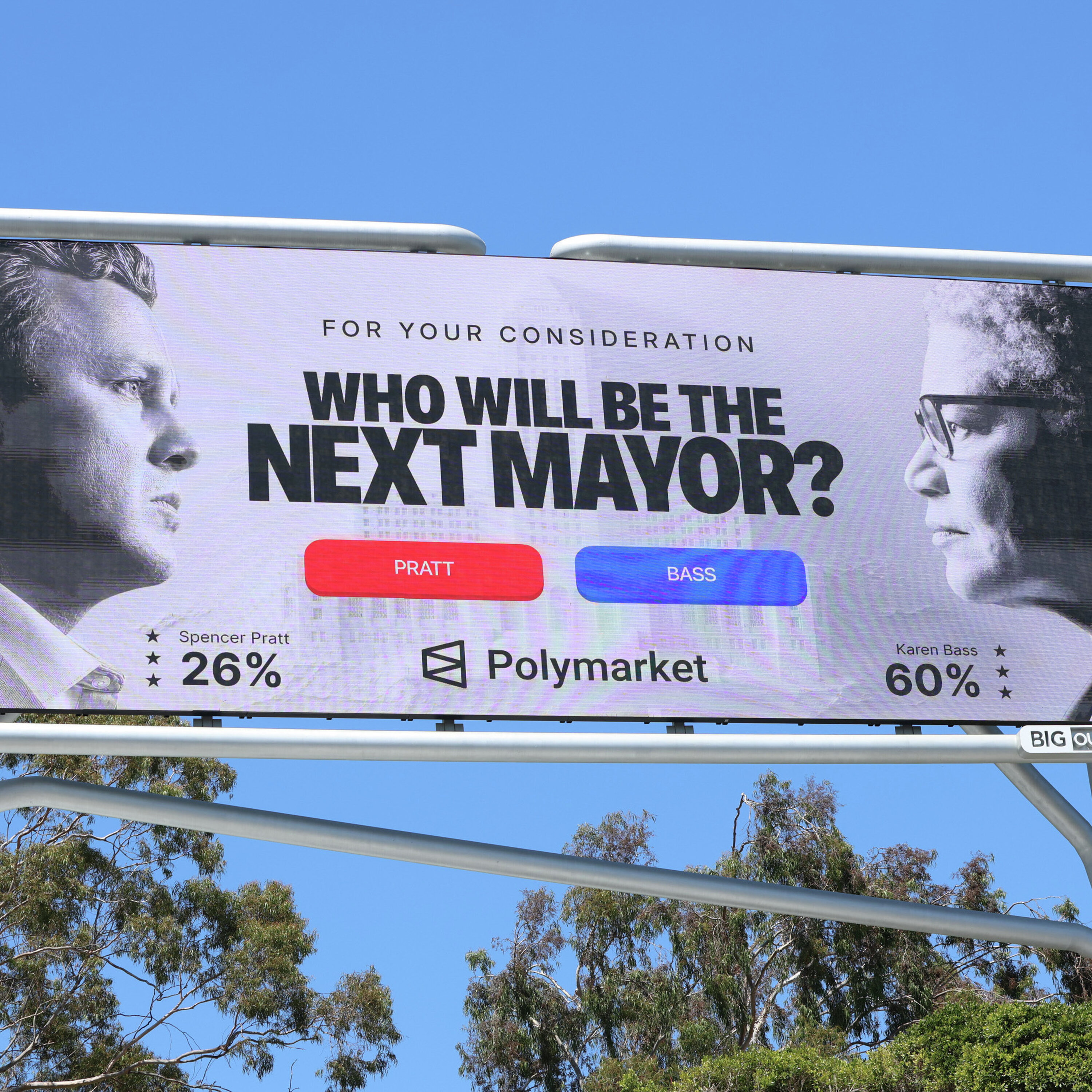
Around the time Matt Mahan was surging on polymarket in the California governor's race, another candidate was riding his own wave of prediction market hype in the Los Angeles mayoral primary. Republican former reality TV star Spencer Pratt.
- [17:34]
Bloomberg Audio Studios Announcer
Call sheet prediction markets are showing a 59% chance that Spencer Pratt finishes second place in the first round of the LA mayoral election.
- [17:42]
Liam Vaughn
What if he clears 51% tonight? Kal, she's saying he's gonna go.
- [17:46]
Sarah Holder
When the votes finally rolled in, Pratt came in third, failing to qualify for the November runoff. But not everyone was willing to accept that the prediction markets had been wrong.
- [17:57]
Liam Vaughn
You saw lots of right wing supporters of Pratt coming forward and saying, this is ridiculous. The race was rigged. Like, there must be an issue here.
- [18:07]
Sarah Holder
Some of the posts came from influencers who were being paid by Kalshee and Polymarket to cite their odds. According to Semaphore, after paid influencers for Kalshi questioned the integrity of the LA mayoral election on X, Kalshee asked them to take the post down.
- [18:23]
Liam Vaughn
So Trump wrote on Truth Social, this is an outrage. Essentially Spencer was robbed and he's kind of citing how well he was doing in the race up until that point. And so the concern is that ultimately these markets kind of present themselves as truth machines, but they can also be utilized by people that are looking to spread mistruths.
- [18:45]
Sarah Holder
In the past year, the platforms have missed the mark in high profile races like in Argentina, India and New York City. And one election in Romania showed they can also be vulnerable to potential influence from bad actors.
- [19:00]
Liam Vaughn
There was an election in 2024 that was actually annulled because there was found to have been Russian disinformation campaign campaign that was enacted on TikTok and YouTube. It was so bad that they ended up canceling the election. They held another election. And that election was subject to a lot of speculation around whether the polymarket numbers for the kind of nationalist candidate who was supported by the Kremlin were being manipulated because there was such a big divergence between what the polls said and what the odds were on this political candidate. And there were lots of people that kind of suggested that this was like Russia cottoning on to the potential opportunity to mess with people's perceptions of reality by targeting prediction markets alongside TikTok or YouTube or, you know, other other forms of disinformation.
- [19:51]
Sarah Holder
An active disinformation campaign Yeah. A firm Bloomberg asked to view the trades found that a few recently created accounts were driving a lot of the trading. Liam says maybe that was a coincidence, but for supporters of the right wing candidate George Simeon, the bets helped create the expectation that he'd win.
- [20:12]
Liam Vaughn
When this guy Simeon lost again, you had all these people coming forward and saying, look, this is ridiculous. On Polymarket, he was, you know, a dead sir and now you expect us to believe that he lost. So it's almost like there's damage either way. Even if ultimately it doesn't succeed, or even if ultimately it's not manipulation, if everyone is suggesting it, then it kind of degrades the sanctity and faith in the democratic process.
- [20:37]
Sarah Holder
I'm wondering, given all this potential for manipulation and just the rise of these prediction markets importance and reach, do you see the risks of this becoming more severe moving forward? Are we at an inflection point?
- [20:50]
Liam Vaughn
I think so. I think that essentially you can have a situation where something is quite cheap to move, can have a huge amount of traction both in social media and in the media. And so I do think that the risks are increasing that people will try and manipulate these markets for kind of political ends. Having said that, I do think there's fairly easy solutions to some of these issues. A lot of the issues around Polymarket could be fairly easily remedied if it kind of emulated its rival Kalshi and, and started getting the identification of its, of its users.
- [21:28]
Sarah Holder
Another thing that could minimize the risk of manipulation would actually be to increase the number of people placing bets, boosting the trading volume on the platforms. More gambling carries its own downsides, but more heavily traded markets are harder and more expensive to manipulate.
- [21:46]
Liam Vaughn
I think that if you talk to Kalshi and Polymarket, they kind of hope that one day everyone's going to be sitting there watching television, betting on everything, and everyone's going to want to bet on the, you know, local mayoral race in, you know, in Sacramento. I'm not sure that that's going to happen.
- [22:03]
Sarah Holder
Liam. The midterms are coming up in the US we're going to be seeing a lot more polls, a lot more prediction market election odds being reported. How should the public and the media be reading these results?
- [22:18]
Liam Vaughn
What the media companies can do, and this is something that a professor at Stanford called Andy hall, he's done a lot of work on and essentially he sort of suggests a charter for the media where they only cite markets of a certain size. They just do some basic interrogation of like, is this price being determined by one or two wallets? Or is there a real diverse number of trades that have come to this price? He also suggests rather than taking like a price at a set moment in time, which can be pushed around, that you actually take some kind of average over the course of a day. So it's different things that the media companies could do fairly easily that wouldn't really undermine their use of these things, but would make the odds that they're citing more robust.
- [23:09]
Sarah Holder
This is the Big Take from Bloomberg News. I'm Sarah Holder. To get more from the Big Take and unlimited access to all of bloomberg.com, subscribe today@bloomberg.com podcast offer. If you like this episode, make sure to subscribe and review the Big Take. Wherever you listen to podcasts, it helps people find the show. Thanks for listening. We'll be back tomorrow.
- [23:39]
4imprint Advertiser
Whatever your goal, trade show giveaways, client gifts or team gear, 4imprint has the promo products to match. With thousands of options from apparel and drinkware to tech and totes, it's easy to find the right fit for your brand and budget. With standout choices at every price point and with their 360 degree guarantee, you can be four imprint certain your order will show up just right, right on time. Explore more@4imprint.com 4imprint for certain
- [24:08]
M&M's Advertiser 1
M&M's popped caramel do sound different. Oh no. People are gonna be obsessed.
- [24:14]
M&M's Advertiser 2
What do you mean?
- [24:15]
Bloomberg Audio Studios Announcer
Hmm.
- [24:15]
M&M's Advertiser 1
People hate the sound of chewing. Maybe they won't like the crunch.
- [24:20]
M&M's Advertiser 2
Maybe we're saved.
- [24:21]
M&M's Advertiser 1
Wait a minute. Yellow. Have you been eating them this whole time? Mmm.
- [24:29]
M&M's Advertiser 2
So tasty.
- [24:31]
M&M's Advertiser 1
Hands off us.
- [24:33]
M&M's Advertiser 2
M&Ms. Popped caramel. It's more fun together.
- [24:38]
Bloomberg Audio Studios Announcer
There are exciting things happening at your local CVS shop. New extra big deals with extra care every two weeks. No coupon needed. Plus get access to exclusive sale prices, personalized deals and more. As a member, Extra Care is the way to save at cvs. Join for free online or in store and start saving. Visit your local CVS store or cvs.com extrabigdeals for this week's deals.