Loading summary
Transcript66 lines
- [00:01]
Bank of America Representative
Introducing B of a Rewards A new loyalty program with rewards for every ambition. From cash back deals on brands you know and love to a credit card rewards bonus from fueling up to rewards that fuel your goals. It all starts with a Bank of America checking account and grows from there. What would you like the power to do? Bank of America Open or enroll your account@bankofamerica.com V of A rewards bank of America corporation. All rights reserved.
- [00:30]
IBM Spokesperson
So there's a lot of noise about AI, but time's too tight for more promises. So let's talk about results. At IBM, we work with our employees to integrate technology right into the systems they need. Now a global workforce of 300,000 can use AI to fill their HR questions, resolving 94% of common questions, not noise. Proof of how we can help companies get smarter by putting AI where it actually pays off, deep in the work that moves the business. Let's create smarter business IBM Healthcare doesn't always work great.
- [01:02]
Optum Representative
If you've ever waited on a refill or couldn't schedule an appointment, you get it. That's the kind of stuff Optum is changing. They're using data and technology to integrate patient care, pharmacy and everything else. So healthcare is connected, not complicated. What's that look like? Cheaper prescriptions that are easier to get and care that looks at the whole person how you need it. Optum is helping make healthcare work as one for everyone. Learn more at business.optum.com
- [01:33]
Bloomberg Audio Studios Announcer
Bloomberg Audio Studios Podcasts Radio News
- [01:40]
Narrator (Wan Ha)
in the spring of 2011, an ancient statue from Cambodia was said to be auctioned at Sotheby's in New York. The five foot tall artifact, with its powerful chest and large round eyes, is known as the Dirodana.
- [01:54]
Matthew Campbell
The Duryodhana is a thousand year old sandstone sculpture of a warrior from a Cambodian temple called Koh Ker.
- [02:04]
Narrator (Wan Ha)
Matthew Campbell is a senior reporter and editor for Bloomberg businessweek. Though the figure was sculpted out of stone, it managed to capture movement as if the warrior was ready to leap in a duel.
- [02:16]
Matthew Campbell
The object is significant artistically because it is one of the most amazing stone sculptures that's ever come out of Cambodia, and specifically of this remarkable ancient civilization called the Khmer Empire, which produced, among other things, Angkor Wat.
- [02:34]
Narrator (Wan Ha)
Sotheby's was aiming to sell the sculpture for as much as $3 million. To collectors it was a masterpiece, but to US prosecutors who'd been tracking its sale, it was something else. Evidence.
- [02:48]
Matthew Campbell
What was really significant about it from a legal perspective was no one had seen this object in a long time. It had last been published in 1975. There was no record of where it was before that.
- [03:04]
Narrator (Wan Ha)
For decades, the Duryodana had seemingly vanished before resurfacing on the other side of the world. Records show that it was first sold in 1975 in London. Documents tracking its chain of custody beyond that were scant. But federal investigators who were looking into the statue had one clue they couldn't ignore.
- [03:27]
Matthew Campbell
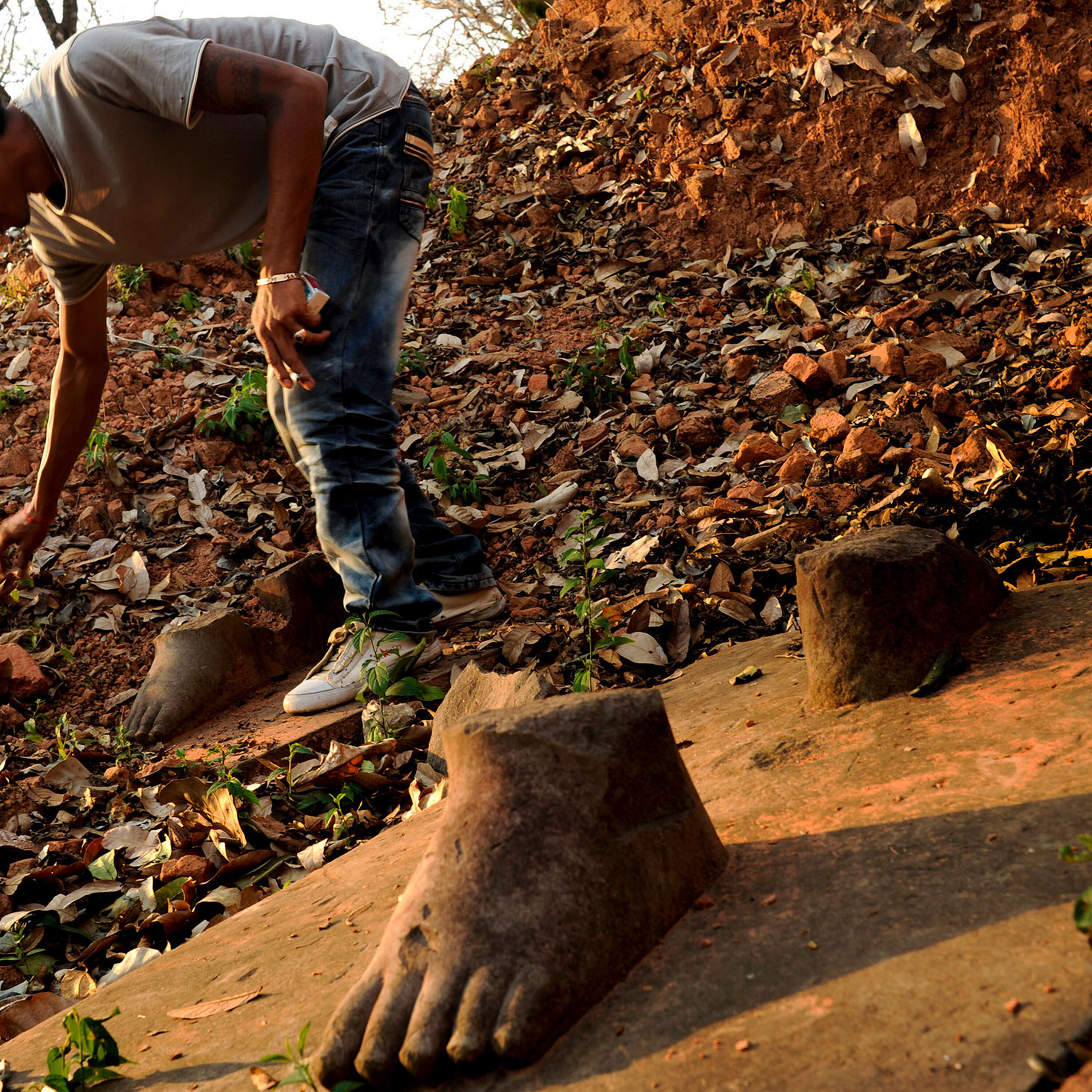
When this piece arrived in New York City in 2010 for sale by Sotheby's, it had no feet. Its feet have been broken off at the ankles. And through kind of a coincidence, feet which matched it had been discovered at a temple site in Cambodia.
- [03:47]
Narrator (Wan Ha)
Investigators believed that the Duradana had been stolen. Ripped from an ancient site in Cambodia and working its way through the most exclusive tiers of the fine art world. On the day the statue was about to go under the hammer, Sotheby's unexpectedly pulled it from sale after federal agents warned the auction house the item could be stolen property. Meanwhile, authorities dug deeper into their case trying to prove it.
- [04:13]
Matthew Campbell
So the Department of Justice went into this case with a pretty good idea of where this thing had come from, but not who had stolen it or when.
- [04:22]
Narrator (Wan Ha)
Finding answers to those questions would send investigators on a far reaching hunt that lasted for more than a decade. That search has consequences for some of the world's wealthiest museums and collectors, with implications for a country whose art had been used to prop up a multimillion dollar industry.
- [04:41]
Matthew Campbell
When federal prosecutors began working on this, they were of the view that they were looking at a long term criminal conspiracy which stretched from the killing fields of Cambodia all the way to the Upper east side of Manhattan.
- [05:00]
Narrator (Wan Ha)
This is the big take Asia. From Bloomberg News, I'm Wan Ha. Every week we take you inside some of the world's biggest, biggest and most powerful economies and the markets, tycoons and businesses that drive this ever shifting region. Today on the show, how Cambodia's stolen gods got scattered around the world and the unlikely investigation that's helping to bring them home. For roughly 500 years, beginning in the 9th century, Cambodia sat at the heart of the Khmer empire. One of the most powerful civilizations of the pre modern world. Its rulers built monumental temples like Angkor Wat and filled them with grand sculptures in stone and bronze. But by the end of Cambodia's Civil War in 1998, many of those treasures were gone, looted during three decades of conflict and upheaval. And the country itself was in shambles. Roughly 2 million Cambodians, a quarter of the population, died in the few years that the Khmer Rouge was in power in the late 1970s. They were then ousted by Vietnamese forces. But fighting between insurgent groups continued for another 20 years.
- [06:17]
Matthew Campbell
The Cambodian civil war went on very violently, very viciously, all the way to 1998. And wars run on bullets, they run on fuel, but they really run on money. You can't fight a war without money.
- [06:32]
Narrator (Wan Ha)
Matthew Campbell is the author of the man who Stole the Gods, A True Story of War Obsession and a Global Art Conspiracy.
- [06:40]
Matthew Campbell
And in Cambodia, one of the ways to fund yourself is to steal and sell ancient artworks. So all sides in the civil war were engaged in this. There were also just opportunistic thieves taking advantage of chaos who were not themselves competence in the war.
- [06:59]
Narrator (Wan Ha)
And somewhere amid that chaos, the Dear Donna disappeared from Cambodia. Decades later, when Sotheby's tried to auction the statue in New York, the Cambodian government rang the alarm. It asked the US for help to recover it. But first prosecutors had to prove it had been stolen.
- [07:18]
Matthew Campbell
One of the critical components is you need to be able to show that looting or stealing this object was illegal in the country where it came from at the time it occurred. In addition to national laws in the US and elsewhere, there is a treaty under the aegis of UNESCO, the United Nations Cultural Heritage Agency, which governs, or attempts to govern the movement of what they call cultural property, which is basically art and artifacts around the world. And the UNESCO treaty is complicated, but generally, in, for example, the world of big museums, there's a cutoff in 1970. So if you can show that an object left its country of origin before 1970, it's generally considered fairly safe to acquire.
- [08:08]
Narrator (Wan Ha)
In the case of the Duradana, the where was clear enough. Proving the when would be harder. At the time, Sotheby's was confident the Dior Donna was out of Cambodia. Before the 1970 cutoff, there was a
- [08:22]
Matthew Campbell
pretty strong impression by the people at Sotheby's that it had been in the possession pre1975 of a very prominent art dealer, a British man named Douglas Latchford. And actually, in Sotheby's internal deliberations, before it agreed to sell this thing, they had reached out to Latchford. He had initially said, yes, I did have it. Then he changed his story and said, actually, I didn't. So the whereabouts of this thing were kind of a mystery. This is an enormous object. It weighs hundreds and hundreds of pounds. It had obviously been removed somewhat violently from the place where it came from. Who took it out? How did they get it to the border
- [09:03]
Narrator (Wan Ha)
to UNRAVEL that mystery authorities needed someone on the ground in Cambodia.
- [09:09]
Bradley Gordon
What happened in 2012? I was sitting in my office in Phnom Penh. I was scrolling through the Internet, and I came across an op ed, and it was about the looting of Cambodia.
- [09:22]
Narrator (Wan Ha)
That's Bradley Gordon, an American lawyer living in the Cambodian capital of Phnom Penh. The op ed he came across struck a chord, so he reached out to the authors.
- [09:32]
Bradley Gordon
Shortly afterwards, I found myself getting hired by the Department of Justice out of New York, the prosecutors there who were working on the Dury Adana case, and they said, hey, you actually could be helpful to us. Maybe go out and collect some testimonies of villagers and see if you can find an eyewitness.
- [09:51]
Narrator (Wan Ha)
At first, Brant thought the assignment would be fairly straightforward. But in a country still living with the legacy of war and genocide, finding those answers would prove much harder than he expected.
- [10:05]
Bradley Gordon
When we went to the village, the first stop, hardly anyone talked to us. They didn't tell us anything.
- [10:10]
Narrator (Wan Ha)
But Brad and his team, some he hired from the village, kept at it. They spent months returning to villages around Koke, the temple complex where the Duryodana was taken. And after months of interviews, their search led them to a former child soldier in the Khmer Rouge, One who didn't just have a lead, but who claimed he had stolen more than a thousand Cambodian artifacts. His name was Daeduc or Tuktik.
- [10:39]
Bradley Gordon
We told him he would not be arrested, that we would make sure that people he told us about, they were not going to get arrested either. And I think he really believed in karma. He didn't do this for anything, but, you know, just improving his chances of maybe a better next life. And I think he was very aware of how wrong it was, what he had done. And he was a very thoughtful person in many ways and very reflective. And I think for him, he saw what an incredible crime this was against the Cambodian people. And I think he wanted to do whatever he could to try to make things right.
- [11:24]
Narrator (Wan Ha)
Daeduc told Brad he built a network of hundreds of looters that targeted ancient sites across Cambodia. The artifacts were then moved through Thailand and into the international art market. Deduc often worked with one particular broker, and he knew that a large chunk of the works were sold to one client. Here's Matthew Campbell again.
- [11:47]
Matthew Campbell
He understood that there was a Westerner, a man in Bangkok, who Tuktik referred to as Sia Ford. Sia is a Thai honorific. It means lord or something like that.
- [11:57]
Narrator (Wan Ha)
Lord Ford was Douglas Latchford, the collector who changed his story when Sotheby's first asked about the Giordana de Duc said he had been supplying Latch. That revelation suggested that Latchford's influence extended all the way from the international art market down the chain to the people digging artifacts out of the ground.
- [12:18]
Matthew Campbell
Latchford was not himself a looter. We don't have any evidence of him in a temple ripping things out. He was a voracious buyer. And Brad also learned that Latchford had sent instructions up the chain. He would tell people what he wanted, what kind of artworks he was looking for. He would say he was looking for bronzes in a certain style or a certain kind of Hindu iconography. That information would reach looters in the field and they would go try and get it.
- [12:49]
Narrator (Wan Ha)
Rad had helped uncover a sprawling trafficking network that looted Cambodia's ancient sites and fed a global demand for Khmer antiquities.
- [12:58]
Matthew Campbell
There were looting crews in the field all over Cambodia, all through the civil war. Actually, the most intense phase of looting was in the mid to late 1990s. You had these industrial scale raids on certain sites, and I use the word industrial very deliberately. We're talking construction equipment, dynamite, occasionally gun battles between rival looting crews who were after the same stuff. These looting crews would then move artworks to the Thai border, where there were brokers who would get them over the border and to Bangkok where Lashford was waiting. And Latchford was essentially the interface between this looting supply chain I just described and the international market. So he had impeccable relationships with big buyers, both privately and with big museums like the Metropolitan in New York. And he was a trusted supplier to all these people.
- [13:54]
Narrator (Wan Ha)
Will Cambodia recover what was lost and what the discovery means for museums and collectors around the world? That's after the break.
- [14:07]
The Hartford Representative
Support for the show comes from public.com if you're actively involved in your portfolio, you probably catch yourself repeating the same actions. Buying the dip, manually sweeping idle cash, putting on a hedge on public. You can now create AI agents that handle all these tasks on your behalf. Just describe what you want to do in plain English, like if the Vix hits 25, buy a put option on the S&P 500. Or if my cash balance goes above $20,000, move the excess into my direct index. You approve the workflow and your agent handles the risk. Monitoring the market, watching for your conditions and executing your strategies exactly as defined. An investing platform driven by your intent, not just your clicks. You can also get full read and write access to your account via the public API. Go to public.com market and fund your account in five minutes or less. That's public.com market paid for by Public Investing Brokerage Services by Open to the Public Investing Inc. Member FINRA and SIPC Advisory Services by Public Advisors, LLC. SEC registered advisor complete disclosures available@public.com disclosures
- [15:16]
Matthew Campbell
Amazon Health AI Presents Painful Thoughts I
- [15:22]
Bank of America Representative
I can't stop scratching my downtown. Mm, yeah, but I'm not itching to go downtown and tell a receptionist I'm here to talk about my downtown. Some things you'd rather type than say out loud.
- [15:36]
Matthew Campbell
There's no question too embarrassing for Amazon Health AI. Chat your symptoms and get virtual care 24. 7 Healthcare just got less painful.
- [15:47]
Bloomberg Audio Studios Announcer
Bite into a stacked sandwich made with herobread or a fully loaded bagel and the only thing you'll think is delicious. You won't think it's up to 19 grams of protein, but it is. You wouldn't believe it has 11 to 32 grams of fiber, but it does. Herobread makes loaves, buns, tortillas, bagels and noodles packed with taste, but without all the net carbs, we're talking 0 to 5 grams net carbs per serving. With HeroBread there are no compromises, just flavor. There's none of the stiff baked goods you'd expect from better for your brands. There's just the soft, fluffy bread you crave, plus small batch drops of indulgent favorites like the popular 2 gram net carb Hero croissant and 3 gram net carb Hero pain au chocolat. And right now, Herobred is offering 10% off your order. Go to Hero Co and use Code Iheart at checkout. That's Code iheartro Co. All figures per serving of herobread See nutrition facts on Hero Co.
- [16:51]
Narrator (Wan Ha)
American lawyer Bradley Gordon helped federal prosecutors unfold uncover a trafficking network that systematically looted Cambodia's ancient temples and funneled their treasures onto the international art market. Then came the reckoning in 2019, eight years after prosecutors first challenged the sale of the Giordana at a Sotheby's auction, they indicted the man they believe sat at the center of that network, British art dealer Douglas Latchford. As we allege in that indictment, Lashford lied about the provenance of the Cambodian antiquities he was selling in order to cover up the fact that they were looted. These artifacts included the Deir Adana and many other Khmer antiquities, but the case never reached trial. Latchford died in 2020 at age 88. Here's Bloomberg's Matthew Campbell.
- [17:42]
Matthew Campbell
In terms of criminal consequences, there have not been that many, honestly. Latchford was charged another dealer In New York, Nancy Weiner was charged. She ultimately pleaded guilty and did not do any jail time in exchange for cooperation with law enforcement. One of the criticisms of these investigations generally is that they don't involve enough criminal prosecution that it's mostly about what they call forfeiture, taking objects rather than trying to put people in jail. But nonetheless, they have changed the incentives. They have succeeded in significantly reducing the demand for works like this.
- [18:20]
Narrator (Wan Ha)
As for the Girudana, Sotheby's settled its case with the US and agreed to send back the statute to Cambodia.
- [18:27]
Matthew Campbell
I am much honored to represent the Kingdom of Cambodia.
- [18:31]
Narrator (Wan Ha)
Here's Cambodian Deputy Prime Minister Suk an receiving the statue at a press conference in 2014.
- [18:37]
Matthew Campbell
To receive and bring the statue of Diorodana back to our homeland where he belong.
- [18:48]
Narrator (Wan Ha)
But that was over a decade ago. And the Deiryodana is just one of thousands of artifacts believed to have been stolen. Many remain scattered across museums, auction houses and private collections around the world.
- [19:01]
Matthew Campbell
It's very hard to value them because, of course, the price of an artwork or of any asset is what someone will pay. There's no mark to market here, but we can say with confidence that Certainly by the late 90s, early 2000s, the best pieces were selling for seven figure prices, sometimes five or six million dollars each. So the size of the whole market would be hundreds of millions. You know, nothing like the market for, say, modern paintings or old masters, but a significant part of the art world, we know that one Silicon Valley billionaire, Jim Clark, co founder of Netscape, he spent about $35 million on these pieces.
- [19:41]
Narrator (Wan Ha)
After the Giordana case exposed how that trade worked, a new challenge emerged, figuring out where all the looted objects ended up. Bradley Gordon is doing that work to this day. In 2018, the Cambodian government appointed him to lead a restitution team tasked with tracking down the artifacts.
- [20:00]
Bradley Gordon
We're doing a lot of work, for example, at Ta Prohm, which is a very famous temple at Angkor, the one that was in Angelina Jolie's movie Tomb Raider.
- [20:10]
Narrator (Wan Ha)
Brad and his team have been interviewing experts, guards, villagers and former looters for years. They've compiled a database with more than 2100 objects they believe were likely looted from Cambodia. Many have ties to Douglas Latchford. Some are currently housed in museums like New York's Metropolitan Museum of Art and the British Museum in London. Roughly another thousand or so are believed to be in private collections.
- [20:37]
Bradley Gordon
We have quite a few negotiations going on right now with private collectors around the world, and then we're talking to more and More museums. And we're finding that many museums are willing to do the right thing. We do have a number of museums that are very reluctant.
- [20:55]
Narrator (Wan Ha)
According to Brad, at least 300 looted Khmer artifacts have returned to Cambodia in the past decade as a result of his team's work and joint efforts with the US Government. The Met, for example, has returned more than a dozen pieces to Cambodia. Matt says those returns have transformed Cambodia's recovery effort from a handful of isolated victories into one of the most successful repatriation campaigns in the art world.
- [21:20]
Matthew Campbell
Actually, the National Museum in Phnom Penh is packed to the gills. There is now very little art from this part of the world that is changing hands, at least openly. It would now be very hard, certainly in any public way to sell a major piece from Cambodia without a lot of questions being asked.
- [21:41]
Narrator (Wan Ha)
The investigation has also reshaped how museums, dealers and collectors think about provenance and stolen art.
- [21:49]
Matthew Campbell
There are people who would basically say museums are by definition monuments to theft, you know, and colonialism and looting. I don't totally agree. I think one thing that is striking is that there appears to be a universal urge when a country is on the rise to obtain the treasures of other people. This is why there are Egyptian obelisks in Rome. You know that, and that goes back 2,000 years. The big challenge, honestly, is that this is still going on. It's happening in lots of other places. Every time a country falls apart, one of the very first things that happens is the museums are hit, archaeological sites are hit, historical monuments are hit, often by people who know what they're doing, who know what to take, who take the high quality saleable objects. Most recently in Sudan, in Ethiopia, in Ukraine, there have been very large scale thefts of art and artifacts because there is a market, people want them and they will pay for them.
- [22:53]
Narrator (Wan Ha)
For many Cambodians, these aren't simply relics of the past or, or works of art. And Brad says that's become evident to him as some of the pieces return home.
- [23:04]
Bradley Gordon
I can see that for many of the Cambodians, it's like a return of a lost one. It's something they, you know, they've been yearning for. They've been thinking about somebody they lost during the war and the parents of these statues, to them they're living. And I feel many times it's like welcoming a family member, a long lost relationship, family member coming home. And I, I do think it brings back many, many memories of what Cambodia was like before the war and what happened during the war. It's unbelievable how this has touched the hearts of so many people here and we can see how how much it provides healing for the nation.
- [23:54]
Narrator (Wan Ha)
This is the Big Take Asia from Bloomberg News. I'm Juan Ha. To get more from the Big Take and unlimited access to all of bloomberg.com, subscribe today@bloomberg.com podcastoffer if you liked the episode, make sure to subscribe and review the Big Take Asia. Wherever you listen to podcasts, it really helps people find the show. Thanks for listening. See you next time.
- [24:23]
The Hartford Representative
When you're running a business, the best days are the ones where priorities stay on track. For midsize and large companies, risk can affect multiple parts of the organization at once, from property and liability to cyber and regulatory challenges. At that level, managing risk becomes an ongoing discipline. At the Hartford, the focus is on helping businesses manage risk before it turns into something more disruptive. And when losses do happen, that work is paired with insurance coverage shaped by years of underwriting, risk engineering and claims experience. Learn more@the Hartford.com riskmitigation policies provided by Hartford Fire Insurance Company and its property and casualty affiliates.
- [25:02]
Sephora Representative
Hartford, Connecticut skincare means Sephora Makeup Same. They've got the products, expertise and the brands that fit your lifestyle. But when I talk about hair care, do you make the same connection? Well, you should. Sephora is just as trusted for hair. Whether you're looking to repair, strengthen, hydrate or add shine, you'll find brands like Kerastase, K18 and Gisu, plus the guidance that helped you choose what's right for your hair. And with free shipping and same day delivery, great hair care is easier than ever. Shop hair at Sephora today.
- [25:36]
Kia Representative
Some so called SUVs feel more like toys. You need a real vehicle that'll handle real life. A real SUV like the all new 2027 Kia Seltos with its best in class interior room, it'll make the others feel like toys. Check out the new 2027 Kia Seltos X line. It's real world ready Kia Movement that inspires limited inventory. Available comparison based on publicly available data regarding Cargo Room and 2026 entry All Wheel Drive CUVs as of May 2026 entry All Wheel Drive SUV Class as defined by Kia segmentation.