Loading summary
Transcript79 lines
- [00:00]
LPL Financial Narrator
What if you could have more wins, more support, more sound effects? At LPL Financial, we like the sound of that because LPL offers more advisors. What if you could have more ways to help your clients ready to invest? What if you could find an advisor that really understands you when it comes to your finances, your business, your future? At lpl, we ask what if you
- [00:24]
Advertisement Voiceover
could Paid Advertisement Investing involves risk, including potential loss of principal. LPL Financial LLC Member FINRA SIPC At
- [00:31]
Venture Global Narrator
Venture Global, we think about what can be done, not what's usually done through innovation. Venture Global is not only building some of the largest energy facilities in the world right here in the United States, but delivering American energy at a fraction of the cost in a fraction of the time. So while others are busy talking, we're busy building. That's Venture Global. That's unstoppable energy.
- [01:00]
Chase for Business Narrator
Small businesses are the pulse of every community. They bring people together, create opportunities and drive growth. Chase for Business helps business owners like you with personalized guidance and convenient digital tools all in one place. With that guidance and your determination, you can take your business farther and help build a brighter future for your community. Learn more@chase.com business chase for business make more of what's yours the Chase Mobile app is available for select mobile devices. Message and data rates. May apply JP Morgan Chase Bank NA Member FDIC Copyright 2026 JPMorgan Chase Co. Bloomberg Audio Studios Podcasts Radio news I
- [01:46]
Customer/Consumer Voice
love the fit, the comfort, basic style, good quality.
- [01:51]
Bloomberg Reporter - Sarah Holder
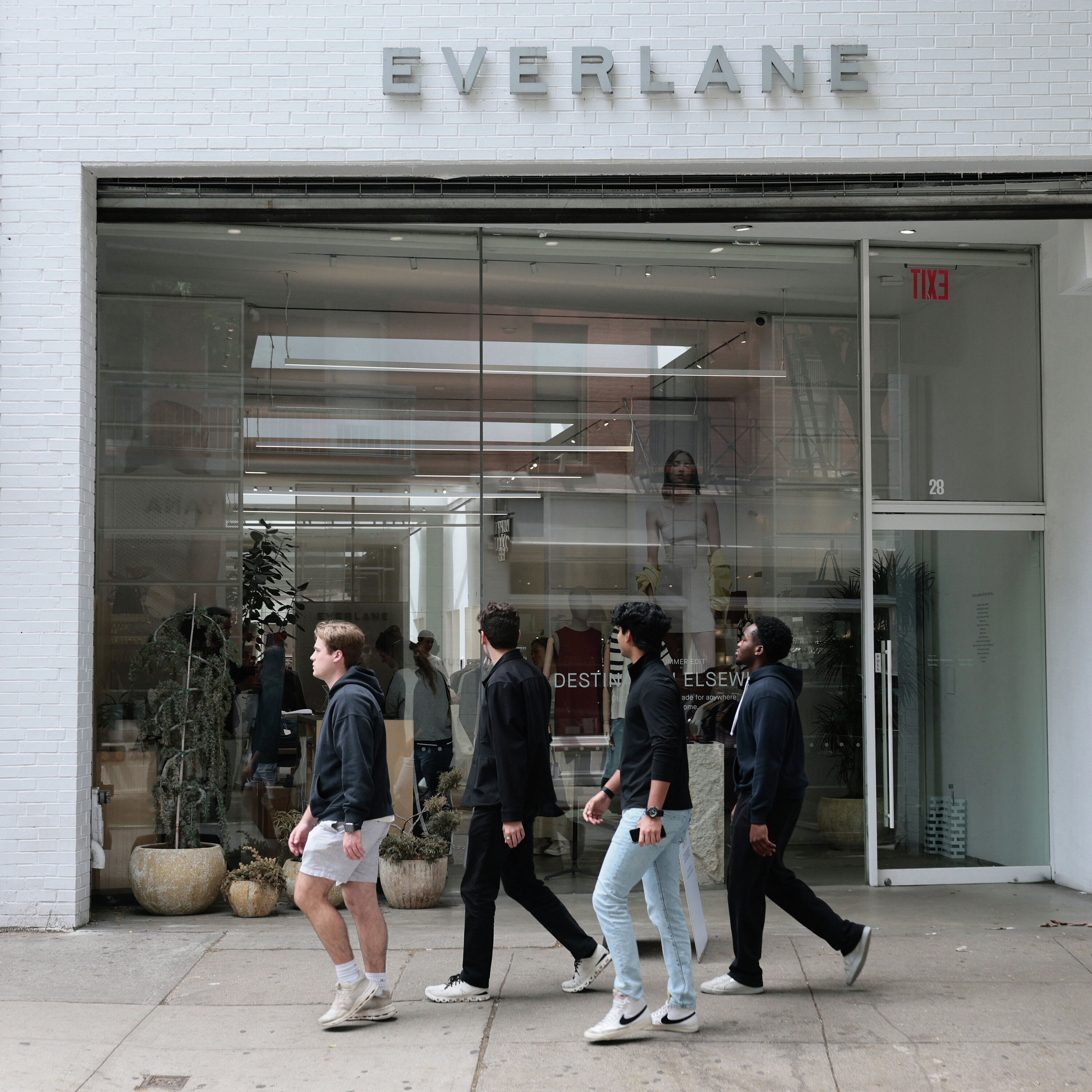
You might know the clothing company Everlane for its plain tees, sensible work pants, millennial cool basics. Or you might know it more by reputation. The brand's marketing has always touted its commitment to quality, sustainability and to transparent pricing. These days, Everlane isn't the retail darling it once was. It's laden with debt and struggling to connect with customers the way it did in the mid 2010s. But outside the company store in lower Manhattan in early June, customers told us Everlane's stated values are a big part of the reason they've kept shopping there. They mostly use pretty good material that it will last.
- [02:31]
Customer/Consumer Voice
They brand it as radically sustainable, and they're also transparent about where they source their clothes from.
- [02:38]
Bloomberg Reporter - Sarah Holder
But that last customer, Anupriya Aggarwal, said she might reconsider shopping at Everlane.
- [02:44]
Customer/Consumer Voice
When I found out that it's been acquired by Shein, which is like this mega fast fashion brand outlet, it was very appalling to me.
- [02:55]
Bloomberg Reporter - Sarah Holder
Shein, the e commerce giant founded in China, bought Everlane last month from its private equity owner the sale price, a reported $100 million. Shein is a king of fast fashion. As of 2022, it released about a thousand new women's clothing styles every day, leading to concerns that its clothes aren't just fast fashion, but low quality and disposable. In addition to its environmental impact, the company has also come under scrutiny for the labor conditions of its suppliers. In some ways, Shein seemed like the anti Everlane.
- [03:33]
Customer/Consumer Voice
I just have questions around why they decided to sell to Shein. It just doesn't align like, value wise, you know.
- [03:41]
Bloomberg Reporter - Sarah Holder
Many other Everlane customers had a similar reaction.
- [03:44]
Customer/Consumer Voice
Wake up, babe.
- [03:45]
Bloomberg Reporter - Sarah Holder
Everlane apparently is selling to shein for $100 million. This is my last straw.
- [03:52]
Customer/Consumer Voice
What do you mean?
- [03:53]
Bloomberg Reporter - Sarah Holder
One of the most controversial fast fashion
- [03:55]
LPL Financial Narrator
brands is acquiring allegedly a brand that's a leader in ethical, sustainable, modern consumerism.
- [04:02]
Bloomberg Reporter - Sarah Holder
The Internet seemed to echo with wait, what?
- [04:06]
Michael Prisman (Everlane Co-founder)
It was in some ways great to know that that many people cared.
- [04:10]
Bloomberg Reporter - Sarah Holder
That's Michael Prisman, who co founded everlane back in 2011. He stepped down as CEO in 2021 and left the company's board in January 2026. When he heard about the sale, he called up another former board member.
- [04:24]
Michael Prisman (Everlane Co-founder)
I don't think either of us expected that kind of a reaction because in many ways Everlane had lost its way in the past few years.
- [04:32]
Customer/Consumer Voice
Even if you don't really shop there anymore, like, what probably stays with you from Everlane as a brand is the fact that they did have this sort of like ethical consumer ethos.
- [04:42]
Bloomberg Reporter - Sarah Holder
Amanda Mull is a reporter for Bloomberg Businessweek.
- [04:45]
Customer/Consumer Voice
And people who sort of took that at face value or even people who were like mildly skeptical of it, were shocked that Everlane, that the people in charge of it would say, all right, we're going to sell this to the highest bidder, even if the highest bidder is sort of the opposite of the original Everlane promise.
- [05:08]
Bloomberg Reporter - Sarah Holder
I'm Sarah Holder and this is the big take from Bloomberg News today on the show Everlane Shein and why Retail can't bank on millennial Optimism anymore. Everlane launched in San Francisco in the 2000 and tens during the early days of a direct to consumer boom. And Bloomberg's Amanda Mull says right away it found its audience.
- [05:35]
Customer/Consumer Voice
It designed clothes that were very much targeting like a young white collar woman who like cared about the stuff she bought and wanted high basics in like a sort of design forward, well considered type of style.
- [05:50]
Bloomberg Reporter - Sarah Holder
So yeah, it felt like a very millennial brand. I was living in San Francisco and there was one right on Valencia Street. And I would always, like, wander into the very stark, basic white building.
- [06:02]
Customer/Consumer Voice
Yeah, sort of like a. Like the aesthetic was. Was somewhat like Apple store for clothing.
- [06:07]
Exactly.
- [06:08]
Bloomberg Reporter - Sarah Holder
But when it launched, Everlane wasn't a brick and mortar store. It was a website built around an idea.
- [06:15]
Customer/Consumer Voice
It was the Obama. You know, it was after the Great Recession. You had millennials as a huge consumer generation coming into the workplace, sort of starting to grow up a little bit into adulthood. And you had, like, a generation of idealistic young people who were looking to express their values, however it was possible. Everlane saw this generation and went, we could tell them how clothes are made. We could help them feel good about the choices they're making.
- [06:43]
Bloomberg Reporter - Sarah Holder
Everlane's co founder Michael Prisman, says the goal was to be more open about how clothing moved through supply chains and what that actually costs.
- [06:52]
Michael Prisman (Everlane Co-founder)
We started with a T shirt and then grew into a full array of product and then moved from pricing transparency to factory transparency to sustainability.
- [07:00]
Customer/Consumer Voice
Often there was, like, a little picture of workers, theoretically, at those factories on the website. This sweater was from a factory in China. This pair of shoes was from a factory in Vietnam.
- [07:11]
Bloomberg Reporter - Sarah Holder
It was an innovative approach at the time, and for a while, it worked so well that the company expanded into retail stores with that Apple store for clothing vibe. So what changed? What brought Everlane to the point where it sold itself to Shein?
- [07:27]
Customer/Consumer Voice
Well, I think the first issue you have is the pandemic. So you had a population, especially among Everlane's target market, which is people who work laptop jobs, people who do knowledge work, people who could work from home and did not need office clothes anymore. And that's really what Everlane was known for, is like. Like a nice pair of clothes that you could go to the office, you could go to lunch. They did not really emphasize, like, comfortable things to wear at home in leisure time. So like a lot of other apparel brands, their sales just really had a difficult time.
- [07:56]
Bloomberg Reporter - Sarah Holder
The second issue, beyond the types of products they were selling, was consumer behavior. Shoppers became more price sensitive and maybe more cynical.
- [08:06]
Customer/Consumer Voice
People become, you know, sort of disillusioned of the ethical consumer behavior idea, because people, I think some of them, especially people in this demographic, learn more about, like, how the apparel industry actually works and get sort of sick of trying to mediate the risks and the downsides of it themselves.
- [08:25]
Bloomberg Reporter - Sarah Holder
Everlane made several attempts to turn things around. In 2020, the company took on a private equity investor backed by French luxury fashion house LVMH and took out loans meant to help the company grow. There Were also leadership changes, including Prisman's departure. But as Everlane floundered, another retail model was on the rise.
- [08:47]
Michael Prisman (Everlane Co-founder)
It's easy to see the allure of fast fashion.
- [08:50]
Customer/Consumer Voice
Well, you may have heard of Shein. It is an online fast fashion brand
- [08:54]
IBM/Public/Insurance Advertisement Voiceover
known for its trendy styles and its cheap prices.
- [08:57]
Customer/Consumer Voice
Shein is built on not necessarily like ideas or design, but on logistics. It is a company built by looking at where there might be inefficiencies in the traditional way that fashion is sold to create margin where there hadn't been before, while also lowering prices in a way that hadn't been possible before. So you get a company that, like, is not going to tell you much about where its clothing is made, where each design was made that, you know, uploads to its website, like on some days, thousands of new, new pieces that you can shop from that have no one particular design ethos, no one particular brand ethos except cheap and fast.
- [09:38]
Bloomberg Reporter - Sarah Holder
Shein has faced allegations of using forced labor in its supply chain and has been sued for copyright infringement. A spokesperson for Shein told us that the company complies with the relevant laws and regulations in each market we operate in. In response to allegations of copyright infringement, the spokesperson said the company takes all claims of infringement seriously.
- [10:00]
Michael Prisman (Everlane Co-founder)
When Sheehan came onto the scene, I think I was even quoted saying that in my opinion, their products were way too cheap and there was way too
- [10:07]
Bloomberg Reporter - Sarah Holder
many of them, Everlane co founder Michael Prisman.
- [10:10]
Michael Prisman (Everlane Co-founder)
And it was not conducive to the environment, but not just the environment in general, just waste and over consumption.
- [10:19]
Bloomberg Reporter - Sarah Holder
So you had kind of a negative impression of Shein.
- [10:22]
Michael Prisman (Everlane Co-founder)
I have a negative impression of Shein. So I would continue to stay there.
- [10:26]
Bloomberg Reporter - Sarah Holder
So by early 2026, you have a debt burdened Everlane that's limping along, struggling to connect with customers and fast fashion giant Shein pumping cheap clothes into the global market. They seemed worlds apart until they came together. So what does Shein want with Everlane and how does this sale fit into the bigger picture for other direct to consumer brands from Allbirds to Quince? That's coming up.
- [10:58]
IBM Advertisement Narrator
So there's a lot of noise about AI, but time's too tight for more promises. So let's talk about results. At IBM, we work with our employees to integrate technology right into the systems they need. Now a global workforce of 300,000 can use AI to fill their HR questions, resolving 94% of common questions, not noise. Proof of how we can help companies get smarter by putting AI where it actually pays off. Deep in the work that moves the business. Let's create smarter business.
- [11:28]
IBM/Public/Insurance Advertisement Voiceover
IBM support for the show comes from Public Lately it feels like there are two types of investing platforms. Some are traditional brokerages that haven't changed much in decades, and others feel less like investing and more like a game. Public is positioned differently. It's an investing platform for people who are serious about building their wealth on public. You can build a portfolio of stocks, options, bonds, crypto without all the bugs or the confetti. Retirement accounts? Yep. High yield cash? Yes again. They even have direct indexing. Public has modern design, powerful tools and customer support that actually helps go to public.com market and earn an uncapped 1% bonus when you transfer your portfolio. That's public.com market and paid for by Public Holdings Brokerage Services by Public Investing member FINRA SIPC Advisory Services by Public Advisors SEC Registered Advisor crypto services by ZeroHash all investing involves risk of loss. See complete disclosures@public.com disclosures when you own
- [12:28]
Chase for Business Narrator
your own business, you own every decision. Now own the card that rewards you for it. The Chase Sapphire Reserve for Business Card brings the best Sapphire Reserve benefits to business owners who expect hard working rewards. Designed to meet the needs of business owners at scale, this Pay In Full card elevates your travel experience and offers premium benefits and value toward business services that will take your business to the next level, fuel your business and maximize rewards with 8x points on all purchases through Chase Travel, 3x points on social media and search engine advertising, annual partnership credits and more. Make every journey more rewarding with a $300 annual travel credit and access to a network of airport lounges. Whether you're looking for pre flight productivity or time to rest and recharge, Chase Sapphire Reserved for business, it's the card that gives back all you put in. Learn more@chase.com reservebusiness chase for business make more of what's yours. Accounts subject to credit approval restrictions and limitations apply. Cards are issued by JPMorgan Chase Bank NA member FDIC.
- [13:39]
Bloomberg Reporter - Sarah Holder
By 2026, Everlane's value had plummeted. Meanwhile, Shein was doing well despite facing a slew of controversies and taking a hit from changes to US Tariff policy. Last November, Sheehan told investors it was expecting to bring in $2 billion in net income in 2025, almost double what it did in 2024. So the big fish swallowed the smaller fish. In late May, Everlane confirmed it would be bought by Shein. What made Everlane attractive to Sheehan? Why did Sheehan want to buy this
- [14:12]
Customer/Consumer Voice
struggling company My theory is that Shein has been looking at the sort of meteoric growth of a brand we haven't mentioned yet, which is Quints, and said we would like to apply the Shein logistics structure to a brand that already appeals to like a higher income, more materials conscious customer. And their options were basically to try to launch a brand of their own, or they could try to buy one that already has a name recognition and a customer base. And so I think that they are looking at Everlane potentially as like a sort of quick and dirty way to spin up a competitor for Quint's.
- [14:56]
Bloomberg Reporter - Sarah Holder
Quint's started selling inexpensive luxury fare in 2019. They're known for products like a $50 cashmere sweater, but they've expanded to sell bedding, luggage, and even jewelry with lab grown diamonds. And just like Everlane, Quint Quince includes information on its factories and sustainability efforts right on its website. It's an American company, but like Sheehan, its supply chain is global.
- [15:21]
Customer/Consumer Voice
The big thing about Shein is that it doesn't really have many US Logistics nodes. One of the big differences in Shein's model is that they warehouse pretty much everything they sell overseas. And then when a customer orders it, they're ordering something very inexpensive. They're getting it shipped for free, and they're gonna wait a little bit for it. So it's sort of like they took the opposite track as Amazon. They went, if you are getting, you know, a pair of jeans for $9 and you can buy them in every color and wear them until the end of the season and then get whatever's trendy next year, then like, maybe you're fine waiting a week or 10 days for that. And they were right.
- [15:56]
Bloomberg Reporter - Sarah Holder
Quint's uses a similar approach. When you order something from Quince, it'll ship to you directly from Asia. They don't stockpile a bunch of products in a US Warehouse. And like Shein, Quince works very hard to figure out what customers want and to produce it quickly.
- [16:12]
Customer/Consumer Voice
They are a huge data scraper. They scrape a lot of data about what people are buying and what people are looking for at other clothing websites online. And they use that to respond in like a very targeted way to new trends or new consumer desires. They can respond to trends in like a matter of a few weeks instead of it being like a 6 to 18 month thing that a clothing brand has to bet on.
- [16:32]
Bloomberg Reporter - Sarah Holder
But Quince is different from Shein in big ways too.
- [16:36]
Customer/Consumer Voice
They use a lot of natural fibers. They use organic cotton, they use European linen, they use Real leather, things like that. Shein has come under a lot of fire for making like crap, for making stuff that is like essentially garbage. That's how people talk about these clothes.
- [16:52]
Bloomberg Reporter - Sarah Holder
Shein has also been criticized for using a lot of polyester, a form of plastic, the vast majority of which ends up incinerated or in landfills. A company spokesperson told us Shein prioritizes its product quality and, and that by producing products on demand instead of en masse, it reduces waste. So is Shein's plan to take its supply chain tech company model and apply it to Everlane to make Everlane more like Quint's?
- [17:19]
Customer/Consumer Voice
This is my guess. We don't have information on this yet. Shein hasn't said exactly what they're going to do with it, but I think that this is sort of the obvious first stop for this, for this acquisition. Because Quint's has been enormously popular. They did a recent round of applause, venture funding that valued the company at $10 billion, which is almost double what they were a year ago. They are bringing online new product categories all the time. They make furniture now. In my chat with executives there, it seems like they think that this logistics system that Quince has is applicable to all types of product categories. Like, you know, if we can define what a consumer wants and we can find a supplier that can work with us on a high volume, low price model and then get materials at high volume and low prices as well, then we can make whatever people want. And setting up that kind of logistics system is really, really difficult. It is a very like large scale, multi vendor endeavor. And Shein already has those relationships, it has those logistics channels. It is in many ways, you know, a matter of just giving them different materials and different designs to make.
- [18:25]
Bloomberg Reporter - Sarah Holder
But even if Shein tries to replicate Quince's model, competing with the company's success will be harder. Michael Prisman told us what he learned from Everlane was that it's a hard moment to be a mid priced brand. Ultra wealthy spenders want a more premium product. While everyday consumers are tightening their belts. The so called K shaped economy is also showing up in retail.
- [18:49]
Michael Prisman (Everlane Co-founder)
What that means is you can end up with either fast fashion or sort of niche luxury brands.
- [18:58]
Bloomberg Reporter - Sarah Holder
And beyond that, he says today's consumers aren't willing to choose one brand over another based on ethics alone.
- [19:05]
Customer/Consumer Voice
I've heard people theorize that this is sort of like maybe not the end, but another nail in the coffin of the era of like millennial optimism and the idea that like you as a consumer through Your choices could, like, make a real difference in the world. I think that people are right to look at this and go, what has happened to Everlane, at least in part disproves the notion that people care like that much about all of these things, or at least care in a way that makes them willing to pay more for something. If there's one thing about the American consumer they don't want to buy less. Like, that is their revealed preference in every bit of data we have is that people want to find a way to continue buying discretionary items if at all possible.
- [19:47]
Bloomberg Reporter - Sarah Holder
Shein declined to comment on its plans for Everlane. When we reached out to Everlane to ask about the sale, we, the company sent a statement from its current CEO that said Everlane will, quote, remain an independent brand, staying true to our long standing brand values, sustainability commitments and exceptional quality. Amanda, is that going to be possible under Shein?
- [20:09]
Customer/Consumer Voice
I mean, I think it would be possible if Shein wanted to let them. But like, I don't understand why Shein would buy the company if they were intending not to apply many of the elements of their logistics system to the company. The value that Shein can bring to apparel branding is efficiency, is a supply chain that, like, cuts out every ounce of extra fat.
- [20:32]
Bloomberg Reporter - Sarah Holder
Everlane is just the latest direct to consumer company to struggle. In April, the sneaker brand Allbirds announced that it was on the brink of bankruptcy and would pivot from shoes to AI infrastructure. Casper Sleep, the mattress startup with all the subway ads, was bought by a polyurethane foam manufacturer in 2024. So I wanted to know whether Amanda viewed Everlane's sale as a sign that the direct to consumer model is broken.
- [21:01]
Customer/Consumer Voice
I hate to give a cliched answer, but it all sort of goes back to business fundamentals. Like, if you have a company that like, understands its customer, understands its appeal to its customer, understands like, how that can be applied to like, new types of products or new initiatives, then like, there's no reason that these companies can't be solid companies. Warby Parker found like a real inefficiency in the market for prescription glasses, which is that Ellis Orlexotica basically owned the entire market and they undercut that quasi monopoly and continue to design new types of glasses. And they do retail stores so you can try them on. People get new glasses every year, every two years. They come in, they order contacts. Warby Parker does eye exams now.
- [21:40]
Bloomberg Reporter - Sarah Holder
Like, they give people a reason to keep coming back.
- [21:42]
Customer/Consumer Voice
Right? This is why the mattress startups had a really, really hard time after launch because people buy a mattress once every 10 years. So if you're like making the right kind of product and you understand your customer and you're making something that they want to come back and keep buying more of and they have a reason to, then there's no reason that these companies can't continue to thrive.
- [22:01]
Bloomberg Reporter - Sarah Holder
As for Michael Prisman, he's taking another swing at it, starting a new apparel company that he says will have the same principles but in when it was
- [22:11]
Michael Prisman (Everlane Co-founder)
started, Everlane was a mission driven company. And I think this is also the challenge of bringing in venture capital and private equity into a mission driven company is because ultimately they do have an exit date. Once you bring on capital, you have to be somewhat a steward of that capital. And so now you're managing both capital and mission. And those two can be in conflict with each other, no doubt.
- [22:35]
Bloomberg Reporter - Sarah Holder
This is the big take from bloomberg news. I'm sarah holder. The show is hosted by me, david gura and wan ha. The show is made by aaron edwards, david fox, jeff grocott, paddy hirsch, rachel lewis, christie emma munger, lauren newcomb, naomi ng, julia press, tracy samuelson, naomi shaven, alex sugiura, julia weaver, yang yang and taka yasuzawa. Our executive producer is nicole beemsterborg. To get more from the big take and unlimited access to all of bloomberg.com, subscribe today@bloomberg.com podcastoffer thanks for listening. We'll be back on Monday.
- [23:18]
Advertisement Voiceover
As industries evolve faster than ever, companies need an environment that accelerates strategic growth and Michigan delivers on that promise. From emerging startups to global enterprises, Michigan offers what executives value most. A resilient innovative age ecosystem, diverse communities that attract top talent, and a quality of life that supports work life balance. With our unified Team Michigan approach, businesses scale faster and compete at the highest level. Michigan Pure Opportunity Seize your opportunity@MichiganBusiness.org whatever
- [23:49]
4imprint Advertisement Narrator
your goal, trade show giveaways, client gifts or team gear, 4imprint has the promo products to match. With thousands of options from apparel and drinkware to tech and totes, it's easy to find the right fit for your brand and budget. With standout choices at every price point and with their 360 degree guarantee, you can be four imprint certain your order will show up just right, right on time. Explore more@4imprint.com 4imprint for certain when you're
- [24:16]
IBM/Public/Insurance Advertisement Voiceover
running a business, the best days are the ones where priorities stay on track. For midsize and large companies, risk can affect multiple parts of the organization at once. From property and liability to cyber and regulatory challenges risk at that level, managing risk becomes an ongoing discipline. At the Hartford, the focus is on helping businesses manage risk before it turns into something more disruptive. And when losses do happen, that work is paired with insurance coverage shaped by years of underwriting, risk engineering and claims experience. Learn more@thehartford.com Riskmitigation policies provided by Hartford Fire Insurance Company and its property and casualty affiliates, Hartford, Connecticut.