Loading summary
Transcript68 lines
- [00:01]
Red Lion Hotels / Sonesta Advertiser
From coast to coast. Unlock adventure at Red Lion Hotels by Sonesta, where restful sleep, friendly service and local knowledge await. Whether for business or pleasure, spend less and make more of every trip. When you sign up for Sinesta Travel Pass, you'll get their best rates instantly. Go to sonesta.com to book your stay and unlock their best rates with Sonesta Travel Pass. Here today, Rome tomorrow. Join now@sonesta.com terms and conditions apply.
- [00:28]
David Gura
Adobe Acrobat Studio your new foundation Use
- [00:31]
Public / Okta Advertiser
PDF spaces to generate a presentation.
- [00:35]
Lloyd Blankfein
Grab your docs, your permits, your moves, AI levels up, your pitch gets it in a groove. Choose a template with your timeless cool. Come on now, let's flex those tools.
- [00:45]
David Gura
Draft, design, deliver, make it sing. AI builds the deck so you can build that thing. Do that, do that, do that with Acrobat.
- [00:54]
Lloyd Blankfein
Learn more@adobe.com dothatwith acrobat foreign.
- [01:03]
David Gura
From iShares, you get access to both
- [01:05]
Red Lion Hotels / Sonesta Advertiser
monthly income and growth potential in one simple ETF.
- [01:09]
Lloyd Blankfein
It's the best of both worlds.
- [01:11]
David Gura
Discover Bali iShares Large Cap Premium Income Active ETF iShares the market is yours. Visit www.ishares.com to view perspectives for investment
- [01:19]
Red Lion Hotels / Sonesta Advertiser
objectives, risks, fees, expenses and other information
- [01:21]
David Gura
that you should read and consider carefully before investing. Risks include principal loss and the use of derivatives, which could increase risks and volatility. Monthly income is not guaranteed. Prepared by BlackRock Investments, LLC.
- [01:31]
Cincinnati Insurance Advertiser
Bloomberg Audio Studios Podcasts Radio News Ever
- [01:37]
David Gura
since Lloyd Blankfein retired as the CEO of Goldman Sachs back in 2018, life has been pretty different.
- [01:44]
Lloyd Blankfein
Every day I get up and I kind of do what I want to do that day. I swim every day. I watch podcasts. I don't get calls that require me to jump on a plane and fly to Riyadh on four hours notice so that I could so they could raise by a few percentage points the odds of getting a transaction that we're competing for.
- [02:02]
David Gura
Still, it's hard for Blank vine to turn off the part of his brain that was running one of the country's biggest banks for over a decade.
- [02:09]
Lloyd Blankfein
I still have the occupational hazard. I still have the background noise of following markets. I still, I still know the price of everything all the time. I over trade the markets all day for myself. I'm a busybody and I'm nosy and I look at what's going on and if, and if I see a transaction, if I read about a transaction and I wonder, gee is you know, who's doing this transaction? So I pick up, you know, one of My grandkids, toy telephones. And I bark into it and say, are we in this? Why not? And there's nothing, nobody at the other end.
- [02:41]
David Gura
So Blankfein just wrote a book reflecting on how he got where he is today. And he's also been thinking about what he sees as warning signs in the markets.
- [02:50]
Lloyd Blankfein
Right now you have market problems and crashes and problems simply because a lack of discipline builds up over time. It's human nature. There's an inevitability about it. We're kind of, I don't know if we're in the absolute end of the cycle, but we're getting close to the end of, you know, late stages of cycles on this and we're due for a kind of a reckoning.
- [03:17]
David Gura
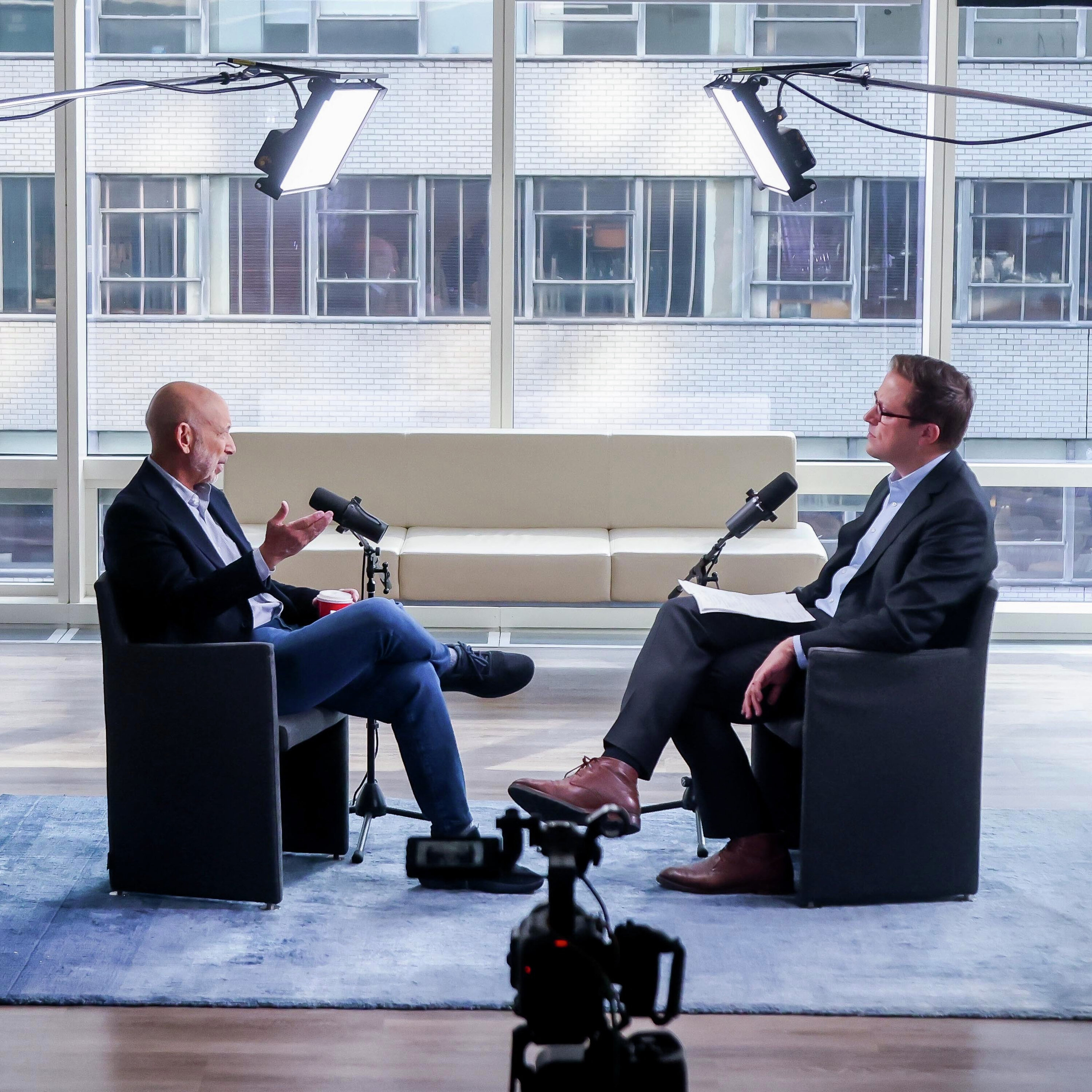
I'm David Gura and this is the big take from Bloomberg News. Today on the show, I sit down with Goldman Sachs's former CEO Lloyd Blankfein. We talk about the risks of private credit, what he learned running the bank during the global financial crisis, and how he thinks companies and executives should and shouldn't engage with polit. You write in the book about this transition that took place in the 90s away from kind of narrative driven investing or trading into more algorithmic trading. It does strike me we're in a moment where there is a prevailing narrative that's the AI narrative. How is it going to revolutionize the world? Is it going to revolutionize the world? How long would that take? Are you an AI user, an AI skeptic?
- [04:02]
Lloyd Blankfein
Look, I think it's a continuum. We always, when you say algorithmic trading, there were always, there were always people who used analysis, technical analysis as, you know, as technology advanced, you'd have machines looking for the technical points and follow that. And the point of algorithmic traders or technical trading is to take the human emotion out of it. Because there's, you know, there's a school that says, oh my God. You'll sit there and say, gee, when X, Y and Z happens, I'm going to do it. But when X, Y and Z happens, people don't do it. Let me make an analogy. In the real world, everyone says, I just can't wait to buy waterfront property when it gets cheaper. I'm going to buy it right after the next hurricane. And of course, the next hurricane happens, property values along waterfront get lower. And guess what? When everybody else is scared and wants to sell at a lower price, you don't want to buy at the lower price because you're scared too. So this is something that would take the emotion out of it and just force you into doing things based on signals. And it was working then, it's working now, just better technology, faster and more variables.
- [05:07]
David Gura
Is AI something that you're playing around with right now?
- [05:11]
Lloyd Blankfein
Mostly it's a parlor trick, because I'm asking it for questions that I could get the answer to, but not as quickly and not as delightfully. When it gives me something that's coherent, I would say when I use Google, I get a bibliography. When I use CHAT or one of the other AI, I get an essay that purports to be the answer. Sometimes I want a bibliography because I want to do the background stuff myself and look through it. And sometimes I just want an answer. The thing also about a bibliography is you kind of check sources. When you just get an answer, you kind of wonder whether it's right or not. I'm not running a company now, so I can't tell you which parts of our operations and technology and other things are being displaced by AI, such that we can have a much smaller headcount. In that I do know, based upon other cycles, that in the short term you won't lose headcount. You'll have to add a headcount to use the new technology while having the old, while having the old systems in place, because you need a reliable system and you can't switch on a dimensional. So you'll have to run them both parallel for a while. Are we over investing in it? Maybe. Even if it's perfect and right in every way, not every company doing it will be a winner. So undoubtedly, in hindsight, we'll wish we hadn't made some investments or we hadn't invested in companies that are involved in it, but we just don't know which. But one other thing, the hyperscale. I mean, really, companies investing close to, and in some cases over $100 billion a year. How many countries could invest in R and D for over $100 million a year? But I have to say, the people who are doing it, these companies, most of them are run by their founders who have most of their wealth tied up in those companies. So they're playing with their own money and they're risking their own wealth in this. And I would say I don't know if they're right, but they are at least as likely to be right as anybody else who's doing it. And it's their money. They're putting their money where their mouth is.
- [07:14]
David Gura
Let me ask you about something complementary to this. There is a growing chorus warning about what AI is going to mean for private credit. So you had Jamie Dimon saying, I see a couple people doing some dumb things. Marathon's Bruce Richards predicting the default rate in direct lending is going to rise in the next few years because of software's exposure to all of this. Are you worried about private credit? You with your banking background, how much it's grown and the integrity of that credit?
- [07:38]
Lloyd Blankfein
One has to worry about opaque assets where there's illiquidity. So it's very hard to mark to mark. And you're marking it by analogy to other companies. So it's not, there's no precision there. Very hard to test in the market whether your marks are correct because the only way to really test is to sell some. And it's very hard to sell to a knowledgeable buyer because any knowledgeable buyer would have to do the work and the credit analysis and who's going to do the credit analysis to buy a little smidgen, little piece of something. And another phenomenon that's gone on is we have, and this is just taking it away from credit for a second and just talking generically about opaque assets. The markets have been very good for a very long time. The one thing that imposes a lot of discipline on people are problems and losses and disasters and something like that happens. And then everybody goes into shock. And then all of a sudden everyone gets very careful about how they allocate capital, at least for a while. And like any other commodity, investing dollars is, if everything is always good and there's no adverse consequences, you start to lose discipline over time. By the way, this is why there are cycles to everything. Business cycles, history cycles, market cycles. And so it's been a long time since we have had to, you know, redress things. You know, have this bad habit of quoting movies sometimes. Remember in the movie, you know, the Godfather, when they're going to the mattresses and the guy says, you know, we have to have these things every 10 years to get rid of all the bad blood that's built up over that 10 years. So generally I'd be very, very. I'm always very cautious. I'm in the risk management business, but especially cautious at this time. You can point to several reasons, but if for no other reason, just because we haven't had a problem for such a long time, undoubtedly we've put money in places where write offs are going to need to happen. And when you're dealing with opaque, illiquid assets like credit, that's a place that one would clearly have to look.
- [09:42]
David Gura
You've spoken out against people putting private equity and credit in retirement portfolios. This is something that an arm of Goldman Sachs is doing, encouraging people to do. If you were still running the firm, is that something you would be encouraging as well? Given the opacity of this asset class, is it something that mom and pop
- [09:59]
Lloyd Blankfein
and the rest should have, again, specific firms, they have firms that are really good and care about. But there's thousands, hundreds of firms doing this. And not everybody has. Not everybody's been around for 150 years or more and wants to be around for another 150 years or more. So I would say just generically putting the relative riskiness aside, I would say the consequences of being wrong or having a problem in the account of retirees that is real people, citizens, taxpayers, voters is much more highly consequential. The political sector, the government sector really cares, but not that much. If institutional investors lose money, they're smart, they can afford it. Even very, very, very high net worth individuals, they must be smart because they have money. And even if they're not smart, they can afford it. But when you lose money for individuals, for consumers, that is taxpayers and citizens, people in government get very, very upset. Regulators get very, very upset. So my point in that you should approach when you're dealing with that segment with a lot more trepidation. Not because the odds of this security will, you know, will be worse in their account of someone else. Just the consequence of a bad outcome is much more dramatic to the people who do that. We're an institutional firm, so we never really had that. But I understand the consequences of that in the financial crisis. And so I just cautioned. Now I would say that as at all times, but here we are at late cycle in these markets. Is it the absolute end of the cycle? I don't know. But after so many years of a bull market and a bull run in all these assets, we're getting close. We're in the later part of the cycle, I'm sure. So wouldn't you know it? So this is the time when firms are lobbying to give individuals to bestow on them the opportunity of investing in these assets, these relatively illiquid assets at this particular time of the cycle. I think the people who are doing this should think about that very, very hard. And if they're going to do it, exercise a much greater degree of caution and just be aware of the calculus. Is it worth it? In other words, if your business is really terrific, if you're growing, you're doing very, very well, do you really need to extend your franchise that much by going to this much more dangerous sector.
- [12:27]
David Gura
You've called yourself a worrier more than a warrior. Something Jamie Dimon clearly is worried about is that we're back in a period that's like 05 06, the run up to the crisis. How does that strike you when you hear that? Do you see the historical analogy that he does this moment to that.
- [12:43]
Lloyd Blankfein
Yeah. No, I can't speak. I mean, he's smart, he sees a lot of stuff. I can't comment on what he's saying, but I'd say the best analogy would be to say, you know, kind of late cycle, you know, you know, the crisis that we had was, you know, in different forms. It was basically a real estate collapse and took the form of real, of mortgages, you know, loans on real estate, real estate on real estate. That was really what it was and in one form or another. And that was kind of late stage when individuals started to get involved in. And of course that was what, you know, on the, you know, inflamed the politics at the time and really. Cause, you know, was dramatic. And of course banks were very, very complicated. We can talk about that. But what's an analogy? Maybe you couldn't find an analogy in that. In companies that are historically institutional companies transacting institutional oriented products who are, you know, trying to have very small size transactions put into mutual funds or 401ks. Oh by the way, into affiliated insurance companies, which is kind of one step away for individuals because remember, insurance companies take your premium and will pay you back. They're the one, they're really, it's really individuals that are counting on, you know, in a lot of cases, individuals that are counted on those companies having, you know, having a good portfolio that's solvent and so that they could pay back their debts with, you know, their obligations when their own. They'll. When certain contingencies happen years and years forward, kind of a re. Kind of, kind of a consumer oriented business. Also. Also. So maybe that's an analogy because they both feel kind of late stage with assets and opportunities that normally wouldn't, you know, wouldn't go to individuals. That's what I see. But you know, these crises don't have to, you know, be the same. But you know, in some way or another they rhyme and they always come from, they'll come from different things. Look, if we're sitting here, one of the things I always thought if we're sitting here fretting about a specific thing, that's the thing that's less likely to happen because if we're fretting about it, that means we're all going home, talking to our people, trying to moderate the risks associated with it. And that's usually a good thing. Usually what you get is usually when the world blows up, it's something you thought was aaa. It's inevitably going to be something. And the question is, what is it? And who has contingency planned well enough? Who's looked around corners and seen that possibility that they may have thought was a very remote possibility, but it was a contingency that happened. And so they contingency planned and did something, got closer to home at the right place and reduced their risks.
- [15:29]
David Gura
Coming up, how Lloyd Blankfein managed Goldman Sachs during a challenging year and how the bank changed when it went public.
- [15:41]
Public / Okta Advertiser
Support for the show comes from public. Lately it feels like there are two types of investing platforms. Some are traditional brokerages that haven't changed much in decades, and others feel less like investing and more like a game. Public is positioned differently. It's an investing platform for people who are serious about building their wealth on public. You can build a portfolio of stocks, options, bonds, crypto without all the bugs or the confetti. Retirement accounts? Yep. High yield cash? Yes again. They even have direct indexing. Public has modern design, powerful tools and customer support that actually helps go to public.com market and earn an uncapped 1% bonus when you transfer your portfolio. That's public.com market and paid for by Public Holdings Brokerage Services by public investing member FINRA SIPC advisory services by public advisors SEC registered advisor crypto services by ZeroHash. All investing involves risk of loss. See complete disclosures@public.com disclosures the thing about
- [16:41]
IBM Advertiser
AI for business, it may not automatically fit the way your business works. At IBM, we've seen this firsthand. But by embedding AI across hr, IT and procurement processes, we've reduced costs by millions, slash repetitive tasks and freed thousands of hours for strategic work. Now we're helping companies get smarter by putting AI where it actually pays off. Deep in the work that moves the let's create smarter business. IBM.
- [17:10]
Cincinnati Insurance Advertiser
If you follow markets, you know the value of long term thinking. You plan, you diversify, you prepare for volatility. But in life, even the best strategies can't prevent every bad day a fire, a loss, a disruption that demands immediate attention. When that happens, what matters isn't just what you planned. It's who shows up. That's where Cincinnati Insurance comes in. For more than 75 years they've helped individuals and businesses navigate life's toughest moments with care, expertise and personal attention. Together with independent agents, Cincinnati Insurance focuses on relationships, not transactions. Their approach is grounded in experience, follow through and trust built over time. Bad days happen and when they do, you deserve an insurance partner who understands risk, respects what you've built and is ready to help you move forward. The Cincinnati insurance companies, let them make your bad day better. Find an independent agent. @cinfin.com.
- [18:16]
David Gura
I'd like to talk about your appetite for risk taking, how that's evolved. We could go back to 1994, which was a bad year for Goldman and you write in the book about how there was this kind of pendulum shift. There was excessive risk taking and then there was kind of excessive caution that followed that as the company kind of found its feet again. Talk if you would, just about finding that balance.
- [18:34]
Lloyd Blankfein
Well, 1994 was a really bad year for Goldman because we were kind of there by ourselves. You know, if you're going to have a bad year, you'd like everybody around you to have a bad year. You'd like it to be a generic problem. You'd like to be the best of a bad group or even in the middle of a bad group. But you know, we were miserable. We didn't have a lot of company in 94. We made the firm made, you know, we had very big positions that were conditioned on rates not coming down or at least not coming up, especially European. This was a time of a crisis and a lot of pressure on economies in Europe. And we thought they surely won't want to immiserate their people by taking interest rates in a slow growth environment. Guess what? They immiserated their people in a slow rate environment. So we did poorly. We lost money. That was a moment in time also where the firm was a private partnership and in a private partnership and by the way, a private partnership with unlimited liability for the partners. So you can not only lose all the money you had in your firm in the firm, but they'll come around and take away your home and you know, and so that really makes you really focused. And in our business, if you're afraid to lose money, it's very hard to make money. Not because people are betting wildly, but we intermediate the other side of what people want to do. People want to sell blocks of something, people want to hedge people big positions where there's no other side, where we would have to position that risk until we could cut it into little pieces and sell it off. But that's a Lot of risk. And so people were very, very loathe. So it's not just what you lose in the moment. It's all the opportunities that you inevitably let go by that you otherwise would have taken advantage on. And that could go for a long time. And what you have to do there is leadership has to be, you know, kind of sober about the fact that you really don't want to lose more money, but at the same time, encourage people to go ahead. And you have to have the discipline in your own organization to let people know by your behavior that you're not going to punish or kill people for having legitimate losses that were not. That were, you know, people. You're not supposed to be stupid, but even smart people are wrong a good percentage of the time. If you punish people for being wrong as if they were stupid, you'll lose them.
- [20:52]
Cincinnati Insurance Advertiser
You'll.
- [20:52]
Lloyd Blankfein
Even if they don't walk away, you lose their mind and you lose their ambition. So that's a very, very delicate management problem after crisis like that, to get people up on front of foot again. And by the way, what they're feeling, you're feeling too. You know, you're a little bit about. You're a little like the flight attendant going through turbulence, you know, and the engine may sound a little bit different. And you kind of wonder, is it supposed to sound like that? And if you're the flight attendant, you better have us. You better have a big fat smile pasted on your face, because if you look like you're terrified, guess what? The passengers. Guess how the passengers are going to respond. So I would say, you know, in a crisis, put the oxygen mask on you first before you put it on your kids, because you're not doing your kids any favors if you pass out. And the other thing is, try to look like you're not scared to death.
- [21:42]
David Gura
Goldman's special sauce, as you put it, is that heritage you're talking about the fact that it was a partnership for as long as it was. How has it post IPO been able to retain a lot of that? Maybe the special sauce isn't as strong as it was before, but it does have a unique flavor.
- [21:56]
Lloyd Blankfein
And how does it retain that? The thing that we would have least predicted that we were the most nervous about, that most came up into the debates about whether we should go public or not, which, by the way, I thought was inevitable given we needed a balance sheet and stable capital. But the thing that was that I would thought would have been the biggest surprise if I could look forward to where we are today is how well Goldman Sachs preserved the partnership culture 25 years, more than 25 years after we've been a public company. Now what does that mean, a partnership culture? People don't necessarily understand it when I. And by the way, I spend half my tenure in the private firm, half my tenure in the public company. In a private company, the people that report to you are your co owners of the business. They have a set of expectations. They act like owners. They expect to know everything that's going on. A Japanese bond salesman wants to know what's going on in investment banking in London. If somebody screws up somewhere in the world, it affects everybody around the firm. They're not just in their own cylinder. It's not considered rude to be a busybody and look around and see what's going around the whole firm. It's their expectations, their sense of entitlement to have that people expect to be consulted as owners. People think if they object, you'll listen to them and you may be slow in implementing a decision that you thought was the right thing to do, but people are objecting. And so you socialize things more. People in the firm get paid based upon how the firm as a whole did, not their little cylinder or not their little space. There's a lot of differences between a partnership culture and a regular corporate. And I think the firm did a good job in protecting that. Even though nobody's been a partner for a long time, but they call themselves partners and it's real. And I'll tell you another thing. There's an economic difference. When I was in a private partnership, you care about your capital account. You don't have stock at the end of your and you leave your capital in the firm because your money is the working capital of the firm. You care about how money accretes into your capital account, but you don't care if it's a smooth accretion every year or if it rises 5% every year. You care what it looks like after 20, 25, 30 years. And so if in a 10 year cycle, you make money four years, lose money in two years, break even four other years, that's perfectly fine as long as it's enough. In a corporation, a public company, it's not just your earnings, it's your earnings times a multiple. And the multiple is governed by people's sense of the stability of your earnings and the growth of your earnings. So all of a sudden you care about your e, your earnings, but you really care about your pe and maybe you'd forgo some of your earnings in order to have more stability in those earnings so you get a higher multiple. And so I think over time, the real test was how do you function, recognize that you had different ownership base, that is public shareholders versus the partnership. How do you satisfy your public owners who care about a share price and still have all those partnership culture elements, you know, the risk profile, everything. I'd say that process started with my predecessor, Hank who?
- [25:15]
David Gura
Paulson?
- [25:15]
Lloyd Blankfein
Yes, Hank Paulson, who was CEO when the firm went public. It certainly continued threading that needle with me. And I tell you, I think my successor, David Solomon, has done a good time. And in some ways, he's completed that transition to a great extent, because what I didn't do so much and what he did, I kept a lot of our investing opportunities on balance sheet, which was a very big source of E, P and L. But it was somewhat, sometimes a burden on our pen multiple because it would be much more volatile. He's moved a lot of that off balance sheet, which frankly was what our real owners at this point really would want to have happen. You know, for a long time in Hank's tenure and my tenure, we were a public company, but most of the shares were owned by insiders, by partners. Over time, partners retire, they sell their stock. And so over time, it becomes more and more like a traditional public company where the public owns the vast majority of shares and the insiders own a small amount. Early in my tenure, the partners, you know, the traditional older partners, still own most of the stock. And it was reflected in a board of directors where we had sometimes four or five Goldman people. Goldman employees were on the board of directors. That wouldn't happen today.
- [26:39]
David Gura
After the break, Lloyd Blankfein's thoughts on Kathy Rummler's resignation following the latest Epstein files release and his perspective on how companies should engage with politics.
- [26:52]
Public / Okta Advertiser
Support for the show comes from Public. Public is an investing platform that offers access to stocks, options, bonds, and crypto. And they've also integrated AI with tools that can assist investors in building customized portfolios. One of these tools is called Generated Assets. It allows you to turn your ideas into investable indexes. So let's say you're interested in something specific, like biotech companies with high R and D spend small cap stocks with improving operating margins, or the S&P 500 minus high debt companies. Chances are there isn't an ETF that fits your exact criteria. But on public, you just type in a prompt and their AI screens thousands of stocks and builds a one of a kind index. You can even backtest it against the S&P 500. Then you can invest in a few clicks. Go to public.com market and earn an uncapped 1% bonus when you transfer your portfolio. That's public.com market ad paid for by Public Holdings Brokerage Services by Public Investing Member FINRA SIPC Advisory Services by Public Advisors SEC Registered Advisor Crypto Services by ZeroHash Sample prompts are for illustrative purposes only, not investment advice. All investing involves risk of loss. See complete disclosures@public.com disclosures so there's a
- [28:05]
IBM Advertiser
lot of noise about AI. But time's too tight for more promises. So let's talk about results. At IBM we work with our employees to integrate technology right into the systems they need. Now a Global workforce of 300,000 can use AI to fill their HR questions. Resolving 94% of common questions. Not noise proof of how we can help companies get smarter by putting AI where it actually pays off. Deep in the work that moves the business. Lets create smarter business.
- [28:34]
Cincinnati Insurance Advertiser
IBM if you follow markets, you know the value of long term thinking. You plan, you diversify, you prepare for volatility. But even the best strategies can't prevent every bad day. For more than 75 years, Cincinnati Insurance has helped individuals and businesses navigate tough moments. With expertise, personal attention and independent agents who focus on relationships, not transactions, the Cincinnati Insurance companies let them make your bad day better. Find an agent@cinfin.com.
- [29:15]
David Gura
There is, as I see it, a very vibrant alumni network in part thanks to you and your work kicking that off and organizing it. How actively are you engaged with what the firm is doing, you and other alums of the firm watching what's happening
- [29:28]
Lloyd Blankfein
so all the time, I mean it's a very important thing, very important to the core of Goldman Sachs that we care about our alumni. And in return the alumni care very much about the firm. If you went to somebody who had been at Goldman Sachs for five years, 25 years ago, had a great career and you ask them to oh, tell me about yourself, first thing they'll say is I'm ex Goldman. A lot of people at Goldman Sachs go into public service after their tenure at the firm. And in fact people refer to sometimes revolving doors. R wasn't a revolving door government took from Goldman. We didn't hire principally, we didn't hire people from government, it was the other way around. But we get people that were public servicing minded. We care about our alumni. If somebody is going into government 15 years after, guess who they ask to help them with their process of getting through the. Getting through the Senate process of confirmation or other things. But having been there is highly valuable. It's a very important recruiting tool and it's a very important morale lift. And part of the, you know, part of the perks of being at the firm is that you get to have been at the firm. There are always going to be people who think they're going for 30 years to gomen. They stay three, and there are people who only intend to stay three and they stay 30. But whether it's three or 30, it's a good place to get your training, start your career and to maintain the relationship with.
- [30:54]
David Gura
I suspect that you, as a Goldman alum, have followed the scandal that erupted around Kathy Rummler, the general counsel who came into that job after you'd left, a scandal that was brought about by the fact that many emails between her and Jeffrey Epstein were made public. She effectively became a reputational risk herself. And I'm curious how you think the firm, again, as an alum, how you think they've handled that.
- [31:19]
Lloyd Blankfein
You know, I tell you, I don't shy away from, you know, provocation, but I just don't know. I hadn't met Kathy. She came in after I left. I don't know what the calculus was. I'd say, in general, one of the ways in which you're a good partnership is if you think. And again, this is a big if. I don't know. I really don't know. I don't know what was exchanged. I don't know, Kathy. I don't know the situation. But I'll say as a generic matter, applied to other situations like the financial crisis or a big loss, I prefer to talk about that. And you can draw your own analogy where something goes wrong or we're doing M and A and in M and A transaction, as people hear, you know, you have a TV station. People here well know sometimes your opponents in an M and A will use the media against you and make accusations and try to gin up. Will try to gin up support for themselves by slandering the opposition in some way or another. If you. Even if the pressure on you in that kind of a context gets severe, if you cut and run on somebody in your fund that you think whether you're right or wrong, you think is unfair, and you really think it, and you really think they did nothing wrong, you really think that somebody's just picking on them and you really think it's caught, kind of get caught up because there's some hostile M and A situation, not Real. And if you add badly to your own people, that's not just a specific costly thing to do with respect to that person, but that's a signaling that goes on to the rest of the organization. And so one, you know, one doesn't do that. So you're asking me a specific question about a specific person. I don't know enough to comment on that. But I will say what people are neglecting in looking at these situations is I don't think that people who, you know, look, in the mortgage crisis, you know, there are a lot of people, you know, you had people at other firms that blew up certain things. They got fired. Did anybody ever hear, ever know the name of somebody, the person who was running the mortgage business at Goldman Sachs during that era? No, it was all me. I was the symbol. I was the guy in charge. Everyone did this. I promise you. I never sold a mortgage in the firm. First of all, you didn't do mortgages. It was secondary markets in that. But if they were doing their job and did nothing wrong and hedged appropriately and didn't lose money and did everything right, we didn't fire those people because there was a clamor for that to happen. And if I had done it, we wouldn't have been Goldman Sachs anymore. We wouldn't have the people, we wouldn't be able to recruit, we wouldn't be able to retain the firm, wouldn't have its relationship with the people. So I am intentionally not asking the specific question you're asking because I don't know about it. It's not like I'm shying away from. It'd be unfair. But I will say what not what doesn't get talked about is the support that a firm should show to its people if they believe that there's unfairness in the world. And by the way, we're seeing some of this stuff where people get merely cited. Let's say in this situation where in a cancel culture world, again, I'm talking more generically, people are cunning and running on people. Not just in this context, but, you know, every day you can read in the paper somebody's getting fired for something that maybe three years from now they'll look back and saying, was that really, was that really a capital offense and why the people overreacting to it. So again, I shy away from the specifics of this because I don't know enough. I'm not, and it wouldn't be right to comment. But I do say that the world more generally is in a bad, the polarized World we're in today is in a bad place with respect to penalties and accusations for question. You know, for, you know, every crime is a felony, every felony is a capital offense. And I'm not sure that that's warranted.
- [35:05]
David Gura
One more question on this note. You write about a mantra that you used and read out to colleagues of yours at Goldman. You said there should be any tolerance for bad behavior you observe at your company.
- [35:14]
Lloyd Blankfein
Yep.
- [35:15]
David Gura
Is that not applicable here? I think through sort of what's happened, which is the board clearly vetted her and asked about her relationship with you
- [35:22]
Lloyd Blankfein
keep wanting to talk about this. I don't really have much to. I don't have much to say about it. I know in a trial the prosecutor informs the jury about what you know, how bad the victim suffered. But at the end of the day, you still, the jury has to find out whether the person under trial was the perpetrator or did anything wrong. So at the end of the day, you can appeal to people's emotion about how bad something the outcome and the consequences something was. But you still have to decide whether that perhaps the person who's on the dock did something wrong. And so, you know, if you want to talk about what happened in any given situation, I probably agree with you. But at the end of the day, the ex lawyer in me wants to focus. This is all I am with you on the severity and the difficult of the outcomes. And you want people who are responsible to suffer what they deserve to suffer. But at the end of the day, you still have to decide if these are the right people and if what they did was. Was the. Would cause the problem. And so that's all you know, can go around. Go around about it. But I don't, I don't know this situation.
- [36:29]
David Gura
Let me pull back and ask just about the.
- [36:31]
Lloyd Blankfein
By the way, I got called by press people to comment on my mentions in the Epstein file. There are five mentions of his office trying to get in touch with me to invite me to specific dinners. And I kept being out of town. And by the way, I have no memory of it. But my, you know, when people I didn't know call my office, invited me to stuff, I never said no, but I didn't say yes if I didn't know them. And so the fifth time the memo went back internal to Epstein's organization. Should I keep trying with Lloyd or should I give it up? And the answer came back, I think at this point, give it up. And I didn't know that because if somebody had asked me, did I ever meet him? No. Did I ever engage with him? No. But it was sidebar third parties discussing how I was responding. And I frankly have no memory of not being responsive. But that didn't stop reporters before I knew how I was mentioned, calling me up and asking me if I wanted to comment on my mentions. Just saying.
- [37:34]
David Gura
You characterize yourself as a moderate globalist, and I wonder how you see the way that corporate America is interacting with Washington today. What do you think as you watch your contemporaries, other CEOs, interact with this White House in the way in which they are.
- [37:52]
Lloyd Blankfein
Look, you have to do what you have to do. I say somewhere else, look, I don't want to do this, I don't want to do that, blah, blah, blah. But if somebody puts a gun in your head, you're going to do stuff you otherwise wouldn't like to do. I think. I think we shouldn't have blue companies and red companies. I mean, I don't.
- [38:10]
David Gura
And it feels that way to you?
- [38:11]
Lloyd Blankfein
Yeah, starting to feel. Yeah, it's starting to feel that people are being asked and expected to take positions on the issue. You know, controversial issues, I think that, that, by the way, are properly left to the political sector. I'm not saying that people shouldn't have positions on them, but not in terms of your platform because you're a, you know, because you're a, you know, consumer company and you're selling toothpaste. But people are shoving microphones in people's faces and say, you really should take a position here. I mean, so you could take a position as an individual, but recognize the reason why they're shoving the microphone in your face is because you have the platform of your company. And since your. The interest in you is coming from people's interest in that platform, I think you have a duty to do what's in the interest of the company. Now, I think there are times when you not only can, but maybe you should take a position. And that is specifically where the issue that's being debated is in the core of your expertise. So if there's a government shutdown looming because the government can't pass a budget, I think you can ask Goldman Sachs what do you think the consequences will be? And somebody at Goldman Sachs who knows about this stuff should comment upon it, take a view and explain it to the public why they have the view that they have. I think there are cases where the issue affects your people in a way that otherwise wouldn't allow them, may or may not allow them to do their jobs, like marriage equality. I took a very strong position on marriage equality. I was the chairman of the New York City Partnership, which is like kind of the local chamber of commerce, but only for very big. But for very, very big companies in New York. And we were very strong on that issue and we lobbied for it. But you know, in that respect, I'm the champion of the people who work at Goldman Sachs. As individuals, you can vote, you can make statements, you can carry a placard and march. But I'm not sure it's right to use the prestige of your corporation. And certainly I don't think you should be required to do that. And there are people who would want to require companies to do that. It makes no sense. Why should we divide countries polarized enough? Why should we divide our economy in
- [40:17]
David Gura
half on that issue of polarization? We've seen companies have to go to the White House. The US Government taking stakes in companies. What do you make of that in the year 2026 to see a Republican president heading down that path?
- [40:30]
Lloyd Blankfein
Look, I think one shouldn't defend the extreme of anything. So generally I think the economy does well without centralized control. Centralized management of government dictates. I'm glad that Al Gore never built the information superhighway and laid all that cable five minutes before the, you know, before the cloud, the Internet and the cloud took over and made it vestigial. The strength of the US Economy is that we have millions of decision makers. And the real strength of the economy is that when those decision makers are wrong, you know, you build an airport in the wrong place. Planes don't land there, fees don't get paid, the bank loans don't get paid off, they repossess, they plow it over, and they build a Walmart quicker than any other country would. That's the strength of our economy. Having government as a decider or having government owning a stake such that it slows down the processes that I just described is not a good thing. Is there room for government? Sometimes, yes. Orphan drugs that otherwise wouldn't be made. Where we have a social thing, delivering rural mail where nobody would. The electrification of the Tennessee valley in the 30s when nobody would have have spent that money. Supply chain where no individual company, you know, has the wherewithal or the incentive to play that money. Where they have to invest some infrastructure as a matter of public policy or national security. Lot of opportunities for government. Maybe they've hit all the right ones, but I think there are a lot of wrong ones that are possibly to be hit. And if the government is involved in may get too much capital and it may have that capital much longer than it needs to to do. And the incentive structure is just, you know, discombobulated. So there's not no time for it. But it's not a lot.
- [42:18]
David Gura
Lloyd Blankfein, thank you very much.
- [42:20]
Lloyd Blankfein
Thank you.
- [42:25]
David Gura
This is the Big Take from Bloomberg News. I'm David Gura. To get more from the Big Take and unlimited access to all of bloomberg.com, subscribe today@bloomberg.com podcastoffer. You can watch this episode on YouTube if you like this episode. Make sure to follow and review the Big Take wherever you listen to podcasts. It helps people find the show. Thanks for listening. We'll be back tomorrow.
- [42:57]
Red Lion Hotels / Sonesta Advertiser
From coast to coast, Unlock adventure at Red Lion Hotels by Sinesta, where restful sleep, friendly service and local knowledge await. Whether for business or pleasure. Spend less and make more of every trip. When you sign up for Sonesta TravelPass, you'll get their best rates instantly. Go to sonesta.com to book your stay and unlock their best rates with Sonesta Travel Pass here today, Rome tomorrow. Join now@sonesta.com terms and conditions apply.
- [43:24]
Cincinnati Insurance Advertiser
If you follow markets, you know the value of long term thinking. You plan, you diversify, you prepare for volatility. But even the best strategies can't prevent every bad day. For more than 75 years, Cincinnati Insurance has helped individuals and businesses navigate tough moments. With expertise, personal attention and independent agents who focus on relationships, not transactions, the Cincinnati insurance companies let them make your bad day better. Find an agent at Cin Fin
- [43:59]
Public / Okta Advertiser
these
- [43:59]
Red Lion Hotels / Sonesta Advertiser
days it seems like AI agents are just about everywhere. You turn every field and every function. But without identity, you can't trust they'll serve your business instead of jeopardizing it. Fortunately, Okta helps you get identity right by securing your AI agents identities, giving you a single layer of control, a single standard of trust. So whether an AI agent supports a single user or your entire enterprise, with Okta you'll turn turn risk into opportunity. Secure every agent, secure any agent. Okta secures AI.