Loading summary
Transcript100 lines
- [00:00]
IBM Narrator
So there's a lot of noise about AI, but time's too tight for more promises. So let's talk about results. At IBM, we work with our employees to integrate technology right into the systems they need. Now a global workforce of 300,000 can use AI to fill their HR questions, resolving 94% of common questions, not noise. Proof of how we can help companies get smarter by putting AI where it actually pays off, deep in the work that moves the business. Let's create smarter business IBM Running a
- [00:31]
Matt Rogers
business is hard enough. Don't make it harder. With a dozen apps that don't talk to each other. One for sales, another for inventory, a separate one for accounting. That's software overload. Odoo is the all in one platform that replaces them all. CRM, accounting, inventory, E commerce, hr. Fully integrated, easy to use, and built to grow. With your business, thousands have already made the switch. Why not you try Odoo for free@odoo.com that's odoo.com this is Matt Rogers from Las Culturistas with Matt Rogers and Bowen Yang.
- [01:04]
Bowen Yang
This is Bowen Yang from Las Culturistas with Matt Rogers and Bowen Yang.
- [01:07]
Matt Rogers
Hey, so what if you could boost the WI fi to one of your devices when you need it most?
- [01:12]
Bowen Yang
Because Xfinity WI fi can. And what if your WI fi could fix itself before there's even really a problem? Xfinity is so reliable. It does that too.
- [01:20]
Matt Rogers
What if your wifi had parental instincts? Xfinity WI fi is part nanny, part ninja, protecting your kids while they're online.
- [01:27]
Bowen Yang
And finally, what if your WI fi was like the smartest WI fi?
- [01:31]
Matt Rogers
Yeah, it's W that is so smart it makes everything work better together.
- [01:36]
Bowen Yang
Bottom line, Xfinity is smart and reliable. You deserve the peace of mind of having wifi that's got your back.
- [01:41]
Matt Rogers
Xfinity. Imagine that.
- [01:47]
IBM Narrator
Bloomberg Audio Studios Podcasts Radio news the
- [01:52]
David Gura
U. S. Iran war has entered its fifth day with no signs of de escalation. On Wednesday, Defense Secretary Pete Hegseth confirmed the sinking of an Iranian warship off the coast of Sri Lanka, telling reporters that the war with Iran was just getting started. We are accelerating, not decelerating.
- [02:10]
Antony Blinken
Iran's capabilities are evaporating by the hour, while American strength grows fiercer, smarter and utterly dominant. More bombers, more fire.
- [02:19]
David Gura
President Trump showed no sign of looking for an off ramp. He brushed off reports that Iran's Ministry of Intelligence reached out indirectly to discuss ways to end the conflict. Writing on Truth Social quote they want to talk. I said too late. In light of all This I wanted to sit down with someone who understands the complexities of negotiating with Iran's regime and the unforeseen consequences when diplomacy fails.
- [02:42]
Interviewer (David Gura)
Mr. Secretary, thank you very much.
- [02:44]
Antony Blinken
Great to be with you.
- [02:45]
David Gura
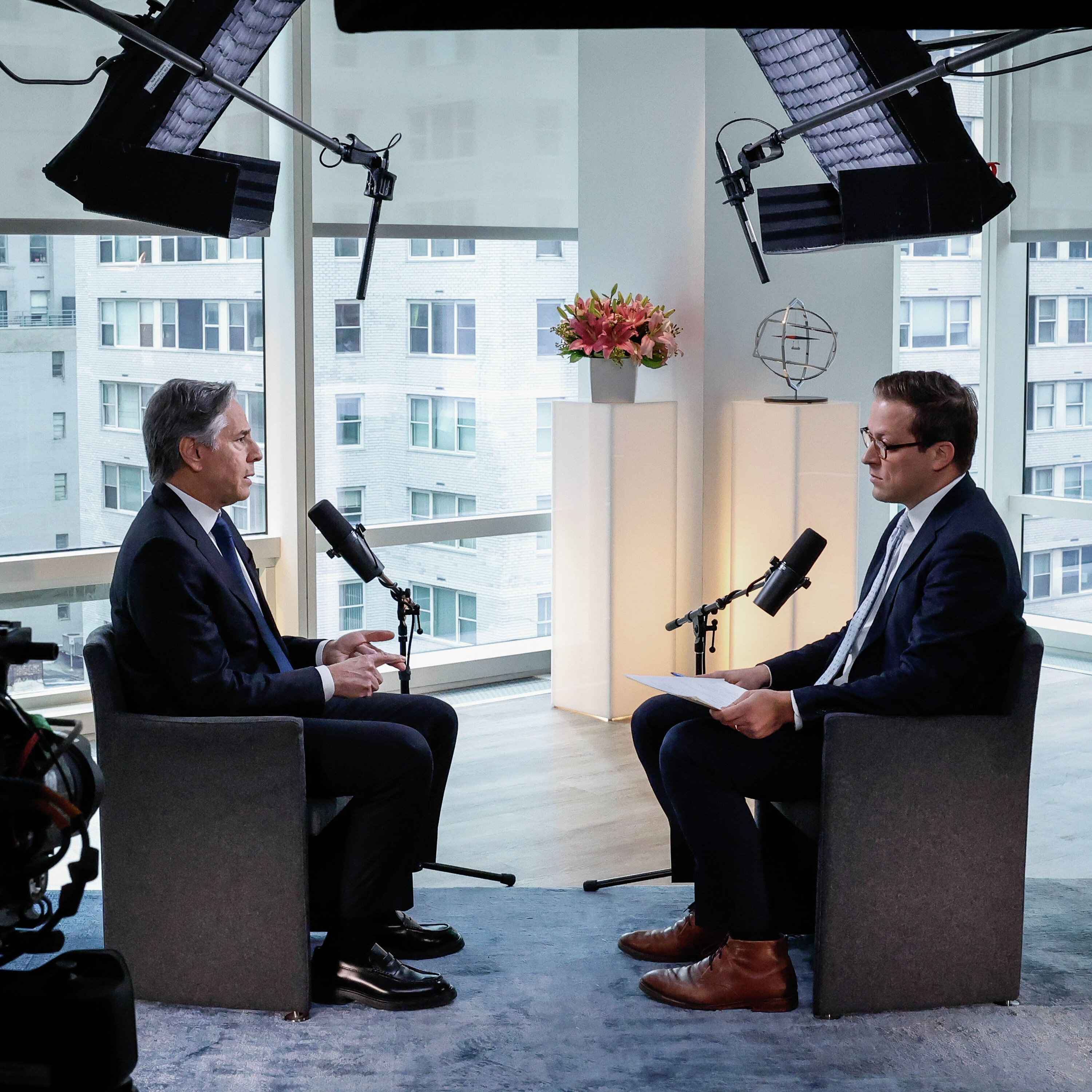
Antony Blinken served as Secretary of State under President Biden. He spent much of his tenure trying to revive the 2015 Joint Comprehensive Plan of Action, or JCPOA, the Iran nuclear deal he helped negotiate as Deputy Secretary of State under President Obama. President Trump withdrew from that agreement during his first term. A pivotal moment, Blinken says, on the path to war with Iran. I'm David Gura, and this is the big take from Bloomberg News. Today on the show, my conversation with former Secretary of State Antony Blinken on how the US Tried to avoid conflict with Iran, how this war could end and its consequences for the region and the US World standing.
- [03:33]
Interviewer (David Gura)
We've heard from the president, secretary of State, secretary of Defense, chairman of the Joint Chiefs. I'm curious at this point what your understanding is of the case this administration has made for the US Going to war against Iran.
- [03:45]
Antony Blinken
Well, look, the case keeps shifting, but the first thing to say is this from my perspective. Once our men and women in uniform are engaged in an operation or in a war, my first thought is for their safety and for their success, irrespective of what I think about how we got there or even where this is going. So that's primarily what I'm thinking of. But having said that, we've heard, you know, a number of shifting rationales, but I think it's important to take into account that we've got to be able to hold multiple truths in our head at the same time. Is it a good thing that this Ayatollah is gone? Yes. Terrible tyrant. Is it a good thing, potentially at least, that Iran's nuclear program is, I guess, re obliterated because apparently it was obliterated last June, but maybe not so much because they had to re obliterate it or its missile program diminished or its, its navy sunk. Yes. But to do that and to take on the extraordinary risks that go with it without having made the case with the American people, with citing imminent threats that apparently didn't exist, I think that's problematic. And the chances of unintended consequences taking hold in any situation like this are very real, very serious for our partners and allies in the region and for ourselves and, of course, for the Iranian people. I think a big question that everyone has is, okay, have we done regime change in Iran or just ayatollah change, which is the way it looks Right.
- [05:21]
Interviewer (David Gura)
Now you brought up the argument that there was an imminent threat. In years past, you'd warned that there were a matter of weeks before Iran could develop fissile uranium. Is that an argument that's persuasive to you so much as that's been made by the administration that, that there was an imminent threat?
- [05:36]
Antony Blinken
It's an ironic argument in a number of ways. First, as I said, they claim to have obliterated the nuclear fissile material program back in June, and now we're told, actually, no, we didn't. And a number of us warned at the time that one of the reasons why military action against the nuclear program might not do the trick is that the Iranians were likely to start to rebuild, maybe rebuild deeper underground where we couldn't get at it. Whether that was happening or to what extent, I don't know because I'm not privy to that information. But at least that seems to be part of the rationale. The deeper irony, of course, is that we never should have been in this position. Insofar as the agreement that President Obama reached, the Iran nuclear deal, the so called jcpoa, put Iran's nuclear program in a box. It made sure that Iran could not produce the fissile material needed for a nuclear weapon in less than a year. And so if they chose to break out of the box and go for that, we'd see it and we'd have plenty of time to be able to do something about it. President Trump tore up that agreement, said he'd replace it with something better. He never did. And that's the road that we then wound up on that led to, in some ways to where we are today, with Iran, yes, dramatically advancing its production of fissile materials so that that breakout time moved from one year to a couple of weeks. But you don't only need fissile material, you actually need a weapon too. And I think, as has been publicly reported, our intelligence agencies and others, the iaea, continue to conclude that Iran has not made a decision to actually weaponize if and when they do, or if and when they did. Most estimates had that, that timeline at a couple of years. There are different kinds of weapons, less sophisticated ones. You could build on a quicker timeline. But the bottom line is that on the nuclear side, there was no imminent threat. There was, though, the fact that, yes, in terms of fissile material production, they'd gone from the Obama deal more than a year to a few weeks.
- [07:29]
Interviewer (David Gura)
The Supreme Leader, who's been killed, of course, warned in the run up to this that if there were US Strikes, the US Risked a wider regional war. How has what's played out over these last few days, how does that compare to what you expected would happen here? I imagine in your old jobs there were planning meetings and war games in which you kind of tried to figure out what might happen here. As we see this war widen, is that in keeping with what you expected when you heard the Supreme Leader warn of that?
- [07:55]
Antony Blinken
Well, look, it's certainly something that should have been anticipated. And what's one of the striking features so far is that Iran has launched far more missiles and far more drones at the Arab countries in the Gulf and in the region than it has even at Israel, disproportionately so. And in part, that's to because we have bases and a presence there. But they've gone beyond that. They've gone at infrastructure that these countries have, the oil infrastructure. They want to try to inflict so much pain that we can't sustain the effort. And that's something that should have been anticipated. And David, I think we're looking at a couple of things going forward in terms of where does this go and how does this end. And it seems to me that there are two critical factors to look at. Markets and munitions markets. Where are the oil markets, where's the stock market, where's the bond market? I know President Trump is very attentive to those. And if they go in a southerly direction and stay that way, or in the case of oil in a northernly direction, that's going to be possibly a limiting factor. Then munitions. There's really a race on to figure out who expends their munitions first and fastest. Do the Iranians put us in a position where we've used up a lot of interceptors to deal with defense or even our offensive missiles to take out their launchers? Or conversely, did they run out and we still have what we need? Again, I don't know the numbers here. I'm not privy to that. But it is something we have to be very, very attentive to because these things are not in infinite supply. The production times are very long. And of course, we're also using very, in many cases, very expensive weapons to take down $20,000 drones. That's not a good equation if you keep that going over time. One of the things I'm worried about, and this gets to the second and third order consequences, is we so deplete our arsenal and it takes a long time to rebuild it, that that puts us in a disadvantageous position when it comes to, say, a China or a Russia. All of those things need to be factored in. And again, it's one of the reasons why if you're going to undertake something like this, you've got to make sure that you've factored all of that in. And again, it really should start with explaining to the American people why you're doing something, why it's necessary, why. Now, do you see an off ramp
- [10:07]
Interviewer (David Gura)
anywhere at this point?
- [10:08]
Antony Blinken
I do, in the sense that one, as I said, I think the off ramp will be governed by this question of munitions and markets. And then what is that off ramp? I think the president may simply declare victory. He'll say, got rid of the Ayatollah. We diminished or degraded or destroyed their nuclear program. Again, we did the same thing to the missile program. We did the same thing to the Navy. And as to the regime, well over to the Iranian people. Good luck to them, hope they succeed. And if they don't, it's their fault. If they do, we'll take the credit. How Iran responds to that remains to be seen. And for the regime, survival is success. Right now, the expectation seems to be the ayatollah's son is his successor. He's very tied into the irgc. And so you may have a situation where much as we want and. And everyone should want to see a change in that regime, we have regime change without regime change, status quo, Status quo, and even, potentially even worse because it may simply ultimately reinforce the irgc, the specialized military. And part of the problem with these things is that it's very hard to produce regime change from outside. You can't bomb your way to it. We've had a lot of experience with that and not such good experience over the last 20 years. It's even not so likely to come from the streets, even with the extraordinarily courageous Iranian people. It's more likely to come from kind of within the palace. And then it could go in any one of multiple directions. You could get more pragmatic people, not good guys, but more pragmatic people who are open to curbing the excesses of the regime, focusing at home instead of focusing abroad doing deals. But right now, it looks more likely that you're going to have hardliners and the who had a song way back in the 60s or 70s. Here's to the new boss, same as the old boss. That seems to be right now, at least, where we're headed.
- [12:12]
Interviewer (David Gura)
You've warned of the dangers of US intervention many times. 2024, you spoke at the Council on Foreign Relations. And you said effectively, I think if we look at the last 20 years, our experiments in regime change have not exactly been resounding successes. CNN is reporting that the U.S. is considering arming the Kurds in Iran. Bloomberg hasn't confirmed that reporting. When you hear that, what red flags does that raise for you?
- [12:35]
Antony Blinken
Oh, the red flag it raises is this could be Syria redux or it could be Libya redux. You could see the country fracturing, imploding, or even exploding with refugees and migration, with the exporting of some of their problems, with extremist groups taking hold in one part or another, it's incredibly fraught and incredibly dangerous. And as sympathetic as I am to the Kurds, who've been incredible partners for us and incredibly brave, I don't think that getting into the business of arming these groups is ultimately going to be a good thing. And then you're going to have other countries that pick their partners inside. And again, you wind up with something like Syria, something like Libya.
- [13:14]
Interviewer (David Gura)
Let's talk a bit about diplomacy. The president posted on Truth social media, they want to talk. Referring to the Iranians. I said, too late. Is it too late for there to be a diplomatic solution or to have those conversations at this point?
- [13:27]
Antony Blinken
I think it's never too late for diplomacy. The question is, is there a good moment? Is this the right moment for it? I would hope so, because on one level, the Iranians have never been weaker, at least not in recent memory, militarily, politically, at home, diplomatically, abroad, and their proxies are for the most part gone or vastly diminished. So that's why I was hopeful before this action started that maybe they actually would get a renewed nuclear deal because Iran had a very weak hand to play. So I think there is a possibility of doing that, whether the new, whatever the new regime is or the continuation of the existing regime is ready to do that, wants to do that, to be determined. It also depends on what the Trump administration wants to do. And I imagine Israel is going to have a say in this as well
- [14:17]
Interviewer (David Gura)
as the administration was marshaling all of this military might to the Middle East. You had Jared Kushner, the president's son in law, Steve Witkoff, his longtime friend, now envoy to many conflicts and regions, meeting in Geneva in meetings mediated by the Omanis. Do you think that those were good faith conversations when you look at it now, in hindsight?
- [14:35]
Antony Blinken
Look, I can't. It's hard for me to tell, not being in the room, not being privy to those conversations. I certainly want to Believe so. I don't know. As you know, I think Jared Kushner, Steve Witkoff are very able negotiators, but it was not clear to me that the expertise was also with them, which is very necessary when you're dealing with nuclear matters. When we did the jcpoa, we had very senior diplomats, but we had tremendous technical expertise at hand because it's complicated stuff and you want to make sure you're not making a mistake. So I'm not sure who was actually in the room and whether the people in the room could fully evaluate and assess is this a good deal, is this a bad deal? And I've heard different versions of what the Iranians were actually willing to do. Not willing to do, different versions of what we were willing to do or not willing to do, not being there, it's hard to tell. But, David, when President Trump tore up the JCPOA back in the day, first term, he said he wanted to replace it with a better deal. And I think there was actually an opportunity to do that because Iran was. Was in so much of a weaker position now than it was back when President Obama negotiated the deal.
- [15:42]
Interviewer (David Gura)
You, of course, are a professional diplomat. You've dealt with the Iranians directly. And I'm curious if you think that Steve Witkoff, Jared Kirschner, were at some sort of inherent disadvantage in those talks because you had professional diplomats on one side and they were on the other. This isn't what they've done their entire lives.
- [15:57]
Antony Blinken
Look, a number of the Iranians have been doing this for a long time. And when we change administrations, we change out the people who are doing these issues. And there's a certain learning curve and you have to get up to speed and become genuinely expert in things again. That's why I think it's so important to make sure that you have the experts with you. They're the continuity. The Iranians have continuity because it's usually the same cast of characters, the same guys that have been doing this for a long time. Aranchi, the foreign minister, was Zarif's the then foreign minister's deputy back then. So he knows what he's doing.
- [16:34]
David Gura
My interview with former Secretary of State Antony Blinken continues after the break.
- [16:44]
IBM Narrator
The thing about AI for business, it may not automatically fit the way your business works. At IBM, we've seen this firsthand. But by embedding AI across hr, IT and procurement processes, we've reduced costs by millions, slashed repetitive tasks, and freed thousands of hours for strategic work. Now we're helping companies get smarter by putting AI where it actually pays off, deep in the work that moves the business. Let's create smarter business. IBM.
- [17:14]
Matt Rogers
This is Matt Rogers from Las Culturistas with Matt Rogers and Bowen Yang.
- [17:17]
Bowen Yang
This is Bowen Yang from Las Culturistas with Matt Rogers and Bowen Yang. What if your WI fi was more than just WI fi? What if your WI fi made everything in your whole house just work together better?
- [17:28]
Matt Rogers
Well, Xfinity wifi pretty much does exactly that. It's powered by their best, most elite, high performing tech.
- [17:34]
Bowen Yang
Allow us to paint a very realistic example. Everyone in your house, everyone is on their devices at the exact same time. Gaming, working, swiping.
- [17:43]
Antony Blinken
Right?
- [17:44]
Bowen Yang
Because of course they are. And the finale of your favorite show of all time of the week is on at the exact same moment. Well, you can boost the WI fi to your device with Xfinity.
- [17:53]
Matt Rogers
And have you ever asked yourself, what if my WI fi could keep watch over my kids for me? Well, probably not, because that's a weird thing to ask yourself. But Xfinity WI fi has parenting skills, even if you sometimes forget yours. Xfinity's like, don't worry, I'll monitor the WI fi.
- [18:09]
Bowen Yang
It's completely proactive, fixing issues before they even happen. Bottom line, Xfinity is smart and reliable. You deserve the peace of mind of having WI fi that's got your back.
- [18:19]
Matt Rogers
Xfinity. Imagine that.
- [18:21]
Antony Blinken
Ryan Reynolds here from Mint Mobile with a message for everyone paying big wireless way too much. Please, for the love of everything good
- [18:28]
IBM Narrator
in this world, stop with Mint. You can get premium wireless for just $15 a month. Of course, if you enjoy overpaying.
- [18:34]
Antony Blinken
No judgments. But that's weird.
- [18:36]
IBM Narrator
Okay, one judgment anyway.
- [18:40]
Antony Blinken
Give it a try@mintmobile.com Switch upfront payment of $45 for 3 month plan equivalent to $15 per month required intro rate first 3 months only, then full price plan options available, taxes and fees extra. See full terms@mintmobile.com.
- [18:56]
Interviewer (David Gura)
You've noted in the past that during war games something's come up where if there were to be this kind of chaos in Iran, the regime might move uranium to different places across the country. And going back to what you were talking about a moment ago, the prospects of there being a Libya esque or Syria esque civil war. How worried should we be about that? Nuclear material being effectively scattered across this country and there being next to no accountability for A where it is and B into whose hands it falls.
- [19:23]
Antony Blinken
Yeah, I think that's a real concern. I would assume that the remaining material. And again, I don't know, we've seen lots of reports that it's likely that they were able to preserve, safeguard a lot of your uranium, but I don't know that for a fact. I would assume that they've tried to disperse it, as you said, presumably in places that the regime has some control over. But if the country winds up in some kind of civil war. Yeah, that's a real concern and something that we have to factor into our thinking. If we're going to start, you know, dropping matches there in terms of arming various groups, we better watch out in terms of getting what we wish for. But you've seen extraordinarily courageous people beyond imagination who are out in the streets looking for, looking for change, getting mowed down by this regime. And we all want to see a different future for them, different leadership for them. But it's very, very hard, if not impossible, to do that from the outside, as we were saying. And the risks now are that instead of having a change, having a transition, you have an implosion and then maybe even an explosion that has real effects outside the country. Our partners in the region have far fewer interceptors, air defense interceptors, than we do. If it gets to the point where they're running out and the Iranians have enough to continue going at their infrastructure, at their people, I think there's going to be a pretty strong demand signal on the administration to take an off ramp to stop. We've had other second and third order consequences here. At the very time when Russia is really reaching a weak point because of its dependence on oil to fuel its war economy, in large part because the price of oil has gone down, it's having more trouble exploiting oil because of sanctions and restrictions that we put on technology. That's been a huge and growing factor. And the thing to do now, ideally, would be to squeeze the shadow fleet that they have that's going around the world, and that's the one thing that's able to keep them going at the very time when that's possible. And that that might force Putin to finally cut a deal on Ukraine. They get a lifeline, and the lifeline is the price of oil is going up and the value of that shadow fleet oil is going up and people will need it and want to buy it. The Europeans, in turn, having moved away from Russian gas, are now more dependent on the Middle East. And if that gets tied up, if the Straits of Hormuz remain problematic, that's going to put a lot of pressure on them. So mapping out, gaming out, planning out and then making sure you have something in place to deal with all of these second and third order effects, usually important. And it's not at all clear to me that that was done from where we sit today.
- [22:08]
Interviewer (David Gura)
Are you confident that the US can extricate itself from this without putting boots on the ground in Iran?
- [22:14]
Antony Blinken
It depends what the objective is. I think that yes. In short, as I said a moment ago, you know, the president could theoretically declare victory tomorrow and claim that, you know, severe damage was done to the regime, to the missiles, to the nuclear program, to the Navy, and call it a day. But then for what? Most of that stuff ultimately can be rebuilt. And absent a change in the governance in the regime, which right now in this moment doesn't seem to be forthcoming, huge risk without the support of the, well, without the, in effect, the buy in from the American people. That leaves us actually potentially for some time in a strategically weakened position with regard, for example, to China or Russia, because our own stockpiles of critical long range precision guided weapons are down, our air defense stockpile interceptors is down. That's usually usually questionable, but I think that is an off ramp that's available to the president if he wants to take it.
- [23:20]
Interviewer (David Gura)
As you've pointed out, President Trump pulled out of the Iran nuclear deal during his first term. When you were Secretary of State, there was an effort to reanimate that, to get another iteration of it. What were the challenges of that? And why was it the case that in 2022 those talks broke down?
- [23:37]
Antony Blinken
Look, we tried very hard to get back to the deal, but at that point in time, and especially with the passage of time, there were two things that were critical. One was that, of course, the Iranians, not without reason, said, how can we trust anything we can do a deal? And then maybe the President Biden's successor does exactly what President Trump does. So there was a limiting factor there, but the bigger limiting factor was getting the Iranians to agree to terms that we deemed necessary and sufficient to make the deal, the right deal to do. And in particular, re extending the timelines, the constraints that the original deal had in them on the nuclear program. We couldn't get to where we thought we needed to be to make it worthwhile. And we were doing it in partnership and very close partnership with our European friends and allies, with the French, with the British, with the Germans, with the European Union, something that hadn't been the case in the immediate previous years. And I think we all agreed that the deal that the Iranians were willing to sign onto was simply not adequate. I wish we could have gotten there. But more than that, I wish that President Trump had not torn up the original deal. We'd be in a very different position and a very different world.
- [24:49]
Interviewer (David Gura)
I want to ask you about something that your successor said this week. Secretary of State Marco Rubio was talking about the motivations for this war. He said Israel was planning attacks that could lead to reprisals on American troops, so the US had to get involved militarily. He since walked that back a bit. But what does that say to you about the relationship between the US And Israel and the influence that the US has over Israeli policy?
- [25:10]
Antony Blinken
Look, you know, this has been a long story when it comes to Iran. And back during the Obama administration, the Israelis were pushing President Obama to take military action against Iran and were warning that they would do it themselves if he didn't. And he wouldn't, because he thought the better way to get at the nuclear program, which is what we were focused on, was through very muscular diplomacy, backed up by very, very strong sanctions that we rallied the world to put in place, and then we got the Iran nuclear agreement. In the days after the October 7th attack on Israel, the horrific attack on Israel by Hamas, the Israelis were insisting that in the north, Hezbollah from Lebanon was about to attack and they wanted to strike preemptively against Hezbollah. And President Biden said, look, we will. We're with you. We'll always be with you in defending Israel. And if you're attacked, we're there. But we're not there if you're going to start something. And we came within about 30 minutes of having a war in the north based on bad information that the Israelis had about an imminent attack from Hezbollah. We were able to avert that. But the president was, Biden was very insistent. We're not going to do something that you initiate, that you start. It's very different than defending Israel when it's been attacked. I can't speak to what the dynamic was this time. You know, I heard that then it was walked back. The president said it was the other way around. There's been a shifting rationale, a shifting explanation for why this, why now. And again, that's why it's so important to have ideally laid this out before the American people and our partners and allies. We might have had less friction with them if there was a compelling case to be made to make sure that we laid that out in advance and had them with us on the takeoff, not mid flight or on the landing.
- [27:03]
Interviewer (David Gura)
You have faced protesters when you've given Speeches. I remember there was an interruption in the press briefing room at the State Department when you were giving remarks. And the criticism you faced has been you and the administration. The Biden administration effectively gave cover to Israel and Prime Minister Netanyahu for them to prosecute the war that they prosecuted in Gaza that led to 75,000 people dying. In hindsight, do you regret not exerting more pressure on or trying to do more to constrain, yes, Israel, but principally the prime minister in that war?
- [27:35]
Antony Blinken
Look, David, when there's been such terrible loss, such terrible suffering, when so many innocent people, Palestinian men, women and children, lost their lives, you're always going to ask yourself, I always ask myself, could we, should we have done something different? And we had to make judgments in the moment to try to achieve a number of objectives. And in a way, I should really start with where we ended, which is we ended with a ceasefire that we handed off to the Trump administration. We ended with the hostages coming out, prisoners being released from Israeli jails, tens of thousands of trucks going into Gaza.
- [28:15]
Interviewer (David Gura)
I think that is a mutual achievement between the Biden and the Trump administration.
- [28:18]
Antony Blinken
Well, I think it was largely President Biden's, but I'm very thankful for the role that Steve Witkoff in particular played in supporting that in the moment. And that's what we were able to hand off. And then in that agreement, in the ceasefire agreement, it was for six weeks, and during those six weeks, the notion was that the parties would negotiate the terms of an enduring ceasefire. That didn't happen. They went back to war. And then finally President Trump, eight or nine months later, landed this, the current ceasefire. But do I wish that we could have gotten that sooner with less suffering? Absolutely. But there were a lot of things that were going on that we had to factor in. One was we were trying, obviously, to make sure that October 7th could never happen again. And October 7th was almost written off immediately by much of the world, starting practically on October 8th. And you had a traumatized Israeli society, and then now you've had a traumatized Palestinian broader Society from October 8th on. But we wanted to make sure that couldn't happen again. We wanted to avert a wider war, which would have caused even more death, destruction and suffering and probably would have prolonged Gaza even more. And so that meant making sure, among other things, that there was a strong deterrent in place, including Israel's deterrent to say to would be aggressors who were prepared to jump in, pile in because they thought Israel was down, if not out. Hezbollah, Iran, the Houthis, etc. Don't do it. And so we had to preserve Israel's deterrent. We wanted to get. We thought the best way to end this was through the deal that we ultimately got, the ceasefire and hostage deal. But part of the problem was, part of the challenge was that Hamas was constantly strong, arming things because of two factors. One, it thought the cavalry was eventually going to come to the rescue. The Iranians, Hezbollah, et cetera. And until it was clear. And that didn't happen until really September of 2024, with the death of Nasrallah, with other leaders who were taken out by the Israelis, with the decimation, if not well, or diminishment, at least, of Hezbollah itself. That wasn't clear till then. And that notion of the cavalry coming to the rescue was still there. The second thing that was really problematic was that, and we know this from the. All the information we had, Hamas was looking for any gaps between us and Israel and Israel's other supporters. And as soon as they saw something emerge, they would step back. So in public, it was critical that we preserve as much solidarity as possible. Even as in private, we were hammering them every single day on humanitarian assistance for Palestinian people, on civilian casualties. And of course, they were operating in a unique environment where Hamas was hiding among and below all of the civilian infrastructure and civilians themselves, in schools and mosques and hospitals. That doesn't excuse some of the actions that Israel took in trying to get at Hamas, not at Palestinians. But it is necessary to understand that that was part of the environment. I also think, at the end of the day, this is just my judgment, and I may be wrong, that this was perceived in Israel among the vast majority of the population, not just Prime Minister Netanyahu, people in his government, but the vast majority of the population, including many who don't like him at all, to be an existential matter. And irrespective of what we did or anyone else did, they were likely to continue with or without us. So for us, it was, how do we bring this to an end as quickly and effectively as possible, again, making sure that it's not likely to happen again, averting a wider war, and all the while trying to look out for people who are caught in this horrific crossfire?
- [32:14]
Interviewer (David Gura)
Is it wrong to look at this as a continuum that Prime Minister Netanyahu is able to prosecute the war in the way in which he wanted, that led him to feel emboldened enough to take these strikes in concert with the United States?
- [32:29]
Antony Blinken
Certainly there's a profound connection there, because I think in the past he has probably been reluctant to go at Iran directly because of the threat of retaliation, a response from Hezbollah, but with Hezbollah vastly diminished, even though they, they did respond, not in a, not in such a significant way. And by the way, something truly remarkable, the prime minister of Lebanon denounced Hezbollah for getting into this and firing it at Israel. That's remarkable. But for sure, I think the Israelis, yes, were in a position where something they hesitated to do in the past, that is Direct confrontation with Iran because of the likelihood that others would get in and go at them, that was taken away and that did open the door to them doing what they've done.
- [33:16]
David Gura
More from my interview with former Secretary of State Antony Blinken after the break.
- [33:25]
IBM Narrator
The thing about AI for business, it may not automatically fit the way your business works. At IBM, we've seen this firsthand. But by embedding AI across hr, IT and procurement processes, we've reduced costs by millions, slashed repetitive tasks, and freed thousands of hours for strategic work. Now we're helping companies get smarter by putting AI where it actually pays off, deep in the work that moves the business. Let's create smarter business. IBM.
- [33:55]
Matt Rogers
This is Matt Rogers from Las Coldrisas with Matt Rogers and Bowen Yang.
- [33:58]
Bowen Yang
This is Bowen Yang from Lost Culturistas with Matt Rogers and Bowen Yang. What if your WI fi was more than just WI fi? What if your WI fi made everything in your whole house just work together better?
- [34:09]
Matt Rogers
Well, Xfinity WI Fi pretty much does exactly that. It's powered by their best, most elite high performing tech.
- [34:15]
Bowen Yang
Allow us to paint a very realistic example. Everyone in your house, everyone is on their devices at the exact same time. Gaming, working, swiping. Right? Because of course they are. And the finale of your favorite show of all time of the week is on at the ex exact same moment. Well, you can boost the WI fi to your device with Xfinity.
- [34:34]
Matt Rogers
And have you ever asked yourself, what if my WI fi could keep watch over my kids for me? Well, probably not, because that's a weird thing to ask yourself. But Xfinity WI Fi has parenting skills, even if you sometimes forget yours. Xfinity's like, don't worry, I'll monitor the WI Fi.
- [34:50]
Bowen Yang
It's completely proactive, fixing issues before they even happen. Bottom line, Xfinity is smart and reliable. You deserve the peace of mind of having WI Fi that's got your back.
- [35:00]
Matt Rogers
Xfinity, Xfinity.
- [35:01]
Advertisement Narrator
Imagine that support for the show comes from public, the investing platform for those who take it seriously. On public, you can build a multi asset portfolio of stocks, bonds, options, crypto and now generated assets which allow you to turn any idea into an investable index with AI. It all starts with your prompt. From renewable energy companies with high free cash flow to semiconductor suppliers growing revenue over 20% year over year. You can literally type anything prompt and put the AI to work. It screens thousands of stocks, builds a one of a kind index and lets you back test it against the S&P 500. Then you can invest in a few clicks. Generated assets are like ETFs with infinite possibilities, completely customizable and based on your thesis, not someone else's. Go to public.com podcast and earn an uncapped 1% bonus when you transfer your portfolio. That's public.com podcast paid for by Public Investing Brokerage Services by Open to the Public Investing Inc. Member FINRA NSI Advisory Services by Public Advisors llc SEC Registered Advisor Generated Assets is an interactive analysis tool. Output is for informational purposes only and is not an investment recommendation or advice. Complete disclosures available at public.com disclosures.
- [36:08]
Interviewer (David Gura)
I want to wrap up with where this leaves us, where this leaves the world and Prime Minister Mark Carney of Canada spoke recently and he said this is just another example of what he's talked about before, this rupture in the global order that that's happened on two counts here. There have been two failures, the first of which was the multilateral institutions that we've relied on weren't able to constrain Iran effectively. That's one. The second is you have the US and Israel now going it together without the consent of the UN or other multilateral institutions. Do you agree with him as he talks about the way that that hegemony, the global order has changed.
- [36:40]
Antony Blinken
Look, we're very much at an inflection point in the global order, in the rules based order that we spent 80 years building up. And that was premised on one, I think profound insight and that was enlightened self interest, the notion that the success and strength of others would be our own as well. And we were able to build a system that avoided other countries ganging up against us, as is usually the case when one country rises above the others. We had new markets for all the stuff we wanted to sell. We had new partners to deal with with different conflicts, different problems. We had new allies to deter aggression, especially with NATO. And now that system is being put in the for now at least in the dustbin and being replaced with. There are different versions of this. Some people believe that the President's engaged in Going back to a kind of spheres of influence world where the Russians do what they want in their part of the world, the Chinese do what they want, except maybe on the economic issues in their part, and we do what we want to do on our part, particularly in the Western Hemisphere. And then you've got these problematic areas that are dealt with by force. That's a profound thing, and that's what's happening now. But I think at the same time, and this is what's maybe most frustrating of all in the Middle east, is that there's also extraordinary opportunity, if very big, if this does produce some kind of real change in Iran, then you have the prospect of a region that heads in a very different direction, that is integrated with its people, it's moving back and forth, its economy is integrated, greater success, greater prosperity for folks. But there remains one catch to that vision, besides how Iran resolves, and that's the question of Israelis and Palestinians. The truly big vision right now would be to actually resolve that question, not to try to put it under the rug yet again. The bottom line is this. There are roughly 7 million Jews in Israel. There are about 2 million Arabs, 5 million Palestinians between the west bank and Gaza. No one is going anywhere, despite the efforts of some on both sides to make that happen. And so tell me how this ends. I don't see how this ends without some kind of genuine political accommodation that realizes the rights of Palestinians. This is the moment for that big vision because that brings with it something incredibly powerful. Normalization of relations between Israel and Saudi Arabia. And then potentially other countries will follow suit from Qatar to Indonesia. And then if the Iranian problem is diminished and Iran really has to face a choice between being a pariah, problem, gadfly, or mending its ways, I think that's the most likely way we're actually going to see real change. Unfortunately, tragically, given the trauma on all sides after October 7, on the Israeli side and among Palestinians, it's awfully hard to get there. But that's where you need people of vision to try to move things in that direction. There is actually an opportunity to do that. I worry that that opportunity will not be seized and we're going to just see a continuation among Israelis and Palestinians. And also Iran is again, likely in this moment. If I had to bet, again, we're replacing one ayatollah for another, and the nature of the regime in this moment doesn't seem likely to change. I hope I'm pleasantly surprised and the Iranians get the leadership that they deserve. But the jury's very much out on that.
- [40:19]
Interviewer (David Gura)
Something you warned about during your tenure as Secretary of State was the role that China could play in subverting or reinventing the international order. How do you think about that now in this moment?
- [40:29]
Antony Blinken
Well, you know, nature abhors a vacuum. If we're disengaged, if we're not leading in the effort to shape that order, then China is going to fill the void. The flip side of that coin, David, is we've got to be doing it with allies and partners. We need in all of these problem areas to be working in concert, whether it's dealing with the problems that China poses. We're much stronger when we're allied in partner. When we're dealing with China alone, we're 20 or 25% of world GDP. When we're aligned with the Europeans, with Japan, Korea, India, we're suddenly 50 or 60%. That's a lot harder. Bigger weight that China has to account for.
- [41:08]
Interviewer (David Gura)
Last question is what this war in Iran means for President Trump's other ambitions, be that Cuba, be that Greenland continued project in Venezuela. How do you think about what this may or may not lead to?
- [41:21]
Antony Blinken
Well, in some ways, Iran's the outlier because these other areas that you just mentioned are all within what would be our so called sphere of influence. And that's why I said, you know, before the president seems to see the world in terms of these spheres of influence and anything within our sphere we should in one way or another control. And there's kind of a very 19th century view that actually controlling the territory is the most important, most important thing. Never mind that there's absolutely no need to do that. I mean, in the case of Greenland, simply asking would have gotten the right answer in terms of putting more military forces there or striking deals on their raw materials. But that world, the spheres of influence world, where the big guys on the block and it is guys in this view get to do what they want in their area. That's the way things were for much of the latter part of the 19th century. But it didn't end well. We ultimately end up with World War I. I'm equally concerned, David, with another alliance that's been shattered and that's an internal alliance. You know, when we started the 20th century, there was not a major pursuit of science in which the United States led the world. By the time we got to the 21st century, there was not a major pursuit in science and technology where the United States did not lead the world. That didn't happen by accident. It happened because we built an alliance between the federal government, universities, research institutions, national labs. The amount of GDP that we dedicated to research and development went from about 1 1/2% after World War II to, by the time President Biden left office, 3.5%. And that produced extraordinary innovation coupled with this welcome mat for the best and brightest from around the world who would do their studies here, attracted by being with the best and brightest and an open system. Then they stayed around and created things that made us a leader in all of these fields, which redounded to our economy and redounded to our national security. As that system is being blown up, I think that may be the biggest threat of all. If we lose that, we lose a lot.
- [43:27]
Interviewer (David Gura)
Mr. Secretary, thank you very much.
- [43:29]
Antony Blinken
Great to be with you.
- [43:32]
Interviewer (David Gura)
This is the Big Take from Bloomberg News. I'm David Gura.
- [43:35]
David Gura
To get more from the Big Take
- [43:37]
Interviewer (David Gura)
and unlimited access to all of bloomberg.com, subscribe today@bloomberg.com podcastoffer. You can watch this episode on YouTube. If you like this episode, make sure to follow and review the Big Take wherever you listen to podcasts. It helps people find the show.
- [43:51]
David Gura
Thanks for listening.
- [43:52]
Interviewer (David Gura)
We'll be back tomorrow.
- [44:05]
Matt Rogers
This is Matt Rogers from Las Culturistas with Matt Rogers and Bowen Yang.
- [44:09]
Bowen Yang
This is Bowen Yang from Las Culturistas with Matt Rogers and Bowen Yang.
- [44:12]
Matt Rogers
Hey, so what if you could boost the WI fi to one of your devices when you need it most?
- [44:16]
Bowen Yang
Because Xfinity WI fi can. And what if your wifi could fix itself before there's even really a problem? Xfinity is so reliable it does that too.
- [44:24]
Matt Rogers
What if your wifi had parental instincts? Xfinity wifi is part nanny, part ninja, protecting your kids while they're online.
- [44:31]
Bowen Yang
And finally, what if your wifi was like smartest WI fi?
- [44:36]
Matt Rogers
Yeah, it's WI fi that is so smart it makes everything work better together.
- [44:40]
Bowen Yang
Bottom line, Xfinity is smart and reliable. You deserve the peace of mind of having WI fi that's got your back.
- [44:46]
Matt Rogers
Xfinity Imagine that pro drivers live for
- [44:50]
Advertisement Narrator
race day, but for small business owners, every day is race day. That's why going pro with Lenovo Pro matters. One on one advice. IT solutions and customized hardware powered by Intel Core Ultra processors keep your business on the right track.
- [45:07]
Interviewer (David Gura)
Business goes pro with Lenovo Pro.
- [45:10]
Advertisement Narrator
Sign up for free@lenovo.com Pro. With volley from Ishares. You get access to both monthly income and growth potential in one simple etf.
- [45:30]
Antony Blinken
It's the best of both worlds.
- [45:31]
Advertisement Narrator
Discover Bali ishares large cap premium income active ETF iShares the market is yours. Visit www.ishares.com to view perspectives for investment objectives, risks, fees, expenses and other information that you should read and consider carefully before investing. Risks include principal loss in the use of derivatives, which could increase risks and volatility. Monthly income is not guaranteed. Prepared by BlackRock Investments, LLC.