Loading summary
Transcript72 lines
- [00:00]
Arvind Krishna
So there's a lot of noise about AI, but time's too tight for more promises. So let's talk about results. At IBM, we work with our employees to integrate technology right into the systems they need. Now a global workforce of 300,000 can use AI to fill their HR questions, resolving 94% of common questions, not noise. Proof of how we can help companies get smarter by putting AI where it actually pays off, deep in the work that moves the business. Let's create smarter business IBM for many
- [00:31]
Dr. Guy Winch
men, mental health challenges aren't recognized until they've already taken a toll. Work pressure, financial stress, changing relationships, and traditional expectations around masculinity can quietly wear men down, often without clear warning signs. In season three of the Visibility Gap, Dr. Guy Winch and his guests explore how these pressures show up, how to spot them earlier, and how men can access meaningful support. Listen to the new season of the Visibility Gap, a podcast presented by Cigna Healthcare Foreign.
- [01:05]
BlackRock Representative
From iShares, you get access to both monthly income and growth potential in one simple ETF. It's the best of both worlds. Discover Bali iShares Large Cap Premium Income Active ETF iShares the market is yours. Visit www.ishares.com to view perspectives for investment objectives, risks, fees, expenses and other information that you should read and consider carefully before investing. Risks include principal loss and the use of derivatives, which could increase risks and volatility. Monthly income is not guaranteed. Prepared by BlackRock LLC.
- [01:33]
Bloomberg Audio Studios Announcer
Bloomberg Audio Studios Podcasts Radio News.
- [01:47]
Juan Ha
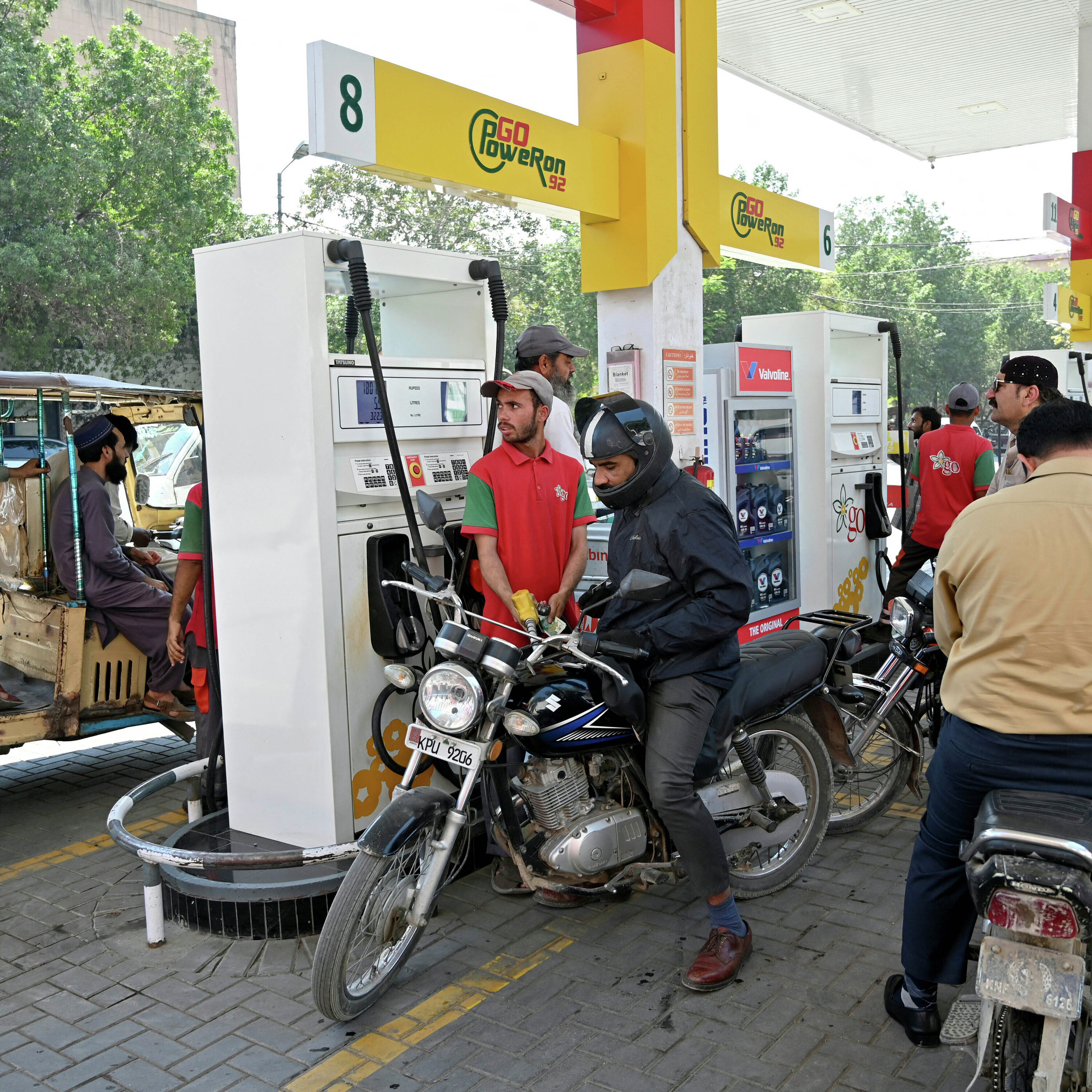
This is Fussy Monkey. He's Bloomberg's beer chief in Karachi, Pakistan. He's at a gas station right now, topping off his car before the government raises fuel prices yet again. In the US and the uk, fuel prices rise and fall with the market, but in Pakistan, the government adjusts them on a fixed schedule, typically every two weeks. So when Fassi heard that war had broken out in Iran and the Strait of Hormuz was effectively closed, he knew prices would spike. So his first stop, the gas station,
- [02:25]
Pakistani Energy Analyst
so basically topped up right till the end. So you know when you put a pump to fill your car, it automatically stops after it automatically stops. There is still some space to fill in a few more litres as well.
- [02:39]
Juan Ha
It turned out to be the right call because just days later, the government raised fuel prices by a record amount.
- [02:47]
Pakistani Energy Analyst
It was the biggest increase in Pakistan's history by 21%, to be precise. And right before that, we saw that there were massive, massive long lines at fuel pumps.
- [02:58]
Juan Ha
Like much of South Asia, Pakistan's economy is especially vulnerable to swings in Global energy costs. The country imports most of its fuel with the vast majority of those imports coming from Gulf countries. So when supply routes like the Strait of Hormuz are disrupted, the shock hits hard at home.
- [03:20]
Pakistani Energy Analyst
Tonight, Pakistan increased food prices. It was, you know, chaos at food pumps. We saw that there were massive, massive long lines. There were scuffles at fuel stations. There were violence in multiple places as well. And fuel pumps actually ran completely dry.
- [03:38]
Juan Ha
After oil prices surged past $100 a barrel, Pakistan's government rolled out more than a dozen fuel saving measures. Officials also said they would begin adjusting prices more often now weekly to keep pace with the volatility.
- [03:54]
Mushar Zaidi
Part of the measures that we've taken in terms of conservation and austerity include four day work week, a lot of work from home, a substantial reduction in government.
- [04:05]
Juan Ha
Last week, Mushar Zaidi, the spokesperson for Pakistan's prime minister, told Bloomberg that the government was bracing for prolonged energy shocks.
- [04:14]
Mushar Zaidi
We're also very conscious of the negative impact of this conflict not just on Pakistan, but on the whole region.
- [04:21]
Clara Ferreira Marquez
The Asia region as a whole is actually feeling it very acutely, especially if you compare it with the rest of the world.
- [04:27]
Juan Ha
Clara Ferreira Marquez is Bloomberg's managing editor for commodities and energy in Asia.
- [04:33]
Clara Ferreira Marquez
And that's largely just to do with the way that flows through the Middle east are directed. But it is both a shortage problem and a price problem at the moment.
- [04:48]
Juan Ha
Welcome to the Big Take Asia from Bloomberg News. I'm Wan Ha. Every week we take you inside some of the world's biggest and most powerful economies in the markets, tycoons and businesses that drive this ever shifting region. Today on the show, how a global energy shock is rippling through Asia. We begin in Pakistan where the government has responded with tough measures. Then we'll look at how other countries across the region are managing the knock on effects of rising energy prices. Pakistan sits at the crossroads of South Asia and the Middle East. With few oil reserves of its own, it depends heavily on the Gulf for energy. Tankers loaded with crude oil, refined fuels and liquefied natural gas stream across the Arabian Sea.
- [05:44]
Pakistani Energy Analyst
To keep the country running, Pakistan imports most of its energy needs. So basically petrol crude, diesel, lng. If I look at Pakistan's biggest trading partners, the countries it imports from are uae, Saudi Arabia and Qatar. And primarily its energy.
- [06:05]
Juan Ha
Pakistan is the world's fifth most populous country with more than 250 million people. That sheer size drives an enormous, enormous demand for energy. And with most of it imported, Pakistan's government is doing everything it can to curb fuel Consumption.
- [06:24]
Pakistani Energy Analyst
Pakistan's response has been quite radical and quite big and drastic. So Pakistan came out with more than a dozen measures to curb fuel consumption, to temporarily stop salaries for cabinet members for two months. They've shut down schools for a couple of weeks. They have moved to a four day week for the next two months. The government has said that they will reduce their expenditure by 20%, which is quite significant. They're now going to use like half of their transport vehicles and they're also going to reduce consumption by half in those government departments.
- [06:59]
Juan Ha
What does that mean in terms of the day to day life now for
- [07:03]
Pakistani Energy Analyst
many Pakistanis, it is manageable in the sense that I think, you know, we had the COVID crisis in which everyone learned how to do things remotely. The government has asked all private sector and public sector. Only 50% workforce should be going to the offices now. And students have been asked to have online classes in universities.
- [07:25]
Clara Ferreira Marquez
These are Covid era measures to save energy that we haven't seen obviously since
- [07:30]
Juan Ha
COVID That's Bloomberg's Clara Ferreira Marquez at
- [07:35]
Clara Ferreira Marquez
that point we were a week or so into the war. So it's very rapid and very extreme. And it is not only about shortages, it is about saving money. It is about subsidies that will be more expensive. It is about the strain to these budgets.
- [07:51]
Juan Ha
The austerity measures may feel harsh, but this isn't the first time Pakistan has implemented them. Four years ago, the country went through a crippling energy crisis fueled in part by Russia's invasion of Ukraine.
- [08:05]
Pakistani Energy Analyst
Pakistan suffered daily blackouts and energy saving measures were again introduced to curb the blackouts. But the situation was quite different then. Pakistan was going through an economic crisis. At that time we didn't have enough dollars to pay for fuel. Now four years later, we are in a much better place. Pakistan's reserves, dollar reserves have gone up. Now we are around $21 billion total reserves. It's at a four year high right now.
- [08:35]
Juan Ha
Pakistan may have more dollars in the bank today, but rising oil prices pose a real risk. Investors worry that the stability Pakistan has built over the past few years could quickly unravel if the trend continues.
- [08:50]
Clara Ferreira Marquez
The country is in a slightly better position this time, but that doesn't mean that industries won't feel the pain, that the country's budget won't feel the pain. And certainly the measures that they have taken suggest that they are positioning themselves for a lengthy period of heightened prices. You know, things do come unstuck. Pakistan during the European gas crisis after Russia's invasion of Ukraine is a very good Example of that, the trading houses cut off Pakistan in order to serve Europe, where prices were far higher. I think it's almost inevitable that countries with less purchasing power will find themselves a little bit further back in the queue. But remember, political allegiances also matter here, and those are complex across the region.
- [09:33]
Juan Ha
Beneath the immediate strain of rising oil prices, Pakistan faces a familiar cycle. Periods of growth followed by sudden crashes, persistent instability, and repeated bailouts. Since the 1950s, the country has been the recipient of more than 20 bailouts from the International Monetary Fund, making it one of the fund's most frequent borrowers.
- [09:58]
Pakistani Energy Analyst
Pakistan has this economic cycle for what we call a boom and bust cycle. As I mentioned, dollar reserves. That's quite a key indicator in Pakistan's history. What happens is that we run out of dollars and then, you know, there's an economic slowdown. We run back to the IMF for a bailout.
- [10:13]
Juan Ha
On top of that, Pakistan is heavily indebted to a wide range of creditors, including China. Its interest payments alone amount to 43% of the country's export revenues, one of the highest ratios in the world. Rising energy costs mean there will be less capacity to service that debt, potentially pushing the country closer to default.
- [10:37]
Pakistani Energy Analyst
This is compounded by other issues that we are facing right now. There are a lot of fundamental issues in Pakistan of corruption that has never been controlled. There's political instability in Pakistan all the time. One is trying to overthrow the other. There is a lot of regime change that happens. All of this constrains the economy and the country and the growth of the country.
- [11:00]
Juan Ha
And it's not just the war in Iran. Adding pressure, Pakistan has opened another front much closer to home. Last month, the government declared what it called an open war with its neighbor Afghanistan, launching airstrikes across the border. What is behind this latest escalation?
- [11:20]
Pakistani Energy Analyst
When the US And NATO pulled out of Afghanistan a few years ago, the Afghan Taliban government came to power. And since then, we've seen that militancy or terrorist attacks in Pakistan have increased over time. The Afghan Taliban government is giving safe haven to terrorists who are planning, plotting, and also sometimes entering as suicide bombers and attacking Pakistan. So Pakistan's Defense Minister has called an open war against Afghanistan now, and Pakistan has been quite aggressive in the past two weeks.
- [11:52]
Juan Ha
What is the public sentiment regarding this conflict, especially as a country faces this severe energy crisis?
- [11:59]
Pakistani Energy Analyst
So Pakistan is a country that usually is not in consensus on a lot of things or most things. But this is one area that people are in consensus on this. Most people. I'll tell you which part Is not. But most people are in consensus that, that this is the way forward because, you know, Pakistan has been trying for two to three years to get the Afghan Taliban to deal with this issue, but they haven't been. So Pakistan has now taken it into its own hands.
- [12:29]
Juan Ha
And right now, I mean, getting back to the energy situation, what's the current outlook for Pakistan's energy crisis and is there consensus on how that might be resolved?
- [12:40]
Pakistani Energy Analyst
It all depends on how long the war, war lasts. Pakistan has used its current relations to get fuel this week. But if it's a short shock that lasts a week or so, then Pakistan is good. Pakistan will be able to ride it out. But if this conflict is prolonged, it goes on for several months, then we are looking at a more severe scenario and widespread energy shortages across the country. By shortages, I mean electricity blackouts for four to six hours. There will be fuel rationing as well. Anything can happen. There could be deadly protests. There could be pressure on the government to resign. There could be a lot of unrest in the country and hopefully we don't get there.
- [13:30]
Juan Ha
Pakistan isn't the only country in Asia affected by this energy crisis. After the break, we'll look at how the ripple effects of oil and gas price hikes are being felt across the region.
- [13:51]
Malcolm Gladwell
Hello.
- [13:52]
Clara Ferreira Marquez
Hello.
- [13:52]
Malcolm Gladwell
I'm Malcolm Gladwell, host of the podcast smart talks with IBM. I recently sat down with IBM's chairman and CEO Arvind Krishna, and I asked him, how can companies use AI to its fullest potential to create smarter business?
- [14:07]
IBM Executive
My one advice to them, pick areas you can scale. Don't pick the shiny little toys on the side. For example, if anybody has more than 10% of what they had for customer service 10 years ago, they're already five years behind. If anybody is not using AI to make their developers who write software, 30% more productive today with the goal of being 70% more productive.
- [14:39]
Pakistani Energy Analyst
Yeah.
- [14:40]
IBM Executive
So we are not asking our clients to be the first experiment on it. We say you can leverage what we did. We are happy to bring out all our learnings, including what needs to change in the process. Because the biggest change is not technology is getting people to accept that there's a different way to do things.
- [14:58]
Malcolm Gladwell
To listen to the full conversation, visit IBM.com smarttalks.
- [15:09]
Dr. Guy Winch
For many men, mental health challenges aren't recognized until they've already taken a toll. Work pressure, financial stress, changing relationships, and traditional expectations around masculinity can quietly wear men down, often without clear warning signs. In season three of the Visibility Gap, Dr. Guy Winch and his guests Explore how these pressures show up, how to spot them earlier, and how men can access meaningful support. Listen to the new season of the Visibility Gap, a podcast presented by Cigna Healthcare.
- [15:39]
Bloomberg Audio Studios Announcer
You need to make a huge presentation in an hour. Adobe Acrobat uses AI to take all your documents and generate a presentation with a single click. Build slides quickly and streamline the process. Need a last minute pitch deck? Do that with Acrobat. Need to level up your presentation design? Do that with acrobat. You have 30 plus documents that need to be simplified into a proposal. Do that, do that, do that with Acrobat. Learn more@adobe.com Dothatwith Acrobat.
- [16:19]
IBM Executive
Last few hours or so President Trump
- [16:20]
Pakistani Energy Analyst
here is demanding that other countries contribute to the defense of the Strait of Hormuz, which remains effectively shut to oil tankers.
- [16:27]
Juan Ha
Earlier this week, President Donald Trump pressured countries including China to help unblock the Strait of Hormuz. Trump even threatened to delay his summit with President Xi Jinping if Beijing doesn't step in. But Bloomberg Commodities and Energy editor Clara Ferreira Marquez says it's unlikely China will bow to that pressure.
- [16:50]
Clara Ferreira Marquez
Remember, China has a non intervention policy. It tends to stay well out of these situations. It has escorted vessels before, but not in these contexts. I can see very little upside for China here. As for a delay in the meeting, I'm not sure that China's particularly concerned about that. So so I understand that this sounds quite effective, but in reality it probably says more about the pressures on the Trump administration than it does about the Chinese.
- [17:18]
Juan Ha
Trump also threatened to expand strikes on Iran's Kharg island, targeting its oil infrastructure.
- [17:25]
IBM Executive
We can do that on five minutes notice. It'll be over.
- [17:29]
Juan Ha
Across Asia Pacific, rising oil and gas prices are already reshaping economies, straining budgets and forcing governments to rethink how they protect industries and households. Clara says it's the poorer countries with less resilient economies that are being hit hardest and fastest.
- [17:49]
Clara Ferreira Marquez
The wealthier countries can generally at least buy their way out of it in the short term. They can get LNG from Australia, they can get it from the us but it is going to cost more. So it has to come further and it probably won't be available immediately and then you're competing with plenty of others who are also trying to replace supply, which again puts the more price sensitive countries at a disadvantage advantage.
- [18:12]
Juan Ha
And what's the situation with energy surpluses or reserves?
- [18:16]
Clara Ferreira Marquez
So the reserves picture is a bit complicated. China obviously has extensive reserves under its Strategic Petroleum Reserve and also commercial reserves. It's something they've been building up for a very long time. It's part of China's wide package of energy security. Places like Singapore would have them, but it's not widespread. Most of these countries are fuel importers. Even somewhere like Indonesia, which does produce its own crude, is still a net importer of crude and is still a net importer of fuels.
- [18:43]
Juan Ha
It's not just oil and gas that are at stake. The closure of the Strait of Hormuz is disrupting a wide range of commodities.
- [18:51]
Clara Ferreira Marquez
We do tend to focus on it as a energy producing region. So, for example, gas is a feedstock for fertiliser, but there are flows of fertiliser itself coming from the region. It's aluminum, it's steel for the industry. There's a huge amount that is actually produced here.
- [19:07]
Juan Ha
Take lpg, that's liquefied petroleum gas as an example. It's used for cooking in many homes as well as in key industries. India is the world's second largest importer of lpg and right now it's facing an acute shortage.
- [19:23]
Clara Ferreira Marquez
With those sources no longer arriving, you saw the Indian government channeling resources towards households rather than industry.
- [19:33]
Juan Ha
Over the weekend, Prime Minister Narendra Modi announced that India had secured safe passage for two LPG tankers through the Strait of Hormuz. Since the war began, only a handful of nations, including China and Russia, have managed to get vessels through safely. Clara, We've seen Russian oil prices climb sharply in recent weeks. What were once discounts have in some cases turned into premiums. At the same time, the Trump administration has temporarily eased sanctions on certain Russian shipments. How is that reshaping the oil market and affecting countries like India that do buy oil from Russia?
- [20:12]
Clara Ferreira Marquez
India isn't traditionally a large consumer of Russian oil. After the war in Ukraine, discounts became extremely attractive and India became the largest buyer of seaborne Russian oil. The Trump administration has sought to change that, largely to pressure President Putin. And that is now changing again. The US has now provided two waivers that would allow countries, including India. The first was just for India. The second was wider, to buy Russian oil already on the water. So that then opens the potential for India to take more. The issue is exactly the one that you've identified, which is it's actually pretty expensive now, so that initial advantage is no longer as attractive. However, this oil is on the water, so it is available. So the prices are rising. Indian refiners will have to pay more because what was a discount is in some cases now turning to a premium. And the Chinese refiners, particularly the private sector that had been really reliant on these discounted flows. They're all paying more for them.
- [21:12]
Juan Ha
Rising energy prices have an immediate effect on people's economic security. And we've seen here in Asia that economic insecurity can lead to political unrest. Where do you think are the stress points here in Asia Pacific?
- [21:26]
Clara Ferreira Marquez
That's difficult to say because I think you have some places where it would be very immediate. So you try and put up fuel prices in an emerging economy in Southeast Asia and you will almost certainly fuel people on the streets very quickly because it's a very large proportion of your spending every month. Right. It'll go into food, which is directly impacted by fuel costs, and then fuel costs themselves. But it plays out in the longer term here and that it's not really just a problem for Asia. I mean, the US has midterms at the end of this year. Right. It's going to be a massive issue there too. It's an issue in Brazil, which has elections in October. So the political repercussions here will play out over a long period of time, especially if the this is drawn out.
- [22:13]
Juan Ha
This is the Big Take Asia from Bloomberg News. I'm Juan Ha. To get more from the Big Take and unlimited access to all of bloomberg.com, subscribe today@bloomberg.com podcastoffer if you liked the episode, make sure to subscribe and review the bigtik Asia. Wherever you listen to podcasts, it really helps people find the show. Thanks for listening. See you next time.
- [22:46]
Bloomberg Audio Studios Announcer
If you follow markets, you know the value of long term thinking. You plan, you diversify, you prepare for volatility. But in life, even the best strategies can't prevent every bad day. A fire, a loss, a disruption that demands immediate attention. When that happens, what matters isn't just what you planned. It's who shows up. That's where Cincinnati Insurance comes in. For more than 75 years, they've helped individuals and businesses navigate life's toughest moments with care, expertise and personal attention. Together with independent agents, Cincinnati Insurance focuses on relationships, not transactions. Their approach is grounded in experience, follow through, and trust built over time. Bad days happen, and when they do, you deserve an insurance partner who understands risk, respects what you've built, and is ready to help you move forward. The Cincinnati insurance companies Let them make your bad day better. Find an independent agent@cin fin.com this is
- [23:47]
Bethenny Frankel
Bethenny Frankel from Just Be with Bethenny Frankel. Let me be blunt. Most dog food is junk. It just is. And I'm not feeding junk to Biggie and Smalls is why they eat just food for dogs. It's real 100% human grade food with ingredients I actually recognize, not mystery pellets pretending to be healthy. And once I switched, the difference was obvious. Better digestion, better skin, more energy. Dogs who actually feel good instead of just surviving dinner. Here's the thing you care about quality. You make an intentional choice to be healthy. So why are you gambling with your dog's health? So let's think about our furry babies. Go to justfood for dogs.com right now and get 50% off your first box. No code. Just try it. Because once you see the difference, you're not going back.
- [24:33]
Sonesta Representative
Travel smarter, not Harder at America's Best Value in by Sonesta with convenient locations from coast to coast and value packed comfort at every turn. And when you're a Sinesta Travel Pass member, staying at America's Best Value in means earning points toward free nights, upgrades and more. Go to sonesta.com to book your stay and unlock the best rates with Sonesta Travel Pass here today, Rome tomorrow. Join now@sonesta.com terms and conditions apply.