Loading summary
Transcript93 lines
- [00:00]
David Gura
So there's a lot of noise about AI, but time's too tight for more promises. So let's talk about results. At IBM, we work with our employees to integrate technology right into the systems they need. Now a global workforce of 300,000 can use AI to fill their HR questions, resolving 94% of common questions, not noise. Proof of how we can help companies get smarter by putting AI where it actually pays off, deep in the work that moves the business. Let's create smarter business IBM. The news doesn't stop on the weekends.
- [00:34]
Emily Simpson
Context changes constantly, and now Bloomberg is the place to stay on top of it all.
- [00:39]
David Gura
Hi, I'm David Gura. Join us every Saturday and Sunday for the new Bloomberg this weekend.
- [00:44]
Emily Simpson
I'm Christina Raffini. We'll bring you the latest headlines in depth analysis and big interviews, all the stories that hit home on your days off. And I'm Lisa Mateo. Watch and listen to Bloomberg this weekend for thoughtful, enlightening conversations about business, lifestyle, people, and culture.
- [00:59]
David Gura
On Saturday mornings, we put the past week's events into contexts, examining what happened in the markets and the world.
- [01:06]
Emily Simpson
Then on Sundays, we speak with journalists, columnists, and key political figures to prepare you for the week ahead. Join us as soon as you wake up and bring us with you wherever your weekend plans take you.
- [01:16]
David Gura
Watch us on Bloomberg Television, listen on Bloomberg Radio, stream the show live on the Bloomberg Business app, or listen to
- [01:22]
Emily Simpson
the podcast that's Bloomberg this weekend, Saturdays and Sundays starting at 7am Eastern on February 28th. Make us part of your weekend routine on Bloomberg Television Radio and wherever you get podcasts. Hey, everyone, it's Emily Simpson and Shane Simpson from the Legally Brunette podcast.
- [01:43]
David Gura
Each week we're bringing you true crime through a legal lens.
- [01:47]
Emily Simpson
Whether you want all the facts on the disappearance of Nancy Guthrie or you still need to wrap your head around the Diddy verdict, we're breaking it all down step by step.
- [01:56]
David Gura
And we're not just lawyers, we're also husband and wife. It makes for some pretty entertaining episodes.
- [02:02]
Emily Simpson
Listen to Legally Brunette on the iHeartRadio app, Apple Podcasts, or wherever you get your podcasts. Bloomberg Audio Studios Podcasts Radio News hi, David.
- [02:17]
David Gura
Hey, Sarah.
- [02:17]
Christina Raffini
Nice to see you in the studio.
- [02:18]
David Gura
It is good to be here with you.
- [02:19]
Christina Raffini
And we're never here at the same time.
- [02:21]
David Gura
We're never here at the same time. We're like ships in the night and so rarely are.
- [02:24]
Christina Raffini
But okay. But now we're not ships in the night anymore. No, we've made it into the studio together.
- [02:28]
David Gura
Yes.
- [02:29]
Christina Raffini
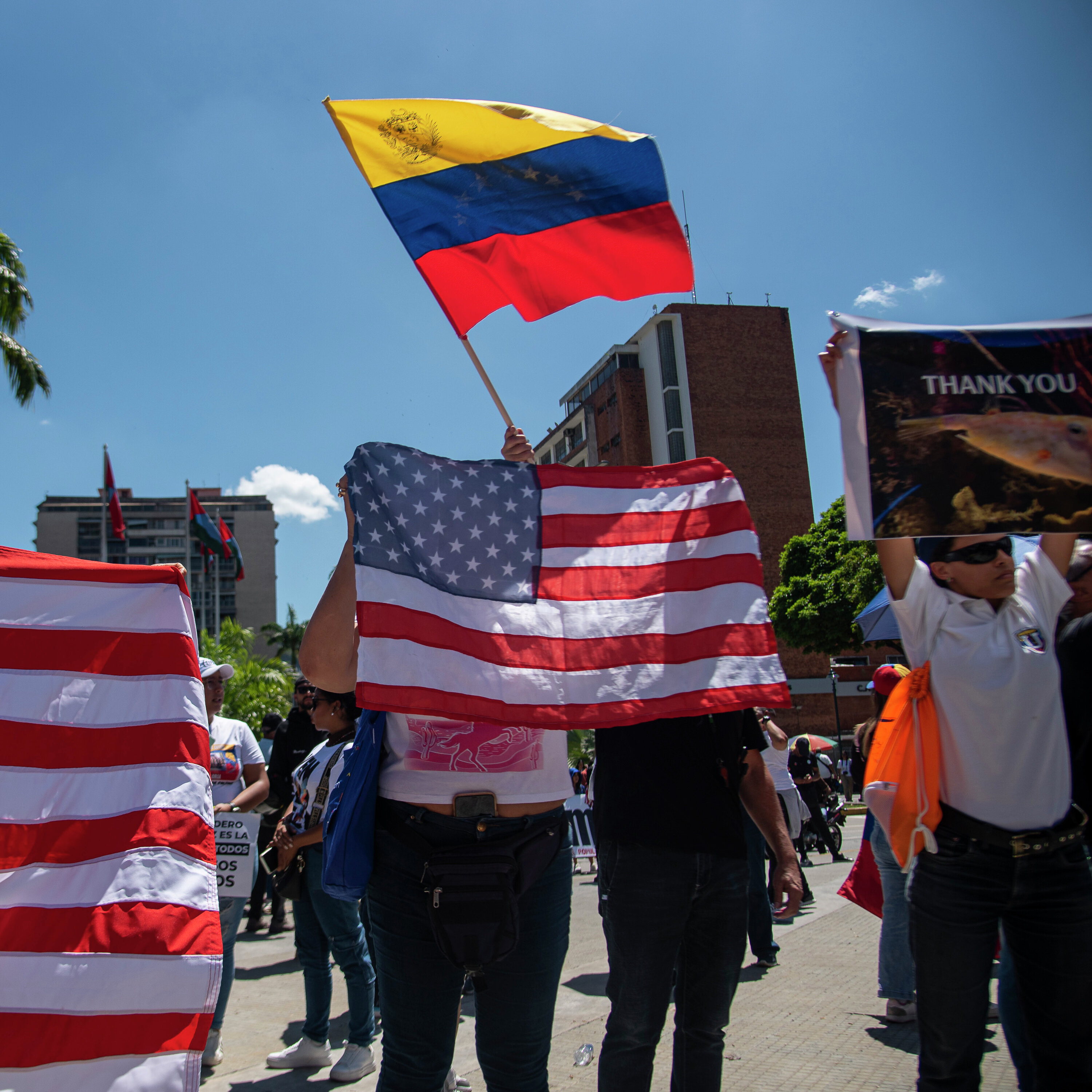
So, David, ever since the US launched a major military operation in Venezuela in. And even before that, we've been talking a lot about it on the show.
- [02:37]
David Gura
Yeah. I am fascinated by this story in part because I used to live in South America. I lived in Bolivia when that country was going through a political transition. I'm very eager to see sort of what will come of this effort the US Made to shake things up, change the circumstances of Venezuela.
- [02:52]
Christina Raffini
And today we're going to hear a brand new conversation you had this week about the state of play in Venezuela. And it's also airing on this new show that you're about to launch, Bloomberg.
- [03:02]
David Gura
Yes. So that new show is called Bloomberg this Weekend, and it's gonna debut on Bloomberg TV and Bloomberg Radio on Saturday. You can also stream it online. I'm gonna host it with Christina Raffini and Lisa Mateo.
- [03:13]
Christina Raffini
David Gurr. You're doing a show during the week and during the weekend. When do you sleep?
- [03:17]
David Gura
I'm trying to figure this out, but rest assured, I'm not going anywhere. I will be here on the Big Ting.
- [03:22]
Christina Raffini
Well, your first get was a great get. Tell us about this guest who's coming on the show.
- [03:28]
David Gura
Yeah. I sat down with Phil Gunson, who is a bit of a rarity. He's covered Latin America for the better part of four decades, and he's focused on one country in particular.
- [03:37]
Phil Gunson
What it says on my business card is that I am Crisis Group's senior analyst for the Andes region. But in practice, that means that I focus on Venezuela. Venezuela keeps me busy. I've lived in caracas for nearly 27 years now.
- [03:49]
David Gura
Phil moved there in 1999. So he was there when Hugo Chavez came to power. He was there when Hugo Chavez died. He was there when Nicolas Maduro became the president of Venezuela.
- [03:57]
Christina Raffini
Was he there when the US Went in and captured Nicolas Maduro?
- [04:00]
David Gura
He was there. And he told me his house is pretty close to the military base where Maduro was taken.
- [04:06]
Phil Gunson
This is the point where I embarrassingly have to admit that I slept all the way through.
- [04:09]
David Gura
You did.
- [04:10]
Phil Gunson
I mean, the attack in Venezuelan time. The bombs and rockets started falling about 2 in the morning. I was fast asleep.
- [04:18]
Christina Raffini
Wow.
- [04:18]
David Gura
Yeah, that chaos didn't wake him up, but his phone eventually did. And since then, Phil has been really focused on how the US Is engaging with Venezuela today. He and I talked a lot about that, and we dug into really how uncertain the country's future is.
- [04:32]
Phil Gunson
As we like to say in Crisis Group, a transition is a process, not an event.
- [04:37]
Christina Raffini
Well, I'm really excited to hear more. So here's my co host David Gura with Phil Gunson. Don't forget to catch this and more on Bloomberg this weekend from 7 to 10am Eastern time every Saturday and Sunday, I'll be setting my alarm.
- [04:57]
David Gura
I'm David Gura and this is the big take from Bloomberg News. Today on the show, my conversation with International Crisis Group senior analyst Phil Gun. We discuss how Venezuela has changed and how it hasn't since the US captured Nicolas Maduro and what could come next. Let's spend some time talking about the events of January 3rd with the US's Operation Absolute Resolve. Remind us what the run up to that was like, what the weeks and months leading up to that date were like and felt like in Venezuela.
- [05:30]
Phil Gunson
You know, it was very startling, I suppose, because when Trump came back to power in January of last year, we and I think a lot of other analysts had concluded that Trump's approach to Venezuela was going to be rather less effective. I mean, it was going to be a pragmatic approach, not regime change, not maximum pressure as we saw under Trump. 1 and that was the way he started out. And then August of last year, we began to see this immense military buildup which was framed as a counter narcotics operation. And to be honest, I think in Crisis Group and elsewhere it was largely interpreted as a bluff. On the one hand, it's saber rattling in order to persuade Maduro to leave because the consequences of not doing so would be severe on the assumption that that would be enough, that there wouldn't be any need to put, as they say, boots on the ground because clearly Trump was not willing to do that. And so I think we, and I think President Maduro himself concluded, well, this is not going to really come to anything. But the buildup went on and on and on. And you had the aircraft carrier, you know, the Gerald R. Ford deployed to the Caribbean, this massive, massive military buildup to the point where we began to say, well, you know, they just can't just sail away. And Maduro showed no signs of leaving. It became very hard to understand how this was going to end. When it did conclude with January 3rd, it wasn't any of the scenarios that we had really anticipated.
- [07:00]
David Gura
Could you describe the uncertainty of those hours that followed for you and for others who live in Venezuela, just wondering what would happen next and did it feel like a vacuum was opening up?
- [07:13]
Phil Gunson
It was all really very quick, actually. I mean, it almost was too quick for us to properly work out what we were feeling about. I mean, the first sensation is, well, okay, it's obviously a US Attack. It's not a complete surprise because Trump had been threatening this repeatedly, pretty much every weekend for weeks before that. We'd been expecting some kind of attack. So in that sense, it wasn't totally shocking. What was really shocking was suddenly to realize Maduro was snatched along with his wife. What did that mean? But by the time we got around to trying to work out what that might mean, you know, there was already press conference in Washington with Trump saying, you know, announcing the operation. And that was, in a way, the biggest surprise of the whole morning, which was Trump saying, well, Maria Corina Machado is a great lady, but unfortunately she doesn't have the support in Venezuela to be installed as the government. So we're going to be dealing with Delsey Rodriguez, who's Maduro's vice president. That was probably the most surprising thing in those few hours.
- [08:21]
David Gura
What is the state of political power in Venezuela today? So Maduro is gone. He's in a jail cell in Brooklyn. Delsey Rodriguez is in power on an interim basis. Maria Carney Machado is somewhere, we don't know exactly where. Who is in control? And how would you assess the longevity of the kind of political moment that we're in?
- [08:39]
Phil Gunson
I think that's probably the key issue. Obviously, we heard from President Trump very soon after January 3rd. I can't remember it was on the same day, but within a couple of days at least, he was saying, the US Is going to be running Venezuela. We're looking around and going, where are they? Because there's nobody here on the ground. There's not been an embassy. There is now. They've reopened the embassy and they're starting to establish a US diplomatic presence in Caracas. But since 2019, there were no US diplomats in Venezuela. There certainly weren't boots on the ground. There's no military occupation in Venezuela. So in what sense is the US Running Venezuela? And my immediate thought was, seems to me the Venezuelan government is running Venezuela. But of course, then it becomes more complicated. Then you have to work out, well, okay, the US Says that they're going to be running Venezuela because if the Delsey government doesn't do what they say, then there will be consequences. And therefore, you know, this is kind of a neo colonial sort of operation. But to try to run especially a country the size of Venezuela, country twice the size of California, twice the size of Iraq, nearly 30 million people, topographically very difficult. Politically, very difficult, full of guns among the security forces and outside, how are you going to do that? How are you going to run Venezuela? So we're still working it out is the honest answer to that question, I think.
- [10:05]
David Gura
How do you think about the role that Dilsey Rodriguez is playing, the apparent closeness she has with the Trump administration, the closeness that she had with Nicolas Maduro, the political power that she's amassed as a result of her career in Venezuelan politics, how she is navigating those two things.
- [10:21]
Phil Gunson
Dulcie Rodriguez and her brother Jorge, who's the guy who runs the national assembly and is a key figure in all of this, he was Maduro's key negotiator for a very long time with the opposition and with the US These two, the Rodriguez siblings are smart people. They're very adaptable, they're very pragmatic. They're also very ideological. I mean, ideologically, they come from the same segment, if you like, of the ideological spectrum as President Maduro himself. They come from the far left, but they are adaptable. And I think that's the key to what Delsey is able to do right now, because she turned on a dime. I mean, and of course, she has maintained the discourse, the narrative for internal purposes about this being a socialist revolution, anti imperialist and all the rest of it, whilst doing her best to comply with what Trump needs. That's not an easy thing to do. I think if anybody can do it, she can. And she's demonstrated that so far. This is a power game. It's about staying in power. And in particular, I think what divides so called moderates from so called hardliners is whether or not they perceive a future for themselves under some form of political transition. I think the Rodriguez siblings can imagine, I don't think they want it, but I think they can imagine surviving a transition. But a lot of the people with guns cannot imagine that. And for them it's an existential issue. And so it's a case of day by day figuring out where the boundaries are. But then, of course, apart from that, the opposition is divided. And that, I think, is one of the key obstacles that might lie in the path of some form of political settlement, some form of transition.
- [12:12]
David Gura
So what could US involvement in Venezuela tell us about Trump's approach to other countries? And is the President's endgame really just about oil? That's after the break.
- [12:24]
Emily Simpson
Hey, everyone, it's Emily Simpson and Shane Simpson from the Legally Brunette podcast.
- [12:29]
David Gura
Each week we're bringing you true crime through a legal lens.
- [12:33]
Emily Simpson
Whether you want all the facts on the disappearance of Nancy Guthrie or you still need to wrap your head around the Diddy verdict, we're breaking it all down. Step by step.
- [12:42]
David Gura
And we're not just lawyers, we're also husband and wife. It makes for some pretty entertaining episodes.
- [12:48]
Emily Simpson
Listen to Legally Burnett on the iHeartRadio app, Apple Podcasts, or wherever you get your podcasts.
- [12:55]
David Gura
Right now we are living through some
- [12:57]
Phil Gunson
of the most tumultuous political times our
- [12:59]
David Gura
country has ever known. I'm David Remnick, and each week on
- [13:03]
Phil Gunson
the New Yorker Radio Hour, I'll try
- [13:05]
David Gura
sense of what's happening alongside politicians and thinkers like Cory Booker, Nancy Pelosi, Liz Cheney, Tim Waltz, Ketanji Brown Jackson, Newt Gingrich, Robert F. Kennedy Jr. Charlamagne, tha God, and so many more.
- [13:18]
Phil Gunson
That's all in the New Yorker Radio
- [13:20]
David Gura
Hour wherever you listen to podcasts at
- [13:24]
Emily Simpson
Charman, we heard you shouldn't talk about going to the bathroom in public, so we decided to sing about it.
- [13:29]
David Gura
Light a candle, pour some wine grab a roll oh, the soft kind for a little me time Charmin Ultra Soft
- [13:36]
Phil Gunson
Smooth Tear Wavy edges for my rear
- [13:39]
Emily Simpson
so let the softness caress your soul
- [13:42]
David Gura
Just relax, you're on a roll Let
- [13:45]
Phil Gunson
her rip Charmin Ultra Soft Smooth Tear
- [13:47]
Emily Simpson
Charmin Ultra Soft Smooth Tear has the same softness you love now with weighty edges that tear better than the leading one Ply brand Enjoy the go with
- [13:53]
Phil Gunson
charming
- [14:00]
David Gura
after the US Captured Nicolas Maduro, President Trump said the US Would run Venezuela, which raised a bunch of questions. I asked Phil Gunson of the International Crisis Group what Maduro's expatriation has meant in real terms. I'd hoped you and I could talk about political transition, and I guess what's sort of peculiar about this moment is you have Maduro being removed from power, yet it seems like there hasn't been much of a political transition yet. I imagine the key to that is elections. At some point, are they being talked about? What would they need to look like to remove what I imagine is a huge hurdle here for there being any kind of viable political change?
- [14:37]
Phil Gunson
Well, as we like to say in crisis group, a transition is a process, not an event. And one of the things I think that is problematic about the way some people in the opposition regard the term transition and the idea, the concept of transition is that they don't distinguish between transition and regime change. In other words, transition for them is you leave power, we take power. That's a transition. A transition for us is a process whereby the government that is still in power concedes certain things over a period of time. The opposition also concedes certain things, and they come to an agreement about where this process is going what the end result should be Elections, at least a presidential election, to my mind, should be closer towards the end of that process than the beginning.
- [15:27]
David Gura
What is the US Getting from this leadership change? I suppose it's somebody who will return their phone calls. But what makes Delsey Rodriguez more palatable to the US than, and I should say US leadership, the Trump administration, than Nicolas Maduro was.
- [15:41]
Phil Gunson
If you ask some people, they would say it's oil. I mean, Trump wants the oil, Dolce is giving him the oil, and therefore that's the beginning and the end of the story. I think it's a lot more complicated than that. And I don't actually think that oil in the purely material sense is necessarily even most of what it's about. I think the US Wants a stable, friendly Venezuela, open to US Capital that excludes forces seen by the US as hostile to US interests.
- [16:16]
David Gura
So part of this grander plan for
- [16:18]
Phil Gunson
the continent and even beyond, I mean, it's a geopolitical issue. And the facts of what happened on January 3rd in Venezuela, the very facts of that, the way it happened, what happened then, the implications of that are particularly significant for the region and the way the US Relates to the region and vice versa. But they're also have implications beyond. I mean, I think, for example, that what we're now seeing around Iran is partly Trump saying, well, look, it worked really well in Venezuela. I mean, you know, let's try and do the same in Iran. There's a sense in which the US Was emboldened by that event to say, oh, well, look, we don't even need to put boots on the ground. We can do these really, you know, very sophisticated military operations, and we can make people do what we want.
- [17:05]
David Gura
You mentioned oil, and the President talks an awful lot about the potential for that to be good for Venezuela and good for the U.S. if U.S. energy companies were to go into Venezuela, build new infrastructure, repair old infrastructure, that could benefit both countries. First of all, I'm wondering just does the prospect of that, has that improved the economy in Venezuela at all? Just the fact that the US Is showing more interest in improving the economic situation in Venezuela?
- [17:32]
Phil Gunson
Yes and no. The most immediate impact of that is, okay, the US took something like 50 million barrels of oil, sold it more or less at market prices, and via complicated financial arrangement, sent hundreds of millions of dollars into Venezuela, which were then sold by a set of private banks on the open market for more or less market rates. So that helped to bring down the exchange rate, but it's not yet filtered through or trickled down, if you like, to the extent that ordinary Venezuelans doing their weekly shopping can see a benefit. One of the huge problems that we have in Venezuela is that this is a country which ought to be rich, and it ought to be, you know, you ought to have, you know, a per capita income among the highest in the region, used to be among the highest in the world. And, and yet more than 80% of the population lives in poverty. And it's also worth mentioning that one of the first things Trump did when he came back to power last year was to slash overseas aid. And that had an immediate impact on malnutrition in Venezuela because the World Food Program immediately found its budgets cut. So right now, Venezuelans have hopes that this will improve. But what economists say is it's going to take probably six to eight months before the real benefits, if they do filter down, eventually do do that.
- [18:53]
David Gura
There was this trip a couple of weeks ago. Chris Wright, the Energy Secretary, traveled to Caracas and my colleague Henry Hordern was on that trip with him. And there is just something extraordinary about that image of seeing a US Energy secretary, a cabinet member, on the ground in Venezuela. What did that trip signal to you? And here I'm getting into the kind of longer term prospects of U.S. engagement in the energy sector.
- [19:15]
Phil Gunson
One of the striking things about that was just reading the body language and the fact that the energy secretary and the interim president were chatting away happily to each other and touring oil installations. This is a really strange thing to see in Venezuela. But Delsey Rodriguez certainly is not reluctant to see the economy open up and more money come in. And in that sense, there's an awful lot of common ground where, of course, it may break down is if the US Starts to insist on a political transition. And so the danger that we see, I think, is that this could reach a new or we could basically maintain this new equilibrium of friendly relations between Washington, Caracas that have absolutely nothing to do with what the bulk of Venezuelans ultimately want to see because they're not part of the discussion.
- [20:03]
David Gura
I want to ask you lastly, what you'll be watching for in the months ahead. What's most important to pay attention to?
- [20:10]
Phil Gunson
You know, I think what most concerns me and what most concerns us in Crisis Group is precisely what I said about the fact that this is a dialogue between two governments, neither of which were elected by Venezuelans, really, let's face it, over the heads of the Venezuelan people. What I think is going to be one of our biggest questions is to what extent is the US Prepared to push for this, given that moves towards a political transition could destabilize the rest of what they're interested in. It could create a backlash, for example, among the people who fear they might end up in jail of a transition happen. That's the sort of thing that we're really looking at.
- [20:52]
David Gura
Phil, thank you very much.
- [20:53]
Phil Gunson
Thank you. It's been a pleasure.
- [21:01]
David Gura
This is the Big Take from Bloomberg News. I'm David Gura. To get more from the Big Take and unlimited access to all of bloomberg.com subscribe today@bloomberg.com podcastoffer if you like this episode, make sure to follow and review the Big Take. Wherever you listen to podcasts. It helps people find the show. Also, check out Bloomberg this Weekend, our new live weekend morning show. We bring news, analysis and some fun to your Saturdays and Sundays starting at 7am Eastern Time. Bloomberg this weekend live on Bloomberg TV and Bloomberg Radio and streaming@Bloomberg.com thanks for listening. The Big Take we'll be back tomorrow.
- [21:39]
Christina Raffini
Foreign.
- [21:44]
Emily Simpson
Hey everyone, it's Emily Simpson and Shane Simpson from the Legally Brunette podcast.
- [21:49]
David Gura
Each week we're bringing you true crime through a legal lens.
- [21:52]
Emily Simpson
Whether you want all the facts on the disappearance of Nancy Guthrie or you still need to wrap your head around the Diddy verdict, we're breaking it all down step by step.
- [22:02]
David Gura
And we're not just lawyers, we're also husband and wife. It makes for some pretty entertaining episodes.
- [22:07]
Emily Simpson
Listen to Legally brunette on the iHeartRadio app, Apple Podcasts, or wherever you get your podcasts. What if we told you America's economy is strong enough that we can have nice things? I'm Katherine Ann Edwards and I'm an economist.
- [22:21]
David Gura
I'm Robin Rousey and I'm an editor.
- [22:23]
Emily Simpson
Every Tuesday on Optimist Economy, we talk through economic policies that matter. Social Security, the minimum wage, immigration, child care, care.
- [22:31]
David Gura
We look at the research and the data, not just politicized hot takes.
- [22:34]
Emily Simpson
You'll probably learn something, you'll probably laugh, and you'll finally understand why we can have a better economy.
- [22:41]
David Gura
Search for Optimist Economy Wherever you listen to podcasts.