Loading summary
Transcript37 lines
- [00:00]
Bloomberg Daybreak Hosts
What if you could have even more and more and more help to pursue your goals? At LPL Financial, we offer more ways for advisors and their clients to thrive. So what if you could Paid Advertisement Investing involves risk, including potential asset Principal LPL Financial LLC Member FINRA SIPC Small businesses are the pulse of every community. They bring people together, create opportunities and drive growth. Chase for Business helps business owners like you with personalized guidance and convenient digital tools all in one place. With that guidance and your determination, you can take your business farther and help build a brighter future for your community. Learn more@chase.com business chase for business make more of what's yours the Chase Mobile app is available for select mobile devices. Message and data rates may apply JPMorgan Chase Bank NA member FDIC Copyright 2026 JPMorgan Chase Co.
- [00:53]
IBM Representative
So there's a lot of noise about AI, but time's too tight for more promises. So let's talk about results. At IBM, we work with our employees to integrate technology right into the systems they need. Now a global workforce of 300,000 can use AI to fill their HR questions, resolving 94% of common questions, not noise. Proof of how we can help companies get smarter by putting AI where it actually pays off, deep in the work that moves the business. Let's create smarter business IBM
- [01:25]
Mark Champion
Bloomberg Audio
- [01:26]
Bloomberg Daybreak Hosts
Studios Podcasts Radio news
- [01:32]
David Gura
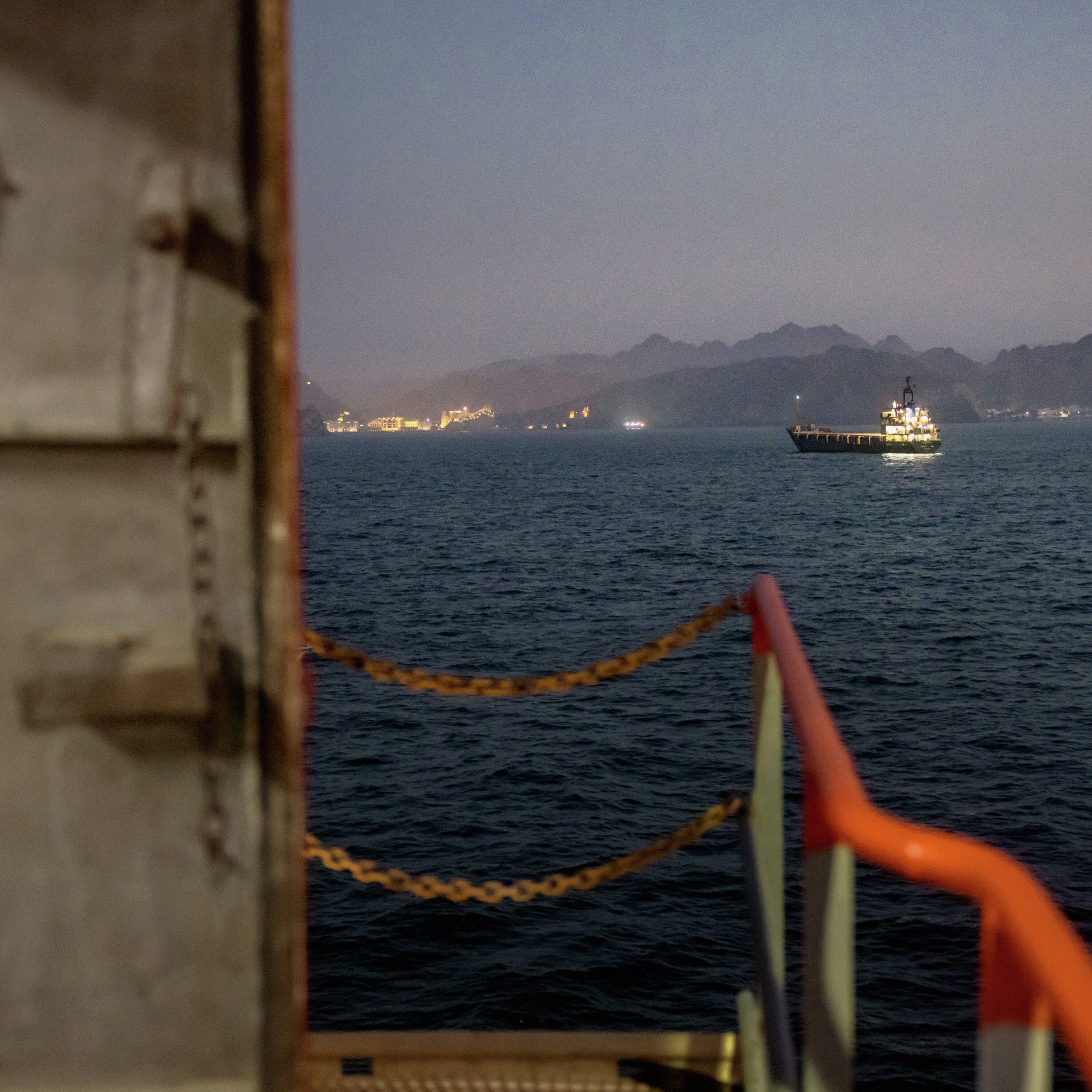
Nearly four months after the war In Iran began, U.S. and Iranian negotiators are trying to turn their ceasefire into lasting peace. The two sides signed a memorandum of understanding earlier this month, which provides a roadmap toward a deal. But efforts to lock that deal have been slow going and rife with contradictory rhetoric over everything from the status of Iran's nuclear enrichment programs to its future ambitions for the Strait of Hormuz. On Thursday, a cargo ship was struck by a projectile near the coast of Oman, hours after Iran's navy warned vessels against using unsanctioned routes. The strike comes at a critical time for President Trump. This week, a handful of Senate Republicans joined Democrats in a vote that would force the president to halt military operations in Iran or seek congressional authorization. It underscores the growing discomfort the GOP and the broader American public has with the conflict. A new Quinnipiac University poll shows 6 in 10Americans don't think that the war was worth it.
- [02:33]
Mark Champion
This deal is the kind of deal that you get when you lose a war.
- [02:37]
David Gura
Mark Champion is a Bloomberg opinion columnist who covers international affairs, and he says what he's seen of the draft MOU and the reaction to it suggests that at least for now, it only solves the problems the Trump administration created.
- [02:49]
Mark Champion
What he did get was two things. In essence, he got to restart the nuclear talks that had been underway when the war began, and then he also got to an agreement to reopen the Strait of Hormuz. There's really nothing else in that deal that says, hey, here's why we fought the war.
- [03:08]
David Gura
I'm David Gura and this is the big take from Bloomberg News. Today on the show, I sit down with Mark Champion to discuss the state of negotiations between the US and Iran, how a proposed MoU compares to the Obama era nuclear deal deal, and what foreign powers from the Gulf to China will be watching for in a settlement. So, Mark, the the clock is ticking. We're about a week into this 60 day period. The Vice President traveled to Switzerland to meet with his Iranian counterparts and the Pakistanis and the Qataris were there. Secretary of State Marco Rubio is on his way back from his tour of the Gulf, where he met with allies to try to drum up support for a potential deal. What is the status of the negotiations now? What are the main sticking points that these two sides are going to be haggling over?
- [03:53]
Mark Champion
Yeah, they are very far apart, you know, so in essence, this is a ceasefire deal. It's not a peace deal, it's a ceasefire deal. This is what they needed to do what the US What Trump felt he needed to do in order to open up the Strait to Hormuz. So it's just the very beginning point. This sort of, okay, we're going to stop shooting so that we can talk. It has set a framework for the talks which is quite favorable to the Iranians. One of the things that it does is to say, okay, we're going to talk about the nuclear fire and the highly enriched uranium, but doesn't really make clear how much more they're going to be willing to talk about. They haven't made any commitments to talk about ending the program forever, which was one of the war goals and the reason why Trump did reject the jzpoa. Second thing is Lebanon. This is a very, very difficult problem. You have to bear in mind that in terms of the cost of this war in lives, in, you know, people displaced, the toll on Lebanon has been higher than any other country, including the Gulf countries that were hit, including Iran. It was a small country, pulled into this war because Hezbollah, either at Iran's bidding or just because they wanted to do it, they entered the war, started firing at Israel. Israel took that as an opportunity to go and solve the problem once and for all of Hezbollah firing across into its communities north, which had made them largely uninhabitable. The Iranians have managed to put in the first point of these 14 points a reference that connects this ceasefire to Lebanon and says Lebanon is part of the ceasefire. So if the ceasefire in Lebanon fails, the Iranians can say the ceasefire with the US is off. So they have this kind of leverage. And it's a wedge issue to put distance between the Americans and the Israelis.
- [05:50]
David Gura
I want to return to Lebanon and Israel in just a moment. Before I get there, you're highlighting something I wanted to ask you about which are kind of the timing pressures that both sides face here. The president has this 60 day period, obviously the midterms come on the heels of that. That's a great incentive for him to get something done before voters go to the polls here in the United States. As you've pointed out, though, the Iranians don't feel that same level of pressure. And what they've shown themselves to be expert at is attenuating this, lengthening this talk a bit about that kind of dynamic and how that stands to shape the way these talks unfold and I guess the prospects of them being extended beyond 60 days if necessary.
- [06:25]
Mark Champion
Yeah, absolutely. So if it weren't for the midterms, to be honest, I wouldn't really pay much attention to the 60 day deadlines. The thing is that these nuclear talks, if they are serious at all, they are extremely complex and technical and they have taken literally years, tens of years to get where things. First of all, we got with the jcpoa and then we were in talks again when the war started. These things take a long time and you have to have a lot of people involved who actually know what they're talking about. And Iranians have been doing it for a long time and their people really know their stuff.
- [07:01]
David Gura
Mark, I want to return to Israel and Lebanon. Of course, Israel, not a party to this memo of understanding, yet has so much determinism here as these talks continue, whether Israel continues to wage war against Hezbollah. What are the implications here as you see them for us? Israeli relationship?
- [07:19]
Mark Champion
It's actually very big and Israelis are worried about it. We read the press, you look at the op eds, you watch some of the tv and you can see this debate with columns, sort of headlines of people sort of writing the commentatoria saying we need to start talking to the Democrats again, we need to start repairing the damage. Because essentially what has happened is that Prime Minister Netanyahu has bet his entire relationship with the US which is the most important relationship that Israel has. Everybody in Israel understands that, and he has bet all of that on Donald Trump. So if the rest of America is drifting away from you, as the opinion polls show, if the Democratic Party is drifting away where it used to be, bipartisan support, absolutely solid for Israel, you didn't have to worry because President Trump's got your back and you managed to get him to do something that you've been trying to get American presidents to do for a long time. Now, suddenly, that is falling apart.
- [08:26]
David Gura
I want to ask you about Iran and what all of this means for Iran. I suppose one possible upshot here is that it could go from being kind of on the fringes of the global economy to being more integrated within it. If these sanctions are lifted, it's able to sell oil once again and it's going to continue to have this kind of influence over the Strait of Hormuz. What could that mean for Iran and its people? How should we think about the way in which this could potentially benefit them?
- [08:50]
Mark Champion
The regime has two problems. One problem is that its policies on sanctions and proxies and basically trying to spread its influence through the Levant, these policies have led to its international isolation. They don't care. So the hardliners in Iran who now are more or less in charge, they have always said, we don't need to talk to the West. We can work with China, Russia, etc. We should be in splendid isolation. They didn't always win the argument because it's very flawed. That's not their biggest problem. Their biggest problem is that they are corrupt and ineffective as a government. And that will not change because of the sanctions. The effect of the sanctions over the years has been to entrench the share of the economy that the Islamic Revolutionary Guard Corps controls. So you have a huge parts of the economy that are run by essentially the military. They are very corrupt and they are not very efficient. And this is part of the reason for the anger that brought people out into the streets who were not all that politically motivated and hadn't come out into the streets before. These are all problems that are going to resurface as soon as there is a peace. Which, you know, in my opinion, is one reason why the IRGC is not all that much in a hurry to get to peace.
- [10:29]
David Gura
Coming up, how the debate over control of the Strait of Hormuz could play out and what other foreign powers may take away from President Trump's approach to these talks.
- [10:42]
IBM Representative
The thing about AI for business, it may not automatically fit the way your business works. At IBM, we've seen this firsthand, but by embedding AI across hr, IT and procurement processes, we've reduced cost by millions, slash repetitive tasks, and freed thousands of hours for strategic work. Now we're helping companies get smarter by putting AI where it actually pays off, deep in the work that moves the business. Let's create smarter business.
- [11:11]
Public.com Representative
IBM support for the show comes from public.com if you're actively involved in your portfolio, you probably catch yourself repeating the same actions. Buying the dip, manually sweeping idle cash, putting on a hedge on Public, you can now create AI agents that handle all these tasks on your behalf. Just describe what you want to do in plain English like if the Vix hits 25, buy a put option on the S&P 500 or if my cash balance goes above $20,000, move the excess into my direct index. You approve the workflow and your agent handles the risk, monitoring the market, watching for your conditions and executing your strategies exactly as defined. An investing platform driven by your intent and not just your clicks. You can also get full read and write access to your account via the public API. Go to public.com market and fund your account in five minutes or less. That's public.com market paid for by Public
- [12:08]
David Gura
Investing Brokerage Services by Open to the Public Investing Inc. Member FINRA and SIPC Advisory Services by Public Advisors, LLC SEC registered advisor complete
- [12:18]
4imprint Representative
disclosures available@public.com disclosures whether you're planning a big tech event, launching a new campaign or just stocking up on team gear, finding the right promotional products makes all the difference. 4imprint offers thousands of options from on trend apparel and premium drinkware to tech totes and giveaways so you can find the right fit for any audience, purpose or budget. You can customize it all. Your logo, your message, your look and many items come with no setup charge to help you save. And if you're really watching the bottom line, you'll find standout choices at every price point so you can make a real impact while staying on budget. Plus, you'll get expert help, fast turnaround times and their 360 degree guarantee so you can be four imprint certain your order will arrive on time and look exactly right. Whatever your goal, 4imprint makes it easy to find your perfect promo match. Explore the possibilities today@4imprint.com for Imprint for certain.
- [13:20]
David Gura
Mark. You've been covering this region for quite some time and about a decade ago the US and Iran were negotiating the future of its nuclear program as part of the Obama era nuclear agreement. President Trump famously left the JCPOA during his first term. And I've been thinking a lot about how that deal compares to what's being negotiated now. And do you have any optimism there is a pathway here for an agreement that is as good as the JCPOA was or maybe even better than that agreement?
- [13:46]
Mark Champion
It's very tempting to say, you know, this is he can't get as good a deal as Obama got. There's a long passage of time that has passed and a lot has happened since. So the Iranians enriched all this uranium to 60%, which is near weapons grade, last June, July, when the US and Israel bombed a number of the major facilities, nuclear facilities, known ones that the Iranians have. The nuclear inspectors who used to go there haven't been able to go. You know, they have a new facility that wasn't hit. We don't know if they're going to be making that one work. So I think it's actually going to be quite difficult to compare. But what I do think is pretty clear is that if the JCPOA had stayed in effect, then they wouldn't have had this highly enriched uranium. There would have been fewer problems to solve.
- [14:37]
David Gura
There was so much focus on the prospect of nuclear weapons. Iran's ballistic missiles. What we've seen deployed as a very potent weapon in this conflict has been Iran's control of the Strait of Hormuz. And we had the Trump administration insisting there be no tolls over that waterway. Going forward, Iran has pushed back on that. How do you see this part playing out? And do you think that Iran will be willing to cede what control it's recognized it has over that waterway?
- [15:07]
Mark Champion
Let's put it this way, they are being very clear in what they say and in what they do that they have no intention of giving up the control that they now have. Initially, what they said was, yeah, for 60 days, part of the deal, we won't be charging anybody anything. But in the meantime, because they've been saying that Israel wasn't abiding by the ceasefire in Lebanon and any other excuse that they have, they have been saying, okay, we're setting up these different controls bodies, and if you are passing through the Strait, you need to work with them, it is difficult under international law, and therefore it would be politically difficult for them to do in a sustained way, to just set up a toll booth and say, you're passing through, give us money. The Danes did it until 1857, I think the date was. But it's hard to see that easily sustained today. So what they're doing instead is using a R, which says you can charge, as the Turks do, for example, for shipping, going through the Bosphorus. You can charge fees for services, piloting services, various kinds of services, ensuring environmental safety, all that sort of thing. You can charge those fees and they can be reasonably substantial and give you a bit of income. So what the Iranians are doing is to say, okay, the fee we're going to charge is insurance. So if you want to pass through here, then we are going. You need to buy insurance from us. If you don't buy the insurance and you don't follow through the waterways that we suggest, it's going to be very dangerous. Now, who's going to make it dangerous? The Iranians are going to make it dangerous. So it's a classic mob move where you basically offer protection and you say, you'll be safe so long as you pay us. If you don't, you won't be safe. And who's going to make you unsafe? We are.
- [17:02]
David Gura
Mark, a last question here. I'd love for us to pull back. And you've spent your career looking at kind of shifting alliances, the way that geopolitics has changed since the Cold War. And I wonder if you could situate what we've seen happen here over the last few months in that broader historical context. If I'm Vladimir Putin or Xi Jinping, what is my takeaway from the way this war was initiated, how it was waged, and the process that's taking place now? The talks between the US And Iran over some sort of resolution to this?
- [17:30]
Mark Champion
They both Russia and the Chinese will be watching very, very carefully. The Chinese in particular always do. But there are complex lessons here to make so very quickly. First of all, there's a military one. The US Showed again that it is still the preeminent military power in the world. It has a lot of kit that it can do a lot of damage with. It's very precise. It's quite impressive they did all that. The second thing you look at is that having all that, they failed. And that is, you know, the sort of lesson that, you know, Vladimir Putin doesn't need to learn from anybody else. He sent an enormous force into Ukraine in 2022. The Ukrainians were no match for it. And he almost four and a half going on to five years later, he's still there, he's still stuck. He's not really doing very well. So they will have looked at that and say, huh, yes, the Americans have the same problems. I think the more interesting Thing is that in the Gulf, in the region, there's going to be and already is a serious rethink of how to organize themselves, how to organize the region. It always has been. For years now, the security of the Gulf has been organized around a principle that they have shared interests with the United States. Those shared interests are kind of bound by the physical bases, military bases that are there. And the assumption always was they're there so that the Americans can protect their interests and at the same time, they'll protect ours. And in particular, they'll protect us against any attack from Iran. That's what they were worried about because the Gulf states are not aligned. They're quite divided over how to respond to this. But each of them is thinking, okay, how do we reorganize ourselves? Because what we had did not work, and we cannot rely on the US in the way that we did. The interesting thing in terms of, you know, China, et cetera, and the wider map that you're talking about is that, you know, if it's not going to be the U.S. there's this quite interesting grouping. The Saudis, the Egyptians, the Pakistanis, and now also the Qataris have joined in. There's this grouping of countries that are trying to sort of middle powers trying to sort of assert their interests aside from those of the US and they are all countries that look to China. China's already an ally of Iran. Russia's obviously an ally of Iran, too. But China is probably more important in this sense. And you can see, you know, the Saudis sell a lot of oil to China. There's a kind of re thinking of how this works. Doesn't mean that they're abandoning the US and going to China as anything kind of crude as that. The US Is still essential and they're not about to sort of lose, but they need to diversify and they are beginning to look at that.
- [20:23]
David Gura
This is the Big Take from Bloomberg News. I'm David Gura. To get more from the Big Take and unlimited access to all of bloomberg.com, subscribe today@bloomberg.com podcastoffer if you liked this episode, make sure to follow and review the Big Take wherever you you listen to podcasts. It helps people find the show. Thanks for listening. We'll be back tomorrow. Okay, tech leaders, word on the street
- [20:52]
Public.com Representative
is security incidents are dropping way down
- [20:55]
David Gura
with Windows 11 PCs built in. Security for the win. Upgrade to Windows 11 Pro@windows means business.com.
- [21:05]
Bloomberg Daybreak Hosts
get the news you need in just 15 minutes.
- [21:07]
4imprint Representative
Start your day with Bloomberg Daybreak. The podcast with a global view on the stories that matter.
- [21:12]
David Gura
I'm Nathan Hager.
- [21:13]
Bloomberg Daybreak Hosts
And I'm Karen Moscow. Join us each morning for curated stories on current events, politics, business and foreign
- [21:19]
4imprint Representative
relations, plus one conversation on the day's biggest developments, all in just 15 minutes.
- [21:25]
Bloomberg Daybreak Hosts
Subscribe to Bloomberg Daybreak for a precise, thoughtful take on the stories that matter.
- [21:29]
4imprint Representative
Listen to Bloomberg Daybreak each morning on Apple, Spotify, or anywhere you listen to.