Loading summary
Transcript107 lines
- [00:02]
A
The news doesn't stop on the weekends.
- [00:04]
B
Context changes constantly and now Bloomberg is the place to stay on top of it all.
- [00:09]
A
Hi, I'm David Gura.
- [00:10]
C
Join us every Saturday and Sunday for the new Bloomberg this Weekend.
- [00:14]
B
I'm Christina Raffini. We'll bring you the latest headlines in depth analysis and big interviews, all the stories that hit home on your days off. And I'm Lisa Mateo. Watch and listen to Bloomberg this weekend for thoughtful, enlightening conversations about business, lifestyle, people and culture. On Saturday mornings, we put the past
- [00:31]
A
week's events into context, examining what happened in the markets and the world.
- [00:36]
B
Then on Sundays, we speak with journalists, columnists and key political figures to prepare you for the week ahead. Join us as soon as you wake up and bring us with you wherever your weekend plans take you.
- [00:46]
A
Watch us on Bloomberg Television, listen on Bloomberg Radio, stream the show live on the Bloomberg Business app, or listen to
- [00:52]
D
the podcast that's Bloomberg this Weekend.
- [00:55]
B
Saturdays and Sundays starting at 7am Eastern on February 28, make us part of your weekend routine on Bloomberg Television Radio and wherever you get your podcasts. Hey everyone, it's Emily Simpson and Shane Simpson from the Legally Brunette podcast.
- [01:13]
C
Each week we're bringing you true crime
- [01:15]
A
through a legal lens.
- [01:17]
B
Whether you want all the facts on the disappearance of Nancy Guthrie or you still need to wrap your head around the Diddy verdict, we're breaking it all down step by step.
- [01:26]
C
And we're not just lawyers, we're also husband and wife.
- [01:29]
A
It makes for some pretty entertaining episodes.
- [01:32]
B
Listen to Legally Brunette on the iHeartRadio app, Apple Podcasts or wherever you get your podcasts.
- [01:40]
A
Bloomberg Audio Studios Podcasts Radio News Another
- [01:46]
D
week, another air induced panic in the markets and scare trade.
- [01:52]
B
Right now we saw that sell off over in the US Another ice scare grips the market. The market is just taking a look
- [01:58]
D
around at any possible sector that could be disrupted by AI selling first, asking questions later. Part of the reason for this week's sell off was a thought experiment posted by a research group called Citrini playing out some of the ways artificial intelligence could disrupt the economy by 2028.
- [02:15]
C
Citrini Research Publishing A hypothetical scenario where
- [02:19]
D
the agent AI commerce routing of retail
- [02:21]
C
payments upends apparently the fee and merchant subsidy businesses of names like American Express, Synchrony and Capital One.
- [02:28]
D
Those names plunging the hypothetical scenario played into fears that have been rippling through the market for a while. Fears that AI could make entire lines of business obsolete with consequences for consumer spending, real estate and financial markets. One of the AI tools getting attention right now is Anthropic's Claude chatbot, which promises to write code that businesses have traditionally paid programmers or other companies to make. Claude has even caught the eye of the Pentagon, which is pressing Anthropic to give it full access to the technology. On Tuesday, the company released new features that had investors fearing further disruption to
- [03:08]
B
that Anthropic out with an update on Claude that talked about modernizing the COBOL programming language, dated programming language that IBM uses, and that sent the IBM share price down by 13%. And so it prompts lots of questions about where you can hide if anywhere.
- [03:22]
D
And there's a second concern in the market that some of the biggest tech companies that play some of the biggest bets on AI may not have enough to show for it.
- [03:32]
A
Most notably, you've seen all of the major hyperscalers. So the companies that are really spending aggressively on AI, this is your Microsoft meta Alphabet, Amazon. The market has become a lot more impatient looking at this spending, wondering when are we going to start seeing this money paying off?
- [03:51]
D
Ryan Vlastilika covers tech stocks for Bloomberg and he says that as the AI scare trade grips the market, there's one company that's been remarkably insulated.
- [04:02]
A
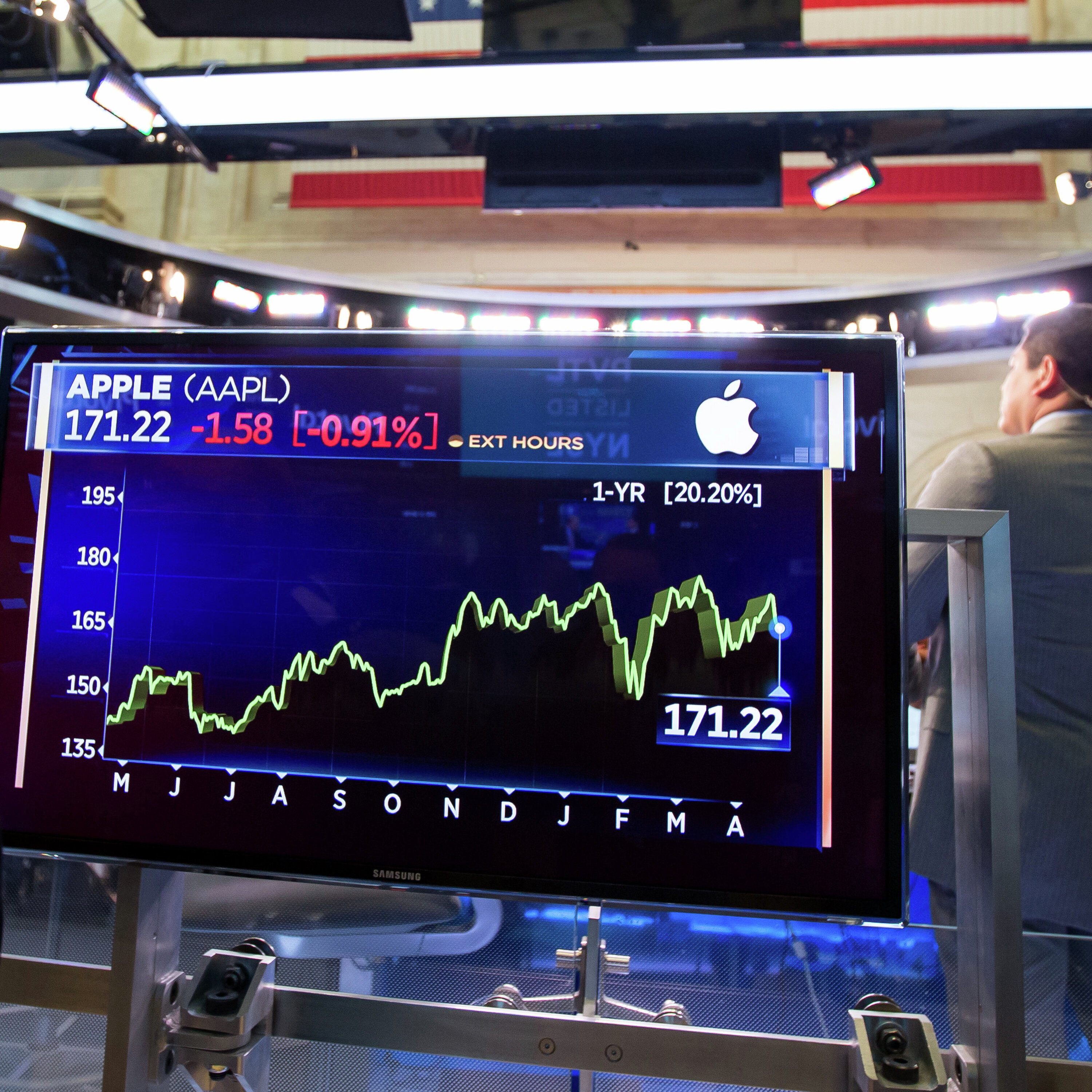
Now, Apple manages to be nowhere near either of these central narratives Right now. If you look at the two major themes in the technology sector, it is concerns about AI CapEx, which Apple isn't doing, and it's concerns about AI related disruption. And it doesn't really seem like Apple is really in the path of AI disruption in the same way that you would say software companies are or a just growing list of companies and sectors are.
- [04:29]
D
As most of the Nasdaq has trended down in recent weeks, Apple stock has often moved in the opposite direction.
- [04:36]
A
The overall moves of the major indexes aren't dictating the way Apple moves. This has really been visible in days when there has been a lot of AI related angst in the market. Things are down pretty broadly except for Apple, which is up pretty solidly. So we've been describing this as Apple decoupling itself from the broader market.
- [04:58]
D
That's something Ryan says hasn't happened to this degree since the days of the ipod.
- [05:03]
A
This level of decoupling, we're at a nearly two decade low so far.
- [05:08]
D
AI jitters don't seem to be hitting Apple as hard as its competitors. And Bloomberg's Apple reporter Mark Gurman says that's a mixed blessing.
- [05:18]
C
If you asked Apple six months ago would you like to be an AI company at the forefront or not, they would say yes, but they're extremely behind. Not on purpose, but by accident.
- [05:34]
D
I'm Sarah Holder and this is the big take from Bloomberg News today on the show Apple and the AI scare trade. Is Apple a safe haven for investors freaking out over AI and is that a good thing for the company long term? Bloomberg's Ryan Vlastilica says that Apple's decoupling from the Nasdaq is notable because if anything, Apple has been a long time market bellwether.
- [06:05]
A
I think in a normal kind of environment when you don't have this sort of AI wildcard, it's pretty common to see Apple moving somewhat more or less in line with the overall market because it has sort of traditional drivers like consumer spending, consumer sentiment, overall growth rates, how you know, what is GDP doing right now, all those other factors. Now Apple stock has been a pretty strong performer. That's why it's one of the biggest companies in the world.
- [06:30]
D
To understand just how far Apple has diverged from its peers in the Nasdaq, Ryan looks at correlation.
- [06:37]
A
Basically you measure it on a range of positive one to negative one. So positive one would be complete correlation, two different securities moving in complete synchronicity with each other. And of course negative one would be complete inverse correlation, say oil prices and airline stocks. So if oil prices are going up, airline stocks are probably going down. So that would be inverse correlation.
- [07:00]
D
And he applied that analysis to Apple.
- [07:02]
A
So we charted out correlation between Apple and the NASDAQ 100, which is primarily composed of these big tech companies. If you want to put a number on it, it fell to a correlation of think 0.21.
- [07:15]
D
That's a 40 day average. And that 0.21 from earlier in February was the lowest level since 2006. Ryan says it's bounced up a little since then.
- [07:26]
A
Apple is basically no correlation at all, which means it's not really moving on the major themes that are driving the overall index.
- [07:35]
D
The big themes like the AI hype cycles and sell offs. Over the past month, at least Apple Apple hasn't really been getting caught up in the drama. While the Mag 7 is down about 4 and a half percent so far in February, Apple is up. That's after underperforming the Mag 7. In the longer term, Ryan says there's a number of reasons for this.
- [07:57]
A
It's not a major spender and it doesn't seem like it's really at risk of AI disruption in the way that some of these other stocks are.
- [08:04]
D
But that doesn't mean investors see a bet on Apple as a Bet against AI.
- [08:08]
A
The fact that you can get all of these AI services on the iPhone, the fact that people will be accessing AI through the iPhone or other Apple products means that if you are still optimistic about the potential of AI, Apple isn't a terrible way to play that thesis because it is something that could see as AI proliferates, increased growth, more adoption, people aren't going to start abandoning their phones on account of this issue. As somebody told me, no one is out there coding a new iPhone for themselves.
- [08:40]
D
So it's clear that investors are treating Apple as a bit of an outlier right now. But it's not as simple as Apple going up while others are going down. Apple shares have had their own ups and downs even over the past two weeks. They're just out of sync in this way that you're describing. Can this be explained by investors seeing Apple as this kind of hedge against AI bets, or are they also responding to other kinds of news coming out of the company?
- [09:03]
A
I do think a lot of it is Apple's sort of insulation from some of these AI cross currents. Now, I was speaking to someone who basically said the fact that correlation is so low with the broader market does kind of increase its value as sort of diversification within the overall market. Especially since you do have this sort of AI upside optionality from the fact that if AI really proliferates and everyone is using it, maybe that means more demand for, you know, the next generation of iPhone or other Apple products like that. So you can use these things on the most advanced hardware that you can get.
- [09:35]
C
Yes.
- [09:35]
D
And we'll talk to Mark about some of the ways that Apple is investing in AI moving forward and how its AI bets have gone so far. But I'm wondering why this decoupling matters right now. What does it reveal about how investors are viewing the AI race more broadly? Because these two fears that you laid out, that companies are spending too much on AI or that AI is going to disrupt all these software companies, they feel a little bit in intention.
- [10:02]
A
Yes, I think you're right about that. I think there is a lot of concern right now about when are we going to see this pay off and at the same time is this going to destroy everything? So those two narratives have been very much present in the market. And you're right that there might be some tension. But I think people, if you're looking around and you're trying to find something that feels like a safe bet right now, Apple is sort of a kind of obvious place, especially within big tech, to look for something like that.
- [10:28]
D
Coming up, Bloomberg's Mark Gurman on how a series of missteps and missed opportunities put Apple in this position in the first place and what the company is doing to catch up on AI.
- [10:41]
B
Hey everyone, it's Emily Simpson and Shane Simpson from the Legally Brunette podcast.
- [10:46]
C
Each week we're bringing you true crime
- [10:48]
A
through a legal lens.
- [10:49]
B
Whether you want all the facts on the disappearance of Nancy Guthrie or or you still need to wrap your head around the Diddy verdict, we're breaking it all down step by step.
- [10:59]
C
And we're not just lawyers, we're also husband and wife.
- [11:02]
A
It makes for some pretty entertaining episodes.
- [11:04]
B
Listen to Legally brunette on the iHeartRadio app, Apple Podcasts, or wherever you get your podcasts. Bloomberg Daybreak is your best way to get informed first thing in the morning, right in your podcast feed. Hi, I'm Karen Moscow.
- [11:19]
C
And I'm Nathan Hager.
- [11:20]
D
Each morning we're up early putting together
- [11:22]
C
the latest episode of Bloomberg Daybreak US Edition. It's your daily 15 minute podcast on
- [11:28]
B
the latest in global news, politics and international relations. Listen to the Bloomberg Daybreak US Edition podcast each morning for the stories that matter with the context you need. Find us on Apple, Spotify or anywhere you listen.
- [11:49]
D
This Winter Olympics, there was a video going around from the 2002 Winter Games in Salt Lake City. It was that year's thousand meter short track speed skating final and it's relevant to today's AI race.
- [12:02]
A
I promise this is a nine lap race and now it's only one man across the line for gold. It'll be over in 90 seconds.
- [12:10]
D
Five skaters were competing, including Apollo Ohno, the American speed skating icon. By the final lap, Ono is at the head of a tight pack and an Australian skater, Steven Bradbury, is dead last. But then something remarkable happens. Ono and the other three leading skaters topple onto the ice. And Bradbury glides past them for the goals. Australia's first in the Winter Games. To this day, when somebody wins because the rest of the field has flamed out, Australians call it doing a Bradbury. I wanted to bring Bloomberg's chief Apple correspondent Mark Gurman into the conversation and ask him. With Apple getting investor love for effectively being behind in AI, is the company doing a Bradbury?
- [13:04]
C
Well, if they're doing a Bradbury, I think they fell backwards into it because the plan certainly wasn't for them to do a BradB. The reality is is that Apple was caught flat footed and so yes, they're getting the benefit on the stock right now because of that but that's not a good thing for the long term business being so behind in a core technology. And we're talking about the core technology of all core technologies here, so.
- [13:31]
D
Right. Apple has trailed its Magnificent Seven peers pretty significantly, at least when it comes to spending on AI, even though the company famously is sitting on a lot of cash. So when you think about Apple's position right now, how much of the separation from the pack is due to a strategy or is it a result of a failed strategy?
- [13:53]
C
Oh, I absolutely think it's the result of failed strategy. And then they've seen how these other companies are having their own financial issues and their own problems and they said maybe it's kind of a good thing that we failed, so maybe let's turn the failed strategy into our strategy.
- [14:07]
D
Is that what's happening?
- [14:08]
C
I think to some extent, yeah.
- [14:10]
D
Is that what you're hearing from people at Apple, that they want to lean into this now?
- [14:13]
C
Well, no, I haven't heard specifically. They want to lead into it, but they're, you know, very careful when it comes to investing. They've had opportunities to buy, you know, major AI companies like Mistral out of France and Perplexity, that search engine AI app, and they've chosen not to make those major investments. They're partnering with Google to help them build their own new Apple foundation model using Gemini. So they're going at it very slow after trying to race into it and it blowing up in their faces. I mean, Apple intelligence lags behind the competition significantly. They've been trying to release this new version of Siri now for two years that uses AI to let you tap into your personal data and on screen content and control applications in a more precise way. It's going to take them another three to six months, maybe even longer to get those features out. They're not going to launch their first chatbot until the tail end of this year. So they're definitely behind by any, any metric. And trust me, it wasn't supposed to be this way.
- [15:09]
D
In some ways, Apple is being rewarded by investors for that. Can you talk more about how you're viewing this decoupling dynamic?
- [15:17]
C
I think investors have realized that Apple is failing in AI and they're seeing Apple as a company that's very focused on the hardware. And if you look at investments and portfolio diversification, Apple really is not an AI company, it's a hardware company. Whereas all these other companies have become AI companies and it's not the way it was supposed to be. Apple was supposed to become an AI company by now, but it's diversified because it's simply not.
- [15:46]
D
How does the company think about its place in the AI race?
- [15:50]
C
It depends who you're asking. It depends when you're asking them. If you ask them in an official setting, they'll probably tell you that they think they're doing a great job in AI. The reality is, is that they're trailing all their competitors in AI. Their LLMs are subpar. Their models, for all intents and purposes are subpar. Their integr of AI across the software stack is subpar. They're only really getting religion now on using AI to run the company. So they are very much far behind.
- [16:18]
D
Apple has declined to comment on Bloomberg's reporting about these AI efforts.
- [16:23]
C
Will they turn things around? Absolutely. But will they be pushed to the forefront? No, but I think with the right combination of models and the combination of their hardware, I think from an AI hardware perspective, they could definitely be a leader.
- [16:37]
D
Well, Apple does have several AI hardware products on the way. Tell me a little bit more about those.
- [16:41]
C
So they're working on three main ones. One is a version of AirPods with cameras. One is smart glasses with cameras and one is a necklace pendant that you can wear on your shirt or around your neck with cameras. And the idea is to use visual intelligence, the environment around you, to feed data into Siri for it to help you take action. One classic example is right now if you're wearing AirPods or using an Apple device while on a walk and you have turn by turn directions on in maps, it'll tell you make a turn in 450ft or in 1 mile or whatever. Now it could tell you make a right turn past the gray three story building because it can see what's around you, not only no distances.
- [17:22]
D
So it's not investing in chatbots to the same scale as some of its competitors, but it is investing in these hardware products. Can you talk about how that's a different strategy than some of the other mag7 companies and why you think it's developed that way?
- [17:35]
C
Well, they are building a chatbot. They are going to revamp Siri around this chatbot type of interface later this year and deeply integrate these gemini models across iOS, iPadOS and macOS with the next major versions that are going to be introduced in June and released in September.
- [17:50]
D
But they're late on that front.
- [17:51]
C
Yeah, they're pretty late. And then in terms of Hardware, Apple makes 80% of their revenue from products. They're a hardware business. They have not really shown a way that they're going to be able to monetize AI in the near future from a software stack standpoint. And so the only way they're going to be able to monetize AI to any considerable degree for the underlying business is going to be through hardware. So from that standpoint, AI hardware is is the game in town for Apple to augment iPhone revenue.
- [18:21]
D
So if investors get past their jitters about AI and they decide in whatever way that the technology will be transformative, will support high company valuations and massive spending, what does it mean for Apple
- [18:33]
C
from an investment standpoint? I just don't see how Apple being so behind and not showing any ingenuity in terms of AI makes them an interesting company to invest in. Right. They're an interesting company to invest in because everyone knows they're going to come out with great hardware, everyone knows that they're forecasting solid results for the current quarter, everyone knows they're going to continue making a ton of money on the devices and but in terms of future upside, it's just not exciting to investors right now, in my view.
- [19:08]
D
This is the Big Take from Bloomberg News. I'm Sarah Holder. To get more from the Big Take and unlimited access to all of bloomberg.com, subscribe today@bloomberg.com podcastoffer if you liked this episode, make sure to subscribe and review the Big Take. Wherever you listen to podcasts, it helps people find the show. Thanks for listening. We'll be back tomorrow.
- [19:39]
B
Hey everyone, it's Emily Simpson and Shane Simpson from the Legally Brunette podcast.
- [19:45]
C
Each week we're bringing you true crime
- [19:47]
A
through a legal lens.
- [19:48]
B
Whether you want all the facts on the disappearance of Nancy Guthrie or you still need to wrap your head around the Diddy verdict, we're breaking it all down step by step.
- [19:58]
C
And we're not just lawyers, we're also husband and wife.
- [20:01]
A
It makes for some pretty entertaining episodes.
- [20:03]
B
Listen to Legally Brunette on the iHeartRadio app, Apple Podcasts, or wherever you get your podcasts.
- [20:11]
C
This is Special Agent Regal, Special Agent Bradley Hall. The time is approximately 11:15am about to start consensual telephone call with Dr. Daiwa Zhang.
- [20:29]
A
China's Ministry of State Security is one of the most mysterious and powerful spy
- [20:33]
C
agencies in the world.
- [20:35]
A
But in 2017, the FBI got inside.
- [20:45]
C
Wait.
- [20:52]
A
I'd never seen that much evidence in my entire career, and I don't think we'll ever see that much evidence again. I now have several terabytes of an
- [21:00]
C
MSS officer, no doubt, no question of his life.
- [21:04]
A
And that's a unicorn this is a
- [21:07]
C
story of the inner workings of the MSS and how one man's ambition and
- [21:12]
A
mistakes opened its vault of secrets.
- [21:16]
C
Listen to the Six Bureau from Bloomberg Podcasts starting on February 13th on the iHeartRadio app, Apple Podcasts, or wherever you get your podcast.