Loading summary
Transcript53 lines
- [00:01]
IBM Representative
The thing about AI for business? It may not automatically fit the way your business works. At IBM, we've seen this firsthand. But by embedding AI across hr, IT and procurement processes, we've reduced costs by millions, slash repetitive tasks, and freed thousands of hours for strategic work. Now we're helping companies get smarter by putting AI where it actually pays off, deep in the work that moves the business. Let's create smarter Business IBM Find home
- [00:31]
Sonesta Hotel Advertiser
wherever you roam at Sinesta Es and Simply Suites, where longer stays feel comfortable, flexible and easy. Stretch out and enjoy spacious accommodations and homelike amenities designed to help you settle in and stay productive or relaxed for however long you need and when you're a Sonesta TravelPass member. Staying at Sonesta Es and Simply Suites means earning points toward free nights, upgrades and more with every eligible stay. Go to Sonesta.com to book your stay and unlock the best rates with Sonesta TravelPass here today, Rome tomorrow. Join now@sinesta.com Terms and conditions apply for
- [01:08]
Cigna Healthcare Podcast Host
many men, mental health challenges aren't recognized until they've already taken a toll. Work pressure, financial stress, changing relationships and traditional expectations around masculinity can quietly wear men down, often without clear warning signs. In season three of the Visibility Gap, Dr. Guy Winch and his guests explore how these pressures show up, how to spot them earlier, and how men can access meaningful support. Listen to the new season of the Visibility Gap, a podcast presented by Cigna Healthcare,
- [01:40]
Sarah Holder
Bloomberg Audio Studios Podcasts Radio News A month into the Iran war, the costs are mounting, and the Trump administration continues to send mixed messages about when and how the war will end. Gas prices in the US climbed above an average of $4 a gallon on Monday for the first time since August of 2022. Jet fuel has surged, and in a post on Truth Social this morning, President Trump suggested countries facing shortages buy oil from the United States or, quote, build up some delayed courage. Go to the strait and just take it. The post comes amid reporting from the Wall Street Journal that the president has told aides he's willing to even if the Strait of Hormuz remains largely closed. And U.S. defense Secretary Pete Hegseth said today that diplomatic talks with Iran are ongoing.
- [02:35]
Peter Martin
We would much prefer to get a deal if Iran was willing to relinquish material they have and ambitions they have. Open this great that's the goal.
- [02:45]
Sarah Holder
Hexath said he thought the talks were gaining strength, but that the US Would continue its strikes if a deal isn't reached.
- [02:52]
Peter Martin
We don't want to have to do more militarily than we have to. But I didn't mean it flippantly when I said, in the meantime, we'll negotiate with bombs.
- [02:59]
Sarah Holder
The flurry of headlines on Tuesday comes on the heels of another threat the president made against Iran. On Monday, he posted on Truth Social that if the Iranian regime fails to reach a deal shortly, the United States would obliterate all of Iran's electric generating plants, oil wells, Kharg island, where most of Iran's oil is processed for shipping, and and possibly all of the country's desalination plants.
- [03:26]
Peter Martin
It's an extraordinary threat. In truth, Iran's reaction to that is likely to cause more problems when it comes to desalination plants.
- [03:34]
Sarah Holder
Peter Martin covers defense policy and intelligence for Bloomberg. He says desalination infrastructure is critical to the countries of the Gulf.
- [03:43]
Peter Martin
Tens of millions of people across the region are dependent on the desalinization process.
- [03:48]
Sarah Holder
An American president threatening to destroy desalination plants is unprecedented. And if it happened, it could be a violation of international law. It could spark a humanitarian crisis.
- [04:02]
Peter Martin
I think it's fair to say that it's something that no other president within living memory would have done. But that's been true of a lot of Trump's actions so far. Successive US Administrations have talked about whether or not military action against Iran could work and have decided ultimately that it wouldn't. The costs would be too high. President Trump has made a different calculation. And so I think it would be naive to suggest that he might not also take surprising and controversial steps in this case, too.
- [04:39]
Sarah Holder
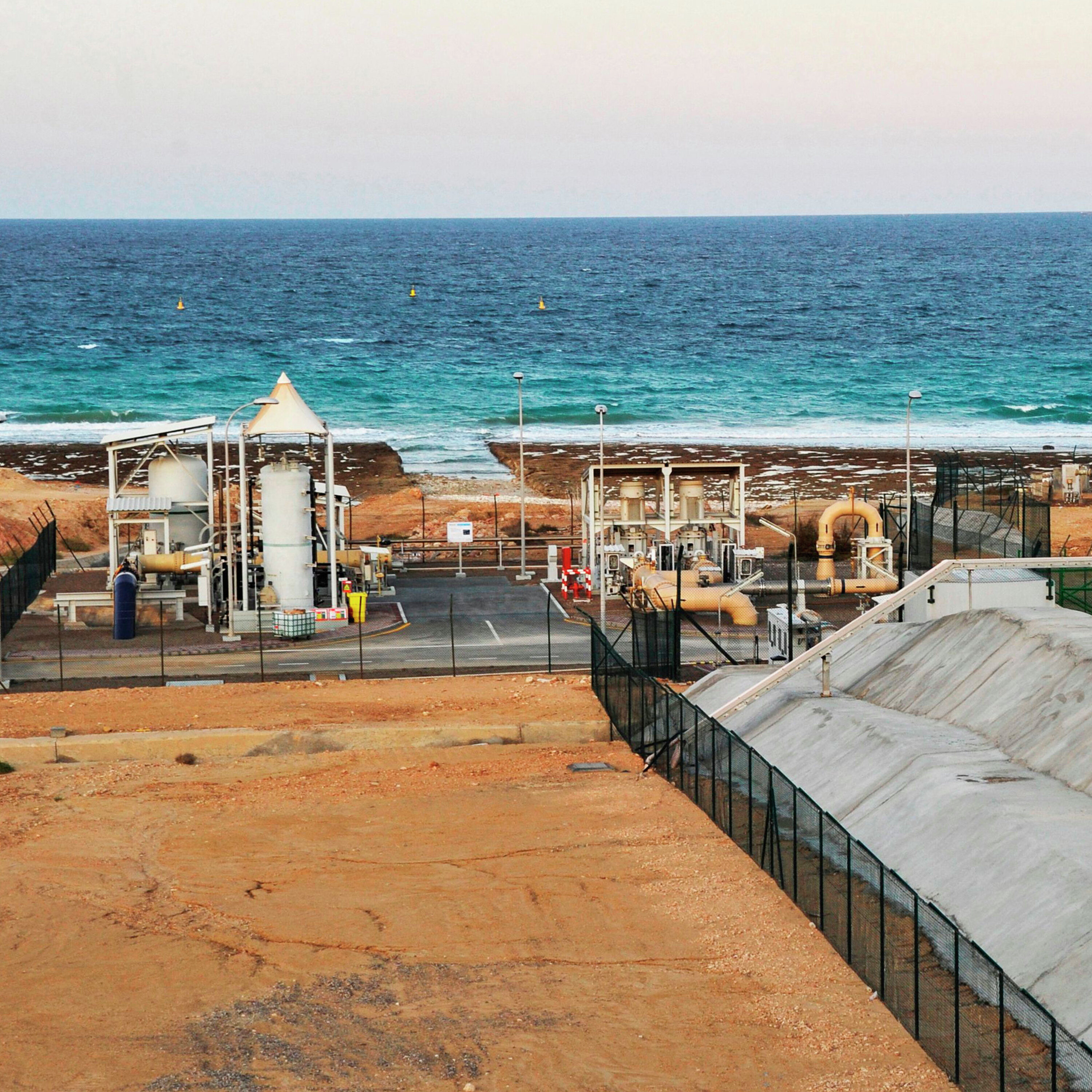
I'm Sarah Holder and this is the big take from Bloomberg News today. On the show, we look at the vital yet vulnerable infrastructure that makes life possible in the Middle east and what would happen if desalination plants become targets in the war with Iran. The countries that ring the western side of the Persian Gulf, Bahrain, Kuwait, Saudi Arabia, Qatar and the United Arab Emirates, are among the most water scarce countries in the world.
- [05:11]
Peter Martin
And as a result of that, countries across the region are reliant on desalinization to obtain drinking water and other water for commercial and industrial uses. To sort of put it in context a little bit, around 40% of the water that is used by the UAE comes from desalination, about 70% for Saudi Arabia and actually 90% for Kuwait. So it's absolutely crucial to civilian and
- [05:41]
Sarah Holder
industrial life across the Persian Gulf. What are the alternatives to desalination? What other water sources are there?
- [05:49]
Peter Martin
There's very limited fresh water in the Gulf. There are river sources. Some countries hold underground Reserves which have enough water for a few days or a week. But really there is no alternative in most of the Gulf countries.
- [06:04]
Sarah Holder
So, Peter, let's get a sense of the history of this technology in the Gulf. What was it like there before desalination, and when did the first desalination plants come online?
- [06:14]
Peter Martin
Yeah, I mean, the technique has been around for millennia. It's just a basic. Basically, it's the process of removing salt from seawater and making that water drinkable. There were sort of two techniques which dominated for a long time. One was thermal desalination, which I can remember being shown as a kid in elementary school, which is where you heat water, steam evaporates, and then you capture the steam. And there's another process called reverse osmosis, which is now the dominant technology and the one that's spread all across the Middle east, which is where you use pressure to push seawater through a membrane and you remove the salt from it. So, basically, before the advent of this technology and its widespread use, there's no way that Gulf countries could have supported the kinds of populations that they have now. I think all of the Gulf countries, countries are incredibly dependent on the technology, and without it, they wouldn't have the kind of tourism, service, financial industries that you see today.
- [07:18]
Sarah Holder
How reliant is desalination infrastructure on other kinds of infrastructure, like energy and oil infrastructure, which was also talked about in Trump's Truth Social post, as a potential target in this war?
- [07:31]
Peter Martin
Yeah, so desalination plants have a kind of symbiotic relationship with energy and power plants. The pressure that's required to push water through those filtration membranes and to remove the salt from the water is incredibly energy intensive. So they're often built next to power plants. That makes them very expensive. Some estimates I've heard put desalinated water at about 25 times more expensive than other sources around most of the world. But in the Gulf, the region has a huge advantage in that it's endowed with massive amounts of oil and other hydrocarbons, bringing down some of those costs.
- [08:09]
Sarah Holder
So, Peter, I mean, you laid out how many people across the Gulf states depend on desalination. But this problem isn't limited to the Gulf. Right. Other countries in the Middle east also depend on this technology, including Israel, which is an active party in this war. Israel gets about 70% of its water from desalination plants. So how vulnerable is oil, all of this infrastructure in the Gulf, in Israel, to being damaged in this war?
- [08:38]
Peter Martin
Yeah, I mean, the infrastructure is vulnerable across the entire region. Israel has excellent air defenses compared to many of its neighbors. It also has alternative sources of water. There's a major lake that it relies on, and it's worked for decades really to reduce its vulnerability to water scarcity. So if a desalination plant were to be taken offline in Israel, it would be a problem, but not a catastrophe in the same way that it might be for, say, Kuwait.
- [09:09]
Sarah Holder
And I feel like this has all been building to the question of Iran. Can you walk through how dependent Iran is on desalination and on desalination infrastructure?
- [09:20]
Peter Martin
Iran is not particularly dependent on it. It has desalination plants and it would be disruptive to take them offline. The country has suffered from drought in recent months, but now, as we head to the springtime, there's access to fresh water from rain. Iran has multiple rivers. And so I don't think that it's an existential threat to rulers in Tehran in the same way as it is to its Arab Gulf neighbors.
- [09:50]
Sarah Holder
But if President Trump does follow through on his threat to possibly destroy Iran's desalination infrastructure, it could trigger a dangerous chain reaction. And it wouldn't be the first time a desalination plant in the Gulf had been targeted in war. After the break, we'll look at exactly what the human and economic costs could be if it happened again.
- [10:20]
Public Investing Advertiser
Support for the show comes from Public. Public is an investing platform that offers access to stocks, options, bonds and crypto. And they've also integrated AI with tools that can assist investors in building customized portfolios. One of these tools is called Generated Assets. It allows you to turn your ideas into investable indexes. So let's say you're interested in something specific, like biotech companies with high R and D spend, small cap stocks with improving operating margins, or the S&P 500 minus high debt companies. Chances are there isn't an ETF that fits your exact criteria. But on Public you just type in a prompt and their AI screens thousands of stocks and builds a one of a kind index. You can even backtest it against the S&P 500. Then you can invest in a few clicks, go to public.com market and earn an uncapped 1% bonus when you transfer your portfolio. That's public.com market ad paid for by Public Holdings Brokerage Services by public investing member FINRA, SIPC advisory services by public advisors SEC registered advisor crypto services by ZeroHash sample prompts are for illustrative purposes only, not investment advice. All investing involves risk of loss. See complete disclosures@public.com disclosures in the fall
- [11:33]
Rachel Brown
of 2023, Romana Didalo, a woman calling herself the Queen of Canada, drove into Richmond, Saskatchewan, with a fleet of RVs and set up her kingdom in an abandoned school. So the town banded together to get the cult out by any means necessary. My name is Rachel Brown, and in this season of Uncover, I explore what happens when a conspiracy theory lands in your backyard. The Cult Queen of Canada, available now on cbc. Listen and everywhere you get your podcasts.
- [12:04]
Sarah Holder
Early birds always rise to the occasion for summer vacation planning because early gets you closer to the action. So don't be late. Book your next vacation early on VRBO and save over $120. Rise and shine. Average savings $141 select homes only. Why are desalination plants attractive targets for military action? Why have they become targets before?
- [12:36]
Peter Martin
In theoretical terms, they're large, fixed targets that are easy to locate, they're difficult to replace quickly. They can put tremendous stress on any government that's reliant on that technology if you remove it because your civilian population is then put at risk. It has happened before. During the first Gulf War, Iraq targeted Kuwait's desalination plants, taking some of them offline. But in truth, they have rarely been targeted. The Geneva Convention makes it clear that it's illegal to target them because they're necessary for civilians to survive. So they're relatively easy, large targets that are simple to hit. It's just that the legality of that is very problematic.
- [13:25]
Sarah Holder
Yeah, yeah. I mean, you mentioned the Kuwait attack. What does the fallout from that tell us about the stakes of potential strikes on desalination plants in this war?
- [13:36]
Peter Martin
Yeah. Iraq targeted some of Kuwait's desalination plants in the first Gulf War, taking some of them offline and reducing the access of Kuwait's population. Relation to drinking water. Supplies were then brought in from Saudi Arabia and other neighbouring countries and that the US also helped with some of that response. But in truth, it's difficult to maintain reserves for large civilian populations for long periods of time.
- [14:03]
Sarah Holder
And if a plant like this is attacked, how long could it take to get back online?
- [14:08]
Peter Martin
Yeah, so experts I've spoken to say that minor damage could be repaired in months, perhaps weeks, but that larger scale damage would require years to repair.
- [14:20]
Sarah Holder
What happens if water begins to run out and these countries see shortages? What are the humanitarian implications of that?
- [14:28]
Peter Martin
Yeah, so I mean, the most immediate result would be that households would begin to run short on water, and that could happen within a matter of days. Typically, governments, you would expect them to start doing things like rationing water use, restricting commercial use, perhaps distributing bottled water to populations. And if it were to persist for a long time, I think that probably evacuations would be considered.
- [14:53]
Sarah Holder
And from an economic standpoint, which parts of these Gulf States economies are most vulnerable? Again, if a plant like this were to be taken out or even damaged,
- [15:04]
Peter Martin
if you think of somewhere like Dubai with a massive urban population, an economy which runs on services, finance, tourism, the life of the population there would be very difficult to sustain. All of the industries surrounding it would be difficult to sustain. Essentially, these economies would come grinding to a halt without the ability to obtain the water that they need.
- [15:29]
Sarah Holder
Given the extremely high stakes of keeping these desalination plants running, I'm wondering what Gulf countries are doing to protect their water supplies and their manufacturing facilities right now and how well those efforts have been working.
- [15:45]
Peter Martin
Experts that I've spoken to say that there's not really very much that they can do to protect the facilities. They're large, they're exposed, they're quite technically fragile. There's a lot of sensitive technology inside. And, you know, the countries themselves are protected by air defenses. Most of the Gulf states have a pretty good record of shooting down incoming Iranian missiles and drones, but it's not a perfect record. Lots are still getting through, and there's not really much that can be done to harden them in the short term other than just trying to shoot down missiles and drones.
- [16:23]
Sarah Holder
Striking desalination plans would be a violation of the Geneva Convention. It's a war crime. What would the consequences be if a country or a government like the US did target desalination plants in this war?
- [16:37]
Peter Martin
I think the truth is that we don't know. We'd be entering uncharted territory. From the outset, this war has been questioned by some of the US's closest allies when it comes to whether or not American actions have been legal. US strikes on desalination plants would certainly invite that kind of questioning, as would Iranian retaliation. But I think a lot of people feel like we've got to a point here where we're kind of an outrage fatigue. I'm not sure what would happen in practical terms, other than a huge international outcry.
- [17:14]
Sarah Holder
Are there risks that even accidentally, or as a symptom of this broader conflict in the Middle east, that desalination plants might be damaged, whether through strikes from Iran, the us, or other regional players? And what are the implications of that?
- [17:35]
Peter Martin
Yeah, there's absolutely that risk. If energy facilities were to be targeted, there's the potential that that damage could take desalination plants offline because they're so energy intensive. And there's also, of course, the possibility of collateral damage. Trust on both sides in this war is running pretty low at the moment, and so it would be quite difficult for either side to convince the other that that kind of damage had been accidental and that that raises the possibility of escalation quite considerably.
- [18:06]
Sarah Holder
Well, we've already seen one example of a desalination plant being damaged in this conflict. The Iranian government has said that a desalination plant was damaged on Qezem island in the Strait of Hormuz, disrupting the water supply to 30 villages. How did Iran and the US respond to that incident, and how much does this raise the risk of future attacks on desalination plants in this war?
- [18:32]
Peter Martin
I think a lot depends on whether President Trump goes through with his most recent threats. Iran said that its facility had been hit in early March. The US Responded by saying that the facility was not deliberately targeted. And exactly what happens kind of remains in dispute. But Iran did retaliate by hitting a facility in the Gulf state of Bahrain and saying subsequently that any further attacks on Iranian energy infrastructure could be met by attacks on Gulf desalination facilities. So I think it's something that both sides have kind of put in play. But so far on the ground, there's been a reasonable degree of restraint between both sides. Precisely. I think because the humanitarian consequences would be so grave and the reputational cost to either side for actually carrying out activities which are so crucial to civilian life would be pretty high.
- [19:37]
Sarah Holder
This is the Big Take from Bloomberg News. I'm Sarah Holder. To get more from the the Big Take and unlimited access to all of bloomberg.com, subscribe today@bloomberg.com podcastoffer if you like this episode, make sure to subscribe and review. The Big Take. Wherever you listen to podcasts, it helps people find the show. Thanks for listening. We'll be back tomorrow.
- [20:09]
Cigna Healthcare Podcast Host
For many men, mental health challenges aren't recognized until they've already taken a toll. Work pressure, financial stress, changing relationships, and traditional expectations around masculinity can quietly wear men down, often without clear warning signs. In season three of the Visibility Gap, Dr. Guy Winch and his guests explore how these pressures show up, how to spot them earlier, and how men can access meaningful support. Listen to the new season of the Visibility Gap, a podcast presented by Cigna Healthcare.
- [20:39]
Rachel Brown
When a birthday party in suburban San Jose turns deadly, 18 year old identical twins are arrested for suspected murder. One of them spends nearly two years in jail before the truth comes out. Authorities locked up the wrong twin. How could one brother let his twin take the fall? And why would the other give up his freedom for a crime he didn't commit? Blood Will Tell is a modern day Shakespearean saga about what we're willing to sacrifice for the people we love and whether our most tragic mistakes are worthy of redemption. Listen to Blood Will Tell, a new series from Audible and Campside Media. Wherever you get your podcasts
- [21:29]
Lisa, Licensed Psychotherapist
hi, my name is Lisa and I'm a licensed psychotherapist, which means my work doesn't magically end when the session does. There are notes to write, appointments to manage, billing, insurance, follow ups, and somehow all that admin used to creep into my nights and weekends. That's why I switched to Simple Practice. Simple Practice is an all in one electronic health record built specifically for therapists with HIPAA compliant tools and high trust certification so I don't have to worry about juggling systems or cutting corners just to keep things running. Scheduling, documentation, billing, insurance, client communications, even automated appointment reminders. It all lives in one place. And if you're starting or growing a practice, SimplePractice also offers a credentialing service that helps simplify insurance enrollment, which can be a huge lift when you're starting to scale. Start with a seven day free trial, then get 50% off your first three months. Just go to Simplepractice.
- [22:25]
Peter Martin
Com.
- [22:26]
Lisa, Licensed Psychotherapist
Again, that's simplepractice.
- [22:28]
Peter Martin
Com.