Loading summary
Transcript72 lines
- [00:00]
Michael McDermott
At CES. Michael McDermott, EVP of Samsung, spoke with Bloomberg Media Studios about what the company calls its next AI chapter, your companion to AI Living.
- [00:09]
Samsung AI Representative
It's a shift from AI as a feature to AI as a trusted partner in everyday life.
- [00:18]
Bloomberg Audio Studios Announcer
Bloomberg Audio Studios Podcasts Radio News.
- [00:24]
Sarah Holder
My.
- [00:25]
Bloomberg Audio Studios Announcer
Vision for New York City in 2025.
- [00:27]
Sarah Holder
Looks like Zoran Mandani New Yorkers across the city went to the polls to cast their ballots for mayor. On Manhattan's Upper east side, we spoke to voters motivated by a wide range of issues. Mamdani is very like pro immigrant, pro LGBTQ community.
- [00:45]
Emily Flitter
The biggest thing for me has been corruption that I've seen.
- [00:48]
Katherine Wilde
But New York City is too big a city for somebody to run that has never had a full time real job.
- [00:57]
Sarah Holder
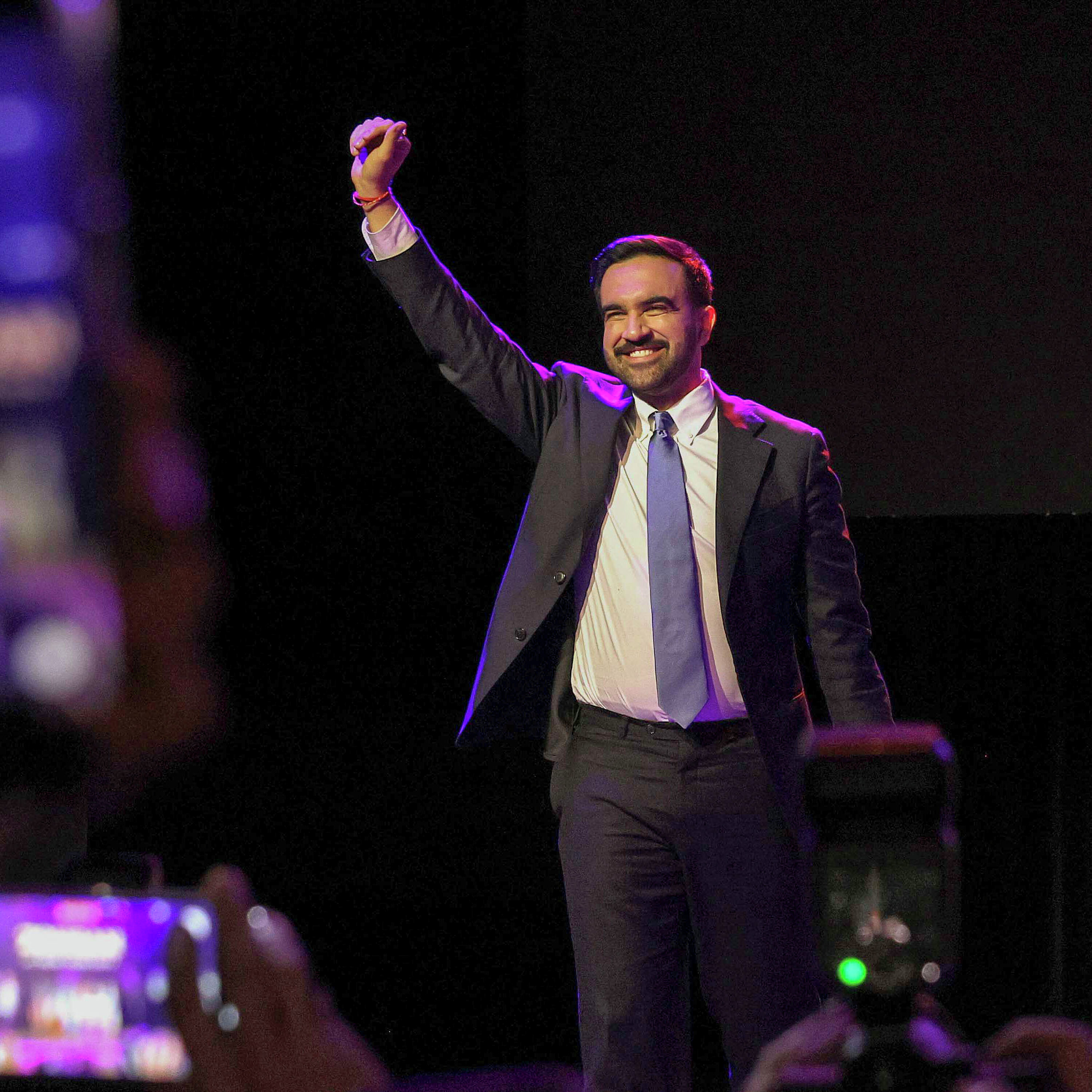
No one's getting free groceries and no one's getting free rent. More than 2 million New Yorkers came out to vote for mayor, something that hasn't happened since 1969. And when the results came in, more than 50% of voters went for Zoran Mamdani, the 34 year old Democratic socialist whose platform was laser focused on one key affordability.
- [01:20]
Zoran Mamdani
Tonight you have delivered a mandate for change, a mandate for a new kind of politics, a mandate for a city we can afford.
- [01:35]
Sarah Holder
Mamdani won every borough but Staten Island. He won in precincts that were majority black and majority Hispanic, and precincts where most residents were renters and public transit users. Now, as Mayor elect Madani faces a new challenge governing a city of eight and a half million people, including the vocal minority of New York's wealthiest who opposed him and and poured millions into political action groups trying to defeat him. Mamdani has been unapologetic and steadfast in his message that many of the city's problems are rooted in income inequality. And in his victory speech, billionaires were part of what he said had gone wrong.
- [02:16]
Zoran Mamdani
We will put an end to the culture of corruption that has allowed billionaires like Trump to evade taxation and exploit tax breaks.
- [02:26]
Sarah Holder
But with their outsized income influence on the city's politics, economy and revenue, Mamdani has also tried to make peace with the city's 1%. And there are signs that several of those big name high net worth skeptics are already coming around. Last month Jamie Dimon, the CEO of JPMorgan Chase, said at a conference led by Fortune magazine that he was ready to work with Mandani if he won.
- [02:51]
Emily Flitter
If he becomes mayor, I will call.
- [02:54]
Michael McDermott
Him and offer my help.
- [02:56]
Sarah Holder
Doesn't mean I'll agree with him. And at a news conference today, Mamdani said he's ready to sit down with people like Dimon, too.
- [03:04]
Zoran Mamdani
So I look forward to having those kinds of meetings, be it with Jamie Dimon or be it with other business leaders and continuing to show that our affordability agenda is an agenda that would also benefit businesses across the city.
- [03:17]
Sarah Holder
I'm Sarah Holder and this is the big take from Bloomberg News today. On the show, New York City's uber wealthy tried to stop Zoran Mamdani's rise. Now they're processing his victory. Can Mamdani come to the table with billionaires and business leaders while delivering on the policies and principles that got him elected? New York, New York, the Big Apple, the city that never sleeps, and the city where money never sleeps.
- [03:52]
Bloomberg Audio Studios Announcer
This is a really great place to get rich.
- [03:55]
Sarah Holder
Emily Flitter covers economic and social inequality for Bloomberg. She says from 2015 to 2023, the city minted 9,000 new million dollar earners, a rate of 3 per day. By 2023, there were almost 35,000 New Yorkers making a million or more a year. But if New York is a good place to get rich, it's an even better place to get richer.
- [04:21]
Bloomberg Audio Studios Announcer
The billionaires who already live in New York City saw their combined net worth grow 90% in the last nine years.
- [04:31]
Sarah Holder
Mamdani ran on a platform highlighting the fact that along with that growing wealth has come a growing wealth divide. Here he is on NBC's Meet the Press in June.
- [04:41]
Zoran Mamdani
I don't think that we should have billionaires because frankly, it is so much money in a moment of such inequality.
- [04:48]
Sarah Holder
New York City has some of the deepest income inequality in the country. According to an analysis of census data by the center for New York City affairs, the top 20% of New Yorkers have total incomes 33 times larger than the bottom 20%. And Mamdani's campaign promised to tax those at the top to provide more public services for everyone.
- [05:09]
Emily Flitter
The sort of three pillars of his campaign are the fast and free buses, freezing the rent and free childcare for children between 6 weeks and 5 years old.
- [05:19]
Sarah Holder
Bloomberg City Lab reporter Fola Akinibi recently profiled Mamdani for businessweek and looked at why his campaign caught on.
- [05:28]
Emily Flitter
It speaks to the underlying stress and the underlying weight of the conditions in the city. Right. And when you look at at the same time the stock market doing what it's doing and folks at the top getting wealthier and you see a federal push to cut taxes and the number.
- [05:42]
Sarah Holder
Of millionaires in the city has grown.
- [05:44]
Emily Flitter
Has grown as well. I Think people start asking questions about where they fit in.
- [05:49]
Sarah Holder
But as Mandani campaigned on affordability for all, he also tried to win over the city's 1%. In New York, that's people making at least $900,000 a year. They're a big driver of the city's economy because of how much money they pay in income and property taxes. Mamdani recognized that a path to victory in New York included getting them on board. So he reached out to Katherine Wilde.
- [06:16]
Katherine Wilde
During the year before the primary election, I had met with Zoran a few times, had introduced him to a couple business leaders.
- [06:26]
Sarah Holder
Catherine is the president and CEO of the Partnership for New York City, a trade group representing the city's largest employers across industries like real estate and banking.
- [06:36]
Katherine Wilde
Although there was not, frankly, a lot of interest in his candidacy in the business community, no one had basically ever heard of him. If they had, it was that he was a socialist and a marginal character.
- [06:49]
Sarah Holder
After Mamdani's dramatic primary win, that changed. Catherine set up a series of meetings between Mamdani and the city's business leaders to talk about their visions for the city. Which policy areas have been most concerning or divisive to business leaders, and where are their areas of agreement?
- [07:09]
Katherine Wilde
So I think in general, their areas of agreement are that there is an affordability crisis in the city and that we need to bring costs down and disagreement on how do we solve that with the business community thinking we do not solve that by increasing government spending because that will just put a new tax burden on everybody.
- [07:35]
Sarah Holder
Many business leaders viewed Mamdani with skepticism, thinking he was young and relatively inexperienced. Some believed his proposals were unrealistic or even posed a fundamental threat to their financial interests. And Catherine said people in her network also had other concerns.
- [07:53]
Katherine Wilde
One source of great concern is coming from members of the Jewish community that feel the strong importance of the Jewish homeland. The other areas are in terms of support for charter schools, mayoral control of schools, most importantly public safety.
- [08:11]
Sarah Holder
Big name wealthy New Yorkers largely backed former New York governor Andrew Cuomo. A Bloomberg News analysis found that pro Cuomo and anti Mamdani PACS raised over $26 million between the June primary and yesterday's election, Fueled by donations from investors like Bill Ackman and Dan Loeb, as well as Michael R. Bloomberg, the founder and majority owner of Bloomberg lp.
- [08:35]
Emily Flitter
There's been a lot of outside money flowing into this race. And when you look at the advertisements and the messages that are coming from these outside groups, these outside PACs, they've been pretty dark pictures of what the city could look like under Mayor Mamdania. They say that, like, you know, crime is going to spike and the city is going to change.
- [08:54]
Sarah Holder
Mamdani won't be able to achieve his key affordability proposals alone because the city doesn't fully control its own purse drinks. He's proposed paying for things like free buses and universal childcare with increased corporate and income taxes. But the power to set those tax rates and the operation of the Metropolitan Transportation Authority is held in the state's capital, Albany.
- [09:19]
Emily Flitter
So free buses would require likely some money from the MTA. The campaign puts a cost at around $700 million a year. The city has $116 billion budget. The city might be able to afford it on its own, but he, again, would probably need some state funding for that. Universal childcare is a huge. It's a massive undertaking. We're talking about six, seven billion dollars a year. And it's also something that could not be stood up, you know, in one year or overnight. Right. Like something that's going to take years. Now, Governor Kathy Hochul in the past has said that she is not open to raising taxes, and she has her own election to look forward to in 2026. At the same time, I think Mamdani's calculation here is that all these people can be pushed. And, you know, funny enough, if you look at Hoko's appearance at this Mom Donnie rally, that was about a week or two ago, she was heckled when she came onto stage, people were chanting, tax the rich, tax the rich. And she equivocated.
- [10:10]
Bloomberg Audio Studios Announcer
All right, I can hear you.
- [10:14]
Sarah Holder
Hochul later said on a podcast that she still didn't plan to raise taxes, but that she was hearing people's voices. Katherine Wild says the business community, meanwhile, sees tax hikes as a non starter.
- [10:27]
Katherine Wilde
Personal and corporate tax increases are great concerns since we're the highest tax city in the country. So a New Yorker today in a middle or upper middle income family, 55% of their paycheck goes to the government in state, federal, and city taxes. And if you go to Florida or Texas or Tennessee, you end up paying 38% because they don't have state and local income taxes. We just saw a $2.6 billion increase in state tax revenues because of Wall street bonuses. We do not want to lose those bonuses. We want them to stay right here.
- [11:06]
Sarah Holder
How would the business leaders like to see Mom Donnie address some of those key affordability issues, if not by raising taxes or going to the state for.
- [11:15]
Katherine Wilde
More money by reducing the size of government we have 300,000 employees of new York City government, the most in history. I think that the city spending is mostly on labor, and those expenses have gone up more than 50% over the past decade. So I think most people in the private sector think we could get along with less government.
- [11:42]
Sarah Holder
The fear that wealthy New Yorkers might leave if they're taxed too much or if the city isn't run in the way they want is one that Mamdani's critics repeated in the lead up to the election. In late October, Bill Ackman posted on X that Mamdani's quote anti business policies, including higher corporate taxes, will kill NYC jobs and cause companies to flee. And here's the Heritage Foundation's Stephen Moore on Fox Business News in September.
- [12:09]
Samsung AI Representative
If Mandami wins, Wall street will no.
- [12:12]
Katherine Wilde
Longer be located in Manhattan. It will move.
- [12:17]
Sarah Holder
So now that Mamdani's one is Wall street moving to Florida? That's after the break.
- [12:30]
Michael McDermott
How do you shift AI from being a flashy feature to a trusted partner in consumers everyday lives on the ground at CES Bloomberg Media Studios? Asked Michael McDermott, EVP of Samsung.
- [12:40]
Samsung AI Representative
Our 2026 vision is built around an AI companion. It understands you and responds intuitively. This intelligence works quietly in the background across TVs, home appliances and mobile devices. By putting AI at the center of everything we do, we're simply improving everyday life for everyone everywhere.
- [13:00]
Charmin Advertiser
At Charmin, we heard you shouldn't talk about going to the bathroom in public, so we decided to sing about it.
- [13:05]
Zoran Mamdani
Charmin Ultra Strong you can use less better than the rest Shaman Ultra Strong Booty Pass the clean text Salmon weave texture it's the best study up. Teach a lesson on fresh your booty Pass the clean test. Charmin Ultra Strong Charmin Ultra Strong with.
- [13:25]
Charmin Advertiser
Diamond Weed Texture cleans better than the leading one ply brand so you can use less. Enjoy the go with charming.
- [13:36]
Sarah Holder
If New York's billionaires and multimillionaires were to pack up and leave tomorrow, it would have a big impact on the city's finances. The top 1% of earners account for 40% of the city's $18 billion in annual income tax revenue. And the homes they own and offices they run or work for rack up a lot of real estate taxes, covering a large proportion of the city's $34 billion in annual property levies. But Bloomberg's Emily Flitter says those big real estate investments are also part of the reason that it isn't so easy for the city's corporations to quit New York Barclays just announced plans to invest a billion dollars in an office tower in Times Square. J.P. morgan's new Park Avenue building fits 10,000 employees.
- [14:23]
Bloomberg Audio Studios Announcer
That's not something that any of these owners or investors in real estate can just pick up and walk away with.
- [14:33]
Sarah Holder
Sure, there are plenty of financial professionals who've already been lured to South Florida, earning it the nickname Wall Street South. But Emily says when it comes to earning potential and lifestyle potential, New York wins every time.
- [14:48]
Bloomberg Audio Studios Announcer
In 2024, Wall Street south financial industry employees earned $182,000 on average. Whereas if you were working in finance in Manhattan last year, you earned an average of $413,000. And I'm actually, I'm from Miami. I love Miami. So I don't want to be dissing Miami, but it just doesn't have as much stuff as New York. It has fewer fancy restaurants. It doesn't have as many really high end stuff schools. And let me just point out that the biggest corporate move to South Florida has been from Chicago. Citadel moved to Miami. Ken Griffin moved down there. But Ken Griffin just announced that Citadel is going to invest a lot of money so that they can enhance their presence in New York.
- [15:45]
Sarah Holder
Emily says if you really want to know how New Yorkers might react to a tax increase, you can look back to what happened after New York increased its top personal income tax rates in 2021 from 8.82% to nearly 11% for the highest earners.
- [16:02]
Bloomberg Audio Studios Announcer
Overall, the data showed that people did not leave New York in significant numbers because of the tax hikes. It's as simple as that.
- [16:11]
Sarah Holder
And while Katherine Wilds, the head of the Partnership for New York City, cautions that higher taxes could make the city less competitive, she says the fears about Mamdani have been overblown.
- [16:23]
Katherine Wilde
Certainly I don't think people who are knowledgeable are going to pick up and leave before they know that something really devastating is going to happen. And there's no indication that that's the case. Much of the rhetoric around this mayoral election have suggested that a Mamdani victory will result in the city falling into deep decline, that it will be like the 1970s. People should know that if the budget in the city goes out of whack, we have a financial control board which is run by the governor, the state controller, private sector representation, they take over. The mayor has no control over increasing income or corporate taxes. The mayor has some control over real estate taxes. But Mamdani has already said he wants to reduce real estate taxes where possible. Last spring, he was talking about, I'm going to freeze the rent. We asked the question, how are you going to freeze the rent if you don't freeze the costs? How are you going to continue to encourage investment in rental housing if you don't have some incentives, financial incentives for that investment? He has now incorporated into his freeze the rent plan, a plan to reform property taxes. So that's an example where I have seen him incorporate the feedback he's gotten and now seems prepared to take a more comprehensive and practical view of that issue.
- [18:03]
Sarah Holder
Catherine says another example of Mamdani's openness to compromise was his decision to keep Police Commissioner Jessica Tisch in her position. If he won, is it fair to say that one of the takeaways of this conversation at least, is Wall street, don't panic?
- [18:18]
Katherine Wilde
Absolutely. My message would be, don't panic, but be prepared to roll up your sleeves and help our next mayor solve the affordability crisis, which will be good for business, for Wall street and for the residents of New York City.
- [18:35]
Sarah Holder
As Mamdani enters Gracie Mansion, buoyed by the support of a diverse coalition of New Yorkers, a Bloomberg City Lab's Fola Akinibi says Mamdani will continue to walk this fine line. Can he come to the table for compromises with big business while staying true to the values that have made him so popular?
- [18:55]
Emily Flitter
I think that's what's going to define his administration, right? Like, whether he's able to sort of, like, thread some of these needles.
- [19:01]
Sarah Holder
I'm wondering whether you think the business community was caught off guard by the rise of Mamdani and what they should take away from the way that he's resonated with voters.
- [19:12]
Emily Flitter
I think a lot of people were caught off guard by Mamdani's rise, and I think it speaks to again how much his message of affordability has resonated. This is a guy that throughout the campaign has stuck to that talking point. If you ask him any question, he'll always return to affordability as part of his answer to the question. And I think it shows the power of that kind of messaging.
- [19:32]
Sarah Holder
Already it seems like Wall street is coming around. Bill Ackman, the billionaire investor who'd been warning of an imminent exodus of the wealthy if Mamdani won, posted on X last night, tagging Maidani, quote, congrats on the win. Now you have a big responsibility. If I can help nyc, just let me know what I can do. And even President Donald Trump, speaking earlier today, followed up criticism of Mamdani by saying, we want New York to be successful. We'll help him a little bit. Maybe this is the Big Take from Bloomberg News. I'm Sarah Holder. To get more from the Big Take and unlimited access to all of bloomberg.com, subscribe today@bloomberg.com podcastoffer if you like this episode, make sure to follow and review the Big Take wherever you listen to podcasts. It helps people find the show. Thanks for listening. We'll be back tomorrow.
- [20:36]
Charmin Advertiser
Did you know Tide has been upgraded to provide an even better clean in cold water? Tide is specifically designed to fight any stain you throw at it, even in cold butter. Yep, chocolate ice cream. Sure thing. Barbecue sauce. Tide's got you covered. You don't need to use warm water. Additionally, Tide pods let you confidently fight tough stains with new coldzyme technology. Just remember, if it's gotta be clean, it's gotta be Tide.
- [21:06]
Toyota Advertiser
Dear Winter, Toyota can't get enough of you. Cause Toyota's got 25 vehicles with available all wheel drive and four wheel drive. And that's more than any other auto brand. From the versatile RAV4 to the svelte crown, the sleek Camry all wheel drive, the Corolla hybrid all wheel drive, the rugged Tacoma, the tenacious Tundra, and the spacious grand Highlander with all wheel drive to keep you and yours safe. Hey, you bring the action, we'll bring the traction. Toyota, let's go places Based on manufacturers websites as a 10, 20, 25.