Loading summary
Transcript68 lines
- [00:00]
IBM Representative
So there's a lot of noise about AI, but time's too tight for more promises. So let's talk about results. At IBM, we work with our employees to integrate technology right into the systems they need. Now a Global workforce of 300,000 can use AI to fill their HR questions. Resolving 94% of common questions, not noise. Proof of how we can help companies get smarter by putting AI where it actually pays off, deep in the work that moves the business. Let's create smarter business.
- [00:29]
Optum Healthcare Representative
IBM Healthcare doesn't always work great. If you've ever waited on a refill or couldn't schedule an appointment, you get it. That's the kind of stuff Optum is changing. They're using data and technology to integrate patient care, pharmacy, and everything else. So healthcare is connected, not complicated. What's that look like? Cheaper prescriptions that are easier to get and care that looks at the whole person how you need it. Optum is helping make healthcare work as one for everyone. Learn more@business.optum.com as industries evolve faster than
- [01:02]
Michigan Economic Development Official
ever, companies need an environment that accelerates strategic growth. And Michigan delivers on that promise. From emerging startups to global enterprises, Michigan offers what executives value most. A resilient, innovative ecosystem, diverse communities that attract top talent, and a quality of life that supports work life balance with our unified Team Michigan approach, businesses scale faster and compete at the highest level. Michigan Pure opportunity Seize your opportunity at michigan in business.org Bloomberg Audio Studios podcasts
- [01:36]
Sarah Holder
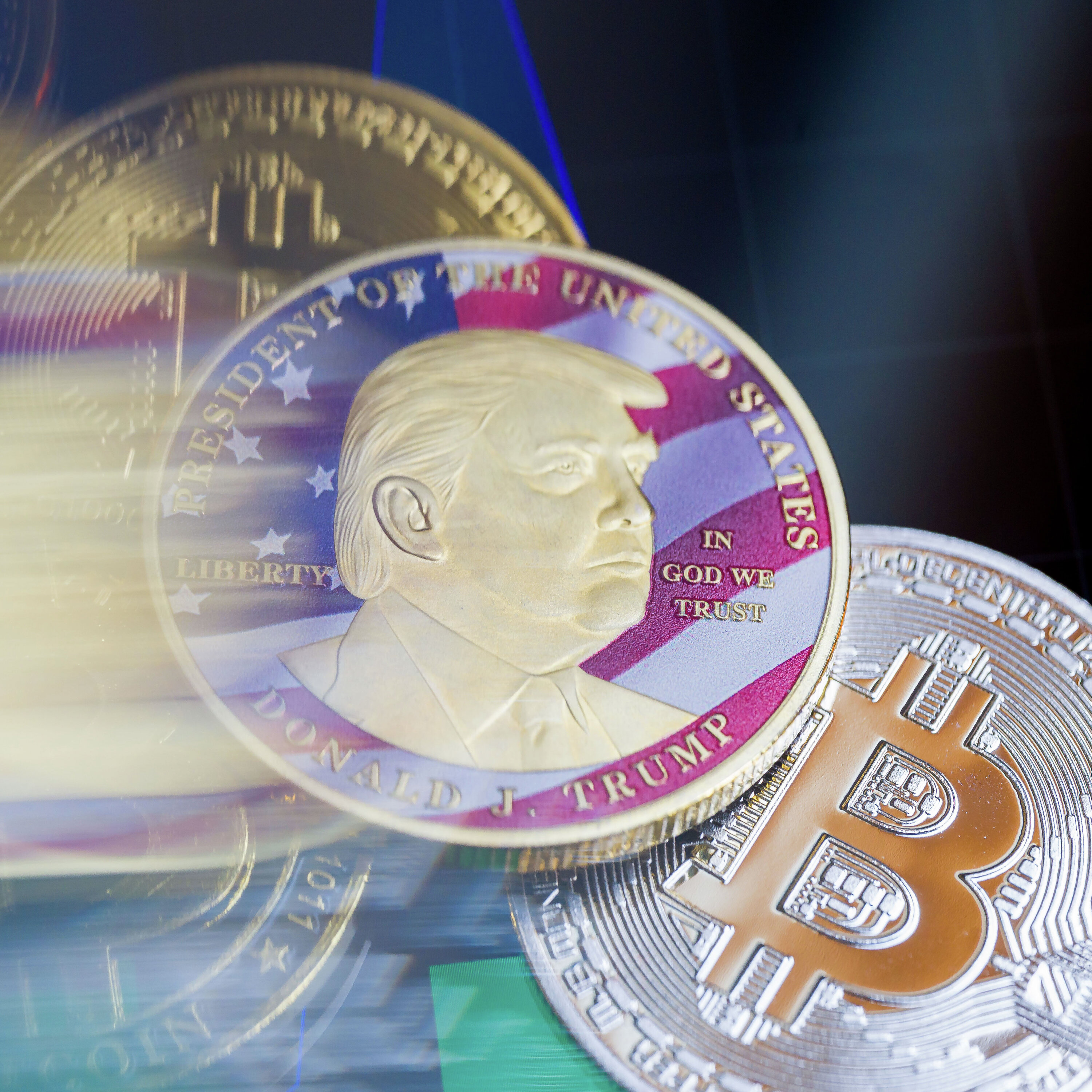
Radio news out of all the income streams that Donald Trump reported in his latest financial disclosure, there was one particular industry that turned out to be especially lucrative for the crypto.
- [01:51]
Bill Allison
He had a better year making off of crypto than just about, you know, any of the companies that are in this business.
- [01:56]
Sarah Holder
That's Bloomberg's campaign finance reporter, Bill Allison, who's covered Trump's financial disclosures since 2015, when he ran for president.
- [02:04]
Bill Allison
The first time, that disclosure was all of 92 pages. The most recent one was 927 pages. So it showed that he had a tremendous amount of income from his various
- [02:17]
Sarah Holder
crypto ventures, at least $1.4 billion in total. a time when the crypto industry at large has been reeling from losses, the president's gains stand out.
- [02:29]
Bill Allison
It's more money than he's made in any single year he's been president, and it's his biggest source of revenue.
- [02:34]
Sarah Holder
Trump also made money playing the stock market with bets on companies whose fates are heavily influenced by federal policy. His financial disclosure shows the dollar value of his thousands of securities trades could have been anywhere between $600 million and $1.86 billion. The disclosure is full of other new details about Trump's business dealings.
- [02:57]
Bill Allison
He's selling Trump watches, which made like more than $4 million. There's the Bibles, there's a Trump guitar.
- [03:03]
Sarah Holder
He made $77 million from his Mar a Lago resort, $122 million from Trump National Doral Golf Club, and $25 million from his Virginia golf club.
- [03:14]
Optum Healthcare Representative
To critics who say you're profiting off the presidency.
- [03:16]
Donald Trump
Mr. Well, you know why I'm profiting? Because the stock market's going up. Everybody's profiting.
- [03:22]
Sarah Holder
As president, Trump isn't subject to the same ethics rules as other public officials.
- [03:27]
Bill Allison
Basically, you didn't want a situation where a president would have to decide, you know, can I make a decision or do I have to recuse myself? We can't have the president recuse himself from a decision. So the position is exempted from a lot of these laws. As a result, you know, Trump has kind of like he interprets that to mean the president can't have a conflict of interest.
- [03:46]
Sarah Holder
Those ethics laws were written in 1960.
- [03:50]
Bill Allison
We've never had a president quite like Donald Trump. The ethics laws did not take into account the idea that you would have a president who was a billionaire with a far flung real estate empire, with properties that he's managing or owns around the world. And what it creates is this system where anybody can buy into business with Donald Trump, you know, foreign governments, sovereign wealth funds, billionaires. And even if there isn't a conflict of interest, it really creates the appearance of one. It really does muddy the waters whenever this it makes decisions. And it raises the question, you know, well, does he have a financial interest in this?
- [04:32]
Sarah Holder
I'm Sarah Holder and this is the big take from Bloomberg News today on the show, all the president's profits. What Trump's 2025 disclosure reveals about the money he's made since taking office a second time and the ethics concerns it's raising.
- [04:48]
Donald Trump
Foreign.
- [04:54]
Sarah Holder
You've been covering Trump's financial disclosure since he was a candidate the first time around. What stood out about this latest disclosure?
- [05:03]
Bill Allison
Well, you know, clearly the crypto, I mean, and he did report some earnings from crypto in his from 2024. And I think he made about 57, $58 million from crypto, which was, you know, a lot. That was enough for a headline. And now he's up, you know, well over 1.4 billion.
- [05:19]
Sarah Holder
That is a lot more.
- [05:20]
Bill Allison
Is a lot more. Yes.
- [05:21]
Sarah Holder
I mean, the other Evolution has been Trump's sort of mindset on crypto, right? Back in 2021, Trump said Bitcoin seemed like a scam. Now he's made more than $1 billion off the crypto industry. How much has Trump's perspective on crypto really changed over the past few years? And what's behind that shift?
- [05:41]
Bill Allison
I think the changes really started post January 6, 2021. The way that Trump left office, he had trouble doing business with normal financial institutions. After that. He claims he was debanked and that big institutions wouldn't take his business. And at the same time, you have the Biden administration cracking down on crypto. And, you know, with a lot of prosecutions, the SEC made it sort of a central thing that they went after and they kind of became strange bedfellows that the crypto industry saw in Donald Trump somebody who would promote their interests. And they held fundraisers for him in the 2024 campaign. And Donald Trump learned to love crypto as well. His first ventures, crypto, you know, were selling these tokens that presented him like a superhero and stuff, and they sold very well. And I think he made a couple of million from it. And, you know, he never looked back.
- [06:30]
Sarah Holder
And at this point, can you give us a sense of what Trump's crypto empire looks like? How exactly did he make this $1.4 billion he did last year?
- [06:40]
Bill Allison
There's three components to it. One is World Liberty Financial, which is the company that he bought, started before the presidential election in 2024. Steve Witkoff, his Middle east envoy, and Donald Trump are sort of the high level names as co founders. Basically it markets something called a stablecoin and USD1 is the name of it. And it's gotten some big heavy hitters buying into it. There's an investment fund in the Middle east that used $2 billion worth of USD 1 to buy into the Binance Exchange. And so token sales have generated a huge amount of money for Donald Trump. And it's about 594 million. So that's component one. And then one of his sources of income, this is from stablecoin Holdco, the name of the company. It's an LLC and they got capital contributions from new members. So there's people buying into this company and they sold, you know, class C units to other people, as the disclosure tells us. So basically he's selling equity stakes in these ventures. So that's one way that he made money. And then the other thing is a separate company called CIC Digital llc, which sells his meme Coins. And these are like these Trump tokens and cards and whatever that people buy. And that made him $636 million. And the thing about the meme business, the dollar Trump coin, is that it says right on the website that markets them that these are not for investment purposes. These are to show support for the President. And yet at the same time, he kind of like, pumps up the value of these by hosting an annual conference that you get to meet the president. If you're one of the top holders of this, it's just generated a huge amount of revenue for him. You have these huge spikes in price. Certainly the first time he did one of these conferences where people could come. And it's almost that this is a way to kind of get access to the president, the way he's operating the tokens.
- [08:37]
Sarah Holder
Well, it is interesting, though, because the World Liberty Token has not done so well. Neither has the Meme Coin. According to our colleagues, the World Liberty Token is down 75%. The meme coin has fallen 95% in value. You know, the New York Times reported that according to cryptocurrency analytics firm Nansen, nearly a million people who lost money on Trump's Meme Coin collectively lost more than $3.8 billion. So explain how Trump's crypto ventures can be bringing in so much income while the cryptocurrency tokens themselves are doing badly.
- [09:12]
Bill Allison
Yeah, because he's essentially selling it. And it's the old cliche. He's selling high and everybody else is stuck with it when it's low. It's almost like an IPO if the IPO is really hyped and the initial price is $100, and then in two weeks, people find out that the company isn't making any money, and it drops to 50. The people who sold it for $100 don't lose that $100. They get to keep the cash. And that's essentially how Trump has managed to make money off of these various crypto ventures.
- [09:39]
Sarah Holder
And put that in perspective for us. How significant are Trump's crypto earnings compared to how other crypto investors or the industry at large has fared this past year?
- [09:50]
Bill Allison
The past year has been a bad year for crypto. There was a huge sell off in October of like, $19 billion of winding, risky positions. This cost a lot of people a lot of money. So the industry has not been thriving. Bitcoin is way down. The Trump family itself has lost money from their own venture, American Bitcoin, which is investing in Bitco. So, you know, they're not making money across the board. But Trump has done very well with his, you know, in some ways, it may be the best place to be is at the beginning of the chain of transactions and, you know, take the money and run.
- [10:24]
Sarah Holder
So part of what you're describing is the President using his fame and his renown to sell meme coins. Stablecoins. Trump is also ultimately in charge of regulating the crypto industry as President of the United States. The fact that he has his hands in so many of these crypto enterprises has raised questions because of that about conflict of interest. I'm wondering, Bill, what are the biggest ethical concerns here?
- [10:55]
Bill Allison
Well, certainly for crypto, it's a huge ethical concern. You know, one of the things that some Democrats have been saying about the Clarity act is let's put in a provision there that the president can't make money off of crypto, essentially. And obviously that's something that Trump is probably not going to want to sign. It does create this situation, though, where his administration has made recommendations for how we're going to regulate. What kind of market guardrails do you need? What kind of things do you need to do to make this industry safe? And when he's profiting from it so much, he has a skewed perspective somewhat on what is useful and what isn't. And I think that anytime you have somebody, you wouldn't want the head of General Motors making all the decisions about auto safety. You wouldn't want anybody who has a vested interest in a particular industry being the final word on regulation in an industry. And that's kind of what Trump has become with the crypto industry right now.
- [11:46]
Sarah Holder
After the break, we unpack Trump's aggressive trading strategy.
- [11:57]
Michigan Economic Development Official
Not every sale happens at the register. Before AT&T business Wireless, checking out customers on our mobile POS systems took too long. Basically a staring contest where everyone loses. It's crazy what people say during an awkward silence. Now transactions are done before the silence takes hold. That means I can focus on the task at hand and make an extra sail or two. Sometimes I do miss the bonding time sometimes.
- [12:21]
AT&T Business Representative
AT&T business Wireless connecting changes everything. Support for the show comes from public.com if you're actively involved in your portfolio, you probably catch yourself repeating the same actions and buying the dip. Manually sweeping idle cash, putting on a hedge on Public. You can now create AI agents that handle all these tasks on your behalf. Just describe what you want to do in plain English, like if the Vix hits 25, buy a put option on the S&P 500 or if my cash balance goes above $20,000, move the excess into my Direct Index. You approve the workflow and your agent handles the risk, monitoring the market, watching for your conditions and executing your strategies exactly as defined. An investing platform driven by your intent, not just your clicks. You can also get full read and write access to your account via the public API. Go to public.com market and fund your account in five minutes or less. That's public.com market paid for by Public
- [13:23]
Bill Allison
Investing Brokerage Services by Open to the Public Investing Inc. Member FINRA and SIPC Advisory Services by Public Advisors, LLC. SEC registered advisor complete disclosures available@public.com disclosures
- [13:36]
Optum Healthcare Representative
let's talk about healthcare for a Second. It doesn't always work the way people expect it to. If you've ever waited on a prescription refill or had a hard time getting the care you needed, you know the feeling the system should just work better for everyone. That's exactly what the people at Optum are trying to do every day. They're a healthcare company linking patient care and pharmacy services and using data and technology to drive the whole system so care is connected, not complicated for patients and providers. Things like making it easier to get care that looks at the whole person, from primary care doctors to mental health support and even in home care. And then using technology to make sure they all work together. Technology designed to help doctors spend less time on busy work and more time with their patients and those prescriptions. Optum is working to bring costs down, save patients money and make it easier to get refills. Little by little, Optum is helping make healthcare work as one for everyone. Head to business.optum.com to see how.
- [14:40]
Sarah Holder
Bill how do presidents typically handle their finances upon taking office?
- [14:46]
Bill Allison
Generally speaking, when if you go back to Jimmy Carter when the Ethics for Government act was passed. The act doesn't obligate the President to divest or do any of the things that it does for cabinet level officials. And Jimmy Carter, he took pains to get his businesses so that they wouldn't be causing conflicts.
- [15:03]
Sarah Holder
So that he put he famously put his peanut farm in a blind trust.
- [15:06]
Bill Allison
Exactly. Yes. And of course I'm sure he still knew he had a peanut farm, but he tried to comply with it. George H.W. bush put all of his assets into a blind trust when he became vice President and kept it through his 12 years in office as vice president and President. Bill Clinton and Hillary Clinton, they put their assets into a blind trust that I think stuck around long after he became president until they dissolved. It so generally, the way that you try to do this is either you have somebody independent of you running your assets and making the decisions, or you kind of divest. You put things into broadly based mutual funds where they're thought not to cause conflicts of interest. And that's sort of what presidents have done in the past to avoid these conflicts.
- [15:48]
Sarah Holder
So there's no federal law that mandates that you have to divest from your assets, or you have to put your assets in a blind trust, but it's just what's been done.
- [15:55]
Bill Allison
And if you go back to Trump's first term, you know, Walter Shaub was the head of the Office of Government Ethics and tried to explain to Trump that this is done so that it sets an example and the tone for the rest of your administration that you know that you're going to have to make sacrifices, that you're going to have to divest things. And it's much harder to make that case to high ranking administration officials when the President's not doing it right.
- [16:18]
Sarah Holder
So what has Trump said about why he hasn't done this, why he hasn't stuck to this precedent, why he hasn't sent the signal?
- [16:25]
Bill Allison
His famous line is that the President can't have a conflict of interest. Beyond that, he says that his assets are managed independently. It doesn't have anything to do with it. I certainly don't believe that the President has time to sit around day trading with a Bloomberg terminal on his desk. I don't think he's doing that. But the problem is that there's no kind of blind trust. And he has to see because he has to sign the disclosures about what he's been buying. So he knows what he owns and he knows what's going on with his business is. And I think that that's what creates, you know, the real sense that there are conflicts of interest that play out potentially every day in his administration.
- [17:02]
Sarah Holder
Yeah. As Trump was departing for North Dakota ahead of July 4th celebrations, he spoke to this question, what message does this
- [17:10]
Optum Healthcare Representative
send to average Americans, especially those who
- [17:12]
Donald Trump
may be struggling right now financially? I don't get involved in my personal. We have funds that run my money.
- [17:18]
Bill Allison
But you are benefiting.
- [17:20]
Donald Trump
Well, I've made a lot of money before I became president, and they invest my money and I don't talk to them, I don't even speak to them.
- [17:27]
Sarah Holder
What do we know about how Trump's money is managed?
- [17:32]
Bill Allison
What we know is what the disclosures tell us, which isn't a whole lot. He has eight separate investment accounts where those accounts are held, who manages them? We don't know. That's not part of the information that they provided us with. We know that he's making huge amounts of trades. In the most recent year, he was making on average 85 per trading day. And lots of times within the same company will be traded sometimes on the same day. So there's a huge amount of churn. A huge amount. And most of these trades, interestingly enough, are between $1,015,000, which doesn't sound like a lot of money, but certainly adds up. And the President has said he has nothing to do with any of these decisions. They're independently managed. The trades are follow indexes. They're the automatic trades, and all kinds of companies with business before the federal government. And it does kind of raise certain questions about what kind of investment strategy are they following. We don't know what indexes they're following. They do look like, in fairness, given the volume of trades and the number of trades, this is some kind of automated trading strategy. But at the same time, it does raise these questions. There's huge trading activity around the times that there's huge trading activity for everybody else. You know, when he started putting tariffs on foreign countries, that caused all kinds of market activity.
- [18:53]
Sarah Holder
And as you mentioned, he's making a really remarkable amount of these trades. His disclosure showed he made 21,000 trades in 2025, an average of 85 trades per day.
- [19:06]
Bill Allison
It's a very aggressive trading strategy.
- [19:10]
Sarah Holder
Yeah. What do we know about how much he made on these trades?
- [19:14]
Bill Allison
That's very hard to say because of the way that the disclosures report the activity. So it'll give you a range in which the asset price or sale price was, but you don't know what time the trade was made. You don't know exactly how many shares were sold. So you really can't chart his performance over time. Instead, you're left with these broad ranges that really don't tell you that much, because if you look at the total volume of those trades, it could be as much as like $1.8 billion. So he could have made a killing. He could have gotten, you know, lost his shirt on a particular trade. You know, this is sort of the problem with the disclosures are not very detailed in that sense.
- [19:51]
Sarah Holder
Many of the transactions that were disclosed involve big companies that have business with the federal government. What are the rules around trading equities or investing in the stock market as
- [20:04]
Bill Allison
president, there really are none. In the same way with members of Congress that they're allowed to trade equities Several members do, several members don't. Sometimes they use an independent person to try to shield them from any kind of appearance of impropriety. But generally speaking, that elected officials are allowed to trade in the market, this is very different from appointees that if you're the head of a Treasury or Commerce or Defense, there's a huge amount of ethical review if you want to trade something or buy something, something. And the stuff that these folks are investing in usually are those broad based mutual funds that don't cause conflicts of interest. They're not buying individual equities. It's incredibly rare to see that happen at that level. But the person who's their boss is allowed to trade stocks. And Trump is certainly the first president to trade like this.
- [20:55]
Sarah Holder
Yeah, I mean, some of the companies that he bought and traded shares of include Amazon, Nvidia, Netflix. I can think of a lot of federal policies that impact these companies on the day to day companies that the Trump administration has done deals with directly in some cases.
- [21:13]
Bill Allison
Certainly a lot of people have been talking about the number of trades that he's made with companies that have business before the government, like Nvidia, like Amazon, including companies that he's met with their CEOs, he's touted their stocks, he's talked about what great companies some of these organizations are. A number of Democrats in Congress have been somewhat upset about this, have been raising questions about the timing of these trades. I can tell you one thing with certainty. If Democrats take the majority in either the House or the Senate, this will be one of the things they'll be looking at very closely.
- [21:47]
Sarah Holder
Is there a risk for Trump that these disclosures could lead to legal action or further investigation?
- [21:54]
Bill Allison
Certainly further investigation. I think the real fallout potentially is political. When you have a president who, and let's face it, one of the big issues that we're heading into with the midterms is that people feel worse off than they did before he was elected. Obviously they didn't feel great under the Biden economy either. But with the Iran war, with the rise in gas prices, with other prices staying up or not coming down as quickly, and he had promised that he was going to solve the price problem and instead when he's making 1.4 billion off of crypto and a lot of money off of other things and stock trades and everything else, and talking about, well, he's doing fine because the stock market is doing fine, that's the kind of message that rubs the wrong way. And I think that people start to think, well, maybe this president isn't on my side.
- [22:44]
Sarah Holder
This is the Big Take from Bloomberg News. I'm Sarah Holder. To get more from the Big Take and unlimited access to all of bloomberg.com, subscribe today@bloomberg.com podcastoffer. If you liked this episode, make sure to follow and review the Big Take. Wherever you listen to podcasts, it helps people find the show. Thanks for listening. We'll be back tomorrow.
- [23:12]
AT&T Business Representative
When you're running a business, the best days are the ones where priorities stay on track. For midsize and large companies, risk can affect multiple parts of the organization at once, from property and liability to to cyber and regulatory challenges. At that level, managing risk becomes an ongoing discipline. At the Hartford, the focus is on helping businesses manage risk before it turns into something more disruptive. And when losses do happen, that work is paired with insurance coverage shaped by years of underwriting, risk engineering and claims experience. Learn more@thehartford.com riskmitigation policies provided by Harford Fire Insurance Company and its property and casualty affiliates Hartford, Connecticut the official language
- [23:54]
Boost Mobile Representative
of football is trash talk, late night group chats, memes and unbelievable highlight clips. That's why Boost Mobile brings you our new Global Connection plan, the first plan ever made for WhatsApp. Get unlimited data, talk and text, international roaming and calls to over 100 countries for just $40 a month. 40 price includes $5 a month auto pay discount. After 40 gigabytes of premium high speed data speeds will be lowered. Coverage not available everywhere. Visit Store or BoostMobile.com for details.
- [24:24]
Michigan Economic Development Official
For 20 years, they had a friendship that was bulletproof. Literally. Octavia Spencer and Hannah Waddingham star in Prime Video's hilarious, action packed new series Ride or Die. When Debbie is forced on the run because of her husband's corrupt dealings, only her fierce and lethal secret assassin best friend Judith can save her. What follows is a wild race across Europe packed with action, laughs and danger. Don't miss the new series Ride or Die, now streaming only on Prime Video.