Loading summary
Transcript59 lines
- [00:00]
Chase Business Representative
Small businesses are the pulse of every community. They bring people together, create opportunities and drive growth. Chase for Business helps business owners like you with personalized guidance and convenient digital tools all in one place. With that guidance and your determination, you can take your business farther and help build a brighter future for your community. Learn more@chase.com business chase for business Make More of what's Yours the Chase Mobile app is available for select mobile devices. Message and data rates may apply. JPMorgan Chase Bank NA Member FDIC Copyright 2026 JPMorgan Chase Co.
- [00:37]
The Hartford Insurance Representative
When you're running a business, the best days are the ones where priorities stay on track. For midsize and large companies, risk can affect multiple parts of the organization at once, from property and liability to cyber and regulatory challenges. At that level, managing risk becomes an ongoing discipline. At the Hartford, the focus is on helping businesses manage risk before it turns into something more disruptive. And when losses do happen, that work is paired with insurance coverage shaped by years of underwriting, risk engineering and claims experience. Learn more@thehartford.com riskmitigation policies provided by Hartford Fire Insurance Company and its property and casualty affiliates.
- [01:17]
Sonesta Travel Pass Representative
Hartford, Connecticut Sonesta Travel Pass Makes Traveling More Rewarding Designed to help you get more out of every stay, sign up@sinesta.com to enjoy instant savings, bonus points and valuable perks like early check in, late checkout, room upgrades and free stays over time. With Sonesta Travel Pass, every stay brings you closer to your next reward. Choose from more than 1100 hotels across 13 distinctive brands and unlock the best available rates when you book direct with Sonesta TravelPass. Here today, roam tomorrow. Join now@sonesta.com terms and conditions apply.
- [01:56]
Chase Business Representative
Bloomberg Audio Studios Podcasts Radio News
- [02:02]
Wan Ha (Bloomberg Host)
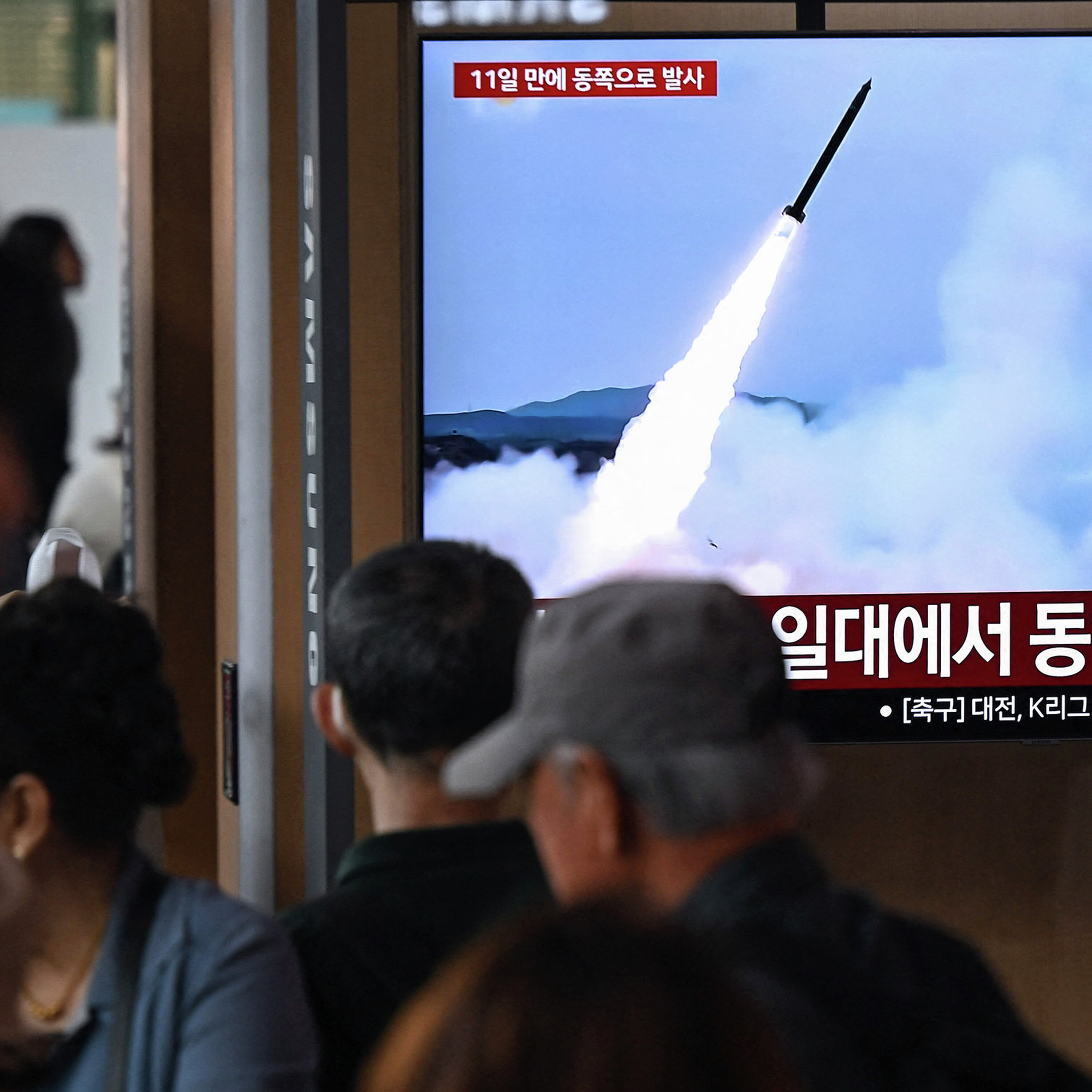
as global attention focuses on the war in the Middle east and missiles being launched in the region, one country thousands of miles away has been watching closely and firing missiles of its own.
- [02:15]
Michigan Business Representative
North Korea launched ballistic missiles toward waters
- [02:18]
John Herskovitz (Bloomberg Editor and North Korea Expert)
off its east coast.
- [02:19]
The Hartford Insurance Representative
This is believed to be North Korea's
- [02:20]
John Herskovitz (Bloomberg Editor and North Korea Expert)
seventh ballistic missile test of the year,
- [02:22]
Wan Ha (Bloomberg Host)
and potentially North Korean leader Kim Jong Un personally oversaw the latest missile launches. On April 19, state media reported that Kim expressed great satisfaction over the test firing.
- [02:39]
John Herskovitz (Bloomberg Editor and North Korea Expert)
You have Kim Jong Un watching missiles flying off. His daughter was there as well on hand, and they show on state media the precision with which the missiles hit this island.
- [02:52]
Wan Ha (Bloomberg Host)
John Herskovitz is a Bloomberg editor based in Tokyo. He's been covering North Korea for more than 20 years. John says the purpose of these missile tests is twofold. First, they're a Demonstration for a key overseas buyer.
- [03:06]
John Herskovitz (Bloomberg Editor and North Korea Expert)
North Korea has been supplying these missiles to Russia. And the tests have varied to show the various ways that the missiles can be used.
- [03:15]
Wan Ha (Bloomberg Host)
And then there's also the message North Korea is trying to send to the US At a time when American military resources are stretched by conflicts elsewhere.
- [03:26]
John Herskovitz (Bloomberg Editor and North Korea Expert)
You have the message to the outside world that North Korea's missiles are abundant, deadly, and can do far more than imagined. And they're looking at the US and saying, you have your defense systems. We know what they are, and we're rolling out these systems, trying to defeat them.
- [03:48]
Wan Ha (Bloomberg Host)
This is the big Take Asia. From Bloomberg News, I'm Wan Ha. Every week we take you inside some of the world's biggest and most powerful economies and the markets, tycoons and businesses that drive this ever shifting region. Today on the show, how North Korea's buildup of nuclear missiles has reached a dangerous tipping point for, for the U.S. Now, John, most of us, of course, are not weapons investigators. When we talk about a country's nuclear capability or nuclear arsenal, what are we actually counting? What are we talking about?
- [04:26]
John Herskovitz (Bloomberg Editor and North Korea Expert)
It's a lot of different things. The first thing is fissile material. This is like stuff for bombs and it's usually plutonium or highly enriched uranium. The other thing is warheads. The actual bombs, they're small enough to go onto missiles. If they need to be delivered by bombers, they're even small enough to go onto like artillery shells. And then we have the delivery systems. These are the ballistic missiles, the bombers, the things that would actually be capable of taking a nuclear bomb and sending it to the enemy. So for North Korea, they have lots of places to produce fissile material. They are making warheads. And then the delivery systems, which are the ballistic missiles from the short range for South Korea, maybe Japan, all the way to ICBM's Intercontinental Ballistic Missile, which are designed to hit the US for
- [05:27]
Wan Ha (Bloomberg Host)
years, North Korea has sat at the bottom of the global nuclear hierarchy. In 2018, after meeting Kim Jong Un, President Donald Trump declared in a tweet that North Korea is no longer a nuclear threat. Now, almost a decade later, North Korea still has the smallest arsenal among the nine countries that have nuclear arms capabilities. But John says that picture may be changing in critical ways.
- [05:55]
John Herskovitz (Bloomberg Editor and North Korea Expert)
It's on a trajectory to have a significant number of ICBMs and warheads which will just keep on growing, getting on parity with the U.S. russia and to a lesser extent China. It's not in the picture. But being along the lines of Britain, France, India and Pakistan is something that's realistic. If the trajectory continues over the next five to 10 years.
- [06:22]
Wan Ha (Bloomberg Host)
What do we know about how North Korea's nuclear program has evolved? How extensive is the nuclear arsenal now compared to more recent times? You know, Trump's first administration.
- [06:33]
John Herskovitz (Bloomberg Editor and North Korea Expert)
When Trump left office after his first term, North Korea showed that it could fire off an ICBM and that it had the ability to build warheads. Whether North Korea could affix a warhead on top of an ICBM that could reach the US and deliver a strike, that was questionable. It was at a stage where it could produce about six bombs worth of nuclear material a year, according to estimates from nuclear experts. If we look at where it is now, North Korea has built out its ICBM arsenal, it's modernized its missiles, it's built up new launcher systems, and it has increased its ability of producing fissile material to maybe 12 to 15 a year. The President of South Korea has said earlier this year it's about 20 bombs worth of material a year.
- [07:40]
Wan Ha (Bloomberg Host)
John, North Korea is one of the most isolated countries in the world. How has it that it's been able to make such progress on nuclear weapons in such a short amount of time?
- [07:52]
John Herskovitz (Bloomberg Editor and North Korea Expert)
Kim Jong Un has prioritized rocket munitions as a key component of his government. In being so heavily sanctioned, Kim Jong Un has realized the more he can do at home, the better the system becomes. They've moved as much of the production as they can to within its borders. He has the devoted a lot of energy into building up missile production to building launchers. North Korea is also more information savvy under Kim Jong Un than it was under the previous leaders. Lots of these technologies are old technologies which are available, ready for copying. The North Korean short range ballistic missile which was involved in the recent test is very similar to a Russian missile. Making short range ballistic missiles is something that a lot of countries have done. North Korea has studied it. This is a priority for Kim and you can see the way that the production has gone. They're rolling out more and more of these short range ballistic missiles during the Cold War. During the Korean War, the Soviet Union used to supply arms to North Korea. Now North Korea is supplying arms to Russia. Things have changed.
- [09:17]
Wan Ha (Bloomberg Host)
As of last year, North Korea was estimated to have 50 warheads and enough fissile material for 90 bombs altogether. That's according to the Stockholm International Peace Research Institute. John, how do experts arrive at those estimates and how confident are we in those numbers?
- [09:35]
John Herskovitz (Bloomberg Editor and North Korea Expert)
The warhead figure? We don't know for sure. It's not out in the open. The Fissile material. We have a pretty good idea. So if you just like go into Google Earth and type In Yong Yong 5 megawatt reactor, you can see it. This is its main nuclear facility. The IAE has been to the site. US scientists have been to this site. So they know what this can do. And it's an old design. So it's well known what the capacity is for this in uranium enrichment sites. North Korea in the past year or so released photos from inside these facilities. It showed the centrifuges which do the enrichment. Very detailed. They wanted to show the world. This is what we have nuclear scientists who are really good at looking at this Wonka stuff, counting the centrifuges and how they're arranged can figure out how much uranium per year can be enriched at these sites. And North Korea is making more and more of this bomb grade material for its weapons. That's growing. And we can see this.
- [10:49]
Wan Ha (Bloomberg Host)
John says that steady growth has pushed North Korea's nuclear program toward a critical tipping point. It's no longer just about estimates and stockpiles. Now North Korea's ongoing production has experts asking whether U.S. missile defenses could fend off an attack.
- [11:08]
John Herskovitz (Bloomberg Editor and North Korea Expert)
North Korea is getting to a stage where it can produce more ICBMs than the US has interceptors to take them down. The US has a certain number of ground based interceptors in Alaska and also I believe in California that are designed to hit ICBMs. ICBMs fly like 10001300 kilometers above the earth, like three or four times the height of the Earth International Space Station, and they go really fast. Getting interceptors up there that can hit them is tough. It's expensive as well. So the US has about 44 of these interceptors and they take about two interceptors for each ICBM. We spoke to one expert who said North Korea is probably at about 24 ICBMs now and building them out. So you're at a stage where you could theoretically overwhelm the defense systems and it increases the chances of delivering a strike on the U.S. wow.
- [12:19]
Wan Ha (Bloomberg Host)
So that's a really dangerous math game.
- [12:21]
John Herskovitz (Bloomberg Editor and North Korea Expert)
It is a dangerous math game. And it's like there are other interceptor systems out there, but you have to be in the right place at the right time. It's just not a lot of time. If you fire off an ICBM from North Korea, you're looking like 25 to 35 minutes from launch to impact.
- [12:37]
Wan Ha (Bloomberg Host)
In the US we obviously don't want to be alarmists, but it is a bit scary though to Think about could North Korea, with all of these ICBMs and nuclear missile now, could they launch a nuclear strike that the US could not stop?
- [12:52]
John Herskovitz (Bloomberg Editor and North Korea Expert)
The US has expressed confidence that it can deter and intercept a North Korean nuclear attack. But there's a chance now and with each passing year, the chance of that happening becomes higher and higher. The more North Korea can produce ICBMs, warheads and bomb grade material to put in them, the greater the risk for the US by the same token, if North Korea were to strike the U.S. this would be suicidal. It would be the end of Kim Jong Un's regime. It would be, it would invite an absolutely massive retaliatory strike that would damage North Korea from top to bottom in ways from which would take years and decades to recover.
- [13:41]
Wan Ha (Bloomberg Host)
And John says it's still not clear if North Korea's weapons could conduct an actual long range attack on the U.S.
- [13:49]
John Herskovitz (Bloomberg Editor and North Korea Expert)
they've detonated nuclear devices, they've done mock nuclear strikes with the short range ballistic missiles. The things that we don't know is if North Korea has re entry capability for its warheads, heat shields. Because you're reentering the atmosphere like we saw the Artemis II mission, you're doing that sort of thing. It gets really hot. So we don't know if North Korea has the re entry capability for its warheads. But this is a 1950s, 1960s technology. I spoke to one nuclear expert who said that if a country has the ability to build an icbm, they probably have the ability to have a re entry vehicle.
- [14:33]
Wan Ha (Bloomberg Host)
After the break, how North Korea's aggressive nuclear bet has changed its relations with all of its neighbors and made it a more successful economy than it's ever been.
- [14:50]
The Hartford Insurance Representative
Support for the show comes from public. Lately it feels like there are two types of investing platforms. Some are traditional brokerages that haven't changed much in decades and others feel less like investing and more like a game. Public is positioned differently. It's an investing platform for people who are serious about building their wealth on public. You can build a portfolio of stocks, options, bonds, crypto without all the bugs or the confetti. Retirement accounts. Yep. High yield cash. Yes again. They even have direct indexing. Public has modern design, powerful tools and customer support that actually helps go to public.com market and earn an uncapped 1% bonus when you transfer your portfolio. That's public.com market and paid for by Public Holdings Brokerage Services by Public Investing member finra SIPC Advisory Services by Public Advisors SEC Registered Advisor Crypto Services by Zero Hash. All investing involves risk of loss. See complete disclosures at public.com disclosures a
- [15:49]
Sonesta Travel Pass Representative
business gift is never just a gift. It's a thank you, a milestone, a moment of appreciation. It's a message about how much someone matters and what your brand stands for. At 4imprint, you'll find thousands of customizable options like premium apparel, branded drinkware, tech totes and more, each chosen not just for function but for meaning. You can tailor every detail your logo, your message, your presentation so your gift feels personal and on brand. And with expert support, dependable service, and thousands without a setup fee. Creating something thoughtful doesn't mean making it complicated. Every order is backed by 4imprint's 360 degree guarantee, so you can be 4imprint certain it'll arrive exactly as expected, on time and with the care your brand deserves. Because when the moment matters, the right gift speaks volumes and the right partner makes it easy. Explore gifting with purpose and certainty@4imprint.com for Imprint for certain, Sonesta Travel Pass makes traveling more rewarding Designed to help you get more out of every stay. Sign up@sonesta.com to enjoy instant savings, bonus points and valuable perks like early check in, late checkout, room upgrades and free stays. Over time. With Sonesta TravelPass, every stay brings you closer to your next reward. Choose from more than 1100 hotels across 13 distinctive brands and unlock the best available rates when you book direct with Sonesta TravelPass here today, Rome tomorrow. Join now@sonesta.com terms and conditions apply.
- [17:29]
Wan Ha (Bloomberg Host)
President Trump's relationship with Kim Jong Un has swung back and forth over the years, from calling Kim rocket man.
- [17:36]
John Herskovitz (Bloomberg Editor and North Korea Expert)
Rocket man should have been handled a
- [17:38]
Wan Ha (Bloomberg Host)
long time ago to famously saying that he and Kim fell in love in 2018 and we go back and forth and then we fell in love.
- [17:47]
John Herskovitz (Bloomberg Editor and North Korea Expert)
Okay. No, really.
- [17:49]
The Hartford Insurance Representative
He wrote me beautiful letters and they're great letters. We fell in love.
- [17:55]
Wan Ha (Bloomberg Host)
After a series of high profile meetings during Trump's first term, talks between Washington and Pyongyang ultimately collapsed without a deal to scale back North Korea's nuclear program. Since then, direct contact between Trump and Kim has largely dried up. There's been speculation about whether that could change, especially with Trump expected to travel to China next month. But Bloomberg's John Herskovitz says that even if the two leaders do meet again, the balance of power has shifted.
- [18:26]
John Herskovitz (Bloomberg Editor and North Korea Expert)
North Korea still shows some respect to Trump, but they've also demanded that the US Accept it as a nuclear power, treat it as such, saying that it can't go forward with any negotiations unless it gets an equal billing at the table. So the deference to Trump is still there, but the reliance on Trump just isn't as great as it once was. It's getting help from Russia. It still has China as an ally and friend, and it's found more ways to get money. It has cybercrimes, it's arsenal that's moving to Russia. That's a way of getting more aid and support from Putin.
- [19:06]
Wan Ha (Bloomberg Host)
I mean, how has that picture changed? You mentioned with Russia and the war in Ukraine.
- [19:11]
John Herskovitz (Bloomberg Editor and North Korea Expert)
North Korea has some of the largest stores of artillery shells in the world because of its standoff with South Korea. And North Korea had millions of artillery shells and artillery rockets that had sent to Russia on top of this parts for Soviet era tanks. North Korea has, they have like really old clunkers. No one else has this amount of stuff that Russia needed for Ukraine and they have an avenue to get it there.
- [19:39]
Wan Ha (Bloomberg Host)
And in return for that flow of weapons, John says Russia has been sending back something just as critical for North Korea. Money.
- [19:49]
John Herskovitz (Bloomberg Editor and North Korea Expert)
Now, we've gotten some estimates about the value of the aid that North Korea has received from Russia. Maybe like 16 to 20 billion dollars. North Korea's economy is about 25 billion a year. Whether it's 16 or 20, whatever it is, it's the largest influx of aid that has happened during Kim Jong Un's reign. It solidified his ability to rule the country and it's brought a stability, which means that we're going to see, likely see several more, more years of Kim having very solid control over the country. Prices have been stabilized, goods are moving into the country, and you can see it in some of the stuff that North Korea is doing. North Korea has gone on a splurge of building housing and factories across the country. It's getting materials which were once banned under sanctions, and they seem to be appearing in, in the country now, helping him do a building boom.
- [20:52]
Wan Ha (Bloomberg Host)
So the fact that North Korea gets assistance now from Russia in exchange for military weaponry that Russia needs, that totally cuts out the need for U.S. assistance or us holding out the carrot of will lift sanctions if you give up your nuclear program. What does that mean then for US Leverage in this new world?
- [21:17]
John Herskovitz (Bloomberg Editor and North Korea Expert)
There just isn't much leverage that the US has. The leverage is that we can offer more economic incentives, but it's difficult for Kim to accept them. Part of the system in North Korea is that there is sacrifice for the collective good if everything becomes abundant, if the US Isn't a threat, then why is the leadership protecting North Korea from the US And a possible invasion. So keeping the US At a bit of a distance works in North Korea's propaganda apparatus at this point. It has help from Russia. The support from China is there. It's in one of its strongest positions that it has ever been.
- [22:00]
Wan Ha (Bloomberg Host)
John says that shift has Pyongyang operating from a position of unusual confidence. And that matters when global tension and US Military resources are stretched to elsewhere.
- [22:13]
John Herskovitz (Bloomberg Editor and North Korea Expert)
North Korea sees its nuclear arsenal as the sword and the shield, protecting the country and being able to inflict heavy blows on its opponents. So the idea of having this arsenal has just been reinforced because of what happened in Iran.
- [22:31]
Wan Ha (Bloomberg Host)
For North Korea, John says the fighting involving Iran is being closely studied as a preview of how the US might operate in a real conflict.
- [22:43]
John Herskovitz (Bloomberg Editor and North Korea Expert)
North Korea has seen how the US works strategically, what it will strike first in the event of a war. It'll go after nuclear facilities, it'll go after missile storage sites, it'll go after air defense systems. For North Korea, this has probably been a wake up call. We have to do better at protecting our missiles. We have to do better at having our air defense systems ready to take on the U.S. so they've seen how the U.S. operates now, and they're probably looking at how to bolster its defenses in case the US Strikes first. And there's also what has gone on in Venezuela, what's going on in Iran. There's the worry of the so called decapitation strike, getting the leader. So North Korea has been thinking about this for years, and I'm sure their policy people have been looking at what to do if there is an attack on Kim Jong Un. How do we respond? What systems do we have in place?
- [23:51]
Wan Ha (Bloomberg Host)
That leaves a broader question. How should the world respond now that North Korea's nuclear capabilities appear to have reached a tipping point?
- [24:02]
John Herskovitz (Bloomberg Editor and North Korea Expert)
You know, there's some people who have argued that instead of removing nuclear weapons from the Korean peninsula, we should talk about limitation, monitoring, getting a threshold and keeping the state there. Kind of like what the US and Russians did during the Cold War with the various strategic Armed limitation treaties and things of that sort. That should be the new way of thinking. Setting limits, verification, and accepting North Korea as having nuclear nuclear weapons and trying to cap what it has. I think the determination of South Korea and the US And Japan and NATO allies will be to illuminate North Korea's nuclear weapons program entirely. It's just the reality. And what people want in theory are different. So maybe we'll see a shift in thinking of the US Administration about how it treats North Korea. But at this time, the policy is getting rid of its nuclear arsenal, but perhaps that should be reassessed.
- [25:07]
Wan Ha (Bloomberg Host)
This is the Big Take Asia from Bloomberg News. I'm wan ha to get more from the Big Take and unlimited access to all of bloomberg.com, subscribe today@bloomberg.com podcasto. If you like the episode, make sure to subscribe and review the Big Take Asia. Wherever you listen to podcasts, it really helps people find the show. Thanks for listening. See you next time.
- [25:40]
Chase Business Representative
If you follow markets, you know the value of long term thinking. You plan, you diversify, you prepare for volatility. But even the best strategies can't prevent every bad day. For more than 75 years, Cincinnati Insurance has helped individuals and businesses navigate tough moments. With expertise, personal attention and independent agents who focus on relationships, not transactions, the Cincinnati Insurance companies let them make your bad day better. Find an agent@cin fin.com as industries evolve
- [26:17]
Michigan Business Representative
faster than ever, companies need an environment that accelerates strategic growth. And Michigan delivers on that promise. From emerging startups to global enterprises, Michigan offers what executives value most a resilient, innovative ecosystem, diverse communities that attract top talent, and a quality of life that supports work life. Balance with our unified Team Michigan approach, businesses scale faster and compete at the highest level. Michigan Pure Opportunity Seize your opportunity@MichiganBusiness.org these
- [26:47]
Okta Representative
days it seems like AI agents are just about everywhere you turn, every field and every function. But without identity, you can't trust they'll serve your business instead of jeopardizing it. Fortunately, Okta helps you get identity right by securing your AI agents identities, giving you a single layer of control, a single, single standard of trust. So whether an AI agent supports a single user or your entire enterprise, with Okta you'll turn risk into opportunity. Secure every agent. Secure any agent. Okta secures AI.